

Developing risk prediction models for type 2 diabetes: a systematic review of methodology and reporting
Open accessThe DOI matches its Crossref record; 102 of the 102 references it cites were found in a registry or an index.
Abstract
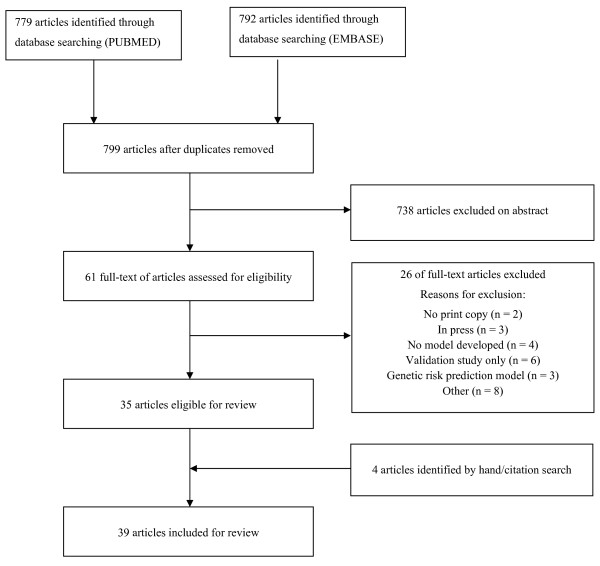
BACKGROUND: The World Health Organisation estimates that by 2030 there will be approximately 350 million people with type 2 diabetes. Associated with renal complications, heart disease, stroke and peripheral vascular disease, early identification of patients with undiagnosed type 2 diabetes or those at an increased risk of developing type 2 diabetes is an important challenge. We sought to systematically review and critically assess the conduct and reporting of methods used to develop risk prediction models for predicting the risk of having undiagnosed (prevalent) or future risk of developing (incident) type 2 diabetes in adults. METHODS: We conducted a systematic search of PubMed and EMBASE databases to identify studies published before May 2011 that describe the development of models combining two or more variables to predict the risk of prevalent or incident type 2 diabetes. We extracted key information that describes aspects of developing a prediction model including study design, sample size and number of events, outcome definition, risk predictor selection and coding, missing data, model-building strategies and aspects of performance. RESULTS: Thirty-nine studies comprising 43 risk prediction models were included. Seventeen studies (44%) reported the development of models to predict incident type 2 diabetes, whilst 15 studies (38%) described the derivation of models to predict prevalent type 2 diabetes. In nine studies (23%), the number of events per variable was less than ten, whilst in fourteen studies there was insufficient information reported for this measure to be calculated. The number of candidate risk predictors ranged from four to sixty-four, and in seven studies it was unclear how many risk predictors were considered. A method, not recommended to select risk predictors for inclusion in the multivariate model, using statistical significance from univariate screening was carried out in eight studies (21%), whilst the selection procedure was unclear in ten studies (26%). Twenty-one risk prediction models (49%) were developed by categorising all continuous risk predictors. The treatment and handling of missing data were not reported in 16 studies (41%). CONCLUSIONS: We found widespread use of poor methods that could jeopardise model development, including univariate pre-screening of variables, categorisation of continuous risk predictors and poor handling of missing data. The use of poor methods affects the reliability of the prediction model and ultimately compromises the accuracy of the probability estimates of having undiagnosed type 2 diabetes or the predicted risk of developing type 2 diabetes. In addition, many studies were characterised by a generally poor level of reporting, with many key details to objectively judge the usefulness of the models often omitted.
Overview
The claims and statistics of this paper haven’t been checked yet.
Free: it reads the open-access text and checks the first 5 claims that cite a source we can check. Create a free account to check every claim.
Integrity signals
Registry
Cites
Statistics
Figures
Verification
Claims the paper makes
The claims and statistics of this paper haven’t been checked yet.
Free: it reads the open-access text and checks the first 5 claims that cite a source we can check. Create a free account to check every claim.
Claims other papers make about this one
Each is checked against this paper’s own text: does it say what the citing paper says it does?
The source backs part of the claim, not all of it — or backs it for a different population, condition or comparison.
In the citing paper
“However, the overwhelming evidence shows that the quality of reporting of prediction model studies is poor.”
From Transparent Reporting of a multivariable prediction model for Individual Prognosis Or Diagnosis (TRIPOD): The TRIPOD Statement (2015) · cites this paper as [23]
Experimental — accuracy not yet measuredThe source backs part of the claim, not all of it — or backs it for a different population, condition or comparison.
In the citing paper
“Many reviews have showed that the quality of reporting in published articles describing the development or validation of multivariable prediction models in medicine is poor [23–27,29].”
From Transparent reporting of a multivariable prediction model for individual prognosis or diagnosis (TRIPOD): the TRIPOD Statement (2015) · cites this paper as [24]
Experimental — accuracy not yet measuredThe cited source says what the claim attributes to it.
In the citing paper
“Many reviews have showed that the quality of reporting in published articles describing the development or validation of multivariable prediction models in medicine is poor (23)(24)(25)(26)(27)29).”
From Transparent Reporting of a multivariable prediction model for Individual Prognosis Or Diagnosis (TRIPOD): The TRIPOD Statement (2015) · cites this paper as [23]
The cited source says what the claim attributes to it.
In the citing paper
“Collins and colleagues [24] evaluated the methodological conduct and reporting of 39 reports published before May 2011 describing the development of models to predict prevalent or incident type 2 diabetes. Reporting was also found to be generally poor, with key details on which predictors were examined, the handling and reporting of missing data, and model-building strategy often poorly described.”
From Transparent reporting of a multivariable prediction model for individual prognosis or diagnosis (TRIPOD): the TRIPOD Statement (2015) · cites this paper as [24]
The cited source says what the claim attributes to it.
In the citing paper
“However, the overwhelming evidence shows that the quality of reporting of prediction model studies is poor.”
From Transparent Reporting of a Multivariable Prediction Model for Individual Prognosis or Diagnosis (TRIPOD): The TRIPOD Statement (2015) · cites this paper as [24]
3 more claims about this paper
Create a free account to see every claim other papers make about this one.
Self-check
Percentages, sums and reported differences re-computed from the paper’s own numbers.
The self-check needs the paper’s full text.
Citations
Cites
Preferred Reporting Items for Systematic Reviews and Meta-Analyses: the PRISMA statement
Moher, D., Liberati, A., Tetzlaff, J., Altman, D. G., & for the PRISMA Group (2009) · BMJ · doi:10.1136/bmj.b2535 · Cited by 83,823
Preferred reporting items for systematic reviews and meta-analyses: the PRISMA Statement.
(2009) · PubMed Central · Cited by 44,859
von Elm, E., Altman, D. G., Egger, M., Pocock, S. J., Gøtzsche, P. C., Vandenbroucke, J. P., & Initiative, F. T. S. (2007) · PLoS Medicine · doi:10.1371/journal.pmed.0040296 · Cited by 23,020
CONSORT 2010 Statement: updated guidelines for reporting parallel group randomised trials
the CONSORT Group, Schulz, K. F., Altman, D. G., & Moher, D. (2010) · BMC Medicine · doi:10.1186/1741-7015-8-18 · Cited by 13,371
Elm, E. V., Altman, D. G., Egger, M., Pocock, S. J., Gøtzsche, P. C., & Vandenbroucke, J. P. (2007) · BMJ · doi:10.1136/bmj.39335.541782.ad · Cited by 10,766
A simulation study of the number of events per variable in logistic regression analysis
Peduzzi, P., Concato, J., Kemper, E., Holford, T. R., & Feinstein, A. R. (1996) · Journal of Clinical Epidemiology · doi:10.1016/s0895-4356(96)00236-3 · Cited by 9,655 · cited 3×
“A rule of thumb is that models should be developed with 10 to 20 events per variable (EPV) [63,64].”
BackgroundCONSORT 2010 Statement: updated guidelines for reporting parallel group randomised trials
Schulz, K. F., Altman, D. G., Moher, D., & for the CONSORT Group (2010) · BMJ · doi:10.1136/bmj.c332 · Cited by 9,329
CONSORT 2010 statement: updated guidelines for reporting parallel group randomized trials
Schulz, K. F., Altman, D. G., Moher, D., & for the CONSORT Group* (2010) · Annals of Internal Medicine · doi:10.7326/0003-4819-152-11-201006010-00232 · Cited by 3,824
Towards complete and accurate reporting of studies of diagnostic accuracy: The STARD Initiative.
Bossuyt, P. M., Reitsma, J. B., Bruns, D. E., Gatsonis, C. A., Glasziou, P. P., Irwig, L. M., Lijmer, J. G., Moher, D., Rennie, D., de Vet, H. C. W., et al. (2003) · Annals of Internal Medicine · doi:10.7326/0003-4819-138-1-200301070-00010 · Cited by 3,219
Towards complete and accurate reporting of studies of diagnostic accuracy: the STARD initiative
Bossuyt, P. M., Reitsma, J. B., Bruns, D. E., Gatsonis, C. A., Glasziou, P. P., Irwig, L. M., Lijmer, J. G., Moher, D., Rennie, D., & de Vet, H. C. W. (2003) · BMJ · doi:10.1136/bmj.326.7379.41 · Cited by 3,215
Research works printed but not linked: 3
- Mallett S Royston P Dutton S Waters R Altman DG Reporting methods in studies developing prognostic models in cancer: a review BMC Med 2010 8 20 10.1186/1741-7015-8-20 20353578 PMC2856521 · DOI · Paper page
- Mallett S Royston P Waters R Dutton S Altman DG Reporting performance of prognostic models in cancer: a review BMC Med 2010 8 21 10.1186/1741-7015-8-21 20353579 PMC2857810 · DOI · Paper page
- Wasson JH Sox HC Neff RK Goldman L Clinical prediction rules: applications and methodological standards N Engl J Med 1985 313 793 799 10.1056/NEJM198509263131306 3897864 · DOI · Paper page
Cited by
Items 401–490 of 490
Prediction of New Onset Diabetes after Liver TransplantPreprint
Yasodhara, A., Bhat, M., & Goldenberg, A. (2018) · arXiv (Cornell University) · doi:10.48550/arxiv.1812.00506 · Cited by 2
“However, recent review of type-2 diabetes risk-prediction models described many deficiencies in majority of them (Collins et al., 2011).”
AzoresDiab model: the risk prediction of type 2 diabetes in the Azores
Tavares, D. P., & Jorge (2021) · Rural and Remote Health · doi:10.22605/rrh5967 · Cited by 1
Approaches to predict future type 2 diabetes mellitus and chronic kidney disease: A scoping review
Bußmann, A., Speckemeier, C., Ehm, A., Kollar, B., Neumann, A., & Neusser, S. (2025) · PLoS ONE · doi:10.1371/journal.pone.0325182 · Cited by 4
Development and validation of a Jordan-specific risk score for type 2 diabetes mellitus
Alareeki, A., Awad, S. F., Critchley, J., Ajlouni, K. M., Khader, Y. S., & Abu-Raddad, L. J. (2025) · BMJ Nutrition Prevention & Health · doi:10.1136/bmjnph-2024-001027 · Cited by 1
Smidt, M. F.-D., Rolandsson, O., Griffin, S. J., & Wennberg, P. (2026) · Diabetes & Metabolic Syndrome Clinical Research & Reviews · doi:10.1016/j.dsx.2026.103379 · Cited by 1
“However, in previous validation studies calibration was either not assessed or incompletely reported [27].”
Queiroz, S., Gadelha, J. G., & Husain, N. (2026) · BMC Endocrine Disorders · doi:10.1186/s12902-026-02301-2 · Cited by 1
“Over the past two decades, numerous multi-variable prediction models have been developed to identify high-risk individuals using readily available clinical and demographic variables [3, 4].”
Kim, S., & Cho, J. M. (2026) · Diabetology & Metabolic Syndrome · doi:10.1186/s13098-026-02176-2 · Cited by 1
“Over the past decades, numerous diabetes risk prediction models have been developed using traditional statistical methods, primarily logistic regression or Cox proportional hazards regression, incorporating demographic, lifestyle, and bio-chemical predictors [4, 5].”
A Neural Network based Approach for the Diabetes Risk Estimation
Jain, D., & Singh, D. (2013) · International Journal of Computer Applications · doi:10.5120/12774-8467 · Cited by 1
Kavian, F., Benton, F., McGill, J., & Luscombe‐Marsh, N. D. (2021) · JBI Evidence Synthesis · doi:10.11124/jbies-20-00492 · Cited by 1
Presentation of a model-based data mining to predict lung cancer.
Shahhoseini, R., Ghazvini, A., Esmaeilpour, M., Pourtaghi, G., & Tofighi, S. (2015) · PubMed · Cited by 1
A risk scores for predicting prevalence of diabetes in the LAO population
Louangdouangsithidet, S., Jiamjarasrangsi, W., & Sapwarobol, S. (2018) · International Journal of Diabetes in Developing Countries · doi:10.1007/s13410-018-0659-5 · Cited by 1
Screening Strategies for Type 2 Diabetes and Risk Stratification in Minorities
Kengne, A. P. (2018) · Updates in hypertension and cardiovascular protection · doi:10.1007/978-3-319-93148-7_18 · Cited by 1
Talakey, A. A., Hughes, F. J., AlMoharib, H. S., Al‐Askar, M., & Bernabé, E. (2021) · Community Dental Health · doi:10.1922/cdh_00083-2020talakey06 · Cited by 1
Flynn, S., Millar, S., Buckley, C. M., Junker, K., Phillips, C. M., & Harrington, J. M. (2021) · HRB Open Research · doi:10.12688/hrbopenres.13254.1 · Cited by 1
Künstliche Intelligenz und maschinelles Lernen in der Diabetesforschung
Nguyen, P., Ohnmacht, A. J., Galhoz, A., Büttner, M., Theis, F. J., & Menden, M. P. (2021) · Der Diabetologe · doi:10.1007/s11428-021-00817-w · Cited by 1
Glurich, I., Shimpi, N. A., Bartkowiak, B., Berg, R. L., & Acharya, A. (2021) · Clinical and Experimental Dental Research · doi:10.1002/cre2.515 · Cited by 4
“…of later studies was to identify additional models that met inclusion criteria of the current study with the same stringency criteria applied by Collins et al. (2011) and further explored inclusion of oral health variables in predictive models examining risk for undiagnosed Type II…”
BackgroundMethodResultInfluentialExternal validation of non-invasive diabetes score in a 15-year prospective study
Liu, L., Wang, Z., Zhao, L., Chen, X., & He, S. (2022) · The American Journal of the Medical Sciences · doi:10.1016/j.amjms.2022.05.023 · Cited by 1
The burden of diabetes in the Americas
Bernabé‐Ortiz, A., & Carrillo-Larco, R. M. (2022) · The Lancet Diabetes & Endocrinology · doi:10.1016/s2213-8587(22)00196-6 · Cited by 1
Improved Models for Diabetes Prediction by Integrating PCA Technique
Lu, Y. (2023) · Highlights in Science Engineering and Technology · doi:10.54097/hset.v47i.8172 · Cited by 1
Moons, K. G. M., Altman, D. G., Reitsma, J. B., loannidis, J. P. A., Macaskill, P., Steyerberg, E. W., Vickers, A. J., Ransohoff, D. F., & Collins, G. S. (2023) · Вопросы современной педиатрии · doi:10.15690/vsp.v22i2.2557 · Cited by 1
Benders, P. M. B., Schouten, J. A., Vena, A., Buil, J. B., Bronkhorst, E., & Bassetti, M. (2025) · BMC Infectious Diseases · doi:10.1186/s12879-025-10644-9 · Cited by 2
“Reporting was generally found to be poor [21–24].”
Leti, F., Taila, M., & DiStefano, J. K. (2014) · Springer eBooks · doi:10.1007/978-3-319-13689-9_11 · Cited by 1
García‐Blanco, A., Diago, V., Cruz, V. S.-D., Hervás, D., Cháfer‐Pericás, C., & Vento, M. (2017) · Psychoneuroendocrinology · doi:10.1016/j.psyneuen.2017.07.490 · Cited by 1
He, Q. (2012) · Carolina Digital Repository (University of North Carolina at Chapel Hill) · doi:10.17615/gked-nm15 · Cited by 1
Feature pre-selection for the development of epigenetic biomarkersPreprint
Cheng, Y., Gieger, C., Campbell, A., McIntosh, A. M., Waldenberger, M., McCartney, D. L., Marioni, R. E., & Vallejos, C. A. (2024) · medRxiv · doi:10.1101/2024.02.14.24302694 · Cited by 1
“While many T2D risk factors have been identified, we based these on the most utilised factors in existing risk scores according to [31].”
Methodische Entwicklung von Scores am Beispiel des Diabetes
Kowall, B., & Rathmann, W. (2014) · Der Diabetologe · doi:10.1007/s11428-014-1210-z
A Proposal for the Development and Validation of a Diabetic Self-Management Education (DSME) Program
Garrison, M. S. (2015) · ScholarWorks (Walden University)
The TRIPOD Statement: how to present the results of diagnostic and prognostic studies
Колос, И. П., Anichkov, D. A., & Boytsov, S. A. (2015) · Rational Pharmacotherapy in Cardiology · doi:10.20996/1819-6446-2015-11-6-558-560
Predicting Relative Risk for Diabetes Mellitus using Association Rule Summarization Technique in EMR
si, T. (2015) · International Journal of Innovative Research in Science Engineering and Technology · doi:10.15680/ijirset.2015.0403026
Kwong, K. (2016) · uO Research (University of Ottawa) · doi:10.20381/ruor-5825
Atenção Farmacêutica: Adesão ao tratamento.
Filho, J. D. M. (2013)
Biomarkers and prediction models for type 2 diabetes and diabetes related outcomes
Abbasi, A. (2013) · University of Groningen research database (University of Groningen / Centre for Information Technology)
Towards Early Diagnosis and Prevention of Type 2 Diabetes: the Role of Smartphones
Ogeh, D. N., & Fatumo, S. (2014)
Risk prediction model: Statistical and artificial neural network approach
Paiman, N. A., Hariri, A., & Masood, I. (2017) · AIP conference proceedings · doi:10.1063/1.4981143
Al-Rawashdeh, I. (2017) · White Rose eTheses Online (University of Leeds, The University of Sheffield, University of York)
Prognostication Stereotype of Patients Morbidity and Mortality by Extraction of E-Health Records
Sunitha, T., Shyamala, J., & Rani.A, A. J. S. (2018) · International Journal of Emerging Research in Management and Technology · doi:10.23956/ijermt.v6i6.271
A scoring system to detect fixed airflow limitation in smokers from simple easy-to-use parameters
Conejos, E. R., Palazón‐Bru, A., la Rosa, D. M. F.-D., Sánchez-Molla, M., Baeza, M. R., Gil-Guillén, V. F., & Cortés‐Castell, E. (2018) · Scientific Reports · doi:10.1038/s41598-018-31198-8 · Cited by 1
Risk Assessment of Future Type 2 Diabetes and Implication for Prevention
Modesti, P. A., Calabrese, M., & Galanti, G. (2018) · Updates in hypertension and cardiovascular protection · doi:10.1007/978-3-319-93148-7_17
Janus, E. D., & Dunbar, J. (2018) · Clinical Endocrinology · doi:10.1111/cen.13904
Association Rule Summarization for Relative Risk Analysis of Diabetes Mellitus
Sorte, R. R., Bante, C. B., Thakare, A. P., Saha, S., Meshram, M. B., & Gaikwad, V. P. (2018) · Zenodo (CERN European Organization for Nuclear Research) · doi:10.5281/zenodo.21733106
Jiang, D., & Shen, Y. (2019) · Expert Review of Molecular Diagnostics · doi:10.1080/14737159.2019.1692656
Ecología del riesgo de diabetes mellitus tipo 2.
Ramírez-Girón, N. (2019) · El Repositorio Academico Digital de la UANL (Universidad Autónoma de Nuevo León) · Cited by 1
Shirinzadeh, M. (2020) · MacSphere (McMaster University) · doi:10.71548/17855 · Cited by 1
Gray, L. J. (2020) · Springer eBooks · doi:10.1007/978-3-030-38647-4_5
Mazzini, M. C. R., Blumer, M. G., Hoehne, E. L., Guimarães, K. R. L. S. L. D. Q., Caramelli, B., Fornari, L. S., & Malheiros, S. V. P. (2013) · Revista da Associação Médica Brasileira (English Edition) · doi:10.1016/s2255-4823(13)70446-6
Kamalzadeh, H. (2020) · SMU Scholar (Southern Methodist University)
Maximizing research value: adequate reporting and effective (de-)implementation strategies
Heus, P. (2020) · Utrecht University Repository (Utrecht University) · doi:10.33540/8 · Cited by 1
[Diagnosis of granulomatous lung diseases].
Khomenko, A. G. (1991) · PubMed
Prognosis of Transient Ischemic Attack and Stroke
Lau, G. K. K., Pendlebury, S. T., & Rothwell, P. M. (2018)
Prediction Models for Tuberculosis Treatment Outcomes
Peetluk, L. S. (2021)
Discovery of Type 2 Diabetes Trajectories from Electronic Health Records
Oh, W.-S. (2020) · University of Minnesota Digital Conservancy (University of Minnesota)
Branched-chain amino acids and trimethylamine N-oxide as biomarkers of cardiometabolic outcomes
Flores-Guerrero, J. L. (2021) · University of Groningen research database (University of Groningen / Centre for Information Technology) · doi:10.33612/diss.192215052
de Kloet, E. R., Meijer, O. C., & Molendijk, M. L. (2013) · Faculty Opinions – Post-Publication Peer Review of the Biomedical Literature · doi:10.3410/f.718003526.793475579
Methods of Determining Prognosis
Lau, G. K. K., Pendlebury, S. T., & Rothwell, P. M. (2018) · Cambridge University Press eBooks · doi:10.1017/9781316161609.015
Collins, G. S. (2013) · Journal of Clinical Epidemiology · doi:10.1016/j.jclinepi.2012.12.005
“[1] examined the articles for reporting of modeling methods and performance metrics and concluded that many of the published models, including our previous work, were inadequately developed and reported.”
MethodComparative analysis of screening models for undiagnosed diabetes in Mexico
Félix‐Martínez, G. J., & Godínez-Fernández, J. R. (2020) · Endocrinología Diabetes y Nutrición (English ed ) · doi:10.1016/j.endien.2019.08.009 · Cited by 1
Wedig, I. J. (2023) · Digital Commons - Michigan Tech (Michigan Technological University) · doi:10.37099/mtu.dc.etdr/1549 · Cited by 1
Phan, T.-P., Nguyen, P., Vo, T. H., Hsu, M., Saputra, Y. E., Hien, N. T., Chen, C., Le, K. M., Nguyen, H. B., & Hsu, J. C. (2023) · Research Square · doi:10.21203/rs.3.rs-3311009/v1 · Cited by 1
A risk scores for predicting prevalence of diabetes and pre-diabetes in the LAO population
Louangdouangsithidet, S. (2016) · Chula Digiverse · doi:10.58837/chula.the.2016.1595
Royo‐Bordonada, M. Á., Damián, J., López, F. J. G., Galan, I., Pérez‐Gómez, B., Sanz‐Barbero, B., Catalá-López, F., Rodríguez‐Artalejo, F., Imaz-Iglesia, I., González-García, J., et al. (2023) · doi:10.4321/repisalud.17538
Zhang, Y., Zhang, X., Razbek, J., Li, D., Xia, W., Bao, L., Mao, H., Daken, M., & Cao, M. (2022) · Figshare · doi:10.6084/m9.figshare.20677966
Zhang, Y., Zhang, X., Razbek, J., Li, D., Xia, W., Bao, L., Mao, H., Daken, M., & Cao, M. (2022) · Figshare · doi:10.6084/m9.figshare.20677969
Modelling in DOHaD: Challenges and Opportunities in the Era of Big Data
Sigurðardottir, J. N., & Ayis, S. A. (2024) · Cambridge University Press eBooks · doi:10.1017/9781009201704.027
Integration of Artificial Intelligence with Diabetic Data for Increasingly Personalized Medicine
Diouf, M., Diallo, T. A., Diallo, E. N., Diouf, B., & Dioum, I. (2025) · Lecture notes of the Institute for Computer Sciences, Social Informatics and Telecommunications Engineering · doi:10.1007/978-3-031-81573-7_7
Transfer learning for high dimensional data with discrete responses
Zheng, Z., Zheng, S., & Zhao, J. (2025) · Computational Statistics & Data Analysis · doi:10.1016/j.csda.2025.108292
Zhang, Y., Zhang, X., Razbek, J., Li, D., Xia, W., Bao, L., Mao, H., Daken, M., & Cao, M. (2022) · Figshare · doi:10.6084/m9.figshare.20677972
Punyadasa, D. H., Kumarapeli, V., & Senaratne, W. (2024) · Figshare · doi:10.6084/m9.figshare.24761918
Hu, X., Lin, Y., Appleton, A. A., Wang, W., Yu, B., Zhou, L., Li, G., Zhou, Y., Ou, Y., & 董豪坚 (2024) · Figshare · doi:10.6084/m9.figshare.26692126
Liu, C., Qi, Y., Liu, X., Chen, M., Xiong, Y., Huang, S., Zou, K., Tan, J., & Sun, X. (2023) · Figshare · doi:10.6084/m9.figshare.22599989
Punyadasa, D. H., Kumarapeli, V., & Senaratne, W. (2023) · Figshare · doi:10.6084/m9.figshare.24761372
Dhiman, P., Ma, J., Navarro, C. L. A., Speich, B., Bullock, G., Damen, J. A., Hooft, L., Kirtley, S., Riley, R. D., CALSTER, B. V., et al. (2022) · Figshare · doi:10.6084/m9.figshare.19565865
Self-citationLiu, C., Qi, Y., Liu, X., Chen, M., Xiong, Y., Huang, S., Zou, K., Tan, J., & Sun, X. (2023) · Figshare · doi:10.6084/m9.figshare.22599986
Liu, C., Qi, Y., Liu, X., Chen, M., Xiong, Y., Huang, S., Zou, K., Tan, J., & Sun, X. (2023) · Figshare · doi:10.6084/m9.figshare.22599992
Mussa, J. (2024) · eScholarship@McGill (McGill) · doi:10.82308/54537
Ghatrora, K. K., Verma, A., Bhatia, T. K., Deepali, & Singh, Y. (2025) · International Conference on Internet of Things: Smart Innovation and Usages (IoT-SIU) · doi:10.1109/iot-siu65919.2025.11402868
Silva, J. A., Bloch, K. V., Szklo, M., & Deusdará, R. (2026) · Journal of Clinical Medicine · doi:10.3390/jcm15062224
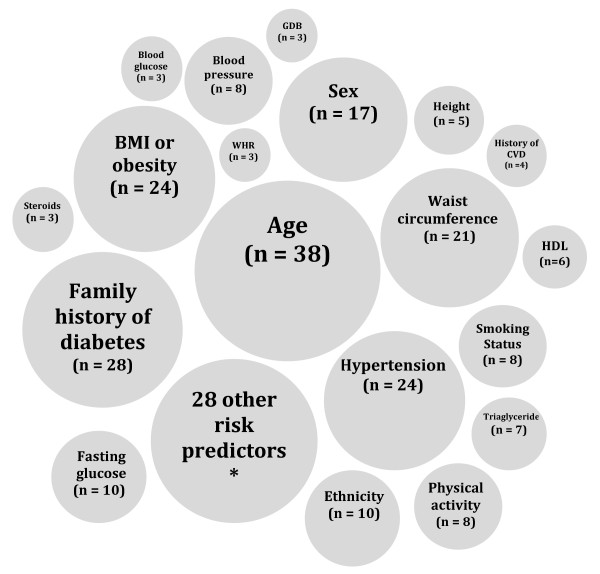
“In this review, the most common predictors were age, family history of diabetes, body mass index, hypertension, waist circumference, and sex [24].”
Risk prediction models for imported infectious diseases: A systematic review
Xu, S., Xie, J., Xie, L., Zhang, L., Xie, C., Zhang, Y., Hong, S., Qu, L., Yuan, G., Chen, R., et al. (2026) · International Journal of Infectious Diseases · doi:10.1016/j.ijid.2026.108737
Xu, Z., Zhang, Y., & Zhang, H. (2026) · Frontiers in Endocrinology · doi:10.3389/fendo.2026.1850071
Manuel, D. G., Eddeen, A. B., Finès, P., Bennett, C. L., Fisher, S., Jessri, M., Perez, R., Tuna, M., Sanmartin, C., Sequeira, Y., et al. (2026) · medRxiv · doi:10.64898/2026.06.12.26355459
Predictive models of adverse outcomes of overweight or obesity: a nationwide cohort validation
Turchin, A., Shubina, M., Morrison, F. J. R., Ahmad, N. N., Neff, L. M., & Kan, H. (2026) · BMC Endocrine Disorders · doi:10.1186/s12902-026-02399-4
Khan, S., & Shah, Z. (2026) · Engineering Applications of Artificial Intelligence · doi:10.1016/j.engappai.2026.115678
Ziegfeld, L., van Drie, R. A. N., Adhikari, A., & van der Waa, J. (2026) · Lecture notes in computer science · doi:10.1007/978-3-032-35387-0_34
Amirvala, R., Hadaegh, F., Khalili, D., Rahmani, F., & Asgari, S. (2026) · Diabetes Research and Clinical Practice · doi:10.1016/j.diabres.2026.113576
Zhao, X.-F., Tang, S.-S., Ji, H.-Y., Xuedong, A., Kang, X., Jiang, L.-L., & Lian, F. (2026) · World Journal of Diabetes · doi:10.4239/wjd.123851
Barua, S., Jabran, S., Rodgers, C., & Fong, A. C. M. (2026) · Discover Public Health · doi:10.1186/s12982-026-03175-4
Matuli, C., Waeni, J. M., Gicheru, E., Sande, C., & Gallagher, K. E. (2026) · Frontiers in Medicine · doi:10.3389/fmed.2026.1943481
Predicting the epidemic: a study of diabetes risk profiling in a multi-ethnic inner city population
Noble, D. J. (2012) · OpenGrey (Institut de l'Information Scientifique et Technique)
Metadata
- Authors
- Collins, G. S., Mallett, S., Omar, O., & Yu, L.-M.
- Affiliations
- University of Oxford (GB)
- Venue
- BMC Medicine
- Published
- 2011-09-08
- Volume
- 9
- Issue
- 1
- Pages
- 103-103
- ISSN
- 1741-7015 (ISSN-L)
- PMC
- PMC3180398
- OpenAlex
- W2102171609
- Cited by
- 484
- References
- 101
- Citations by year
- 2026: 15 · 2025: 26 · 2024: 29 · 2023: 30 · 2022: 34 · 2021: 44 · 2020: 41 · 2019: 37 · 2018: 47 · 2017: 26 · 2016: 30 · 2015: 51 · 2014: 29 · 2013: 29 · 2012: 15
- FWCI
- 3.43
- Type
- journal article
- Language
- en
- Open access
- gold
- doi.org
- Licence
- Locations
- BMC Medicine (publishedVersion, cc-by)
- Europe PMC (PubMed Central) (publishedVersion, cc-by)
- PubMed Central (publishedVersion, cc-by)
- PubMed (publishedVersion)
- DOAJ (DOAJ: Directory of Open Access Journals) (submittedVersion)
- University of Birmingham Research Portal (University of Birmingham) (submittedVersion, other-oa)
- Funders
- Cancer Research UK
- Topics
- Physical Sciences › Mathematics › Statistics and Probability › Statistical Methods in Epidemiology
- Health Sciences › Medicine › Endocrinology, Diabetes and Metabolism › Diabetes, Cardiovascular Risks, and Lipoproteins
- Health Sciences › Health Professions › Health Information Management › Artificial Intelligence in Healthcare
- Keywords
- risk prediction model, model development methodology, reporting quality, new-onset diabetes, missing data handling
- MeSH terms
- Diabetes Mellitus, Type 2, Humans, Research Design, Risk Assessment
About these checks
Registry, retraction, Cites and statistics results are computed, not judged, with one exception: a printed reference that no index lists is read once by a model before it counts as a citation error. Claims are extracted by a model and kept only when their quote appears verbatim in the text; each cited source is then checked, with a model’s help, for whether it says what the claim relies on. Those verdicts can be wrong — read the claim’s quote and the cited source before relying on one.
Statistics and arithmetic are recomputed, not judged.
Confidence bands are shown only for fields calibrated on our annotated test set. None is calibrated yet, so no band is shown.
What counts as a claim ›How we measure confidence ›How we check this ›
Are you an author, or do you see a problem with this page? Request a review
Data sources
Bibliographic data: Semantic Scholar, OpenAlex, Crossref.
Contains information from the Semantic Scholar Academic Graph Datasets, made available under the ODC Attribution License (ODC-BY 1.0).
Semantic Scholar’s data is described in: Kinney, R., et al. (2023). The Semantic Scholar Open Data Platform. arXiv:2301.10140.
