

Developing risk prediction models for type 2 diabetes: a systematic review of methodology and reporting
Open accessThe DOI matches its Crossref record; 102 of the 102 references it cites were found in a registry or an index.
Abstract
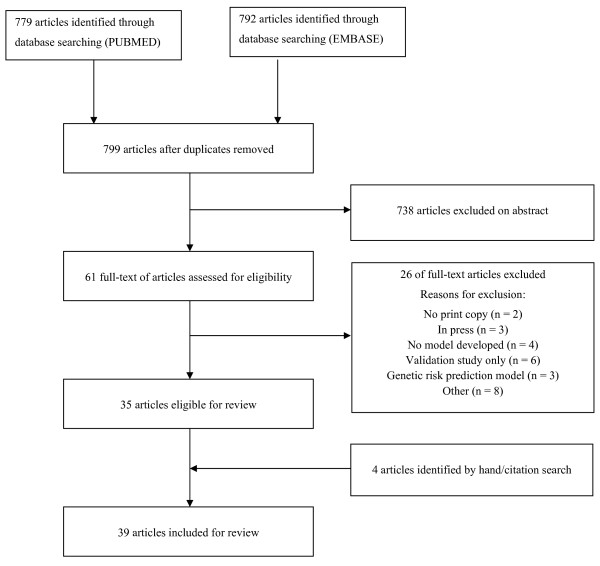
BACKGROUND: The World Health Organisation estimates that by 2030 there will be approximately 350 million people with type 2 diabetes. Associated with renal complications, heart disease, stroke and peripheral vascular disease, early identification of patients with undiagnosed type 2 diabetes or those at an increased risk of developing type 2 diabetes is an important challenge. We sought to systematically review and critically assess the conduct and reporting of methods used to develop risk prediction models for predicting the risk of having undiagnosed (prevalent) or future risk of developing (incident) type 2 diabetes in adults. METHODS: We conducted a systematic search of PubMed and EMBASE databases to identify studies published before May 2011 that describe the development of models combining two or more variables to predict the risk of prevalent or incident type 2 diabetes. We extracted key information that describes aspects of developing a prediction model including study design, sample size and number of events, outcome definition, risk predictor selection and coding, missing data, model-building strategies and aspects of performance. RESULTS: Thirty-nine studies comprising 43 risk prediction models were included. Seventeen studies (44%) reported the development of models to predict incident type 2 diabetes, whilst 15 studies (38%) described the derivation of models to predict prevalent type 2 diabetes. In nine studies (23%), the number of events per variable was less than ten, whilst in fourteen studies there was insufficient information reported for this measure to be calculated. The number of candidate risk predictors ranged from four to sixty-four, and in seven studies it was unclear how many risk predictors were considered. A method, not recommended to select risk predictors for inclusion in the multivariate model, using statistical significance from univariate screening was carried out in eight studies (21%), whilst the selection procedure was unclear in ten studies (26%). Twenty-one risk prediction models (49%) were developed by categorising all continuous risk predictors. The treatment and handling of missing data were not reported in 16 studies (41%). CONCLUSIONS: We found widespread use of poor methods that could jeopardise model development, including univariate pre-screening of variables, categorisation of continuous risk predictors and poor handling of missing data. The use of poor methods affects the reliability of the prediction model and ultimately compromises the accuracy of the probability estimates of having undiagnosed type 2 diabetes or the predicted risk of developing type 2 diabetes. In addition, many studies were characterised by a generally poor level of reporting, with many key details to objectively judge the usefulness of the models often omitted.
Overview
The claims and statistics of this paper haven’t been checked yet.
Free: it reads the open-access text and checks the first 5 claims that cite a source we can check. Create a free account to check every claim.
Integrity signals
Registry
Cites
Statistics
Figures
Verification
Claims the paper makes
The claims and statistics of this paper haven’t been checked yet.
Free: it reads the open-access text and checks the first 5 claims that cite a source we can check. Create a free account to check every claim.
Claims other papers make about this one
Each is checked against this paper’s own text: does it say what the citing paper says it does?
The source backs part of the claim, not all of it — or backs it for a different population, condition or comparison.
In the citing paper
“However, the overwhelming evidence shows that the quality of reporting of prediction model studies is poor.”
From Transparent Reporting of a multivariable prediction model for Individual Prognosis Or Diagnosis (TRIPOD): The TRIPOD Statement (2015) · cites this paper as [23]
Experimental — accuracy not yet measuredThe source backs part of the claim, not all of it — or backs it for a different population, condition or comparison.
In the citing paper
“Many reviews have showed that the quality of reporting in published articles describing the development or validation of multivariable prediction models in medicine is poor [23–27,29].”
From Transparent reporting of a multivariable prediction model for individual prognosis or diagnosis (TRIPOD): the TRIPOD Statement (2015) · cites this paper as [24]
Experimental — accuracy not yet measuredThe cited source says what the claim attributes to it.
In the citing paper
“Many reviews have showed that the quality of reporting in published articles describing the development or validation of multivariable prediction models in medicine is poor (23)(24)(25)(26)(27)29).”
From Transparent Reporting of a multivariable prediction model for Individual Prognosis Or Diagnosis (TRIPOD): The TRIPOD Statement (2015) · cites this paper as [23]
The cited source says what the claim attributes to it.
In the citing paper
“Collins and colleagues [24] evaluated the methodological conduct and reporting of 39 reports published before May 2011 describing the development of models to predict prevalent or incident type 2 diabetes. Reporting was also found to be generally poor, with key details on which predictors were examined, the handling and reporting of missing data, and model-building strategy often poorly described.”
From Transparent reporting of a multivariable prediction model for individual prognosis or diagnosis (TRIPOD): the TRIPOD Statement (2015) · cites this paper as [24]
The cited source says what the claim attributes to it.
In the citing paper
“However, the overwhelming evidence shows that the quality of reporting of prediction model studies is poor.”
From Transparent Reporting of a Multivariable Prediction Model for Individual Prognosis or Diagnosis (TRIPOD): The TRIPOD Statement (2015) · cites this paper as [24]
3 more claims about this paper
Create a free account to see every claim other papers make about this one.
Self-check
Percentages, sums and reported differences re-computed from the paper’s own numbers.
The self-check needs the paper’s full text.
Citations
Cites
Preferred Reporting Items for Systematic Reviews and Meta-Analyses: the PRISMA statement
Moher, D., Liberati, A., Tetzlaff, J., Altman, D. G., & for the PRISMA Group (2009) · BMJ · doi:10.1136/bmj.b2535 · Cited by 83,823
Preferred reporting items for systematic reviews and meta-analyses: the PRISMA Statement.
(2009) · PubMed Central · Cited by 44,859
von Elm, E., Altman, D. G., Egger, M., Pocock, S. J., Gøtzsche, P. C., Vandenbroucke, J. P., & Initiative, F. T. S. (2007) · PLoS Medicine · doi:10.1371/journal.pmed.0040296 · Cited by 23,020
CONSORT 2010 Statement: updated guidelines for reporting parallel group randomised trials
the CONSORT Group, Schulz, K. F., Altman, D. G., & Moher, D. (2010) · BMC Medicine · doi:10.1186/1741-7015-8-18 · Cited by 13,371
Elm, E. V., Altman, D. G., Egger, M., Pocock, S. J., Gøtzsche, P. C., & Vandenbroucke, J. P. (2007) · BMJ · doi:10.1136/bmj.39335.541782.ad · Cited by 10,766
A simulation study of the number of events per variable in logistic regression analysis
Peduzzi, P., Concato, J., Kemper, E., Holford, T. R., & Feinstein, A. R. (1996) · Journal of Clinical Epidemiology · doi:10.1016/s0895-4356(96)00236-3 · Cited by 9,655 · cited 3×
“A rule of thumb is that models should be developed with 10 to 20 events per variable (EPV) [63,64].”
BackgroundCONSORT 2010 Statement: updated guidelines for reporting parallel group randomised trials
Schulz, K. F., Altman, D. G., Moher, D., & for the CONSORT Group (2010) · BMJ · doi:10.1136/bmj.c332 · Cited by 9,329
CONSORT 2010 statement: updated guidelines for reporting parallel group randomized trials
Schulz, K. F., Altman, D. G., Moher, D., & for the CONSORT Group* (2010) · Annals of Internal Medicine · doi:10.7326/0003-4819-152-11-201006010-00232 · Cited by 3,824
Towards complete and accurate reporting of studies of diagnostic accuracy: The STARD Initiative.
Bossuyt, P. M., Reitsma, J. B., Bruns, D. E., Gatsonis, C. A., Glasziou, P. P., Irwig, L. M., Lijmer, J. G., Moher, D., Rennie, D., de Vet, H. C. W., et al. (2003) · Annals of Internal Medicine · doi:10.7326/0003-4819-138-1-200301070-00010 · Cited by 3,219
Towards complete and accurate reporting of studies of diagnostic accuracy: the STARD initiative
Bossuyt, P. M., Reitsma, J. B., Bruns, D. E., Gatsonis, C. A., Glasziou, P. P., Irwig, L. M., Lijmer, J. G., Moher, D., Rennie, D., & de Vet, H. C. W. (2003) · BMJ · doi:10.1136/bmj.326.7379.41 · Cited by 3,215
Research works printed but not linked: 3
- Mallett S Royston P Dutton S Waters R Altman DG Reporting methods in studies developing prognostic models in cancer: a review BMC Med 2010 8 20 10.1186/1741-7015-8-20 20353578 PMC2856521 · DOI · Paper page
- Mallett S Royston P Waters R Dutton S Altman DG Reporting performance of prognostic models in cancer: a review BMC Med 2010 8 21 10.1186/1741-7015-8-21 20353579 PMC2857810 · DOI · Paper page
- Wasson JH Sox HC Neff RK Goldman L Clinical prediction rules: applications and methodological standards N Engl J Med 1985 313 793 799 10.1056/NEJM198509263131306 3897864 · DOI · Paper page
Cited by
Moons, K. G. M., Altman, D. G., Reitsma, J. B., Ioannidis, J. P. A., Macaskill, P., Steyerberg, E. W., Vickers, A. J., Ransohoff, D. F., & Collins, G. S. (2015) · Annals of Internal Medicine · doi:10.7326/m14-0698 · Cited by 5,147
Collins, G. S., Moons, K. G. M., Dhiman, P., Riley, R. D., Beam, A. L., Van Calster, B., Ghassemi, M., Liu, X., Reitsma, J. B., van Smeden, M., et al. (2024) · BMJ · doi:10.1136/bmj-2023-078378 · Cited by 4,718
“…research Adherence to the TRIPOD+AI reporting recommendations could encourage the improved use of research time, effort, and money the bmj | BMJ 2024;385:e078378 | doi: 10.1136/bmj-2023-078378 concerns about transparency and completeness of reporting in the field, 10 11 and the resulting usability.”
MethodInfluentialCollins, G. S., Reitsma, J. B., Altman, D. G., & Moons, K. G. M. (2015) · BMJ · doi:10.1136/bmj.g7594 · Cited by 4,388
“Collins and colleagues (24) evaluated the methodological conduct and reporting of 39 reports published before May 2011 describing the development of models to predict prevalent or incident type 2 diabetes.”
Collins, G. S., Reitsma, J. B., Altman, D. G., & Moons, K. G. M. (2015) · British Journal of Cancer · doi:10.1038/bjc.2014.639 · Cited by 3,293
“…have showed that the quality of reporting in published articles describing the development or validation of multivariable prediction models in medicine is poor (Laupacis et al, 1997; Ettema et al, 2010; Mallett et al, 2010; Collins et al, 2011; Bouwmeester et al, 2012; Collins et al, 2013, 2014).”
InfluentialCollins, G. S., Reitsma, J. B., Altman, D. G., & Moons, K. G. M. (2015) · Annals of Internal Medicine · doi:10.7326/m14-0697 · Cited by 3,267
“Collins and colleagues [24] evaluated the methodological conduct and reporting of 39 reports published before May 2011 describing the development of models to predict prevalent or incident type 2 diabetes.”
BackgroundPROBAST: A Tool to Assess the Risk of Bias and Applicability of Prediction Model Studies
Wolff, R. F., Moons, K. G. M., Riley, R. D., Whiting, P. F., Westwood, M., Collins, G. S., Reitsma, J. B., Kleijnen, J., Mallett, S., & for the PROBAST Group† (2019) · Annals of Internal Medicine · doi:10.7326/m18-1376 · Cited by 2,984
“Prediction models, both diagnostic and prognostic, are widely used for a variety of medical domains and settings,(14-16) evidenced by the large number of models developed, especially in cancer,(17, 18) neurology,(19, 20) and cardiovascular disease domains.”
BackgroundSelf-citationMoons, K. G. M., de Groot, J. A. H., Bouwmeester, W., Vergouwe, Y., Mallett, S., Altman, D. G., Reitsma, J. B., & Collins, G. S. (2014) · PLoS Medicine · doi:10.1371/journal.pmed.1001744 · Cited by 2,018
“Numerous systematic reviews of prediction models have reported that the number of events per candidate predictor is often poorly reported and, when it is reported, that the EPV is often less than ten [2,15,56,78].”
BackgroundInfluentialSelf-citationCollins, G. S., Reitsma, J. B., Altman, D. G., & Moons, K. (2015) · BMC Medicine · doi:10.1186/s12916-014-0241-z · Cited by 1,927
“These and other reviews provide a clear picture that, across different disease areas and different journals, there is a generally poor level of reporting of prediction model studies [6,2-27,29].”
InfluentialMoons, K. G. M., Wolff, R. F., Riley, R. D., Whiting, P. F., Westwood, M., Collins, G. S., Reitsma, J. B., Kleijnen, J., & Mallett, S. (2019) · Annals of Internal Medicine · doi:10.7326/m18-1377 · Cited by 1,669
Self-citationPrognosis Research Strategy (PROGRESS) 3: Prognostic Model Research
Steyerberg, E. W., Moons, K. G. M., van der Windt, D. A., Hayden, J. A., Perel, P., Schroter, S., Riley, R. D., Hemingway, H., Altman, D. G., & for the PROGRESS Group (2013) · PLoS Medicine · doi:10.1371/journal.pmed.1001381 · Cited by 1,508
“Reviews have shown widespread deficiencies in publications describing the development and validation of prognostic models [15,61–63,70].”
BackgroundReducing waste from incomplete or unusable reports of biomedical research
Glasziou, P., Altman, D. G., Bossuyt, P., Boutron, I., Clarke, M., Julious, S., Michie, S., Moher, D., & Wager, E. (2014) · The Lancet · doi:10.1016/s0140-6736(13)62228-x · Cited by 1,319
Goldstein, B. A., Navar, A. M., Pencina, M. J., & Ioannidis, J. P. A. (2017) · Journal of the American Medical Informatics Association · doi:10.1093/jamia/ocw042 · Cited by 936
“9 In this review, we focus specifically on the unique components of EHR data and how they have been utilized.”
BackgroundPrediction models for cardiovascular disease risk in the general population: systematic review
Damen, J. A. A. G., Hooft, L., Schuit, E., Debray, T. P. A., Collins, G. S., Tzoulaki, I., Lassale, C. M., Siontis, G. C. M., Chiocchia, V., Roberts, C., et al. (2016) · BMJ · doi:10.1136/bmj.i2416 · Cited by 935
Collins, G. S., Reitsma, J. B., Altman, D. G., & Moons, K. G. M. (2015) · British Journal of Surgery · doi:10.1002/bjs.9736 · Cited by 889
Self-citationCollins, G. S., Dhiman, P., Andaur Navarro, C. L., Ma, J., Hooft, L., Reitsma, J. B., Logullo, P., Beam, A. L., Peng, L., Van Calster, B., et al. (2021) · BMJ Open · doi:10.1136/bmjopen-2020-048008 · Cited by 852
Collins, G. S., Reitsma, J. B., Altman, D. G., & Moons, K. G. M. (2015) · Circulation · doi:10.1161/circulationaha.114.014508 · Cited by 793
“Collins and colleagues (24) evaluated the methodological conduct and reporting of 39 reports published before May 2011 describing the development of models to predict prevalent or incident type 2 diabetes.”
A guide to systematic review and meta-analysis of prognostic factor studies
Riley, R. D., Moons, K. G. M., Snell, K. I. E., Ensor, J., Hooft, L., Altman, D. G., Hayden, J., Collins, G. S., & Debray, T. P. A. (2019) · BMJ · doi:10.1136/bmj.k4597 · Cited by 742
Collins, G. S., de Groot, J. A., Dutton, S., Omar, O., Shanyinde, M., Tajar, A., Voysey, M., Wharton, R., Yu, L.-M., Moons, K. G., et al. (2014) · BMC Medical Research Methodology · doi:10.1186/1471-2288-14-40 · Cited by 729
“Systematic reviews of studies developing prediction models have identified numerous models for predicting the same or similar outcome [1,56-59].”
BackgroundMethodResultInfluentialSelf-citationCollins, G. S., Ogundimu, E. O., & Altman, D. G. (2016) · Statistics in Medicine · doi:10.1002/sim.6787 · Cited by 665
Siontis, G. C. M., Tzoulaki, I., Castaldi, P. J., & Ioannidis, J. P. A. (2015) · Journal of Clinical Epidemiology · doi:10.1016/j.jclinepi.2014.09.007 · Cited by 459
O’Donovan, G., Lee, I.-M., Hamer, M., & Stamatakis, E. (2017) · JAMA Internal Medicine · doi:10.1001/jamainternmed.2016.8014 · Cited by 462
Collins, G. S., Reitsma, J. B., Altman, D. G., & Moons, K. G. M. (2015) · European Urology · doi:10.1016/j.eururo.2014.11.025 · Cited by 439
Gerry, S., Bonnici, T., Birks, J., Kirtley, S., Virdee, P. S., Watkinson, P. J., & Collins, G. S. (2020) · BMJ · doi:10.1136/bmj.m1501 · Cited by 383
(2024) · BMJ · doi:10.1136/bmj.q902 · Cited by 416
“…and to provide guidance regardless of whether regression models or machine learning methods have been used The TRIPOD+AI statement consists of a 27 item checklist, an expanded checklist concerns about transparency and completeness of reporting in the field, 10 11 and the resulting usability.”
Dall, T. M., Yang, W., Halder, P., Pang, B., Massoudi, M., Wintfeld, N., Semilla, A. P., Franz, J., & Hogan, P. F. (2014) · Diabetes Care · doi:10.2337/dc14-1036 · Cited by 382
Collins, G. S., Reitsma, J. B., Altman, D. G., & Moons, K. G. M. (2015) · Journal of Clinical Epidemiology · doi:10.1016/j.jclinepi.2014.11.010 · Cited by 324
“Collins and colleagues [24] evaluated the methodological conduct and reporting of 39 reports published before May 2011 describing the development of models to predict prevalent or incident type 2 diabetes.”
Abbasi, A., Peelen, L. M., Corpeleijn, E., van der Schouw, Y. T., Stolk, R. P., Spijkerman, A. M. W., van der A, D. L., Moons, K. G. M., Navis, G., Bakker, S. J. L., et al. (2012) · BMJ · doi:10.1136/bmj.e5900 · Cited by 321
Mining Electronic Health Records (EHRs): A Survey
Yadav, P., Steinbach, M., Kumar, V., & Simon, G. (2018) · ACM Computing Surveys · doi:10.1145/3127881 · Cited by 299
“Risk Prediction/Biomarker Discovery [90, 239] [79–84] [97, 183, 263, 276, 278, 287, 288, 291, 325–331] [319]”
Predicting Type 2 Diabetes Using Logistic Regression and Machine Learning Approaches
Joshi, R. D., & Dhakal, C. K. (2021) · International Journal of Environmental Research and Public Health · doi:10.3390/ijerph18147346 · Cited by 260
“These are mainly based on assessing risk factors of diabetes, such as household and individual characteristics; however, the lack of an objective and unbiased evaluation is still an issue [24].”
BackgroundObstructive Sleep Apnea and Incident Diabetes. A Historical Cohort Study
Kendzerska, T., Gershon, A. S., Hawker, G., Tomlinson, G., & Leung, R. S. (2014) · American Journal of Respiratory and Critical Care Medicine · doi:10.1164/rccm.201312-2209oc · Cited by 280
“AWK in TST, number of events 28 (20-41) 24.”
BackgroundCowley, L. E., Farewell, D. M., Maguire, S., & Kemp, A. M. (2019) · Diagnostic and Prognostic Research · doi:10.1186/s41512-019-0060-y · Cited by 263
Diagnostic and prognostic prediction models
Hendriksen, J. M. T., Geersing, G. J., Moons, K. G. M., & de Groot, J. A. H. (2013) · Journal of Thrombosis and Haemostasis · doi:10.1111/jth.12262 · Cited by 229
Population-Level Prediction of Type 2 Diabetes From Claims Data and Analysis of Risk Factors
Razavian, N., Blecker, S., Schmidt, A. M., Smith-McLallen, A., Nigam, S., & Sontag, D. (2015) · Big Data · doi:10.1089/big.2015.0020 · Cited by 212
“We use an algorithm based on Dual Coordinate Descent,(38) which handles massive datasets very efficiently, to train these models from data.(39,40) We optimized a reweighted log likelihood to correct for the class imbalance during the training.”
Hippisley-Cox, J., & Coupland, C. (2017) · BMJ · doi:10.1136/bmj.j5019 · Cited by 216
Three myths about risk thresholds for prediction models
on behalf of the Topic Group ‘Evaluating diagnostic tests and prediction models’ of the STRATOS initiative, Wynants, L., van Smeden, M., McLernon, D. J., Timmerman, D., Steyerberg, E. W., & Van Calster, B. (2019) · BMC Medicine · doi:10.1186/s12916-019-1425-3 · Cited by 213
Risk and management of pre-diabetes
Beulens, J., Rutters, F., Rydén, L., Schnell, O., Mellbin, L., Hart, H., & Vos, R. (2019) · European Journal of Preventive Cardiology · doi:10.1177/2047487319880041 · Cited by 201
“%) of people diagnosed with pre-diabetes do not progress to T2DM.”
BackgroundInfluentialReps, J. M., Schuemie, M. J., Suchard, M. A., Ryan, P. B., & Rijnbeek, P. R. (2018) · Journal of the American Medical Informatics Association · doi:10.1093/jamia/ocy032 · Cited by 205
“The implications of the proposed patient-level prediction framework are: (1) a common framework will encourage collaboration when developing patient-level prediction; (2) the standardizations present the opportunity to develop and validate predictive models using observational data at scale; and (3) insight in to the…”
BackgroundMethodPrognostic models in obstetrics: available, but far from applicable
Kleinrouweler, C. E., Cheong-See, F. M., Collins, G. S., Kwee, A., Thangaratinam, S., Khan, K. S., Mol, B. W. J., Pajkrt, E., Moons, K. G. M., & Schuit, E. (2016) · American Journal of Obstetrics and Gynecology · doi:10.1016/j.ajog.2015.06.013 · Cited by 193
Collins, G. S., Omar, O., Shanyinde, M., & Yu, L.-M. (2013) · Journal of Clinical Epidemiology · doi:10.1016/j.jclinepi.2012.06.020 · Cited by 192
Self-citationRubin, K. H., Friis-Holmberg, T., Hermann, A. P., Abrahamsen, B., & Brixen, K. (2013) · Journal of Bone and Mineral Research · doi:10.1002/jbmr.1956 · Cited by 190
“Despite the importance of calibration of the tools, we and other systematic reviews have all found that calibration is frequently not done.((19,21))”
BackgroundMethodResultInfluentialMachine learning in precision diabetes care and cardiovascular risk prediction
Oikonomou, E. K., & Khera, R. (2023) · Cardiovascular Diabetology · doi:10.1186/s12933-023-01985-3 · Cited by 190
“This followed multiple reports, including systematic reviews of risk prediction models in type 2 diabetes, that showed widespread use of poor methods and reporting [122, 123] contributing to “avoidable waste” in research evidence [124].”
BackgroundCollins, G. S., Ogundimu, E. O., Cook, J. A., Manach, Y. L., & Altman, D. G. (2016) · Statistics in Medicine · doi:10.1002/sim.6986 · Cited by 185
“In the context of clinical prediction, investigators developing new prognostic models frequently categorise continuous predictors into two or more categories [6].”
BackgroundA Clinical Risk Stratification Tool for Predicting Treatment Resistance in Major Depressive Disorder
Perlis, R. H. (2013) · Biological Psychiatry · doi:10.1016/j.biopsych.2012.12.007 · Cited by 169
Kengne, A. P., Beulens, J. W., Peelen, L. M., Moons, K. G., van der Schouw, Y. T., Schulze, M. B., Spijkerman, A. M., Griffin, S. J., Grobbee, D. E., Palla, L., et al. (2014) · The Lancet Diabetes & Endocrinology · doi:10.1016/s2213-8587(13)70103-7 · Cited by 170
Poor performance of clinical prediction models: the harm of commonly applied methods
Steyerberg, E. W., Uno, H., Ioannidis, J. P. A., van Calster, B., Ukaegbu, C., Dhingra, T., Syngal, S., & Kastrinos, F. (2018) · Journal of Clinical Epidemiology · doi:10.1016/j.jclinepi.2017.11.013 · Cited by 168
Efficient treatment of outliers and class imbalance for diabetes prediction
Nnamoko, N., & Korkontzelos, I. (2020) · Artificial Intelligence in Medicine · doi:10.1016/j.artmed.2020.101815 · Cited by 189
“Indeed, the vast majority of reported experiments in diabetes prediction only enhanced classification Accuracy up to 82% [61], which is 7.”
Zhang, L., Wang, Y., Niu, M., Wang, C., & Wang, Z. (2020) · Scientific Reports · doi:10.1038/s41598-020-61123-x · Cited by 152
“…risk scores based on statistical knowledge have been developed for predicting individual’s risk of developing T2DM, such as risk evaluation formula 5 , Archimedes trial-validated diabetes model 6 , the diabetes risk score 7 , genetic risk score 8 , the New Chinese Diabetes Risk Score 42 and the…”
BackgroundBuilding Risk Prediction Models for Type 2 Diabetes Using Machine Learning Techniques
Xie, Z., Nikolayeva, O., Luo, J., & Li, D. (2019) · Preventing Chronic Disease · doi:10.5888/pcd16.190109 · Cited by 188
Lu, H., Uddin, S., Hajati, F., Moni, M. A., & Khushi, M. (2021) · Applied Intelligence · doi:10.1007/s10489-021-02533-w · Cited by 170
Seto, H., Oyama, A., Kitora, S., Toki, H., Yamamoto, R., Kotoku, J., Haga, A., Shinzawa, M., Yamakawa, M., Fukui, S., et al. (2022) · Scientific Reports · doi:10.1038/s41598-022-20149-z · Cited by 172
Heus, P., Damen, J. A. A. G., Pajouheshnia, R., Scholten, R. J. P. M., Reitsma, J. B., Collins, G. S., Altman, D. G., Moons, K. G. M., & Hooft, L. (2018) · BMC Medicine · doi:10.1186/s12916-018-1099-2 · Cited by 147
Collins, G. S., Reitsma, J. B., Altman, D. G., & Moons, K. G. M. (2015) · BJOG An International Journal of Obstetrics & Gynaecology · doi:10.1111/1471-0528.13244 · Cited by 207
Sussman, J. B., Kent, D. M., Nelson, J. P., & Hayward, R. A. (2015) · BMJ · doi:10.1136/bmj.h454 · Cited by 143
STRengthening Analytical Thinking for Observational Studies: the STRATOS initiative
Sauerbrei, W., Abrahamowicz, M., Altman, D. G., le Cessie, S., Carpenter, J., & initiative, O. B. O. T. S. (2014) · Statistics in Medicine · doi:10.1002/sim.6265 · Cited by 135
“The treatment and handling of missing data was not reported in 16 studies (41%) [28].”
BackgroundAidi, H. E., Adams, A. L. L., Moons, K. G. M., den Ruijter, H. M., Mali, W. P. T. M., Doevendans, P. A., Nagel, E. C., Schalla, S. M., Bots, M. L., & Leiner, T. (2014) · Journal of the American College of Cardiology · doi:10.1016/j.jacc.2013.11.048 · Cited by 150
“5 None C B B C C C C 32 (11–50) d CM, MI, CHF: 47 (15)”
MethodInfluentialAndaur Navarro, C. L., Damen, J. A. A., Takada, T., Nijman, S. W. J., Dhiman, P., Ma, J., Collins, G. S., Bajpai, R., Riley, R. D., Moons, K. G. M., et al. (2022) · BMC Medical Research Methodology · doi:10.1186/s12874-021-01469-6 · Cited by 126
Dhiman, P., Ma, J., Andaur Navarro, C. L., Speich, B., Bullock, G., Damen, J. A. A., Hooft, L., Kirtley, S., Riley, R. D., Van Calster, B., et al. (2022) · BMC Medical Research Methodology · doi:10.1186/s12874-022-01577-x · Cited by 140
“…implemented in clinical practice due to incomplete reporting and failure to follow methodological recommendations, often resulting in poor quality studies and models due to using sample sizes that are too small, risk of overfitting and lack of external validation of developed models [14, 30–35].”
BackgroundBlagus, R., & Lusa, L. (2015) · BMC Bioinformatics · doi:10.1186/s12859-015-0784-9 · Cited by 158
“Prediction models represent a valuable tool in the decision making process of clinicians and health policy makers and are extensively used in medicine [1], however the majority of prediction studies in high impact journals do not follow the current methodological recommendations, limiting their reliability and applica…”
BackgroundDebray, T. P. A., Riley, R. D., Rovers, M. M., Reitsma, J. B., Moons, K. G. M., & Cochrane IPD Meta-analysis Methods group (2015) · PLOS Medicine · doi:10.1371/journal.pmed.1001886 · Cited by 129
Cai, Y., Cai, Y.-Q., Tang, L.-Y., Wang, Y.-H., Gong, M., Jing, T.-C., Li, H.-J., Li-Ling, J., Hu, W., Yin, Z., et al. (2024) · BMC Medicine · doi:10.1186/s12916-024-03273-7 · Cited by 122
“…in the field of T-Ms research, these may lead to a large number of useless prediction models, thereby suggesting that more attention should be paid to external validation to avoid research waste and facilitate the translation of high-per-forming predictive models into clinical practice [147– 149].”
BackgroundAndaur Navarro, C. L., Damen, J. A. A., van Smeden, M., Takada, T., Nijman, S. W. J., Dhiman, P., Ma, J., Collins, G. S., Bajpai, R., Riley, R. D., et al. (2023) · Journal of Clinical Epidemiology · doi:10.1016/j.jclinepi.2022.11.015 · Cited by 121
Improving the reporting of randomised trials: the CONSORT Statement and beyond
Altman, D. G., Moher, D., & Schulz, K. F. (2012) · Statistics in Medicine · doi:10.1002/sim.5402 · Cited by 117
Jiménez-Lucena, R., Rangel-Zúñiga, O. A., Alcala-Diaz, J. F., López-Moreno, J., Roncero‐Ramos, I., Molina‐Abril, H., Yubero‐Serrano, E. M., Caballero‐Villarraso, J., Delgado‐Lista, J., Castano, J. P., et al. (2018) · Molecular Therapy — Nucleic Acids · doi:10.1016/j.omtn.2018.05.002 · Cited by 127
“It is, therefore, critical that there be early identification of individuals at high risk for developing diabetes in order to devise prevention strategies aimed at controlling the factors related to the development of the disease.(3,4)”
BackgroundAnderson, J. P., Parikh, J. R., Shenfeld, D. K., Ivanov, V., Marks, C., Church, B. W., Laramie, J. M., Mardekian, J., Piper, B. A., Willke, R. J., et al. (2016) · Journal of Diabetes Science and Technology · doi:10.1177/1932296815620200 · Cited by 110
A Review of Emerging Technologies for the Management of Diabetes Mellitus
Zarkogianni, K., Litsa, E., Mitsis, K., Wu, P.-Y., Kaddi, C. D., Cheng, C.-W., Wang, M. D., & Nikita, K. S. (2015) · IEEE Transactions on Biomedical Engineering · doi:10.1109/tbme.2015.2470521 · Cited by 112
“The IIAS has been in silico evaluated using the UVa T1DM simulator [100] and its performance has been compared against both the adaptive basal therapy presented in [41] and the artificial pancreatic b-cell,”
BackgroundMethodDhiman, P., Ma, J., Navarro, C. A., Speich, B., Bullock, G., Damen, J. A., Kirtley, S., Hooft, L., Riley, R. D., Van Calster, B., et al. (2021) · Journal of Clinical Epidemiology · doi:10.1016/j.jclinepi.2021.06.024 · Cited by 110
“However, numerous studies have observed poor reporting of prediction models [5–7] , particularly in the field of oncology [8–13] .”
BackgroundGradient boosting for high-dimensional prediction of rare events
Blagus, R., & Lusa, L. (2016) · Computational Statistics & Data Analysis · doi:10.1016/j.csda.2016.07.016 · Cited by 126
Comparing risk prediction models
Collins, G. S., & Moons, K. G. M. (2012) · BMJ · doi:10.1136/bmj.e3186 · Cited by 110
Silva, K. D., Lee, W. K., Forbes, A., Demmer, R. T., Barton, C., & Enticott, J. (2020) · International Journal of Medical Informatics · doi:10.1016/j.ijmedinf.2020.104268 · Cited by 108
Wessler, B. S., Lai YH, L., Kramer, W., Cangelosi, M., Raman, G., Lutz, J. S., & Kent, D. M. (2015) · Circulation: Cardiovascular Quality and Outcomes · doi:10.1161/circoutcomes.115.001693 · Cited by 105
Li, J., Chen, Q., Hu, X., Yuan, P., Cui, L., Tu, L., Cui, J. W., Huang, J.-B., Jiang, T., Ma, X., et al. (2021) · International Journal of Medical Informatics · doi:10.1016/j.ijmedinf.2021.104429 · Cited by 110
Fahey, M., Crayton, E., Wolfe, C., & Douiri, A. (2018) · PLOS ONE · doi:10.1371/journal.pone.0185402 · Cited by 96
Cichosz, S. L., Johansen, M. D., & Hejlesen, O. (2016) · Journal of Diabetes Science and Technology · doi:10.1177/1932296815611680 · Cited by 101
“More specifically, the problematic issues typically encompass which predictors were included, how continuous variables were dichotomized, how missing values were dealt with, how adequate statistical measures were reported, or which procedures were used for validating the results.(11) Furthermore, poor design and repor…”
BackgroundMethodInfluentialSystematic review of prediction models for gestational hypertension and preeclampsia
Antwi, E., Amoakoh‐Coleman, M., Vieira, D. L., Madhavaram, S., Koram, K. A., Grobbee, D. E., Agyepong, I. A., & Klipstein‐Grobusch, K. (2020) · PLoS ONE · doi:10.1371/journal.pone.0230955 · Cited by 114
Hodgson, L. E., Sarnowski, A., Roderick, P. J., Dimitrov, B. D., Venn, R. M., & Forni, L. G. (2017) · BMJ Open · doi:10.1136/bmjopen-2017-016591 · Cited by 100
Key steps and common pitfalls in developing and validating risk models
Wynants, L., Collins, G. S., & CALSTER, B. V. (2016) · BJOG An International Journal of Obstetrics & Gynaecology · doi:10.1111/1471-0528.14170 · Cited by 106
Daghistani, T., & Alshammari, R. (2020) · Journal of Advances in Information Technology · doi:10.12720/jait.11.2.78-83 · Cited by 99
“It is not a simple to identify risk factors; even we select them from the literature but may not reach statistical significance level [3].”
BackgroundInfluentialStuderus, E., Ramyead, A., & Riecher-Rössler, A. (2017) · Psychological Medicine · doi:10.1017/s0033291716003494 · Cited by 91
“The results of this review are therefore consistent with reviews of prediction modeling studies in other medical fields (Mushkudiani et al. 2008; Mallett et al. 2010; Collins et al. 2011; Bouwmeester et al. 2012; Collins et al. 2013).”
BackgroundResultInfluentialLópez‐Ayala, P., Riley, R. D., Collins, G. S., & Zimmermann, T. (2025) · BMJ · doi:10.1136/bmj-2024-082440 · Cited by 111
TRIPOD statement: a preliminary pre-post analysis of reporting and methods of prediction models
Najafabadi, A. H. Z., Ramspek, C. L., Dekker, F. W., Heus, P., Hooft, L., Moons, K. G. M., Peul, W. C., Collins, G. S., Steyerberg, E. W., & van Diepen, M. (2020) · BMJ Open · doi:10.1136/bmjopen-2020-041537 · Cited by 101
Bullock, G. S., Mylott, J. A., Hughes, T., Nicholson, K. F., Riley, R. D., & Collins, G. S. (2022) · Sports Medicine · doi:10.1007/s40279-022-01698-9 · Cited by 112
Zarkogianni, K., Athanasiou, M., Thanopoulou, A. C., & Nikita, K. S. (2018) · IEEE Journal of Biomedical and Health Informatics · doi:10.1109/jbhi.2017.2765639 · Cited by 83
“One of the most reliable and popular measures of discrimination is the Area Under the Curve (AUC), also known as c-statistic [48].”
BackgroundRisk prediction models for graft failure in kidney transplantation: a systematic review
Kaboré, R., Haller, M. C., Harambat, J., Heinze, G., & Leffondré, K. (2016) · Nephrology Dialysis Transplantation · doi:10.1093/ndt/gfw405 · Cited by 95
Abbasi, A., Corpeleijn, E., Meijer, E., Postmus, D., Gansevoort, R. T., Gans, R. O. B., Struck, J., Hillege, H. L., Stolk, R. P., Navis, G., et al. (2012) · Diabetologia · doi:10.1007/s00125-012-2545-x · Cited by 90
“In these models, sex has been incorporated as one of the most commonly used predictors for the risk of diabetes [27].”
MethodMa, J., Dhiman, P., Qi, C., Bullock, G. S., van Smeden, M., Riley, R. D., & Collins, G. S. (2023) · Journal of Clinical Epidemiology · doi:10.1016/j.jclinepi.2023.07.017 · Cited by 96
“Many reviews have highlighted poor reporting and methodological concerns about how continuous predictors are handled in the methods (i.e., use of categorization or dichotomization) and how they are presented in the results (often not reported), in line with our findings [20,21,63,64].”
Gerry, S., Birks, J., Bonnici, T., Watkinson, P., Kirtley, S., & Collins, G. S. (2017) · BMJ Open · doi:10.1136/bmjopen-2017-019268 · Cited by 93
“14 15 Systematic reviews of clinical prediction models in other clinical areas have all concluded that many are poorly developed 15–17 and that they are rarely and inappropriately evaluated 18 19 (often referred to as validation), that is, tested in different settings to which they were developed.”
BackgroundAndaur Navarro, C. L., Damen, J. A. A. G., Takada, T., Nijman, S. W. J., Dhiman, P., Ma, J., Collins, G. S., Bajpai, R., Riley, R. D., Moons, K. G., et al. (2020) · BMJ Open · doi:10.1136/bmjopen-2020-038832 · Cited by 83
Systematic review of predictive risk models for adverse drug events in hospitalized patients
Falconer, N., Barras, M. A., & Cottrell, N. (2018) · British Journal of Clinical Pharmacology · doi:10.1111/bcp.13514 · Cited by 88
Olivera, A. R., Roesler, V., Iochpe, C., Schmidt, M. I., Vigo, Á., Barreto, S. M., & Duncan, B. B. (2017) · Sao Paulo Medical Journal · doi:10.1590/1516-3180.2016.0309010217 · Cited by 77
Sahle, B. W., Owen, A. J., Chin, K. L., & Reid, C. M. (2017) · Journal of Cardiac Failure · doi:10.1016/j.cardfail.2017.03.005 · Cited by 85
Visentin, A. P. V., Colombo, R., Scotton, E., Fracasso, D. S., Rosa, A. R., Branco, C. S., & Salvador, M. M. (2020) · Oxidative Medicine and Cellular Longevity · doi:10.1155/2020/2972968 · Cited by 88
“In other areas, such as in diabetes or heart disease [68], a large genomic association between these illnesses and the molecular targets of marketed drugs is known, with high treatment efficacy.”
BackgroundGroot, O. Q., Bindels, B. J. J., Ogink, P. T., Kapoor, N. D., Twining, P. K., Collins, A. K., Bongers, M. E. R., Lans, A., Oosterhoff, J. H. F., Karhade, A. V., et al. (2021) · Acta Orthopaedica · doi:10.1080/17453674.2021.1910448 · Cited by 82
“Other key characteristics recommended evaluating a model’s performance such as calibration, and whether decision-curve analysis was inadequately or not reported, as observed here and in similar reviews (Collins et al. 2011, 2014, Bouwmeester et al. 2012, Tangri et al. 2013).”
ResultNanri, A., Nakagawa, T., Kuwahara, K., Yamamoto, S., Honda, T., Okazaki, H., Uehara, A., Yamamoto, M., Miyamoto, T., Kochi, T., et al. (2015) · PLOS ONE · doi:10.1371/journal.pone.0142779 · Cited by 72
Dall, T. M., Narayan, K. M. V., Gillespie, K. B., Gallo, P. D., Blanchard, T. D., Solcan, M., O’Grady, M., & Quick, W. W. (2014) · Population Health Metrics · doi:10.1186/1478-7954-12-12 · Cited by 67
“We selected explanatory variables for the regression analysis (described later) based on established [9,10,23-27] risk factors for diabetes that are common to the NHANES and MEPS databases, as well as variables associated with greater access to or use of health care services.”
BackgroundMethodLynam, A., McDonald, T., Hill, A., Dennis, J., Oram, R., Pearson, E., Weedon, M., Hattersley, A., Owen, K., Shields, B., et al. (2019) · BMJ Open · doi:10.1136/bmjopen-2019-031586 · Cited by 72
Costa, B., Barrio, F., Piñol, J. L., Cabré, J.-J., Mundet, X., Sagarra-Alamo, R., Salas‐Salvadó, J., & Solà-Morales, O. (2013) · BMC Medicine · doi:10.1186/1741-7015-11-45 · Cited by 94
“In all these studies, diagnoses were assessed using the glucose-based criteria [17-19].”
MethodDefinition of intervention points in prediabetes
Ferrannini, E. (2014) · The Lancet Diabetes & Endocrinology · doi:10.1016/s2213-8587(13)70175-x · Cited by 74
The potential of novel biomarkers to improve risk prediction of type 2 diabetes
Herder, C., Kowall, B., Tabák, Á. G., & Rathmann, W. (2013) · Diabetologia · doi:10.1007/s00125-013-3061-3 · Cited by 81
Ding, D., Chong, S., Jalaludin, B. B., Comino, E. J., & Bauman, A. E. (2015) · Diabetes Research and Clinical Practice · doi:10.1016/j.diabres.2015.02.002 · Cited by 79
Abbasi, A., Sahlqvist, A., Lotta, L. A., Brosnan, J. M., Vollenweider, P., Giabbanelli, P. J., Nunez, D. J., Waterworth, D. M., Scott, R. A., Langenberg, C., et al. (2016) · PLoS ONE · doi:10.1371/journal.pone.0163721 · Cited by 68
“In this context, the utility of biomarkers (or variables) is clinically-relevant for predicting the future risk of T2D [4,16,48,49], while individuals are not necessarily in prediabetes state.”
BackgroundResult
Metadata
- Authors
- Collins, G. S., Mallett, S., Omar, O., & Yu, L.-M.
- Affiliations
- University of Oxford (GB)
- Venue
- BMC Medicine
- Published
- 2011-09-08
- Volume
- 9
- Issue
- 1
- Pages
- 103-103
- ISSN
- 1741-7015 (ISSN-L)
- PMC
- PMC3180398
- OpenAlex
- W2102171609
- Cited by
- 484
- References
- 101
- Citations by year
- 2026: 15 · 2025: 26 · 2024: 29 · 2023: 30 · 2022: 34 · 2021: 44 · 2020: 41 · 2019: 37 · 2018: 47 · 2017: 26 · 2016: 30 · 2015: 51 · 2014: 29 · 2013: 29 · 2012: 15
- FWCI
- 3.43
- Type
- journal article
- Language
- en
- Open access
- gold
- doi.org
- Licence
- Locations
- BMC Medicine (publishedVersion, cc-by)
- Europe PMC (PubMed Central) (publishedVersion, cc-by)
- PubMed Central (publishedVersion, cc-by)
- PubMed (publishedVersion)
- DOAJ (DOAJ: Directory of Open Access Journals) (submittedVersion)
- University of Birmingham Research Portal (University of Birmingham) (submittedVersion, other-oa)
- Funders
- Cancer Research UK
- Topics
- Physical Sciences › Mathematics › Statistics and Probability › Statistical Methods in Epidemiology
- Health Sciences › Medicine › Endocrinology, Diabetes and Metabolism › Diabetes, Cardiovascular Risks, and Lipoproteins
- Health Sciences › Health Professions › Health Information Management › Artificial Intelligence in Healthcare
- Keywords
- risk prediction model, model development methodology, reporting quality, new-onset diabetes, missing data handling
- MeSH terms
- Diabetes Mellitus, Type 2, Humans, Research Design, Risk Assessment
About these checks
Registry, retraction, Cites and statistics results are computed, not judged, with one exception: a printed reference that no index lists is read once by a model before it counts as a citation error. Claims are extracted by a model and kept only when their quote appears verbatim in the text; each cited source is then checked, with a model’s help, for whether it says what the claim relies on. Those verdicts can be wrong — read the claim’s quote and the cited source before relying on one.
Statistics and arithmetic are recomputed, not judged.
Confidence bands are shown only for fields calibrated on our annotated test set. None is calibrated yet, so no band is shown.
What counts as a claim ›How we measure confidence ›How we check this ›
Are you an author, or do you see a problem with this page? Request a review
Data sources
Bibliographic data: Semantic Scholar, OpenAlex, Crossref.
Contains information from the Semantic Scholar Academic Graph Datasets, made available under the ODC Attribution License (ODC-BY 1.0).
Semantic Scholar’s data is described in: Kinney, R., et al. (2023). The Semantic Scholar Open Data Platform. arXiv:2301.10140.
