

Epidemics of viral meningitis caused by echovirus 6 and 30 in Korea in 2008
Open accessThe DOI matches its Crossref record; 20 of the 22 references it cites were found in a registry or an index.
Abstract
Background: Enteroviruses (EVs) are the leading cause of aseptic meningitis, which is the most frequent central nervous system infection worldwide. We aimed to characterize the EVs involved in an aseptic meningitis outbreak in Korea in 2008. In Korea, Echovirus type 30 (E30) and E6 have been associated with outbreaks and frequent meningitis. Methods: During 2008, through nationwide surveillance, we collected specimens from 758 patients with aseptic meningitis-related clinical manifestations. The detection of EVs from specimens was subjected to a diagnostic real-time RT-PCR in the 5' NCR. A semi-nested polymerase chain reaction (PCR) to amplify sequences from the VP1 region and sequence comparison with reference strains registered in Genbank was performed for the genotype determination. Results: Most patients (98%) in this outbreak were children < 15 years of age. The temporal distribution of the E6 and E30 epidemics showed an obvious seasonal pattern during the short period from June to July. A large majority of the EV-positive patients experienced fever, headache, vomiting, and neck stiffness. Some patients also showed cold symptoms, sore throat, altered mental status, and seizures. We did not observe a higher fatality rate in children with E6 or E30 infection. Most of the patients recovered uneventfully. In most cases, the cerebrospinal fluid (CSF) profile was studied, and generally showed a higher than normal white blood cell count (≥ 5/mm 3). We detected EVs from 513 patients (67.68%) and identified the EV genotype in 287 patients. E30 (n = 155, 50.4%) and E6 (n = 95, 33.1%) were the predominant genotypes. E9, E1, E7, E16, coxsackievirus A3, 4, 6, coxsackievirus B1, 3, and 10 were also identified. According to phylogenetic analysis, E30 belonged to subgroup 4b, and E6, to the C4 subgroup. Conclusions: Conclusively, aseptic meningitis was the most common manifestation in children with either echovirus 30 or 6 infection. Identification of E6 and E30 as the prominent EVs in the 2008 outbreak in South Korea shows the potential of EVs to cause a serious disease in an unpredictable (fashion. Our findings provide new) insights into the clinical and virological features of the aseptic meningitis outbreak caused by E30 and E6.
Overview
The claims and statistics of this paper haven’t been checked yet.
Free: it reads the open-access text and checks the first 5 claims that cite a source we can check. Create a free account to check every claim.
Integrity signals
Registry
Cites
Statistics
Figures
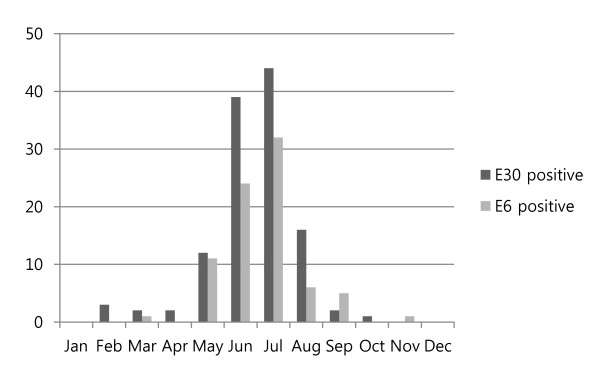
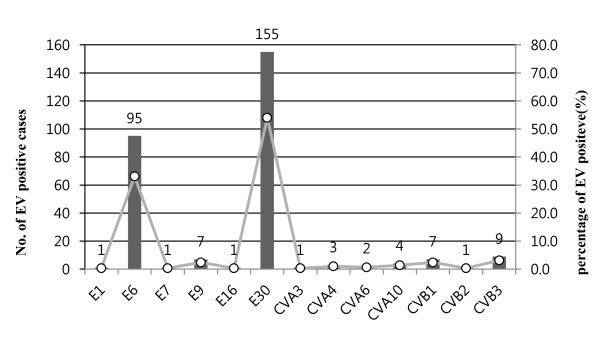
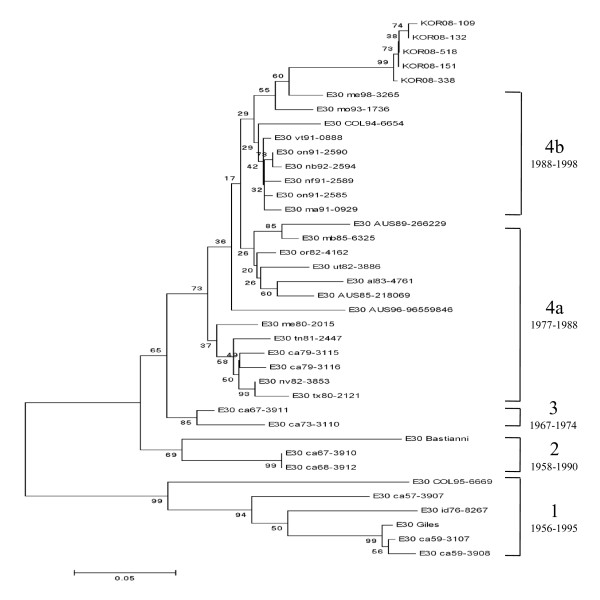
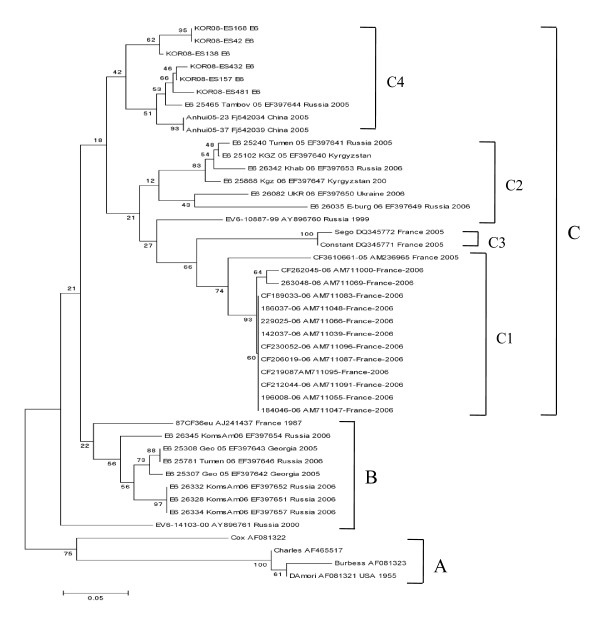
Verification
Claims the paper makes
The claims and statistics of this paper haven’t been checked yet.
Free: it reads the open-access text and checks the first 5 claims that cite a source we can check. Create a free account to check every claim.
Claims other papers make about this one
Each is checked against this paper’s own text: does it say what the citing paper says it does?
The cited source says what the claim attributes to it.
In the citing paper
“Echoviruses, such as E-6, E-9, E-11, E-13, E-19, and E-30 also belong to the species Enterovirus B and are commonly known to be associated with viral meningitis in children [69].”
From Viral meningitis: an overview (2021) · cites this paper as [69]
Self-check
Percentages, sums and reported differences re-computed from the paper’s own numbers.
The self-check needs the paper’s full text.
Citations
Cites
Enteroviruses : Polioviruses, Coxsackieviruses, Echoviruses, and Newer Enteroviruses
Pallansch, M. (2001) · Medical Entomology and Zoology · Cited by 890
Enterovirus Surveillance - United States, 1970-2005: (540562006-001)
Khetsuriani, N., LaMonte-Fowlkes, A., Oberste, M. S., & Pallansch, M. A. (2006) · PsycEXTRA Dataset · doi:10.1037/e540562006-001 · Cited by 702
Verstrepen, W. A., Kuhn, S., Kockx, M. M., Van De Vyvere, M. E., & Mertens, A. H. (2001) · Journal of Clinical Microbiology · doi:10.1128/jcm.39.11.4093-4096.2001 · Cited by 177 · cited 1×
“[14].”
Lee, B. E., & Davies, H. D. (2007) · Current Opinion in Infectious Diseases · doi:10.1097/qco.0b013e3280ad4672 · Cited by 163
Oberste, M. S., Maher, K., Kennett, M. L., Campbell, J. J., Carpenter, M. S., Schnurr, D., & Pallansch, M. A. (1999) · Journal of Clinical Microbiology · doi:10.1128/jcm.37.12.3928-3933.1999 · Cited by 154
Mirand, A., Henquell, C., Archimbaud, C., Chambon, M., Charbonne, F., Peigue-Lafeuille, H., & Bailly, J.-L. (2008) · Journal of Clinical Microbiology · doi:10.1128/jcm.01020-07 · Cited by 96 · cited 1×
“Meningitis outbreaks typically occur in restricted geographical areas or communities during the summer and autumn seasons and lead to increased hospital admissions for short periods [16,17].”
BackgroundChadwick, D. R. (2005) · British Medical Bulletin · doi:10.1093/bmb/ldh057 · Cited by 96
Dagan, R., Jenista, J. A., & Menegus, M. A. (1988) · The Journal of Pediatrics · doi:10.1016/s0022-3476(88)80566-3 · Cited by 87 · cited 1×
“The typical presentation of enteroviral meningitis in children is vomiting, anorexia, rash or respiratory symptoms, and meningism, often preceded by flu-like symptoms and sore throat [20].”
BackgroundSavolainen, C., Hovi, T., & Mulders, M. N. (2001) · Archives of Virology · doi:10.1007/s007050170160 · Cited by 85 · cited 3×
“Meningitis outbreaks typically occur in restricted geographical areas or communities during the summer and autumn seasons and lead to increased hospital admissions for short periods [16,17].”
BackgroundEnteroviruses in Spain: virological and epidemiological studies over 10 years (1988–97)
TRALLERO, G., CASAS, I., TENORIO, A., ECHEVARRIA, J. E., CASTELLANOS, A., LOZANO, A., & BREÑA, P. P. (2000) · Epidemiology and Infection · doi:10.1017/s0950268899003726 · Cited by 85 · cited 1×
“E6, E9, E11, E13, E19, and E30 are the most common EV genotypes detected from patients with aseptic meningitis, either in an epidemic or endemic form of the disease [5-9].”
BackgroundEchovirus 30, Jiangsu Province, China
Zhao, Y. N., Jiang, Q. W., Jiang, R. J., Chen, L., & Perlin, D. S. (2005) · Emerging infectious diseases · doi:10.3201/eid1104.040995 · Cited by 68 · cited 2×
“Since the development of reverse transcription-polymerase chain reaction (RTPCR) assays for the detection and molecular typing of EVs from clinical samples, many aseptic meningitis outbreaks have been described worldwide during the last few years [10,11].”
BackgroundEmergence of recent echovirus 30 lineages is marked by serial genetic recombination events
Mirand, A., Henquell, C., Archimbaud, C., Peigue-Lafeuille, H., & Bailly, J.-L. (2007) · Journal of General Virology · doi:10.1099/vir.0.82146-0 · Cited by 59 · cited 1×
“Since the development of reverse transcription-polymerase chain reaction (RTPCR) assays for the detection and molecular typing of EVs from clinical samples, many aseptic meningitis outbreaks have been described worldwide during the last few years [10,11].”
BackgroundEmergence of Echovirus Type 13 as a Prominent Enterovirus
Mullins, J. A., Khetsuriani, N., Nix, W. A., Oberste, M. S., LaMonte, A., Kilpatrick, D. R., Dunn, J., Langer, J., McMinn, P., Huang, Q. S., et al. (2004) · Clinical Infectious Diseases · doi:10.1086/380462 · Cited by 56 · cited 1×
“Aseptic meningitis in children is the most commonly encountered serious illness associated with enteroviral infections, often appearing in the form of an outbreak [1-3].”
BackgroundEchovirus 30 Infection and Aseptic Meningitis in Parents of Children Attending a Child Care Center
Helfand, R. F., Khan, A. S., Pallansch, M. A., Alexander, J. P., Meyers, H. B., DeSantis, R. A., Schonberger, L. B., & Anderson, L. J. (1994) · The Journal of Infectious Diseases · doi:10.1093/infdis/169.5.1133 · Cited by 53 · cited 1×
“E6, E9, E11, E13, E19, and E30 are the most common EV genotypes detected from patients with aseptic meningitis, either in an epidemic or endemic form of the disease [5-9].”
BackgroundChomel, J. J., Antona, D., Thouvenot, D., & Lina, B. (2003) · European Journal of Clinical Microbiology & Infectious Diseases · doi:10.1007/s10096-003-0896-4 · Cited by 48 · cited 1×
“E30 is known to cause outbreaks by maintaining its isolation rates and increasing its circulation periodically [11,21].”
BackgroundAseptic meningitis in Germany associated with echovirus type 13
Diedrich, S., & Schreier, E. (2001) · BMC Infectious Diseases · doi:10.1186/1471-2334-1-14 · Cited by 37
An aseptic meningitis outbreak caused by echovirus 6 in Anhui province, China
Mao, N., Zhao, L., Zhu, Z., Chen, X., Zhou, S., Zhang, Y., Cui, A., Ji, Y., Xu, S., & Xu, W. (2010) · Journal of Medical Virology · doi:10.1002/jmv.21707 · Cited by 36 · cited 1×
“E6, E9, E11, E13, E19, and E30 are the most common EV genotypes detected from patients with aseptic meningitis, either in an epidemic or endemic form of the disease [5-9].”
BackgroundReintjes, R., Pohle, M., VIETH, U., Lyytikäinen, O., TIMM, H., Schreier, E., & Petersen, L. R. (1999) · The Pediatric Infectious Disease Journal · doi:10.1097/00006454-199902000-00005 · Cited by 32 · cited 1×
“E6, E9, E11, E13, E19, and E30 are the most common EV genotypes detected from patients with aseptic meningitis, either in an epidemic or endemic form of the disease [5-9].”
BackgroundDumaidi, K., Frantzidou, F., Papa, A., Diza, E., & Ántoniadis, A. (2006) · Journal of Clinical Laboratory Analysis · doi:10.1002/jcla.20129 · Cited by 30 · cited 1×
“However, a few winter outbreaks of meningitis caused by EVs have been reported [18].”
BackgroundRelation of Culture Site to the Recovery of Nonpolio Enteroviruses
Mintz, L., & Drew, W. (1980) · American Journal of Clinical Pathology · doi:10.1093/ajcp/74.3.324 · Cited by 19
Research works printed but not linked: 1
- Jee YM Cheon DS Choi WY Ahn JB Kim KS Chung YS Lee JW Lee KB Noh HS Park KS Lee SH Kim SH Cho KS Kim ES Jung JK Yoon JD Cho HW Updates on enterovirus surveillance in Korea Infection Chemother 2004 36 294 303
Cited by
Kohil, A., Jemmieh, S., Smatti, M. K., & Yassine, H. M. (2021) · Archives of Virology · doi:10.1007/s00705-020-04891-1 · Cited by 164
Human Neonatal Fc Receptor Is the Cellular Uncoating Receptor for Enterovirus B
Zhao, X., Zhang, G., Liu, S., Chen, X., Peng, R., Dai, L., Qu, X., Li, S., Song, H., Gao, Z., et al. (2019) · Cell · doi:10.1016/j.cell.2019.04.035 · Cited by 125
“In recent years, severe outbreaks of echovirus infections have been documented in America, Europe, and Asia (Croker et al., 2015; Kadambari et al., 2014; Kim et al., 2012; Mao et al., 2010).”
Mao, Q., Wang, Y., Bian, L., Xu, M., & Liang, Z. (2016) · Emerging Microbes & Infections · doi:10.1038/emi.2016.73 · Cited by 109
Is a multivalent hand, foot, and mouth disease vaccine feasible?
Klein, M. H., & Chong, P. C.-S. (2015) · Human Vaccines & Immunotherapeutics · doi:10.1080/21645515.2015.1049780 · Cited by 78
Fernández-García, M. D., Kébé, O., Fall, A. D., & Ndiaye, K. (2017) · Scientific Reports · doi:10.1038/s41598-017-03835-1 · Cited by 65
Metadata
- Authors
- Kim, H.-J., Kang, B., Hwang, S., Hong, J., Kim, K., & Cheon, D.-S.
- Affiliations
- Korea National Institute of Health (KR)
- Kyung Hee University (KR)
- Corresponding author
- Cheon, Doo-Sung
- Venue
- Virology Journal
- Published
- 2012-02-15
- Volume
- 9
- Issue
- 1
- Pages
- 38-38
- ISSN
- 1743-422X (ISSN-L)
- PMC
- PMC3298778
- OpenAlex
- W2131706244
- Cited by
- 70
- References
- 22
- Citations by year
- 2025: 1 · 2024: 5 · 2023: 3 · 2022: 3 · 2021: 12 · 2020: 7 · 2019: 5 · 2018: 4 · 2017: 6 · 2016: 6 · 2015: 4 · 2014: 1 · 2013: 11 · 2012: 2
- FWCI
- 3.70
- Type
- journal article
- Language
- en
- Open access
- gold
- doi.org
- Licence
- cc-by
- Locations
- Virology Journal (publishedVersion, cc-by)
- Europe PMC (PubMed Central) (publishedVersion, cc-by)
- PubMed Central (publishedVersion, cc-by)
- PubMed (publishedVersion)
- DOAJ (DOAJ: Directory of Open Access Journals) (submittedVersion)
- Topics
- Health Sciences › Medicine › Infectious Diseases › Viral Infections and Immunology Research
- Health Sciences › Medicine › Infectious Diseases › Infectious Encephalopathies and Encephalitis
- Health Sciences › Medicine › Public Health, Environmental and Occupational Health › Mosquito-borne diseases and control
- Keywords
- aseptic meningitis, viral meningitis, echovirus 6, echovirus 30, enterovirus outbreak, enterovirus genotyping, VP1 region, phylogenetic analysis, seasonal distribution, children, Coxsackie virus, fatality rate, seizures
- MeSH terms
- Adolescent, Child, Child, Preschool, Echovirus Infections, Female, Humans, Infant, Infant, Newborn, Male, Meningitis, Viral, Molecular Sequence Data, Phylogeny, RNA, Viral, Virology, Polymerase Chain Reaction, Sequence Analysis, DNA, Reverse Transcriptase Polymerase Chain Reaction, Enterovirus B, Human, Republic of Korea, Real-Time Polymerase Chain Reaction
About these checks
Registry, retraction, Cites and statistics results are computed, not judged, with one exception: a printed reference that no index lists is read once by a model before it counts as a citation error. Claims are extracted by a model and kept only when their quote appears verbatim in the text; each cited source is then checked, with a model’s help, for whether it says what the claim relies on. Those verdicts can be wrong — read the claim’s quote and the cited source before relying on one.
Statistics and arithmetic are recomputed, not judged.
Confidence bands are shown only for fields calibrated on our annotated test set. None is calibrated yet, so no band is shown.
What counts as a claim ›How we measure confidence ›How we check this ›
Are you an author, or do you see a problem with this page? Request a review
Data sources
Bibliographic data: Semantic Scholar, OpenAlex, Crossref.
Contains information from the Semantic Scholar Academic Graph Datasets, made available under the ODC Attribution License (ODC-BY 1.0).
Semantic Scholar’s data is described in: Kinney, R., et al. (2023). The Semantic Scholar Open Data Platform. arXiv:2301.10140.
