

CONSORT 2010 Statement: updated guidelines for reporting parallel group randomised trials
Open accessThe DOI matches its Crossref record; 41 of the 43 references it cites were found in a registry or an index, and 1 are not checked yet; 3 of the 20 sources its claims cite were checked for support.
Abstract
The CONSORT statement is used worldwide to improve the reporting of randomised controlled trials. Kenneth Schulz and colleagues describe the latest version, CONSORT 2010, which updates the reporting guideline based on new methodological evidence and accumulating experience. To encourage dissemination of the CONSORT 2010 Statement, this article is freely accessible on bmj.com and will also be published in the Lancet, Obstetrics and Gynecology, PLoS Medicine, Annals of Internal Medicine, Open Medicine, Journal of Clinical Epidemiology, BMC Medicine, and Trials.
Verified 2026-10-05 · 1 reference not checked yet
Overview
CoChat Summary
TL;DR
CONSORT 2010 updates the 2001 reporting guideline for parallel-group randomised trials, providing a 25-item checklist and a flow diagram to improve completeness, clarity, and transparency of trial reports. The revision is evolutionary, based on accumulated methodological evidence and CONSORT Group consensus.
Key findings
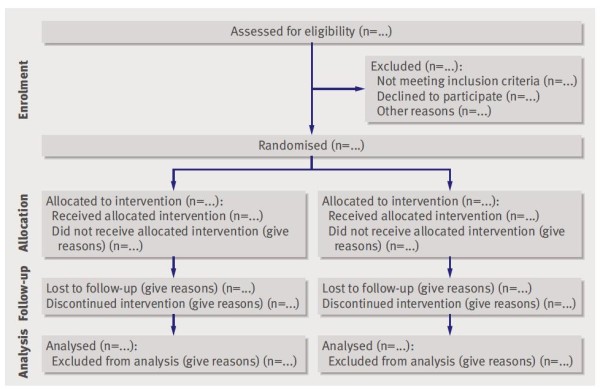
- CONSORT 2010 consists of this paper, a 25-item checklist (Table 1), and a flow diagram (Figure 1); the flow diagram was not modified except for one word.
- The update made evolutionary rather than revolutionary changes, kept existing item numbers except for some renumbering of items 2 to 5, and added new items or sub-items on topics including trial design, changes to methods or outcomes after trial commencement, blinding details, trial registration, protocol availability, and funding.
- The statement focuses on the most common design type—individually randomised, two-group, parallel trials—which the paper says accounts for over half of trials in the literature.
- The CONSORT database contains more than 700 studies, and more than 400 journals have explicitly supported the CONSORT statement.
Methods
- Design: consensus update of the 2001 CONSORT statement by the CONSORT Group, informed by methodological evidence and experience.
- Sample/process: 31 members met in Montebello, Canada, in January 2007; participants synthesised evidence on checklist items, the group deliberated each item, and the executive convened teleconferences and meetings, producing seven major iterations before feedback and finalisation.
- Main analysis: items deemed absolutely fundamental to reporting a randomised controlled trial were retained; the updated explanation and elaboration manuscript was drafted and iteratively revised by the group.
Limitations
- The paper states that CONSORT 2010 focuses predominantly on the two-group, parallel randomised controlled trial, and that other trial designs or situations require additional information and may need CONSORT extensions.
- The paper states that CONSORT 2010 does not include recommendations for designing, conducting, or analysing trials, and is not intended as an instrument to evaluate trial quality or to construct a “quality score.”
- The paper states a potential drawback: a reporting guideline might encourage some authors to report fictitiously what the guidance suggests rather than what was actually done; the text also makes evident that this is a guideline statement rather than a new empirical evaluation of CONSORT 2010’s effects.
Model-written summary. Check it against the paper before relying on it.
Integrity signals
Registry
Cites
Statistics
Figures
Verification
Claims the paper makes
3 Valid · 0 Not valid · 9 Not checked · 7 Own results and interpretations
Every source the paper cites for this claim was checked and supports it.
In the paper
“However, randomised trials can yield biased results if they lack methodological rigour [1].”
§ CONSORT 2010 Statement: updated guidelines for reporting parallel group randomised trials > Introduction
What the sources say
- Supportedcites [1] Jüni P Altman DG Egger M Systematic reviews in health care: assessing the quality of controlled clinical trials BMJ 2001 323 42 6 10.1136/bmj.323.7303.42 11440947 PMC1120670 source
The Conclusions section states there is ample evidence that many trials are methodologically weak and that deficiencies translate into biased findings, directly supporting the claim. The 'Empirical evidence of bias' section (and the introductory framing on internal validity being threatened by selection, performance, detection, and attrition bias) documents that inadequate concealment of allocation exaggerated treatment effects (combined ratio of odds ratios 0.70, 95% CI 0.62 to 0.80), i.e. biased results arising from lacking methodological rigour. (LLM, conf=0.90)
plainstates a possible cause- Asserted: passes — The authors put it forward as true.
- Checkable: passes — It can be checked against evidence.
- Load-bearing: passes — The paper’s conclusions depend on it.
- Based: passes — The paper gives a reason why it holds.
- Supported
The cited sources support only part of this claim — read each source’s verdict below.
In the paper
“While those statements improved the reporting quality for some randomised controlled trials, [9,10] many trial reports still remain inadequate [2].”
§ CONSORT 2010 Statement: updated guidelines for reporting parallel group randomised trials > Introduction
What the sources say
- Not checked yetcites [9] Plint AC Moher D Morrison A Schulz K Altman DG Hill C Gaboury Does the CONSORT checklist improve the quality of reports of randomised controlled trials? A systematic review Med J Aust 2006 185 263 7 16948622 source
- Partly supportedcites [10] Hopewell S Dutton S Yu L-M Chan A-W Altman DG The quality of reports of randomised trials in 2000 and 2006: a comparative study of articles indexed by PubMed BMJ 2010 340 c723 10.1136/bmj.c723 20332510 PMC2844941 sourceExperimental — accuracy not yet measured
Our copy supports the improvement half of the claim: the 'What this study adds' box (Discussion > Conclusions) states that 'Reporting of methodological details in publications of randomised trials has improved somewhat between 2000 and 2006,' and the Principal findings (Discussion) report 'clear evidence of improved reporting of several important aspects of trial methods.' The link to CONSORT is only inferential/hedged: the Introduction frames the aim as assessing 'whether the recommendations have led to improvements,' and the endorsement comparison (Results; Discussion > Comparison with other studies) shows significantly better reporting in CONSORT-endorsing journals, a finding the authors say 'should be viewed with a certain amount of caution' and attribute the explicit conclusion of adoption being 'associated with improved reporting' to another work (the systematic review at ref 23). So the causal phrasing 'improved the reporting quality' is stronger than this source states, and it concerns parallel-group trials indexed in PubMed published in 2000 and 2006. (LLM, conf=0.70)
plainstates a cause- Asserted: passes — The authors put it forward as true.
- Checkable: passes — It can be checked against evidence.
- Load-bearing: passes — The paper’s conclusions depend on it.
- Based: passes — The paper gives a reason why it holds.
The cited sources support only part of this claim — read each source’s verdict below.
In the paper
“Unfortunately, attempted assessments frequently fail because authors of many trial reports neglect to provide lucid and complete descriptions of that critical information [2-4].”
§ CONSORT 2010 Statement: updated guidelines for reporting parallel group randomised trials > Introduction
What the sources say
- Not checked yetcites [2] Chan AW Altman DG Epidemiology and reporting of randomised trials published in PubMed journals Lancet 2005 365 1159 62 10.1016/S0140-6736(05)71879-1 15794971 source
- Not checked yetcites [3] Glasziou P Meats E Heneghan C Shepperd S What is missing from descriptions of treatment in trials and reviews? BMJ 2008 336 1472 4 10.1136/bmj.39590.732037.47 18583680 PMC2440840 source
- Partly supportedcites [4] Dwan K Altman DG Arnaiz JA Bloom J Chan AW Cronin E Decullier E Easterbrook PJ Von Elm E Gamble C Ghersi D Ioannidis JP Simes J Williamson PR Systematic review of the empirical evidence of study publication bias and outcome reporting bias PLoS ONE 2008 3 e3081 10.1371/journal.pone.0003081 18769481 PMC2518111 sourceExperimental — accuracy not yet measured
The Results (Publication and trial findings; page unavailable) report that substantial proportions of trial outcomes were omitted or incompletely reported, supporting the claim about missing findings. The paper does not establish that attempted assessments frequently fail for this reason or that trial reports commonly lack clear descriptions of methodology. (LLM, conf=0.82)
plainstates a cause- Asserted: passes — The authors put it forward as true.
- Checkable: passes — It can be checked against evidence.
- Load-bearing: passes — The paper’s conclusions depend on it.
- Based: passes — The paper gives a reason why it holds.
In the paper
“While those statements improved the reporting quality for some randomised controlled trials, [9,10] many trial reports still remain inadequate [2].”
§ CONSORT 2010 Statement: updated guidelines for reporting parallel group randomised trials > Introduction
What the sources say
- Not checked yetcites [2] Chan AW Altman DG Epidemiology and reporting of randomised trials published in PubMed journals Lancet 2005 365 1159 62 10.1016/S0140-6736(05)71879-1 15794971 source
plain- Asserted: passes — The authors put it forward as true.
- Checkable: passes — It can be checked against evidence.
- Load-bearing: passes — The paper’s conclusions depend on it.
- Based: passes — The paper gives a reason why it holds.
In the paper
“That support seems warranted: when used by authors and journals, CONSORT seems to improve reporting [9].”
§ CONSORT 2010 Statement: updated guidelines for reporting parallel group randomised trials > Background to CONSORT
What the sources say
- Not checked yetcites [9] Plint AC Moher D Morrison A Schulz K Altman DG Hill C Gaboury Does the CONSORT checklist improve the quality of reports of randomised controlled trials? A systematic review Med J Aust 2006 185 263 7 16948622 source
hedgedstates a possible cause- Asserted: passes — The authors put it forward as true.
- Checkable: passes — It can be checked against evidence.
- Load-bearing: unclear — It is unclear whether the paper’s conclusions depend on it.
- Based: passes — The paper gives a reason why it holds.
7 more claims
Create a free account to see all 19 claims and to verify the 17 references still open.
- Probably not a substantial claim. 5
- It may state two separate claims as one. 3
Claims other papers make about this one
Each is checked against this paper’s own text: does it say what the citing paper says it does?
The source backs part of the claim, not all of it — or backs it for a different population, condition or comparison.
In the citing paper
“RCTs have specific governance characteristics (including prospective trial registration requirements), detailed protocols (including documentation of study medication), and checklists that have to be completed at submission to journals [9, 10].”
From Checklist to assess Trustworthiness in RAndomised Controlled Trials (TRACT checklist): concept proposal and pilot (2023) · cites this paper as [10]
Experimental — accuracy not yet measuredThe cited source says what the claim attributes to it.
In the citing paper
“The CONSORT checklist (Schulz et al., 2010) (Appendix A) and JARS guidelines (American Psychological Association, 2008) were applied in reporting the findings.”
From An online acceptance, commitment, and self-compassion based treatment to decrease psychological distress in people with type 2 diabetes: A feasibility randomised-controlled trial (2023) · cites this paper as Schulz et al., 2010
Citations
Cites
Preferred Reporting Items for Systematic Reviews and Meta-Analyses: the PRISMA statement
Moher, D., Liberati, A., Tetzlaff, J., Altman, D. G., & for the PRISMA Group (2009) · BMJ · doi:10.1136/bmj.b2535 · Cited by 83,823
Self-citationPreferred reporting items for systematic reviews and meta-analyses: the PRISMA Statement.
(2009) · PubMed Central · Cited by 44,859
Self-citationvon Elm, E., Altman, D. G., Egger, M., Pocock, S. J., Gøtzsche, P. C., Vandenbroucke, J. P., & Initiative, F. T. S. (2007) · PLoS Medicine · doi:10.1371/journal.pmed.0040296 · Cited by 23,020
Self-citationElm, E. V., Altman, D. G., Egger, M., Pocock, S. J., Gøtzsche, P. C., & Vandenbroucke, J. P. (2007) · BMJ · doi:10.1136/bmj.39335.541782.ad · Cited by 10,766
Self-citationMoher, D., Hopewell, S., Schulz, K. F., Montori, V., Gotzsche, P. C., Devereaux, P. J., Elbourne, D., Egger, M., & Altman, D. G. (2010) · BMJ · doi:10.1136/bmj.c869 · Cited by 8,883
Self-citationSchulz (1995) · doi:10.1001/jama.1995.03520290060030 · Cited by 5,634
Moher, D., Schulz, K. F., & Altman, D. G. (2001) · The Lancet · doi:10.1016/s0140-6736(00)04337-3 · Cited by 5,373
Self-citationMoher, D., Pham, B., Jones, A., Cook, D. J., Jadad, A. R., Moher, M., Tugwell, P., & Klassen, T. P. (1998) · The Lancet · doi:10.1016/s0140-6736(98)01085-x · Cited by 3,560
Self-citationConsort 2010 statement: extension to cluster randomised trials
Campbell, M. K., Piaggio, G., Elbourne, D. R., Altman, D. G., & for the CONSORT Group (2012) · BMJ · doi:10.1136/bmj.e5661 · Cited by 3,510
Self-citationAssessing the quality of controlled clinical trials
Jüni, P., Altman, D. G., & Egger, M. (2001) · BMJ · doi:10.1136/bmj.323.7303.42 · Cited by 3,309 · cited 1×
“However, randomised trials can yield biased results if they lack methodological rigour [1].”
Self-citation
Cited by
Items 401–500 of 1,835
Web-Based Weight Loss Intervention for Men With Type 2 Diabetes: Pilot Randomized Controlled Trial
Haste, A., Adamson, A. J., McColl, E., Araujo-Soares, V., & Bell, R. (2017) · JMIR Diabetes · doi:10.2196/diabetes.7430 · Cited by 39
Direct and Transcutaneous Vagus Nerve Stimulation for Treatment of Tinnitus: A Scoping Review
Yakunina, N., & Nam, E. (2021) · Frontiers in Neuroscience · doi:10.3389/fnins.2021.680590 · Cited by 44
Chowdhury, D., Bansal, L., Duggal, A. K., Datta, D., Mundra, A., Krishnan, A., Koul, A., & Gupta, A. (2021) · Cephalalgia · doi:10.1177/03331024211047454 · Cited by 40
Regulatory and Ethical Aspects of Orthobiologic Therapies
Murray, I. R., Chahla, J. A., Wordie, S. J., Shapiro, S. A., Piuzzi, N. S., Frank, R. M., Halbrecht, J., Okada, K., Nakamura, N., Mandelbaum, B. R., et al. (2022) · Orthopaedic Journal of Sports Medicine · doi:10.1177/23259671221101626 · Cited by 42
García-Hernández, V. M., Gallar, M., Sánchez-Soriano, J., Micol, V., Roche, E., & García-García, E. (2013) · International Journal of Food Sciences and Nutrition · doi:10.3109/09637486.2013.812619 · Cited by 39
Ñaupari‐Villasante, R., Matos, T. P., de Albuquerque, E. G., Warol, F., Tardem, C., Calazans, F. S., Poubel, L. A., Reis, A., Barceleiro, M. D. O., & Loguércio, A. D. (2023) · Dental Materials · doi:10.1016/j.dental.2023.04.007 · Cited by 39
Mindfulness-Based Interventions for Psoriasis: a Randomized Controlled Trial
D’Alton, P., Kinsella, L., Walsh, O., Sweeney, C., Timoney, I., Lynch, M., O’Connor, M., & Kirby, B. (2019) · Mindfulness · doi:10.1007/s12671-018-0973-5 · Cited by 39
Learning in situ: a randomized experiment in video streamingPreprint
Yan, F. Y., Ayers, H. R., Zhu, C., Fouladi, S., Hong, J. W., Zhang, K., Levis, P. A., & Winstein, K. (2019) · arXiv (Cornell University) · doi:10.48550/arxiv.1906.01113 · Cited by 317
Sinjari, B., D’Addazio, G., Tullio, I. D., Traini, T., & Caputi, S. (2018) · BioMed Research International · doi:10.1155/2018/5326340 · Cited by 43
Morrongiello, B. A., Corbett, M., Beer, J., & Koutsoulianos, S. (2018) · Journal of Pediatric Psychology · doi:10.1093/jpepsy/jsy056 · Cited by 36
Vicente-Campos, D., Sánchez-Jorge, S., Terrón-Manrique, P., Guisard, M., Collin, M., Castaño, B., Rodríguez‐Sanz, D., Vallejo, R., Chicharro, J. L., & Calvo‐Lobo, C. (2021) · Journal of Clinical Medicine · doi:10.3390/jcm10214983 · Cited by 51
Research article title content and form in high-ranked international clinical medicine journals
Kerans, M. E., Marshall, J., Murray, A., & Sabaté, S. (2020) · English for Specific Purposes · doi:10.1016/j.esp.2020.06.001 · Cited by 49
LOGUERCIO, A. D., TAY, L. Y., HERRERA, D. R., BAUER, J., & REIS, A. (2015) · Brazilian Oral Research · doi:10.1590/1807-3107bor-2015.vol29.0099 · Cited by 38
Homeopathy for treatment of irritable bowel syndrome
Peckham, E. J., Nelson, E. A., Greenhalgh, J., Cooper, K. L., Roberts, E. R., & Agrawal, A. (2013) · Cochrane Database of Systematic Reviews · doi:10.1002/14651858.cd009710.pub2 · Cited by 50
Bordini, D., Paula, C. S., da Cunha, G. R., Caetano, S. C., Bagaiolo, L., Ribeiro, T. C., Martone, M. C. C., Portolese, J., Moya, A. C., Brunoni, D., et al. (2020) · Journal of Intellectual Disability Research · doi:10.1111/jir.12759 · Cited by 54
Gillespie, B. M., Walker, R., Latimer, S. L., Thalib, L., Whitty, J. A., McInnes, E., Lockwood, I., & Chaboyer, W. P. (2021) · International Journal of Nursing Studies · doi:10.1016/j.ijnurstu.2021.103976 · Cited by 59
Cahill, L. S., Carey, L. M., Lannin, N. A., Turville, M. L., & O’Connor, D. A. (2017) · Cochrane Database of Systematic Reviews · doi:10.1002/14651858.cd012575 · Cited by 39
Bier, B., Ouellet, É., & Belleville, S. (2018) · Neuropsychology · doi:10.1037/neu0000417 · Cited by 47
Hollaar, V. R. Y., van der Putten, G.-J., van der Maarel‐Wierink, C. D., Bronkhorst, E. M., Swart, B. J. M. D., & Creugers, N. H. J. (2017) · BMC Geriatrics · doi:10.1186/s12877-017-0519-z · Cited by 40
Catalá-López, F., Aleixandre-Benavent, R., Caulley, L., Hutton, B., Tabarés-Seisdedos, R., Moher, D., & Alonso-Arroyo, A. (2020) · Trials · doi:10.1186/s13063-019-3944-9 · Cited by 38
Self-citationEngh, J. A., Andersen, E., Holmen, T. L., Martinsen, E. W., Mordal, J., Morken, G., & Egeland, J. (2015) · Trials · doi:10.1186/s13063-015-1094-2 · Cited by 49
Cheong, K. B., Zhang, J., & Huang, Y. (2014) · Complementary Therapies in Medicine · doi:10.1016/j.ctim.2014.05.002 · Cited by 41
Matos, T. D. P., Gutiérrez, M. F., Hanzen, T. A., Malaquias, P., de Paula, A. M., de Souza, J. J., Hass, V., Eduardo Fernandez, G., Reis, A., & Loguércio, A. D. (2019) · Journal of Dentistry · doi:10.1016/j.jdent.2019.103219 · Cited by 43
Malmberg Gavelin, H., Eskilsson, T., Boraxbekk, C.-J., Josefsson, M., Stigsdotter Neely, A., & Slunga Järvholm, L. (2018) · Stress · doi:10.1080/10253890.2018.1461833 · Cited by 36
Intermittent self-dilatation for urethral stricture disease in males
Jackson, M. J., Veeratterapillay, R., Harding, C., et al. (2014) · Cochrane Database of Systematic Reviews · doi:10.1002/14651858.cd010258.pub2 · Cited by 37
O’Connor, G., COATES, V. E., & O’Neill, S. M. (2013) · European Journal of Oncology Nursing · doi:10.1016/j.ejon.2013.10.011 · Cited by 41
Citation impact was highly variable for reporting guidelines of health research: a citation analysis
Caulley, L., Cheng, W., Catalá-López, F., Whelan, J., Khoury, M., Ferraro, J., Husereau, D., Altman, D. G., & Moher, D. (2020) · Journal of Clinical Epidemiology · doi:10.1016/j.jclinepi.2020.07.013 · Cited by 37
Self-citationFayed, N., de Camargo, O. K., Elahi, I., et al. (2014) · Quality of Life Research · doi:10.1007/s11136-013-0483-9 · Cited by 37
Hashim, H. A., Alsherbini, W., & Bazeed, M. F. (2011) · Contraception · doi:10.1016/j.contraception.2011.07.012 · Cited by 39
Kramer, A. H., Roberts, D. J., Holodinsky, J. K., Todd, S., Hill, M. D., Zygun, D. A., Faris, P., & Wong, J. H. (2014) · Neurocritical Care · doi:10.1007/s12028-014-9965-z · Cited by 38
Pouw, M. A., Calf, A. H., Munster, B. C. V., ter Maaten, J. C., Smidt, N., & de Rooij, S. E. (2018) · BMJ Open · doi:10.1136/bmjopen-2017-020332 · Cited by 37
Reinhardt, K. R., Duggal, S., Umunna, B.-P. N., Reinhardt, G. A., Nam, D., Alexiades, M. M., & Cornell, C. N. (2013) · Clinical Orthopaedics and Related Research · doi:10.1007/s11999-013-3351-6 · Cited by 37
Kyriacos, U., Jelsma, J. M., James, M. F., & Jordan, S. E. (2015) · Trials · doi:10.1186/s13063-015-0624-2 · Cited by 45
Critical Appraisal Tools and Reporting Guidelines
Haile, Z. T. (2021) · Journal of Human Lactation · doi:10.1177/08903344211058374 · Cited by 48
Wang, P., Song, M., Wang, X., Zhang, Y., & Wu, Y. (2023) · British Journal of Clinical Pharmacology · doi:10.1111/bcp.15726 · Cited by 36
Hayden, J. A., Ellis, J., Ogilvie, R., Boulos, L., & Stanojevic, S. (2021) · Journal of Clinical Epidemiology · doi:10.1016/j.jclinepi.2021.01.020 · Cited by 36
Tjaden, C. D., Mulder, C. L., den Hollander, W., Castelein, S., Delespaul, P., Keet, R., van Weeghel, J., & Kroon, H. (2021) · JAMA Psychiatry · doi:10.1001/jamapsychiatry.2021.2880 · Cited by 44
Arshad, S., Zaidi, S. J. A., & Farooqui, W. A. (2021) · BMC Oral Health · doi:10.1186/s12903-021-01864-x · Cited by 47
Bentley, C. L., Mountain, G. A., Thompson, J., Fitzsimmons, D. A., Lowrie, K., Parker, S. G., & Hawley, M. (2014) · Trials · doi:10.1186/1745-6215-15-313 · Cited by 41
Bressan, A. K., Aubin, J., Martel, G., Dixon, E., Bathe, O. F., Sutherland, F. R., Balaa, F. K., Mimeault, R., Edwards, J. P., Grondin, S. C., et al. (2017) · Annals of Surgery · doi:10.1097/sla.0000000000002614 · Cited by 39
The Efficacy of Cognitively-Based Compassion Training for African American Suicide Attempters
LoParo, D., Mack, S. A., Patterson, B., Negi, L. T., & Kaslow, N. J. (2018) · Mindfulness · doi:10.1007/s12671-018-0940-1 · Cited by 44
Kearley, B., & Gottfredson, D. C. (2019) · Journal of Experimental Criminology · doi:10.1007/s11292-019-09382-1 · Cited by 43
Al-Zahrani, T., Doais, K. S., Aljassir, F., et al. (2015) · The Journal of Arthroplasty · doi:10.1016/j.arth.2014.07.032 · Cited by 36
The problem of the poor control arm in surgical randomized controlled trials
Strobel, O., & Büchler, M. W. (2013) · Journal of British Surgery · doi:10.1002/bjs.8998 · Cited by 36
The Growth of Clinical Trials and Systematic Reviews in Informing Dermatological Patient Care
Williams, H. C., & Dellavalle, R. P. (2011) · Journal of Investigative Dermatology · doi:10.1038/jid.2011.337 · Cited by 38
Understanding Physical Activity Outcomes as a Function of Teen Smoking Cessation
Horn, K. A., Branstetter, S. A., Zhang, J., Jarrett, T. D., Tompkins, N. O., Anesetti‐Rothermel, A., Olfert, M. D., Richards, T., & Dino, G. (2013) · Journal of Adolescent Health · doi:10.1016/j.jadohealth.2013.01.019 · Cited by 44
Fornusek, C. P., & Kilbreath, S. L. (2017) · Journal of Cancer Survivorship · doi:10.1007/s11764-017-0622-3 · Cited by 36
Shang, Q., Wang, H., Li, S., & Xu, H. (2013) · Evidence-based Complementary and Alternative Medicine · doi:10.1155/2013/756519 · Cited by 36
Farrand, P., Pentecost, C., Greaves, C., Taylor, R. S., Warren, F., Green, C., Hillsdon, M., Evans, P., Welsman, J., & Taylor, A. H. (2014) · Trials · doi:10.1186/1745-6215-15-196 · Cited by 28
Tusch, E. S., Alperin, B. R., Ryan, E., Holcomb, P. J., Mohammed, A. H. S., & Daffner, K. R. (2016) · Frontiers in Aging Neuroscience · doi:10.3389/fnagi.2016.00255 · Cited by 45
Ruffino, D., Malliaras, P., Marchegiani, S., & Campana, V. (2021) · Physical Therapy in Sport · doi:10.1016/j.ptsp.2021.08.002 · Cited by 50
White, C., Shanley, D. C., Zimmer‐Gembeck, M. J., Walsh, K., Hawkins, R. M. F., Lines, K., & Webb, H. J. (2018) · Child Abuse & Neglect · doi:10.1016/j.chiabu.2018.05.024 · Cited by 45
Patterned feeding experience for preterm infants: study protocol for a randomized controlled trial
Pickler, R. H., Wetzel, P. A., Meinzen‐Derr, J. K., Tubbs‐Cooley, H. L., & Moore, M. (2015) · Trials · doi:10.1186/s13063-015-0781-3 · Cited by 41
Sakzewski, L., Reedman, S. E., & Hoffmann, T. (2016) · Research in Developmental Disabilities · doi:10.1016/j.ridd.2016.09.018 · Cited by 32
A randomized controlled trial of coordination exercise on cognitive function in obese adolescents
Liu, J.-H., Alderman, B. L., Song, T., Chen, F., Hung, T., & Chang, Y. (2017) · Psychology of sport and exercise · doi:10.1016/j.psychsport.2017.09.003 · Cited by 43
Østergaard, B., Imhof, R. M., Shamali, M., Nørgaard, B., Jeune, B., Pedersen, K. S., & Lauridsen, J. T. (2020) · Journal of Clinical Nursing · doi:10.1111/jocn.15603 · Cited by 40
Gollan, R., Ernst, M., Lieker, E., Caro-Valenzuela, J., Monsef, I., Dresen, A., Roheger, M., Skoetz, N., Kalbe, E., & Folkerts, A. (2022) · Journal of Parkinson s Disease · doi:10.3233/jpd-223252 · Cited by 46
Nouchi, R., Taki, Y., Takeuchi, H., Hashizume, H., Nozawa, T., Sekiguchi, A., Nouchi, H., & Kawashima, R. (2012) · Trials · doi:10.1186/1745-6215-13-32 · Cited by 42
Kouloutbani, K., Venetsanou, F., Markati, A., Karteroliotis, K. E., & Politis, A. M. (2021) · International Psychogeriatrics · doi:10.1017/s1041610221000193 · Cited by 46
MacKinnon, A., Madsen, J. W., Giesbrecht, G. F., Campbell, T. S., Carlson, L. E., Dimidjian, S., Letourneau, N. L., Tough, S., & Tomfohr‐Madsen, L. M. (2021) · Mindfulness · doi:10.1007/s12671-020-01585-2 · Cited by 39
Smits, J. A. J., Pollack, M. H., Rosenfield, D., Otto, M. W., Dowd, S. M., Carpenter, J. K., Dutcher, C. D., Lewis, E. M., Witcraft, S. M., Papini, S., et al. (2020) · JAMA Network Open · doi:10.1001/jamanetworkopen.2020.6777 · Cited by 33
Kangaslampi, S., Garoff, F., & Peltonen, K. (2015) · BMC Psychiatry · doi:10.1186/s12888-015-0520-z · Cited by 52
Hannes, K., Heyvaert, M., Slegers, K., Vandenbrande, S., & Nuland, M. V. (2015) · International Journal of Qualitative Methods · doi:10.1177/1609406915611528 · Cited by 61
Bryant, A. G., Bauer, A. E., Stuart, G. S., Levi, E. E., Zerden, M. L., Danvers, A. A., & Garrett, J. M. (2016) · Journal of Pediatric and Adolescent Gynecology · doi:10.1016/j.jpag.2016.08.003 · Cited by 34
LOGUERCIO, A. D., MARAN, B. M., HANZEN, T. A., PAULA, A. M. D., PERDIGÃO, J., & REIS, A. (2017) · Brazilian Oral Research · doi:10.1590/1807-3107bor-2017.vol31.0060 · Cited by 34
Ekeblad, A., Falkenström, F., Andersson, G., Vestberg, R., & Holmqvist, R. (2016) · Depression and Anxiety · doi:10.1002/da.22495 · Cited by 33
Warren, J. A., Blackhurst, D. W., Ewing, J. A., & Carbonell, A. M. (2024) · Surgical Endoscopy · doi:10.1007/s00464-024-11202-1 · Cited by 38
Mol, F. M. U., Jansen, C. H., Boelens, O. B., et al. (2018) · Scandinavian Journal of Pain · doi:10.1515/sjpain-2018-0011 · Cited by 34
Prospective reporting of statistical analysis plans for randomised controlled trials
Hemming, K., Kearney, A., Gamble, C., Li, T., Jüni, P., Chan, A.-W., & Sydes, M. R. (2020) · Trials · doi:10.1186/s13063-020-04828-8 · Cited by 34
Farag, A. M., Albuquerque, R., Ariyawardana, A., Chmieliauskaite, M., Forssell, H., Nasri‐Heir, C., Klasser, G. D., Sardella, A., Mignogna, M. D., Ingram, M., et al. (2019) · Oral Diseases · doi:10.1111/odi.13053 · Cited by 41
Emery, C. A., Roos, E. M., Verhagen, E. A. L. M., Finch, C. F., Bennell, K. L., Story, B., Spindler, K. P., Kemp, J. L., & Lohmander, S. L. (2015) · Osteoarthritis and Cartilage · doi:10.1016/j.joca.2015.03.009 · Cited by 36
McBride, C. A., Kimble, R. M., & Stockton, K. A. (2018) · Burns & Trauma · doi:10.1186/s41038-018-0135-y · Cited by 33
Factors Influencing Hospital Emergency Evacuation during Fire: A Systematic Literature Review
Sahebi, A., Jahangiri, K., Alibabaei, A., & Khorasani‐Zavareh, D. (2021) · International Journal of Preventive Medicine · doi:10.4103/ijpvm.ijpvm_653_20 · Cited by 48
Hosseini, S. A., Nematollahi, S., Husain, D., Banaei-Jahromi, N., Majdinasab, N., & Rahimlou, M. (2022) · Frontiers in Neuroscience · doi:10.3389/fnins.2022.901846 · Cited by 44
Akuffo, K. O., Beatty, S., Stack, J., Dennison, J. L., O’Regan, S., Meagher, K. A., Pető, T., & Nolan, J. M. (2014) · Ophthalmic Epidemiology · doi:10.3109/09286586.2014.888085 · Cited by 36
Kee, E. G., Kimble, R. M., Cuttle, L., & Stockton, K. A. (2013) · Trials · doi:10.1186/1745-6215-14-403 · Cited by 38
Bruni, A., Ferrillo, M., Gallo, V., et al. (2024) · American Journal of Orthodontics and Dentofacial Orthopedics · doi:10.1016/j.ajodo.2024.04.006 · Cited by 33
Lee, M. S., Choi, T., Shin, B., & Ernst, E. (2011) · Journal of Autism and Developmental Disorders · doi:10.1007/s10803-011-1409-4 · Cited by 32
Bernocchi, P., Scalvini, S., Galli, T., Paneroni, M., Baratti, D., Turla, O., Rovere, M. T. L., Volterrani, M., & Vitacca, M. (2016) · Trials · doi:10.1186/s13063-016-1584-x · Cited by 38
Beyond the Constraints of an RCT: Naturalistic treatment outcomes for anxiety-related disorders
Asnaani, A., Benhamou, K., Kaczkurkin, A. N., Turk-Karan, E., & Foa, E. B. (2020) · Behavior Therapy · doi:10.1016/j.beth.2019.07.007 · Cited by 32
Slade, M., Rennick‐Egglestone, S., Elliott, R. A., Newby, C., Robinson, C., Gavan, S. P., Paterson, L., Ali, Y., Yeo, C., Glover, T., et al. (2024) · World Psychiatry · doi:10.1002/wps.21176 · Cited by 32
Self-citationJohnstone, J., Heels‐Ansdell, D., Thabane, L., Meade, M. O., Marshall, J., Lauzier, F., Duan, E. H., Zytaruk, N. L., Lamarche, D., Surette, M. G., et al. (2019) · BMJ Open · doi:10.1136/bmjopen-2018-025228 · Cited by 37
Pharmacopuncture for Cancer Care: A Systematic Review
Cheon, S., Zhang, X., Lee, I., Cho, S., Chae, Y., & Lee, H. (2014) · Evidence-based Complementary and Alternative Medicine · doi:10.1155/2014/804746 · Cited by 32
He, H., Zhou, X., Wang, Q., & Zhao, Y. (2013) · Evidence-based Complementary and Alternative Medicine · doi:10.1155/2013/426207 · Cited by 35
Hiscock, H., Quach, J., Paton, K., Peat, R., Gold, L. H., Arnup, S. J., Sia, K.-L., Nicolaou, E., & Wake, M. A. (2018) · Behavioral Sleep Medicine · doi:10.1080/15402002.2018.1469493 · Cited by 33
Nickerson, A. B., Tulledge, J., Manges, M. E., Kesselring, S., Parks, T. W., Livingston, J. A., & Dudley, M. J. (2019) · Child Abuse & Neglect · doi:10.1016/j.chiabu.2019.104101 · Cited by 40
Nijman, T. A. J., van Vliet, E. O. G., Naaktgeboren, C. A., Rengerink, K. O., de Lange, T. S., Bax, C. J., Bloemenkamp, K. W. M., van Eyck, J., Kok, M., Scheepers, H. C. J., et al. (2016) · European Journal of Obstetrics & Gynecology and Reproductive Biology · doi:10.1016/j.ejogrb.2016.08.024 · Cited by 32
de Lorena, S. B., de Lima, M. D. C. C., Ranzolin, A., & Duarte, Â. L. B. P. (2014) · Revista Brasileira de Reumatologia · doi:10.1016/j.rbr.2014.08.015 · Cited by 54
Losana-Ferrer, A., Manzanas-López, S., Cuenca‐Martínez, F., Paris‐Alemany, A., & Touche, R. L. (2018) · Human Movement Science · doi:10.1016/j.humov.2018.01.011 · Cited by 37
Suffoletto, B., Callaway, C. W., Kristan, J., Monti, P., & Clark, D. B. (2013) · Trials · doi:10.1186/1745-6215-14-93 · Cited by 29
Yndigegn, T., Hofmann, R., Jernberg, T., & Gale, C. P. (2018) · Heart · doi:10.1136/heartjnl-2017-312322 · Cited by 40
Vodstrcil, L. A., Plummer, E. L., Fairley, C. K., Tachedjian, G., Law, M. G., Hocking, J. S., Worthington, K., Grant, M., Okoko, N., & Bradshaw, C. S. (2019) · Scientific Reports · doi:10.1038/s41598-019-39879-8 · Cited by 34
Özden, F., & Sarı, Z. (2023) · Archives of Gerontology and Geriatrics · doi:10.1016/j.archger.2023.105058 · Cited by 40
Hesam‐Shariati, N., Chang, W., Wewege, M. A., McAuley, J. H., Booth, A., Trost, Z., Lin, C., Newton-John, T. R. O., & Gustin, S. M. (2021) · European Journal of Neurology · doi:10.1111/ene.15189 · Cited by 48
Mondelaers, V., Suciu, S., Moerloose, B. D., Ferster, A., Mazingue, F., Plat, G., Yakouben, K., Uyttebroeck, A., Lutz, P., Costa, V., et al. (2017) · Haematologica · doi:10.3324/haematol.2017.165845 · Cited by 29
Gatz, M., Schweda, S., Betsch, M., et al. (2021) · Sports Health: A Multidisciplinary Approach · doi:10.1177/1941738121991791 · Cited by 31
Jakola, A. S., Werlenius, K., Mudaisi, M., Hylin, S., Kinhult, S., Bartek, J., Salvesen, Ø. O., Carlsen, S. M., Strandéus, M., Lindskog, M., et al. (2018) · F1000Research · doi:10.12688/f1000research.16786.1 · Cited by 35
Moslemi, E., Dehghan, P., Khani, M., Sarbakhsh, P., & Sarmadi, B. (2022) · British Journal Of Nutrition · doi:10.1017/s0007114522002124 · Cited by 36
Metadata
- Authors
- the CONSORT Group, Schulz, K. F., Altman, D. G., & Moher, D.
- Affiliations
- Family Health International 360 (US)
- University of Ottawa (CA)
- Corresponding author
- Schulz, Kenneth F
- Venue
- Trials
- Published
- 2010-03-24
- Volume
- 11
- Issue
- 1
- Pages
- 32-32
- ISSN
- 1745-6215 (ISSN-L)
- PMC
- PMC2857832
- OpenAlex
- W2884313467
- Semantic Scholar
- 98910daf518f68f480fbbce09e96b8dcd6602bd3
- Cited by
- 1,871
- References
- 43
- Citations by year
- 2026: 51 · 2025: 107 · 2024: 158 · 2023: 172 · 2022: 242 · 2021: 224 · 2020: 130 · 2019: 99 · 2018: 97 · 2017: 98 · 2016: 84 · 2015: 115 · 2014: 79 · 2013: 69 · 2012: 65
- FWCI
- 69.77
- Type
- journal article
- Language
- en
- Open access
- gold
- doi.org
- Licence
- cc-by
- creativecommons.org/licenses/by/2.0 (tdm)
- Locations
- Trials (publishedVersion, cc-by)
- Europe PMC (PubMed Central) (publishedVersion, cc-by)
- PubMed Central (publishedVersion, cc-by)
- PubMed (publishedVersion)
- DOAJ (DOAJ: Directory of Open Access Journals) (submittedVersion, cc-by-sa)
- uO Research (University of Ottawa) (submittedVersion, public-domain)
- Funders
- University of Pennsylvania
- Johns Hopkins University
- University of Ottawa
- McMaster University
- Cancer Research UK
- National Institute for Health and Care Research
- University of Oxford
- Institut National de la Santé et de la Recherche Médicale
- Johns Hopkins Bloomberg School of Public Health
- Canadian Institutes of Health Research
- Medical Research Council
- Topics
- Social Sciences › Decision Sciences › Statistics, Probability and Uncertainty › Meta-analysis and systematic reviews
- Physical Sciences › Mathematics › Statistics and Probability › Statistical Methods in Clinical Trials
- Health Sciences › Medicine › Public Health, Environmental and Occupational Health › Clinical practice guidelines implementation
- Keywords
- CONSORT 2010, reporting guidelines, randomized controlled trials, trial reporting quality, reporting bias
- MeSH terms
- Publishing, Research Design, Randomized Controlled Trials as Topic
About these checks
Registry, retraction, Cites and statistics results are computed, not judged, with one exception: a printed reference that no index lists is read once by a model before it counts as a citation error. Claims are extracted by a model and kept only when their quote appears verbatim in the text; each cited source is then checked, with a model’s help, for whether it says what the claim relies on. Those verdicts can be wrong — read the claim’s quote and the cited source before relying on one.
The claim verdicts this report counts are experimental: their accuracy is not yet measured.
A language model drew the claims from the paper on 2026-10-05, under version 3 of the claim definition (model deepseek-v4.1-flash, prompt extract-v3).
A second model labelled each claim on 2026-10-05 (model jev-1.13-20260917, definition revision gold-guideline-v0.2).
Cited sources are checked with a language model’s help (qwen3.8-omni-flash and gpt-6-sol).
Statistics and arithmetic are recomputed, not judged.
Confidence bands are shown only for fields calibrated on our annotated test set. None is calibrated yet, so no band is shown.
What counts as a claim ›How we measure confidence ›How we check this ›
Are you an author, or do you see a problem with this page? Request a review
Data sources
Bibliographic data: Semantic Scholar, OpenAlex, Crossref.
Contains information from the Semantic Scholar Academic Graph Datasets, made available under the ODC Attribution License (ODC-BY 1.0).
Semantic Scholar’s data is described in: Kinney, R., et al. (2023). The Semantic Scholar Open Data Platform. arXiv:2301.10140.
