

CONSORT 2010 Statement: updated guidelines for reporting parallel group randomised trials
Open accessThe DOI matches its Crossref record; 41 of the 43 references it cites were found in a registry or an index, and 1 are not checked yet; 3 of the 20 sources its claims cite were checked for support.
Abstract
The CONSORT statement is used worldwide to improve the reporting of randomised controlled trials. Kenneth Schulz and colleagues describe the latest version, CONSORT 2010, which updates the reporting guideline based on new methodological evidence and accumulating experience. To encourage dissemination of the CONSORT 2010 Statement, this article is freely accessible on bmj.com and will also be published in the Lancet, Obstetrics and Gynecology, PLoS Medicine, Annals of Internal Medicine, Open Medicine, Journal of Clinical Epidemiology, BMC Medicine, and Trials.
Verified 2026-10-05 · 1 reference not checked yet
Overview
CoChat Summary
TL;DR
CONSORT 2010 updates the 2001 reporting guideline for parallel-group randomised trials, providing a 25-item checklist and a flow diagram to improve completeness, clarity, and transparency of trial reports. The revision is evolutionary, based on accumulated methodological evidence and CONSORT Group consensus.
Key findings
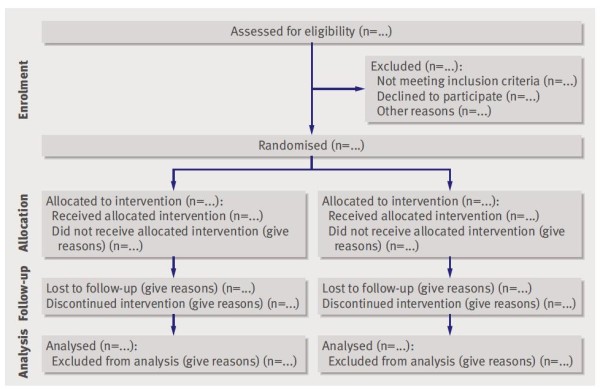
- CONSORT 2010 consists of this paper, a 25-item checklist (Table 1), and a flow diagram (Figure 1); the flow diagram was not modified except for one word.
- The update made evolutionary rather than revolutionary changes, kept existing item numbers except for some renumbering of items 2 to 5, and added new items or sub-items on topics including trial design, changes to methods or outcomes after trial commencement, blinding details, trial registration, protocol availability, and funding.
- The statement focuses on the most common design type—individually randomised, two-group, parallel trials—which the paper says accounts for over half of trials in the literature.
- The CONSORT database contains more than 700 studies, and more than 400 journals have explicitly supported the CONSORT statement.
Methods
- Design: consensus update of the 2001 CONSORT statement by the CONSORT Group, informed by methodological evidence and experience.
- Sample/process: 31 members met in Montebello, Canada, in January 2007; participants synthesised evidence on checklist items, the group deliberated each item, and the executive convened teleconferences and meetings, producing seven major iterations before feedback and finalisation.
- Main analysis: items deemed absolutely fundamental to reporting a randomised controlled trial were retained; the updated explanation and elaboration manuscript was drafted and iteratively revised by the group.
Limitations
- The paper states that CONSORT 2010 focuses predominantly on the two-group, parallel randomised controlled trial, and that other trial designs or situations require additional information and may need CONSORT extensions.
- The paper states that CONSORT 2010 does not include recommendations for designing, conducting, or analysing trials, and is not intended as an instrument to evaluate trial quality or to construct a “quality score.”
- The paper states a potential drawback: a reporting guideline might encourage some authors to report fictitiously what the guidance suggests rather than what was actually done; the text also makes evident that this is a guideline statement rather than a new empirical evaluation of CONSORT 2010’s effects.
Model-written summary. Check it against the paper before relying on it.
Integrity signals
Registry
Cites
Statistics
Figures
Verification
Claims the paper makes
3 Valid · 0 Not valid · 9 Not checked · 7 Own results and interpretations
Every source the paper cites for this claim was checked and supports it.
In the paper
“However, randomised trials can yield biased results if they lack methodological rigour [1].”
§ CONSORT 2010 Statement: updated guidelines for reporting parallel group randomised trials > Introduction
What the sources say
- Supportedcites [1] Jüni P Altman DG Egger M Systematic reviews in health care: assessing the quality of controlled clinical trials BMJ 2001 323 42 6 10.1136/bmj.323.7303.42 11440947 PMC1120670 source
The Conclusions section states there is ample evidence that many trials are methodologically weak and that deficiencies translate into biased findings, directly supporting the claim. The 'Empirical evidence of bias' section (and the introductory framing on internal validity being threatened by selection, performance, detection, and attrition bias) documents that inadequate concealment of allocation exaggerated treatment effects (combined ratio of odds ratios 0.70, 95% CI 0.62 to 0.80), i.e. biased results arising from lacking methodological rigour. (LLM, conf=0.90)
plainstates a possible cause- Asserted: passes — The authors put it forward as true.
- Checkable: passes — It can be checked against evidence.
- Load-bearing: passes — The paper’s conclusions depend on it.
- Based: passes — The paper gives a reason why it holds.
- Supported
The cited sources support only part of this claim — read each source’s verdict below.
In the paper
“While those statements improved the reporting quality for some randomised controlled trials, [9,10] many trial reports still remain inadequate [2].”
§ CONSORT 2010 Statement: updated guidelines for reporting parallel group randomised trials > Introduction
What the sources say
- Not checked yetcites [9] Plint AC Moher D Morrison A Schulz K Altman DG Hill C Gaboury Does the CONSORT checklist improve the quality of reports of randomised controlled trials? A systematic review Med J Aust 2006 185 263 7 16948622 source
- Partly supportedcites [10] Hopewell S Dutton S Yu L-M Chan A-W Altman DG The quality of reports of randomised trials in 2000 and 2006: a comparative study of articles indexed by PubMed BMJ 2010 340 c723 10.1136/bmj.c723 20332510 PMC2844941 sourceExperimental — accuracy not yet measured
Our copy supports the improvement half of the claim: the 'What this study adds' box (Discussion > Conclusions) states that 'Reporting of methodological details in publications of randomised trials has improved somewhat between 2000 and 2006,' and the Principal findings (Discussion) report 'clear evidence of improved reporting of several important aspects of trial methods.' The link to CONSORT is only inferential/hedged: the Introduction frames the aim as assessing 'whether the recommendations have led to improvements,' and the endorsement comparison (Results; Discussion > Comparison with other studies) shows significantly better reporting in CONSORT-endorsing journals, a finding the authors say 'should be viewed with a certain amount of caution' and attribute the explicit conclusion of adoption being 'associated with improved reporting' to another work (the systematic review at ref 23). So the causal phrasing 'improved the reporting quality' is stronger than this source states, and it concerns parallel-group trials indexed in PubMed published in 2000 and 2006. (LLM, conf=0.70)
plainstates a cause- Asserted: passes — The authors put it forward as true.
- Checkable: passes — It can be checked against evidence.
- Load-bearing: passes — The paper’s conclusions depend on it.
- Based: passes — The paper gives a reason why it holds.
The cited sources support only part of this claim — read each source’s verdict below.
In the paper
“Unfortunately, attempted assessments frequently fail because authors of many trial reports neglect to provide lucid and complete descriptions of that critical information [2-4].”
§ CONSORT 2010 Statement: updated guidelines for reporting parallel group randomised trials > Introduction
What the sources say
- Not checked yetcites [2] Chan AW Altman DG Epidemiology and reporting of randomised trials published in PubMed journals Lancet 2005 365 1159 62 10.1016/S0140-6736(05)71879-1 15794971 source
- Not checked yetcites [3] Glasziou P Meats E Heneghan C Shepperd S What is missing from descriptions of treatment in trials and reviews? BMJ 2008 336 1472 4 10.1136/bmj.39590.732037.47 18583680 PMC2440840 source
- Partly supportedcites [4] Dwan K Altman DG Arnaiz JA Bloom J Chan AW Cronin E Decullier E Easterbrook PJ Von Elm E Gamble C Ghersi D Ioannidis JP Simes J Williamson PR Systematic review of the empirical evidence of study publication bias and outcome reporting bias PLoS ONE 2008 3 e3081 10.1371/journal.pone.0003081 18769481 PMC2518111 sourceExperimental — accuracy not yet measured
The Results (Publication and trial findings; page unavailable) report that substantial proportions of trial outcomes were omitted or incompletely reported, supporting the claim about missing findings. The paper does not establish that attempted assessments frequently fail for this reason or that trial reports commonly lack clear descriptions of methodology. (LLM, conf=0.82)
plainstates a cause- Asserted: passes — The authors put it forward as true.
- Checkable: passes — It can be checked against evidence.
- Load-bearing: passes — The paper’s conclusions depend on it.
- Based: passes — The paper gives a reason why it holds.
In the paper
“While those statements improved the reporting quality for some randomised controlled trials, [9,10] many trial reports still remain inadequate [2].”
§ CONSORT 2010 Statement: updated guidelines for reporting parallel group randomised trials > Introduction
What the sources say
- Not checked yetcites [2] Chan AW Altman DG Epidemiology and reporting of randomised trials published in PubMed journals Lancet 2005 365 1159 62 10.1016/S0140-6736(05)71879-1 15794971 source
plain- Asserted: passes — The authors put it forward as true.
- Checkable: passes — It can be checked against evidence.
- Load-bearing: passes — The paper’s conclusions depend on it.
- Based: passes — The paper gives a reason why it holds.
In the paper
“That support seems warranted: when used by authors and journals, CONSORT seems to improve reporting [9].”
§ CONSORT 2010 Statement: updated guidelines for reporting parallel group randomised trials > Background to CONSORT
What the sources say
- Not checked yetcites [9] Plint AC Moher D Morrison A Schulz K Altman DG Hill C Gaboury Does the CONSORT checklist improve the quality of reports of randomised controlled trials? A systematic review Med J Aust 2006 185 263 7 16948622 source
hedgedstates a possible cause- Asserted: passes — The authors put it forward as true.
- Checkable: passes — It can be checked against evidence.
- Load-bearing: unclear — It is unclear whether the paper’s conclusions depend on it.
- Based: passes — The paper gives a reason why it holds.
7 more claims
Create a free account to see all 19 claims and to verify the 17 references still open.
- Probably not a substantial claim. 5
- It may state two separate claims as one. 3
Claims other papers make about this one
Each is checked against this paper’s own text: does it say what the citing paper says it does?
The source backs part of the claim, not all of it — or backs it for a different population, condition or comparison.
In the citing paper
“RCTs have specific governance characteristics (including prospective trial registration requirements), detailed protocols (including documentation of study medication), and checklists that have to be completed at submission to journals [9, 10].”
From Checklist to assess Trustworthiness in RAndomised Controlled Trials (TRACT checklist): concept proposal and pilot (2023) · cites this paper as [10]
Experimental — accuracy not yet measuredThe cited source says what the claim attributes to it.
In the citing paper
“The CONSORT checklist (Schulz et al., 2010) (Appendix A) and JARS guidelines (American Psychological Association, 2008) were applied in reporting the findings.”
From An online acceptance, commitment, and self-compassion based treatment to decrease psychological distress in people with type 2 diabetes: A feasibility randomised-controlled trial (2023) · cites this paper as Schulz et al., 2010
Citations
Cites
Preferred Reporting Items for Systematic Reviews and Meta-Analyses: the PRISMA statement
Moher, D., Liberati, A., Tetzlaff, J., Altman, D. G., & for the PRISMA Group (2009) · BMJ · doi:10.1136/bmj.b2535 · Cited by 83,823
Self-citationPreferred reporting items for systematic reviews and meta-analyses: the PRISMA Statement.
(2009) · PubMed Central · Cited by 44,859
Self-citationvon Elm, E., Altman, D. G., Egger, M., Pocock, S. J., Gøtzsche, P. C., Vandenbroucke, J. P., & Initiative, F. T. S. (2007) · PLoS Medicine · doi:10.1371/journal.pmed.0040296 · Cited by 23,020
Self-citationElm, E. V., Altman, D. G., Egger, M., Pocock, S. J., Gøtzsche, P. C., & Vandenbroucke, J. P. (2007) · BMJ · doi:10.1136/bmj.39335.541782.ad · Cited by 10,766
Self-citationMoher, D., Hopewell, S., Schulz, K. F., Montori, V., Gotzsche, P. C., Devereaux, P. J., Elbourne, D., Egger, M., & Altman, D. G. (2010) · BMJ · doi:10.1136/bmj.c869 · Cited by 8,883
Self-citationSchulz (1995) · doi:10.1001/jama.1995.03520290060030 · Cited by 5,634
Moher, D., Schulz, K. F., & Altman, D. G. (2001) · The Lancet · doi:10.1016/s0140-6736(00)04337-3 · Cited by 5,373
Self-citationMoher, D., Pham, B., Jones, A., Cook, D. J., Jadad, A. R., Moher, M., Tugwell, P., & Klassen, T. P. (1998) · The Lancet · doi:10.1016/s0140-6736(98)01085-x · Cited by 3,560
Self-citationConsort 2010 statement: extension to cluster randomised trials
Campbell, M. K., Piaggio, G., Elbourne, D. R., Altman, D. G., & for the CONSORT Group (2012) · BMJ · doi:10.1136/bmj.e5661 · Cited by 3,510
Self-citationAssessing the quality of controlled clinical trials
Jüni, P., Altman, D. G., & Egger, M. (2001) · BMJ · doi:10.1136/bmj.323.7303.42 · Cited by 3,309 · cited 1×
“However, randomised trials can yield biased results if they lack methodological rigour [1].”
Self-citation
Cited by
Measurement Schmeasurement: Questionable Measurement Practices and How to Avoid Them
Flake, J. K., & Fried, E. I. (2020) · Advances in Methods and Practices in Psychological Science · doi:10.1177/2515245920952393 · Cited by 969
Exercise for improving balance in older people
Howe, T. E., Rochester, L., Neil, F., Skelton, D. A., & Ballinger, C. (2011) · Cochrane Database of Systematic Reviews · doi:10.1002/14651858.cd004963.pub3 · Cited by 809
Response rates for CBT for anxiety disorders: need for standardized criteria
Loerinc, A. G., Meuret, A. E., Twohig, M. P., Rosenfield, D., Bluett, E. J., & Craske, M. G. (2015) · Clinical Psychology Review · doi:10.1016/j.cpr.2015.08.004 · Cited by 592
Chlorhexidine mouthrinse as an adjunctive treatment for gingival health
James, P., Worthington, H. V., Parnell, C., Harding, M., Lamont, T., Cheung, A., Whelton, H., & Riley, P. (2017) · Cochrane Database of Systematic Reviews · doi:10.1002/14651858.cd008676.pub2 · Cited by 571
Fransen, P. S., Beumer, D., Berkhemer, O. A., van den Berg, L. A., Lingsma, H., van der Lugt, A., van Zwam, W. H., van Oostenbrugge, R. J., Roos, Y. B., Majoie, C. B., et al. (2014) · Trials · doi:10.1186/1745-6215-15-343 · Cited by 551
Piet, J., Würtzen, H., & Zachariae, R. (2012) · Journal of Consulting and Clinical Psychology · doi:10.1037/a0028329 · Cited by 436
Weir, C. J., Butcher, I., Assi, V., Lewis, S. C., Murray, G. D., Langhorne, P., & Brady, M. C. (2018) · BMC Medical Research Methodology · doi:10.1186/s12874-018-0483-0 · Cited by 425
Aveyard, P., Begh, R., Parsons, A., & West, R. (2012) · Addiction · doi:10.1111/j.1360-0443.2011.03770.x · Cited by 390
Morgan, A. J., Reavley, N. J., Ross, A., Too, L. S., & Jorm, A. F. (2018) · Journal of Psychiatric Research · doi:10.1016/j.jpsychires.2018.05.017 · Cited by 372
Baud, O., Maury, L., Lebail, F., Ramful, D., El Moussawi, F., Nicaise, C., Zupan-Simunek, V., Coursol, A., Beuchée, A., Bolot, P., et al. (2016) · The Lancet · doi:10.1016/s0140-6736(16)00202-6 · Cited by 364
Haywood, K., Whitehead, L., Nadkarni, V. M., Achana, F., Beesems, S., Böttiger, B. W., Brooks, A., Castrén, M., Ong, M. E., Hazinski, M. F., et al. (2018) · Circulation · doi:10.1161/cir.0000000000000562 · Cited by 362
Searching for the backfire effect: Measurement and design considerations.
Swire-Thompson, B., DeGutis, J., & Lazer, D. (2020) · Journal of Applied Research in Memory and Cognition · doi:10.1016/j.jarmac.2020.06.006 · Cited by 360
Herold, F., Törpel, A., Schega, L., & Müller, N. G. (2019) · European Review of Aging and Physical Activity · doi:10.1186/s11556-019-0217-2 · Cited by 349
“, exercise and training variables) and pay attention to established guidelines such as the CONSORT statement [202] or the STROBE statement [203].”
Effects of Dual-Language Immersion Programs on Student Achievement: Evidence From Lottery Data
Steele, J. L., Slater, R. O., Zamarro, G., Miller, T., Li, J., Burkhauser, S., & Bacon, M. (2017) · American Educational Research Journal · doi:10.3102/0002831216634463 · Cited by 309
Saunders, B., Elliott-Sale, K., Artioli, G. G., Swinton, P. A., Dolan, E., Roschel, H., Sale, C., & Gualano, B. (2017) · British Journal of Sports Medicine · doi:10.1136/bjsports-2016-096396 · Cited by 302
Wells, M., Williams, B., Treweek, S., Coyle, J., & Taylor, J. (2012) · Trials · doi:10.1186/1745-6215-13-95 · Cited by 297
Murray, I. R., Geeslin, A. G., Goudie, E. B., Petrigliano, F. A., & LaPrade, R. F. (2017) · Journal of Bone and Joint Surgery · doi:10.2106/jbjs.16.00793 · Cited by 298
Randomized controlled trials – a matter of design
Siepmann, T., Spieth, P. M., Kubasch, A. S., Penzlin, A. I., Illigens, B. M.-W., & Barlinn, K. (2016) · Neuropsychiatric Disease and Treatment · doi:10.2147/ndt.s101938 · Cited by 292
The Impact of Water, Sanitation and Hygiene Interventions to Control Cholera: A Systematic Review
Taylor, D. L., Kahawita, T. M., Cairncross, S., & Ensink, J. H. J. (2015) · PLOS ONE · doi:10.1371/journal.pone.0135676 · Cited by 270
Monti, D. A., Mitchell, E., Bazzan, A. J., Littman, S., Zabrecky, G., Yeo, C. J., Pillai, M. V., Newberg, A. B., Deshmukh, S., & Levine, M. (2012) · PLoS ONE · doi:10.1371/journal.pone.0029794 · Cited by 274
Arnold, B. F., Null, C., Luby, S. P., Unicomb, L., Stewart, C. P., Dewey, K. G., Ahmed, T., Ashraf, S., Christensen, G., Clasen, T., et al. (2013) · BMJ Open · doi:10.1136/bmjopen-2013-003476 · Cited by 256
Corticosteroids as adjunctive therapy in the treatment of influenza
Rodrigo, C., Leonardi-Bee, J., Nguyen-Van-Tam, J., & Lim, W. S. (2016) · Cochrane Database of Systematic Reviews · doi:10.1002/14651858.cd010406.pub2 · Cited by 264
Topper, M., Emmelkamp, P. M. G., Watkins, E., & Ehring, T. (2017) · Behaviour Research and Therapy · doi:10.1016/j.brat.2016.12.015 · Cited by 254
Adams, V., Mathisen, B., Baines, S., Lazarus, C., & Callister, R. (2013) · Dysphagia · doi:10.1007/s00455-013-9451-3 · Cited by 254
Chowdhury, E. A., Richardson, J. D., Holman, G. D., Tsintzas, K., Thompson, D., & Betts, J. A. (2016) · The American Journal of Clinical Nutrition · doi:10.3945/ajcn.115.122044 · Cited by 255
Use of machine learning to analyse routinely collected intensive care unit data: a systematic review
Shillan, D., Sterne, J. A. C., Champneys, A., & Gibbison, B. (2019) · Critical Care · doi:10.1186/s13054-019-2564-9 · Cited by 251
Self-help cognitive-behavioral therapy for insomnia: A meta-analysis of randomized controlled trials
Ho, F. Y.-Y., Chung, K.-F., Yeung, W.-F., Ng, T. H., Kwan, K.-S., Yung, K.-P., & Cheng, S. K. (2015) · Sleep Medicine Reviews · doi:10.1016/j.smrv.2014.06.010 · Cited by 239
Moraschini, V., Fai, C. K., Alto, R. M., & dos Santos, G. O. (2015) · Journal of Dentistry · doi:10.1016/j.jdent.2015.06.005 · Cited by 230
Gegenfurtner, A., & Ebner, C. (2019) · Educational Research Review · doi:10.1016/j.edurev.2019.100293 · Cited by 227
Haywood, K., Whitehead, L., Nadkarni, V. M., Achana, F., Beesems, S., Böttiger, B. W., Brooks, A., Castrén, M., Ong, M. E. H., Hazinski, M. F., et al. (2018) · Resuscitation · doi:10.1016/j.resuscitation.2018.03.022 · Cited by 227
Clinical trials in progressive multiple sclerosis: lessons learned and future perspectives
Ontaneda, D., Fox, R. J., & Chataway, J. (2015) · The Lancet Neurology · doi:10.1016/s1474-4422(14)70264-9 · Cited by 220
Moreno, B., Bellido, D., Sajoux, I., Goday, A., Saavedra, D., Crujeiras, A. B., & Casanueva, F. F. (2014) · Endocrine · doi:10.1007/s12020-014-0192-3 · Cited by 222
Müller, A. M., Alley, S., Schoeppe, S., & Vandelanotte, C. (2016) · International Journal of Behavioral Nutrition and Physical Activity · doi:10.1186/s12966-016-0434-2 · Cited by 213
Betts, J. A., Richardson, J. D., Chowdhury, E. A., Holman, G. D., Tsintzas, K., & Thompson, D. (2014) · The American Journal of Clinical Nutrition · doi:10.3945/ajcn.114.083402 · Cited by 209
Surgical versus non-surgical interventions for treating patellar dislocation
Smith, T. O., Donell, S., Song, F., & Hing, C. B. (2015) · Cochrane Database of Systematic Reviews · doi:10.1002/14651858.cd008106.pub3 · Cited by 208
Adam, A., & Jensen, J. D. (2016) · BMC Public Health · doi:10.1186/s12889-016-3985-x · Cited by 199
Effectiveness of lifestyle health promotion interventions for nurses: a systematic review
Stanulewicz, N., Knox, E., Narayanasamy, M., Shivji, N., Khunti, K., & Blake, H. (2019) · International Journal of Environmental Research and Public Health · doi:10.3390/ijerph17010017 · Cited by 206
Growth factors for treating diabetic foot ulcers
Martí-Carvajal, A. J., Gluud, C., Nicola, S., Simancas-Racines, D., Reveiz, L., Oliva, P., & Cedeño-Taborda, J. (2015) · Cochrane Database of Systematic Reviews · doi:10.1002/14651858.cd008548.pub2 · Cited by 192
Wells, R., Outhred, T., Heathers, J. A. J., Quintana, D. S., & Kemp, A. H. (2012) · PLoS ONE · doi:10.1371/journal.pone.0046597 · Cited by 188
The quality of evidence in Chinese meta-analyses needs to be improved
Yao, L., Sun, R., Chen, Y.-L., Wang, Q., Wei, D., Wang, X., & Yang, K. (2016) · Journal of Clinical Epidemiology · doi:10.1016/j.jclinepi.2016.01.003 · Cited by 180
Ishaque, S., Karnon, J., Chen, G., Nair, R., & Salter, A. B. (2019) · Quality of Life Research · doi:10.1007/s11136-018-2016-z · Cited by 179
Guidelines for Developing Yoga Interventions for Randomized Trials
Sherman, K. J. (2012) · Evidence-Based Complementary and Alternative Medicine · doi:10.1155/2012/143271 · Cited by 171
Bayes, J., Schloss, J., & Sibbritt, D. (2022) · The American Journal of Clinical Nutrition · doi:10.1093/ajcn/nqac106 · Cited by 175
Second-generation antipsychotics for major depressive disorder and dysthymia
Komossa, K., Depping, A. M., Gaudchau, A., Kissling, W., & Leucht, S. (2010) · Cochrane Database of Systematic Reviews · doi:10.1002/14651858.cd008121.pub2 · Cited by 171
Johnson, S. D., Tilley, N., & Bowers, K. J. (2015) · Journal of Experimental Criminology · doi:10.1007/s11292-015-9238-7 · Cited by 166
Chandler, M. J., Parks, A. C., Marsiske, M., Rotblatt, L. J., & Smith, G. E. (2016) · Neuropsychology Review · doi:10.1007/s11065-016-9330-4 · Cited by 169
Benzodiazepines for schizophrenia
Dold, M., Li, C., Tardy, M., Khorsand, V., Gillies, D., & Leucht, S. (2012) · Cochrane Database of Systematic Reviews · doi:10.1002/14651858.cd006391.pub2 · Cited by 169
Cheema, B. S., Kilbreath, S. L., Fahey, P. P., Delaney, G. P., & Atlantis, E. (2014) · Breast Cancer Research and Treatment · doi:10.1007/s10549-014-3162-9 · Cited by 164
Shanbhag, S., Dahiya, M., & Croucher, R. (2012) · Journal of Clinical Periodontology · doi:10.1111/j.1600-051x.2012.01910.x · Cited by 157
Routinely collected data for randomized trials: promises, barriers, and implications
Mc Cord, K. A., Al-Shahi Salman, R., Treweek, S., Gardner, H., Strech, D., Whiteley, W., Ioannidis, J. P. A., & Hemkens, L. G. (2018) · Trials · doi:10.1186/s13063-017-2394-5 · Cited by 148
Oxygen Saturation Target Range for Extremely Preterm Infants: A Systematic Review and Meta-analysis
Manja, V., Lakshminrusimha, S., & Cook, D. J. (2015) · JAMA Pediatrics · doi:10.1001/jamapediatrics.2014.3307 · Cited by 160
Ong, C. W., Clyde, J. W., Bluett, E. J., Levin, M. E., & Twohig, M. P. (2016) · Journal of Anxiety Disorders · doi:10.1016/j.janxdis.2016.03.006 · Cited by 160
Androgens (dehydroepiandrosterone or testosterone) for women undergoing assisted reproduction
Nagels, H. E., Rishworth, J. R., Siristatidis, C. S., & Kroon, B. (2015) · Cochrane Database of Systematic Reviews · doi:10.1002/14651858.cd009749.pub2 · Cited by 156
TRIGEN INTERTAN Intramedullary Nail Versus Sliding Hip Screw
Matre, K., Vinje, T., Havelin, L. I., Gjertsen, J., Furnes, O. N., Espehaug, B., Kjellevold, S. H., & Fevang, J. M. (2013) · Journal of Bone and Joint Surgery · doi:10.2106/jbjs.k.01497 · Cited by 154
Miloff, A., Lindner, P., Dafgård, P., Deak, S., Garke, M., Hamilton, W., Heinsoo, J., Kristoffersson, G., Rafi, J., Sindemark, K., et al. (2019) · Behaviour Research and Therapy · doi:10.1016/j.brat.2019.04.004 · Cited by 155
Schwertner, A., Conceição dos Santos, C. C., Costa, G. D., Deitos, A., de Souza, A., de Souza, I. C. C., Torres, I. L. S., da Cunha Filho, J. S. L., & Caumo, W. (2013) · Pain · doi:10.1016/j.pain.2013.02.025 · Cited by 155
Motov, S. M., Rockoff, B., Cohen, V., Pushkar, I., Likourezos, A., McKay, C., Soleyman-Zomalan, E., Homel, P., Terentiev, V., & Fromm, C. (2015) · Annals of Emergency Medicine · doi:10.1016/j.annemergmed.2015.03.004 · Cited by 165
Gunst, J. D., Pahus, M. H., Rosás-Umbert, M., Lu, I., Benfield, T., Nielsen, H. I., Johansen, I. S., Mohey, R., Østergaard, L. J., Klastrup, V., et al. (2022) · Nature Medicine · doi:10.1038/s41591-022-02023-7 · Cited by 167
Sattler, K. M., Deane, F. P., Tapsell, L., & Kelly, P. J. (2018) · Health Psychology Open · doi:10.1177/2055102918759691 · Cited by 150
A checklist to assess Trustworthiness in RAndomised Controlled Trials (TRACT checklist)
Mol, B. W., Lai, S., Rahim, A., Bordewijk, E. M., Wang, R., Eekelen, R. V., Gurrin, L. C., Thornton, J. G., Wely, M. V., & Li, W. (2023) · doi:10.21203/rs.3.rs-2119486/v1 · Cited by 149
Recruitment, Retention, and Blinding in Clinical Trials
Page, S. J., & Persch, A. C. (2013) · American Journal of Occupational Therapy · doi:10.5014/ajot.2013.006197 · Cited by 148
Kang, Y., Rahrig, H., Eichel, K., Niles, H. F., Rocha, T., Lepp, N. E., Gold, J., & Britton, W. B. (2018) · Journal of School Psychology · doi:10.1016/j.jsp.2018.03.004 · Cited by 143
Comparing artificial intelligence and human coaching goal attainment efficacy
Terblanche, N. H. D., Molyn, J., de Haan, E., & Nilsson, V. O. (2022) · PLoS ONE · doi:10.1371/journal.pone.0270255 · Cited by 195
Laird, K. T., Tanner-Smith, E. E., Russell, A. C., Hollon, S. D., & Walker, L. S. (2017) · Clinical Psychology Review · doi:10.1016/j.cpr.2016.11.001 · Cited by 141
Statistical primer: sample size and power calculations—why, when and how?†
Hickey, G. L., Grant, S. W., Dunning, J., & Siepe, M. (2018) · European Journal of Cardio-Thoracic Surgery · doi:10.1093/ejcts/ezy169 · Cited by 136
Cheema, B. S., Chan, D., Fahey, P. P., & Atlantis, E. E. (2014) · Sports Medicine · doi:10.1007/s40279-014-0176-8 · Cited by 151
Mol, B. W., Lai, S., Rahim, A., Bordewijk, E. M., Wang, R., van Eekelen, R., Gurrin, L. C., Thornton, J. G., van Wely, M., & Li, W. (2023) · Research Integrity and Peer Review · doi:10.1186/s41073-023-00130-8 · Cited by 154
Ghimire, S., Kyung, E., Kang, W., & Kim, E. (2012) · Trials · doi:10.1186/1745-6215-13-77 · Cited by 140
Serum biomarkers for improved diagnostic of pancreatic cancer: a current overview
Bünger, S., Laubert, T., Roblick, U. J., & Habermann, J. K. (2010) · Journal of Cancer Research and Clinical Oncology · doi:10.1007/s00432-010-0965-x · Cited by 147
Subramaniam, P., Woods, B. T., & Whitaker, C. J. (2013) · Aging & Mental Health · doi:10.1080/13607863.2013.837144 · Cited by 166
Evidence-based recommendations for blinding in surgical trials
Probst, P., Zaschke, S., Heger, P., Harnoss, J. C., Hüttner, F. J., Mihaljevic, A. L., Knebel, P., & Diener, M. K. (2019) · Langenbeck's Archives of Surgery · doi:10.1007/s00423-019-01761-6 · Cited by 121
Effect of Active Lessons on Physical Activity, Academic, and Health Outcomes: A Systematic Review
Martin, R., & Murtagh, E. M. (2017) · Research Quarterly for Exercise and Sport · doi:10.1080/02701367.2017.1294244 · Cited by 130
Aitken, E., Jackson, A. J., Kearns, R. J., Steven, M., Kinsella, J., Clancy, M. J., & Macfarlane, A. (2016) · The Lancet · doi:10.1016/s0140-6736(16)30948-5 · Cited by 149
de Oliveira Silva, F., Ferreira, J. V., Plácido, J., Sant’Anna, P., Araújo, J., Marinho, V., Laks, J., & Camaz Deslandes, A. (2019) · Maturitas · doi:10.1016/j.maturitas.2019.04.217 · Cited by 132
van het Reve, E., & de Bruin, E. D. (2014) · BMC Geriatrics · doi:10.1186/1471-2318-14-134 · Cited by 111
Zhu, W., Liu, S., Cao, J., Wang, H., Liang, H., Jiang, K., Cui, Y., Chai, C. A., Şahinler, E. B., Aquino, A., et al. (2024) · EClinicalMedicine · doi:10.1016/j.eclinm.2024.102724 · Cited by 146
Cheong, K. B., Zhang, J.-P., Huang, Y., & Zhang, Z.-J. (2013) · PLoS ONE · doi:10.1371/journal.pone.0082474 · Cited by 131
Percutaneous cholecystostomy for high-risk surgical patients with acute calculous cholecystitis
Gurusamy, K. S., Rossi, M., & Davidson, B. R. (2013) · Cochrane Database of Systematic Reviews · doi:10.1002/14651858.cd007088.pub2 · Cited by 144
Franco, K. F. M., Lenoir, D., Franco, Y. R. D. S., dos Reis, F. J. J., Cabral, C. M. N., & Meeus, M. (2020) · European Journal of Pain · doi:10.1002/ejp.1666 · Cited by 148
Graziani, F., Gennai, S., Cei, S., Cairo, F., Baggiani, A., Miccoli, M., Gabriele, M., & Tonetti, M. S. (2011) · Journal Of Clinical Periodontology · doi:10.1111/j.1600-051x.2011.01815.x · Cited by 137
Vano, M., Derchi, G., Barone, A., Pinna, R., Usai, P., & Covani, U. (2018) · Clinical Oral Investigations · doi:10.1007/s00784-017-2113-3 · Cited by 121
I.31, a new combination of probiotics, improves irritable bowel syndrome-related quality of life
Lorenzo-Zúñiga, V. (2014) · World Journal of Gastroenterology · doi:10.3748/wjg.v20.i26.8709 · Cited by 121
Ghawadra, S. F., Lim Abdullah, K., Choo, W. Y., Danaee, M., & Phang, C. K. (2020) · Journal of Nursing Management · doi:10.1111/jonm.13049 · Cited by 116
Transcatheter Therapy for Hepatic Malignancy: Standardization of Terminology and Reporting Criteria
Gaba, R. C., Lewandowski, R. J., Hickey, R., Baerlocher, M. O., Cohen, E. I., Dariushnia, S. R., d’Othée, B. J., Padia, S. A., Salem, R., Wang, D. S., et al. (2016) · Journal of Vascular and Interventional Radiology · doi:10.1016/j.jvir.2015.12.752 · Cited by 128
Lörwald, A. C., Lahner, F.-M., Nouns, Z. M., Berendonk, C., Norcini, J., Greif, R., & Huwendiek, S. (2018) · PLOS ONE · doi:10.1371/journal.pone.0198009 · Cited by 117
Outcomes associated with virtual reality in psychological interventions: where are we now?
Turner, W. A., & Casey, L. M. (2014) · Clinical Psychology Review · doi:10.1016/j.cpr.2014.10.003 · Cited by 116
Losco, C. D., Grant, W. D., Armson, A. J., Meyer, A. J., & Walker, B. F. (2017) · Medical Teacher · doi:10.1080/0142159x.2016.1271944 · Cited by 116
Wang, R., Lin, S., Wang, Y., Qian, W., & Zhou, L. (2017) · PLoS ONE · doi:10.1371/journal.pone.0175985 · Cited by 111
Blinded by PRISMA: Are Systematic Reviewers Focusing on PRISMA and Ignoring Other Guidelines?
Fleming, P. S., Koletsi, D., & Pandis, N. (2014) · PLoS ONE · doi:10.1371/journal.pone.0096407 · Cited by 115
Lefebvre, C., Glanville, J., Wieland, L. S., Coles, B., & Weightman, A. L. (2013) · Systematic Reviews · doi:10.1186/2046-4053-2-78 · Cited by 112
Shirvani, A., Kalajian, T. A., Song, A., & Holick, M. F. (2019) · Scientific Reports · doi:10.1038/s41598-019-53864-1 · Cited by 122
Uhre, C. F., Uhre, V. F., Lønfeldt, N. N., Pretzmann, L., Vangkilde, S., Plessen, K. J., Gluud, C., Jakobsen, J. C., & Pagsberg, A. K. (2020) · Journal of the American Academy of Child & Adolescent Psychiatry · doi:10.1016/j.jaac.2019.08.480 · Cited by 103
Boelens, O. B., van Assen, T., Houterman, S., Scheltinga, M. R., & Roumen, R. M. (2013) · Annals of Surgery · doi:10.1097/sla.0b013e318285f930 · Cited by 115
Stuiver, M. M., ten Tusscher, M. R., Agasi-Idenburg, C. S., Lucas, C., Aaronson, N. K., & Bossuyt, P. M. (2015) · Cochrane Database of Systematic Reviews · doi:10.1002/14651858.cd009765.pub2 · Cited by 114
Sommers-Spijkerman, M. P. J., Trompetter, H. R., Schreurs, K. M. G., & Bohlmeijer, E. T. (2018) · Journal of Consulting and Clinical Psychology · doi:10.1037/ccp0000268 · Cited by 109
Low‐dose suramin in autism spectrum disorder: a small, phase I/II, randomized clinical trial
Naviaux, R. K., Curtis, B., Li, K., Naviaux, J. C., Bright, A. T., Reiner, G., Westerfield, M., Goh, S., Alaynick, W. A., Wang, L., et al. (2017) · Annals of Clinical and Translational Neurology · doi:10.1002/acn3.424 · Cited by 123
Mendoza‐Azpur, G., de la Fuente, A., Chavez, E., et al. (2019) · Clinical Implant Dentistry and Related Research · doi:10.1111/cid.12740 · Cited by 111
Salari, N., Fatahi, B., Bartina, Y., Kazeminia, M., Fatahian, R., Mohammadi, P., Shohaimi, S., & Mohammadi, M. (2021) · Journal of Translational Medicine · doi:10.1186/s12967-021-03185-7 · Cited by 107
Cognitive behaviour therapy for depression in primary care: systematic review and meta-analysis
Santoft, F., Axelsson, E., Öst, L.-G., Hedman-Lagerlöf, M., Fust, J., & Hedman-Lagerlöf, E. (2019) · Psychological Medicine · doi:10.1017/s0033291718004208 · Cited by 105
de Wijkerslooth, T. R., Stoop, E. M., Bossuyt, P. M., et al. (2012) · Gut · doi:10.1136/gutjnl-2011-301327 · Cited by 109
Metadata
- Authors
- the CONSORT Group, Schulz, K. F., Altman, D. G., & Moher, D.
- Affiliations
- Family Health International 360 (US)
- University of Ottawa (CA)
- Corresponding author
- Schulz, Kenneth F
- Venue
- Trials
- Published
- 2010-03-24
- Volume
- 11
- Issue
- 1
- Pages
- 32-32
- ISSN
- 1745-6215 (ISSN-L)
- PMC
- PMC2857832
- OpenAlex
- W2884313467
- Semantic Scholar
- 98910daf518f68f480fbbce09e96b8dcd6602bd3
- Cited by
- 1,871
- References
- 43
- Citations by year
- 2026: 51 · 2025: 107 · 2024: 158 · 2023: 172 · 2022: 242 · 2021: 224 · 2020: 130 · 2019: 99 · 2018: 97 · 2017: 98 · 2016: 84 · 2015: 115 · 2014: 79 · 2013: 69 · 2012: 65
- FWCI
- 69.77
- Type
- journal article
- Language
- en
- Open access
- gold
- doi.org
- Licence
- cc-by
- creativecommons.org/licenses/by/2.0 (tdm)
- Locations
- Trials (publishedVersion, cc-by)
- Europe PMC (PubMed Central) (publishedVersion, cc-by)
- PubMed Central (publishedVersion, cc-by)
- PubMed (publishedVersion)
- DOAJ (DOAJ: Directory of Open Access Journals) (submittedVersion, cc-by-sa)
- uO Research (University of Ottawa) (submittedVersion, public-domain)
- Funders
- University of Pennsylvania
- Johns Hopkins University
- University of Ottawa
- McMaster University
- Cancer Research UK
- National Institute for Health and Care Research
- University of Oxford
- Institut National de la Santé et de la Recherche Médicale
- Johns Hopkins Bloomberg School of Public Health
- Canadian Institutes of Health Research
- Medical Research Council
- Topics
- Social Sciences › Decision Sciences › Statistics, Probability and Uncertainty › Meta-analysis and systematic reviews
- Physical Sciences › Mathematics › Statistics and Probability › Statistical Methods in Clinical Trials
- Health Sciences › Medicine › Public Health, Environmental and Occupational Health › Clinical practice guidelines implementation
- Keywords
- CONSORT 2010, reporting guidelines, randomized controlled trials, trial reporting quality, reporting bias
- MeSH terms
- Publishing, Research Design, Randomized Controlled Trials as Topic
About these checks
Registry, retraction, Cites and statistics results are computed, not judged, with one exception: a printed reference that no index lists is read once by a model before it counts as a citation error. Claims are extracted by a model and kept only when their quote appears verbatim in the text; each cited source is then checked, with a model’s help, for whether it says what the claim relies on. Those verdicts can be wrong — read the claim’s quote and the cited source before relying on one.
The claim verdicts this report counts are experimental: their accuracy is not yet measured.
A language model drew the claims from the paper on 2026-10-05, under version 3 of the claim definition (model deepseek-v4.1-flash, prompt extract-v3).
A second model labelled each claim on 2026-10-05 (model jev-1.13-20260917, definition revision gold-guideline-v0.2).
Cited sources are checked with a language model’s help (qwen3.8-omni-flash and gpt-6-sol).
Statistics and arithmetic are recomputed, not judged.
Confidence bands are shown only for fields calibrated on our annotated test set. None is calibrated yet, so no band is shown.
What counts as a claim ›How we measure confidence ›How we check this ›
Are you an author, or do you see a problem with this page? Request a review
Data sources
Bibliographic data: Semantic Scholar, OpenAlex, Crossref.
Contains information from the Semantic Scholar Academic Graph Datasets, made available under the ODC Attribution License (ODC-BY 1.0).
Semantic Scholar’s data is described in: Kinney, R., et al. (2023). The Semantic Scholar Open Data Platform. arXiv:2301.10140.
