

Process evaluations for cluster-randomised trials of complex interventions: a proposed framework for design and reporting
Open accessThe DOI matches its Crossref record; 42 of the 42 references it cites were found in a registry or an index.
Abstract
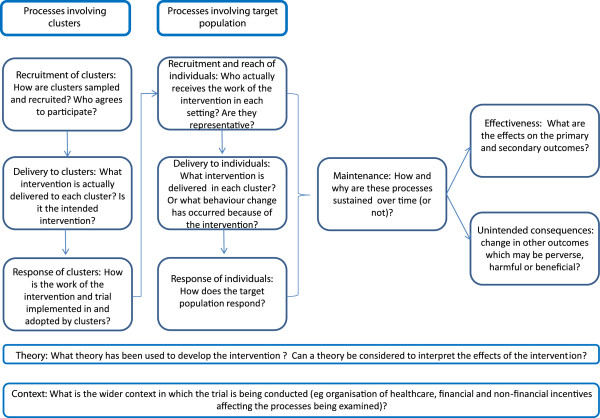
BACKGROUND: Process evaluations are recommended to open the 'black box' of complex interventions evaluated in trials, but there is limited guidance to help researchers design process evaluations. Much current literature on process evaluations of complex interventions focuses on qualitative methods, with less attention paid to quantitative methods. This discrepancy led us to develop our own framework for designing process evaluations of cluster-randomised controlled trials. METHODS: We reviewed recent theoretical and methodological literature and selected published process evaluations; these publications identified a need for structure to help design process evaluations. We drew upon this literature to develop a framework through iterative exchanges, and tested this against published evaluations. RESULTS: The developed framework presents a range of candidate approaches to understanding trial delivery, intervention implementation and the responses of targeted participants. We believe this framework will be useful to others designing process evaluations of complex intervention trials. We also propose key information that process evaluations could report to facilitate their identification and enhance their usefulness. CONCLUSION: There is no single best way to design and carry out a process evaluation. Researchers will be faced with choices about what questions to focus on and which methods to use. The most appropriate design depends on the purpose of the process evaluation; the framework aims to help researchers make explicit their choices of research questions and methods. TRIAL REGISTRATION: Clinicaltrials.gov NCT01425502.
Overview
The claims and statistics of this paper haven’t been checked yet.
Free: it reads the open-access text and checks the first 5 claims that cite a source we can check. Create a free account to check every claim.
Integrity signals
Registry
Cites
Statistics
Figures
Verification
Claims the paper makes
The claims and statistics of this paper haven’t been checked yet.
Free: it reads the open-access text and checks the first 5 claims that cite a source we can check. Create a free account to check every claim.
Claims other papers make about this one
Each is checked against this paper’s own text: does it say what the citing paper says it does?
The source backs part of the claim, not all of it — or backs it for a different population, condition or comparison.
In the citing paper
“Attempts to understand the dynamics of implementation and to evaluate their effects are either front-loaded into clinical trials in the form of programme theories that specify their expected mode of operation and outcomes or revealed in retrospective ‘process’ evaluations of activity over time and the effects of this activity on outcomes [1, 2].”
From Implementation, context and complexity (2016) · cites this paper as [2]
Experimental — accuracy not yet measuredThe cited source says what the claim attributes to it.
In the citing paper
“These evaluations are integral for providing explanations to trial outcomes and to understand future implementation challenges in different settings.49 54”
In the citing paper
“The non-RCT literature highlighted many of the same issues as the RCT reviews,9,20 particularly the need for better reporting of the content and make-up of interventions, as well as greater insight into any process evaluation.37”
From Challenges in designing, conducting, and reporting oral health behavioral intervention studies in primary school age children: methodological issues (2014) · cites this paper as [37]
Self-check
Percentages, sums and reported differences re-computed from the paper’s own numbers.
The self-check needs the paper’s full text.
Citations
Cites
Developing and evaluating complex interventions: the new Medical Research Council guidance
Craig, P., Dieppe, P., Macintyre, S., Michie, S., Nazareth, I., & Petticrew, M. (2008) · BMJ · doi:10.1136/bmj.a1655 · Cited by 10,995 · cited 2×
“terature on process evaluation and the RE-AIM framework [3,11,19,23,26,27,31], and on published process evaluations”
BackgroundMethodConsort 2010 statement: extension to cluster randomised trials
Campbell, M. K., Piaggio, G., Elbourne, D. R., Altman, D. G., & for the CONSORT Group (2012) · BMJ · doi:10.1136/bmj.e5661 · Cited by 3,510
CONSORT statement: extension to cluster randomised trials
Campbell, M. K., Elbourne, D. R., & Altman, D. G. (2004) · BMJ · doi:10.1136/bmj.328.7441.702 · Cited by 2,557 · cited 4×
“At a minimum, recruitment is likely to be monitored to fulfil CONSORT requirements for reporting findings of the main trial [28], but a more in-depth understanding of why clusters participate (or not) can inform the interpretation and implementation of trial findings.”
BackgroundMethodInfluentialImplementing, Embedding, and Integrating Practices: An Outline of Normalization Process Theory
May, C., & Finch, T. (2009) · Sociology · doi:10.1177/0038038509103208 · Cited by 2,115
Developing and Evaluating Complex Interventions: New Guidance
Craig, P., Dieppe, P. A., MacIntyre, S., Michie, S., Nazareth, I., & Petticrew, M. P. (2006) · UCL Discovery (University College London) · Cited by 1,989
Michie, S., Johnston, M., Francis, J., Hardeman, W., & Eccles, M. (2008) · Applied Psychology · doi:10.1111/j.1464-0597.2008.00341.x · Cited by 1,789 · cited 1×
“Similar to understanding the response of organisational or individual professionals to interventions directed at them, it may be helpful to draw on prior [37] or other relevant theory [38] to examine individual responses.”
BackgroundProcess evaluation in randomised controlled trials of complex interventions
Oakley, A., Strange, V., Bonell, C., Allen, E., & Stephenson, J. (2006) · BMJ · doi:10.1136/bmj.332.7538.413 · Cited by 1,247
Design and Analysis of Cluster Randomization Trials in Health Research
DONNER, A. P., & Klar, N. S. (2000) · Cited by 1,236
Process evaluation for public health interventions and research
Steckler, A., Linnan, L. A., & Israel, B. A. (2002) · Cited by 863
Lewin, S., Glenton, C., & Oxman, A. D. (2009) · BMJ · doi:10.1136/bmj.b3496 · Cited by 678 · cited 4×
“terature on process evaluation and the RE-AIM framework [3,11,19,23,26,27,31], and on published process evaluations”
BackgroundMethodInfluential
Cited by
Items 101–200 of 551
Grant, A. M., Guthrie, B., & Dreischulte, T. (2014) · BMJ Open · doi:10.1136/bmjopen-2013-004153 · Cited by 32
Self-citationRichter, C., Berg, A., Fleischer, S., Köpke, S., Balzer, K., Fick, E.-M., Sönnichsen, A. C., Löscher, S., Vollmar, H. C., Haastert, B., et al. (2015) · Implementation Science · doi:10.1186/s13012-015-0268-3 · Cited by 36
“[56].”
Sebire, S. J., Edwards, M. J., Campbell, R. M., Jago, R., Kipping, R., Banfield, K., Tomkinson, K., Garfield, K., Lyons, R. A., Simon, J., et al. (2016) · Pilot and Feasibility Studies · doi:10.1186/s40814-015-0045-8 · Cited by 35
“A detailed process evaluation will examine acceptability of the intervention and methods, intervention delivery and implementation, potential intervention mechanisms and the influence of school context [43] using qualitative and quantitative approaches amongst peer-supporters, non-peer-supporter pupils, peersupporter…”
Knight, L., Allen, E., Mirembe, A. F., Nakuti, J., Namy, S., Child, J. C., Sturgess, J., Kyegombe, N., Walakira, E., Elbourne, D. R., et al. (2018) · BMC Public Health · doi:10.1186/s12889-018-5462-1 · Cited by 53
“2013 process evaluation framework [17] we describe the overall implementation of the Toolkit in terms of four implementation components: Raising Voices delivery of the intervention to schools, school-led implementation of Toolkit activities, adoption of Toolkit elements in schools and the reach of the intervention to…”
MethodWilfling, D., Dichter, M., Trutschel, D., & Köpke, S. (2019) · Journal of Alzheimer s Disease · doi:10.3233/jad-180784 · Cited by 33
Roberts, S., Desbrow, B., & Chaboyer, W. P. (2015) · Scandinavian Journal of Caring Sciences · doi:10.1111/scs.12239 · Cited by 36
on behalf of the CRADLE Trial Collaborative Group, Vousden, N., Lawley, E., Seed, P. T., Gidiri, M. F., Charantimath, U., Makonyola, G., Brown, A., Yadeta, L., Best, R., et al. (2019) · Implementation Science · doi:10.1186/s13012-019-0885-3 · Cited by 31
Process evaluations of health-promotion interventions in sports settings: a systematic review
Lim, A. S. X., Schweickle, M. J., Liddelow, C., Liddle, S. K., & Vella, S. A. (2023) · Health Promotion International · doi:10.1093/heapro/daad114 · Cited by 34
“Chen (2020), Gray et al. , 2013, Lauwerier et al .”
Grant, R. W., Uratsu, C. S., Estacio, K. R., Altschuler, A., Kim, E. S., Fireman, B. H., Adams, A. S., Schmittdiel, J. A., & Heisler, M. (2016) · Contemporary Clinical Trials · doi:10.1016/j.cct.2016.01.012 · Cited by 31
“Process evaluations are recommended to better understand the “black box” of how complex clinical trial interventions are actually implemented [28].”
BackgroundAagaard, K., Meléndez‐Torres, G. J., & Overgaard, C. (2020) · Journal of Clinical Nursing · doi:10.1111/jocn.15373 · Cited by 30
Process evaluation of the Bristol girls dance project
Sebire, S. J., Edwards, M. J., Kesten, J. M., May, T., Banfield, K., Bird, E. L., Tomkinson, K., Blair, P. S., Powell, J. E., & Jago, R. (2016) · BMC Public Health · doi:10.1186/s12889-016-3010-4 · Cited by 33
“A detailed process evaluation of the underpinning mechanisms can offer insight as to why an intervention was (in) effective [20].”
BackgroundD’Mello-Guyett, L., Greenland, K., Bonneville, S., D’hondt, R., Mashako, M., Gorski, A., Verheyen, D., den Bergh, R. V., Maes, P., Checchi, F., et al. (2020) · Conflict and Health · doi:10.1186/s13031-020-00294-w · Cited by 33
“A process evaluation framework, including the domains, dimensions, research questions and data collection methods (Table 1), was developed using the process evaluation literature [47, 49, 52, 69], as well as relevant published applications in public health [70, 71] together with complex system theory [53].”
BackgroundMethodGrant, A. M., Dreischulte, T., & Guthrie, B. (2017) · Implementation Science · doi:10.1186/s13012-016-0531-2 · Cited by 37
“A coding frame was developed inductively from field notes and initial interviews and based on our topic guides, framework [18], and logic model [20].”
BackgroundMethodSelf-citationSalisbury, C., Man, M., Chaplin, K., Mann, C., Bower, P., Brookes, S. T., Duncan, P., Fitzpatrick, B., Gardner, C., Gaunt, D., et al. (2019) · Health Services and Delivery Research · doi:10.3310/hsdr07050 · Cited by 34
“nurse reviews but no GP review) 31/797 (4) Medication reviewed by pharmacist 607/797 (76) Number of time hospital physician was contacted 0/797 (0) Out of those who had at least one GP or nurse review Most important problem noted 616/622 (99) EQ-5D pain question noted 611/622 (98) PHQ-9 entered 599/622 (96) Patient ag…”
BackgroundSelf-citationHolle, D., Roes, M., Buscher, I., Reuther, S., Müller, R., & Halek, M. (2014) · Trials · doi:10.1186/1745-6215-15-485 · Cited by 31
Bakker, F. C., Persoon, A., Schoon, Y., & Rikkert, M. G. M. O. (2014) · Journal of Evaluation in Clinical Practice · doi:10.1111/jep.12252 · Cited by 28
de Velde, S. V., Roshanov, P. S., Kortteisto, T., Kunnamo, I., Aertgeerts, B., Vandvik, P. O., & Flottorp, S. A. (2015) · Implementation Science · doi:10.1186/s13012-016-0393-7 · Cited by 29
“Further, we will identify process evaluations or qualitative studies that followed trials on the effectiveness of CCDSS [40, 41].”
MethodZamboni, K., Singh, S., Tyagi, M., Hill, Z. E., Hanson, C., & Schellenberg, J. (2021) · Implementation Science · doi:10.1186/s13012-020-01058-z · Cited by 32
Berwig, M., Dichter, M., Albers, B., Wermke, K., Trutschel, D., Seismann-Petersen, S., & Halek, M. (2017) · BMC Health Services Research · doi:10.1186/s12913-017-2231-2 · Cited by 29
“Data for the process evaluation will be collected continuously throughout the study and as part of the telephone interviews at both measurement points (T0, T1) to investigate the process evaluation domains of reach, fidelity, dosage, and context [47, 48].”
BackgroundKlingshirn, H., Müller, M., Beutner, K., Hirt, J., Strobl, R., Grill, E., Meyer, G., & Saal, S. (2020) · BMC Geriatrics · doi:10.1186/s12877-020-01655-z · Cited by 29
“(2013) [25] Domain Research question Research methods and measures Delivery to clusters What intervention is actually delivered to each nursing home? Were the components of the implementation introduced as planned? Evaluation of the facilitators workshop using documentation forms Evaluation of the information session…”
BackgroundMethodInfluentialHeggdal, K., Mendelsohn, J., Stepanian, N., Oftedal, B. F., & Larsen, M. H. (2021) · Health Expectations · doi:10.1111/hex.13271 · Cited by 31
Berger-Höger, B., Liethmann, K., Mühlhauser, I., Haastert, B., & Steckelberg, A. (2015) · Trials · doi:10.1186/s13063-015-0991-8 · Cited by 26
“[87], we distinguish between clusters and individuals to address the specifics of a cluster-randomized trial.”
BackgroundGilissen, J., Pivodic, L., Dael, A. W.-V., Gastmans, C., Stichele, R. V., Engels, Y., Vernooij-Dassen, M. J. F. J., Deliëns, L., & den Block, L. V. (2020) · BMC Palliative Care · doi:10.1186/s12904-019-0505-7 · Cited by 30
“Firstly, while there are very few high-quality studies that evaluate the effects of ACP in nursing homes, and in particular very few cluster RCTs [3], we contribute to filling this gap by planning and designing this proposed study according to recent recommendations in the conduct of high-quality RCTs [35, 36].”
MethodSumnall, H. R., Agus, A. M., Cole, J. C., Doherty, P., Foxcroft, D., Harvey, S. A., McKay, M. T., Murphy, L., & Percy, A. (2017) · Public Health Research · doi:10.3310/phr05020 · Cited by 30
Kozica, S. L., Lombard, C. B., Ilić, D., Ng, S., Harrison, C. L., & Teede, H. J. (2015) · BMC Public Health · doi:10.1186/s12889-015-1995-8 · Cited by 32
Process Evaluation of Implementation Strategies
Hulscher, M., & Wensing, M. (2020) · Wiley eBooks · doi:10.1002/9781119488620.ch22 · Cited by 30
Robbins, L. B., Ling, J., Törüner, E. K., Bourne, K. A., & Pfeiffer, K. A. (2016) · BMC Public Health · doi:10.1186/s12889-016-3329-x · Cited by 26
“and critically examine the delivery of each component of any multi-component intervention [19].”
BackgroundScott, P., Rigby, M., Ammenwerth, E., McNair, J., Georgiou, A., Hyppönen, H., de Keizer, N. F., Magrabi, F., Nykänen, P., Gude, W. T., et al. (2017) · Yearbook of Medical Informatics · doi:10.1055/s-0037-1606530 · Cited by 27
Masterson‐Algar, P., Burton, C. R., & Rycroft‐Malone, J. (2018) · BMC Medical Research Methodology · doi:10.1186/s12874-018-0647-y · Cited by 25
“Each process evaluation will be different, but, the MRC guidance was created in order to facilitate its planning and conducting [13, 16].”
BackgroundMethodResultInfluentialGrischott, T., Rachamin, Y., Senn, O., Hug, P., Rosemann, T. J., & Neuner‐Jehle, S. (2022) · Journal of General Internal Medicine · doi:10.1007/s11606-022-07728-6 · Cited by 28
“Implementation outcomes were collected in parallel to the core study and evaluated according to an adapted framework(28) for process evaluation studies.(35)”
MethodMcCann, T. V., & Lubman, D. I. (2014) · BMC Psychiatry · doi:10.1186/1471-244x-14-168 · Cited by 27
“However, they are criticised frequently for being a ‘black box’ because they fail to explain why interventions work or fail [25].”
BackgroundLiu, H., Muhunthan, J., Hayek, A., Hackett, M. L., Laba, T., Peiris, D., & Jan, S. (2016) · Systematic Reviews · doi:10.1186/s13643-016-0314-5 · Cited by 27
Roberts, S., McInnes, E., Bucknall, T. K., Wallis, M. C., Banks, M., & Chaboyer, W. P. (2017) · Implementation Science · doi:10.1186/s13012-017-0547-2 · Cited by 28
Isselhard, A., Töpper, M., Berger‐Höger, B., Steckelberg, A., Fischer, H., Vitinius, F., Beifus, K., Köberlein–Neu, J., Wiedemann, R., Rhiem, K., et al. (2020) · Trials · doi:10.1186/s13063-020-04431-x · Cited by 25
“Although this study is no cluster-randomized trial, the formative evaluation follows Grant’s framework for designing process evaluations [57].”
MethodGude, W. T., Roos-Blom, M.-J., van der Veer, S. N., Dongelmans, D. A., de Jonge, E., Peek, N. B., & de Keizer, N. F. (2019) · Implementation Science · doi:10.1186/s13012-019-0937-8 · Cited by 26
Friberg, F., Wallengren, C., Håkanson, C., Carlsson, E. K., Smith, F., Pettersson, M. E., Sarenmalm, E. K., Sawatzky, R. G., & Öhlén, J. (2018) · BMC Health Services Research · doi:10.1186/s12913-018-3218-3 · Cited by 24
“Although it is important to study causal mechanisms [1, 21] contextual and pragmatic circumstances have to be considered [22, 25, 26].”
InfluentialHealy, P., Smith, V. A., Savage, G., Clarke, M. J., Devane, D., Groß, M. M., Morano, S., Daly, D., Grylka‐Baeschlin, S., Nicoletti, J., et al. (2018) · Trials · doi:10.1186/s13063-017-2401-x · Cited by 24
“, the response of clusters and individuals to the intervention [10])”
BackgroundInfluentialAng, W. H. D., Chew, H. S. J., Ong, Y. H. N., Zheng, Z. J., Shorey, S., & Lau, Y. (2022) · International Journal of Environmental Research and Public Health · doi:10.3390/ijerph191912899 · Cited by 24
“This leads to the second area that examines the mechanism of the intervention, which is important to allow further works to replicate a similar intervention [40].”
BackgroundSkudlik, S., Hirt, J., Döringer, T., Thalhammer, R., Lüftl, K., Prodinger, B., & Müller, M. (2023) · BMC Nursing · doi:10.1186/s12912-022-01139-y · Cited by 15
“…easily transferred to other health care health system due to the different contextual factors which have crucial influence on the implementation strategies and the success of the intervention [28, 29], such as education, staffing requirements, reimbursement, or interprofessional collaboration [30].”
Möhler, R., Calo, S., Guiteras, A. R., Renom, H., & Meyer, G. (2023) · Cochrane Database of Systematic Reviews · doi:10.1002/14651858.cd009812.pub3 · Cited by 25
Grant, A. M., Dreischulte, T., & Guthrie, B. (2017) · BMJ Open · doi:10.1136/bmjopen-2016-015281 · Cited by 26
Self-citationJong, S. T., Croxson, C. H. D., Foubister, C., Brown, H. E., Guell, C., Lawlor, E. R., Wells, E. K., Wilkinson, P. O., Wilson, E., van Sluijs, E. M. F., et al. (2020) · Children · doi:10.3390/children7110231 · Cited by 28
“Previous research on school-based physical activity interventions highlighted the need to critically examine the delivery of each component and the processes of any complex intervention [15].”
Choi, H., Jung, Y., & Kim, H. (2021) · Implementation Science · doi:10.1186/s13012-021-01113-3 · Cited by 27
Grant, A., Dreischulte, T., Treweek, S., & Guthrie, B. (2012) · Trials · doi:10.1186/1745-6215-13-154 · Cited by 22
Self-citationChan, E., Guo, C.-L., Lee, P.-Y., Liu, S.-D., & Mark, C. (2017) · International Journal of Disaster Risk Science · doi:10.1007/s13753-017-0121-1 · Cited by 20
Driediger, M. V., Vanderloo, L. M., Burke, S. M., Irwin, J. D., Gaston, A., Timmons, B. W., Johnson, A. M., & Tucker, P. (2018) · Health Education & Behavior · doi:10.1177/1090198118775489 · Cited by 22
Möhler, R., Bartoszek, G., & Meyer, G. (2013) · BMC Medical Research Methodology · doi:10.1186/1471-2288-13-125 · Cited by 21
“The integration of the local context and detailed information on the process evaluation has recently been described as frequently underreported [43,44].”
BackgroundThe Self-Determined Learning Model of Instruction: Promoting Implementation Fidelity
Shogren, K. A., Raley, S. K., Rifenbark, G. G., Lane, K. L., Bojanek, E. K., Karpur, A., & Quirk, C. (2021) · Inclusion · doi:10.1352/2326-6988-9.1.46 · Cited by 26
“delineate the “black box” that has up until this point characterized our understanding of whether interventions are delivered and received as intended (Grant et al., 2013).”
BackgroundCorder, K. L., Brown, H. E., Croxson, C. H. D., Jong, S. T., Sharp, S. J., Vignoles, A. F., Wilkinson, P. O., Wilson, E., & van Sluijs, E. M. F. (2021) · Public Health Research · doi:10.3310/phr09060 · Cited by 26
Quasdorf, T., Clack, L., Uribe, F. L., Holle, D., Berwig, M., Purwins, D., Schultes, M.-T., & Roes, M. (2021) · Systematic Reviews · doi:10.1186/s13643-021-01825-z · Cited by 24
Hahlweg, P., Lindig, A., Frerichs, W., Zill, J. M., Hanken, H., Müller, V., Peters, M.-C., & Scholl, I. (2023) · BMC Health Services Research · doi:10.1186/s12913-023-09778-w · Cited by 21
“A thorough process evaluation can help to recognize implementation problems and explain effects (or lack thereof) in the outcomes evaluation [27, 28].”
BackgroundChapman, S., Sullivan, C., Palm, C. A., Huynh, U. K., Diru, W., & Masira, J. (2016) · Journal of Environmental Management · doi:10.1016/j.jenvman.2016.08.014 · Cited by 25
On behalf of the WAVES study trial investigators, Griffin, T. L., Clarke, J. L., Lancashire, E. R., Pallan, M. J., & Adab, P. (2017) · BMC Public Health · doi:10.1186/s12889-017-4690-0 · Cited by 26
Jong, S. T., Brown, H. E., Croxson, C. H. D., Wilkinson, P. O., Corder, K. L., & van Sluijs, E. M. F. (2018) · Trials · doi:10.1186/s13063-018-2661-0 · Cited by 22
“Despite increasing emphasis on the importance of process evaluation of complex interventions, explicit reporting of process evaluations and publishing of process evaluation protocols is limited [2].”
BackgroundSawan, M. J., O’Donnell, L. K., Reeve, E., Gnjidic, D., Chen, T. F., Kelly, P. J., Bell, J. S., & Hilmer, S. N. (2020) · Research in Social and Administrative Pharmacy · doi:10.1016/j.sapharm.2020.06.010 · Cited by 21
Fenn, B., Sangrasi, G. M., Puett, C., Trenouth, L., & Pietzsch, S. (2015) · BMC Public Health · doi:10.1186/s12889-015-2380-3 · Cited by 23
Khan, K., Hollis, C. P., Hall, C. L., Davies, E. B., Mataix‐Cols, D., Andrén, P., Murphy, T. L., Brown, B. J., Murray, E., & Glazebrook, C. (2020) · Trials · doi:10.1186/s13063-019-3974-3 · Cited by 20
Lockwood, I., Walker, R., Latimer, S. L., Chaboyer, W. P., Cooke, M. L., & Gillespie, B. M. (2022) · Contemporary Clinical Trials Communications · doi:10.1016/j.conctc.2022.100894 · Cited by 20
“Framework(s): Grant’s framework [45], MRC’s guidance for process”
BackgroundMcCarthy, C., Pericin, I., Smith, S. M., Kiely, B. T., Moriarty, F., Wallace, E., & Clyne, B. (2022) · Health Expectations · doi:10.1111/hex.13630 · Cited by 20
“The methods for this mixed methods parallel process evaluation have been described in the published protocol,(13) and were developed based on a framework that was designed to guide the conduct of process evaluations for cluster RCTs.(14) Quantitative and qualitative data collection techniques were employed and data wa…”
MethodInfluentialHogg, H. D. J., Al-Zubaidy, M., Keane, P. A., Hughes, G., Beyer, F. R., & Maniatopoulos, G. (2023) · Frontiers in Health Services · doi:10.3389/frhs.2023.1161822 · Cited by 22
Jäger, C., Freund, T., Steinhäuser, J., Aakhus, E., Flottorp, S. A., Godycki-Ćwirko, M., van Lieshout, J., Krause, J., Szécsényi, J., & Wensing, M. (2014) · Trials · doi:10.1186/1745-6215-15-87 · Cited by 21
Saarijärvi, M., Wallin, L., & Bratt, E. (2020) · European Journal of Cardiovascular Nursing · doi:10.1177/1474515120906561 · Cited by 21
Borek, A., Smith, J. R., Greaves, C. J., Gillison, F., Tarrant, M., Morgan‐Trimmer, S., McCabe, R., & Abraham, C. (2019) · Efficacy and Mechanism Evaluation · doi:10.3310/eme06030 · Cited by 24
Kozica, S. L., Lombard, C. B., Harrison, C. L., & Teede, H. J. (2016) · Implementation Science · doi:10.1186/s13012-016-0521-4 · Cited by 26
Allan, S., McLeod, H. J., Bradstreet, S., Morton, E., Imogen, B., Wilson-Kay, A., Whitehill, H., Clark, A., Matrunola, C., Farhall, J., et al. (2021) · JMIR Human Factors · doi:10.2196/24055 · Cited by 21
“Reporting a more detailed examination of recruitment processes, particularly recruitment barriers [32], is suggested to be useful in interpreting trial results and developing strategies for improvement [33].”
BackgroundJeffries, M., Salema, N.-E., Laing, L., Shamsuddin, A., Sheikh, A., Avery, A. J., Chuter, A., Waring, J. J., & Keers, R. N. (2021) · PLoS ONE · doi:10.1371/journal.pone.0250946 · Cited by 21
Influential methods reports for group-randomized trials and related designs
Murray, D. M. (2022) · Clinical Trials · doi:10.1177/17407745211063423 · Cited by 19
“64 316 High RCR and citation count Grant et al.(81) 14.”
BackgroundMethodBlyth, A., Maskrey, V., Notley, C. J., Barton, G., Brown, T. J., Aveyard, P. N., Holland, R., Bachmann, M. O., Sutton, S. R., Leonardi‐Bee, J., et al. (2015) · Health Technology Assessment · doi:10.3310/hta19590 · Cited by 23
Scott, S. D., Rotter, T., Hartling, L., Chambers, T., & Bannar‐Martin, K. H. (2014) · Systematic Reviews · doi:10.1186/2046-4053-3-149 · Cited by 22
“, examines quantitative, qualitative, and mixed methods primary studies together) in health sciences [21].”
BackgroundMcDonall, J., de Steiger, R. N., Reynolds, J., Redley, B., Livingston, P. M., & Botti, M. A. (2016) · BMC Musculoskeletal Disorders · doi:10.1186/s12891-016-1133-5 · Cited by 19
Peden, C. J., Stephens, T., Martin, G. P., Kahan, B. C., Thomson, A., Everingham, K., Kocman, D., Lourtie, J., Drake, S., Girling, A. J., et al. (2019) · Health Services and Delivery Research · doi:10.3310/hsdr07320 · Cited by 23
Roy, R., & Ray, S. (2020) · Energy Sources Part A Recovery Utilization and Environmental Effects · doi:10.1080/15567036.2020.1817191 · Cited by 20
“Several approaches are available for systematic evaluation of factors and prediction of response (process outcome) (Grant et al. 2013).”
Baas, G., Crutzen, S., Smits, S., Denig, P., Taxis, K., & Heringa, M. (2023) · Basic & Clinical Pharmacology & Toxicology · doi:10.1111/bcpt.13931 · Cited by 19
“20 In addition, it includes aspects such as the maintenance, unintended consequences and context of the intervention.”
BackgroundProcess evaluation of complex interventions: a summary of Medical Research Council guidance
Moore, G. F., Audrey, S., Barker, M. E., Bond, L. M., Bonell, C. P., Hardeman, W., Moore, L., O’Cathain, A., Tinati, T., E.Wight, D., et al. (2015) · Enlighten: Publications (University of Glasgow) · doi:10.4324/9780203794982-38 · Cited by 24
Corbett, T., Walsh, J. C., Groarke, A., Moss-Morris, R., Morrissey, E., & McGuire, B. E. (2017) · JMIR Cancer · doi:10.2196/cancer.6987 · Cited by 18
“This theory could clarify the processes by which CBT can impact posttreatment CrF by outlining the mechanisms that are hypothesized to bring about change in symptoms [34-36].”
BackgroundZeng, D., Chien, W. T., & Yang, M. (2024) · Journal of Nursing Management · doi:10.1155/2024/7033013 · Cited by 24
“Future studies are recommended to adopt a process evaluation to thoroughly understand the intervention implementation, compliance of participants, and successful features of the programme [70].”
Kaboré, C., Ridde, V., Kouanda, S., Queuille, L., Somé, P., Agier, I., & Dumont, A. (2016) · BMC Pregnancy and Childbirth · doi:10.1186/s12884-016-1112-8 · Cited by 20
“To understand the reasons underlying the intervention’s effectiveness (or lack thereof ), the heterogeneity of its effects, and role of context, it is essential that effectiveness and implementation (including fidelity) be analyzed together [36, 37].”
Greenland, K., Chipungu, J., Chilekwa, J. C., Chilengi, R., & Curtis, V. (2017) · Globalization and Health · doi:10.1186/s12992-017-0302-0 · Cited by 21
“We added eight evaluation ‘domains’ to this ToC, in line with Linnan and Steckler [35] and others [9, 36, 37].”
MethodMueller, C. A., Hesjedal-Streller, B., Fleischmann, N., Tetzlaff, B., Mallon, T., Scherer, M., Köpke, S., Balzer, K., Gärtner, L., Maurer, I., et al. (2020) · Trials · doi:10.1186/s13063-020-04736-x · Cited by 18
“The trial includes a comprehensive mixed methods process evaluation based on existing frameworks for the evaluation of complex interventions [48, 49].”
MethodWillis, C., Elliott, C. M., Reid, S. L., Nyquist, A., Jahnsen, R. B., Bölte, S., Rosenberg, M., & Girdler, S. J. (2021) · Disability and Rehabilitation · doi:10.1080/09638288.2021.1907458 · Cited by 18
Sluggett, J. K., Hughes, G. A., Ooi, C. E., Chen, E. Y. H., Corlis, M. E., Hogan, M. E., Caporale, T., Emden, J. V., & Bell, J. S. (2021) · International Journal of Environmental Research and Public Health · doi:10.3390/ijerph18115778 · Cited by 18
“framework for process evaluations of cluster RCTs of health interventions [11].”
BackgroundMethodInfluentialMassazza, A., May, C. R., Roberts, B., Tol, W. A., Bogdanov, S., Nadkarni, A., & Fuhr, D. C. (2022) · Social Science & Medicine · doi:10.1016/j.socscimed.2022.114994 · Cited by 19
Bunn, C., Palmer, V. J., Chng, N. R., Andersen, E., Gray, C. M., Hunt, K., Jelsma, J. G. M., Morgan, H. M., der Sanden, M. W. G. N., Pereira, H. V., et al. (2023) · BMC Public Health · doi:10.1186/s12889-023-15419-y · Cited by 21
Hollis, C. P., Hall, C. L., Khan, K., Novere, M. L., Marston, L., Jones, R., Hunter, R. M., Brown, B. J., Sanderson, C., Andrén, P., et al. (2023) · Health Technology Assessment · doi:10.3310/cpms3211 · Cited by 17
Grischott, T., Zechmann, S., Rachamin, Y., Markun, S., Chmiel, C., Senn, O., Rosemann, T. J., Rodondi, N., & Neuner‐Jehle, S. (2018) · Implementation Science · doi:10.1186/s13012-018-0839-1 · Cited by 18
Sun, Y., Wang, A., Yu, S., Hagger, M. S., Chen, X., Fong, S. S. M., Zhang, C., Huang, Y., Baker, J. S., Dutheil, F., et al. (2020) · BMC Public Health · doi:10.1186/s12889-020-09128-z · Cited by 17
on behalf of the PVS group, Sánchez, Á., Grandes, G., Cortada, J. M., Pombo, H., Martinez, C., Corrales, M. H., de la Peña, E., Mugica, J., & Gorostiza, E. (2017) · BMC Family Practice · doi:10.1186/s12875-017-0585-5 · Cited by 22
“Process evaluations within trials explore the implementation, receipt and setting of an intervention, and help interpret the outcome results and ascertain the true implications of interventions in real practice [4, 5].”
BackgroundIngram, M., Denman, C. A., Cornejo-Vucovich, E. C., Castro-Vásquez, M. D. C., Aceves, B., Ocejo, A. G., de Zapien, J. G., & Rosales, C. (2019) · Frontiers in Public Health · doi:10.3389/fpubh.2019.00347 · Cited by 17
“As a complex research study, aspects of the implementation study served as process evaluation for the cluster RCT of the MSD intervention (9, 13, 43).”
BackgroundMethodBeames, J. R., Lingam, R., Boydell, K., Calear, A. L., Torok, M. H., Maston, K., Zbukvic, I., Huckvale, K., Batterham, P. J., Christensen, H. M., et al. (2021) · BMJ Open · doi:10.1136/bmjopen-2020-042133 · Cited by 18
Thomas, L. H., French, B., Sutton, C., Forshaw, D., Leathley, M. J., Burton, C. R., Roe, B. H., Cheater, F., Booth, J., McColl, E., et al. (2015) · Programme Grants for Applied Research · doi:10.3310/pgfar03010 · Cited by 23
“In this chapter, we report findings from the process evaluation structured according to Grant’s framework.(170)”
BackgroundMethodInfluentialFrench, C. M., Dowrick, A., Fudge, N., Pinnock, H., & Taylor, S. J. (2022) · BMC Medical Research Methodology · doi:10.1186/s12874-022-01767-7 · Cited by 17
Bugge, C., Hay‐Smith, J., Hagen, S., Grant, A. M., Taylor, A., & Dean, S. G. (2024) · BMC Women s Health · doi:10.1186/s12905-024-03308-4 · Cited by 16
Self-citationGibson, J. M. E., Thomas, L. H., Harrison, J., Watkins, C. L., & the ICONS Project Team and the ICONS Patient, P. A. C. I. G. (2018) · Journal of Clinical Nursing · doi:10.1111/jocn.14346 · Cited by 16
Yu, C. H. Y., Casey, C. G., Ke, C., Lebovic, G., & Straus, S. E. (2018) · Canadian Journal of Diabetes · doi:10.1016/j.jcjd.2018.08.189 · Cited by 16
Dichter, M., Berg, A., Hylla, J., Eggers, D., Wilfling, D., Möhler, R., Haastert, B., Meyer, G., Halek, M., & Köpke, S. (2021) · BMC Geriatrics · doi:10.1186/s12877-020-01997-8 · Cited by 16
“[30], which explicitly refers to clusterrandomized studies and, in addition to the various ele-”
BackgroundEvidence-based practices in pressure ulcer prevention: Lost in implementation?
Balzer, K., & Kottner, J. (2015) · International Journal of Nursing Studies · doi:10.1016/j.ijnurstu.2015.08.006 · Cited by 17
Low, L. L., Rahim, I. A., Hamzah, N. A. R., & Ismail, M. S. (2021) · PLoS ONE · doi:10.1371/journal.pone.0245125 · Cited by 17
Thienpondt, A., Cauwenberg, J. V., Damme, J. V., & Deforche, B. I. (2024) · BMC Public Health · doi:10.1186/s12889-024-17941-z · Cited by 15
“The first key element is “reach” ( based on ‘reach’ in RE-AIM [15], Saunders [14] and Grant [9], with the addition of Grant’s ‘recruitment’ element [9]), i.e. channels to reach participants, representativeness of participants, motivations and reasons for (not) participating.”
BackgroundMethodInfluentialMukanga, B., Dlamini, S., & Taylor, M. (2024) · BMC Health Services Research · doi:10.1186/s12913-024-11083-z · Cited by 21
Ochieng, C., Haghparast‐Bidgoli, H., Batura, N., Odhiambo, A., Shannon, G. D., Copas, A. J., Palmer, T., Dickin, S., Noel, S., Fielding, M., et al. (2019) · Trials · doi:10.1186/s13063-019-3224-8 · Cited by 17
Metadata
- Authors
- Grant, A., Treweek, S., Dreischulte, T., Foy, R., & Guthrie, B.
- Affiliations
- University of Dundee (GB)
- University of Leeds (GB)
- Corresponding author
- Grant, Aileen
- Venue
- Trials
- Published
- 2013
- Volume
- 14
- Issue
- 1
- Pages
- 15
- ISSN
- 1745-6215 (ISSN-L)
- PMC
- PMC3600672
- OpenAlex
- W2128920447
- Semantic Scholar
- 58b5af7929c0bfb71f7ecbda5b931fad772b7950
- Cited by
- 541
- References
- 42
- Citations by year
- 2026: 27 · 2025: 21 · 2024: 68 · 2023: 55 · 2022: 47 · 2021: 65 · 2020: 55 · 2019: 33 · 2018: 44 · 2017: 35 · 2016: 32 · 2015: 31 · 2014: 20 · 2013: 7
- FWCI
- 54.34
- Type
- journal article
- Language
- en
- Open access
- gold
- doi.org
- Licence
- cc-by
- Locations
- Trials (publishedVersion, cc-by)
- Europe PMC (PubMed Central) (publishedVersion, cc-by)
- PubMed Central (publishedVersion, cc-by)
- PubMed (publishedVersion)
- Edinburgh Research Explorer (University of Edinburgh) (publishedVersion, cc-by)
- White Rose Research Online (University of Leeds, The University of Sheffield, University of York) (acceptedVersion)
- Discovery Research Portal (University of Dundee) (submittedVersion)
- Stirling Online Research Repository (University of Stirling) (submittedVersion, cc-by)
- Open access LMU (Ludwid Maxmilian's Universitat Munchen) (submittedVersion)
- Open Access Institutional Repository at Robert Gordon University (Robert Gordon University) (submittedVersion, cc-by)
- Funders
- Scottish Government
- Chief Scientist Office, Scottish Government Health and Social Care Directorate
- Topics
- Health Sciences › Health Professions › General Health Professions › Health Policy Implementation Science
- Social Sciences › Public Administration › Evaluation and Performance Assessment
- Physical Sciences › Mathematics › Statistics and Probability › Advanced Causal Inference Techniques
- Keywords
- process evaluation, complex interventions, intervention implementation, participant responses, reporting guidelines, research design
- MeSH terms
- Humans, Outcome and Process Assessment, Health Care, Research Design, Treatment Outcome, Practice Guidelines as Topic, Evidence-Based Medicine, Information Dissemination, Qualitative Research
About these checks
Registry, retraction, Cites and statistics results are computed, not judged, with one exception: a printed reference that no index lists is read once by a model before it counts as a citation error. Claims are extracted by a model and kept only when their quote appears verbatim in the text; each cited source is then checked, with a model’s help, for whether it says what the claim relies on. Those verdicts can be wrong — read the claim’s quote and the cited source before relying on one.
Statistics and arithmetic are recomputed, not judged.
Confidence bands are shown only for fields calibrated on our annotated test set. None is calibrated yet, so no band is shown.
What counts as a claim ›How we measure confidence ›How we check this ›
Are you an author, or do you see a problem with this page? Request a review
Data sources
Bibliographic data: Semantic Scholar, OpenAlex, Crossref.
Contains information from the Semantic Scholar Academic Graph Datasets, made available under the ODC Attribution License (ODC-BY 1.0).
Semantic Scholar’s data is described in: Kinney, R., et al. (2023). The Semantic Scholar Open Data Platform. arXiv:2301.10140.
