

Process evaluations for cluster-randomised trials of complex interventions: a proposed framework for design and reporting
Open accessThe DOI matches its Crossref record; 42 of the 42 references it cites were found in a registry or an index.
Abstract
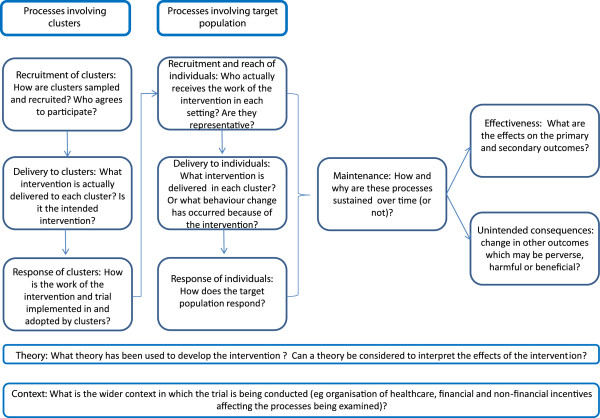
BACKGROUND: Process evaluations are recommended to open the 'black box' of complex interventions evaluated in trials, but there is limited guidance to help researchers design process evaluations. Much current literature on process evaluations of complex interventions focuses on qualitative methods, with less attention paid to quantitative methods. This discrepancy led us to develop our own framework for designing process evaluations of cluster-randomised controlled trials. METHODS: We reviewed recent theoretical and methodological literature and selected published process evaluations; these publications identified a need for structure to help design process evaluations. We drew upon this literature to develop a framework through iterative exchanges, and tested this against published evaluations. RESULTS: The developed framework presents a range of candidate approaches to understanding trial delivery, intervention implementation and the responses of targeted participants. We believe this framework will be useful to others designing process evaluations of complex intervention trials. We also propose key information that process evaluations could report to facilitate their identification and enhance their usefulness. CONCLUSION: There is no single best way to design and carry out a process evaluation. Researchers will be faced with choices about what questions to focus on and which methods to use. The most appropriate design depends on the purpose of the process evaluation; the framework aims to help researchers make explicit their choices of research questions and methods. TRIAL REGISTRATION: Clinicaltrials.gov NCT01425502.
Overview
The claims and statistics of this paper haven’t been checked yet.
Free: it reads the open-access text and checks the first 5 claims that cite a source we can check. Create a free account to check every claim.
Integrity signals
Registry
Cites
Statistics
Figures
Verification
Claims the paper makes
The claims and statistics of this paper haven’t been checked yet.
Free: it reads the open-access text and checks the first 5 claims that cite a source we can check. Create a free account to check every claim.
Claims other papers make about this one
Each is checked against this paper’s own text: does it say what the citing paper says it does?
The source backs part of the claim, not all of it — or backs it for a different population, condition or comparison.
In the citing paper
“Attempts to understand the dynamics of implementation and to evaluate their effects are either front-loaded into clinical trials in the form of programme theories that specify their expected mode of operation and outcomes or revealed in retrospective ‘process’ evaluations of activity over time and the effects of this activity on outcomes [1, 2].”
From Implementation, context and complexity (2016) · cites this paper as [2]
Experimental — accuracy not yet measuredThe cited source says what the claim attributes to it.
In the citing paper
“These evaluations are integral for providing explanations to trial outcomes and to understand future implementation challenges in different settings.49 54”
In the citing paper
“The non-RCT literature highlighted many of the same issues as the RCT reviews,9,20 particularly the need for better reporting of the content and make-up of interventions, as well as greater insight into any process evaluation.37”
From Challenges in designing, conducting, and reporting oral health behavioral intervention studies in primary school age children: methodological issues (2014) · cites this paper as [37]
Self-check
Percentages, sums and reported differences re-computed from the paper’s own numbers.
The self-check needs the paper’s full text.
Citations
Cites
Developing and evaluating complex interventions: the new Medical Research Council guidance
Craig, P., Dieppe, P., Macintyre, S., Michie, S., Nazareth, I., & Petticrew, M. (2008) · BMJ · doi:10.1136/bmj.a1655 · Cited by 10,995 · cited 2×
“terature on process evaluation and the RE-AIM framework [3,11,19,23,26,27,31], and on published process evaluations”
BackgroundMethodConsort 2010 statement: extension to cluster randomised trials
Campbell, M. K., Piaggio, G., Elbourne, D. R., Altman, D. G., & for the CONSORT Group (2012) · BMJ · doi:10.1136/bmj.e5661 · Cited by 3,510
CONSORT statement: extension to cluster randomised trials
Campbell, M. K., Elbourne, D. R., & Altman, D. G. (2004) · BMJ · doi:10.1136/bmj.328.7441.702 · Cited by 2,557 · cited 4×
“At a minimum, recruitment is likely to be monitored to fulfil CONSORT requirements for reporting findings of the main trial [28], but a more in-depth understanding of why clusters participate (or not) can inform the interpretation and implementation of trial findings.”
BackgroundMethodInfluentialImplementing, Embedding, and Integrating Practices: An Outline of Normalization Process Theory
May, C., & Finch, T. (2009) · Sociology · doi:10.1177/0038038509103208 · Cited by 2,115
Developing and Evaluating Complex Interventions: New Guidance
Craig, P., Dieppe, P. A., MacIntyre, S., Michie, S., Nazareth, I., & Petticrew, M. P. (2006) · UCL Discovery (University College London) · Cited by 1,989
Michie, S., Johnston, M., Francis, J., Hardeman, W., & Eccles, M. (2008) · Applied Psychology · doi:10.1111/j.1464-0597.2008.00341.x · Cited by 1,789 · cited 1×
“Similar to understanding the response of organisational or individual professionals to interventions directed at them, it may be helpful to draw on prior [37] or other relevant theory [38] to examine individual responses.”
BackgroundProcess evaluation in randomised controlled trials of complex interventions
Oakley, A., Strange, V., Bonell, C., Allen, E., & Stephenson, J. (2006) · BMJ · doi:10.1136/bmj.332.7538.413 · Cited by 1,247
Design and Analysis of Cluster Randomization Trials in Health Research
DONNER, A. P., & Klar, N. S. (2000) · Cited by 1,236
Process evaluation for public health interventions and research
Steckler, A., Linnan, L. A., & Israel, B. A. (2002) · Cited by 863
Lewin, S., Glenton, C., & Oxman, A. D. (2009) · BMJ · doi:10.1136/bmj.b3496 · Cited by 678 · cited 4×
“terature on process evaluation and the RE-AIM framework [3,11,19,23,26,27,31], and on published process evaluations”
BackgroundMethodInfluential
Cited by
Items 201–300 of 551
da Mota, A. C. C., Gonçalves, M. L. L., Horliana, A. C. R. T., Deana, A. M., Cavalcante, L. A. D. S., Gomes, A. O., Mayer, M. P. A., Ando‐Suguimoto, E. S., Fernandes, K. P. S., Mesquita‐Ferrari, R. A., et al. (2021) · Lasers in Medical Science · doi:10.1007/s10103-021-03325-x · Cited by 15
(2022) · doi:10.1186/s40814-022-01018-y · Cited by 15
Protocol for a mixed methods process evaluation of the Promoting Resilience in Nurses (PRiN) trial
Bui, M. V., McInnes, E., Ennis, G., & Foster, K. (2022) · International Journal of Mental Health Nursing · doi:10.1111/inm.12989 · Cited by 16
“To address the objectives for each evaluation component in this study, a combination of surveys and interviews will be used to gather data (Grant et al .”
BackgroundMethodInfluentialManchaiah, V. K. C., Danermark, B., Rönnberg, J., & Lunner, T. (2014) · International Journal of Otolaryngology · doi:10.1155/2014/168684 · Cited by 16
“In addition, in recent years few researchers have highlighted the need for process evaluation in relation to evaluating health interventions [13, 14].”
BackgroundSánchez, Á., Silvestre, C., Campo, N., & Grandes, G. (2016) · Trials · doi:10.1186/s13063-016-1379-0 · Cited by 17
“The development, implementation and evaluation of complex health interventions require careful consideration of not only outcomes obtained but also of the processes involved [13, 14].”
BackgroundMorrow, A., Tucker, K., Shaw, T. J., Parkinson, B., Abraham, C., Wolfenden, L., & Taylor, N. J. (2020) · BMJ Open · doi:10.1136/bmjopen-2019-033552 · Cited by 18
Greenwell, K., Sereda, M., Coulson, N., & Hoare, D. J. (2016) · JMIR Research Protocols · doi:10.2196/resprot.5008 · Cited by 15
“That is, what are the mechanisms through which Internet interventions work (ie, how they work) and the factors that are essential for their success (ie, what makes them work)? Qualitative methods can be particularly helpful for exploring relatively unknown mechanisms of impact and allow unintended and/or unanticipated…”
Zhuo, C., Wei, X., Zhang, Z., Hicks, J. P., Zheng, J., Chen, Z., Haldane, V. E., Walley, J. D., Guan, Y., Xu, H., et al. (2020) · Trials · doi:10.1186/s13063-020-04303-4 · Cited by 15
Alghafri, T. S., Harthi, S. A., Ajmi, F. A., Al-Farsi, Y. M., Craigie, A. M., Bannerman, E., & Anderson, A. S. (2020) · BMC Public Health · doi:10.1186/s12889-020-09029-1 · Cited by 15
Qian, J., Sun, S., Liu, L., & Yu, X. (2021) · BMJ Open · doi:10.1136/bmjopen-2021-051136 · Cited by 14
Husain, N., Lovell, K., Chew-Graham, C. A., Lunat, F., McPhillips, R., Atif, N., Aseem, S., Begum, J., Bee, P., Bhui, K. S., et al. (2021) · BJPsych Open · doi:10.1192/bjo.2021.1032 · Cited by 15
“42 Exploring the mechanisms through which interventions bring about change is crucial to understanding how the effects of the specific intervention occurred, and how these effects can inform the development of similar future interventions.”
Holle, D., Müller-Widmer, R., Reuther, S., Rosier, U., Graf, R., Roes, M., & Halek, M. (2019) · Trials · doi:10.1186/s13063-018-3147-9 · Cited by 14
“[18] for designing process evaluations of cluster-randomised trials was used in the FallDem trial [15].”
MethodHale, L., Devan, H., Davies, C., Dean, S. G., Dowell, A., Grainger, R., Gray, A. R., Hempel, D., Ingham, T., Jones, B., et al. (2021) · BMJ Open · doi:10.1136/bmjopen-2020-046376 · Cited by 13
Atzmon, O., Crowther, M. E., Bei, B., & O’Connor, D. A. (2025) · Implementation Science · doi:10.1186/s13012-025-01435-6 · Cited by 14
“…a theoretical approach informed the interpretation of the implementation components of the trial, with Frost et al. [54] using Social Practice Theory, Petersen et al. [55] using RE-AIM, and Teupen et al. [69] using Grant et al.’s [84] framework for process evaluations of cluster randomised trials.”
InfluentialAbraham, J., Bake, M., Berger‐Höger, B., Köpke, S., Kupfer, R., Meyer, G., & Mohler, R. A. (2020) · Journal of Advanced Nursing · doi:10.1111/jan.14694 · Cited by 13
Darley, S., Knowles, S. E., Woodward‐Nutt, K., Mitchell, C., Grande, G., Ewing, G., Rhodes, S., Bowen, A., & Patchwood, E. (2021) · BMJ Open · doi:10.1136/bmjopen-2020-038129 · Cited by 13
Skoss, R., White, J., Stanley, M. J., Robinson, M., Thompson, S., Armstrong, E., & Katzenellenbogen, J. M. (2021) · BMJ Open · doi:10.1136/bmjopen-2020-046042 · Cited by 13
Evans, K., Moya, H., Lambert, M., & Spiby, H. (2022) · BMC Pregnancy and Childbirth · doi:10.1186/s12884-022-04996-2 · Cited by 13
Weber, F., Müller, C., Bahns, C., Kopkow, C., Färber, F., Gellert, P. R., Otte, I., Vollmar, H. C., Brannath, W., Diederich, F., et al. (2023) · BMC Musculoskeletal Disorders · doi:10.1186/s12891-023-06255-7 · Cited by 13
on behalf of the LoTS2Care Programme Management Group, Förster, A., Hartley, S., Barnard, L., Ozer, S., Hardicre, N., Crocker, T. F., Fletcher, M., Moreau, L. A., Atkinson, R., et al. (2018) · Trials · doi:10.1186/s13063-018-2669-5 · Cited by 15
“A parallel process evaluation will be undertaken based on the MRC guidance for conducting process evaluations of complex interventions [8, 35] and Grant’s framework for process evaluations of cluster-randomised trials [36].”
MethodOn behalf of the ARRISA-UK Group, Smith, J. R., Musgrave, S. D., Payerne, E., Noble, M., Sims, E. J., Clark, A., Barton, G., Pinnock, H., Sheikh, A., et al. (2018) · Trials · doi:10.1186/s13063-018-2816-z · Cited by 15
van Rensburg, A. J., Kathree, T., Breuer, E., Selohilwe, O., Mntambo, N., Petrus, R., Bhana, A., Lund, C., Fairall, L. R., & Petersen, I. (2021) · Global Health Action · doi:10.1080/16549716.2021.1940761 · Cited by 14
“Opening the ‘black box’ of trials in order to better unpack underlying causal processes has become a central aim of complex intervention programmes [14].”
BackgroundLeinert, C., Brefka, S., Braisch, U., Denninger, N.-E., Müller, M., Benzinger, P., Bauer, J., Bahrmann, A., Frey, N., Katus, H. A., et al. (2021) · BMC Geriatrics · doi:10.1186/s12877-021-02585-0 · Cited by 14
“To investigate the integration, embedding and implementation of the intervention components in routine practice, the Normalization Process Theory (NPT) is used as theoretical approach [58, 59].”
MethodSaal, S., Klingshirn, H., Beutner, K., Strobl, R., Grill, E., Müller, M., & Meyer, G. (2019) · Trials · doi:10.1186/s13063-019-3522-1 · Cited by 14
“Since understanding the motivation of the nursing homes in taking part in the studies is helpful when interpreting the findings or developing tailored recruitment procedures [31], reasons for study participation (or nonparticipation) were evaluated by asking the head nurse.”
BackgroundAresi, G., Giampaolo, M., Chiavegatti, B., & Marta, E. (2023) · Journal of Prevention · doi:10.1007/s10935-023-00741-3 · Cited by 12
“Second, given this study was the first to examine this novel program, we were not able to assess important aspects of the implementation including fidelity, dose and reach (Grant et al., 2013 ).”
BackgroundSeral-Cortés, M., Miguel‐Etayo, P. D., Zapata, P., Miguel‐Berges, M. L., & Moreno, L. A. (2021) · BMC Public Health · doi:10.1186/s12889-021-10297-8 · Cited by 14
Évaluation des effets d'une intervention complexe
Saillour-Glénisson, F., & Salmi, L. (2022) · Revue d Épidémiologie et de Santé Publique · doi:10.1016/j.respe.2022.06.002 · Cited by 16
Simiyu, S. N., Aseyo, E., Anderson, J., Cumming, O., Baker, K. K., Dreibelbis, R., & Mumma, J. A. O. (2022) · Maternal and Child Health Journal · doi:10.1007/s10995-022-03548-6 · Cited by 14
“Our process evaluation builds on published methods and guidance (Linnan & Steckler, 2002; World Health Organization, 2000; Moore et al., 2015; Grant et al., 2013) and directly assessed three broad categories and eight specific intervention components.”
MethodDowns, S., Gueye, D., Sall, M., Ndoye, B., Sarr, N. N., Sarr, M., Mboup, S., Alam, N. A., Diouf, A., Merchant, E. V., et al. (2023) · Frontiers in Public Health · doi:10.3389/fpubh.2023.1258963 · Cited by 12
Kelleher, D., Windle, K., Randell, R., Lord, K., Duffy, L., Akhtar, A., Budgett, J., Zabihi, S., Banks, S., Rapaport, P., et al. (2024) · Age and Ageing · doi:10.1093/ageing/afae109 · Cited by 13
Klafke, N., Mahler, C., von Hagens, C., Wensing, M., Schneeweiß, A., Müller, A., Szécsényi, J., & Joos, S. (2017) · Oncology nursing forum · doi:10.1188/17.onf.e223-e231 · Cited by 12
“Accompanying research is particularly important in multicenter trials in which the intervention may have been implemented in different ways (Grant, Dreischulte, Treweek, & Guthrie, 2012; Grant et al., 2013).”
Grant, A. M., Dean, S. G., Hay‐Smith, J., Hagen, S., McClurg, D., Taylor, A., Kovandzic, M., & Bugge, C. (2019) · BMJ Open · doi:10.1136/bmjopen-2018-024152 · Cited by 16
Self-citationPiotrowski, A., Meyer, M., Burkholder, I., Renaud, D., Müller, M. A., Lehr, T., Laag, S., Meiser, J., Manderscheid, L., & Köberlein–Neu, J. (2020) · Trials · doi:10.1186/s13063-020-04325-y · Cited by 12
“Process evaluation outcomes will be collected according to a framework for clusterrandomized trials of complex interventions [39].”
MethodVickery, N. J., Stephens, T., du Toit, L., van Straaten, D., Pearse, R., Torborg, A., Rolt, L., Puchert, M., Martin, G. P., Biccard, B. M., et al. (2021) · British Journal of Anaesthesia · doi:10.1016/j.bja.2021.07.001 · Cited by 12
Brünn, R., Lemke, D., Basten, J., Kellermann-Mühlhoff, P., Köberlein–Neu, J., Muth, C., van den Akker, M., & on behalf of the AdAM Study Group (2022) · Pharmaceuticals · doi:10.3390/ph15060759 · Cited by 11
“However, few trials follow this advice [19,20].”
Parahoo, K., McKenna, S., Prue, G., McSorley, O., & McCaughan, E. (2017) · Journal of Advanced Nursing · doi:10.1111/jan.13248 · Cited by 11
Bell, J. S., Caze, A. L., Steeper, M., Haines, T. P., Hilmer, S. N., Troeung, L., Quirke, L., Wesson, J., Pond, C. D., Buys, L. R., et al. (2024) · Implementation Science · doi:10.1186/s13012-024-01353-z · Cited by 12
Clarkesmith, D., Pattison, H. M., Xuereb, C. B., & Lane, D. A. (2016) · Healthcare · doi:10.3390/healthcare4010010 · Cited by 15
“These types of interventions are widely used within public health and clinical practice yet their design and evaluation have been criticised as using a “black box” approach, whereby we are unable to determine how and why interventions work due to incomplete reporting and documentation of process [2].”
BackgroundFoley, L. S., Mhurchú, C. N., Marsh, S., Epstein, L. H., Olds, T., Dewes, O., Heke, I., Jiang, Y., & Maddison, R. (2016) · BMC Public Health · doi:10.1186/s12889-016-3124-8 · Cited by 11
Roberts, J. L., Pritchard, A. W., Williams, M. D., Totton, N., Morrison, V. L., Din, N., & Williams, N. H. (2018) · BMJ Open · doi:10.1136/bmjopen-2018-021486 · Cited by 12
Harris, L., Hankey, C. R., Jones, N., Murray, H. M., Pert, C., Tobin, J., Boyle, S., Shearer, R., & Melville, C. A. (2018) · Journal of Intellectual Disability Research · doi:10.1111/jir.12563 · Cited by 11
“Process evaluations are recognised as a key methodology to understand why an intervention had the observed effect (Linnan and Steckler 2002; Grant et al. 2013; Moore et al. 2015).”
BackgroundLi, T., Chen, X., Wang, J., Chen, L., & Cai, W. (2021) · JMIR Research Protocols · doi:10.2196/22771 · Cited by 12
Förster, A., Ozer, S., Crocker, T. F., House, A. O., Hewison, J., Roberts, E., Dickerson, J., Carter, G., Hulme, C. T., Fay, M., et al. (2021) · Programme Grants for Applied Research · doi:10.3310/pgfar09030 · Cited by 11
Self-citationWhidden, C., Cissé, A., Cole, F., Doumbia, S., Guindo, A., Karambé, Y., Treleaven, E., Liu, J. X., Tolo, O., Guindo, L., et al. (2024) · Health Policy and Planning · doi:10.1093/heapol/czae066 · Cited by 10
“Guided by the process evaluation framework of the UK’s Medical Research Council (Moore et al ., 2015) and an adaptation for cluster trials (Grant et al ., 2013), the ProCCM process evaluation thus examined implementation, mechanisms and context in both arms of the ProCCM trial.”
MethodJelsma, J. G. M., Simmons, D. S., Gobat, N., Rollnick, S., Blumska, K., Jans, G., Galjaard, S., Desoyé, G., Corcoy, R., Juarez, F., et al. (2017) · BMC Pregnancy and Childbirth · doi:10.1186/s12884-017-1471-9 · Cited by 10
“Methods There are several approaches for conducting complex process evaluation, with no single best way to design a process evaluation [22].”
van Uum, R. T., Venekamp, R. P., Sjoukes, A., van de Pol, A. C., de Wit, G. A., Schilder, A. G., & Damoiseaux, R. A. M. J. (2018) · Trials · doi:10.1186/s13063-018-2880-4 · Cited by 10
Rowe, A., Titterington, J., & Taggart, L. (2019) · Pilot and Feasibility Studies · doi:10.1186/s40814-019-0468-8 · Cited by 11
Dehl, T., Sauerbrey, U., Dreier, A., Nikelski, A., Chikhradze, N., Keller, A., Laufer, J., Schumacher‐Schönert, F., Kreisel, S. H., Thyrian, J. R., et al. (2021) · Trials · doi:10.1186/s13063-021-05021-1 · Cited by 10
Rachamin, Y., Grischott, T., & Neuner‐Jehle, S. (2021) · BMJ Open · doi:10.1136/bmjopen-2021-049872 · Cited by 10
Gavigan, N., Belton, S., Meegan, S., & Issartel, J. (2021) · Physical Education and Sport Pedagogy · doi:10.1080/17408989.2021.1967305 · Cited by 11
“This qualitative evaluation provides policy makers and practitioners with vital information about how the intervention was delivered, issues arising or how it might be replicated (Moore et al. 2015; Grant et al. 2013).”
BackgroundJepson, R. G., Baker, G., Sivaramakrishnan, D., Manner, J., Parker, R. A., Lloyd, S., & Stoddart, A. (2022) · Public Health Research · doi:10.3310/iexp0277 · Cited by 11
Mäkelä, P., Godfrey, M., Cradduck-Bamford, A., Ellis, G., & Shepperd, S. (2018) · Trials · doi:10.1186/s13063-018-2929-4 · Cited by 10
Beckerman-Hsu, J. P., Aftosmes‐Tobio, A., Gavarkovs, A. G., Kitos, N. R., Figueroa, R., Kalyoncu, Z., Lansburg, K., Yu, X., Kazik, C., Vigilante, A., et al. (2020) · Trials · doi:10.1186/s13063-020-04571-0 · Cited by 10
“[10] and expanding on a brief description of CHL’s process evaluation in the main trial protocol [11], this protocol paper provides comprehensive information on CHL’s implementation, adaptation, and context.”
BackgroundMethodHödl, M., Halfens, R. J. G., & Lohrmann, C. (2019) · Archives of Gerontology and Geriatrics · doi:10.1016/j.archger.2019.01.003 · Cited by 10
van Uum, R. T., Sjoukes, A., Venekamp, R. P., Schilder, A. G., GROOT, E. D., Damoiseaux, R. A. M. J., & Anthierens, S. (2018) · BJGP Open · doi:10.3399/bjgpopen18x101620 · Cited by 9
“Such research may also provide important information about the use of the multifaceted intervention in daily practice, and facilitators and barriers of its use; and insight into whether or not trial outcomes can be reproduced in another context.(11,12,13) This study aims to explore GPs’ views on and expectations regar…”
BackgroundSzymczak, J. E., Petty, L. A., Gandhi, T. N., Neetz, R. A., Hersh, A. L., Presson, A. P., Lindenauer, P. K., Bernstein, S. J., Muller, B. M., White, A. T., et al. (2024) · Implementation Science · doi:10.1186/s13012-024-01348-w · Cited by 9
“To identify contextual factors influencing the implementation of the ROAD Home strategy, and to understand how tailoring works to promote or impede the uptake of evidence, we will conduct a concurrent mixed methods process evaluation [70].”
MethodSackley, C. M., Rick, C., Brady, M., Burton, C. R., Jowett, S. M., Patel, S., Woolley, R. L., Masterson‐Algar, P., Nicoll, A., Smith, C. H., et al. (2024) · Health Technology Assessment · doi:10.3310/adwp8001 · Cited by 10
Masterson‐Algar, P., Burton, C. R., Brady, M., Nicoll, A., Clarke, C. E., Rick, C., Hughes, M., Au, P., Smith, C. H., & Sackley, C. M. (2017) · Trials · doi:10.1186/s13063-017-2130-1 · Cited by 10
“There is no single way to design and carry out a process evaluation [17, 33]; this is particularly true when dealing with complex interventions such as the ones investigated in the PD COMM trial.”
BackgroundGreenwell, K., Sereda, M., Coulson, N., & Hoare, D. J. (2019) · American Journal of Audiology · doi:10.1044/2019_aja-18-0171 · Cited by 10
Holle, D., Teupen, S., Graf, R., Müller-Widmer, R., Reuther, S., Halek, M., & Roes, M. (2020) · BMC Nursing · doi:10.1186/s12912-020-0403-6 · Cited by 9
“The response of the cluster describes how the intervention was adopted by the participating nursing homes (cluster) and whether it was adapted during its implementation in the specific health care context [21].”
BackgroundMacniven, R., Coombes, J., Wilson, R., Simon, A., Mackean, T., Hunter, K., Ma, T., Gwynn, J., Sherrington, C., Tiedemann, A., et al. (2021) · Injury Prevention · doi:10.1136/injuryprev-2020-043980 · Cited by 9
Seckler, E., Regauer, V., Krüger, M., Gabriel, A., Hermsdörfer, J., Niemietz, C., Bauer, P., & Müller, M. (2021) · BMC Family Practice · doi:10.1186/s12875-021-01410-2 · Cited by 9
on behalf of the PREDIAPS Group, Sánchez, Á., Rogers, H. L., Pablo, S., García, E. P., Rodríguez, I., Flores, M. A., Galarza, O., Gaztañaga, A. B., Martínez, P. A., et al. (2021) · BMC Family Practice · doi:10.1186/s12875-021-01378-z · Cited by 9
Chang, Y., Yao, Y., Cui, Z., Yang, G., Li, D., Wang, L., & Tang, L. (2022) · PLoS ONE · doi:10.1371/journal.pone.0259065 · Cited by 12
Irani, L., Verma, S., Mathur, R., Verma, R. K., Mohan, D., Dhar, D., Seth, A., Chaudhuri, I., Chaudhury, M. R., Purthy, A., et al. (2022) · BMJ Open · doi:10.1136/bmjopen-2021-052336 · Cited by 9
Berdal, G., Sand‐Svartrud, A., Linge, A. D., Aasvold, A. M., Tennebø, K., Eppeland, S. G., Hagland, A. S., Ohldieck-Fredheim, G., Valaas, H. L., Bø, I., et al. (2023) · Clinical Rehabilitation · doi:10.1177/02692155231153341 · Cited by 9
“699(2) Paid work, n (%) 86 (42) 73 (45) 0.”
Coteur, K., Nuland, M. V., Schoenmakers, B., Anthierens, S., & den Broeck, K. V. (2023) · JMIR Formative Research · doi:10.2196/43738 · Cited by 10
Lorencatto, F., Stanworth, S. J., & Gould, N. J. (2014) · Transfusion · doi:10.1111/trf.12793 · Cited by 12
Zou, G., Zhang, W., King, R., Zhang, Z., Walley, J. D., Gong, W., Yu, M., & Wei, X. (2020) · International Journal of Environmental Research and Public Health · doi:10.3390/ijerph17114156 · Cited by 9
Pisinger, V. S. C., Hoffmann, S. H., Pålsson, L., Dalum, P., Grønbæk, M., Tolstrup, J. S., Thygesen, L. C., & Krølner, R. F. (2020) · Frontiers in Public Health · doi:10.3389/fpubh.2020.00435 · Cited by 10
Powell, C., Breen, L., Fylan, B., Ismail, H., Alderson, S. L., Gale, C. P., Gardner, P. H., Farrin, A. J., & Alldred, D. P. (2020) · BMJ Open · doi:10.1136/bmjopen-2020-040493 · Cited by 9
Post hoc evaluation of a common-sense intervention for asthma management in community pharmacy
Watkins, K., Seubert, L., Schneider, C. R., & Clifford, R. M. (2016) · BMJ Open · doi:10.1136/bmjopen-2016-012897 · Cited by 10
on behalf of the LoTS2Care Programme Management Group, Hardicre, N., Crocker, T. F., Wright, A., Burton, L.-J., Ozer, S., Atkinson, R. A., House, A. O., Hewison, J., McKevitt, C., et al. (2018) · Trials · doi:10.1186/s13063-018-2683-7 · Cited by 11
Cooper, A. M., Coffey, M., & Dugdill, L. (2014) · Pragmatic and Observational Research · doi:10.2147/por.s52287 · Cited by 8
“Trial evaluation should include process as well as impact and outcome data.(37) This allows the exploration of how and why an intervention might be working and which elements of the intervention may be the “active” components (ie, those that are responsible for the outcomes under investigation).”
Martens, M., Wouters, E., van Olmen, J., Klemenc–Ketiš, Z., Chhim, S., Chham, S., Buffel, V., Danhieux, K., Stojnić, N., Zavrnik, Č., et al. (2022) · BMJ Open · doi:10.1136/bmjopen-2022-062151 · Cited by 8
Stuijt, P. J. C., Heringa, M., van Dijk, L., Faber, A., Burgers, J. S., Feenstra, T., Taxis, K., & Denig, P. (2024) · BMC Family Practice · doi:10.1186/s12875-024-02465-7 · Cited by 8
“The topic list for the semi-structured interview will be based on the framework from Grant et al. [57], and on earlier work from Baas et al. [27].”
MethodThe Partnering with Patients Model of Nursing Interventions: A First Step to a Practice Theory
Moyle, W., Rickard, C. M., Chambers, S. K., & Chaboyer, W. P. (2015) · Healthcare · doi:10.3390/healthcare3020252 · Cited by 8
“referred to as realist evaluations [29], help to better understand how, for whom and under what conditions our interventions work [28,29].”
BackgroundWilliams, N. H., Dodd, S. R., Hardwick, B., Clayton, D., Edwards, R. T., Charles, J. M., Logan, P., Busse, M. E., Lewis, R. A., Smith, T. O., et al. (2020) · BMJ Open · doi:10.1136/bmjopen-2020-039791 · Cited by 8
Hammond, A., Radford, K., Ching, A., Prior, Y., O’Brien, R., Woodbridge, S., Culley, J., Parker, J. L., & Holland, P. (2022) · Trials · doi:10.1186/s13063-022-06871-z · Cited by 8
“Process evaluations can also help research teams in interpreting how study contexts and mechanisms contribute to outcomes, as well as exploring issues for post-trial implementation, if successful [42, 43].”
Backgroundvon der Lühe, V., Roos, M., Löbberding, M., Scholten, N., Müller, W., Hellmich, M., Simić, D., Köpke, S., & Dichter, M. (2023) · BMC Geriatrics · doi:10.1186/s12877-023-04560-3 · Cited by 8
“Theoretical foundations are the MRC guidance for process evaluations of complex interventions [69] and Grant’s framework on process evaluation for cluster-randomised trials [70].”
MethodKomolafe, A. O., Olajubu, A. O., Ijarotimi, O. A., Ogunlade, O. B., Olowokere, A. E., & Irinoye, O. O. (2024) · SAGE Open Nursing · doi:10.1177/23779608231226064 · Cited by 9
“Moreover, measuring adherence allows the researchers to know whether a lack of success with ef fi cacious interventions results from failure to effectively implement interventions as planned or intervention inadequacies (Grant et al., 2013; Muntinga et al., 2015).”
BackgroundKyne, K., McCarthy, C., Kiely, B. T., Smith, S. M., Clyne, B., & SPPiRE Study team (2019) · HRB Open Research · doi:10.12688/hrbopenres.12920.2 · Cited by 11
Urinary incontinence in stroke survivors – Development of a programme theory
Köhler, M., Mayer, H., Kesselring, J., & Saxer, S. (2020) · Journal of Clinical Nursing · doi:10.1111/jocn.15345 · Cited by 8
Haskell, L., Tavender, E. J., O’Brien, S., Wilson, C. L., Babl, F. E., Borland, M. L., Schembri, R., Orsini, F., Cotterell, E., Sheridan, N., et al. (2021) · BMC Health Services Research · doi:10.1186/s12913-021-07279-2 · Cited by 10
“This has been guided by a framework for process evaluation of cRCTs [23], the United Kingdom Medical Research Council (MRC) recommendations for complex interventions [20], and a systematic review of process evaluations in knowledge translation research [22].”
MethodMeysman, J., Morreel, S., Lefevere, E., Verhoeven, V., Graeve, D. D., Monsieurs, K. G., & Philips, H. (2022) · International Emergency Nursing · doi:10.1016/j.ienj.2022.101191 · Cited by 11
Müller, M., Bartoszek, G., Beutner, K., Klingshirn, H., Saal, S., Stephan, A., Strobl, R., Grill, E., & Meyer, G. (2015) · German medical science · doi:10.3205/000217 · Cited by 8
“[47] and will address recruitment, reach and fidelity of the intervention, satisfaction of users, staff and organizations.”
BackgroundBuhse, S., Mühlhauser, I., Kuniß, N., Müller, U. A., Lehmann, T., Liethmann, K., & Lenz, M. (2015) · BMC Family Practice · doi:10.1186/s12875-015-0257-2 · Cited by 11
“[64], the underlying processes involving clusters and patients will be monitored to explore barriers and promoting factors of the implementation of the intervention programme.”
BackgroundIssen, L., Woodcock, T., McNicholas, C., Lennox, L., & Reed, J. E. (2018) · International Journal for Quality in Health Care · doi:10.1093/intqhc/mzy063 · Cited by 9
Gensby, U., Braathen, T. N., Jensen, C., & Eftedal, M. (2018) · International Journal of Disability Management · doi:10.1017/idm.2018.2 · Cited by 9
Albers, W. M. M., Roeg, D. P. K., Nijssen, Y. A. M., Bongers, I. M. B., & van Weeghel, J. (2018) · BMC Psychiatry · doi:10.1186/s12888-018-1831-7 · Cited by 10
on behalf of the EPOCH trial group, Stephens, T., Peden, C. J., Pearse, R. M., Shaw, S. E., Abbott, T. E. F., Jones, E. L., Kocman, D., & Martin, G. P. (2018) · Implementation Science · doi:10.1186/s13012-018-0840-8 · Cited by 8
Bracci, E. L., Collyer, S., Oster, C., Lynch, E., Olasunkanmi‐Alimi, T., Bulto, L. N., & Harvey, G. (2025) · Implementation Science · doi:10.1186/s13012-025-01468-x · Cited by 8
“[111] and the Theory of Planned Behaviour ( n = 6, 8”
Kshatri, J. S., Shenkin, S. D., Mercer, S. W., Weller, D., Palo, S. K., Pati, S., Janssen, D. J. A., & Pati, S. (2023) · Wellcome Open Research · doi:10.12688/wellcomeopenres.19796.1 · Cited by 8
Fernández, I. L., Mayorga-Vega, D., Guijarro-Romero, S., & Viciana, J. (2024) · Retos · doi:10.47197/retos.v55.106263 · Cited by 7
Candelaria, D., Redfern, J., O'Neil, A. E., Brieger, D. B., Clark, R. A., Briffa, T. G., Bauman, A. E., Hyun, K. K., Cunich, M. M., Figtree, G. A., et al. (2024) · BMC Cardiovascular Disorders · doi:10.1186/s12872-024-03971-3 · Cited by 8
“…process evaluations for cluster-randomised trials of complex interventions framework by Grant (2013), and unpack processes involving clusters (recruitment, delivery, responses) and individuals including CR staff and patients, as well as maintenance, effectiveness, and unintended consequences [42].”
BackgroundGuijarro-Romero, S., Mayorga-Vega, D., Casado-Robles, C., & Viciana, J. (2024) · The Journal of Educational Research · doi:10.1080/00220671.2024.2431679 · Cited by 7
Healey, E. L., Jinks, C., Tan, V., Chew-Graham, C. A., Lawton, S., Nicholls, E. E., Finney, A. G., Porcheret, M., Cooper, V., Lewis, M., et al. (2015) · Journal of Comorbidity · doi:10.15256/joc.2015.5.60 · Cited by 10
Carbonneau, É., Dumas, A., Brodeur-Doucet, A., & Fontaine‐Bisson, B. (2022) · Nutrients · doi:10.3390/nu14061151 · Cited by 7
Hodgins, M., Zurynski, Y. A., Burley, J., Pelly, R. M., Hibbert, P. D., Woolfenden, S. R., Le, J., Germano, S., Khano, S., Morris, T. M., et al. (2022) · BMJ Open · doi:10.1136/bmjopen-2022-063450 · Cited by 7
Fasugba, O., Dale, S., McInnes, E., Cadilhac, D. A.-M., Noetel, M., Coughlan, K., McElduff, B., Kim, J., Langley, T., Cheung, N. W., et al. (2023) · Implementation Science · doi:10.1186/s13012-023-01260-9 · Cited by 7
“Frameworks for the design and reporting of the process evaluation of complex interventions developed by the United Kingdom Medical Research Council [68] and cluster randomised controlled trials [69] will inform the design, conduct and reporting of the process evaluation.”
Method
Metadata
- Authors
- Grant, A., Treweek, S., Dreischulte, T., Foy, R., & Guthrie, B.
- Affiliations
- University of Dundee (GB)
- University of Leeds (GB)
- Corresponding author
- Grant, Aileen
- Venue
- Trials
- Published
- 2013
- Volume
- 14
- Issue
- 1
- Pages
- 15
- ISSN
- 1745-6215 (ISSN-L)
- PMC
- PMC3600672
- OpenAlex
- W2128920447
- Semantic Scholar
- 58b5af7929c0bfb71f7ecbda5b931fad772b7950
- Cited by
- 541
- References
- 42
- Citations by year
- 2026: 27 · 2025: 21 · 2024: 68 · 2023: 55 · 2022: 47 · 2021: 65 · 2020: 55 · 2019: 33 · 2018: 44 · 2017: 35 · 2016: 32 · 2015: 31 · 2014: 20 · 2013: 7
- FWCI
- 54.34
- Type
- journal article
- Language
- en
- Open access
- gold
- doi.org
- Licence
- cc-by
- Locations
- Trials (publishedVersion, cc-by)
- Europe PMC (PubMed Central) (publishedVersion, cc-by)
- PubMed Central (publishedVersion, cc-by)
- PubMed (publishedVersion)
- Edinburgh Research Explorer (University of Edinburgh) (publishedVersion, cc-by)
- White Rose Research Online (University of Leeds, The University of Sheffield, University of York) (acceptedVersion)
- Discovery Research Portal (University of Dundee) (submittedVersion)
- Stirling Online Research Repository (University of Stirling) (submittedVersion, cc-by)
- Open access LMU (Ludwid Maxmilian's Universitat Munchen) (submittedVersion)
- Open Access Institutional Repository at Robert Gordon University (Robert Gordon University) (submittedVersion, cc-by)
- Funders
- Scottish Government
- Chief Scientist Office, Scottish Government Health and Social Care Directorate
- Topics
- Health Sciences › Health Professions › General Health Professions › Health Policy Implementation Science
- Social Sciences › Public Administration › Evaluation and Performance Assessment
- Physical Sciences › Mathematics › Statistics and Probability › Advanced Causal Inference Techniques
- Keywords
- process evaluation, complex interventions, intervention implementation, participant responses, reporting guidelines, research design
- MeSH terms
- Humans, Outcome and Process Assessment, Health Care, Research Design, Treatment Outcome, Practice Guidelines as Topic, Evidence-Based Medicine, Information Dissemination, Qualitative Research
About these checks
Registry, retraction, Cites and statistics results are computed, not judged, with one exception: a printed reference that no index lists is read once by a model before it counts as a citation error. Claims are extracted by a model and kept only when their quote appears verbatim in the text; each cited source is then checked, with a model’s help, for whether it says what the claim relies on. Those verdicts can be wrong — read the claim’s quote and the cited source before relying on one.
Statistics and arithmetic are recomputed, not judged.
Confidence bands are shown only for fields calibrated on our annotated test set. None is calibrated yet, so no band is shown.
What counts as a claim ›How we measure confidence ›How we check this ›
Are you an author, or do you see a problem with this page? Request a review
Data sources
Bibliographic data: Semantic Scholar, OpenAlex, Crossref.
Contains information from the Semantic Scholar Academic Graph Datasets, made available under the ODC Attribution License (ODC-BY 1.0).
Semantic Scholar’s data is described in: Kinney, R., et al. (2023). The Semantic Scholar Open Data Platform. arXiv:2301.10140.
