

Process evaluations for cluster-randomised trials of complex interventions: a proposed framework for design and reporting
Open accessThe DOI matches its Crossref record; 42 of the 42 references it cites were found in a registry or an index.
Abstract
BACKGROUND: Process evaluations are recommended to open the 'black box' of complex interventions evaluated in trials, but there is limited guidance to help researchers design process evaluations. Much current literature on process evaluations of complex interventions focuses on qualitative methods, with less attention paid to quantitative methods. This discrepancy led us to develop our own framework for designing process evaluations of cluster-randomised controlled trials. METHODS: We reviewed recent theoretical and methodological literature and selected published process evaluations; these publications identified a need for structure to help design process evaluations. We drew upon this literature to develop a framework through iterative exchanges, and tested this against published evaluations. RESULTS: The developed framework presents a range of candidate approaches to understanding trial delivery, intervention implementation and the responses of targeted participants. We believe this framework will be useful to others designing process evaluations of complex intervention trials. We also propose key information that process evaluations could report to facilitate their identification and enhance their usefulness. CONCLUSION: There is no single best way to design and carry out a process evaluation. Researchers will be faced with choices about what questions to focus on and which methods to use. The most appropriate design depends on the purpose of the process evaluation; the framework aims to help researchers make explicit their choices of research questions and methods. TRIAL REGISTRATION: Clinicaltrials.gov NCT01425502.
Overview
The claims and statistics of this paper haven’t been checked yet.
Free: it reads the open-access text and checks the first 5 claims that cite a source we can check. Create a free account to check every claim.
Integrity signals
Registry
Cites
Statistics
Figures
Verification
Claims the paper makes
The claims and statistics of this paper haven’t been checked yet.
Free: it reads the open-access text and checks the first 5 claims that cite a source we can check. Create a free account to check every claim.
Claims other papers make about this one
Each is checked against this paper’s own text: does it say what the citing paper says it does?
The source backs part of the claim, not all of it — or backs it for a different population, condition or comparison.
In the citing paper
“Attempts to understand the dynamics of implementation and to evaluate their effects are either front-loaded into clinical trials in the form of programme theories that specify their expected mode of operation and outcomes or revealed in retrospective ‘process’ evaluations of activity over time and the effects of this activity on outcomes [1, 2].”
From Implementation, context and complexity (2016) · cites this paper as [2]
Experimental — accuracy not yet measuredThe cited source says what the claim attributes to it.
In the citing paper
“These evaluations are integral for providing explanations to trial outcomes and to understand future implementation challenges in different settings.49 54”
In the citing paper
“The non-RCT literature highlighted many of the same issues as the RCT reviews,9,20 particularly the need for better reporting of the content and make-up of interventions, as well as greater insight into any process evaluation.37”
From Challenges in designing, conducting, and reporting oral health behavioral intervention studies in primary school age children: methodological issues (2014) · cites this paper as [37]
Self-check
Percentages, sums and reported differences re-computed from the paper’s own numbers.
The self-check needs the paper’s full text.
Citations
Cites
Developing and evaluating complex interventions: the new Medical Research Council guidance
Craig, P., Dieppe, P., Macintyre, S., Michie, S., Nazareth, I., & Petticrew, M. (2008) · BMJ · doi:10.1136/bmj.a1655 · Cited by 10,995 · cited 2×
“terature on process evaluation and the RE-AIM framework [3,11,19,23,26,27,31], and on published process evaluations”
BackgroundMethodConsort 2010 statement: extension to cluster randomised trials
Campbell, M. K., Piaggio, G., Elbourne, D. R., Altman, D. G., & for the CONSORT Group (2012) · BMJ · doi:10.1136/bmj.e5661 · Cited by 3,510
CONSORT statement: extension to cluster randomised trials
Campbell, M. K., Elbourne, D. R., & Altman, D. G. (2004) · BMJ · doi:10.1136/bmj.328.7441.702 · Cited by 2,557 · cited 4×
“At a minimum, recruitment is likely to be monitored to fulfil CONSORT requirements for reporting findings of the main trial [28], but a more in-depth understanding of why clusters participate (or not) can inform the interpretation and implementation of trial findings.”
BackgroundMethodInfluentialImplementing, Embedding, and Integrating Practices: An Outline of Normalization Process Theory
May, C., & Finch, T. (2009) · Sociology · doi:10.1177/0038038509103208 · Cited by 2,115
Developing and Evaluating Complex Interventions: New Guidance
Craig, P., Dieppe, P. A., MacIntyre, S., Michie, S., Nazareth, I., & Petticrew, M. P. (2006) · UCL Discovery (University College London) · Cited by 1,989
Michie, S., Johnston, M., Francis, J., Hardeman, W., & Eccles, M. (2008) · Applied Psychology · doi:10.1111/j.1464-0597.2008.00341.x · Cited by 1,789 · cited 1×
“Similar to understanding the response of organisational or individual professionals to interventions directed at them, it may be helpful to draw on prior [37] or other relevant theory [38] to examine individual responses.”
BackgroundProcess evaluation in randomised controlled trials of complex interventions
Oakley, A., Strange, V., Bonell, C., Allen, E., & Stephenson, J. (2006) · BMJ · doi:10.1136/bmj.332.7538.413 · Cited by 1,247
Design and Analysis of Cluster Randomization Trials in Health Research
DONNER, A. P., & Klar, N. S. (2000) · Cited by 1,236
Process evaluation for public health interventions and research
Steckler, A., Linnan, L. A., & Israel, B. A. (2002) · Cited by 863
Lewin, S., Glenton, C., & Oxman, A. D. (2009) · BMJ · doi:10.1136/bmj.b3496 · Cited by 678 · cited 4×
“terature on process evaluation and the RE-AIM framework [3,11,19,23,26,27,31], and on published process evaluations”
BackgroundMethodInfluential
Cited by
Items 301–400 of 551
Fiedler, D. V., Rosenstiel, S., Zeibig, J., Seiffer, B., Welkerling, J., Frei, A. K., Studnitz, T., Baur, J., Helmhold, F., Ray, A. M., et al. (2023) · Trials · doi:10.1186/s13063-023-07331-y · Cited by 7
Svendsen, E. J., Killi, E. M., Rohrer-Baumgartner, N., Holthe, I. L., Sandhaug, M., Borgen, I. M. H., Wade, S. L., Hauger, S. L., Løvstad, M., & Bragstad, L. K. (2023) · BMC Health Services Research · doi:10.1186/s12913-023-09589-z · Cited by 8
Östbring, M. J., Eriksson, T., Petersson, G., & Hellström, L. (2018) · JMIR Research Protocols · doi:10.2196/resprot.8660 · Cited by 7
Mixed Method Research in Palliative Care
Walshe, C. (2019) · Springer eBooks · doi:10.1007/978-3-319-77740-5_109 · Cited by 7
Taggart, L., Johnston, A., Mulhall, P., Hassiotis, A., MURPHY, M. H., Slater, P. F., & Fitzpatrick, B. (2022) · Contemporary Clinical Trials · doi:10.1016/j.cct.2022.106856 · Cited by 8
Wallis, K. A., Elley, C. R., Hikaka, J., & Moyes, S. A. (2022) · Journal of Primary Health Care · doi:10.1071/hc22052 · Cited by 7
Grove, B. E., de Thurah, A. L., Ivarsen, P., Kvisgaard, A. K., Hjøllund, N. H., Grytnes, R., & Schougaard, L. M. V. (2024) · JMIR Formative Research · doi:10.2196/48173 · Cited by 9
An evaluation of the evidence brief for policy development process in WHO EVIPNet Europe countries
Murphy, A., Šubelj, M., Babarczy, B., Köhler, K., Chapman, E., Dobrin, P. T., Oliver, K. A., Nahrgang, S. A., Reinap, M., & Kuchenmüller, T. (2022) · Health Research Policy and Systems · doi:10.1186/s12961-022-00852-z · Cited by 6
Kletter, M., Norman, G., Dumville, J. C., & Wilson, P. M. (2025) · Trials · doi:10.1186/s13063-025-08910-x · Cited by 6
“The role and value of process evaluations conducted alongside trials is long established [1, 2].”
Hertrampf, K., Schlattmann, P., Meyer, G., Gaßmann, G., Abraham, J., Hammen, V., & Schwendicke, F. (2020) · BMJ Open · doi:10.1136/bmjopen-2019-035999 · Cited by 7
Nadal, I. P., Aramrat, C., Jiraporncharoen, W., Pinyopornpanish, K., Wiwatkunupakarn, N., Quansri, O., Rerkasem, K., Srivanichakorn, S., Techakehakij, W., Wichit, N., et al. (2021) · BMJ Open · doi:10.1136/bmjopen-2021-056141 · Cited by 6
Vluggen, S., Metzelthin, S., Passos, V. L., Zwakhalen, S. M. G., Waal, G. H., & Ginkel, J. M. D. M. (2022) · BMC Nursing · doi:10.1186/s12912-022-00902-5 · Cited by 7
“Mechanisms of impact An exploration of the mechanisms through which interventions impact the desired behavior change is pivotal to understand how such effects occurred [51].”
BackgroundLehto, R., Vepsäläinen, H., Lehtimäki, A.-V., Lehto, E., Leppänen, M. H., Skaffari, E., Abdollahi, A. M., Roos, E., Erkkola, M., & Ray, C. (2022) · BMC Public Health · doi:10.1186/s12889-022-14639-y · Cited by 8
Sauro, K. M., Brundin‐Mather, R., Leigh, J. P., Niven, D. J., Kushner, B., Soo, A., Cook, D. J., Straus, S. E., Doig, C. J., Bagshaw, S. M., et al. (2018) · Journal of Critical Care · doi:10.1016/j.jcrc.2018.11.023 · Cited by 6
Buchan, D. S., Donnelly, S., McLellan, G., Gibson, A., & Arthur, R. (2019) · PLoS ONE · doi:10.1371/journal.pone.0218243 · Cited by 7
Wilfling, D., Kühn, A., Lüth, F., Berg, A., Klatt, T., Meyer, G., Dörner, J., Halek, M., Köpke, S., Dichter, M., et al. (2025) · Age and Ageing · doi:10.1093/ageing/afaf051 · Cited by 5
“Furthermore, data were collected from different target groups (nursing home managers, sleep nurses, nurses, social service staff [16, 17]).”
Pease, A. S., Goodenough, T., Sinai, P., Breheny, K., Watanabe, R., & Williams, C. (2021) · BMJ Open · doi:10.1136/bmjopen-2020-044856 · Cited by 6
Purwins, D., Fahsold, A., Quasdorf, T., Berthold, H., Klas, T., Albers, B., Seidel, K., Haberstroh, J., & Holle, B. (2023) · BMJ Open · doi:10.1136/bmjopen-2023-072185 · Cited by 6
Smith, D., Pols, R. G., Lavis, T., Battersby, M., & Harvey, P. W. (2015) · Journal of Gambling Studies · doi:10.1007/s10899-015-9589-z · Cited by 6
“Qualitative investigations alongside clinical trials can help enrich explanations of trial findings and translate theory to practice (Grant et al. 2013).”
BackgroundCognitive Health Promotion Program for Community-Dwelling Seniors: Who Are We Reaching?
Lorthios-Guilledroit, A., Parisien, M., Nour, K., Fournier, B., Guay, D., & Bier, N. (2018) · Journal of Applied Gerontology · doi:10.1177/0733464818790190 · Cited by 4
Mixed Method Research in Palliative Care
Walshe, C. (2018) · Springer eBooks · doi:10.1007/978-3-319-31738-0_109-1 · Cited by 8
“The classic example of this is an embedded qualitative process evaluation within a trial or other evaluation designs (Grant et al. 2013; Linnan and Steckler 2002; Oakley et al. 2006).”
MethodCunningham-Sabo, L. D., Lohse, B., Clifford, J., Burg, A., & Nigg, C. R. (2023) · Journal of Nutrition Education and Behavior · doi:10.1016/j.jneb.2022.08.001 · Cited by 5
“However, monitoring and assessing complex interventions calls for a cadre of process evaluation strategies.(45,46) School-based obesity prevention interventions have reported measuring implementation of the program components, responses from school staff, students, and parents, and/or environmental conditions which ma…”
BackgroundSilies, K., Vonthein, R., Pohontsch, N. J., Huckle, T., Sill, J., Olbrich, D., Inkrot, S., Frielitz, F., Lühmann, D., Scherer, M., et al. (2023) · BMJ Open · doi:10.1136/bmjopen-2023-072955 · Cited by 5
“They will then be evaluated in terms of recruitment, implementation, intervention and maintenance, and context factors (Grant et al., 2013).”
BackgroundNotley, C. J., Blyth, A., Maskrey, V., Karavadra, B., Brown, T. J., Holland, R., Bachmann, M. O., Brandon, T. H., & Song, F. (2017) · Journal of Public Health · doi:10.1093/pubmed/fdx013 · Cited by 5
Corepal, R., Hall, J. F., English, C., Farrin, A. J., Fitzsimons, C. F., Förster, A., Lawton, R., Mead, G. E., & Clarke, D. J. (2019) · BMJ Open · doi:10.1136/bmjopen-2019-031291 · Cited by 5
“Therefore, methodological quality will be evaluated using the Mixed Methods Appraisal Tool, which is designed to concurrently assess qualitative, quantitative and mixed-methods studies.26 Assessment of reporting quality will be guided by Grant et al’s framework for reporting process evaluations of cluster RCTs.25 Two…”
MethodInfluentialWhy is so much clinical research ignored and what can we do about it?
Grant, A. M., Treweek, S. P., & Wells, M. (2016) · British Journal of Hospital Medicine · doi:10.12968/hmed.2016.77.10.554 · Cited by 5
Self-citationWhat is a process evaluation when used alongside a randomised controlled trial?
Bugge, C. (2023) · Evidence-Based Nursing · doi:10.1136/ebnurs-2023-103878 · Cited by 4
“2 3 9 A decade or so ago process evaluations were crit-icised for mainly focusing on qualitative methods 3 ; however, there has been a shift to mixed-methods designs often with a strong qualitative component.”
BackgroundMethodology for evaluation of complex school-based health promotion interventions
O’Byrne, Y., Dinneen, J., & Coppinger, T. C. (2024) · Journal of Public Health Policy · doi:10.1057/s41271-024-00510-4 · Cited by 4
Akksilp, K., Rouyard, T., Isaranuwatchai, W., Nakamura, R., Müller‐Riemenschneider, F., Teerawattananon, Y., & Chen, C. (2025) · JMIR Formative Research · doi:10.2196/57604 · Cited by 6
Gava, V., de Araujo, F. X., Sharma, S., Abbott, J. H., Lamb, S. E., & Ribeiro, D. C. (2024) · Journal of Clinical Epidemiology · doi:10.1016/j.jclinepi.2024.111637 · Cited by 5
Horstmannshoff, C., Skudlik, S., Petermann, J., Kiesel, T., Döringer, T., Crispin, A., Hermsdörfer, J., Köberlein–Neu, J., Jahn, K., Schädler, S., et al. (2023) · Trials · doi:10.1186/s13063-022-07017-x · Cited by 4
Smeets, G., Volkers, K. M., Scherder, E., & Moonen, X. (2024) · JMIR Research Protocols · doi:10.2196/52497 · Cited by 4
“…this study, the following frameworks are used: the Medical Research Council guidance [59], process evaluations for cluster-randomized trials of complex interventions as proposed by Grant et al [60], and the RE-AIM (Reach, Effectiveness, Adoption, Implementation, and Maintenance) framework [61,62].”
Stevens, J., Scherrens, A., Pype, P. F., Deliëns, L., Vleminck, A. D., & Pardon, K. (2024) · BMC Family Practice · doi:10.1186/s12875-024-02510-5 · Cited by 4
“To open the “black box” of this complex ACP intervention and understand why we observed these outcomes, a thorough process evaluation is necessary [23].”
BackgroundMoens, M., Crunelle, C. L., Putman, K. D., Wuyts, E., Bultinck, F., Puyenbroeck, H. V., & Goudman, L. (2024) · PLoS ONE · doi:10.1371/journal.pone.0302842 · Cited by 4
A process evaluation of the walking in ScHools (WISH) study using the RE-AIM framework
Carlin, A., Doherty, L. C., O’Kane, S. M., Jago, R., Lahart, I. M., McDermott, G., Faulkner, M., Gallagher, A. M., & MURPHY, M. H. (2025) · BMC Public Health · doi:10.1186/s12889-025-21434-y · Cited by 4
“…process evaluation in research study designs is essential to determine whether interventions are implemented as intended and to identify gaps between the development of interventions that show promising results at pilot, and their subsequent ‘scale-up’ and adoption in educational settings [29, 30].”
Kovacs, E., Stephan, A., Phillips, A., Schelling, J., Strobl, R., & Grill, E. (2018) · Current Medical Research and Opinion · doi:10.1080/03007995.2018.1456413 · Cited by 4
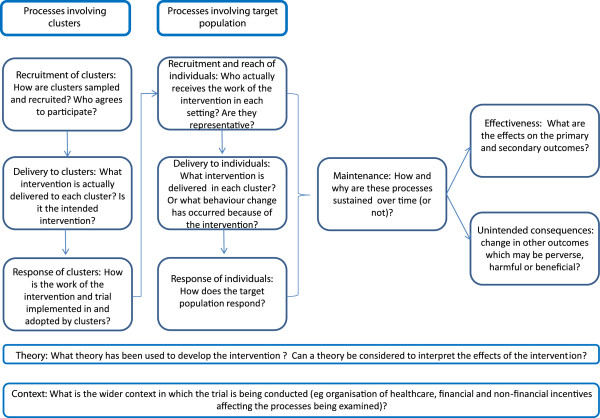
“[32] for cluster-randomized controlled trials, covering the following 11 domains: (1-6) Recruitment, delivery, and response, considered on cluster and individual level, respectively, (7) sustainability, (8) effectiveness, (9) unintended consequences, (10) appropriateness of the applied theory and (11) the influence of…”
Process evaluation of implementing Protected Mealtimes under clinical trial conditions
Porter, J. A., & Ottrey, E. (2018) · Journal of Advanced Nursing · doi:10.1111/jan.13693 · Cited by 5
Murphy, M. E., Byrne, M., Boland, F., Corrigan, D., Gillespie, P., Fahey, T. P., & Smith, S. M. (2018) · Pilot and Feasibility Studies · doi:10.1186/s40814-018-0352-y · Cited by 5
“The process evaluation will include qualitative analysis and quantitative measures of treatment fidelity, collected through the website activity as part of the DECIDE treatment algorithms [41].”
MethodNguyễn, N., Thalhammer, R., Beutner, K., Saal, S., Servaty, R., Klingshirn, H., Icks, A., Freyberg, K., Vomhof, M., Mansmann, U., et al. (2019) · Trials · doi:10.1186/s13063-019-3384-6 · Cited by 5
“Grant’s framework for designing process evaluations of c-RCTs will also be applied [49].”
BackgroundMethodInfluentialLi, J., Luo, X., & Li, Q. (2021) · Healthcare · doi:10.3390/healthcare9020110 · Cited by 4
“It is also proposed that it is difficult to know why complex psychosocial interventions work without exploring their underlying processes [17,20,21].”
BackgroundSa’id, I. I. M., Nadal, I. P., Forbes, A., Goldsmith, K., Ismail, I. Z., Hassan, F., Ching, S. M., Guess, N. D., Murphy, H. R., Prina, M. A., et al. (2021) · International Journal of Qualitative Methods · doi:10.1177/16094069211034010 · Cited by 4
Ouyang, M., Anderson, C. S., Song, L., Malavera, A., Jan, S., Cheng, G., Chu, H., Hu, X., Ma, L., Chen, X., et al. (2022) · Frontiers in Medicine · doi:10.3389/fmed.2022.813749 · Cited by 4
Pisinger, V. S. C., Hoffmann, S. H., Rosing, J. A., Grønbæk, M., Tolstrup, J. S., Thygesen, L. C., & Krølner, R. F. (2020) · BMJ Open · doi:10.1136/bmjopen-2020-038857 · Cited by 4
Process Evaluation in Health Services Research
Wensing, M., & Poß-Doering, R. (2023) · Springer eBooks · doi:10.1007/978-3-031-29998-8_13 · Cited by 3
Woods, C. B., O’Regan, A., Doyle, C. B., Hayes, G., Clifford, A. M., Donnelly, A., Gillespie, P., Glynn, L. G., Murphy, A. W., Sheikhi, A., et al. (2024) · Frontiers in Public Health · doi:10.3389/fpubh.2024.1348110 · Cited by 3
Meyer, S., Söling, S., Lampe, D., Poppe, A., Bartels, R., Grandt, D., Klaas, C., Dumröse, A., Reber, K. C., Greiner, W., et al. (2025) · BMJ Open · doi:10.1136/bmjopen-2024-084696 · Cited by 3
Rowe, A., Titterington, J., Holmes, J., Henry, L. A., & Taggart, L. (2021) · Pilot and Feasibility Studies · doi:10.1186/s40814-021-00771-w · Cited by 3
Steyer, L., Kortkamp, C. P., Mueller, C. A., Tetzlaff, B., Fleischmann, N., Weber, C. E., Scherer, M., Kühn, A., Jarchow, A.-M., Lüth, F., et al. (2022) · Trials · doi:10.1186/s13063-022-06476-6 · Cited by 3
“Following existing frameworks for process evaluations of complex interventions [16, 17], this overall aim is divided into several sub-objectives, each focusing on one specific part of the assumed causal pathway from group allocation to the impact of the interventions on the intermediate outcomes (i.”
MethodRahn, A. C., Peper, J., Köpke, S., Antony, G., Liethmann, K., Vettorazzi, E., Heesen, C., Berghoff, M., Diem, R., Faiss, J. H., et al. (2024) · Patient Education and Counseling · doi:10.1016/j.pec.2024.108293 · Cited by 3
Cepni, A. B., Ledoux, T. A., Walsh, D. W., & Johnston, C. A. (2025) · Health Education Research · doi:10.1093/her/cyaf047 · Cited by 3
Khadija, Z., & Omar, A. (2019) · Global Journal of Health Science · doi:10.5539/gjhs.v11n2p123 · Cited by 3
“Furthermore, young people in the market are given job opportunities with the help of social media (Grant et al., 2013).”
BackgroundWenzel, L., Heesen, C., Scheiderbauer, J., van de Loo, M., Köpke, S., & Rahn, A. C. (2021) · BMJ Open · doi:10.1136/bmjopen-2020-046874 · Cited by 3
Bell, J. S., Ooi, C. E., Troeung, L., Craik, S., Walton, R., & Martini, A. (2022) · Research in Social and Administrative Pharmacy · doi:10.1016/j.sapharm.2022.03.010 · Cited by 3
Kalolo, A., Lalashowi, J., Pamba, D. I., Shayo, P. J., Gitige, C. G., Mvungi, H., Ntagazwa, W., Lekule, I. A., Kisonga, R. M., Mleoh, L., et al. (2022) · BMJ Open · doi:10.1136/bmjopen-2021-054434 · Cited by 3
Grant, A. M., MacIver, E., Adams, N., Teodorowski, P., & Kennedy, C. M. (2023) · Journal of Advanced Nursing · doi:10.1111/jan.15552 · Cited by 3
Self-citationKlein, A.-A., Petermann, J., Brosse, F., Piller, S., Kramer, M., Hanf, M., Dinh, T. S., Schulz-Rothe, S., Engler, J., Mergenthal, K., et al. (2023) · Pilot and Feasibility Studies · doi:10.1186/s40814-023-01375-2 · Cited by 3
Interventional pharmacoepdemiology: design and evaluation of interventions to improve prescribing
Alexander, G. C., Grant, A. M., Hughes, C. M., & Dreischulte, T. (2024) · American Journal of Epidemiology · doi:10.1093/aje/kwae109 · Cited by 3
Self-citationRosenthal, M., Tsuyuki, R. T., & Houle, S. K. D. (2015) · Pilot and Feasibility Studies · doi:10.1186/2055-5784-1-2 · Cited by 4
Werner, E. L., Løchting, I., Storheim, K., & Grotle, M. (2018) · BMC Family Practice · doi:10.1186/s12875-018-0759-9 · Cited by 3
“Process evaluation is highly recommended in the literature on cRCTs [15].”
BackgroundEkambareshwar, M., Taki, S., Mihrshahi, S., Baur, L. A., Wen, L. M., & Rissel, C. E. (2021) · Health Promotion Journal of Australia · doi:10.1002/hpja.562 · Cited by 3
Flowers, P., Mapp, F., McQueen, J., Nandwani, R., The LUSTRUM programme, & Estcourt, C. S. (2021) · medRxiv · doi:10.1101/2021.08.07.21261736 · Cited by 3
Sa’id, I. I. M., Hotung, N., Benton, M., Nadal, I. P., Baharom, A., Prina, M. A., Yusof, B. N. M., Goldsmith, K., Birts, S., Ching, S. M., et al. (2025) · Interactive Journal of Medical Research · doi:10.2196/51718 · Cited by 3
Thalhammer, R., Nguyễn, N., Meyer, G., Skudlik, S., Müller, M., & Beutner, K. (2024) · Trials · doi:10.1186/s13063-024-08652-2 · Cited by 2
“We also adhered to the framework of Grant et al. [11] to distinguish between processes at the cluster and individual levels.”
InfluentialEbert, C., Vogel, M., Gensichen, J., Reif, H., Grögor, L., Junker, L., Ehring, T. W., Hasan, A., Leucht, S., Lochbühler, K., et al. (2025) · Pilot and Feasibility Studies · doi:10.1186/s40814-025-01597-6 · Cited by 2
“Corresponding questionnaires are based on the process evaluation framework for cluster randomised controlled trials of Grant et al. (2013) [57] and a previous similar pilot study conducted in the PC setting [58].”
Self-citationEmerson, L. M., McAuley, D. F., Blackwood, B., & Clarke, M. J. (2025) · Critical Care Explorations · doi:10.1097/cce.0000000000001355 · Cited by 3
“The first review identified four process evaluation frameworks published between 1999 and 2015: two identified directly from the literature search (13, 29), and two identified from searching reference lists (19, 30).”
Liu, W., Xiong, X., Sun, X., Gao, Y., Song, J., Sun, D., Wang, B., & Wu, I. (2025) · Clinical Interventions in Aging · doi:10.2147/cia.s550792 · Cited by 2
“21 The pilot trial was registered in the Chinese Clinical Trial Registry (identifier: ChiCTR2300076166).”
Snyder, J. S., Canda, E., O’Brien, L. A., Reardon, E. E., Ogutu, E. A., Hoffman, S., Bagtas, P. R. C., Santos, F., & Freeman, M. C. (2026) · Implementation Science Communications · doi:10.1186/s43058-026-00872-8 · Cited by 2
“%) applied other frameworks, including the Exploration, Preparation, Implementation, Sustainment (EPIS) framework [26], WHO’s orocess evaluation workbook [27], and conceptual models for implementation outcomes and generalizability [28–30].”
Krølner, R. F., Brautsch, L. A. S., Vilhelmsen, M., Hoeeg, D., Pedersen, N. H., Thomsen, L. T., Nielsen, G., Toft, U., Larsen, M. N., Damsgaard, C. T., et al. (2026) · Trials · doi:10.1186/s13063-026-09635-1 · Cited by 2
“Study strengths of the GHK process evaluation include pre-specification of aims, research objectives, conceptual framework, study design, data collection and analytical procedures in this protocol including study rationale and justification of methodological choices [62, 175, 176].”
Clarke, E., Leamy, M. C., Bird, V., Janošik, M., Jordan, H., Le, B. C., Macpherson, R., Riley, G., Sanger, K., Williams, J., et al. (2020) · Archives of Psychiatry and Mental Health · doi:10.29328/journal.apmh.1001014 · Cited by 2
Patel, K., Say, S., Leng, D., Prak, M., Lo, K., Mukaka, M., Riedel, A., & Turner, C. L. (2021) · BMC Pediatrics · doi:10.1186/s12887-021-02833-7 · Cited by 2
Muzaffar, H., & Nickols‐Richardson, S. M. (2021) · Nutrients · doi:10.3390/nu13113901 · Cited by 2
“The importance of process evaluation in public health interventions is increasingly recognized in research implementation science, but there is a lack of uniformity in the methods employed [14].”
MethodMeijerink, J. F. J., Pronk, M., Lissenberg-Witte, B. I., Jansen, V., & Kramer, S. E. (2021) · Frontiers in Medicine · doi:10.3389/fmed.2021.725388 · Cited by 2
“Used the Booklet to write down goals and experiences 29 (27) 45 (42) 26 (24) 7 (7)”
BackgroundMethodMaking Sense of Process Evaluation
Lauwerier, E., der Veken, K. V., & Willems, S. J. T. (2022) · Routledge eBooks · doi:10.4324/9781003000204-6 · Cited by 2
O’Byrne, Y., Dinneen, J., & Coppinger, T. C. (2023) · Irish Educational Studies · doi:10.1080/03323315.2023.2264271 · Cited by 4
“Teachers were asked to quantify the amount of extra daily PA they delivered, in order to examine whether the intervention (20mins extra daily MVPA) was being delivered as intended (Grant et al. 2013).”
Jordan, J., Tume, L. N., Clarke, M. J., McAuley, D. F., McDowell, C., McIlmurray, L., Morris, K., Peters, M. J., Walsh, T. S., & Blackwood, B. (2023) · PLoS ONE · doi:10.1371/journal.pone.0293063 · Cited by 2
Ralston, J. D., Anderson, M. L., Ng, J., Bashir, A., Ehrlich, K. J., Burns-Hunt, D., Cotton, M., Hansell, L. D., Hsu, C. W., Hunt, H., et al. (2024) · Contemporary Clinical Trials · doi:10.1016/j.cct.2024.107456 · Cited by 2
Folkerts, A., Seven, Ü. S., Guicheteau, J., Dichter, M., Hellmich, M., Köpke, S., & Kalbe, E. (2024) · BMJ Open · doi:10.1136/bmjopen-2023-078369 · Cited by 3
“17 36 The process evaluation procedure was developed according to the models of Grant et al 19 and Moore et al 17 (see figure 1).”
MethodSheringham, J., Steed, L., McClatchey, K., Delaney, B., Barat, A., Hammersley, V., Marsh, V., Fulop, N., Taylor, S. J., & Pinnock, H. (2024) · Trials · doi:10.1186/s13063-024-08179-6 · Cited by 3
“The process evaluation is based on the Medical Research Council guidelines for the process evaluation of complex interventions [14], also drawing on Grant et al.’s process evaluation framework for cluster randomised trials [15].”
MethodCruz, A., Cuxart‐Graell, A., Gonçalves, A. Q., Vázquez-Villegas, J., Vallejo-Godoy, S., Salas-Coronas, J., Piqueras, N. G., Martínez‐Torres, S., Artigues-Barberà, E., Matos, Y. R., et al. (2024) · BMJ Open · doi:10.1136/bmjopen-2023-078337 · Cited by 2
“35 It will be performed before, during and after the trial period (12 months) using both qualitative and quantitative methods.”
MethodBusza, J. R., Machingura, F., & Vuckovic, C. (2024) · Trials · doi:10.1186/s13063-024-08623-7 · Cited by 3
Lahti, H., & Kalakoski, V. (2025) · Psykologia · doi:10.62443/psykologia.v55i2-3.88616 · Cited by 2
Wei, X., Liang, D., Zhang, Z., Thorpe, K. E., Zhou, L., Zhao, J., Qin, H., Liang, X., Cui, Z., Huang, Y. Q., et al. (2025) · PLoS ONE · doi:10.1371/journal.pone.0316073 · Cited by 2
“Since our project contains multiple components, the process evaluation during and after the trial is guided by the framework for the design and evaluation of complex interventions [22,23].”
Emerson, L. M., Blackwood, B., Kydonaki, K., McKenzie, C., Walsh, T. S., & Aitken, L. M. (2025) · Journal of the Intensive Care Society · doi:10.1177/17511437251381951 · Cited by 3
22 Evaluatie van het proces van implementatie
Hulscher, M., Laurant, M. G. H., Wensing, M., & Grol, R. P. T. M. (2015) · Bohn Stafleu van Loghum eBooks · doi:10.1007/978-90-368-1077-7_22 · Cited by 2
Soni, A., Beeken, R. J., McGowan, L. J., Lawson, V., Chadwick, P., & Croker, H. A. (2021) · Nutrients · doi:10.3390/nu13082807 · Cited by 3
“Assessing the mechanisms through which PfP Shape-Up brought about change and whether this was enhanced by the adaptations identified was not possible—this lack of transparency has been characterised as a “black box” [59,60].”
BackgroundTeupen, S., Holle, D., & Roes, M. (2021) · Implementation Science Communications · doi:10.1186/s43058-021-00191-0 · Cited by 2
Kaur, J., Kaur, M., Chakrapani, V., & Kumar, R. (2023) · Health Education Research · doi:10.1093/her/cyad020 · Cited by 2
Fabbri, C., Powell‐Jackson, T., Rodrigues, K., Filippo, A. D., Kaemingk, M., Torrats‐Espinosa, G., Leurent, B., Shayo, E. H., Barongo, V., & Devries, K. M. (2023) · PLOS Global Public Health · doi:10.1371/journal.pgph.0001404 · Cited by 2
Carswell, C. (2026) · Research Portal (Queen's University Belfast) · doi:10.17034/32629830 · Cited by 2
Smith, A. H., Bulamba, F., Nanimambi, J., Adong, L. R., Emacu, B., Kabaleta, M., Khanyalano, J., Hussein, M. A., Mugume, C., Nakibuule, J., et al. (2024) · medRxiv · doi:10.1101/2024.05.24.24307741 · Cited by 2
Evans, K., Spiby, H., Slade, M., Jomeen, J., & Beckhelling, J. (2022) · BMJ Open · doi:10.1136/bmjopen-2022-064659 · Cited by 1
Miller, J., Doulas, T., Bisson, E. J., Abebe, A. B., Chala, M. B., McClintock, C., Varette, K., Vader, K., Desmeules, F., Perreault, K., et al. (2023) · Pilot and Feasibility Studies · doi:10.1186/s40814-023-01352-9 · Cited by 3
“Medical Research Council (MRC) guidelines for the development and evaluation of complex interventions have been used to guide this feasibility study [36, 37].”
MethodKöberlein–Neu, J., & Söling, S. (2024) · Springer eBooks · doi:10.1007/978-3-658-43860-9_22 · Cited by 1
Fox, S. T., Hubbard, R. E., Valks, A., Matsuyama, M., Kalaw, E., Viecelli, A. K., Aquino, M., Johnson, D. W., & Janda, M. (2024) · BMJ Open · doi:10.1136/bmjopen-2023-076328 · Cited by 1
“…MRC domains, we will structure our study design and research questions according to published guidelines for process evaluations of cluster RCTs. 25 A key objective is an exploration of how CGA was implemented in the trial context, including recruitment processes (who was recruited and how),…”
Orsatti, A., Bowden, J. L., Naylor, J., Boland, R. A., Pardey, M. C., Descallar, J., & Mills, K. A. G. (2024) · BMJ Open · doi:10.1136/bmjopen-2024-090360 · Cited by 1
“Further, Grant et al 27 advocate that not all processes need to be investigated in every evaluation, rather, only those pertinent to the nature of the trial.”
InfluentialMacArthur, C., Bick, D., Salmon, V. E., Jones, E., Hay‐Smith, J., Bishop, J. R. B., Gkini, E., Hemming, K., Webb, S. S., Pearson, M., et al. (2024) · Programme Grants for Applied Research · doi:10.3310/tjdh7946 · Cited by 1
Lim, A. S. X., Schweickle, M. J., & Vella, S. A. (2025) · Journal of Applied Sport Psychology · doi:10.1080/10413200.2025.2523868 · Cited by 1
“Process evaluations are a type of program evaluation used to assess the implementation process, and attempt to conclude how well the project followed the strategy laid out in the research plan (Grant et al., 2013).”
Ebert, C., Vogel, M., Gensichen, J., Reif, H., Junker, L., Grögor, L., Padberg, F., Falkai, P., Ehring, T. W., Hasan, A., et al. (2026) · BMC Family Practice · doi:10.1186/s12875-026-03377-4 · Cited by 1
“Treatment lasted up to 12 weeks, during which patients received four 20-min [58] and items adapted from a previous pilot study [59].”
Self-citationRamsden, V., Babl, F. E., Haskell, L., Wilson, C. L., McInnes, E., Middleton, S., Kühn, L., Wallace, A., Bourke, E. M., Jordan, F., et al. (2025) · BMJ Quality & Safety · doi:10.1136/bmjqs-2025-019007 · Cited by 1
Rugendo, E., Lyimo, G. S., Daya, R., Githinji, M., Kashamba, K., Njoki, F., Yusufu, I., Osborn, T., Chase, R. P., Sando, M., et al. (2025) · BMC Psychology · doi:10.1186/s40359-025-03837-z · Cited by 1
“Process evaluation A mixed-methods process evaluation will be conducted using the framework developed by Grant et al. [58].”
Metadata
- Authors
- Grant, A., Treweek, S., Dreischulte, T., Foy, R., & Guthrie, B.
- Affiliations
- University of Dundee (GB)
- University of Leeds (GB)
- Corresponding author
- Grant, Aileen
- Venue
- Trials
- Published
- 2013
- Volume
- 14
- Issue
- 1
- Pages
- 15
- ISSN
- 1745-6215 (ISSN-L)
- PMC
- PMC3600672
- OpenAlex
- W2128920447
- Semantic Scholar
- 58b5af7929c0bfb71f7ecbda5b931fad772b7950
- Cited by
- 541
- References
- 42
- Citations by year
- 2026: 27 · 2025: 21 · 2024: 68 · 2023: 55 · 2022: 47 · 2021: 65 · 2020: 55 · 2019: 33 · 2018: 44 · 2017: 35 · 2016: 32 · 2015: 31 · 2014: 20 · 2013: 7
- FWCI
- 54.34
- Type
- journal article
- Language
- en
- Open access
- gold
- doi.org
- Licence
- cc-by
- Locations
- Trials (publishedVersion, cc-by)
- Europe PMC (PubMed Central) (publishedVersion, cc-by)
- PubMed Central (publishedVersion, cc-by)
- PubMed (publishedVersion)
- Edinburgh Research Explorer (University of Edinburgh) (publishedVersion, cc-by)
- White Rose Research Online (University of Leeds, The University of Sheffield, University of York) (acceptedVersion)
- Discovery Research Portal (University of Dundee) (submittedVersion)
- Stirling Online Research Repository (University of Stirling) (submittedVersion, cc-by)
- Open access LMU (Ludwid Maxmilian's Universitat Munchen) (submittedVersion)
- Open Access Institutional Repository at Robert Gordon University (Robert Gordon University) (submittedVersion, cc-by)
- Funders
- Scottish Government
- Chief Scientist Office, Scottish Government Health and Social Care Directorate
- Topics
- Health Sciences › Health Professions › General Health Professions › Health Policy Implementation Science
- Social Sciences › Public Administration › Evaluation and Performance Assessment
- Physical Sciences › Mathematics › Statistics and Probability › Advanced Causal Inference Techniques
- Keywords
- process evaluation, complex interventions, intervention implementation, participant responses, reporting guidelines, research design
- MeSH terms
- Humans, Outcome and Process Assessment, Health Care, Research Design, Treatment Outcome, Practice Guidelines as Topic, Evidence-Based Medicine, Information Dissemination, Qualitative Research
About these checks
Registry, retraction, Cites and statistics results are computed, not judged, with one exception: a printed reference that no index lists is read once by a model before it counts as a citation error. Claims are extracted by a model and kept only when their quote appears verbatim in the text; each cited source is then checked, with a model’s help, for whether it says what the claim relies on. Those verdicts can be wrong — read the claim’s quote and the cited source before relying on one.
Statistics and arithmetic are recomputed, not judged.
Confidence bands are shown only for fields calibrated on our annotated test set. None is calibrated yet, so no band is shown.
What counts as a claim ›How we measure confidence ›How we check this ›
Are you an author, or do you see a problem with this page? Request a review
Data sources
Bibliographic data: Semantic Scholar, OpenAlex, Crossref.
Contains information from the Semantic Scholar Academic Graph Datasets, made available under the ODC Attribution License (ODC-BY 1.0).
Semantic Scholar’s data is described in: Kinney, R., et al. (2023). The Semantic Scholar Open Data Platform. arXiv:2301.10140.
