

The DOI matches its Crossref record; 67 of the 75 references it cites were found in a registry or an index.
A theory of organizational readiness for change
Open accessAbstract
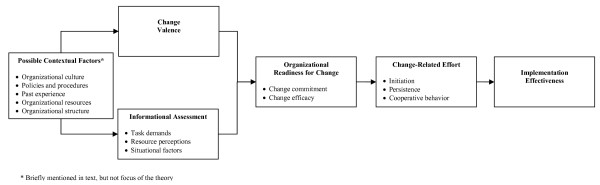
BACKGROUND: Change management experts have emphasized the importance of establishing organizational readiness for change and recommended various strategies for creating it. Although the advice seems reasonable, the scientific basis for it is limited. Unlike individual readiness for change, organizational readiness for change has not been subject to extensive theoretical development or empirical study. In this article, I conceptually define organizational readiness for change and develop a theory of its determinants and outcomes. I focus on the organizational level of analysis because many promising approaches to improving healthcare delivery entail collective behavior change in the form of systems redesign--that is, multiple, simultaneous changes in staffing, work flow, decision making, communication, and reward systems. DISCUSSION: Organizational readiness for change is a multi-level, multi-faceted construct. As an organization-level construct, readiness for change refers to organizational members' shared resolve to implement a change (change commitment) and shared belief in their collective capability to do so (change efficacy). Organizational readiness for change varies as a function of how much organizational members value the change and how favorably they appraise three key determinants of implementation capability: task demands, resource availability, and situational factors. When organizational readiness for change is high, organizational members are more likely to initiate change, exert greater effort, exhibit greater persistence, and display more cooperative behavior. The result is more effective implementation. SUMMARY: The theory described in this article treats organizational readiness as a shared psychological state in which organizational members feel committed to implementing an organizational change and confident in their collective abilities to do so. This way of thinking about organizational readiness is best suited for examining organizational changes where collective behavior change is necessary in order to effectively implement the change and, in some instances, for the change to produce anticipated benefits. Testing the theory would require further measurement development and careful sampling decisions. The theory offers a means of reconciling the structural and psychological views of organizational readiness found in the literature. Further, the theory suggests the possibility that the strategies that change management experts recommend are equifinal. That is, there is no 'one best way' to increase organizational readiness for change.
Overview
The claims and statistics of this paper haven’t been checked yet.
Run the check — free, no account needed. It reads the open-access text and checks the sources it cites.
Integrity signals
Registry
Cites
Statistics
Figures
Verification
Claims the paper makes
The claims and statistics of this paper haven’t been checked yet.
Run the check — free, no account needed. It reads the open-access text and checks the sources it cites.
Claims other papers make about this one
Each is checked against this paper’s own text: does it say what the citing paper says it does?
In the citing paper
“Weiner’s theory of organisational readiness to change [71] proposes that readiness depends on collective behaviour change linked to two key factors, described as change commitment (wanting to change) and change efficacy (able to change).”
From PARIHS revisited: from heuristic to integrated framework for the successful implementation of knowledge into practice (2015) · cites this paper as [71]
In the citing paper
“Weiner’s organizational theory of innovation implementation suggests that leaders are critical in creating readiness for change, ensuring innovation-values fit, and developing plans, practices, structures, and strategies to support implementation (Weiner, 2009).”
From The Roles of System and Organizational Leadership in System-Wide Evidence-Based Intervention Sustainment: A Mixed-Method Study (2016) · cites this paper as Weiner, 2009
In the citing paper
“Organizational readiness for change theory postulates that a higher level of organizational readiness increases the success of innovation adoption and decreases the risk of failure (Snyder-Halpern 2001;Weiner 2009).”
From Ready or not, AI comes—an interview study of organizational AI readiness factors (2021) · cites this paper as Weiner 2009
Self-check
Percentages, sums and reported differences re-computed from the paper’s own numbers.
The self-check needs the paper’s full text.
Citations
Cites
Self-efficacy: The exercise of control
Bandura, A., Freeman, W. H., & Lightsey, R. (1999) · Journal of Cognitive Psychotherapy · doi:10.1891/0889-8391.13.2.158 · Cited by 46,835
(1975) · PhilPapers (PhilPapers Foundation) · Cited by 36,737
Psychometric theory (2nd ed.).
Sitgreaves, R. (1979) · Contemporary Psychology · doi:10.1037/018882 · Cited by 14,384
(1964) · Medical Entomology and Zoology · Cited by 10,439
Commitment in the workplace: toward a general model
Meyer, J. P., & Herscovitch, L. (2001) · Human Resource Management Review · doi:10.1016/s1053-4822(00)00053-x · Cited by 3,856
Self-Efficacy: A Theoretical Analysis of Its Determinants and Malleability
Gist, M. E., & Mitchell, T. R. (1992) · Academy of Management Review · doi:10.5465/amr.1992.4279530 · Cited by 3,713
Field Theory in Social Science: Selected Theoretical Papers.
Price, D. O., Lewin, K., & Cartwright, D. (1951) · American Sociological Review · doi:10.2307/2087618 · Cited by 3,519
Exercise of Human Agency Through Collective Efficacy
Bandura, A. (2000) · Current Directions in Psychological Science · doi:10.1111/1467-8721.00064 · Cited by 3,294
The Challenge of Innovation Implementation
Klein, K. J., & Sorra, J. S. (1996) · The Academy of Management Review · doi:10.2307/259164 · Cited by 2,113
Creating Readiness for Organizational Change
Armenakis, A. A., Harris, S. G., & Mossholder, K. W. (1993) · Human Relations · doi:10.1177/001872679304600601 · Cited by 2,061
Research works printed but not linked: 5
- Kotter JP: Leading change. 1996, Boston: Harvard Business Press
- Bandura A: Social foundations of thought and action: a social cognitive theory. 1986, Englewood Cliffs, N.J.: Prentice-Hall
- Turner D, Crawford M: Change Power: Capabilities that Drive Corporate Renewal. 1998, Warriewood, Australia: Business & Professional Publishing
- Nunnally JC: Psychometric theory. 1978, New York: McGraw-Hill, 2
- Elise LL, Steven VO: A measure of self-care self-efficacy. 1996, 19: 421-429.
Cited by
Sorted by citations
Items 201–300 of 1,001
Pelletier, D. L., Porter, C., Aarons, G. A., Wuehler, S. E., & Neufeld, L. M. (2013) · Advances in Nutrition · doi:10.3945/an.112.003160 · Cited by 51
Patients’ perspectives on the implementation of intra-dialytic cycling—a phenomenographic study
Heiwe, S., & Tollin, H. (2012) · Implementation Science · doi:10.1186/1748-5908-7-68 · Cited by 47
Øvretveit, J., Mittman, B. S., Rubenstein, L. V., & Ganz, D. A. (2017) · International Journal of Health Care Quality Assurance · doi:10.1108/ijhcqa-01-2017-0019 · Cited by 46
Translation research in occupational safety and health: A proposed framework
Schulte, P. A., Cunningham, T. R., Nickels, L., Felknor, S. A., Guerin, R. J., Blosser, F., Chang, C., Check, P., Eggerth, D. E., Flynn, M., et al. (2017) · American Journal of Industrial Medicine · doi:10.1002/ajim.22780 · Cited by 52
Albritton, J., Fried, B. J., Singh, K., Weiner, B. J., Reeve, B. B., & Edwards, J. R. (2019) · BMC Health Services Research · doi:10.1186/s12913-019-4234-7 · Cited by 54
Self-citationGuerin, R. J., Glasgow, R. E., Tyler, A. N., Rabin, B. A., & Huebschmann, A. G. (2022) · Safety Science · doi:10.1016/j.ssci.2022.105763 · Cited by 61
Decoding AI readiness: An in-depth analysis of key dimensions in multinational corporations
Tehrani, A. N., Ray, S., Roy, S. K., Gruner, R. L., & Appio, F. P. (2023) · Technovation · doi:10.1016/j.technovation.2023.102948 · Cited by 75
Abhari, K. (2025) · Information & Management · doi:10.1016/j.im.2025.104212 · Cited by 91
Michaels, C., & Greene, A. M. (2013) · Health Promotion Practice · doi:10.1177/1524839913480800 · Cited by 46
Transitioning mental health into primary care
Miranda, J. J., Diez‐Canseco, F., Araya, R., Cutipé, Y., Castillo, H. L., Herrera-López, V. E., Galea, J. T., Brandt, L. R., Toyama, M., & Cavero, V. (2017) · The Lancet Psychiatry · doi:10.1016/s2215-0366(16)30350-9 · Cited by 46
Capacity-building and training opportunities for implementation science in mental health
Chambers, D., Pintello, D., & Juliano‐Bult, D. (2019) · Psychiatry Research · doi:10.1016/j.psychres.2019.112511 · Cited by 48
Time pressured deprioritization of COPD in primary care: a qualitative study
Sandelowsky, H., Hylander, I., Krakau, I., Modin, S., Ställberg, B., & Nager, A. (2016) · Scandinavian Journal of Primary Health Care · doi:10.3109/02813432.2015.1132892 · Cited by 46
Buzzword or fuzzword: an event study of the metaverse in the Chinese stock market
Xu, Y., Liu, W., He, T., & Tsai, S. (2023) · Internet Research · doi:10.1108/intr-07-2022-0526 · Cited by 45
Neher, M., Petersson, L., Nygren, J., Svedberg, P., Larsson, I., & Nilsén, P. (2023) · Implementation Science Communications · doi:10.1186/s43058-023-00458-8 · Cited by 61
Implementing team huddles in small rural hospitals: How does the Kotter model of change apply?
Baloh, J., Zhu, X., & Ward, M. M. (2017) · Journal of Nursing Management · doi:10.1111/jonm.12584 · Cited by 49
Lorthios-Guilledroit, A., Richard, L., & Filiatrault, J. (2018) · Evaluation and Program Planning · doi:10.1016/j.evalprogplan.2018.01.008 · Cited by 46
Colombini, M., Alkaiyat, A. S., Shaheen, A. A., Moreno, C. G., Feder, G. S., & Bacchus, L. (2019) · Health Policy and Planning · doi:10.1093/heapol/czz151 · Cited by 46
An implementation science primer for psycho-oncology: translating robust evidence into practice
Rankin, N. M., Butow, P. N., Hack, T. F., Shaw, J., Shepherd, H. L., Ugalde, A., & Sales, A. E. (2019) · Journal of Psychosocial Oncology Research and Practice · doi:10.1097/or9.0000000000000014 · Cited by 44
Hodge, L. M., Turner, K. M. T., Sanders, M. R., & Filus, A. (2017) · The Journal of Behavioral Health Services & Research · doi:10.1007/s11414-016-9505-z · Cited by 38
Hodder, R. K., Wolfenden, L., Kamper, S. J., Lee, H., Williams, A. J., O’Brien, K. M., & Williams, C. M. (2016) · Best Practice & Research Clinical Rheumatology · doi:10.1016/j.berh.2017.05.002 · Cited by 44
Organizational readiness for change: A systematic review of the healthcare literature
Caci, L., Nyantakyi, E., Blum, K., Sonpar, A., Schultes, M.-T., Albers, B., & Clack, L. (2025) · Implementation Research and Practice · doi:10.1177/26334895251334536 · Cited by 70
Damian, A. J., Gallo, J. J., Leaf, P. J., & Mendelson, T. (2017) · BMC Health Services Research · doi:10.1186/s12913-017-2695-0 · Cited by 44
Readiness as a precursor of early implementation outcomes: an exploratory study in specialty clinics
Livet, M., Blanchard, C., & Richard, C. (2022) · Implementation Science Communications · doi:10.1186/s43058-022-00336-9 · Cited by 41
Lindig, A., Hahlweg, P., Christalle, E., & Scholl, I. (2020) · BMJ Open · doi:10.1136/bmjopen-2019-034380 · Cited by 46
Bond, M. A., & Haynes, M. C. (2021) · American Journal of Community Psychology · doi:10.1002/ajcp.12557 · Cited by 49
Benn, J. J., Burnett, S. J., Parand, A., Pinto, A. C. S. N., & Vincent, C. A. (2012) · BMJ Quality & Safety · doi:10.1136/bmjqs-2011-000286 · Cited by 43
Implementing Value-Based Payment Reform: A Conceptual Framework and Case Examples
Conrad, D. A., Vaughn, M. G., Grembowski, D. E., & Marcus‐Smith, M. (2015) · Medical Care Research and Review · doi:10.1177/1077558715615774 · Cited by 45
Bidwell, P., Thakar, R., Sevdalis, N., Silverton, L. I., Novis, V., Hellyer, A., Kelsey, M., van der Meulen, J., & Gurol‐Urganci, I. (2018) · BMC Pregnancy and Childbirth · doi:10.1186/s12884-018-1965-0 · Cited by 42
Afrizal, S. H., Hidayanto, A. N., Handayani, P. W., Budiharsana, M. P., & Eryando, T. (2019) · Healthcare Informatics Research · doi:10.4258/hir.2019.25.3.141 · Cited by 45
Lutz, B. J., Reimold, A. E., Coleman, S. W., Guzik, A. K., Russell, L. P., Radman, M. D., Johnson, A. M., Duncan, P. W., Bushnell, C., Rosamond, W. D., et al. (2020) · The Gerontologist · doi:10.1093/geront/gnaa029 · Cited by 44
Zapka, J., Simpson, K., Hiott, L., Langston, L., Fakhry, S. M., & Ford, D. W. (2013) · BMC Health Services Research · doi:10.1186/1472-6963-13-33 · Cited by 43
Jewapatarakul, D., & Ueasangkomsate, P. (2024) · SAGE Open · doi:10.1177/21582440241297405 · Cited by 82
Nickel, N. C., Taylor, E., Labbok, M. H., Weiner, B. J., & Williamson, N. E. (2013) · Midwifery · doi:10.1016/j.midw.2012.12.001 · Cited by 41
Self-citationStamatakis, K. A., McQueen, A., Filler, C., Boland, E., Dreisinger, M., Brownson, R. C., & Luke, D. A. (2012) · Implementation Science · doi:10.1186/1748-5908-7-65 · Cited by 42
Eckstrand, K., Lunn, M. R., & Yehia, B. R. (2017) · LGBT Health · doi:10.1089/lgbt.2015.0148 · Cited by 42
Overview of theories, models and frameworks in implementation science
Nilsen, P. (2020) · Edward Elgar Publishing eBooks · doi:10.4337/9781788975995.00008 · Cited by 48
Alidina, S., Chatterjee, P., Zanial, N., Alreja, S. S., Balira, R., Barash, D. M., Ernest, E., Giiti, G. C., Maina, E., Mazhiqi, A., et al. (2021) · BMJ Quality & Safety · doi:10.1136/bmjqs-2020-011795 · Cited by 42
Lopez, C. J., Edwards, B. Q., Langelier, D. M., Chang, E. K., Chafranskaia, A., & Jones, J. M. (2021) · Archives of Physical Medicine and Rehabilitation · doi:10.1016/j.apmr.2021.02.002 · Cited by 42
Issues and Implications of Readiness to Change
Alolabi, Y. A., Ayupp, K., & Dwaikat, M. A. (2021) · Administrative Sciences · doi:10.3390/admsci11040140 · Cited by 43
Relation between Organizational Capacity for Change and Readiness for Change
Mladenova, I. (2022) · Administrative Sciences · doi:10.3390/admsci12040135 · Cited by 43
Is quality of care improving in the UK?
Pronovost, P. J., Berenholtz, S. M., & Morlock, L. L. (2011) · BMJ · doi:10.1136/bmj.c6646 · Cited by 41
Roodbari, H., Nielsen, K. M., & Axtell, C. M. (2023) · Scandinavian Journal of Work and Organizational Psychology · doi:10.16993/sjwop.171 · Cited by 42
Hannon, P. A., Helfrich, C. D., Chan, K. G., Allen, C. L., Hammerback, K., Kohn, M., Parrish, A. T., Weiner, B. J., & Harris, J. R. (2015) · American Journal of Health Promotion · doi:10.4278/ajhp.141204-quan-604 · Cited by 41
Self-citationWesana, J., Steur, H. D., Dora, M. K., Mutenyo, E., Muyama, L., & Gellynck, X. (2018) · Journal of Cleaner Production · doi:10.1016/j.jclepro.2018.02.021 · Cited by 43
Susyanto, H. (2019) · Jurnal Ekonomi Bisnis dan Akuntansi · doi:10.32424/jeba.v21i1.1287 · Cited by 50
Walker, T. J., Brandt, H. M., Wandersman, A., Scaccia, J., Lamont, A. E., Workman, L. M., Dias, E., Diamond, P. M., Craig, D. W., & Fernández, M. E. (2020) · Implementation Science Communications · doi:10.1186/s43058-020-00088-4 · Cited by 47
Individual psychological distance: a leadership task to assess and cope with invisible change
Abbas, A., Ekowati, D., & Suhariadi, F. (2021) · Journal of Management Development · doi:10.1108/jmd-09-2020-0304 · Cited by 50
Wuni, I. Y., & Shen, Q. (2021) · Smart and Sustainable Built Environment · doi:10.1108/sasbe-03-2021-0051 · Cited by 41
Cultural Competence: A Journey to an Elusive Goal
Saunders, J. A., Haskins, M., & Vasquez, M. L. (2015) · Journal of Social Work Education · doi:10.1080/10437797.2015.977124 · Cited by 40
Segrott, J., Murphy, S., Rothwell, H., Scourfield, J., FOXCROFT, D. R., Gillespie, D., Holliday, J., Hood, K., Hurlow, C., Morgan‐Trimmer, S., et al. (2017) · SSM - Population Health · doi:10.1016/j.ssmph.2017.01.002 · Cited by 40
Developing countries organizations’ readiness for Big Data analytics
Kalema, B. M., & Mokgadi, M. (2017) · Problems and Perspectives in Management · doi:10.21511/ppm.15(1-1).2017.13 · Cited by 40
Exploring Critical Success Factors for Blockchain-based Intelligent Transportation Systems
Çaldağ, M. T., & Gökalp, E. (2020) · Emerging Science Journal · doi:10.28991/esj-2020-sp1-03 · Cited by 40
Encandela, J., Shaull, L., Jayas, A., Amiel, J. M., Brown, D. R., Obeso, V. T., Ryan, M. S., & Andriole, D. A. (2023) · Medical Education Online · doi:10.1080/10872981.2023.2175405 · Cited by 41
Graph theoretic approach for analysing the readiness of an organisation for adapting lean thinking
Gurumurthy, A., Mazumdar, P., & Muthusubramanian, S. (2013) · International journal of organizational analysis · doi:10.1108/ijoa-04-2013-0652 · Cited by 39
Oostendorp, L. J. M., Durand, M., Lloyd, A., & Elwyn, G. J. (2015) · BMC Health Services Research · doi:10.1186/s12913-015-0717-3 · Cited by 39
Statistical process control readiness in the food industry: Development of a self-assessment tool
Lim, S. A. H., & Antony, J. (2016) · Trends in Food Science & Technology · doi:10.1016/j.tifs.2016.10.025 · Cited by 39
Waller, G., Finch, T. L., Giles, E. L., & Newbury‐Birch, D. (2017) · Implementation Science · doi:10.1186/s13012-017-0659-8 · Cited by 40
Dellenborg, L., Wikström, E., & Erichsen, A. (2019) · Advances in Health Sciences Education · doi:10.1007/s10459-018-09869-y · Cited by 48
Franco, M., Minatogawa, V., Durán, O., Batocchio, A., & Quadros, R. (2021) · IEEE Access · doi:10.1109/access.2021.3077849 · Cited by 43
O’Malley, G., Beima‐Sofie, K., Roche, S. D., Rousseau, E., Travill, D., Omollo, V. O., Delany‐Moretlwe, S., Bekker, L., Bukusi, E. A., Kinuthia, J., et al. (2021) · Frontiers in Reproductive Health · doi:10.3389/frph.2021.668672 · Cited by 38
Sales, A. E., Ersek, M. T., Intrator, O. K., Levy, C. R., Carpenter, J. G., Hogikyan, R. V., Kales, H. C., Landis‐Lewis, Z., Olsan, T. H., Miller, S. C., et al. (2016) · Implementation Science · doi:10.1186/s13012-016-0497-0 · Cited by 37
Means, A. R., Ajjampur, S. S. R., Bailey, R. L., et al. (2018) · PLoS neglected tropical diseases · doi:10.1371/journal.pntd.0005988 · Cited by 38
Self-citationWu, R. R., Myers, R. A., Sperber, N. R., Voils, C. I., Neuner, J. M., McCarty, C. A., Haller, I. V., Harry, M. L., Fulda, K. G., Cross, D. S., et al. (2018) · Genetics in Medicine · doi:10.1038/s41436-018-0049-x · Cited by 38
Storkholm, M. H., Mazzocato, P., Tessma, M. K., & Savage, C. (2018) · Implementation Science · doi:10.1186/s13012-018-0769-y · Cited by 38
Structure, Process, and Outcome Data of AWHONN’s Postpartum Hemorrhage Quality Improvement Project
Bingham, D., Scheich, B., & Bateman, B. T. (2018) · Journal of Obstetric, Gynecologic & Neonatal Nursing · doi:10.1016/j.jogn.2018.05.002 · Cited by 38
Impact of quality management practices on change readiness due to new quality implementations
Uluskan, M., McCreery, J. K., & Rothenberg, L. (2018) · International Journal of Lean Six Sigma · doi:10.1108/ijlss-05-2017-0049 · Cited by 38
Cook, C. R., Davis, C. J., Brown, E. C., Locke, J. J., Ehrhart, M. G., Aarons, G. A., Larson, M. F., & Lyon, A. R. (2018) · Implementation Science · doi:10.1186/s13012-018-0804-z · Cited by 38
Livet, M., Blanchard, C., Sorensen, T. D., & McClurg, M. R. (2018) · JACCP JOURNAL OF THE AMERICAN COLLEGE OF CLINICAL PHARMACY · doi:10.1002/jac5.1037 · Cited by 38
Organizational enablers of business process reengineering implementation
Hashem, G. (2019) · International Journal of Productivity and Performance Management · doi:10.1108/ijppm-11-2018-0383 · Cited by 38
Interventions as the centrepiece of psychosocial risk assessment – why so difficult?
Schuller, K. (2019) · International Journal of Workplace Health Management · doi:10.1108/ijwhm-07-2018-0098 · Cited by 44
Nujen, B. B., Mwesiumo, D. E., Solli‐Sæther, H., Slyngstad, A. B., & Halse, L. L. (2018) · Journal of Global Operations and Strategic Sourcing · doi:10.1108/jgoss-05-2018-0020 · Cited by 38
Adams, A. M., Sedalia, S., McNab, S., & Sarker, M. (2015) · Health Policy and Planning · doi:10.1093/heapol/czv053 · Cited by 37
Mukaram, A. T., Rathore, K., Khan, M. A., Danish, R. Q., & Zubair, S. S. (2021) · Management Research Review · doi:10.1108/mrr-09-2020-0598 · Cited by 51
Glenngård, A., & Anell, A. (2021) · BMC Health Services Research · doi:10.1186/s12913-021-06645-4 · Cited by 46
Circular economy: a conceptual model to measure readiness for manufacturing SMEs
Thorley, J., Garza‐Reyes, J. A., & Anosike, A. (2021) · Benchmarking An International Journal · doi:10.1108/bij-03-2021-0161 · Cited by 43
Kruszyńska-Fischbach, A., Sysko-Romańczuk, S., Rafalik, M., Walczak, R., & Kludacz-Alessandri, M. (2021) · Journal of Clinical Medicine · doi:10.3390/jcm11010133 · Cited by 41
Assessing Organizational Readiness to Change through a Framework Applied to Hospitals
Gabutti, I., Colizzi, C., & Sanna, T. (2022) · Public Organization Review · doi:10.1007/s11115-022-00628-7 · Cited by 36
Ring, N., Booth, H., Wilson, C., Hoskins, G., Pinnock, H., Sheikh, A., & Jepson, R. G. (2015) · BMC Family Practice · doi:10.1186/s12875-015-0352-4 · Cited by 36
Thompson, S., Klarenbach, S. W., Molzahn, A. E., Lloyd, A. M., Gabrys, I., Haykowsky, M. J., & Tonelli, M. A. (2016) · BMJ Open · doi:10.1136/bmjopen-2016-012085 · Cited by 40
Koh, S., Lee, M., Brotzman, L., & Shelton, R. C. (2018) · Translational Behavioral Medicine · doi:10.1093/tbm/iby095 · Cited by 38
Diffin, J., Ewing, G., Harvey, G., & Grande, G. (2018) · BMC Palliative Care · doi:10.1186/s12904-018-0382-5 · Cited by 36
Ijab, M. T., Wahab, S. M. A., Salleh, M. A. M., & Bakar, A. A. (2019) · International Conference on Research and Innovation in Information Systems · doi:10.1109/icriis48246.2019.9073631 · Cited by 36
Brake, H. T., & Dückers, M. (2013) · European Journal of Psychotraumatology · doi:10.3402/ejpt.v4i0.19093 · Cited by 37
Alam, S. S., Ahmed, S., & Kokash, H. A. (2023) · Education and Information Technologies · doi:10.1007/s10639-023-12428-7 · Cited by 44
Ordons, A. R. D., Sharma, N., Heyland, D. K., & You, J. J. (2015) · BMC Palliative Care · doi:10.1186/s12904-015-0035-x · Cited by 35
Dunn, S., Sprague, A. E., Grimshaw, J., Graham, I. D., Taljaard, M., Fell, D. B., Peterson, W. E., Darling, E., Harrold, J., Smith, G. N., et al. (2015) · Implementation Science · doi:10.1186/s13012-016-0427-1 · Cited by 35
Transfer of know-how based on learning outcomes for development of open innovation
Dubickis, M., & Gaile-Sarkane, E. (2017) · Journal of Open Innovation Technology Market and Complexity · doi:10.1186/s40852-017-0053-4 · Cited by 45
Arnéguy, E., Ohana, M., & Stinglhamber, F. (2018) · Frontiers in Psychology · doi:10.3389/fpsyg.2018.01172 · Cited by 45
A Roadmap on the Prevention of Cardiovascular Disease Among People Living With Diabetes
Mitchell, S., Malanda, B., Damasceno, A. A. M., Eckel, R. H., Gaiță, D. I., Kotseva, K., Januzzi, J. L., Mensah, G. A., Plutzky, J., Prystupiuk, M., et al. (2019) · Global Heart · doi:10.1016/j.gheart.2019.07.009 · Cited by 35
Engida, Z. M., Alemu, A. E., & Mulugeta, M. A. (2022) · Future Business Journal · doi:10.1186/s43093-022-00148-2 · Cited by 35
Assessment of organizational readiness for digital transformation in SMEs
Silva, R. P., Saraiva, C., & Mamede, H. S. (2022) · Procedia Computer Science · doi:10.1016/j.procs.2022.08.044 · Cited by 37
Readying a region: temporally exploring the development of an Australian regional quadruple helix
Kriz, A., Bankins, S., & Molloy, C. (2017) · R and D Management · doi:10.1111/radm.12294 · Cited by 38
Lyon, A. R., Corbin, C. M., Brown, E. C., Ehrhart, M. G., Locke, J., Davis, C., Picozzi, E., Aarons, G. A., & Cook, C. R. (2022) · Implementation Science · doi:10.1186/s13012-022-01222-7 · Cited by 41
Sanders, K. A., Wolcott, M. D., McLaughlin, J. E., D'Ostroph, A., Shea, C. M., & Pinelli, N. R. (2017) · Research in Social and Administrative Pharmacy · doi:10.1016/j.sapharm.2017.03.004 · Cited by 35
Ittner, D., Hagenauer, G., & Hascher, T. (2019) · Journal of Educational Change · doi:10.1007/s10833-019-09339-1 · Cited by 34
Stanhope, V., Ross, A. M., Choy-Brown, M., & Jessell, L. (2019) · Administration and Policy in Mental Health and Mental Health Services Research · doi:10.1007/s10488-019-00946-x · Cited by 35
Assessment of employees’ attitudes toward ongoing organizational transformations
Heim, I., & Sardar-Drenda, N. (2020) · Journal of Organizational Change Management · doi:10.1108/jocm-04-2019-0119 · Cited by 40
Becker, S. J., Squires, D. D., Strong, D. R., Barnett, N. P., Monti, P. M., & Petry, N. M. (2015) · Substance Abuse · doi:10.1080/08897077.2015.1129524 · Cited by 34
Weinert, L., Müller, J., Svensson, L., & Heinze, O. (2022) · JMIR Medical Informatics · doi:10.2196/34678 · Cited by 33
Are Grittier Front-Line Therapists More Likely to Implement Evidence-Based Interventions?
Wolf, D. A. P. S., Linn, B. K., & Dulmus, C. N. (2018) · Community Mental Health Journal · doi:10.1007/s10597-018-0305-1 · Cited by 33
Metadata
- Authors
- Weiner, B. J.
- Affiliations
- University of North Carolina at Chapel Hill (US)
- Corresponding author
- Weiner, Bryan J
- ORCID
- Weiner, Bryan J
- Venue
- Implementation Science
- Published
- 2009-10-19
- Volume
- 4
- Issue
- 1
- Pages
- 67-67
- ISSN
- 1748-5908 (ISSN-L)
- PMC
- PMC2770024
- OpenAlex
- W2170135023
- Cited by
- 2,268
- References
- 75
- Citations by year
- 2026: 264 · 2025: 182 · 2024: 224 · 2023: 190 · 2022: 229 · 2021: 233 · 2020: 187 · 2019: 153 · 2018: 141 · 2017: 108 · 2016: 84 · 2015: 85 · 2014: 76 · 2013: 52 · 2012: 28
- FWCI
- 33.09
- Type
- journal article
- Language
- en
- Open access
- gold
- doi.org
- Licence
- Locations
- Implementation Science (publishedVersion, cc-by)
- PubMed Central (publishedVersion, cc-by)
- PubMed (publishedVersion)
- DOAJ (DOAJ: Directory of Open Access Journals) (submittedVersion)
- Funders
- National Cancer Institute (R01CA124402)
- Topics
- Social Sciences › Business, Management and Accounting › Organizational Behavior and Human Resource Management › Organizational Change and Leadership
- Health Sciences › Health Professions › General Health Professions › Health Policy Implementation Science
- Social Sciences › Business, Management and Accounting › Organizational Behavior and Human Resource Management › Organizational Management and Change
- Keywords
- organizational preparedness, change management, commitment to change, change efficacy, health care delivery improvement, task demands, resource availability, situational factors, implementation capability, organizational change theory
About these checks
Registry, retraction, Cites and statistics results are computed, not judged, with one exception: a printed reference that no index lists is read once by a model before it counts as a citation error. Claims are extracted by a model and kept only when their quote appears verbatim in the text; each cited source is then checked, with a model’s help, for whether it says what the claim relies on. Those verdicts can be wrong — read the claim’s quote and the cited source before relying on one.
Statistics and arithmetic are recomputed, not judged.
Confidence bands are shown only for fields calibrated on our annotated test set. None is calibrated yet, so no band is shown.
What counts as a claim ›How we measure confidence ›How we check this ›
Are you an author, or do you see a problem with this page? Request a review
