

The DOI matches its Crossref record; 67 of the 75 references it cites were found in a registry or an index.
A theory of organizational readiness for change
Open accessAbstract
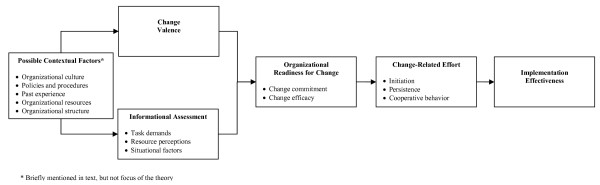
BACKGROUND: Change management experts have emphasized the importance of establishing organizational readiness for change and recommended various strategies for creating it. Although the advice seems reasonable, the scientific basis for it is limited. Unlike individual readiness for change, organizational readiness for change has not been subject to extensive theoretical development or empirical study. In this article, I conceptually define organizational readiness for change and develop a theory of its determinants and outcomes. I focus on the organizational level of analysis because many promising approaches to improving healthcare delivery entail collective behavior change in the form of systems redesign--that is, multiple, simultaneous changes in staffing, work flow, decision making, communication, and reward systems. DISCUSSION: Organizational readiness for change is a multi-level, multi-faceted construct. As an organization-level construct, readiness for change refers to organizational members' shared resolve to implement a change (change commitment) and shared belief in their collective capability to do so (change efficacy). Organizational readiness for change varies as a function of how much organizational members value the change and how favorably they appraise three key determinants of implementation capability: task demands, resource availability, and situational factors. When organizational readiness for change is high, organizational members are more likely to initiate change, exert greater effort, exhibit greater persistence, and display more cooperative behavior. The result is more effective implementation. SUMMARY: The theory described in this article treats organizational readiness as a shared psychological state in which organizational members feel committed to implementing an organizational change and confident in their collective abilities to do so. This way of thinking about organizational readiness is best suited for examining organizational changes where collective behavior change is necessary in order to effectively implement the change and, in some instances, for the change to produce anticipated benefits. Testing the theory would require further measurement development and careful sampling decisions. The theory offers a means of reconciling the structural and psychological views of organizational readiness found in the literature. Further, the theory suggests the possibility that the strategies that change management experts recommend are equifinal. That is, there is no 'one best way' to increase organizational readiness for change.
Overview
The claims and statistics of this paper haven’t been checked yet.
Run the check — free, no account needed. It reads the open-access text and checks the sources it cites.
Integrity signals
Registry
Cites
Statistics
Figures
Verification
Claims the paper makes
The claims and statistics of this paper haven’t been checked yet.
Run the check — free, no account needed. It reads the open-access text and checks the sources it cites.
Claims other papers make about this one
Each is checked against this paper’s own text: does it say what the citing paper says it does?
In the citing paper
“Weiner’s theory of organisational readiness to change [71] proposes that readiness depends on collective behaviour change linked to two key factors, described as change commitment (wanting to change) and change efficacy (able to change).”
From PARIHS revisited: from heuristic to integrated framework for the successful implementation of knowledge into practice (2015) · cites this paper as [71]
In the citing paper
“Weiner’s organizational theory of innovation implementation suggests that leaders are critical in creating readiness for change, ensuring innovation-values fit, and developing plans, practices, structures, and strategies to support implementation (Weiner, 2009).”
From The Roles of System and Organizational Leadership in System-Wide Evidence-Based Intervention Sustainment: A Mixed-Method Study (2016) · cites this paper as Weiner, 2009
In the citing paper
“Organizational readiness for change theory postulates that a higher level of organizational readiness increases the success of innovation adoption and decreases the risk of failure (Snyder-Halpern 2001;Weiner 2009).”
From Ready or not, AI comes—an interview study of organizational AI readiness factors (2021) · cites this paper as Weiner 2009
Self-check
Percentages, sums and reported differences re-computed from the paper’s own numbers.
The self-check needs the paper’s full text.
Citations
Cites
Self-efficacy: The exercise of control
Bandura, A., Freeman, W. H., & Lightsey, R. (1999) · Journal of Cognitive Psychotherapy · doi:10.1891/0889-8391.13.2.158 · Cited by 46,835
(1975) · PhilPapers (PhilPapers Foundation) · Cited by 36,737
Psychometric theory (2nd ed.).
Sitgreaves, R. (1979) · Contemporary Psychology · doi:10.1037/018882 · Cited by 14,384
(1964) · Medical Entomology and Zoology · Cited by 10,439
Commitment in the workplace: toward a general model
Meyer, J. P., & Herscovitch, L. (2001) · Human Resource Management Review · doi:10.1016/s1053-4822(00)00053-x · Cited by 3,856
Self-Efficacy: A Theoretical Analysis of Its Determinants and Malleability
Gist, M. E., & Mitchell, T. R. (1992) · Academy of Management Review · doi:10.5465/amr.1992.4279530 · Cited by 3,713
Field Theory in Social Science: Selected Theoretical Papers.
Price, D. O., Lewin, K., & Cartwright, D. (1951) · American Sociological Review · doi:10.2307/2087618 · Cited by 3,519
Exercise of Human Agency Through Collective Efficacy
Bandura, A. (2000) · Current Directions in Psychological Science · doi:10.1111/1467-8721.00064 · Cited by 3,294
The Challenge of Innovation Implementation
Klein, K. J., & Sorra, J. S. (1996) · The Academy of Management Review · doi:10.2307/259164 · Cited by 2,113
Creating Readiness for Organizational Change
Armenakis, A. A., Harris, S. G., & Mossholder, K. W. (1993) · Human Relations · doi:10.1177/001872679304600601 · Cited by 2,061
Research works printed but not linked: 5
- Kotter JP: Leading change. 1996, Boston: Harvard Business Press
- Bandura A: Social foundations of thought and action: a social cognitive theory. 1986, Englewood Cliffs, N.J.: Prentice-Hall
- Turner D, Crawford M: Change Power: Capabilities that Drive Corporate Renewal. 1998, Warriewood, Australia: Business & Professional Publishing
- Nunnally JC: Psychometric theory. 1978, New York: McGraw-Hill, 2
- Elise LL, Steven VO: A measure of self-care self-efficacy. 1996, 19: 421-429.
Cited by
Sorted by citations
Items 801–900 of 1,001
Commentary on the Culture of Prevention
Sloboda, Z., & David, S. B. (2020) · Prevention Science · doi:10.1007/s11121-020-01158-8 · Cited by 11
Vaskinn, L., Waaler, P. M., Mellblom, A. V., Bjørkli, C. A., & Kjøbli, J. (2021) · Residential Treatment for Children & Youth · doi:10.1080/0886571x.2021.2007826 · Cited by 9
Challenges of Perinatal Depression Care in Mexico City Health Centers
Navarrete, L., Lara, M. A., Berenzon, S., & Mora-Ríos, J. (2022) · International Journal of Women s Health · doi:10.2147/ijwh.s381196 · Cited by 9
Using cognitive interviews to improve a measure of organizational readiness for implementation
McClam, M., Workman, L. M., Dias, E., Walker, T. J., Brandt, H. M., Craig, D. W., Gibson, R. W., Lamont, A. E., Weiner, B. J., Wandersman, A., et al. (2023) · BMC Health Services Research · doi:10.1186/s12913-022-09005-y · Cited by 11
Self-citationZhang, X., Peng, M., He, M., Du, M., Jiang, M., Cui, M., Cai, Y., Yan, Q., & Wang, Y. (2024) · BMC Nursing · doi:10.1186/s12912-023-01694-y · Cited by 15
Mangla, N., & Singh, K. (2024) · International Journal of Global Business and Competitiveness · doi:10.1007/s42943-024-00092-8 · Cited by 9
van de Water, B. J., Renning, K., Nindi-Nyondo, A., et al. (2024) · BMC Nursing · doi:10.1186/s12912-024-02036-2 · Cited by 9
Anaraki, N. R., Mukhopadhyay, M., Jewer, J., Patey, C., Norman, P., Hurley, O., Etchegary, H., & Asghari, S. (2024) · BMC Health Services Research · doi:10.1186/s12913-024-11345-w · Cited by 12
van de Water, B. J., Longacre, A. H., Hotchkiss, J., et al. (2024) · BMC Health Services Research · doi:10.1186/s12913-024-11435-9 · Cited by 9
Han, F., & Zhang, D. (2024) · Heliyon · doi:10.1016/j.heliyon.2024.e37267 · Cited by 9
Network Integration as a Tool for Sustainable Business Development
Shmeleva, N., Tolstykh, T. O., Krasnobaeva, V., et al. (2024) · Sustainability · doi:10.3390/su16219353 · Cited by 9
Moving balance and mobility evidence in to action: A primer in knowledge translation
Sibley, K. M., Straus, S. E., Webster, F., & Jaglal, S. B. (2011) · Gait & Posture · doi:10.1016/j.gaitpost.2011.03.002 · Cited by 9
Leading curriculum changes in schools: The role of school principals as perceived by teachers
Wyk, A. V. (2020) · Perspectives in Education · doi:10.18820/2519593x/pie.v38.i2.10 · Cited by 9
Donkor, A., Luckett, T., Aranda, S. K., Vanderpuye, V. D. N. K., & Phillips, J. L. (2021) · BMC Health Services Research · doi:10.1186/s12913-021-06274-x · Cited by 9
Adopting Artificial Intelligence in the Saudi Arabian Public Sector: Preliminary Findings
Alshahrani, A., Dennehy, D., & Mäntymäki, M. (2021) · Lecture notes in computer science · doi:10.1007/978-3-030-85447-8_7 · Cited by 10
Haffar, M., Al-Hyari, K. A., Djebarni, R., et al. (2022) · Total Quality Management & Business Excellence · doi:10.1080/14783363.2022.2054695 · Cited by 9
Zeeb, H., Brandes, M., Bauer, U., Forberger, S., Gelius, P. C., Muellmann, S., Okan, O., Pfeifer, K., Renner, B., & Wright, M. T. (2022) · Das Gesundheitswesen · doi:10.1055/a-1816-3398 · Cited by 9
Mwanza, J., Kawonga, M., Kumwenda, A., Gray, G., Mutale, W., & Doherty, T. (2022) · Global Health Action · doi:10.1080/16549716.2022.2126269 · Cited by 9
Memmini, A. K., Kinnett-Hopkins, D., Hasson, R. E., Rifat, S. F., & Broglio, S. P. (2023) · Journal of Head Trauma Rehabilitation · doi:10.1097/htr.0000000000000862 · Cited by 10
Contractors’ Environmental Sustainability: The Roles of Innovativeness and Market Orientation
Bamgbade, J. A., Mohammed, K. A., & Nawi, M. N. M. (2016) · Cited by 9
Abrahamsen, C. S., Nørgaard, B., & Draborg, E. (2016) · International Journal of Orthopaedic and Trauma Nursing · doi:10.1016/j.ijotn.2016.10.002 · Cited by 9
Dahlvig, J. E. (2018) · Christian Higher Education · doi:10.1080/15363759.2018.1404819 · Cited by 9
Widayati, A., Virginia, D., Setiawan, C., Fenty, F., Donowati, M. W., Christasani, P. D., Hartayu, T., Suhadi, R., Saini, B., & Armour, C. (2018) · Research in Social and Administrative Pharmacy · doi:10.1016/j.sapharm.2018.01.008 · Cited by 7
Maddigan, J., Butler, M., & Davidson, J. E. (2019) · Healthcare Management Forum · doi:10.1177/0840470419849612 · Cited by 9
Panjaitan, J. M. P., Darwin, M. M., Bastian, I., & Sukamdi, S. (2020) · Gadjah Mada International Journal of Business · doi:10.22146/gamaijb.53968 · Cited by 9
Pandemic anxiety and its correlates among young doctors working frontline in Pakistan
Rashid, A., & Faisal, K. (2020) · Cambridge Prisms Global Mental Health · doi:10.1017/gmh.2020.22 · Cited by 9
Keegan, R. J., Stoljarova, S., Kessler, L., & Jack, S. (2020) · Journal of Applied Sport Psychology · doi:10.1080/10413200.2020.1833378 · Cited by 9
Toccafondi, G., Marzo, F. D., Sartelli, M., et al. (2020) · International Journal for Quality in Health Care · doi:10.1093/intqhc/mzaa137 · Cited by 9
Business analytics practices and managerial implications based on the evidence from Korea
Min, H. (2021) · American Journal of Business · doi:10.1108/ajb-05-2020-0066 · Cited by 9
An Organizational Change With Quarantined Members
Mattar, D. M. (2021) · SAGE Open · doi:10.1177/2158244020988851 · Cited by 9
Hjort (2021) · doi:10.1136/bmjopen-2020-042728 · Cited by 11
Bolton, R. E., Bokhour, B. G., Dvorin, K., Wu, J., Elwy, A. R., Charns, M. P., & Taylor, S. L. (2021) · The Journal of Alternative and Complementary Medicine · doi:10.1089/acm.2020.0383 · Cited by 9
Mandel, D. R., Hendriks, T., & Irwin, D. (2021) · Intelligence and national security · doi:10.1080/02684527.2021.1999621 · Cited by 7
Hearld, L. R., Hall, A. G., Kelly, R. J., Karabukayeva, A., & Singh, J. A. (2021) · Journal of Health Organization and Management · doi:10.1108/jhom-10-2020-0397 · Cited by 9
Means, A. R., Orlan, E., Gwayi-Chore, M.-C., et al. (2021) · Implementation Science Communications · doi:10.1186/s43058-021-00164-3 · Cited by 9
Self-citationPromoting Physical Activity in Rural Settings: Effectiveness and Potential Strategies
Smith, W. J., Martin, M. Y., Pisu, M., Oster, R. A., Qu, H., Shewchuk, R. M., Sheffield, M. E., Minter, A. R., Baumann, A. A., & Rogers, L. Q. (2021) · Translational Journal of the American College of Sports Medicine · doi:10.1249/tjx.0000000000000180 · Cited by 9
Martin, A., & Hatzidimitriadou, E. (2021) · Health & Social Care in the Community · doi:10.1111/hsc.13653 · Cited by 9
A Framework for Equitable Partnerships to Promote Cancer Prevention and Control in Rural Settings
Ko, L. K., Scarinci, I. C., Bouchard, E., Drake, B. F., Rodriguez, E. M., Chen, M. S., Kepka, D., Kruse‐Diehr, A. J., Befort, C. A., Shannon, J., et al. (2022) · JNCI Cancer Spectrum · doi:10.1093/jncics/pkac017 · Cited by 11
Readiness for Organizational Change
Rismansyah, R., Adam, M., Hanafi, A., & Yuliani, Y. (2022) · Advances in economics, business and management research/Advances in Economics, Business and Management Research · doi:10.2991/aebmr.k.220304.047 · Cited by 9
Qualitative analysis of a community pharmacy practice transformation initiative
Bacci, J. L., Ferreri, S. P., Coley, K. C., Daly, C. J., Hake, K. L., Herbert, S. M. C., Hughes, T. D., McDonough, R. P., Roller, J., McGivney, M. S., et al. (2022) · JACCP JOURNAL OF THE AMERICAN COLLEGE OF CLINICAL PHARMACY · doi:10.1002/jac5.1728 · Cited by 9
Hazelzet, E., Houkes, I., Bosma, H., & de Rijk, A. E. (2022) · BMC Public Health · doi:10.1186/s12889-022-14754-w · Cited by 8
Packard, T. R., McCrae, J. S., Phillips, J. D., & Scannapieco, M. (2015) · Human Services Organizations Management Leadership & Governance · doi:10.1080/23303131.2015.1067268 · Cited by 12
Organizational Change – Technology Transfer Processes: A Review of the Literature
Taxman, F. S., & Belenko, S. R. (2011) · Springer eBooks · doi:10.1007/978-1-4614-0412-5_4 · Cited by 9
A relação entre atributos, atitudes e bem-estar na mudança organizacional
Franco, K. S., Neiva, E. R., Nery, V. D. F., & Demo, G. (2016) · Psicologia Teoria e Pesquisa · doi:10.1590/0102-3772e32ne219 · Cited by 9
Setting a Nigeria national malaria operational research agenda: the process
Ajumobi, O. O., Uhomoibhi, P., Onyiah, P., et al. (2018) · BMC Health Services Research · doi:10.1186/s12913-018-3224-5 · Cited by 9
NHS managers’ use of nursing workforce planning and deployment technologies: a realist synthesis
Burton, C. R., Rycroft‐Malone, J., Williams, L., Davies, S., McBride, A., Hall, B., Rowlands, A.-M., Jones, A., Fisher, D., Jones, M., et al. (2018) · Health Services and Delivery Research · doi:10.3310/hsdr06360 · Cited by 9
Electronic Health Records Implementation Readiness: An Integrative Review
Alsadi, M., & Saleh, A. (2019) · Open Journal of Nursing · doi:10.4236/ojn.2019.92014 · Cited by 9
Accelerating innovation and protecting organizations: Pluralism in the COVID‐19 age
Rosa, J. A. (2021) · Journal of Product Innovation Management · doi:10.1111/jpim.12568 · Cited by 9
Sundar, V., & Brucker, D. L. (2022) · Journal of occupational rehabilitation · doi:10.1007/s10926-022-10055-6 · Cited by 8
Bleses, D., Willemsen, M. M., Purtell, K. M., Justice, L. M., Slot, P. L., Dybdal, L., & Højen, A. (2022) · Early Childhood Research Quarterly · doi:10.1016/j.ecresq.2022.12.006 · Cited by 11
Hazim, C., Dobe, I., Pope, S., Ásbjörnsdóttir, K., Augusto, O. J., Bruno, F., Chicumbe, S., Lumbandali, N., Mate, I., Ofumhan, E., et al. (2024) · Implementation Science Communications · doi:10.1186/s43058-024-00564-1 · Cited by 9
Batterham, P. J., Allenhof, C., Pashoja, A. C., Etzelmueller, A., Fanaj, N., Finch, T. L., Freund, J., Hanssen, D. J. C., Mathiasen, K., Piera-Jiménez, J., et al. (2024) · Implementation Research and Practice · doi:10.1177/26334895241245448 · Cited by 11
Gustafsson, C., & Dannapfel, P. (2024) · Disability and Rehabilitation Assistive Technology · doi:10.1080/17483107.2024.2352130 · Cited by 15
Gauging the Technology Acceptance of Manufacturing Employees: A New Measure for Pre-Implementation
Haynes, K., Harris, G. A., Schall, M. C., Liu, J., & Davis, J. (2024) · Sustainability · doi:10.3390/su16124969 · Cited by 8
Santos, P. D. O., Alves, J. L., & de Carvalho, M. M. (2024) · International Journal of Managing Projects in Business · doi:10.1108/ijmpb-02-2024-0044 · Cited by 9
Pike, K. E., Li, L., Naismith, S. L., Bahar‐Fuchs, A., Lee, A., Mehrani, I., Bentvelzen, A. C., Lautenschlager, N. T., O’Connell, M. E., Blackberry, I., et al. (2024) · Neuropsychology Review · doi:10.1007/s11065-024-09650-6 · Cited by 11
Iglesias, I., Marinich, J. A., Anechina, L. R., et al. (2024) · Pharmaceutical Medicine · doi:10.1007/s40290-024-00542-x · Cited by 8
Organizational readiness for implementation: a qualitative assessment to explain survey responses
McClam, M., Workman, L. M., Walker, T. J., Dias, E., Craig, D. W., Padilla, J. R., Lamont, A. E., Wandersman, A. H., & Fernández, M. E. (2025) · BMC Health Services Research · doi:10.1186/s12913-024-12149-8 · Cited by 8
Overcoming Barriers to Using Patient-Reported Outcomes for Clinical Inquiry
Javier, M. L. C., Kim, J. Y., Toone, E., & Granger, B. B. (2016) · AACN Advanced Critical Care · doi:10.4037/aacnacc2016265 · Cited by 8
André, B., Heldal, F., Sjøvold, E., et al. (2021) · Frontiers in Psychology · doi:10.3389/fpsyg.2020.607943 · Cited by 8
Ranjan, P., Usher, E. M., Bates, H. T., Zimmerman, E. K., Tyndall, J., Morris, C. J., Koontz, T. M., & Prokopy, L. S. (2022) · Journal of Hydrology · doi:10.1016/j.jhydrol.2022.127584 · Cited by 8
Mayesti, N., Huang, C. H., Azmir, A. F., et al. (2024) · Digital Library Perspectives · doi:10.1108/dlp-05-2023-0041 · Cited by 8
Alarifi, A. A., Althnayan, S., Bajaba, S. M., & Liu, Y. (2024) · Current Psychology · doi:10.1007/s12144-024-05726-x · Cited by 8
Jackson, G. L., Fix, G. M., White, B. S., Cutrona, S. L., Reardon, C. M., Damschroder, L. J., Burns, M., DeLaughter, K. L., Widerquist, M. A. O., Arasim, M. E., et al. (2024) · Frontiers in Health Services · doi:10.3389/frhs.2023.1223277 · Cited by 9
Mah, S., Teare, G. F., Law, J., & Adhikari, K. (2024) · BMC Health Services Research · doi:10.1186/s12913-024-10676-y · Cited by 8
Rey, L., Brousselle, A., Dedobbeleer, N., & Tremblay, M. (2013) · Canadian Journal of Program Evaluation · doi:10.3138/cjpe.028.001 · Cited by 7
Praet, E. V., & Leuven, S. V. (2018) · International Journal of Business Communication · doi:10.1177/2329488418808017 · Cited by 9
Nawi, M. N. M., Noordin, A., Tamrin, N., et al. (2019) · Ekoloji · Cited by 8
Davis, M. T., Torres, M., Nguyen, A., Stewart, M. T., & Reif, S. (2019) · Journal of Social Work · doi:10.1177/1468017319867834 · Cited by 8
Clinic-Based Community Health Worker Integration
Lee, L., Lewis, C. M., & Montgomery, S. (2019) · Journal of Ambulatory Care Management · doi:10.1097/jac.0000000000000320 · Cited by 8
Deng, Q., Lu, J., Zeng, Z., Zheng, Y., & Liu, W. (2021) · Risk Management and Healthcare Policy · doi:10.2147/rmhp.s293144 · Cited by 8
Brogan, L. A., McPhee, J., Gale-Bentz, E. W., Rudd, B. N., & Goldstein, N. E. S. (2021) · Behavioral Sciences & the Law · doi:10.1002/bsl.2497 · Cited by 11
Behrens, L. L., Boltz, M. P., Riley, K., Eshraghi, K. J., Resnick, B. M., Galik, E. M., Ellis, J., Kolanowski, A. M., & Haitsma, K. S. V. (2021) · BMC Health Services Research · doi:10.1186/s12913-021-07001-2 · Cited by 8
Travis, D. J., Vazquez, C. E., Spence, R., & Brooks, D. (2021) · Journal of Religion and Health · doi:10.1007/s10943-021-01235-4 · Cited by 10
Chang, J. C. H., Sears, C., Bitencourt, N., Peterson, R. G., Alperin, R. A., Goh, Y. I., Overbury, R. S., Sadun, R. E., Smitherman, E. A., White, P. H. P., et al. (2021) · Arthritis Care & Research · doi:10.1002/acr.24822 · Cited by 8
Islam, M. S., Tarannum, S., Banu, S., Chowdhury, K. I. A., Nazneen, A., Chughtai, A. A., & Seale, H. (2022) · PLoS ONE · doi:10.1371/journal.pone.0263115 · Cited by 11
Analysis of Critical Success Factors for Successfully Conducting Digitalization Projects
Leyh, C., Köppel, K., Neuschl, S., et al. (2022) · Lecture notes in business information processing · doi:10.1007/978-3-030-98997-2_1 · Cited by 8
Nguyen, X.-A., Luong, D., Le, T.-P.-T., Hoang, T.-D., & Tran, T.-G. (2022) · Asian Research Journal of Arts & Social Sciences · doi:10.9734/arjass/2022/v18i330351 · Cited by 10
Love, P., Laws, R., Taki, S., West, M. L., Hesketh, K. D., & Campbell, K. J. (2022) · Frontiers in Health Services · doi:10.3389/frhs.2022.1031628 · Cited by 9
DATA SCIENCE FOR SMALL AND MEDIUM-SIZED ENTERPRISES: A STRUCTURED LITERATURE REVIEW
Rautenbach, S., Kock, I. D., & Grobler, J. (2022) · The South African Journal of Industrial Engineering · doi:10.7166/33-3-2797 · Cited by 8
Organizational readiness for building information modeling
Magalhães, R. M., Mello, L. D., & Hippert, M. A. S. (2023) · Frontiers in Engineering and Built Environment · doi:10.1108/febe-07-2022-0028 · Cited by 8
ÖĞRETMENLERİN ÖZ-YETERLİKLERİ İLE DEĞİŞİME HAZIR OLMA DURUMLARI ARASINDAKİ İLİŞKİNİN İNCELENMESİ
Aslan, H., Arzu, B. A. L., AKBULUT, S., et al. (2023) · Scientific Educational Studies · doi:10.31798/ses.1270645 · Cited by 8
Smith, K., Firth, K., Smeeding, S. J. W., Wolever, R. Q., Kaufman, J., Delgado, R. E., Bellanti, D. M., & Xenakis, L. (2015) · EXPLORE · doi:10.1016/j.explore.2015.10.002 · Cited by 8
Kemper, P. F., van Dyck, C., Wagner, C., Wouda, L., & de Bruijne, M. C. (2014) · The Joint Commission Journal on Quality and Patient Safety · doi:10.1016/s1553-7250(14)40041-2 · Cited by 7
Hoff, T. J., & Scott, S. (2016) · Health Care Management Review · doi:10.1097/hmr.0000000000000109 · Cited by 8
Delivering Value Through Evidence-Based Practice
Macias, C. G., Loveless, J., Jackson, A. N., et al. (2017) · Clinical Pediatric Emergency Medicine · doi:10.1016/j.cpem.2017.05.002 · Cited by 8
Small City School Districts’ Capacity for Improvement and the Struggle for Educational Equity
Duke, D. L., & VanGronigen, B. A. (2018) · Urban Education · doi:10.1177/0042085918772625 · Cited by 8
Geller, G., Caldwell, M. T., & Merritt, M. W. (2018) · Journal of College and Character · doi:10.1080/2194587x.2018.1481100 · Cited by 9
Harun, A., & Mansor, Z. (2019) · International Journal of Advanced Computer Science and Applications · doi:10.14569/ijacsa.2019.0100116 · Cited by 9
Lisle, J. D. (2016) · Studies In Educational Evaluation · doi:10.1016/j.stueduc.2016.06.004 · Cited by 9
Planning and Organizing the Change Process
Grol, R. P. T. M., & Wensing, M. (2020) · doi:10.1002/9781119488620.ch4 · Cited by 8
Kemei, R. C. (2014) · Cited by 8
Alzghaibi, H. (2019) · doi:10.23889/suthesis.52386 · Cited by 7
Manalili, K., Scott, C. M., O’Beirne, M., Hemmelgarn, B. R., & Santana, M. (2022) · BMJ Open · doi:10.1136/bmjopen-2021-060441 · Cited by 10
Kalbarczyk, A., Rao, A., & Alonge, O. (2024) · Frontiers in Public Health · doi:10.3389/fpubh.2023.1302756 · Cited by 7
Ansah, R. O., Abubakari, Z., Quaye, B. A., et al. (2024) · Land · doi:10.3390/land13040528 · Cited by 7
Communication climate and organisational trust to readiness for change in higher education
Erlyani, N., Saphira, Y., Hartono, V. L., Justina, A., Zwagery, R. V., Suhariadi, F., & Ardi, R. (2024) · SA Journal of Industrial Psychology · doi:10.4102/sajip.v50i0.2092 · Cited by 8
A typology of organizational readiness for change based on a latent profile analysis
Köhler, A., Ritter, M., & Kauffeld, S. (2024) · Frontiers in Psychology · doi:10.3389/fpsyg.2024.1453836 · Cited by 8
Atzmon, O., Crowther, M. E., Bei, B., & O’Connor, D. A. (2025) · Implementation Science · doi:10.1186/s13012-025-01435-6 · Cited by 13
Trauma-Informed Care Training: a Systemwide Process to Transform the Act of Caring
Keesler, J., Samways, B., & McNally, P. (2025) · Advances in Neurodevelopmental Disorders · doi:10.1007/s41252-025-00449-x · Cited by 8
Metadata
- Authors
- Weiner, B. J.
- Affiliations
- University of North Carolina at Chapel Hill (US)
- Corresponding author
- Weiner, Bryan J
- ORCID
- Weiner, Bryan J
- Venue
- Implementation Science
- Published
- 2009-10-19
- Volume
- 4
- Issue
- 1
- Pages
- 67-67
- ISSN
- 1748-5908 (ISSN-L)
- PMC
- PMC2770024
- OpenAlex
- W2170135023
- Cited by
- 2,268
- References
- 75
- Citations by year
- 2026: 264 · 2025: 182 · 2024: 224 · 2023: 190 · 2022: 229 · 2021: 233 · 2020: 187 · 2019: 153 · 2018: 141 · 2017: 108 · 2016: 84 · 2015: 85 · 2014: 76 · 2013: 52 · 2012: 28
- FWCI
- 33.09
- Type
- journal article
- Language
- en
- Open access
- gold
- doi.org
- Licence
- Locations
- Implementation Science (publishedVersion, cc-by)
- PubMed Central (publishedVersion, cc-by)
- PubMed (publishedVersion)
- DOAJ (DOAJ: Directory of Open Access Journals) (submittedVersion)
- Funders
- National Cancer Institute (R01CA124402)
- Topics
- Social Sciences › Business, Management and Accounting › Organizational Behavior and Human Resource Management › Organizational Change and Leadership
- Health Sciences › Health Professions › General Health Professions › Health Policy Implementation Science
- Social Sciences › Business, Management and Accounting › Organizational Behavior and Human Resource Management › Organizational Management and Change
- Keywords
- organizational preparedness, change management, commitment to change, change efficacy, health care delivery improvement, task demands, resource availability, situational factors, implementation capability, organizational change theory
About these checks
Registry, retraction, Cites and statistics results are computed, not judged, with one exception: a printed reference that no index lists is read once by a model before it counts as a citation error. Claims are extracted by a model and kept only when their quote appears verbatim in the text; each cited source is then checked, with a model’s help, for whether it says what the claim relies on. Those verdicts can be wrong — read the claim’s quote and the cited source before relying on one.
Statistics and arithmetic are recomputed, not judged.
Confidence bands are shown only for fields calibrated on our annotated test set. None is calibrated yet, so no band is shown.
What counts as a claim ›How we measure confidence ›How we check this ›
Are you an author, or do you see a problem with this page? Request a review
