

Dynamic adaptation process to implement an evidence-based child maltreatment intervention
Open accessThe DOI matches its Crossref record; 59 of the 60 references it cites were found in a registry or an index.
Abstract
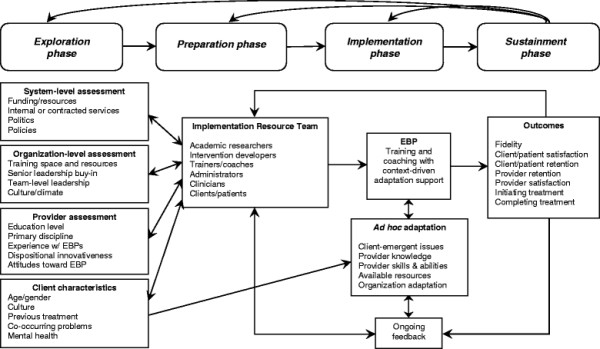
BACKGROUND: Adaptations are often made to evidence-based practices (EBPs) by systems, organizations, and/or service providers in the implementation process. The degree to which core elements of an EBP can be maintained while allowing for local adaptation is unclear. In addition, adaptations may also be needed at the system, policy, or organizational levels to facilitate EBP implementation and sustainment. This paper describes a study of the feasibility and acceptability of an implementation approach, the Dynamic Adaptation Process (DAP), designed to allow for EBP adaptation and system and organizational adaptations in a planned and considered, rather than ad hoc, way. The DAP involves identifying core elements and adaptable characteristics of an EBP, then supporting implementation with specific training on allowable adaptations to the model, fidelity monitoring and support, and identifying the need for and solutions to system and organizational adaptations. In addition, this study addresses a secondary concern, that of improving EBP model fidelity assessment and feedback in real-world settings. METHODS: This project examines the feasibility, acceptability, and utility of the DAP; tests the degree to which fidelity can be maintained using the DAP compared to implementation as usual (IAU); and examines the feasibility of using automated phone or internet-enabled, computer-based technology to assess intervention fidelity and client satisfaction. The study design incorporates mixed methods in order to describe processes and factors associated with variations in both how the DAP itself is implemented and how the DAP impacts fidelity, drift, and adaptation. The DAP model is to be examined by assigning six regions in California (USA) to either the DAP (n=3) or IAU (n=3) to implement an EBP to prevent child neglect. DISCUSSION: The DAP represents a data-informed, collaborative, multiple stakeholder approach to maintain intervention fidelity during the implementation of EBPs in the field by providing support for intervention, system, and organizational adaptation and intervention fidelity to meet local needs. This study is designed to address the real-world implications of EBP implementation in public sector service systems and is relevant for national, state, and local service systems and organizations.
Overview
The claims and statistics of this paper haven’t been checked yet.
Free: it reads the open-access text and checks the first 5 claims that cite a source we can check. Create a free account to check every claim.
Integrity signals
Registry
Cites
Statistics
Figures
Verification
Claims the paper makes
The claims and statistics of this paper haven’t been checked yet.
Free: it reads the open-access text and checks the first 5 claims that cite a source we can check. Create a free account to check every claim.
Claims other papers make about this one
Each is checked against this paper’s own text: does it say what the citing paper says it does?
The cited source says what the claim attributes to it.
In the citing paper
“ongoing adjustment and evaluation of EBT to ensure that a program is response to the local context provides an opportunity to increase intervention effectiveness over time (Aarons et al., 2012; Chambers et al., 2013)”
From User‐centered design for psychosocial intervention development and implementation. (2016) · cites this paper as Aarons et al., 2012
The cited source says what the claim attributes to it.
In the citing paper
“there has been little research focused explicitly on procedures for realizing this goal (Aarons et al., 2012; Lyon et al., 2014c).”
From User‐centered design for psychosocial intervention development and implementation. (2016) · cites this paper as Aarons et al., 2012
The cited source says what the claim attributes to it.
In the citing paper
“The DAP [69] is a multicomponent implementation strategy directly drawn from the EPIS framework.”
From Ten recommendations for using implementation frameworks in research and practice (2020) · cites this paper as [69]
The cited source says what the claim attributes to it.
In the citing paper
“A critical and core component of the DAP is the creation of an Implementation Resource Team that is a multiple stakeholder collaborative designed to support implementation, data interpretation, and explicitly address adaptations during the implementation process.”
From Ten recommendations for using implementation frameworks in research and practice (2020) · cites this paper as [69]
The cited source says what the claim attributes to it.
In the citing paper
“The DAP uses an iterative, data-informed approach to facilitate implementation across each phase of EPIS.”
From Ten recommendations for using implementation frameworks in research and practice (2020) · cites this paper as [69]
Self-check
Percentages, sums and reported differences re-computed from the paper’s own numbers.
The self-check needs the paper’s full text.
Citations
Cites
Qualitative research and evaluation methods
Patton, M. Q. (1980) · Cited by 35,734
Damschroder, L. J., Aron, D. C., Keith, R. E., Kirsh, S. R., Alexander, J. A., & Lowery, J. C. (2009) · Implementation Science · doi:10.1186/1748-5908-4-50 · Cited by 14,496 · cited 1×
“, organization) to effectively implement EBPs [13,14].”
Weighted kappa: nominal scale agreement provision for scaled disagreement or partial credit
Cohen, J. (1968) · Psychological Bulletin · doi:10.1037/h0026256 · Cited by 8,736
Diffusion of Innovations in Service Organizations: Systematic Review and Recommendations
GREENHALGH, T., ROBERT, G., MACFARLANE, F., BATE, P., & KYRIAKIDOU, O. (2004) · The Milbank Quarterly · doi:10.1111/j.0887-378x.2004.00325.x · Cited by 7,448 · cited 1×
“The interplay of characteristics of an intervention with service system and organizational characteristics (system, organization, provider, and client levels) can be complex [12].”
Background(2005) · Cited by 3,748
Advancing a Conceptual Model of Evidence-Based Practice Implementation in Public Service Sectors
Aarons, G. A., Hurlburt, M., & Horwitz, S. M. (2011) · Administration and Policy in Mental Health and Mental Health Services Research · doi:10.1007/s10488-010-0327-7 · Cited by 3,240
Self-citationSchuirmann, D. J. (1987) · Journal of Pharmacokinetics and Biopharmaceutics · doi:10.1007/bf01068419 · Cited by 2,696
Piaget, J. (1976) · Piaget and His School · doi:10.1007/978-3-642-46323-5_2 · Cited by 2,167
Carmichael's Manual of Child Psychology
Sigel, I. E., & Mussen, P. H. (1972) · American Educational Research Journal · doi:10.2307/1161696 · Cited by 2,053
The Handbook of Research Synthesis.
Light, R. J., Cooper, H., & Hedges, L. V. (1994) · Journal of the American Statistical Association · doi:10.2307/2291021 · Cited by 1,868
Research works printed but not linked: 5
- Kauffman Foundation Best Practices Project Kaufman best practices project final report: Closing the quality chasm in child abuse treatment: Identifying and disseminating best practices 2004 Ewing Marion Kauffman Foundation, Kansas
- Rogers EM Diffusions of innovations 1995 4 The Free Press, New York
- Webster New College Dictionary 1995 Houghton Mifflin Company, Boston
- Whitaker D Lutzker J Self-Brown S Edwards A Implementing and evidence-based program for the prevention of child maltreatment: The SafeCare® program Report on Emotional & Behavioral Disorders in Youth 2008 8 55 62
- Fraser D QSR NVivo reference guide 2000 QSR International, Melbourne
Cited by
Items 101–200 of 489
Understanding adaptations to patient-centered medical home activities: The PCMH adaptations model
Hall, T. L., Holtrop, J. S., Dickinson, L. M., & Glasgow, R. E. (2017) · Translational Behavioral Medicine · doi:10.1007/s13142-017-0511-3 · Cited by 37
Walker, S. C., Whitener, R. J., Trupin, E. W., & Migliarini, N. (2013) · Administration and Policy in Mental Health and Mental Health Services Research · doi:10.1007/s10488-013-0530-4 · Cited by 38
“2007) and local agencies are often performing ad hoc adaptations in order to align services with perceived local needs (Aarons et al. 2012; Bumbarger and Campbell 2012).”
BackgroundInfluentialHohmeier, K. C., Wheeler, J. S., Turner, K., Vick, J. S., Marchetti, M. L., Crain, J., & Brookhart, A. (2019) · Implementation Science · doi:10.1186/s13012-019-0946-7 · Cited by 36
Edmunds, S. R., Frost, K. M., Sheldrick, R. C., Bravo, A., Straiton, D., Pickard, K. E., Grim, V., Drahota, A., Kuhn, J., Azad, G. F., et al. (2022) · Autism · doi:10.1177/13623613211064431 · Cited by 36
“Making adaptations in a thoughtful and planned manner has already been the focus of implementation research (Aarons et al., 2012), and we believe that the CORE Fidelity Method complements and supports these efforts.”
Cross, W., West, J., Wyman, P. A., Schmeelk-Cone, K., Xia, Y., Tu, X., Teisl, M., Brown, C. H., & Forgatch, M. (2015) · Prevention Science · doi:10.1007/s11121-014-0488-9 · Cited by 34
“As others have noted (Aarons et al. 2012), adaptations of programs during implementation in real-world settings are common and can reflect positive “edits” to the intervention.”
Kangovi, S., Carter, T., Charles, D., Smith, R. A., Glanz, K., Long, J. A., & Grande, D. (2016) · Population Health Management · doi:10.1089/pop.2015.0157 · Cited by 36
“Numerous published guidelines and frameworks 2,3,8,9,10 emphasize the importance of beginning with a ‘‘manua-lized’’ EBI whose core components, structure, and protocols are well described in an intervention manual.”
Fenwick, K. M., Brimhall, K. C., Hurlburt, M. S., & Aarons, G. A. (2018) · Psychiatric Services · doi:10.1176/appi.ps.201800164 · Cited by 36
“Since ongoing supervisory monitoring and feedback are critical for implementation of EBPs and high quality clinical practice, fostering an environment that encourages openness to feedback is essential (3,10).”
BackgroundSelf-citationKim, J. J., Brookman-Frazee, L. I., Barnett, M. L., Tran, M., Kuckertz, M., Yu, S. H., & Lau, A. S. (2020) · Journal of Community Psychology · doi:10.1002/jcop.22333 · Cited by 36
“When implementing EBPs in real world settings, therapists often report the need to adapt EBPs in order to improve fit for their clients’ particular needs and circumstances (Aarons et al., 2012; Barnett et al., 2018; Lau et al., 2017; Stirman et al., 2013).”
BackgroundWiltsey Stirman, S., Finley, E. P., Shields, N., Cook, J., Haine-Schlagel, R., Burgess, J. F., Dimeff, L., Koerner, K., Suvak, M., Gutner, C. A., et al. (2017) · Implementation Science · doi:10.1186/s13012-017-0544-5 · Cited by 35
McBeath, B., Collins‐Camargo, C., Chuang, E., Wells, R., Bunger, A. C., & Jolles, M. P. (2014) · Children and Youth Services Review · doi:10.1016/j.childyouth.2014.01.014 · Cited by 35
Exploring the linkages of cognitive style and individual innovativeness
Batra, S., & Vohra, N. (2016) · Management Research Review · doi:10.1108/mrr-03-2014-0047 · Cited by 37
Pathways Forward for Embracing Evidence-Based Practice in Group Care Settings
Lee, B. R., & McMillen, J. C. (2017) · Journal of Emotional and Behavioral Disorders · doi:10.1177/1063426616688210 · Cited by 35
Knight, D. K., Joe, G. W., Morse, D. T., Smith, C. N., Knudsen, H. K., Johnson, I. D., Wasserman, G. A., Arrigona, N., McReynolds, L. S., Becan, J. E., et al. (2018) · The Journal of Behavioral Health Services & Research · doi:10.1007/s11414-018-9618-7 · Cited by 35
“Furthermore, guidance on how to initiate and maintain change can facilitate uptake and sustainability.(73) For these reasons, education about the importance of comprehensive assessment and active referral strategies (within a broader best-practice framework)(22) is incorporated into the JJ-TRIALS intervention.”
“Creative Financing”: Funding Evidence-Based Interventions in Human Service Systems
Jaramillo, E. T., Willging, C. E., Green, A. E., Gunderson, L. M., Fettes, D. L., & Aarons, G. A. (2019) · The Journal of Behavioral Health Services & Research · doi:10.1007/s11414-018-9644-5 · Cited by 33
Self-citationLocke, J. J., Kang‐Yi, C. D., Frederick, L., & Mandell, D. S. (2019) · Autism · doi:10.1177/1362361319895923 · Cited by 33
“Individual provider and organizational characteristics have been shown to be critical in the successful implementation of EBPs in non-education service sectors, such as mental health settings (Aarons et al., 2012; Beidas et al., 2013, 2014, 2016; Bonham et al., 2014).”
BackgroundSchwarz, U. V. T., Giannotta, F., Neher, M., Zetterlund, J., & Hasson, H. (2021) · Implementation Science Communications · doi:10.1186/s43058-021-00131-y · Cited by 33
“With the additional resources to manage implementation withdrawn, professionals are likely to make decisions about fidelity and adaptations under bounded conditions characterized by lack of time, information, and think-space in combination with multiple concurrent obligations [28–30], contrary to the rational, structu…”
BackgroundAschbrenner, K. A., Mueller, N., Banerjee, S., & Bartels, S. J. (2021) · Implementation Research and Practice · doi:10.1177/26334895211017252 · Cited by 33
Bennett, S., Ozawa, S., Rodríguez, D., Paul, A., Singh, K., & Singh, S. (2015) · Evaluation and Program Planning · doi:10.1016/j.evalprogplan.2015.05.003 · Cited by 33
“Implementation science acknowledges that blind fidelity to the initial intervention design may be counter-productive, and that adaptation is desirable in order to accommodate differing contextual factors or learning (Aarons et al., 2012; Bopp et al., 2013).”
BackgroundYadav, K., Stahmer, A. C., Mistry, R. D., & May, L. S. (2019) · Academic Emergency Medicine · doi:10.1111/acem.13873 · Cited by 33
Urquhart, R., Kendell, C., Cornelissen, E., Powell, B. J., Madden, L. L., Kissmann, G., Richmond, S. A., & Bender, J. L. (2021) · BMJ Open · doi:10.1136/bmjopen-2020-042503 · Cited by 32
Ramanadhan, S., Ganapathy, K., Nukala, L., Rajagopalan, S., & Camillus, J. C. (2022) · PLoS ONE · doi:10.1371/journal.pone.0261907 · Cited by 32
“We also drew on the conceptualization of sustainability in the implementation science literature as highlighted in the Exploration, Preparation, Implementation, Sustainment framework and Clinical Sustainability Assessment Tool, focusing on implementers and implementing organizations [27,28].”
MethodSanetti, L. M. H., Pierce, A. M., Gammie, L., Dugan, A. G., & Cavallari, J. M. (2022) · BMC Public Health · doi:10.1186/s12889-022-13241-6 · Cited by 32
“That is, implementation outcome data from a pilot trial within a new field, setting, or delivery method can inform data-driven intervention adaptation for a subsequent pilot trial [31].”
BackgroundGreen, A. E., Willging, C. E., Zamarin, K., Dehaiman, L. M., & Ruiloba, P. (2019) · International Journal of Educational Research · doi:10.1016/j.ijer.2018.11.005 · Cited by 21
Self-citationCOUNSELLING AS A TOOL FOR OVERCOMING BARRIERS IN STEM EDUCATION AMONG UNDERREPRESENTED GROUPS
Hamad, N. M. A., Adewusi, O. E., Unachukwu, C. C., Osawaru, B., & Chisom, O. N. (2024) · Engineering Science & Technology Journal · doi:10.51594/estj.v5i1.728 · Cited by 32
Morgan, D., Kosteniuk, J. G., Seitz, D. P., O’Connell, M. E., Kirk, A., Stewart, N. J., Holroyd-Leduc, J. M., Daku, J., Hack, T., Hoium, F., et al. (2019) · Primary Health Care Research & Development · doi:10.1017/s1463423618000968 · Cited by 31
“Thus, best practices must be tailored to community needs and resources and be sustainable while preserving effectiveness (Aarons et al., 2012; Cabassa et al., 2014).”
BackgroundRamos, G., Brookman-Frazee, L., Kodish, T., Rodriguez, A., & Lau, A. S. (2021) · Cultural Diversity & Ethnic Minority Psychology · doi:10.1037/cdp0000357 · Cited by 30
Kho, A., Daumit, G. L., Truesdale, K. P., Brown, A. F., Kilbourne, A. M., Ladapo, J. A., Wali, S., Cicutto, L. C., Matthews, A. K., Smith, J. D., et al. (2022) · Health Services Research · doi:10.1111/1475-6773.13983 · Cited by 30
“Using the Dynamic Adaptation Process, EPIS Framework and communityengaged implementation research methods based in part on the Pastors for Patient-Centered Outcomes Research model, CIRCLChicago aims to determine how components of the Kaiser Hypertension Control Bundle can be successfully adapted to the South Side of C…”
MethodGavarkovs, A. G., Blunt, W. M., & Petrella, R. J. (2018) · Evaluation and Program Planning · doi:10.1016/j.evalprogplan.2018.10.013 · Cited by 28
Aarons, G. A., Sklar, M., Ehrhart, M. G., Roesch, S., Moullin, J. C., & Carandang, K. M. (2024) · Journal of Substance Use and Addiction Treatment · doi:10.1016/j.josat.2024.209437 · Cited by 28
Self-citationHow are qualitative methods used in implementation science research? A scoping review protocol
Hagaman, A. K., Rhodes, E., Nyhan, K., Katague, M., Schwartz, A. E., & Spiegelman, D. L. (2020) · JBI Evidence Synthesis · doi:10.11124/jbies-20-00120 · Cited by 28
“Other studies leverage implementation frameworks to guide the adaptation and continuous improvement of interventions such as the Dynamic Adaptation Process, using various qualitative methods including observation, semistructured interviews, and focus groups.(26) Because qualitative research can use an inductive approa…”
MethodChung, O. S., Dowling, N. L., Brown, C., Robinson, T., Johnson, A. M., Ng, C. H., Yücel, M., & Segrave, R. A. (2022) · Administration and Policy in Mental Health and Mental Health Services Research · doi:10.1007/s10488-022-01235-w · Cited by 28
“To build on this necessary, preliminary research, there is an opportunity to apply theoretical frameworks to facilitate planning and intervention design to enhance implementation success (Aarons et al., 2012).”
BackgroundAn Integrated Strategy for the Cultural Adaptation of Evidence-Based Interventions
Sidani, S., Ibrahim, S., Lok, J., Fan, L., Fox, M. T., & Guruge, S. (2017) · Health · doi:10.4236/health.2017.94053 · Cited by 28
“However, no changes are made to the interventions’ components and activities that operationalize its specific elements because doing so may alter the elements comprising the intervention and weaken its effectiveness in improving the outcomes [3] [25] [29].”
BackgroundHill, J., Cuthel, A. M., Lin, P., & Grudzen, C. R. (2020) · Contemporary Clinical Trials Communications · doi:10.1016/j.conctc.2020.100570 · Cited by 28
Akter, F., Rahman, M. M., Pitchik, H. O., WINCH, P. J., Fernald, L. C. H., Huda, T. M. N., Jahir, T., Amin, R., Das, J. B., Hossain, K., et al. (2020) · International Journal of Environmental Research and Public Health · doi:10.3390/ijerph17176233 · Cited by 28
Aarons, G. A., Seijo, C., Green, A. E., Moullin, J. C., Hasson, H., Schwarz, U. V. T., James, S., Ehrhart, M. G., Ducarroz, S., Sevdalis, N., et al. (2019) · BMC Research Notes · doi:10.1186/s13104-019-4800-4 · Cited by 28
Self-citationTabak, R. G., Strickland, J. R., Stein, R. I., Dart, H., Colditz, G. A., Kirk, B., Dale, A. M., & Evanoff, B. (2018) · BMC Public Health · doi:10.1186/s12889-018-6176-0 · Cited by 27
“[54, 57] However, there are several models for adaptation available [88, 92, 93], and the results obtained might have been different were another model selected.”
ResultAdvancing Implementation Science Measurement
Lewis, C. C., & Dorsey, C. N. (2020) · Springer eBooks · doi:10.1007/978-3-030-03874-8_9 · Cited by 27
Siu, A. L., Zimbroff, R. M., Federman, A. D., DeCherrie, L. V., Garrido, M. M., Morano, B., Lubetsky, S., Catalan, E., & Leff, B. A. (2019) · BMC Health Services Research · doi:10.1186/s12913-019-4063-8 · Cited by 26
Hasson, R. E., Eisman, A. B., Wassmann, A., Beemer, L. R., Templin, T. J., Malinoff, L., Zernicke, R. F., & Rabaut, L. (2023) · Journal of School Health · doi:10.1111/josh.13321 · Cited by 26
Rieckmann, T. R., Moore, L. A., Croy, C. D., Aarons, G. A., & Novins, D. K. (2017) · Psychiatric Services · doi:10.1176/appi.ps.201600397 · Cited by 26
Self-citationEngell, T., Follestad, I. B., Andersen, A., & Hagen, K. A. (2018) · Trials · doi:10.1186/s13063-018-3079-4 · Cited by 27
Gray, S. M., McKay, H. A., Hoy, C. L., Lau, E. Y., Ahn, R., Lusina‐Furst, S., & Sims‐Gould, J. (2020) · Prevention Science · doi:10.1007/s11121-019-01085-3 · Cited by 26
Orengo‐Aguayo, R., Stewart, R. W., Villalobos, B. T., Rodríguez, J. H., Dueweke, A. R., de Arellano, M. A., & Young, J. N. (2020) · American Psychologist · doi:10.1037/amp0000691 · Cited by 26
Rabin, B. A., Cain, K. L., & Glasgow, R. E. (2024) · Annual Review of Public Health · doi:10.1146/annurev-publhealth-071321-041652 · Cited by 25
Jackson, G. L., Cutrona, S. L., White, B. S., Reardon, C. M., Orvek, E., Nevedal, A., Lindquist, J. H., Gifford, A. L., White, L., King, H. A., et al. (2020) · The Joint Commission Journal on Quality and Patient Safety · doi:10.1016/j.jcjq.2020.11.014 · Cited by 25
Implementing Services Integration and Interagency Collaboration: Experiences in Seven Counties
Packard, T. R., Patti, R. J., Daly, D. M., & Tucker-Tatlow, J. (2013) · Administration in Social Work · doi:10.1080/03643107.2012.714719 · Cited by 25
“Austin (2004) and others described over 20 cases of changing public human service agencies, with many based on the new expectations of the federal welfare reform legislation of 1996.”
BackgroundInfluentialAarons, G. A., Askew, R. A., Green, A. E., Yalon, A. J., Reeder, K., & Palinkas, L. A. (2019) · Journal of Children s Services · doi:10.1108/jcs-02-2018-0003 · Cited by 25
Self-citationSmigelsky, M. A., Nieuwsma, J. A., Meador, K. G., Vega, R. J., Henderson, B., & Jackson, G. L. (2020) · Healthcare · doi:10.1016/j.hjdsi.2020.100440 · Cited by 25
Turner, C. W., Robbins, M. S., Rowlands, S., & Weaver, L. R. (2017) · Child Abuse & Neglect · doi:10.1016/j.chiabu.2017.04.005 · Cited by 25
“Model adherence and fidelity are important determinants of successful interventions in community settings (Aarons et al., 2012; Chamberlain et al., 2016).”
Novins, D. K., Croy, C. D., Moore, L. A., & Rieckmann, T. (2016) · Drug and Alcohol Dependence · doi:10.1016/j.drugalcdep.2016.02.007 · Cited by 24
Terrana, A., Viglione, C., Rhee, K., Rabin, B., Godino, J., Aarons, G. A., Chapman, J., Melendrez, B., Holguin, M., Osorio, L., et al. (2024) · Frontiers in Health Services · doi:10.3389/frhs.2023.1281690 · Cited by 24
Self-citationAPPLYING AN IMPLEMENTATION RESEARCH LENS TO INDONESIA’S FREE NUTRITIOUS MEAL PROGRAM
Nurmansyah, M. I., & Fitriani, A. (2025) · Jurnal Administrasi Kesehatan Indonesia · doi:10.20473/jaki.v13i2.2025.133-141 · Cited by 24
Accurso, E. C., Mu, K. J., Landsverk, J. A., & Guydish, J. R. (2021) · Journal of Eating Disorders · doi:10.1186/s40337-021-00454-0 · Cited by 24
“’s [54] dynamic adaptation process (DAP) model, which guides the implementation process in a four-phased iterative model Through active engagement with multiple stakeholders, adaptations are made proactively in a way that honors the core components and/or principles of the evidence-based intervention.”
MethodFinno-Velasquez, M., Fettes, D. L., Aarons, G. A., & Hurlburt, M. S. (2014) · Journal of Children s Services · doi:10.1108/jcs-06-2014-0030 · Cited by 24
“Adaptations that address specific cultural issues, facilitate engagement of a unique group of clients or fit within a particular service system or organisational context may also occur during the process of EBP implementation in local community settings (Aarons et al., 2012; Lee et al., 2008).”
BackgroundSelf-citationYu, S. H., Brookman-Frazee, L. I., Kim, J. J., Barnett, M. L., Wright, B., & Lau, A. S. (2021) · Journal of Consulting and Clinical Psychology · doi:10.1037/ccp0000667 · Cited by 24
Community-Driven Health Solutions on Chicago’s South Side
Smith, J. D., Davis, P., & Kho, A. (2021) · PubMed · doi:10.48558/85p7-3113 · Cited by 24
Identifying barriers to shared decision‐making about bariatric surgery in two large health systems
Arterburn, D. E., Tuzzio, L., Anau, J., Lewis, C. C., Williams, N. A., Courcoulas, A. P., Stilwell, D., Tavakkoli, A., Ahmed, B. H., Wilcox, M. N., et al. (2023) · Obesity · doi:10.1002/oby.23647 · Cited by 23
“(Supporting Information Figure S1) [23, 24].”
BackgroundMethodInfluentialCutbush, S. L., Gibbs, D. A., Krieger, K. E., Clinton-Sherrod, M., & Miller, S. (2016) · Health Promotion Practice · doi:10.1177/1524839916672815 · Cited by 23
“Planned adaptation process, typically involving developers and other experts, are likely to produce modifications that are consistent with developers’ intent (Aarons et al., 2012; Lee et al., 2008; Wingood & DiClemente, 2008).”
BackgroundBecan, J. E., Fisher, J. H., Johnson, I. D., Bartkowski, J. P., Seaver, R., Gardner, S. K., Aarons, G. A., Renfro, T. L., Muiruri, R., Blackwell, L., et al. (2020) · Administration and Policy in Mental Health and Mental Health Services Research · doi:10.1007/s10488-019-01007-z · Cited by 23
Self-citationLane-Fall, M. B., Christakos, A., Russell, G. C., Hose, B., Dauer, E. D., Greilich, P. E., Mershon, B. H., Potestio, C. P., Pukenas, E., Kimberly, J. R., et al. (2021) · Implementation Science · doi:10.1186/s13012-021-01131-1 · Cited by 23
“the “core” versus “adaptable periphery” [78] of this intervention with this multicenter study in ways that are use-”
MethodWalker, S. C., Bumbarger, B. K., & Phillippi, S. W. (2015) · Evaluation and Program Planning · doi:10.1016/j.evalprogplan.2015.05.001 · Cited by 23
Problems in Understanding Program Efficacy in Child Welfare
Jonson‐Reid, M., & Chiang, C.-J. (2019) · Child maltreatment · doi:10.1007/978-3-030-05858-6_21 · Cited by 22
Mohammady, M., Xie, S., Hong, Y., Zhang, M., Wang, L., Pourzandi, M., & Debbabi, M. (2020) · ACM SIGSAC Conference on Computer and Communications Security (CCS) · doi:10.1145/3372297.3417259 · Cited by 22
“Significant amounts of individual information are being collected and analyzed today through a wide variety of applications across different industries [2].”
BackgroundHasson, R. E., Beemer, L. R., Eisman, A. B., & Friday, P. J. (2023) · Kinesiology Review · doi:10.1123/kr.2022-0041 · Cited by 22
Hasson, H., Rundgren, E. H., Strehlenert, H., Gärdegård, A., Uvhagen, H., Klinga, C., Rundgren, Å. H., & Schwarz, U. V. T. (2023) · Implementation Research and Practice · doi:10.1177/26334895231189198 · Cited by 22
“…incongruences mean that either EBIs end up being used in contexts that differ from where they have been shown to be effective or the content, delivery, and format are adapted to fi t the new context (Aarons et al., 2012; Mosson et al., 2017; Stirman et al., 2013; von Thiele Schwarz et al., 2019).”
Chuang, E., Ayala, G. X., Schmied, E. A., Ganter, C., Gittelsohn, J., & Davison, K. K. (2015) · Childhood Obesity · doi:10.1089/chi.2014.0049 · Cited by 23
“88,89 However, adaptation can also result in drift , that is, abandonment of core components or introduction of counterproductive elements that negatively affect intervention effectiveness.”
Collins‐Camargo, C., Chuang, E., McBeath, B., & Mak, S. (2019) · Human Services Organizations Management Leadership & Governance · doi:10.1080/23303131.2019.1606870 · Cited by 22
“, 2014) and opportunities for service innovation (Aarons et al., 2012); and community factors including the macroeconomic context and community needs (Heinrich, Lynn, & Milward, 2010).”
BackgroundNaar, S., MacDonell, K. K., Chapman, J. E., Todd, L., Gurung, S., Cain, D. N., Dilones, R. E., & Parsons, J. T. (2019) · JMIR Research Protocols · doi:10.2196/11200 · Cited by 22
“Aarons et al [26] developed the Dynamic Adaptation Process for adapting an EBP to a new context while maintaining fidelity to core elements during 4 phases of the Exploration, Preparation, Implementation, and Sustainment (EPIS) model [27].”
Sarfan, L. D., Agnew, E. R., Diaz, M., Dong, L., Fisher, K., Spencer, J. M., Howlett, S. A., Hache, R. E., Callaway, C. A., Kilbourne, A. M., et al. (2023) · Trials · doi:10.1186/s13063-023-07148-9 · Cited by 22
“Throughout REP phases 1 and 2, following leading adaptation frameworks, we sought to ensure that Adapted TranS-C would be relevant to the broadest range of patients and to account for factors that impact implementation (e.g., resources required) [66, 71, 72].”
BackgroundLovinsky‐Desir, S., Riley, I. L., Bryant-Stephens, T. C., Keyser, H. H. D., Forno, E., Kozik, A. J., Louisias, M., Matsui, E. C., Sheares, B. J., Thakur, N., et al. (2024) · Annals of the American Thoracic Society · doi:10.1513/annalsats.202407-767st · Cited by 21
“Exploration Preparation, Implementation, and Sustainment (EPIS) framework (125 – 127).”
BackgroundDoyle, K., & Hungerford, C. L. (2014) · Issues in Mental Health Nursing · doi:10.3109/01612840.2014.901452 · Cited by 21
“Reasons for this lack of clarity arise from diverse opinions related to the extent to which the core components of an evidence-based intervention must be maintained before the intervention loses fidelity (Gregory et al., 2012).”
BackgroundAndersson, E., McIlduff, C. D., Turner, K., Thomas, S., Davies, J., Elliott, E. J., & Einfeld, S. (2019) · BMJ Open · doi:10.1136/bmjopen-2019-032559 · Cited by 21
von Thiele Schwarz, U., Förberg, U., Sundell, K., & Hasson, H. (2018) · BMC Medical Research Methodology · doi:10.1186/s12874-018-0496-8 · Cited by 20
Weeks, A. (2022) · Human Services Organizations Management Leadership & Governance · doi:10.1080/23303131.2022.2033902 · Cited by 20
“Most EBP and EIP creators have encouraged adaptation for cultural and context-specific situations, but warn that adaptation to core components of the model might affect the EBPs’ or EIPs’ effectiveness (Aarons et al., 2012).”
BackgroundZetterlund, J., Schwarz, U. V. T., Hasson, H., & Neher, M. (2022) · Frontiers in Health Services · doi:10.3389/frhs.2022.883072 · Cited by 20
Locke, J. J., Corbin, C. M., Collins, V. K., Ehrhart, M. G., Goosey, R., Hatch, K., Espeland, C., Cook, C. R., & Lyon, A. R. (2024) · Implementation Research and Practice · doi:10.1177/26334895241242523 · Cited by 20
“…of evidence-based practices (EBPs), de fi ned as practices and programs shown by high-quality research to have meaningful effects on student outcomes (Aarons et al., 2012; Beidas et al., 2013, 2014, 2015; Bonham et al., 2014; Cook & Odom, 2013; Locke et al., 2019; Williams et al., 2019).”
BackgroundGetting to implementation: Adaptation of an implementation playbook
Yakovchenko, V., Rogal, S. S., Goodrich, D. E., Lamorte, C., Neely, B., Merante, M., Gibson, S. P., Scott, D., McCurdy, H. M., Nobbe, A., et al. (2023) · Frontiers in Public Health · doi:10.3389/fpubh.2022.980958 · Cited by 19
Shattuck, D. G., Willging, C. E., & Green, A. E. (2020) · Journal of School Health · doi:10.1111/josh.12964 · Cited by 19
Self-citationAdaptation in rural water, sanitation, and hygiene programs: A qualitative study in Nepal
Anderson, D. M., Gupta, A. K., Birken, S. A., Sakas, Z., & Freeman, M. C. (2022) · International Journal of Hygiene and Environmental Health · doi:10.1016/j.ijheh.2022.113919 · Cited by 19
Carcone, A. I., Coyle, K. K., Butame, S. A., Harper, G. W., Aarons, G. A., & Naar, S. (2022) · AIDS and Behavior · doi:10.1007/s10461-022-03735-0 · Cited by 19
“Independent, trained interviewers conducted one-on-one interviews via telephone using a semi-structured interview guide adapted from Aarons [39].”
MethodSelf-citationSituational analysis of breast health care systems: Why context matters
Duggan, C. R., Dvaladze, A. L., Scheel, J. R., Stevens, L. M., & Anderson, B. O. (2020) · Cancer · doi:10.1002/cncr.32899 · Cited by 19
“It is interesting to note that adaptation was identified as a necessary component of EPIS with respect to the outer and inner contexts, as well as to the implementation of the EBP.51 The Promoting Action on Research Implementation in Health Services (PARiHS) model proposes that the successful implementation of evidenc…”
ResultStrehlenert, H., Rundgren, E. H., Sjunnestrand, M., & Hasson, H. (2023) · The British Journal of Social Work · doi:10.1093/bjsw/bcad170 · Cited by 19
“In frameworks in implementation science, fidelity is often highlighted as a key factor for successful implementation (Aarons et al. , 2012; Damschroder et al. , 2022).”
Brewer, S. K., Corbin, C. M., Baumann, A. A., Stirman, S. W., Jones, J. M., Pullmann, M. D., Lyon, A. R., Panel, M. E., Aalsma, M. C., Aldridge, W. A., et al. (2024) · Implementation Science Communications · doi:10.1186/s43058-024-00592-x · Cited by 18
“For example, the Dynamic Adaptation Process (DAP) [26] supports thoughtful intervention adaptation during four phases of implementation.”
BackgroundLocke, J. J., Hugh, M. L., Pullmann, M. D., Cook, H., Coifman, J., McRee, E., Joshi, M., Lyon, A. R., & Schwartz, I. S. (2021) · International Journal of Educational Research · doi:10.1016/j.ijer.2021.101779 · Cited by 18
Bello‐Manga, H., Haliru, L., Tabari, A. M., Farouk, B. U., Suleiman, A., Bahago, G. Y., Sani, A. M., Baumann, A. A., DeBaun, M. R., & King, A. A. (2022) · BMC Research Notes · doi:10.1186/s13104-021-05885-1 · Cited by 18
Anderson, D. M., Birken, S. A., Bartram, J., & Freeman, M. C. (2022) · Frontiers in Health Services · doi:10.3389/frhs.2022.896234 · Cited by 18
Jolles, M. P., Fernández, M. E., Jacobs, G., Leon, J. D., Myrick, L., & Aarons, G. A. (2022) · Frontiers in Public Health · doi:10.3389/fpubh.2022.876769 · Cited by 18
“However, tailoring and adaptation are almost always needed, and collaboration can help to support and manage these processes (39).”
BackgroundSelf-citationThe economics of adaptations to evidence-based practices
Salloum, R. G., Wagner, T. H., Midboe, A. M., Daniels, S. I., Quanbeck, A., & Chambers, D. (2022) · Implementation Science Communications · doi:10.1186/s43058-022-00345-8 · Cited by 18
“Adaptation of EBPs has been defined as the process of “thoughtful and deliberate alteration to the design or delivery of an intervention,” with the goal of improving its fit or effectiveness in a new context [9].”
BackgroundBejerholm, U., Allaskog, C., Andersson, J., Nordström, L., & Roe, D. (2022) · Health Expectations · doi:10.1111/hex.13480 · Cited by 18
“They were related to the contextual barriers present, which is often the case.(39,40) For example, staffs' stereotypical views and negative outlook on users' capability and recovery made them deliver RG intervention towards the end of users' stay and focus on discharge issues, rather than incorporating recovery values…”
BackgroundHasson, H., Gröndal, H., Rundgren, Å. H., Avby, G., Uvhagen, H., & Schwarz, U. V. T. (2020) · Implementation Science Communications · doi:10.1186/s43058-020-00005-9 · Cited by 17
“These misfits between contexts mean that EBIs often need to be adapted to fit the new context [15, 16].”
BackgroundDissemination and Implementation of Behavioral Treatments for Anxiety in ASD
Drahota, A., Chlebowski, C., Stadnick, N. A., Baker-Ericzén, M. J., & Brookman-Frazee, L. I. (2017) · Elsevier eBooks · doi:10.1016/b978-0-12-805122-1.00012-0 · Cited by 17
Fox, M. T., Sidani, S., Butler, J. I., Skinner, M. W., & Alzghoul, M. M. (2019) · BMJ Open · doi:10.1136/bmjopen-2018-028050 · Cited by 16
“These adaptations can result in considerable intervention implementation drift to the extent that the adapted interventions no longer resemble the original ones evaluated in the trials.(16) Adapted interventions with substantial drift fail to improve outcomes, highlighting the need to work with nurses in applying a sy…”
Metz, A. J. R., Boaz, A., & Powell, B. J. (2019) · Evidence & Policy · doi:10.1332/174426419x15579811791990 · Cited by 16
“2: 24 C op yr ig ht T he P ol ic y P re ss stakeholder involvement, to support necessary and dynamic adaptations to evidence-based and evidence-informed practices and programmes at practice, organisational, systems, and policy levels to achieve desired child and family outcomes (Aarons et al, 2012).”
BackgroundLiu, F., Wang, N., & Chen, L. (2021) · Current Psychology · doi:10.1007/s12144-021-02360-9 · Cited by 16
Shattuck, D. G., Richard, B. O., Jaramillo, E. T., Byrd, E., & Willging, C. E. (2022) · Frontiers in Health Services · doi:10.3389/frhs.2022.920790 · Cited by 16
“We paired EPIS with the Dynamic Adaptation Process (DAP), an iterative data-informed methodology for tailoring each step of EIP implementation to the specific schoolcommunity contexts (59).”
MethodRaymond, I. J., Iasiello, M. P., Kelly, D., & Jarden, A. (2019) · International Journal of Applied Positive Psychology · doi:10.1007/s41042-019-00014-7 · Cited by 16
Evidence-Based Programs in “Real World” Settings: Finding the Best Fit
Powell, B. J., Bosk, E. A., Wilen, J. S., Danko, C. M., Scoyoc, A. V., & Banman, A. (2015) · Child maltreatment · doi:10.1007/978-3-319-16327-7_7 · Cited by 16
Richard, L., Torres, S., Tremblay, M., Chiocchio, F., Litvak, É., Fortin-Pellerin, L., & Beaudet, N. (2015) · BMC Health Services Research · doi:10.1186/s12913-015-0903-3 · Cited by 16
“Indeed, given the impossibility of standardizing programs across different social and complex settings, some authors have proposed to focus on the integrity (fidelity) of the program and its core components [10, 16, 18].”
BackgroundInfluentialApplication of the FRAME-IS to a multifaceted implementation strategy
Schoenthaler, A., Calle, F. D. L., León, E. D., Garcia, M., Colella, D., Nay, J., & Dapkins, I. P. (2024) · BMC Health Services Research · doi:10.1186/s12913-024-11139-0 · Cited by 15
“Previous studies have shown that planned adaptations to improve intervention fit are multidimensional and occur throughout the implementation process, without compromising the level of fidelity [1, 4, 5].”
BackgroundAssessment and Decision Making to Improve Outcomes in Child Protection
Shlonsky, A., & Mildon, R. L. (2017) · doi:10.1057/978-1-137-44130-0_8 · Cited by 15
Metadata
- Authors
- Aarons, G. A., Green, A. E., Palinkas, L. A., Self-Brown, S., Whitaker, D. J., Lutzker, J. R., Silovsky, J. F., Hecht, D. B., & Chaffin, M. J.
- Affiliations
- University of California San Diego (US)
- University of Southern California (US)
- Georgia State University (US)
- University of Oklahoma Health Sciences Center (US)
- Corresponding author
- Aarons, Gregory A
- ORCID
- Venue
- Implementation Science
- Published
- 2012-04-18
- Volume
- 7
- Issue
- 1
- Pages
- 32-32
- ISSN
- 1748-5908 (ISSN-L)
- PMC
- PMC3436717
- OpenAlex
- W2062957857
- Cited by
- 449
- References
- 60
- Citations by year
- 2026: 24 · 2025: 33 · 2024: 67 · 2023: 42 · 2022: 46 · 2021: 40 · 2020: 36 · 2019: 41 · 2018: 30 · 2017: 20 · 2016: 17 · 2015: 20 · 2014: 14 · 2013: 13 · 2012: 3
- FWCI
- 28.44
- Type
- journal article
- Language
- en
- Open access
- gold
- doi.org
- Licence
- Locations
- Implementation Science (publishedVersion, cc-by)
- Europe PMC (PubMed Central) (publishedVersion, cc-by)
- PubMed Central (publishedVersion, cc-by)
- PubMed (publishedVersion)
- Digital Archive @ GSU (submittedVersion, cc-by)
- DOAJ (DOAJ: Directory of Open Access Journals) (submittedVersion)
- eScholarship (California Digital Library) (submittedVersion)
- Counseling And Psychological Services Dissertations (Georgia State University) (submittedVersion, cc-by)
- Funders
- Centers for Disease Control and Prevention (R01CE001556)
- National Institute of Mental Health (R01MH092950, P30MH074678, R01CE001556, R25MH080916)
- Topics
- Health Sciences › Health Professions › General Health Professions › Health Policy Implementation Science
- Health Sciences › Health Professions › General Health Professions › Health Sciences Research and Education
- Social Sciences › Sociology and Political Science › Child Welfare and Adoption
- Keywords
- child abuse intervention, child neglect prevention, intervention fidelity, fidelity monitoring, drift, organizational adaptation, system adaptation, feasibility and acceptability, client satisfaction
- MeSH terms
- California, Child, Child Abuse, Child Health Services, Child Welfare, Feasibility Studies, Humans, Telephone, Internet, Evidence-Based Practice
About these checks
Registry, retraction, Cites and statistics results are computed, not judged, with one exception: a printed reference that no index lists is read once by a model before it counts as a citation error. Claims are extracted by a model and kept only when their quote appears verbatim in the text; each cited source is then checked, with a model’s help, for whether it says what the claim relies on. Those verdicts can be wrong — read the claim’s quote and the cited source before relying on one.
Statistics and arithmetic are recomputed, not judged.
Confidence bands are shown only for fields calibrated on our annotated test set. None is calibrated yet, so no band is shown.
What counts as a claim ›How we measure confidence ›How we check this ›
Are you an author, or do you see a problem with this page? Request a review
Data sources
Bibliographic data: Semantic Scholar, OpenAlex, Crossref.
Contains information from the Semantic Scholar Academic Graph Datasets, made available under the ODC Attribution License (ODC-BY 1.0).
Semantic Scholar’s data is described in: Kinney, R., et al. (2023). The Semantic Scholar Open Data Platform. arXiv:2301.10140.
