

Dynamic adaptation process to implement an evidence-based child maltreatment intervention
Open accessThe DOI matches its Crossref record; 59 of the 60 references it cites were found in a registry or an index.
Abstract
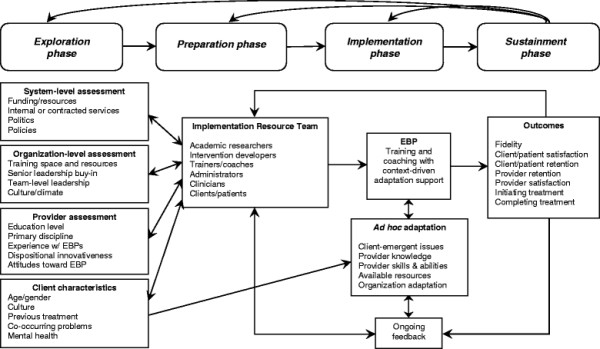
BACKGROUND: Adaptations are often made to evidence-based practices (EBPs) by systems, organizations, and/or service providers in the implementation process. The degree to which core elements of an EBP can be maintained while allowing for local adaptation is unclear. In addition, adaptations may also be needed at the system, policy, or organizational levels to facilitate EBP implementation and sustainment. This paper describes a study of the feasibility and acceptability of an implementation approach, the Dynamic Adaptation Process (DAP), designed to allow for EBP adaptation and system and organizational adaptations in a planned and considered, rather than ad hoc, way. The DAP involves identifying core elements and adaptable characteristics of an EBP, then supporting implementation with specific training on allowable adaptations to the model, fidelity monitoring and support, and identifying the need for and solutions to system and organizational adaptations. In addition, this study addresses a secondary concern, that of improving EBP model fidelity assessment and feedback in real-world settings. METHODS: This project examines the feasibility, acceptability, and utility of the DAP; tests the degree to which fidelity can be maintained using the DAP compared to implementation as usual (IAU); and examines the feasibility of using automated phone or internet-enabled, computer-based technology to assess intervention fidelity and client satisfaction. The study design incorporates mixed methods in order to describe processes and factors associated with variations in both how the DAP itself is implemented and how the DAP impacts fidelity, drift, and adaptation. The DAP model is to be examined by assigning six regions in California (USA) to either the DAP (n=3) or IAU (n=3) to implement an EBP to prevent child neglect. DISCUSSION: The DAP represents a data-informed, collaborative, multiple stakeholder approach to maintain intervention fidelity during the implementation of EBPs in the field by providing support for intervention, system, and organizational adaptation and intervention fidelity to meet local needs. This study is designed to address the real-world implications of EBP implementation in public sector service systems and is relevant for national, state, and local service systems and organizations.
Overview
The claims and statistics of this paper haven’t been checked yet.
Free: it reads the open-access text and checks the first 5 claims that cite a source we can check. Create a free account to check every claim.
Integrity signals
Registry
Cites
Statistics
Figures
Verification
Claims the paper makes
The claims and statistics of this paper haven’t been checked yet.
Free: it reads the open-access text and checks the first 5 claims that cite a source we can check. Create a free account to check every claim.
Claims other papers make about this one
Each is checked against this paper’s own text: does it say what the citing paper says it does?
The cited source says what the claim attributes to it.
In the citing paper
“ongoing adjustment and evaluation of EBT to ensure that a program is response to the local context provides an opportunity to increase intervention effectiveness over time (Aarons et al., 2012; Chambers et al., 2013)”
From User‐centered design for psychosocial intervention development and implementation. (2016) · cites this paper as Aarons et al., 2012
The cited source says what the claim attributes to it.
In the citing paper
“there has been little research focused explicitly on procedures for realizing this goal (Aarons et al., 2012; Lyon et al., 2014c).”
From User‐centered design for psychosocial intervention development and implementation. (2016) · cites this paper as Aarons et al., 2012
The cited source says what the claim attributes to it.
In the citing paper
“The DAP [69] is a multicomponent implementation strategy directly drawn from the EPIS framework.”
From Ten recommendations for using implementation frameworks in research and practice (2020) · cites this paper as [69]
The cited source says what the claim attributes to it.
In the citing paper
“A critical and core component of the DAP is the creation of an Implementation Resource Team that is a multiple stakeholder collaborative designed to support implementation, data interpretation, and explicitly address adaptations during the implementation process.”
From Ten recommendations for using implementation frameworks in research and practice (2020) · cites this paper as [69]
The cited source says what the claim attributes to it.
In the citing paper
“The DAP uses an iterative, data-informed approach to facilitate implementation across each phase of EPIS.”
From Ten recommendations for using implementation frameworks in research and practice (2020) · cites this paper as [69]
Self-check
Percentages, sums and reported differences re-computed from the paper’s own numbers.
The self-check needs the paper’s full text.
Citations
Cites
Qualitative research and evaluation methods
Patton, M. Q. (1980) · Cited by 35,734
Damschroder, L. J., Aron, D. C., Keith, R. E., Kirsh, S. R., Alexander, J. A., & Lowery, J. C. (2009) · Implementation Science · doi:10.1186/1748-5908-4-50 · Cited by 14,496 · cited 1×
“, organization) to effectively implement EBPs [13,14].”
Weighted kappa: nominal scale agreement provision for scaled disagreement or partial credit
Cohen, J. (1968) · Psychological Bulletin · doi:10.1037/h0026256 · Cited by 8,736
Diffusion of Innovations in Service Organizations: Systematic Review and Recommendations
GREENHALGH, T., ROBERT, G., MACFARLANE, F., BATE, P., & KYRIAKIDOU, O. (2004) · The Milbank Quarterly · doi:10.1111/j.0887-378x.2004.00325.x · Cited by 7,448 · cited 1×
“The interplay of characteristics of an intervention with service system and organizational characteristics (system, organization, provider, and client levels) can be complex [12].”
Background(2005) · Cited by 3,748
Advancing a Conceptual Model of Evidence-Based Practice Implementation in Public Service Sectors
Aarons, G. A., Hurlburt, M., & Horwitz, S. M. (2011) · Administration and Policy in Mental Health and Mental Health Services Research · doi:10.1007/s10488-010-0327-7 · Cited by 3,240
Self-citationSchuirmann, D. J. (1987) · Journal of Pharmacokinetics and Biopharmaceutics · doi:10.1007/bf01068419 · Cited by 2,696
Piaget, J. (1976) · Piaget and His School · doi:10.1007/978-3-642-46323-5_2 · Cited by 2,167
Carmichael's Manual of Child Psychology
Sigel, I. E., & Mussen, P. H. (1972) · American Educational Research Journal · doi:10.2307/1161696 · Cited by 2,053
The Handbook of Research Synthesis.
Light, R. J., Cooper, H., & Hedges, L. V. (1994) · Journal of the American Statistical Association · doi:10.2307/2291021 · Cited by 1,868
Research works printed but not linked: 5
- Kauffman Foundation Best Practices Project Kaufman best practices project final report: Closing the quality chasm in child abuse treatment: Identifying and disseminating best practices 2004 Ewing Marion Kauffman Foundation, Kansas
- Rogers EM Diffusions of innovations 1995 4 The Free Press, New York
- Webster New College Dictionary 1995 Houghton Mifflin Company, Boston
- Whitaker D Lutzker J Self-Brown S Edwards A Implementing and evidence-based program for the prevention of child maltreatment: The SafeCare® program Report on Emotional & Behavioral Disorders in Youth 2008 8 55 62
- Fraser D QSR NVivo reference guide 2000 QSR International, Melbourne
Cited by
Items 301–400 of 489
Analysis of longitudinal patterns of child maltreatment reports in the United States
Joseph, J. G., Luo, Z., EPSTEIN, R. A., Gracey, K. A., Kuhn, T. M., Cull, M. J., & Chandrasekhar, R. (2024) · Child Abuse & Neglect · doi:10.1016/j.chiabu.2024.107223 · Cited by 4
Carthon, J. M. B., Brom, H. M., Grantham-Murillo, M., Sliwinski, K. S., Mason, A., Roeser, M., Miles, D., Garcia, D., Bennett, J., Harhay, M. O., et al. (2024) · JMIR Research Protocols · doi:10.2196/54211 · Cited by 4
“This study will also be guided by the Exploration, Preparation, Implementation, Sustainment framework; Proctor’s outcomes framework; and the Health Equity Implementation Framework (HEIF) [44-46].”
MethodKerker, B. D., Milian, J., Clark, M. R., Weiss, D., Lewis, K. D. C., & Willheim, E. (2024) · Journal of Child and Family Studies · doi:10.1007/s10826-023-02771-1 · Cited by 4
“We chose the DAP and implemented the EPIS model within each DAP cycle because this approach allowed for a sequential yet iterative approach that integrated feedback from stakeholders at multiple points in time (Aarons, et al., 2012).”
Heyman, M., Nicholson, J., & English, K. (2024) · Frontiers in Psychiatry · doi:10.3389/fpsyt.2024.1377088 · Cited by 4
Kenga, D., Sacarlal, J., Sidat, M., Amorim, G., Myers, H., Chicamba, V., Kampa, K. T., & Moon, T. D. (2024) · PLoS ONE · doi:10.1371/journal.pone.0306511 · Cited by 4
iKMC-IR Study Group, Yoshida, S., & Portela, A. (2026) · Gates Open Research · doi:10.12688/gatesopenres.16392.1 · Cited by 4
“We will use Consolidated Framework for Implementation Research 15 which recognizes the non-linear and recursive nature of the implementation process.”
InfluentialIntroduction to Intervention Research
Sidani, S., & Braden, C. J. (2011) · Wiley eBooks · doi:10.1002/9781118785553.ch1 · Cited by 4
Hess, J. M., & Davis, S. M. (2023) · Frontiers in Public Health · doi:10.3389/fpubh.2023.1032662 · Cited by 4
“Researchers have noted that a lack of attention to adaptation may be a legacy of empirical models that have relied heavily on conducting science in controlled conditions, which is problematic in real world practice settings (23).”
BackgroundNaar, S., Fernandez, M. I., Todd, L., Green, S. K. S., Henna Budhwani, P., Carcone, A. I., Coyle, K. K., Aarons, G. A., MacDonell, K. K., & Harper, G. W. (2023) · Implementation Research and Practice · doi:10.1177/26334895231164585 · Cited by 4
“The interview was adapted from the EPIS developers (Aarons et al., 2012) and has been previously described (Idalski Carcone et al.”
BackgroundMethodSelf-citationYount, K. M., Comeau, D. L., Sales, J. M., Blake, S., Sacks, M. A., Nicol, H., Bergenfeld, I., Kalokhe, A. S., Stein, A. D., Whitaker, D. J., et al. (2022) · Frontiers in Public Health · doi:10.3389/fpubh.2023.1181543 · Cited by 4
“Additional content will be focused special topics including systemic and organizational influence on D/I (99), the use of technology in D/I research (100), processes for adapting evidencebased programs (101), sustainment of implementation (102), and “real-world” implementation conducted in a non-research setting.”
BackgroundSelf-citationLau, A. S., Lind, T., Cox, J. R., Motamedi, M., Lui, J. H. L., Chlebowski, C., Flores, A., Diaz, D., Roesch, S. C., & Brookman-Frazee, L. I. (2024) · Administration and Policy in Mental Health and Mental Health Services Research · doi:10.1007/s10488-024-01395-x · Cited by 4
Zetterlund, J., Hasson, H., Schwarz, U. V. T., Neher, M., & Wahlström, E. (2025) · Implementation Research and Practice · doi:10.1177/26334895251334552 · Cited by 4
“…occurs during the sustainment phase of implementation, where EBIs often are adapted by professionals delivering the EBI to the end users to ensure a continuous fi t between the EBI and different contexts (Aarons et al., 2012; Bäck et al., 2020; Mosson et al., 2017; von Thiele et al., 2019).”
Co-designing a conceptual framework of home visiting implementation quality
Goldberg, J. L., Sparr, M., Rosinsky, K., Lloyd, C. M., Till, L., Harris, P., Crowne, S. S., Fortune, B., & Higgins, C. (2023) · Children and Youth Services Review · doi:10.1016/j.childyouth.2023.107161 · Cited by 4
Hurley, N. C., Desai, N., Dhruva, S. S., Khera, R., Schulz, W. L., Huang, C., Curtis, J. P., Masoudi, F. A., Rumsfeld, J. S., Negahban, S. N., et al. (2025) · PLOS Digital Health · doi:10.1371/journal.pdig.0000906 · Cited by 4
“These models may also improve the understanding of the dynamics and key variables affecting bleeding risk, representing a transformational change in risk prediction and embrace the principles of a learning health care system [10].”
Pickens, I. B., Howard, M. L., Goldman, J. H., Cruise, K. R., & Watson, K. (2019) · Juvenile and Family Court Journal · doi:10.1111/jfcj.12135 · Cited by 4
McGuire, A. B., Matthias, M. S., Kukla, M., Henry, N. H., Carter, J. L., Flanagan, M., Bair, M. J., & Murphy, J. L. (2021) · Professional Psychology Research and Practice · doi:10.1037/pro0000399 · Cited by 4
“Some implementation models assume modification as a necessary process within implementation that maximizes fit within the clinical setting and patient population (Aarons et al., 2012).”
BackgroundKathuria, H., Herbst, N. P., Seth, B., Clark, K. P., Helm, E. D., Zhang, M. H., O’Donnell, C., Fitzgerald, C. A., Itchapurapu, I. S., Waite, M., et al. (2021) · Implementation Research and Practice · doi:10.1177/26334895211041295 · Cited by 4
“…conducted two rapid-cycle evaluations to identify modifiable barriers to implementation, which informed adaptation and selection of ERIC strategies to overcome barriers in real-time, while maintaining fidelity to the core components of the intervention (Aarons et al., 2012; Stirman et al., 2013).”
BackgroundBartley, L., DePanfilis, D., & Bright, C. L. (2021) · Implementation Research and Practice · doi:10.1177/26334895211050864 · Cited by 4
Pickard, K. E., Burrell, T. L., Brasher, S. N., Buckley, D., Gillespie, S. E., Sharp, W. G., & Scahill, L. D. (2023) · Autism · doi:10.1177/13623613231166181 · Cited by 4
“However, implementing psychosocial and behavioral interventions in community settings is a complex process requiring proactive attention to support intervention fit and adaptation (Aarons et al., 2012; Stirman et al., 2019).”
BackgroundDissemination and Implementation Research
Barnett, M. L., Dickson, K. S., Becker‐Haimes, E. M., & Stadnick, N. A. (2021) · Elsevier eBooks · doi:10.1016/b978-0-12-818697-8.00170-9 · Cited by 4
Analysis of pedestrian injuries in traffic accidents (2)--Especially on leg injury.
Iwadate, K., Ono, K., Ohashi, N., Zhang, S., Misawa, S., & Takatori, T. (1995) · PubMed · Cited by 4
Moon, D. J., Johnson‐Motoyama, M., Nichols, C. B., Rolock, N., Haran, H., & Bai, R. (2022) · Children and Youth Services Review · doi:10.1016/j.childyouth.2022.106457 · Cited by 3
Lao, U., Zhu, H., Liang, F., Bai, E. W., Yin, P., Huang, X., Girdler, S. J., Bölte, S., & Zou, X. (2024) · BMJ Open · doi:10.1136/bmjopen-2023-081827 · Cited by 3
“46 While there are various cultural adaptation frameworks guiding the alignment of health interventions with the needs of a target population, 35 36 47 48 despite some methodological distinctions, they share many similarities.”
Crable, E. L., Meffert, S. M., Kenneally, R. G., Ongeri, L., Bukusi, D. E., Burger, R. L., Rota, G., Otieno, A., Rotai, R., Mathai, M., et al. (2025) · Implementation Science Communications · doi:10.1186/s43058-025-00744-7 · Cited by 3
“The parent trial convened an Implementation Resource Team (IRT) [24, 25] comprised of cross-sector key informants to shepherd implementation activities across study aims.”
Self-citationBoakye, D. S., & Adjorlolo, S. (2025) · BMJ Open · doi:10.1136/bmjopen-2025-105448 · Cited by 3
Dykens, J. A., Sougou, N. M., Gassama, O., Dieng, N. M., Peterson, C. E., Patil, C. L., Awadalla, S., Abboud, S., Ndiaye, I., Diongue, F. B., et al. (2025) · International Journal of Women s Health · doi:10.2147/ijwh.s515070 · Cited by 3
“…research project applies the Dynamic Adaptation Process 35 as integrated into the Exploration, Preparation, Implementation, Sustainment framework 35 to study the adaptation of an evidence-based cervical cancer patient navigation program in urban and rural contexts in Senegal, measure the…”
InfluentialShenderovich, Y., Martin, M., Lachman, J. M., Mgunga, S., Ndyetabura, E., & Wamoyi, J. (2025) · Prevention Science · doi:10.1007/s11121-025-01852-5 · Cited by 3
“This is especially the case in implementation outside of the context of structured research studies, such as program delivery in routine service delivery settings (Chambers & Norton, 2016), where drift from the original design may occur over time (Aarons et al., 2012a, 2012b).”
Brasileiro, J., Muessig, K. E., Lascko, T., Sam-Agudu, N. A., Rochelle, A. E., Mansfield, M. E., Ehoche, A., Adebajo, S., Hightow-Weidman, L. B., Charurat, M., et al. (2026) · Implementation Science Communications · doi:10.1186/s43058-026-00913-2 · Cited by 3
Ford, J. H., Nora, A., & Crnich, C. J. (2023) · Implementation Science Communications · doi:10.1186/s43058-023-00535-y · Cited by 3
“Our process expands on the concepts detailed adaption frameworks such as the FRAME-IS or the Dynamic Adoption Process [32–34].”
MethodZetterlund, J., Hasson, H., Neher, M., & Schwarz, U. V. T. (2024) · Global Implementation Research and Applications · doi:10.1007/s43477-024-00120-y · Cited by 3
“To a large extent, research has addressed the fidelity-adaptation dilemma early in the implementation process (Aarons et al., 2012; Lee et al., 2008), whereas less attention has been paid to the dilemma when the EBIs are fully implemented in organizations, the sustainment phase of imple - mentation.”
Adeleke, S., Ongtengco, A., Youssef, C., Hardy, P., & Pappalardo, A. A. (2024) · Annals of Allergy Asthma & Immunology · doi:10.1016/j.anai.2024.06.023 · Cited by 3
Wong, V., Franke, T., McKay, H. A., Tong, C., MACDONALD, H. M., & Sims‐Gould, J. (2023) · Journal of Aging and Physical Activity · doi:10.1123/japa.2023-0064 · Cited by 3
Adaptability and Fidelity: Exploring the Relationship Between the Two When Implementing SC2.0
Jaouich, A., Carey, S., Saxton, K. G., Rash, J. A., & Brown, J. (2023) · Springer eBooks · doi:10.1007/978-3-031-45206-2_11 · Cited by 3
Boykin, D. M., Smith, T. L., Rakel, B. A., Rodrigues, M. M., Embree, J. L., Woods, K., Chaison, A. D., & Dindo, L. N. (2024) · Translational Behavioral Medicine · doi:10.1093/tbm/ibae027 · Cited by 3
Schwartz, A., Eisman, A. B., Gagliardi, L. J., & Hasson, R. E. (2024) · Journal of School Health · doi:10.1111/josh.13525 · Cited by 3
Schoenberg, N. E., Sherman, D. L., Pfammatter, A. F., Roberts, M. K., Chih, M., Vos, S. C., & Spring, B. J. (2022) · BMC Public Health · doi:10.1186/s12889-022-14475-0 · Cited by 3
“Our overall model of adaptation was based on the NIH’s Cultural Framework of Health [21] and Aaron’s Adaptation framework [22].”
BackgroundMethodPsaros, C., Goodman, G. R., McDonald, V., Ott, C., Blyler, A. P., Rivas, A. M., Shan, L., Campbell, M., Underwood, E., Krakower, D., et al. (2023) · BMJ Open · doi:10.1136/bmjopen-2023-075250 · Cited by 3
Knott, C. L., Miech, E. J., Woodard, N., & Huq, M. R. (2023) · Global Implementation Research and Applications · doi:10.1007/s43477-023-00089-0 · Cited by 3
“These theories and others (Aarons et al., 2012; Meyers et al., 2012) have informed a body of implementation science research that examines how local context relates to intervention outcomes.”
BackgroundMorse, R. M., Lang, I., Rapaport, P., Poppe, M., Morgan‐Trimmer, S., & Cooper, C. (2024) · BMC Geriatrics · doi:10.1186/s12877-024-04762-3 · Cited by 3
“This would then be followed by providing instruction on permissible modifications to the program and supporting implementation of the modified program through monitoring and evaluation [31].”
MethodModification to a Systematically Braided Parent-support Curriculum: Results from a Feasibility Pilot
Guastaferro, K., Miller, K., Lai, B. S., Shanley, J. R., Kemner, A. L., Whitaker, D. J., & Lutzker, J. R. (2019) · Journal of Child and Family Studies · doi:10.1007/s10826-019-01369-w · Cited by 3
“Providers are more likely to make adaptations on their own to an evidence-based program, risking fidelity, when they feel the program is not meeting a client’s needs or engagement is fading (Aarons et al. 2012).”
BackgroundSelf-citationPiirainen, K., & Linnakangas, R. T. (2021) · LaCRIS (University of Lapland) · Cited by 3
Arterburn, D. E., Toh, S., Williams, N. A., Anau, J., Courcoulas, A. P., Tavakkoli, A., Stilwell, D., Tuzzio, L., Lewis, C. C., Wilcox, M. N., et al. (2020) · Journal of Comparative Effectiveness Research · doi:10.2217/cer-2020-0156 · Cited by 3
Roebuck, M. (2021) · uO Research (University of Ottawa) · doi:10.20381/ruor-26016 · Cited by 3
Feroz, A. S. (2024) · TSpace (University of Toronto) · Cited by 3
Nguyen, M. X., Bartels, S. M., Akiba, C. F., Sripaipan, T., Nong, H. T. T., Dang, L. T., Hà, T. V., Hoang, V. T., Giang, L. M., Go, V. F.-L., et al. (2024) · BMC Medical Research Methodology · doi:10.1186/s12874-024-02367-3 · Cited by 2
Navigating Cultural Adaptation: Refugee Parents’ Perspectives on the SafeCare Parenting Program
Rao, N., Whitaker, D. J., Willging, C. E., Weeks, E. A., Self‐Brown, S., Koreis, J. E., & O’Connor, M. H. (2025) · Journal of International Migration and Integration / Revue de l integration et de la migration internationale · doi:10.1007/s12134-025-01299-1 · Cited by 2
“The application of interventions to new populations has been described as a process of “scaling out,” stressing the importance of carefully considered adap-tions during this process (Aarons et al., 2012).”
Self-citationUse and reporting of intervention mapping for adaptation: a systematic review protocol
Kang, E., Sánchez-Blas, H. R., Obekpa, E. O., & Fernández, M. E. (2025) · BMJ Open · doi:10.1136/bmjopen-2025-101585 · Cited by 2
Kenga, D., Moon, T. D., Sidat, M., Chicamba, V., Kenga, A. N., Manjate, Y., Nhanala, D., Caetano, I. C., Pololo, R., Cambaço, O., et al. (2026) · Antibiotics · doi:10.3390/antibiotics15020178 · Cited by 2
“The DAP framework highlights four interrelated phases, namely: (i) exploration, (ii) preparation, (iii) implementation, and (iv) sustainability, each influenced by multiple ecological levels [17].”
Davidson, T. M., Skojec, T., Li, P., Ridings, L. E., Espeleta, H. C., German, S., Mueller, M., Gates, R., Mooney, D., Russell, R., et al. (2026) · Contemporary Clinical Trials Communications · doi:10.1016/j.conctc.2026.101622 · Cited by 2
“In addition, we will systematically track and document local adaptations to the intervention and any modifications to the implementation approach , recognizing that such adaptations are critical for optimizing effectiveness, adoption, and long-term sustainability [48,49].”
Examination of Interventions’ Acceptance
(2021) · Wiley eBooks · doi:10.1002/9781119610113.ch11 · Cited by 2
Langa, J. C., Sidat, M., Sacarlal, J., & Moon, T. D. (2025) · PLoS ONE · doi:10.1371/journal.pone.0324792 · Cited by 2
Nickelsen, T., Muller, G. N., Clark, S. L., Bordiuzhenko, O., Liberzon, I., & Ory, M. G. (2025) · International Journal of Mental Health Systems · doi:10.1186/s13033-025-00690-w · Cited by 2
“The appropriate adaptation of EBC requires good knowledge and familiarity with implementation and dissemination efforts, as emphasized by Aarons et al. [36] in their discussion of the dynamic adaptation process.”
Dorsey, S., Pullmann, M. D., Kerns, S. E. U., Deblinger, E., Lucid, L., Harrison, J. P., Thompson, K., & Berliner, L. (2018) · Implementation Science · doi:10.1186/s13012-018-0715-z · Cited by 2
Kellogg, E. (2020) · Journal of Youth Development · doi:10.5195/jyd.2020.950 · Cited by 2
“However, adaptation is most likely to be effective when it is based on evidence that aligns with the program goals and theory (Aarons et al., 2012; Castro & Yasui, 2017; Chambers et al., 2013; Durlak & DuPre, 2008; Moore et al., 2013).”
Sustaining Impact after Scaling Using Data and Continuous Feedback
Chambers, D., & Norton, W. E. (2021) · Routledge eBooks · doi:10.4324/9780367822972-20 · Cited by 2
Guerrero, E. G., Frimpong, J. A., Hearn, A., Serret, V., van Deen, W. K., Padwa, H., Trotzky‐Sirr, R., Menchine, M. D., & Howard, D. L. (2021) · IntechOpen eBooks · doi:10.5772/intechopen.99206 · Cited by 2
“Furthermore, the comprehensive and multimethod approach to data collection used in this study is consistent with other research in behavioral health [14, 15].”
ResultSiegle, A., zu Sayn-Wittgenstein-Hohenstein, F., & Roes, M. (2020) · Implementation Science · doi:10.1186/s13012-020-01033-8 · Cited by 2
Can Common Elements Support a Public Health Approach to Child Maltreatment?
Polimeni, M., Tan, E. S., Seah, C. K. F., Lewis, J., McLeod, B. D., & Bjørndal, A. (2022) · International Journal on Child Maltreatment Research Policy and Practice · doi:10.1007/s42448-022-00127-8 · Cited by 2
Rigor and Relevance in Social Work Science
Palinkas, L. A. (2019) · Oxford University Press eBooks · doi:10.1093/oso/9780190880668.003.0010 · Cited by 2
Self-citationForm Follows Function: Adapting the Strength Model to Facilitate Implementation and Sustainability
Schoenfeld, E. A., White, B. A., & Youngbloom, A. J. (2020) · KU ScholarWorks (The University of Kansas) · Cited by 2
Translational Research: Bridging the Chasm Between New Knowledge and Useful Knowledge
Kemp, L. (2019) · Springer eBooks · doi:10.1007/978-981-10-5251-4_72 · Cited by 2
Design considerations for preparation, optimization, and evaluation of digital therapeutics
Smith, S. N., Seewald, N. J., & Klasnja, P. (2022) · Elsevier eBooks · doi:10.1016/b978-0-323-90045-4.00015-0 · Cited by 2
Myburgh, N. (2019) · SUNScholar (Stellenbosch University) · Cited by 2
Samson, A. (2015) · Corpus Université Laval (Université Laval) · Cited by 2
Otieno, M. A. (2022) · SU+ Digital Repository (Strathmore University) · Cited by 2
Wilson, S. N., Noble, H. E., Ordoñez, W. J. N., Wong, G. Z., Rodríguez, M. J., Checa, D. O., Warne, M., Senturia, K., & LaGrone, L. N. (2023) · Implementation Science Communications · doi:10.1186/s43058-023-00397-4 · Cited by 1
“With attention to the growing literature on adaptation in implementation science, we suggest our findings on adaptability of this intervention are used to help build an adaptome data platform [31] to better understand how deviations from fidelity may lead to better outcomes based on context.”
BackgroundEngaging African American Faith Leaders as Partners in Ethical Research
Moon, D. J., Nichols, C. B., Wallace, J. M., & Durham, A. (2024) · Journal of Community Engagement and Scholarship · doi:10.54656/jces.v16i2.517 · Cited by 1
Navigating grey areas in HIV and mental health implementation science
Harkness, A., Giusto, A. M., Hamilton, A. B., Hernández-Ramírez, R. U., Spiegelman, D. L., Weiner, B. J., Beidas, R. S., Larson, M. E., Lippman, S. A., Wainberg, M. L., et al. (2024) · Journal of the International AIDS Society · doi:10.1002/jia2.26271 · Cited by 1
Köberlein–Neu, J., & Söling, S. (2024) · Springer eBooks · doi:10.1007/978-3-658-43860-9_22 · Cited by 1
Willging, C. E., Shattuck, D. G., Sklar, M., Sebastian, R. A., Stout, R. L., & Ramos, M. M. (2024) · BMC Health Services Research · doi:10.1186/s12913-024-11785-4 · Cited by 1
“Our interdisciplinary research team will use a multi-faceted implementation strategy—the Dynamic Adaptation Process (DAP) [63, 64]—to introduce and facilitate the adoption of the guidelines in a statewide SBHC network in the largely rural, economically challenged, and culturally rich state of New…”
Wagner, L., Foster, T. E., Bonnet, K. R., Spitler, A. K., Schlundt, D., & Warren, Z. E. (2024) · Autism · doi:10.1177/13623613241307078 · Cited by 1
“These omissions potentially weaken tele-assessment’s relevance and sustainability (Aarons et al., 2012; Wingood & DiClemente, 2008).”
Acharya, S. M., Allam, R. R., Karanjkar, V. K., Rathod, D., Deshpande, P., Palkar, A., Todmal, S., Koli, S., Dhande, S., Chava, N., et al. (2025) · BMC Health Services Research · doi:10.1186/s12913-025-12572-5 · Cited by 1
“Implementation of evidence-based practices from prior studies has indicated that adaptations are often made by systems, organizations, and/or service providers in the implementation process [25].”
Setswe, G., Day, S., Ndebele, F., Pienaar, J., Ncube, V., & Feldacker, C. (2025) · BMJ Open · doi:10.1136/bmjopen-2024-091934 · Cited by 1
Ikonen, R., Runyon, M. K., & Laajasalo, T. (2025) · Child Abuse Review · doi:10.1002/car.70065 · Cited by 1
van Someren, J. L., Möller, E. L., Rodenburg, R., Peters, A. E. J., Hoogsteder, M. H. H., & Ginkel, M. W. H. (2025) · BMJ Paediatrics Open · doi:10.1136/bmjpo-2025-003478 · Cited by 1
“In this study, we had regular meetings with an advisory board, including future users of Soothing and Sleeping (professionals in youth healthcare) and policymakers involved in early infant healthcare.”
Cernigoy, E., Elliott, S. A., Meherali, S. M., Vogelsang, L., & Scott, S. D. (2025) · Journal of Child Health Care · doi:10.1177/13674935251391265 · Cited by 1
“Theories and models such as the EVM (Bernal et al., 1995) and Dynamic Adaptation Process (Aarons et al., 2012) could be used.”
Best, S., Price, E., Cherednichenko, B., Underhill, C. R., Ismail, H., Fehlberg, Z., & Taylor, N. J. (2026) · Implementation Science Communications · doi:10.1186/s43058-026-00855-9 · Cited by 1
“In 2012, Aarons et al [14] described the Dynamic Adaptation Process, which focuses on maintaining intervention fidelity during the real-world implementation of EBPs in response to local needs.”
Sullivan, S. S., Hewner, S. J., Casucci, S., Bowen, E. A., Chandola, V., Sheehan, A. M., Anderson, A., Gabello, J., & Noyes, K. (2026) · Frontiers in Health Services · doi:10.3389/frhs.2026.1737047 · Cited by 1
“We present two real-life case studies from the Personalized Cross-sector Transitional Care Management (PC-TCM) project to illustrate how an extension of the Dynamic Adaptation Process model (DAP) ( 4) into pre-implementation phases (conceptualization and design) can improve implementation success.”
Rollins, A. L., Rujumba, J., Namazzi, R., Munube, D., John, C. C., Ware, R. E., Apolot, D., Ssali, A., Henry, N. H., & Opoka, R. O. (2026) · Blood Global Hematology · doi:10.1016/j.bglo.2026.100091 · Cited by 1
Gambrah-Lyles, C., Abrams, A. W., Loud, S., Schmidt, H. K., Blosberg, E., Wright, M., Poisson, K. E., Fisher, K. S., O’Neill, K. A., Virupakshaiah, A., et al. (2026) · JMIR Research Protocols · doi:10.2196/91763 · Cited by 1
“While frameworks such as the dynamic adaptation process (DAP) [49] and the discover, design/ build, and test (DDBT) [50] model provide clear road maps for adapting interventions, systematic guidance for adapting clinical measures remains less explicit.”
Kim, S., Berg, A., Walker, D. M., Teuschler, L., Sinclair, A., & Hughes, J. L. (2026) · Evidence-Based Practice in Child and Adolescent Mental Health · doi:10.1080/23794925.2026.2673505 · Cited by 1
Aarons, G. A. (2014) · the Clinical Research Education Library · doi:10.1044/cred-pvid-implscid2p1 · Cited by 1
Self-citationPowell, B. J. (2014) · Open Scholarship Institutional Repository (Washington University in St. Louis) · doi:10.7936/k7571943 · Cited by 1
Implementing a technology-based chronic care model: A case study
Maskell, R. (2018) · Scholarship@Western (Western University) · Cited by 1
Holguin, E. (2018) · UNM’s Digital Repository (University of New Mexico) · Cited by 1
Development and testing of a brief EBP implementation intentions scale using Rasch analysis
Moullin, J. C., Ehrhart, M. G., Torres, E., & Aarons, G. A. (2018) · eSpace (Curtin University) · Cited by 1
Self-citationTranslating research into practice—implementation science
Ramanadhan, S. (2020) · Oxford University Press eBooks · doi:10.1093/med/9780198800125.003.0026 · Cited by 1
Mercado, M., Vega‐López, S., Gonzalvez, A., Vega‐Luna, B., Hoyt, S., Martínez, G. M., Ayers, S. L., & Marsiglia, F. F. (2023) · Translational Behavioral Medicine · doi:10.1093/tbm/ibac097 · Cited by 1
Aly, M., Schneider, C. R., Sukkar, M. B., & Lucas, C. (2024) · Research in Social and Administrative Pharmacy · doi:10.1016/j.sapharm.2024.02.008 · Cited by 1
Oluwoye, O. A., Siddiqi, K. A., Stokes, B., & Stokes, S. (2024) · Translational Behavioral Medicine · doi:10.1093/tbm/ibae011 · Cited by 1
Dissemination and Implementation in Social Service Settings
Bunger, A. C., Juckett, L., Lengnick‐Hall, R., Adams, D. R., & McMillen, J. C. (2023) · Oxford University Press eBooks · doi:10.1093/oso/9780197660690.003.0020 · Cited by 1
Myre-Bisaillon, J., Tremblay-Lemieux, C., Paul, M. J., & Ouellette, M. (2024) · Canadian Journal of Education / Revue canadienne de l éducation · doi:10.53967/cje-rce.6155 · Cited by 1
Leveraging the dynamic adaptation process to address LGBTQ+ health equity in New Mexico high schools
Willging, C. E., Shattuck, D. G., Ramos, M. M., Richard, B. O., Lawyer, A., Dickson, E. L., & Aarons, G. A. (2025) · Frontiers in Health Services · doi:10.3389/frhs.2025.1499508 · Cited by 1
Self-citationBoakye, D. S., & Adjorlolo, S. (2026) · Health & Social Care in the Community · doi:10.1155/hsc/9597286 · Cited by 1
Lutzker, J. R., & Casillas, K. L. (2016) · Child Abuse & Neglect · doi:10.1016/j.chiabu.2016.01.005 · Cited by 1
Self-citationNthebolang, O. E. (2020) · Unisa Institutional Repository (University of South Africa) · Cited by 1
Scaling Up Kangaroo Mother Care in Ethiopia and India: A Multi-Site Implementation Research StudyPreprint
Mony, P., Tadele, H., Gobezayehu, A. G., Chan, G. J., Kumar, A., Mazumder, S., Beyene, S. A., Jayanna, K., Kassa, D. H., Mohammed, H. A., et al. (2020) · SSRN Electronic Journal · doi:10.2139/ssrn.3719057 · Cited by 1
Sarfan, L. D., Ge, L., Agnew, E. R., Diaz, M., Fisher, K., Howlett, S. A., Hache, R. E., Spencer, J., & Harvey, A. G. (2025) · Research Square · doi:10.21203/rs.3.rs-6107938/v1 · Cited by 1
“Related, systematic processes have been developed to carefully assess, plan for, and offer feedback on adaptations to treatments during implementation efforts, such as the Dynamic Adaptation Process (23).”
Bing, A., Spiegelman, D. L., & Lok, J. J. (2025) · arXiv (Cornell University) · doi:10.48550/arxiv.2509.11479 · Cited by 1
Metadata
- Authors
- Aarons, G. A., Green, A. E., Palinkas, L. A., Self-Brown, S., Whitaker, D. J., Lutzker, J. R., Silovsky, J. F., Hecht, D. B., & Chaffin, M. J.
- Affiliations
- University of California San Diego (US)
- University of Southern California (US)
- Georgia State University (US)
- University of Oklahoma Health Sciences Center (US)
- Corresponding author
- Aarons, Gregory A
- ORCID
- Venue
- Implementation Science
- Published
- 2012-04-18
- Volume
- 7
- Issue
- 1
- Pages
- 32-32
- ISSN
- 1748-5908 (ISSN-L)
- PMC
- PMC3436717
- OpenAlex
- W2062957857
- Cited by
- 449
- References
- 60
- Citations by year
- 2026: 24 · 2025: 33 · 2024: 67 · 2023: 42 · 2022: 46 · 2021: 40 · 2020: 36 · 2019: 41 · 2018: 30 · 2017: 20 · 2016: 17 · 2015: 20 · 2014: 14 · 2013: 13 · 2012: 3
- FWCI
- 28.44
- Type
- journal article
- Language
- en
- Open access
- gold
- doi.org
- Licence
- Locations
- Implementation Science (publishedVersion, cc-by)
- Europe PMC (PubMed Central) (publishedVersion, cc-by)
- PubMed Central (publishedVersion, cc-by)
- PubMed (publishedVersion)
- Digital Archive @ GSU (submittedVersion, cc-by)
- DOAJ (DOAJ: Directory of Open Access Journals) (submittedVersion)
- eScholarship (California Digital Library) (submittedVersion)
- Counseling And Psychological Services Dissertations (Georgia State University) (submittedVersion, cc-by)
- Funders
- Centers for Disease Control and Prevention (R01CE001556)
- National Institute of Mental Health (R01MH092950, P30MH074678, R01CE001556, R25MH080916)
- Topics
- Health Sciences › Health Professions › General Health Professions › Health Policy Implementation Science
- Health Sciences › Health Professions › General Health Professions › Health Sciences Research and Education
- Social Sciences › Sociology and Political Science › Child Welfare and Adoption
- Keywords
- child abuse intervention, child neglect prevention, intervention fidelity, fidelity monitoring, drift, organizational adaptation, system adaptation, feasibility and acceptability, client satisfaction
- MeSH terms
- California, Child, Child Abuse, Child Health Services, Child Welfare, Feasibility Studies, Humans, Telephone, Internet, Evidence-Based Practice
About these checks
Registry, retraction, Cites and statistics results are computed, not judged, with one exception: a printed reference that no index lists is read once by a model before it counts as a citation error. Claims are extracted by a model and kept only when their quote appears verbatim in the text; each cited source is then checked, with a model’s help, for whether it says what the claim relies on. Those verdicts can be wrong — read the claim’s quote and the cited source before relying on one.
Statistics and arithmetic are recomputed, not judged.
Confidence bands are shown only for fields calibrated on our annotated test set. None is calibrated yet, so no band is shown.
What counts as a claim ›How we measure confidence ›How we check this ›
Are you an author, or do you see a problem with this page? Request a review
Data sources
Bibliographic data: Semantic Scholar, OpenAlex, Crossref.
Contains information from the Semantic Scholar Academic Graph Datasets, made available under the ODC Attribution License (ODC-BY 1.0).
Semantic Scholar’s data is described in: Kinney, R., et al. (2023). The Semantic Scholar Open Data Platform. arXiv:2301.10140.
