

Dynamic adaptation process to implement an evidence-based child maltreatment intervention
Open accessThe DOI matches its Crossref record; 59 of the 60 references it cites were found in a registry or an index.
Abstract
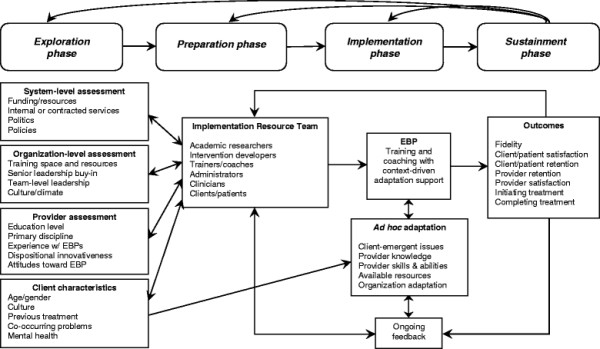
BACKGROUND: Adaptations are often made to evidence-based practices (EBPs) by systems, organizations, and/or service providers in the implementation process. The degree to which core elements of an EBP can be maintained while allowing for local adaptation is unclear. In addition, adaptations may also be needed at the system, policy, or organizational levels to facilitate EBP implementation and sustainment. This paper describes a study of the feasibility and acceptability of an implementation approach, the Dynamic Adaptation Process (DAP), designed to allow for EBP adaptation and system and organizational adaptations in a planned and considered, rather than ad hoc, way. The DAP involves identifying core elements and adaptable characteristics of an EBP, then supporting implementation with specific training on allowable adaptations to the model, fidelity monitoring and support, and identifying the need for and solutions to system and organizational adaptations. In addition, this study addresses a secondary concern, that of improving EBP model fidelity assessment and feedback in real-world settings. METHODS: This project examines the feasibility, acceptability, and utility of the DAP; tests the degree to which fidelity can be maintained using the DAP compared to implementation as usual (IAU); and examines the feasibility of using automated phone or internet-enabled, computer-based technology to assess intervention fidelity and client satisfaction. The study design incorporates mixed methods in order to describe processes and factors associated with variations in both how the DAP itself is implemented and how the DAP impacts fidelity, drift, and adaptation. The DAP model is to be examined by assigning six regions in California (USA) to either the DAP (n=3) or IAU (n=3) to implement an EBP to prevent child neglect. DISCUSSION: The DAP represents a data-informed, collaborative, multiple stakeholder approach to maintain intervention fidelity during the implementation of EBPs in the field by providing support for intervention, system, and organizational adaptation and intervention fidelity to meet local needs. This study is designed to address the real-world implications of EBP implementation in public sector service systems and is relevant for national, state, and local service systems and organizations.
Overview
The claims and statistics of this paper haven’t been checked yet.
Free: it reads the open-access text and checks the first 5 claims that cite a source we can check. Create a free account to check every claim.
Integrity signals
Registry
Cites
Statistics
Figures
Verification
Claims the paper makes
The claims and statistics of this paper haven’t been checked yet.
Free: it reads the open-access text and checks the first 5 claims that cite a source we can check. Create a free account to check every claim.
Claims other papers make about this one
Each is checked against this paper’s own text: does it say what the citing paper says it does?
The cited source says what the claim attributes to it.
In the citing paper
“ongoing adjustment and evaluation of EBT to ensure that a program is response to the local context provides an opportunity to increase intervention effectiveness over time (Aarons et al., 2012; Chambers et al., 2013)”
From User‐centered design for psychosocial intervention development and implementation. (2016) · cites this paper as Aarons et al., 2012
The cited source says what the claim attributes to it.
In the citing paper
“there has been little research focused explicitly on procedures for realizing this goal (Aarons et al., 2012; Lyon et al., 2014c).”
From User‐centered design for psychosocial intervention development and implementation. (2016) · cites this paper as Aarons et al., 2012
The cited source says what the claim attributes to it.
In the citing paper
“The DAP [69] is a multicomponent implementation strategy directly drawn from the EPIS framework.”
From Ten recommendations for using implementation frameworks in research and practice (2020) · cites this paper as [69]
The cited source says what the claim attributes to it.
In the citing paper
“A critical and core component of the DAP is the creation of an Implementation Resource Team that is a multiple stakeholder collaborative designed to support implementation, data interpretation, and explicitly address adaptations during the implementation process.”
From Ten recommendations for using implementation frameworks in research and practice (2020) · cites this paper as [69]
The cited source says what the claim attributes to it.
In the citing paper
“The DAP uses an iterative, data-informed approach to facilitate implementation across each phase of EPIS.”
From Ten recommendations for using implementation frameworks in research and practice (2020) · cites this paper as [69]
Self-check
Percentages, sums and reported differences re-computed from the paper’s own numbers.
The self-check needs the paper’s full text.
Citations
Cites
Qualitative research and evaluation methods
Patton, M. Q. (1980) · Cited by 35,734
Damschroder, L. J., Aron, D. C., Keith, R. E., Kirsh, S. R., Alexander, J. A., & Lowery, J. C. (2009) · Implementation Science · doi:10.1186/1748-5908-4-50 · Cited by 14,496 · cited 1×
“, organization) to effectively implement EBPs [13,14].”
Weighted kappa: nominal scale agreement provision for scaled disagreement or partial credit
Cohen, J. (1968) · Psychological Bulletin · doi:10.1037/h0026256 · Cited by 8,736
Diffusion of Innovations in Service Organizations: Systematic Review and Recommendations
GREENHALGH, T., ROBERT, G., MACFARLANE, F., BATE, P., & KYRIAKIDOU, O. (2004) · The Milbank Quarterly · doi:10.1111/j.0887-378x.2004.00325.x · Cited by 7,448 · cited 1×
“The interplay of characteristics of an intervention with service system and organizational characteristics (system, organization, provider, and client levels) can be complex [12].”
Background(2005) · Cited by 3,748
Advancing a Conceptual Model of Evidence-Based Practice Implementation in Public Service Sectors
Aarons, G. A., Hurlburt, M., & Horwitz, S. M. (2011) · Administration and Policy in Mental Health and Mental Health Services Research · doi:10.1007/s10488-010-0327-7 · Cited by 3,240
Self-citationSchuirmann, D. J. (1987) · Journal of Pharmacokinetics and Biopharmaceutics · doi:10.1007/bf01068419 · Cited by 2,696
Piaget, J. (1976) · Piaget and His School · doi:10.1007/978-3-642-46323-5_2 · Cited by 2,167
Carmichael's Manual of Child Psychology
Sigel, I. E., & Mussen, P. H. (1972) · American Educational Research Journal · doi:10.2307/1161696 · Cited by 2,053
The Handbook of Research Synthesis.
Light, R. J., Cooper, H., & Hedges, L. V. (1994) · Journal of the American Statistical Association · doi:10.2307/2291021 · Cited by 1,868
Research works printed but not linked: 5
- Kauffman Foundation Best Practices Project Kaufman best practices project final report: Closing the quality chasm in child abuse treatment: Identifying and disseminating best practices 2004 Ewing Marion Kauffman Foundation, Kansas
- Rogers EM Diffusions of innovations 1995 4 The Free Press, New York
- Webster New College Dictionary 1995 Houghton Mifflin Company, Boston
- Whitaker D Lutzker J Self-Brown S Edwards A Implementing and evidence-based program for the prevention of child maltreatment: The SafeCare® program Report on Emotional & Behavioral Disorders in Youth 2008 8 55 62
- Fraser D QSR NVivo reference guide 2000 QSR International, Melbourne
Cited by
Palinkas, L. A., Horwitz, S. M., Green, C. A., Wisdom, J. P., Duan, N., & Hoagwood, K. (2015) · Administration and Policy in Mental Health and Mental Health Services Research · doi:10.1007/s10488-013-0528-y · Cited by 12,038
“2008), and one in a simultaneous design for the purpose of complementing one another (Aarons et al. 2012).”
BackgroundMethodInfluentialSelf-citationImplementation strategies: recommendations for specifying and reporting
Proctor, E. K., Powell, B. J., & McMillen, J. C. (2013) · Implementation Science · doi:10.1186/1748-5908-8-139 · Cited by 2,585
“[79] illustrate strategy variation across three phases: adoption decision/preparation, active implementation, and sustainment.”
BackgroundSystematic review of the Exploration, Preparation, Implementation, Sustainment (EPIS) framework
Moullin, J. C., Dickson, K. S., Stadnick, N. A., Rabin, B., & Aarons, G. A. (2019) · Implementation Science · doi:10.1186/s13012-018-0842-6 · Cited by 1,223
“This is supported by recent work identifying the need for a dynamic approach to adaptation that involves all relevant stakeholders through the four EPIS phases in order to capitalize on the knowledge and experience of the implementation team and maximize the ability to find solutions that are acceptable to all stakeho…”
Self-citationStirman, S. W., Miller, C. J., Toder, K., & Calloway, A. (2013) · Implementation Science · doi:10.1186/1748-5908-8-65 · Cited by 691
“[24-26] have also made recommendations regarding specific processes for adapting mental health interventions”
BackgroundChambers, D. A., & Norton, W. E. (2016) · American Journal of Preventive Medicine · doi:10.1016/j.amepre.2016.05.011 · Cited by 581
“A second effort, characterized by Aarons et al. (2012)26 as part of the Dynamic Adaptation Process model, identifies core components and adaptable characteristics, and then lays out five stimuli for adaptations: client-emergent issues, provider knowledge, provider skills and abilities, available…”
BackgroundTen recommendations for using implementation frameworks in research and practice
Moullin, J. C., Dickson, K. S., Stadnick, N. A., Albers, B., Nilsen, P., Broder-Fingert, S., Mukasa, B., & Aarons, G. A. (2020) · Implementation Science Communications · doi:10.1186/s43058-020-00023-7 · Cited by 488
Self-citationUser‐centered design for psychosocial intervention development and implementation.
Lyon, A. R., & Koerner, K. (2016) · Clinical Psychology: Science and Practice · doi:10.1111/cpsp.12154 · Cited by 478
“Although it is often a foregone conclusion that the transfer of an EBT to a community context will be accompanied by an inevitable “voltage drop” in which its effectiveness falters relative to the original efficacy trials, there is growing acknowledgement that ongoing adjustment and evaluation of EBT to ensure that a…”
Aarons, G. A., Ehrhart, M. G., Farahnak, L. R., & Sklar, M. (2014) · Annual Review of Public Health · doi:10.1146/annurev-publhealth-032013-182447 · Cited by 474
Self-citationReframing implementation science to address inequities in healthcare delivery
Baumann, A. A., & Cabassa, L. J. (2020) · BMC Health Services Research · doi:10.1186/s12913-020-4975-3 · Cited by 461
“Scaling-out” evidence-based interventions to new populations or new health care delivery systems
Aarons, G. A., Sklar, M., Mustanski, B., Benbow, N., & Brown, C. H. (2017) · Implementation Science · doi:10.1186/s13012-017-0640-6 · Cited by 399
“In addition, the EPIS framework led to the development of the Dynamic Adaptation Process (DAP) that provides a process for pre-assessment, convening an “implementation resource team” to guide the implementation process, and use of audit and feedback data to help guide appropriate EBI adaptation [49].”
MethodSelf-citationKoorts, H., Eakin, E., Estabrooks, P., Timperio, A., Salmon, J., & Bauman, A. (2018) · International Journal of Behavioral Nutrition and Physical Activity · doi:10.1186/s12966-018-0678-0 · Cited by 335
“the appropriateness and effectiveness of strategies may vary by translation phase [62].”
BackgroundMovsisyan, A., Arnold, L., Evans, R., Hallingberg, B., Moore, G., O’Cathain, A., Pfadenhauer, L. M., Segrott, J., & Rehfuess, E. (2019) · Implementation Science · doi:10.1186/s13012-019-0956-5 · Cited by 331
Cabassa, L. J., & Baumann, A. A. (2013) · Implementation Science · doi:10.1186/1748-5908-8-90 · Cited by 290
“, increase the group size of interventions or shorten sessions), which could affect the effectiveness of the intervention [82].”
BackgroundInfluentialMcCreight, M. S., Rabin, B. A., Glasgow, R. E., Ayele, R. A., Leonard, C. A., Gilmartin, H. M., Frank, J. W., Hess, P. L., Burke, R. E., & Battaglia, C. T. (2019) · Translational Behavioral Medicine · doi:10.1093/tbm/ibz085 · Cited by 274
Novins, D. K., Green, A. E., Legha, R. K., & Aarons, G. A. (2013) · Journal of the American Academy of Child & Adolescent Psychiatry · doi:10.1016/j.jaac.2013.07.012 · Cited by 270
Self-citationKirk, M. A., Moore, J. E., Wiltsey Stirman, S., & Birken, S. A. (2020) · Implementation Science · doi:10.1186/s13012-020-01021-y · Cited by 254
Aarons, G. A., Green, A. E., Trott, E., Willging, C. E., Torres, E. M., Ehrhart, M. G., & Roesch, S. C. (2016) · Administration and Policy in Mental Health and Mental Health Services Research · doi:10.1007/s10488-016-0751-4 · Cited by 251
Self-citationBarrera, M., Berkel, C., & Castro, F. G. (2017) · Prevention Science · doi:10.1007/s11121-016-0705-9 · Cited by 203
“There are, in fact, systematic approaches for making adaptations while preserving core intervention components (Aarons et al. 2012; Lee et al. 2008).”
Hogue, A., Henderson, C. E., Becker, S. J., & Knight, D. K. (2018) · Journal of Clinical Child & Adolescent Psychology · doi:10.1080/15374416.2018.1466307 · Cited by 197
“…wherein EBI implementation activities are carried out incrementally (Langley et al., 2009; Taylor et al., 2013), a “dynamic” sustainment strategy (Aarons et al., 2012; Chambers, Glasgow, & Stange, 2013) is driven by balanced research-community partnerships wherein EBIs are continuously tested…”
BackgroundWiltsey Stirman, S., A Gutner, C., Crits-Christoph, P., Edmunds, J., Evans, A. C., & Beidas, R. S. (2015) · Implementation Science · doi:10.1186/s13012-015-0308-z · Cited by 188
“improving its fit or effectiveness in a given context [12, 13].”
BackgroundNadeem, E., Gleacher, A., & Beidas, R. S. (2013) · Administration and Policy in Mental Health and Mental Health Services Research · doi:10.1007/s10488-013-0502-8 · Cited by 185
“In order to help organizations make thoughtful adaptations, Aarons et al. (2012b) have developed the Dynamic Adaptation Process (DAP), a collaborative, multiple stakeholder process that involves identifying core elements and adaptable characteristics of an EBP, providing training and support that…”
BackgroundWriting implementation research grant proposals: ten key ingredients
Proctor, E. K., Powell, B. J., Baumann, A. A., Hamilton, A. M., & Santens, R. L. (2012) · Implementation Science · doi:10.1186/1748-5908-7-96 · Cited by 169
“implemented without being modified [67,106].”
Dopp, A. R., Parisi, K. E., Munson, S. A., & Lyon, A. R. (2020) · Implementation Science Communications · doi:10.1186/s43058-020-00020-w · Cited by 169
Kilbourne, A. M., Goodrich, D. E., Miake-Lye, I., Braganza, M. Z., & Bowersox, N. W. (2019) · Medical Care · doi:10.1097/mlr.0000000000001144 · Cited by 167
Implementation Research Methodologies for Achieving Scientific Equity and Health Equity
McNulty, M., Smith, J. D., Villamar, J. A., Burnett‐Zeigler, I., Vermeer, W., Benbow, N., Gallo, C. G., Wilensky, U. J., Hjorth, A., Mustanski, B. S., et al. (2019) · Ethnicity & Disease · doi:10.18865/ed.29.s1.83 · Cited by 166
Posadzki, P., Mastellos, N., Ryan, R., Gunn, L. H., Felix, L. M., Pappas, Y., Gagnon, M.-P., Julious, S. A., Xiang, L., Oldenburg, B., et al. (2016) · Cochrane Database of Systematic Reviews · doi:10.1002/14651858.cd009921.pub2 · Cited by 130
Pérez Jolles, M., Willging, C. E., Stadnick, N. A., Crable, E. L., Lengnick-Hall, R., Hawkins, J., & Aarons, G. A. (2022) · Frontiers in Health Services · doi:10.3389/frhs.2022.942658 · Cited by 116
“Researchers and community stakeholders must meaningfully consider their context when selecting an EBP, and be prepared to adapt interventions and strategies to accommodate for changing contextual influences (30, 34).”
Self-citationAarons, G. A., Fettes, D. L., Hurlburt, M. S., Palinkas, L. A., Gunderson, L., Willging, C. E., & Chaffin, M. J. (2014) · Journal of Clinical Child & Adolescent Psychology · doi:10.1080/15374416.2013.876642 · Cited by 126
Self-citationWiltsey Stirman, S., Gamarra, J. M., Bartlett, B. A., Calloway, A., & Gutner, C. A. (2017) · Clinical Psychology: Science and Practice · doi:10.1111/cpsp.12218 · Cited by 138
“These types of adaptations are common in routine care settings (Aarons et al., 2012; Cook, Dinnen, Simiola, et al., 2014; Cook, Dinnen, Thompson, et al., 2014; Stirman, Calloway et al., 2013; Stirman, Miller et al., 2013), and may be examples of a form of “flexible fidelity” that has been advocated…”
Miller, C. J., Wiltsey‐Stirman, S., & Baumann, A. A. (2020) · Journal of Community Psychology · doi:10.1002/jcop.22279 · Cited by 138
“On the other hand, there is growing recognition that adaptations to EBPs are not only common (Aarons et al., 2012; Chambers & Norton, 2016; Wiltsey Stirman et al., 2013), but may be essential to maximizing clinical effectiveness in certain settings and populations (Chambers, Glasgow, & Stange, 2013; Iwelunmor et al.”
BackgroundMethodInfluentialLau, A., Barnett, M., Stadnick, N., Saifan, D., Regan, J., Wiltsey Stirman, S., Roesch, S., & Brookman-Frazee, L. (2017) · Journal of Consulting and Clinical Psychology · doi:10.1037/ccp0000215 · Cited by 124
“Here, we define adaptation as the degree to which therapists modify the delivery, structure or content of the EBP to address population-specific needs (Aarons et al., 2012; Lau, 2006).”
Backgroundvon Thiele Schwarz, U., Aarons, G. A., & Hasson, H. (2019) · BMC Health Services Research · doi:10.1186/s12913-019-4668-y · Cited by 134
“Influences on multiple levels, from the system, organization, provider, and patient, can all influence the degree to which EBIs might require adaptation [14, 21].”
BackgroundSelf-citationDopp, A. R., Parisi, K. E., Munson, S. A., & Lyon, A. R. (2019) · Health Research Policy and Systems · doi:10.1186/s12961-018-0403-0 · Cited by 123
Use and effects of implementation strategies for practice guidelines in nursing: a systematic review
Cassidy, C. E., Harrison, M. B., Godfrey, C. M., Nincic, V., Khan, P. A., Oakley, P., Ross‐White, A., Grantmyre, H., & Graham, I. D. (2021) · Implementation Science · doi:10.1186/s13012-021-01165-5 · Cited by 136
Interagency collaborative team model for capacity building to scale-up evidence-based practice
Hurlburt, M., Aarons, G. A., Fettes, D., Willging, C., Gunderson, L., & Chaffin, M. J. (2014) · Children and Youth Services Review · doi:10.1016/j.childyouth.2013.10.005 · Cited by 132
“It is designed to serve as the ongoing support structure for continued EBP training, coaching, and roll-out across a geographic area and as a facilitator of minor practice adjustments that help to fit a practice to diverse regional contexts (Aarons et al., 2012).”
BackgroundSelf-citationRabin, B. A., Cakici, J. A., Golden, C. A., Estabrooks, P. A., Glasgow, R. E., & Gaglio, B. (2022) · Implementation Science · doi:10.1186/s13012-022-01234-3 · Cited by 128
Designing the Future of Children’s Mental Health Services
Lyon, A. R., Dopp, A. R., Brewer, S. K., Kientz, J. A., & Munson, S. A. (2020) · Administration and Policy in Mental Health and Mental Health Services Research · doi:10.1007/s10488-020-01038-x · Cited by 115
Potthoff, S., Finch, T. L., Bührmann, L., Etzelmüller, A., van Genugten, C., Girling, M., May, C. R., Perkins, N., Vis, C., & Rapley, T. (2023) · Health Expectations · doi:10.1111/hex.13808 · Cited by 122
“Lastly, we identified two approaches that offer more comprehensive guidance for stakeholder engagement in implementation, including the ‘analytic‐deliberative’ model(28) and the dynamic adaptation process (DAP) model.(29) The analytic‐deliberative model was developed with contributions from qualitative and quantitativ…”
BackgroundMethodInfluentialBlackman, K. C., Zoellner, J., Berrey, L. M., Alexander, R., Fanning, J., Hill, J. L., & Estabrooks, P. A. (2013) · Journal of Medical Internet Research · doi:10.2196/jmir.2745 · Cited by 98
“Organizational or delivery level facets of RE-AIM have consistently been underreported across behavior change intervention studies; yet, studies on mHealth PA interventions appear to be even less likely to report on organizational adoption, implementation, and maintenance [29,30,37-39].”
BackgroundAarons, G. A., Green, A. E., Willging, C. E., Ehrhart, M. G., Roesch, S. C., Hecht, D. B., & Chaffin, M. J. (2014) · Implementation Science · doi:10.1186/s13012-014-0183-z · Cited by 107
“These implementations involved university and community collaborations with specific projects to examine: 1) a cascading model of implementation featuring inter-agency collaborative teams [71,72] and 2) utilization of the Dynamic Adaptation Process [73] to facilitate implementation.”
BackgroundSelf-citationCooperative, T. J.-T., Knight, D. K., Belenko, S., Wiley, T., Robertson, A. A., Arrigona, N., Dennis, M., Bartkowski, J. P., McReynolds, L. S., Becan, J. E., et al. (2015) · Implementation Science · doi:10.1186/s13012-016-0423-5 · Cited by 100
“These strategies include a needs assessment [52], ongoing training and education [37, 53], local change teams with facilitation [54, 55], and data-driven decision-making [56, 57].”
BackgroundStirman, S. W., Gutner, C. A., Langdon, K., & Graham, J. R. (2016) · Behavior Therapy · doi:10.1016/j.beth.2015.12.001 · Cited by 103
Implementation Science: Why It Matters for the Future of Social Work
Cabassa, L. J. (2016) · Journal of Social Work Education · doi:10.1080/10437797.2016.1174648 · Cited by 98
Complexity and the science of implementation in health IT—Knowledge gaps and future visions
Abbott, P. A., Foster, J., Marin, H. D. F., & Dykes, P. C. (2014) · International Journal of Medical Informatics · doi:10.1016/j.ijmedinf.2013.10.009 · Cited by 95
VanDevanter, N., Kumar, P. C., Nguyen, N. T., Nguyen, L., Nguyen, T., Stillman, F. A., Weiner, B. J., & Shelley, D. (2017) · Implementation Science · doi:10.1186/s13012-017-0558-z · Cited by 90
“It is surprising that so few of the studies have applied this framework preimplementation given the complexity of moving evidence-based guidelines into practice and the need to tailor these guidelines to the local practice context [14, 20].”
BackgroundImplementation frameworks in child, youth and family services – Results from a scoping review
Albers, B., Mildon, R. L., Lyon, A. R., & Shlonsky, A. (2017) · Children and Youth Services Review · doi:10.1016/j.childyouth.2017.07.003 · Cited by 89
“The EPIS highlights the impact of inter-organizational networks on implementation processes – thereby giving these networks their own stakeholder status (Aarons et al., 2010, 2012).”
BackgroundGaias, L. M., Arnold, K. T., Liu, F. F., Pullmann, M. D., Duong, M. T., & Lyon, A. R. (2021) · Psychology in the Schools · doi:10.1002/pits.22515 · Cited by 88
“” Borrowing from the Dynamic Adaptation Process (Aarons et al., 2012), a school implementation”
BackgroundMethodLengnick‐Hall, R., Willging, C. E., Hurlburt, M. S., Fenwick, K. M., & Aarons, G. A. (2020) · Implementation Science · doi:10.1186/s13012-020-00999-9 · Cited by 87
Self-citationRositch, A. F., Unger‐Saldaña, K., DeBoer, R. J., Ng’ang’a, A., & Weiner, B. J. (2020) · Cancer · doi:10.1002/cncr.32877 · Cited by 86
“Adapting an evidencebased intervention is a balance between ensuring program fidelity and ensuring program fit to the target population (eg, increase contextual responsiveness, acceptability, and feasibility), and there are several frameworks with which to guide and study this process.(81,82)”
BackgroundLau, A. S., & Brookman-Frazee, L. (2015) · Implementation Science · doi:10.1186/s13012-016-0388-4 · Cited by 80
“There is growing attention to the role of therapist adaptations to practices and their implications for implementation outcomes [18, 33, 34].”
BackgroundA Concept Mapping Approach to Guide and Understand Dissemination and Implementation
Green, A. E., Fettes, D. L., & Aarons, G. A. (2012) · The Journal of Behavioral Health Services & Research · doi:10.1007/s11414-012-9291-1 · Cited by 83
“Indeed, empirical research increasingly demonstrates that effective dissemination and implementation must take into account the complexity of the service system, and multiple levels of stakeholders and processes involved at each stage of implementation.(6,35,36) The case study described above provides support for the…”
Self-citationScharf, D. M., Eberhart, N. K., Hackbarth, N. S., Horvitz-Lennon, M. V., Beckman, R., Han, B., Lovejoy, S. L., Pincus, H. A., & Burnam, M. A. (2014) · Rand health quarterly · doi:10.7249/rhq-04-03-06 · Cited by 74
Lyon, A. R., Ludwig, K., Romano, E., Koltracht, J., Vander Stoep, A., & McCauley, E. (2014) · Journal of Clinical Child & Adolescent Psychology · doi:10.1080/15374416.2013.843460 · Cited by 73
“Although there are a few emerging approaches to enhance appropriateness through systematic program adaptation (e.g., Aarons et al., 2012), successful use of these approaches may benefit from a clear understanding of the implementation context and end-users’ perceptions about the match of specific…”
BackgroundLocke, J. J., Lee, K., Cook, C. R., Frederick, L., Vázquez-Colón, C. A., Ehrhart, M. G., Aarons, G. A., Davis, C. J., & Lyon, A. R. (2018) · School Mental Health · doi:10.1007/s12310-018-9292-1 · Cited by 80
Self-citationOdom, S. L., Hall, L. J., & Suhrheinrich, J. (2019) · European Journal of Behavior Analysis · doi:10.1080/15021149.2019.1641952 · Cited by 80
“As can be seen in Figure 3, the EPIS model (Aarons et al., 2012) focuses on four such phases: Exploration, Preparation, Implementation, and Sustainment, with steps and activities specified within each phase.”
MethodLewis, C. C., Scott, K., Marti, C. N., Marriott, B. R., Kroenke, K., Putz, J. W., Mendel, P., & Rutkowski, D. (2015) · Implementation Science · doi:10.1186/s13012-015-0313-2 · Cited by 70
“This proposal reflects a movement in the field of implementation science to compare planned EBP adaptations to standardized EBP approaches [2, 33].”
BackgroundGuerrero, E. G., Padwa, H., Fenwick, K. M., Harris, L. M., & Aarons, G. A. (2015) · Implementation Science · doi:10.1186/s13012-016-0438-y · Cited by 75
“Furthermore, the comprehensive and multimethod approach to data collection used in this study is consistent with other research in behavioral health [30, 64, 65].”
ResultSelf-citationScaling Up Kangaroo Mother Care in Ethiopia and India: A Multi-Site Implementation Research Study
Mony, P. K., Tadele, H., Gebremariam, A., Chan, G. J., Kumar, A., Mazumder, S., Beyene, S. A., Jayanna, K., Kassa, D. H., Mohammed, H., et al. (2020) · BMJ Global Health · doi:10.1136/bmjgh-2021-005905 · Cited by 74
“Feedback was based on qualitative programme learning (managers, health providers and women/family responses) and quantitative data on KMC coverage.”
MethodAdaptation and Fidelity: a Recipe Analogy for Achieving Both in Population Scale Implementation
Kemp, L. (2016) · Prevention Science · doi:10.1007/s11121-016-0642-7 · Cited by 73
Glasgow, R. E., Trinkley, K. E., Ford, B., & Rabin, B. A. (2024) · Global Implementation Research and Applications · doi:10.1007/s43477-024-00134-6 · Cited by 70
“…(1) the importance of considering multilevel context and that for both interventions and implementation strategies ‘one size does not fit all’ (Aarons et al., 2012; Kirk et al., 2020; Mody et al., 2023); (2) for successful implementation there is a need to adapt implementation strategies…”
Watson, D. P., Shuman, V., Kowalsky, J., Golembiewski, E., & Brown, M. (2017) · Harm Reduction Journal · doi:10.1186/s12954-017-0158-x · Cited by 70
Hanson, R. F., Self‐Brown, S., Rostad, W. L., & Jackson, M. C. (2015) · Child Abuse & Neglect · doi:10.1016/j.chiabu.2015.09.014 · Cited by 67
Self-citationWillging, C. E., Green, A. E., Gunderson, L., Chaffin, M., & Aarons, G. A. (2015) · Child Maltreatment · doi:10.1177/1077559514547384 · Cited by 66
“However, consistent with recommendations for continuous feedback to monitor and support adaptation to ensure fit (Aarons et al., 2012), it is critical for systems to adopt continuous evaluation and data monitoring plans so that important processes and outcomes (e.g., safety, permanency, and…”
BackgroundSelf-citationSalveron, M., Bromfield, L., Kirika, C., Simmons, J., Murphy, T., & Turnell, A. (2014) · Children and Youth Services Review · doi:10.1016/j.childyouth.2014.11.011 · Cited by 65
Lyon, A. R., Wasse, J. K., Ludwig, K., Zachry, M., Bruns, E. J., Unützer, J., & McCauley, E. (2016) · Administration and Policy in Mental Health and Mental Health Services Research · doi:10.1007/s10488-015-0637-x · Cited by 63
“Sustainment Through Continued Adaptation and Evaluation (Phase 5) Consistent with recent frameworks for innovation sustainment in healthcare (e.g., Aarons et al. 2011, 2012; Chambers et al. 2013), the CTAP recognizes that ‘‘the only constant is change’’ in HIT redesign.”
Guerin, R. J., Glasgow, R. E., Tyler, A. N., Rabin, B. A., & Huebschmann, A. G. (2022) · Safety Science · doi:10.1016/j.ssci.2022.105763 · Cited by 63
“D & I science systematically addresses the gaps in the research-to-practice pipeline by engaging partners and beneficiaries to tailor the ways that an intervention will be implemented to fit the context and setting of end-users (Aarons et al., 2012; Chambers et al., 2013).”
BackgroundLocke, J., Beidas, R. S., Marcus, S., Stahmer, A., Aarons, G. A., Lyon, A. R., Cannuscio, C., Barg, F., Dorsey, S., & Mandell, D. S. (2016) · Implementation Science · doi:10.1186/s13012-016-0501-8 · Cited by 62
Self-citationThe role of collaborations in sustaining an evidence-based intervention to reduce child neglect
Green, A. E., Trott, E., Willging, C. E., Finn, N. K., Ehrhart, M. G., & Aarons, G. A. (2016) · Child Abuse & Neglect · doi:10.1016/j.chiabu.2015.11.013 · Cited by 48
“Yet , these service recipients may exert an indirect role in the sustainment of SC, as evaluation data such as recidivism rates, service retention, and satisfaction scores may influence a site’s decision to continue, adapt, or terminate SC services (Aarons et al., 2012).”
Self-citationWillging, C. E., Green, A. E., & Ramos, M. M. (2016) · Implementation Science · doi:10.1186/s13012-016-0507-2 · Cited by 58
“, leadership and supportive culture/climate) [43, 47, 48, 62].”
MethodSelf-citationChambers, D. (2023) · Frontiers in Health Services · doi:10.3389/frhs.2023.1204138 · Cited by 57
“Through conceptual advances like the Dynamic Adaptation Process (2), several iterations of the Framework for Reporting Adaptations and Modifications to Evidence-based Interventions (FRAME) (3, 4), and systematic reviews of adaptation research (5, 6), we have seen new recognition of the complexity and nuance of improvi…”
MethodSmith, J. D., Berkel, C., Rudo‐Stern, J., Montaño, Z., George, S. M. S., Prado, G. J., Mauricio, A. M., Chiapa, A., Bruening, M. M., & Dishion, T. J. (2018) · Frontiers in Public Health · doi:10.3389/fpubh.2018.00293 · Cited by 56
“There are a number of process frameworks to prospectively guide the adaptation of EBPs, some of which are more generic (17, 18), while others are specific to cultural adaptation [see Barrera et al.”
BackgroundHoward, A., Aston, S., Gerada, A., Reza, N., Bincalar, J., Mwandumba, H. C., Butterworth, T., Hope, W. W., & Buchan, I. E. (2023) · The Lancet Digital Health · doi:10.1016/s2589-7500(23)00221-2 · Cited by 54
Malti, T., Noam, G. G., Beelmann, A., & Sommer, S. (2016) · Journal of Clinical Child & Adolescent Psychology · doi:10.1080/15374416.2016.1239539 · Cited by 55
“…to a process of flexible decision making regarding the selection, implementation, and evaluation of evidence-based practices and approaches to enhance child mental health and development so that it is tailored to a given context, population, and need (see Aarons et al., 2012; Huey & Polo, 2008).”
BackgroundFixsen, D. L., Blasé, K. A., & Fixsen, A. A. M. (2017) · Criminology & Public Policy · doi:10.1111/1745-9133.12288 · Cited by 54
Wolk, C. B., Pelt, A. E. V., Jager‐Hyman, S., Ahmedani, B. K., Zeber, J. E., Fein, J. A., Brown, G. K., Gregor, C. A., Lieberman, A., & Beidas, R. S. (2018) · JAMA Network Open · doi:10.1001/jamanetworkopen.2018.5309 · Cited by 54
Aarons, G. A., Miller, E. A., Green, A. E., Perrott, J. A., & Bradway, R. (2012) · Journal of Children's Services · doi:10.1108/17466661211286463 · Cited by 51
Self-citationLyon, A. R., Ludwig, K., Wasse, J. K., Bergstrom, A., Hendrix, E., & McCauley, E. (2016) · Administration and Policy in Mental Health and Mental Health Services Research · doi:10.1007/s10488-015-0626-0 · Cited by 43
“Contextual Appropriateness of SA in Schools The contextual appropriateness (a.k.a., compatibility) of new practices has become an increasingly important area of emphasis among researchers interested in closing the ‘‘research to practice gap’’ (Aarons et al. 2012; Chambers et al. 2013).”
Stanton, M. C., Ali, S., & the SUSTAIN Center Team (2022) · Implementation Research and Practice · doi:10.1177/26334895211064250 · Cited by 50
“Tracking feedback from diverse implementation contexts can inform ongoing intervention evolution based on the needs and preferences of marginalized groups (Aarons et al., 2012; Chambers & Norton, 2016).”
Kilbourne, A. M., Almirall, D., Goodrich, D. E., Lai, Z., Abraham, K. M., Nord, K. M., & Bowersox, N. W. (2014) · Implementation Science · doi:10.1186/s13012-014-0163-3 · Cited by 50
“Facilitation was chosen as additional implementation strategy to REP because of its relative feasibility in application across a national network of sites, as well as similarity in theoretical underpinning to other implementation strategies that focus on improving the uptake of psychosocial interventions [34,35].”
Validating the Implementation Climate Scale (ICS) in child welfare organizations
Ehrhart, M. G., Torres, E. M., Wright, L. A., Martinez, S., & Aarons, G. A. (2015) · Child Abuse & Neglect · doi:10.1016/j.chiabu.2015.10.017 · Cited by 50
Self-citationFischer, R. D., Bailey, Y., Shankar, M., Safaeinili, N., Karl, J. A., Daly, A., Johnson, F. N., Winter, T. J., Arahanga‐Doyle, H., Fox, R., et al. (2024) · Clinical Psychology Review · doi:10.1016/j.cpr.2024.102425 · Cited by 50
Lewis, C. C., Darnell, D. A., Kerns, S. E. U., Monroe‐DeVita, M., Landes, S. J., Lyon, A. R., Stanick, C., Dorsey, S., Locke, J. J., Marriott, B. R., et al. (2016) · Implementation Science · doi:10.1186/s13012-016-0428-0 · Cited by 49
Self-citationFidelity monitoring in complex interventions: a case study of the WISE intervention
Swindle, T., Selig, J. P., Rutledge, J. M., Whiteside-Mansell, L., & Curran, G. M. (2018) · Archives of Public Health · doi:10.1186/s13690-018-0292-2 · Cited by 49
The Role of Leadership in Organizational Implementation and Sustainment in Service Agencies
Moullin, J. C., Ehrhart, M. G., & Aarons, G. A. (2017) · Research on Social Work Practice · doi:10.1177/1049731517718361 · Cited by 48
“Another study implemented SafeCare while testing the Dynamic Adaptation Process (DAP) as the implementation strategy (Aarons et al., 2012).”
MethodSelf-citationMediators of a Culturally-Sensitive Intervention for Suicidal African American Women
Zhang, H., Neelarambam, K., Schwenke, T. J., Rhodes, M. N., Pittman, D. M., & Kaslow, N. J. (2013) · Journal of Clinical Psychology in Medical Settings · doi:10.1007/s10880-013-9373-0 · Cited by 47
“To minimize the tension between flexibility and fidelity during the implementation of the manual (Aarons et al., 2012), the adaptation for the participants adheres strictly to the underling TTI model.”
MethodMignogna, J., Martin, L. A., Harik, J., Hundt, N. E., Kauth, M., Naik, A. D., Sorocco, K., Benzer, J., & Cully, J. (2018) · Implementation Science · doi:10.1186/s13012-018-0768-z · Cited by 47
“The DAP model’s provider skills and abilities, patient-emergent issues, and available resources ad hoc adaptations, which occur during the implementation phase, provide an overarching framework to better understand and contextualize these themes [15].”
BackgroundMethodInfluentialMetz, A. J. R., Kainz, K., & Boaz, A. (2023) · Frontiers in Health Services · doi:10.3389/frhs.2022.959386 · Cited by 45
“For example, implementation research is often concerned with stimulating changes to contextual variables, including the values and attitudes of direct practitioners, to align with the use of evidence-based programs (59), rather than using values of practitioners and community members to drive the selection of interven…”
BackgroundGeng, E., Mody, A., & Powell, B. J. (2023) · Annual Review of Public Health · doi:10.1146/annurev-publhealth-051920-124515 · Cited by 45
Baumann, A. A., Domenech Rodríguez, M. M., Amador, N. G., Forgatch, M. S., & Parra-Cardona, J. R. (2014) · Clinical Psychology: Science and Practice · doi:10.1111/cpsp.12059 · Cited by 44
“Some models embed the adaptation process explicitly, usually conceptualizing adaptation as part of the implementation process, and that it should start in the early stages of the process (e.g., Aarons et al., 2012; Cabassa, Druss, Wang, & Lewis-Fernandez, 2011; Lee, Altschul, & Mowbray, 2008).”
MethodWatson, D. P., Brucker, K., McGuire, A. B., Snow‐Hill, N. L., Xu, H., Cohen, A., Campbell, M. R., Robison, L., Sightes, E., Buhner, R., et al. (2019) · Journal of Substance Abuse Treatment · doi:10.1016/j.jsat.2019.06.002 · Cited by 44
“Adaptation is the rule rather than the exception when it comes to program implementation (Aarons et al., 2012; Allen, Linnan, & Emmons, 2012), and Milestone l’s results demonstrate adaptation of POINT is likely to occur at each location in order to ensure an optimal fit within its specific context.”
BackgroundComparative case studies in integrated care implementation from across the globe: a quest for action
Stadnick, N. A., Sadler, E., Sandall, J., Turienzo, C. F., Bennett, I. M., Borkan, J., Oladeji, B. D., Gureje, O., Aarons, G. A., & Sklar, M. (2019) · BMC Health Services Research · doi:10.1186/s12913-019-4661-5 · Cited by 43
Self-citationOpportunities and Challenges in Evidence-based Social Policy and commentaries
Supplee, L. H., & Metz, A. J. R. (2015) · Child Policy Nexus · doi:10.1002/j.2379-3988.2015.tb00081.x · Cited by 43
“The interplay between the service delivery organization, providers, and clients calls for early and ongoing assessments of these multi-level characteristics to determine whether a good enough fit exists between an evidence-based program and local context (Aarons et al., 2012).”
Ramanadhan, S., Galbraith‐Gyan, K. V., Revette, A. C., Foti, A., James, C. R., Martinez-Dominguez, V., Miller, E., Tappin, J., Tracy, N. R., Bruff, C., et al. (2020) · Translational Behavioral Medicine · doi:10.1093/tbm/ibz177 · Cited by 42
“The multi-level influences highlighted (e.g., variable and mismatched funding streams, community context, and organizational constraints related to resources and staffing, practitioner attributes and resources, and multi-level demands on EBP recipients) echo those noted in the underlying theoretical model, the EPIS fr…”
BackgroundLewis, C. C., Puspitasari, A. J., Boyd, M. R., Scott, K., Marriott, B. R., Hoffman, M., Navarro, E., & Kassab, H. D. (2018) · BMC Research Notes · doi:10.1186/s13104-018-3193-0 · Cited by 42
“The tailored implementation method was conceptualized as “customized and collaborative” and it was informed by the Dynamic Sustainability Framework [18], as well as the Dynamic Adaptation Process [19], both of which acknowledge that evidence based practices may require adaptation to best fit the context and implementa…”
Lyon, A. R., Corbin, C. M., Brown, E. C., Ehrhart, M. G., Locke, J., Davis, C., Picozzi, E., Aarons, G. A., & Cook, C. R. (2022) · Implementation Science · doi:10.1186/s13012-022-01222-7 · Cited by 41
Self-citationDesigning, testing, and implementing a sustainable nurse home visiting program: right@home
Goldfeld, S. R., Price, A. M. H., & Kemp, L. (2018) · Annals of the New York Academy of Sciences · doi:10.1111/nyas.13688 · Cited by 41
Rooted in Strengths : Celebrating the Strengths Perspective in Social Work
Mendenhall, A. N., & Carney, M. M. (2020) · KU ScholarWorks (The University of Kansas) · Cited by 41
Barnett, M. L., Brookman-Frazee, L. I., González, J. C., Zhan, C., Rodríguez, A., Stadnick, N. A., & Lau, A. S. (2018) · Journal of Clinical Child & Adolescent Psychology · doi:10.1080/15374416.2018.1485107 · Cited by 40
“By collaborating with community therapists to plan for adaptations that focus on increasing fit for their clients, EBP implementation could be improved for diverse children and families seeking care within publicly funded mental health settings (Aarons et al., 2012).”
BackgroundInfluentialKowalski, C. P., Veeser, M., & Heisler, M. (2018) · BMC Family Practice · doi:10.1186/s12875-018-0797-3 · Cited by 38
Firm, yet flexible: a fidelity debate paper with two case examples
Albers, B., Verweij, L., Blum, K., Oesch, S., Schultes, M.-T., Clack, L., & Naef, R. (2024) · Implementation Science · doi:10.1186/s13012-024-01406-3 · Cited by 37
“This gap has been acknowledged as a challenge in the literature [15], among others, leading to the development of frameworks to support adaptation tracking and decision-making in intervention [16–19] and implementation strategy use [20].”
Metadata
- Authors
- Aarons, G. A., Green, A. E., Palinkas, L. A., Self-Brown, S., Whitaker, D. J., Lutzker, J. R., Silovsky, J. F., Hecht, D. B., & Chaffin, M. J.
- Affiliations
- University of California San Diego (US)
- University of Southern California (US)
- Georgia State University (US)
- University of Oklahoma Health Sciences Center (US)
- Corresponding author
- Aarons, Gregory A
- ORCID
- Venue
- Implementation Science
- Published
- 2012-04-18
- Volume
- 7
- Issue
- 1
- Pages
- 32-32
- ISSN
- 1748-5908 (ISSN-L)
- PMC
- PMC3436717
- OpenAlex
- W2062957857
- Cited by
- 449
- References
- 60
- Citations by year
- 2026: 24 · 2025: 33 · 2024: 67 · 2023: 42 · 2022: 46 · 2021: 40 · 2020: 36 · 2019: 41 · 2018: 30 · 2017: 20 · 2016: 17 · 2015: 20 · 2014: 14 · 2013: 13 · 2012: 3
- FWCI
- 28.44
- Type
- journal article
- Language
- en
- Open access
- gold
- doi.org
- Licence
- Locations
- Implementation Science (publishedVersion, cc-by)
- Europe PMC (PubMed Central) (publishedVersion, cc-by)
- PubMed Central (publishedVersion, cc-by)
- PubMed (publishedVersion)
- Digital Archive @ GSU (submittedVersion, cc-by)
- DOAJ (DOAJ: Directory of Open Access Journals) (submittedVersion)
- eScholarship (California Digital Library) (submittedVersion)
- Counseling And Psychological Services Dissertations (Georgia State University) (submittedVersion, cc-by)
- Funders
- Centers for Disease Control and Prevention (R01CE001556)
- National Institute of Mental Health (R01MH092950, P30MH074678, R01CE001556, R25MH080916)
- Topics
- Health Sciences › Health Professions › General Health Professions › Health Policy Implementation Science
- Health Sciences › Health Professions › General Health Professions › Health Sciences Research and Education
- Social Sciences › Sociology and Political Science › Child Welfare and Adoption
- Keywords
- child abuse intervention, child neglect prevention, intervention fidelity, fidelity monitoring, drift, organizational adaptation, system adaptation, feasibility and acceptability, client satisfaction
- MeSH terms
- California, Child, Child Abuse, Child Health Services, Child Welfare, Feasibility Studies, Humans, Telephone, Internet, Evidence-Based Practice
About these checks
Registry, retraction, Cites and statistics results are computed, not judged, with one exception: a printed reference that no index lists is read once by a model before it counts as a citation error. Claims are extracted by a model and kept only when their quote appears verbatim in the text; each cited source is then checked, with a model’s help, for whether it says what the claim relies on. Those verdicts can be wrong — read the claim’s quote and the cited source before relying on one.
Statistics and arithmetic are recomputed, not judged.
Confidence bands are shown only for fields calibrated on our annotated test set. None is calibrated yet, so no band is shown.
What counts as a claim ›How we measure confidence ›How we check this ›
Are you an author, or do you see a problem with this page? Request a review
Data sources
Bibliographic data: Semantic Scholar, OpenAlex, Crossref.
Contains information from the Semantic Scholar Academic Graph Datasets, made available under the ODC Attribution License (ODC-BY 1.0).
Semantic Scholar’s data is described in: Kinney, R., et al. (2023). The Semantic Scholar Open Data Platform. arXiv:2301.10140.
