

Dynamic adaptation process to implement an evidence-based child maltreatment intervention
Open accessThe DOI matches its Crossref record; 59 of the 60 references it cites were found in a registry or an index.
Abstract
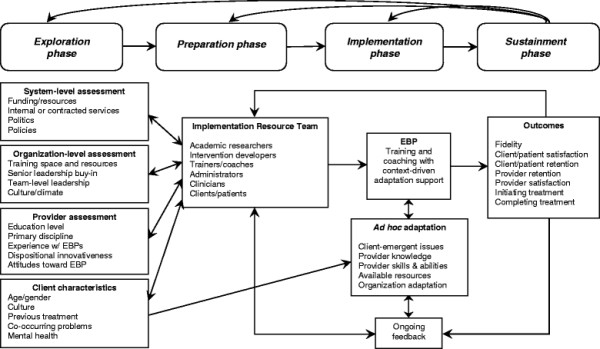
BACKGROUND: Adaptations are often made to evidence-based practices (EBPs) by systems, organizations, and/or service providers in the implementation process. The degree to which core elements of an EBP can be maintained while allowing for local adaptation is unclear. In addition, adaptations may also be needed at the system, policy, or organizational levels to facilitate EBP implementation and sustainment. This paper describes a study of the feasibility and acceptability of an implementation approach, the Dynamic Adaptation Process (DAP), designed to allow for EBP adaptation and system and organizational adaptations in a planned and considered, rather than ad hoc, way. The DAP involves identifying core elements and adaptable characteristics of an EBP, then supporting implementation with specific training on allowable adaptations to the model, fidelity monitoring and support, and identifying the need for and solutions to system and organizational adaptations. In addition, this study addresses a secondary concern, that of improving EBP model fidelity assessment and feedback in real-world settings. METHODS: This project examines the feasibility, acceptability, and utility of the DAP; tests the degree to which fidelity can be maintained using the DAP compared to implementation as usual (IAU); and examines the feasibility of using automated phone or internet-enabled, computer-based technology to assess intervention fidelity and client satisfaction. The study design incorporates mixed methods in order to describe processes and factors associated with variations in both how the DAP itself is implemented and how the DAP impacts fidelity, drift, and adaptation. The DAP model is to be examined by assigning six regions in California (USA) to either the DAP (n=3) or IAU (n=3) to implement an EBP to prevent child neglect. DISCUSSION: The DAP represents a data-informed, collaborative, multiple stakeholder approach to maintain intervention fidelity during the implementation of EBPs in the field by providing support for intervention, system, and organizational adaptation and intervention fidelity to meet local needs. This study is designed to address the real-world implications of EBP implementation in public sector service systems and is relevant for national, state, and local service systems and organizations.
Overview
The claims and statistics of this paper haven’t been checked yet.
Free: it reads the open-access text and checks the first 5 claims that cite a source we can check. Create a free account to check every claim.
Integrity signals
Registry
Cites
Statistics
Figures
Verification
Claims the paper makes
The claims and statistics of this paper haven’t been checked yet.
Free: it reads the open-access text and checks the first 5 claims that cite a source we can check. Create a free account to check every claim.
Claims other papers make about this one
Each is checked against this paper’s own text: does it say what the citing paper says it does?
The cited source says what the claim attributes to it.
In the citing paper
“ongoing adjustment and evaluation of EBT to ensure that a program is response to the local context provides an opportunity to increase intervention effectiveness over time (Aarons et al., 2012; Chambers et al., 2013)”
From User‐centered design for psychosocial intervention development and implementation. (2016) · cites this paper as Aarons et al., 2012
The cited source says what the claim attributes to it.
In the citing paper
“there has been little research focused explicitly on procedures for realizing this goal (Aarons et al., 2012; Lyon et al., 2014c).”
From User‐centered design for psychosocial intervention development and implementation. (2016) · cites this paper as Aarons et al., 2012
The cited source says what the claim attributes to it.
In the citing paper
“The DAP [69] is a multicomponent implementation strategy directly drawn from the EPIS framework.”
From Ten recommendations for using implementation frameworks in research and practice (2020) · cites this paper as [69]
The cited source says what the claim attributes to it.
In the citing paper
“A critical and core component of the DAP is the creation of an Implementation Resource Team that is a multiple stakeholder collaborative designed to support implementation, data interpretation, and explicitly address adaptations during the implementation process.”
From Ten recommendations for using implementation frameworks in research and practice (2020) · cites this paper as [69]
The cited source says what the claim attributes to it.
In the citing paper
“The DAP uses an iterative, data-informed approach to facilitate implementation across each phase of EPIS.”
From Ten recommendations for using implementation frameworks in research and practice (2020) · cites this paper as [69]
Self-check
Percentages, sums and reported differences re-computed from the paper’s own numbers.
The self-check needs the paper’s full text.
Citations
Cites
Qualitative research and evaluation methods
Patton, M. Q. (1980) · Cited by 35,734
Damschroder, L. J., Aron, D. C., Keith, R. E., Kirsh, S. R., Alexander, J. A., & Lowery, J. C. (2009) · Implementation Science · doi:10.1186/1748-5908-4-50 · Cited by 14,496 · cited 1×
“, organization) to effectively implement EBPs [13,14].”
Weighted kappa: nominal scale agreement provision for scaled disagreement or partial credit
Cohen, J. (1968) · Psychological Bulletin · doi:10.1037/h0026256 · Cited by 8,736
Diffusion of Innovations in Service Organizations: Systematic Review and Recommendations
GREENHALGH, T., ROBERT, G., MACFARLANE, F., BATE, P., & KYRIAKIDOU, O. (2004) · The Milbank Quarterly · doi:10.1111/j.0887-378x.2004.00325.x · Cited by 7,448 · cited 1×
“The interplay of characteristics of an intervention with service system and organizational characteristics (system, organization, provider, and client levels) can be complex [12].”
Background(2005) · Cited by 3,748
Advancing a Conceptual Model of Evidence-Based Practice Implementation in Public Service Sectors
Aarons, G. A., Hurlburt, M., & Horwitz, S. M. (2011) · Administration and Policy in Mental Health and Mental Health Services Research · doi:10.1007/s10488-010-0327-7 · Cited by 3,240
Self-citationSchuirmann, D. J. (1987) · Journal of Pharmacokinetics and Biopharmaceutics · doi:10.1007/bf01068419 · Cited by 2,696
Piaget, J. (1976) · Piaget and His School · doi:10.1007/978-3-642-46323-5_2 · Cited by 2,167
Carmichael's Manual of Child Psychology
Sigel, I. E., & Mussen, P. H. (1972) · American Educational Research Journal · doi:10.2307/1161696 · Cited by 2,053
The Handbook of Research Synthesis.
Light, R. J., Cooper, H., & Hedges, L. V. (1994) · Journal of the American Statistical Association · doi:10.2307/2291021 · Cited by 1,868
Research works printed but not linked: 5
- Kauffman Foundation Best Practices Project Kaufman best practices project final report: Closing the quality chasm in child abuse treatment: Identifying and disseminating best practices 2004 Ewing Marion Kauffman Foundation, Kansas
- Rogers EM Diffusions of innovations 1995 4 The Free Press, New York
- Webster New College Dictionary 1995 Houghton Mifflin Company, Boston
- Whitaker D Lutzker J Self-Brown S Edwards A Implementing and evidence-based program for the prevention of child maltreatment: The SafeCare® program Report on Emotional & Behavioral Disorders in Youth 2008 8 55 62
- Fraser D QSR NVivo reference guide 2000 QSR International, Melbourne
Cited by
Items 201–300 of 489
Callaghan‐Koru, J. A., Islam, M., Khan, M. A., Sowe, A., Islam, J., Mannan, I. I., George, J., & The Bangladesh Chlorhexidine Scale Up Study Group (2020) · Health Policy and Planning · doi:10.1093/heapol/czz156 · Cited by 15
Paciocco, S., Kothari, A. R., Licskai, C. J., Ferrone, M., & Sibbald, S. L. (2021) · BMC Health Services Research · doi:10.1186/s12913-021-06636-5 · Cited by 15
Whitaker, D., Self-Brown, S., Weeks, E. A., O'Connor, M. H., Lyons, M., Willging, C. E., Lee, N., Kumar, J., Joseph, H. L., Reidy, D. E., et al. (2021) · BMC Public Health · doi:10.1186/s12889-021-11148-2 · Cited by 11
“Following Aarons and colleagues (Aarons et al., 2012) process for designing adaptations, we created an adaptation team that consisted of model experts (i.”
MethodInfluentialSelf-citationNagy, S. M., Butame, S. A., Todd, L. M., Sheffler, J., Henna Budhwani, P., Fernandez, M. I., MacDonell, K. K., & Naar, S. (2021) · AIDS Care · doi:10.1080/09540121.2021.1950604 · Cited by 15
“lement the EPIS framework as implementation proceeds (Aarons et al., 2012).”
MethodImproving transitions and outcomes of sepsis survivors (I-TRANSFER): a type 1 hybrid protocol
O’Connor, M. L., Kennedy, E. E., Hirschman, K. B., Mikkelsen, M. E., Deb, P., Ryvicker, M. B., Hodgson, N. A., Barrón, Y., Stawnychy, M. A., Garren, P. A., et al. (2022) · BMC Palliative Care · doi:10.1186/s12904-022-00973-w · Cited by 15
“While maintaining the core I-TRANSFER elements, in keeping with a pragmatic design, we will allow variation in the workflow for dyad preferences while providing monitoring and feedback of the implementation through the rollout [84].”
MethodStakeholder and Equity Data-Driven Implementation: a Mixed Methods Pilot Feasibility Study
Aschbrenner, K. A., Kruse, G. R., Emmons, K. M., Singh, D. P., Barber-Dubois, M. E., Miller, A. M., Thomas, A. N., & Bartels, S. J. (2022) · Prevention Science · doi:10.1007/s11121-022-01442-9 · Cited by 15
“1) was modeled on elements of the dynamic adaptation process (DAP) (Aarons et al., 2012), a data-informed, collaborative, stakeholder-engaged approach to guiding adaptations to improve the fit of an EBI in a new context.”
Chuang, E., Collins‐Camargo, C., & McBeath, B. (2017) · Implementation Science · doi:10.1186/s13012-017-0580-1 · Cited by 15
“structured (rather than ad hoc) adaptation of EBTs to local contexts [94, 95].”
BackgroundPankow, J., Willett, J. L., Yang, Y., Swan, H., Dembo, R., Burdon, W. M., Patterson, Y. O., Pearson, F. S., Belenko, S. R., & Frisman, L. K. (2017) · The Journal of Behavioral Health Services & Research · doi:10.1007/s11414-017-9551-1 · Cited by 15
“These elements were examined with qualitative data, drawing on mix-method design—an approach that is increasingly appreciated in implementation science studies.(49)”
MethodSimon, M. A., Tom, L. S., Leung, I. S., Wong, E., Knightly, E., Perez-Vicencio, D., Yau, A., Ortigara, K., & Dong, X. (2019) · Health Services Insights · doi:10.1177/1178632919841376 · Cited by 15
Justice community opioid innovation network (JCOIN): The TCU research hub
Knight, D. K., Becan, J. E., Olson, D., Davis, N. P., Jones, J., Wiese, A. L., Carey, P. D., Howell, D., & Knight, K. K. (2021) · Journal of Substance Abuse Treatment · doi:10.1016/j.jsat.2021.108290 · Cited by 15
Lowell, A. F., Suchman, N. E., Byatt, N., Feinberg, E., Friedmann, P. D., & Peacock‐Chambers, E. (2023) · Infant Mental Health Journal · doi:10.1002/imhj.22041 · Cited by 14
Harnessing Implementation Science in Clinical Psychology: Past, Present, and Future
Beidas, R. S., Boyd, M. R., Casline, E. P., Scott, K., Patel, Z. S., Mills, C., Mustanski, B. S., Schriger, S. H., Williams, F. S., Waller, C., et al. (2025) · Annual Review of Clinical Psychology · doi:10.1146/annurev-clinpsy-081423-021727 · Cited by 14
“…review, resources have been developed to adapt EBTs before implementation and to facilitate rigorous tracking of adaptations to reduce the likelihood of drifting from effective EBT core components (Aarons et al. 2012, Chambers & Norton 2016, Wiltsey Stirman et al. 2019, Wingood & DiClemente 2008).”
Lubans, D. R., Sanders, T., Noetel, M., Parker, P. D., McKay, H. A., Morgan, P. J., Salmon, J., Kirwan, M., Bennie, A., Peralta, L. R., et al. (2022) · International Journal of Behavioral Nutrition and Physical Activity · doi:10.1186/s12966-022-01371-4 · Cited by 14
“a ‘dynamic tension’ between retaining fidelity to the intervention and adapting intervention components and program delivery to meet the needs of different delivery partners and different contexts [49].”
BackgroundIwelunmor, J., Tucker, J. D., Ezechi, O., Nwaozuru, U., Obiezu‐Umeh, C., Gbaja-Biamila, T. A., Oladele, D. A., Musa, A. Z., & Airhihenbuwa, C. O. (2023) · Current HIV/AIDS Reports · doi:10.1007/s11904-023-00652-2 · Cited by 15
“Also, with the Dynamic Adaptation Process [51], adaptation is the steps taken to allow an evidence-based practice to be delivered faithfully in situations where it otherwise might not fit.”
Adaptation in Dissemination and Implementation Science
Baumann, A. A., Stirman, S. W., & Cabassa, L. J. (2023) · Oxford University Press eBooks · doi:10.1093/oso/9780197660690.003.0008 · Cited by 14
Aschbrenner, K. A., Bond, G. R., Pratt, S. I., Jue, K., Williams, G. M., Banerjee, S., & Bartels, S. J. (2020) · Implementation Research and Practice · doi:10.1177/2633489520943200 · Cited by 14
“Organizations and service providers sometimes prospectively plan an adaptation prior to implementing an EBP (Aarons et al., 2012; McGurk et al., 2015), making modifications prior to implementation because of the local circumstances and/or client’s needs and preferences.”
BackgroundInfluentialSil, S., Lee, J. L., Klosky, J. L., Vaz, A., Mee, L. L., Cochran, S., Thompson, B., & Coakley, R. (2021) · Pediatric Blood & Cancer · doi:10.1002/pbc.29013 · Cited by 14
Fagnan, L. J., Ramsey, K., Dickinson, C., Kline, T., & Parchman, M. L. (2021) · The Journal of the American Board of Family Medicine · doi:10.3122/jabfm.2021.04.210011 · Cited by 14
Moore, L. A., Aarons, G. A., Davis, J. H., & Novins, D. K. (2015) · Psychological Services · doi:10.1037/ser0000022 · Cited by 14
“Other process models that consider system, organization, community, provider, and client needs help to identify and adapt systems and organizational process and EBTs for a given community (Aarons et al., 2012).”
BackgroundSelf-citationEiraldi, R. B., Khanna, M. S., Jawad, A. F., Fishman, J., Glick, H. A., Schwartz, B. S., Cacia, J., Wandersman, A., & Beidas, R. S. (2015) · Implementation Science · doi:10.1186/s13012-016-0453-z · Cited by 14
Harvey, A. G., Agnew, E. R., Hache, R. E., Spencer, J. M., Diaz, M., Patino, E. O., Milner, A., Dong, L., Kilbourne, A. M., Buysse, D. J., et al. (2025) · Implementation Science · doi:10.1186/s13012-025-01440-9 · Cited by 13
“Throughout REP Phases 1 and 2, following leading adaptation frameworks, we sought to ensure that Adapted TSC would be relevant to the broadest range of patients and to account for factors that impact implementation (e.g., resources required) [33, 40, 41].”
Knott, C. L., Miech, E. J., Slade, J. L., Woodard, N., Robinson-Shaneman, B.-J., & Huq, M. R. (2022) · Global Implementation Research and Applications · doi:10.1007/s43477-021-00033-0 · Cited by 13
Cabassa, L. J., Gomes, A. P., & Lewis‐Fernández, R. (2014) · Medical Care Research and Review · doi:10.1177/1077558714563171 · Cited by 13
Rotheram-Fuller, E. J., Swendeman, D. T., Becker, K., Daleiden, E. L., Chorpita, B. F., Youssef, M. K., & Rotheram‐Borus, M. J. (2017) · Prevention Science · doi:10.1007/s11121-017-0787-z · Cited by 13
“…about how broad diffusion can be feasibly implemented has led to calls for flexibility in standards, novel models of synthesizing evidence, and iterative quality improvement in the DNA of each behavioral EBI (Aarons et al., 2012; Kazdin & Blase, 2011; Rotheram-Borus, Swendeman, & Chorpita, 2012).”
BackgroundA Methodological Review of SafeCare®
Guastaferro, K., & Lutzker, J. R. (2019) · Journal of Child and Family Studies · doi:10.1007/s10826-019-01531-4 · Cited by 13
Self-citationNaar, S., Pennar, A. L., Wang, B., Brogan-Hartlieb, K., & Fortenberry, J. D. (2021) · Health Psychology · doi:10.1037/hea0001071 · Cited by 13
Willging, C. E., Trott, E. M., Fettes, D. L., Gunderson, L. M., Green, A. E., Hurlburt, M. S., & Aarons, G. A. (2015) · Research on Social Work Practice · doi:10.1177/1049731515601897 · Cited by 14
“Characteristics of this process were the worries about whether the home visitors delivered the RSI with adequate fidelity, which, while sounding like a concrete, measurable property, can be difficult to identify and measure in practice (Aarons et al., 2012; Schoenwald et al., 2011).”
BackgroundSelf-citationClassifying Changes to Preventive Interventions: Applying Adaptation Taxonomies
Roscoe, J. N., Shapiro, V. B., Whitaker, K., & Kim, B. K. E. (2019) · The Journal of Primary Prevention · doi:10.1007/s10935-018-00531-2 · Cited by 12
Cox, B., Flemen-Tung, M., May, N., Cappella, E., Nadeem, E., Park, C., & Chacko, A. (2024) · Social and Emotional Learning Research Practice and Policy · doi:10.1016/j.sel.2024.100047 · Cited by 12
Gunderson, L. M., Shattuck, D. G., Green, A. E., Vitous, C. A., Ramos, M. M., & Willging, C. E. (2021) · Implementation Research and Practice · doi:10.1177/2633489520986214 · Cited by 12
Self-citationAdaptation of a trauma-informed intervention for youth involved in the legal system
Razuri, E. B., Yang, Y., Tinius, E., & Knight, D. K. (2023) · Journal of Substance Use and Addiction Treatment · doi:10.1016/j.josat.2024.209294 · Cited by 12
Egeland, K. M., Hauge, M., Ruud, T., Ogden, T., & Heiervang, K. S. (2019) · Community Mental Health Journal · doi:10.1007/s10597-019-00430-8 · Cited by 12
Fox, M. T., Sidani, S., Butler, J. I., Skinner, M. W., Macdonald, M., Durocher, E., Hunter, K. F., Wagg, A., Weeks, L. E., MacLeod, A., et al. (2021) · Implementation Science Communications · doi:10.1186/s43058-021-00179-w · Cited by 12
Harvey, A. G., Lammers, H. S., Dolsen, E. A., Mullin, A. C., Hilmoe, H. E., Tran, M., Portnova, V., Tuck, A. B., Mallidi, A., Fang, A., et al. (2020) · Evidence-Based Mental Health · doi:10.1136/ebmental-2020-300225 · Cited by 12
Clinician-Reported Modification to a CBT Approach in Children’s Mental Health
Meza, R. D., Jungbluth, N., Sedlar, G., Martin, P., Berliner, L., Wiltsey-Stirman, S., & Dorsey, S. (2020) · Journal of Emotional and Behavioral Disorders · doi:10.1177/1063426619828369 · Cited by 11
Studts, C. R., Merritt, A., Pilar, M. R., Bundy, H. E., Bardach, S., Jacobs, J. A., & Feltner, F. J. (2020) · Journal of Health Care for the Poor and Underserved · doi:10.1353/hpu.2020.0102 · Cited by 11
Jackson, G. L., Fix, G. M., White, B. S., Cutrona, S. L., Reardon, C. M., Damschroder, L. J., Burns, M., DeLaughter, K. L., Widerquist, M. A. O., Arasim, M. E., et al. (2024) · Frontiers in Health Services · doi:10.3389/frhs.2023.1223277 · Cited by 11
“Key ideas from implementation and improvement science are integrated into the facilitation process (e.g., identifying core and adaptable practice components) (31, 54, 55).”
BackgroundDavis, L., Wong, L. W., & Bromley, E. (2022) · Psychiatric Services · doi:10.1176/appi.ps.202100425 · Cited by 11
Sommerfeld, D. H., Aarons, G. A., Naqvi, J. B., Holden, J. L., Perivoliotis, D., Mueser, K. T., & Granholm, E. L. (2018) · Administration and Policy in Mental Health and Mental Health Services Research · doi:10.1007/s10488-018-0904-8 · Cited by 11
Self-citationFogarty, A., Jones, A., Seymour, M., Savopoulos, P., Evans, K., O’Brien, J., O'Dea, L., Clout, P., Auletta, S., & Giallo, R. (2021) · Child & Family Social Work · doi:10.1111/cfs.12890 · Cited by 11
Nicholson, J., Heyman, M., English, K., & Biebel, K. (2022) · Frontiers in Psychiatry · doi:10.3389/fpsyt.2022.801065 · Cited by 10
Kuroda, Y., Fujita, K., Sugimoto, T., Uchida, K., Shimazu, T., Saito, J., Arai, H., & Sakurai, T. (2023) · Archives of Public Health · doi:10.1186/s13690-023-01205-0 · Cited by 10
“The adaptation of evidence-based programmes (EBPs) to particular settings and populations has become common practice in implementation science [15–17]; it is essential for maxi-mising the EBPs’ effectiveness [16, 18, 19].”
BackgroundThe Role of Organizational Processes in Dissemination and Implementation Research
Aarons, G. A., Ehrhart, M. G., Lengnick‐Hall, R., & Moullin, J. C. (2023) · Oxford University Press eBooks · doi:10.1093/oso/9780197660690.003.0009 · Cited by 11
Self-citationBornheimer, L. A., Verdugo, J. L., Krasnick, J., Jeffers, N., Storey, F., King, C. A., Taylor, S. F., Florence, T., & Himle, J. A. (2023) · Social Work in Mental Health · doi:10.1080/15332985.2023.2186736 · Cited by 10
“As a result, we acknowledge the value of individual tailoring and support the existing flexibility within fidelity literature suggesting that tailoring should not involve disruption of an intervention’s core components (Aarons et al., 2012; Kendall & Frank, 2018).”
BackgroundPalinkas, L. A., Belanger, R., Newton, S., Saldana, L., Landsverk, J. A., & Dubowitz, H. (2023) · Academic Pediatrics · doi:10.1016/j.acap.2023.06.024 · Cited by 10
Self-citationAdapting Curricula for Children With Language Comprehension Deficits
Bridges, M. S., Curran, M. K., Neal, C., Piasta, S. B., Fleming, K., & Hogan, T. P. (2023) · Language Speech and Hearing Services in Schools · doi:10.1044/2023_lshss-22-00189 · Cited by 11
Early Family Support Interventions: Creating Context for Success
Daro, D. A. (2016) · Global Social Welfare · doi:10.1007/s40609-016-0048-2 · Cited by 11
“Although adaption may or may not be a deliberate choice, some form of adaptation is likely to be the rule rather than the exception for programs that serve caretakers of young children (Aarons et al 2012).”
BackgroundMeißner, P. (2018) · Learning Health Systems · doi:10.1002/lrh2.10058 · Cited by 10
Olakunde, B. O., Itanyi, I. U., Olawepo, J. O., Liu, L., Afonne, C., Idemili-Aronu, N., Lasebikan, N. N., Onyeka, T. C., Dim, C. C., Chigbu, C. O., et al. (2024) · Implementation Science · doi:10.1186/s13012-024-01349-9 · Cited by 9
“In the preparation phase , we refined the IS and convened implementation resource team (IRT) [54] meetings to further reflect on the refined Core and Core + IS fit with local context.”
MethodSelf-citationKruis, R. D., Johnson, E., Guille, C., Sprouse-McClam, C., Alkis, A., McElligott, J. T., & Harvey, J. (2025) · BMC Family Practice · doi:10.1186/s12875-025-02839-5 · Cited by 9
“Within the DAP model, adaptations are explicit and executed in a planned way by an Implementation Resource Team (IRT), which has expertise in the respective EBP and can ensure fidelity despite adaptations [31].”
InfluentialEffectiveness of Youth and Young Adult Peer Support in Mental Health Services: A Systematic Review
Hoagwood, K., Gendler, C., Davies, N., Davis, K. D., Boorada, P., Lettieri, R., & Kelleher, K. J. (2025) · Administration and Policy in Mental Health and Mental Health Services Research · doi:10.1007/s10488-025-01451-0 · Cited by 9
Powell, T. M., Muller, J. M., & Wetzel, G. (2023) · National symposium on family issues · doi:10.1007/978-3-031-22649-6_2 · Cited by 9
Raymond, I. J. (2019) · Residential Treatment for Children & Youth · doi:10.1080/0886571x.2019.1633985 · Cited by 9
“Further to this, the modular approach operationalized within the LBMmodel is underpinned by the premise that evidence-based programs can be deconstructed into core components and adaptable features (Aarons et al., 2012).”
BackgroundMethodInfluentialSaifan, D., Brookman-Frazee, L. I., Barnett, M. L., González, J. C., & Lau, A. S. (2018) · Cultural Diversity & Ethnic Minority Psychology · doi:10.1037/cdp0000203 · Cited by 9
“A more feasible alternative is a dynamic adaptation process that engages multiple stakeholders to systematically guide adaptations for different contexts (Aarons et al., 2012).”
Lengnick‐Hall, R., Fenwick, K. M., Hurlburt, M. S., Green, A. C., Askew, R. A., & Aarons, G. A. (2019) · Journal of Children s Services · doi:10.1108/jcs-05-2018-0010 · Cited by 9
Self-citationKellner, S., Stocker, U., & Fürst, G. (1985) · Transfusion Medicine and Hemotherapy · doi:10.1159/000221739 · Cited by 9
Smith, J. D., Carroll, A. J., Tedla, Y. G., Sanuade, O. A., Merle, J. L., Heinrich, J., Bannon, J., Abramsohn, E., Ahmad, F. S., Lazar, D., et al. (2025) · Implementation Science · doi:10.1186/s13012-025-01431-w · Cited by 8
“During implementation, we will follow the Dynamic Adaptation Process model [58] to engage community and implementation partners.”
Child maltreatment prevention interventions for Latinx immigrant populations: a systematic review
Finno-Velasquez, M., Sepp, S., López, A., Aquino, E., Cherie, N., & Ortiz-Upston, M. (2022) · Journal of Public Child Welfare · doi:10.1080/15548732.2022.2118929 · Cited by 8
Le, P. D., Choe, K., Burrone, M. S., Bello, I., Velasco, P. R., Arratia, T., Tal, D., Mascayano, F., Jorquera, M. J., Schilling, S., et al. (2022) · Frontiers in Health Services · doi:10.3389/frhs.2022.958743 · Cited by 8
“The cRCT is based on the Dynamic Adaptation Process (DAP) (17).”
MethodInfluentialAhmad, S. Z., Ivers, N. M., Zenlea, I. S., Parsons, J. A., Shah, B. R., Mukerji, G., Punthakee, Z., & Shulman, R. M. (2024) · Implementation Science Communications · doi:10.1186/s43058-024-00563-2 · Cited by 8
“However, adaptation, the “deliberate alteration of (an intervention)’s design or delivery to improve its fit in a given context”, is common under natural conditions [4–10].”
BackgroundCreating global health leaders in pharmacy by evolving postgraduate training
Sasser, C. W., Miller, M. L., Schellhase, E. M., Dascanio, S. A., & Steeb, D. R. (2020) · Research in Social and Administrative Pharmacy · doi:10.1016/j.sapharm.2020.06.001 · Cited by 8
Schwarz, U. V. T., Lyon, A. R., Pettersson, K., Giannotta, F., Liedgren, P., & Hasson, H. (2021) · Implementation Science Communications · doi:10.1186/s43058-021-00187-w · Cited by 9
“For example, a practitioner may omit certain content of an EBI that is perceived as culturally inappropriate to increase acceptability but may, at the same time, decrease the efficacy of the EBI [18, 19].”
BackgroundRojas, N. M., Katter, J., Tian, R., Montesdeoca, J., Caycedo, C., & Kerker, B. D. (2022) · American Journal of Community Psychology · doi:10.1002/ajcp.12616 · Cited by 8
Clinician-Reported Person-Centered Culturally Responsive Practices for Youth with OCD and Anxiety
Flowers, S. N., Sanchez, A. L., Siddiqui, A., Weiss, M., & Becker‐Haimes, E. M. (2025) · Children · doi:10.3390/children12081034 · Cited by 7
Cordasco, K. M., Gabrielian, S. E., Barnard, J. M., Harris, T. E., & Finley, E. P. (2024) · Health Services Research · doi:10.1111/1475-6773.14313 · Cited by 7
Siller, M., Landa, R. J., Vivanti, G., Ingersoll, B. R., Jobin, A., Murphy, M., Pellecchia, M., Boyd, B. A., D’Agostino, S. R., Zierhut, C., et al. (2023) · Topics in Early Childhood Special Education · doi:10.1177/02711214231213285 · Cited by 7
“…leverage implementation science frameworks and community academic partnerships to gather and organize stakeholder input, adapt NDBI strategies for classrooms, and identify factors that facilitate their implementation in community settings (Aarons et al., 2012; Maye et al., 2022; Nilsen, 2020).”
BackgroundPan, L., & Hu, X. (2025) · Sustainability · doi:10.3390/su17188305 · Cited by 7
Bertram, R. M., Decker, T., Gillies, M. E., & Choi, S.-W. (2017) · Families in Society The Journal of Contemporary Social Services · doi:10.1606/1044-3894.2017.4 · Cited by 7
“This is contraindicated in implementation literature (Aarons et al., 2012; Bertram, Blase, et al., 2015; Fixsen et al., 2005).”
Hughes, D., Flight, I. H. K., Chapman, J., & Wilson, C. J. (2018) · Translational Behavioral Medicine · doi:10.1093/tbm/iby030 · Cited by 7
Jones, N., Rosen, C., Helm, S., O'Neill, S. J., Davidson, L., & Shattell, M. M. (2018) · American Journal of Orthopsychiatry · doi:10.1037/ort0000341 · Cited by 7
Salazar, A. S., Sekhon, S., Rohatgi, K. W., Nuako, A. A., Liu, J., Harriss, C., Brennan, E., LaBeau, D., Abdalla, I., Schulze, C., et al. (2020) · Contemporary Clinical Trials · doi:10.1016/j.cct.2020.105991 · Cited by 7
Ng, J., Portillo, S. K., & Thomas, K. R. (2021) · New Directions for Higher Education · doi:10.1002/he.20397 · Cited by 7
Kaiser, B. N., Kaufman, J., Wall, J. T., Friis-Healy, E. A., Ayuku, D., Aarons, G. A., & Puffer, E. S. (2023) · Implementation Science Communications · doi:10.1186/s43058-023-00477-5 · Cited by 7
Self-citationBriand, C., Roebuck, M., Vallée, C., Bergeron‐Leclerc, C., Krupa, T. M., Durbin, J., Aubry, T., Goscha, R., & Latimer, E. A. (2022) · Journal of Evaluation in Clinical Practice · doi:10.1111/jep.13696 · Cited by 7
Feroz, A. S., Riaz, A., Yasmin, H., Saleem, S., Bhutta, Z. A., & Seto, E. (2024) · Digital Health · doi:10.1177/20552076241292682 · Cited by 6
Pickard, K. E., Islam, N., Stahmer, A. C., Sheldrick, R. C., Gillespie, S. E., Singh, J. S., & Scahill, L. D. (2025) · Implementation Research and Practice · doi:10.1177/26334895251343648 · Cited by 6
“…practices (EBPs) are adapted to align services with the context in which they are being implemented (Kim et al., 2020; Lau et al., 2017; Yu et al., 2022), and include adaptations made in response to patient-level, organization-level, and system-level factors (e.g., Aarons et al., 2012).”
Caron, V., Paquet, A., & Bérubé, A. (2019) · Revue de psychoéducation · doi:10.7202/1066145ar · Cited by 6
“…permettent une meilleure adéquation entre les contextes d’origine dans lesquels les pratiques ont été évaluées et les contextes de services courants dans lesquels elles s’implantent par la suite (Aarons et Palinkas, 2007, Aarons et al., 2012; Durlak et Dupré, 2008; Escoffery et al, 2018).”
BackgroundInfluentialFaiela, C., Moon, T. D., Sidat, M., & Sevene, E. (2024) · Implementation Science · doi:10.1186/s13012-024-01382-8 · Cited by 6
“DAP engages stakeholders at all levels to develop robust implementation strategies and will guide the work of phases one, two, and three in our study [29].”
BackgroundSchool Nurse Leadership and the Implementation of School-Based Support for LGBTQ+ Students
Shattuck, D. G., Ramos, M. M., Richard, B. O., Hall, J. L., Sparks, R., & Willging, C. E. (2024) · The Journal of School Nursing · doi:10.1177/10598405241265706 · Cited by 6
“The DAP is a multifaceted implementation approach that emphasizes contextually appropriate adaptation and implementation of practices by an implementation resource teams (IRTs) with the assistance of an implementation coach (Aarons et al., 2012).”
Livet, M., & Fixsen, A. A. M. (2018) · Health Promotion Practice · doi:10.1177/1524839917749468 · Cited by 7
Variations in sustained home visiting care for mothers and children experiencing adversity
Kanda, K., Blythe, S. L., Grace, R., Elcombe, E. L., & Kemp, L. (2021) · Public Health Nursing · doi:10.1111/phn.13014 · Cited by 6
Fogarty, A., Rominov, H., Seymour, M., Evans, K., Fisher, C. C., Jones, A., O’Brien, J., & Giallo, R. (2022) · Journal of Family Issues · doi:10.1177/0192513x211067525 · Cited by 6
“…individual needs of families, they typically focus on parenting education and skill development such as safe parenting practices, strengthening parent–child relationships, managing challenging parent–child interactions and referrals to local services (Aarons et al., 2012; Butchart et al., 2006).”
BackgroundRhoades, K. A., Slep, A. M. S., Lorber, M. F., Heyman, R. E., Eddy, J. M., & Linkh, D. J. (2022) · Prevention Science · doi:10.1007/s11121-022-01352-w · Cited by 6
Arnold, T. L., Gaudiano, B. A., Barnett, A. P., Elwy, A. R., Whiteley, L., Giorlando, K. K., Rogers, B. G., Ward, L. M., Leigland, A., & Brown, L. K. (2023) · Journal of Contextual Behavioral Science · doi:10.1016/j.jcbs.2023.03.009 · Cited by 6
Self‐Brown, S., Weeks, E. A., Perry, E. W., Lee, N., Rivers, D., Reuben, K. E., Rao, N., O’Connor, M. H., Feinberg, I. Z., Willging, C. E., et al. (2022) · Research on Social Work Practice · doi:10.1177/10497315221079237 · Cited by 6
“Amongst EBPs, there is the expectation that programs be delivered with fidelity and adherence to the standards developed for efficacy trials; however, strict adherence may be at odds with successful implementation in real-world practice settings (Aarons et al., 2012).”
BackgroundSelf-citationProvider perspectives of housing programs for young adults experiencing homelessness
Semborski, S., Redline, B., Rhoades, H., & Henwood, B. F. (2020) · Children and Youth Services Review · doi:10.1016/j.childyouth.2020.104898 · Cited by 6
Tools for Evaluating the Implementation of Complex Education Interventions
Kainz, K., Metz, A. J. R., & Yazejian, N. (2021) · American Journal of Evaluation · doi:10.1177/1098214020958490 · Cited by 6
“Increasingly, implementation scientists are documenting the techniques and conditions that support adaptations in systems, organizations, and programs that lead to improved outcomes (Aarons et al., 2012, 2019).”
BackgroundAdewuya, A. O., Ola, B. A., Abímbọ́lá, Ṣ., & Abdulmalik, J. O. (2025) · Journal of Global Health · doi:10.7189/jogh.15.04305 · Cited by 6
“Emerging scholarship suggests that some programme drift, such as peer mentoring networks that compensate for formal training gaps, might represent constructive modifications that enhance intervention appropriateness rather than implementation failures [ 16 , 17 ].”
Leveraging Implementation Science to Achieve Empirical Outcomes
Kaiser, J. (2022) · JONA The Journal of Nursing Administration · doi:10.1097/nna.0000000000001108 · Cited by 5
Davis, W. J., Esposito, M. H., Urban, J. B., & Linver, M. R. (2022) · Journal of Adult and Continuing Education · doi:10.1177/14779714221075829 · Cited by 5
“As the team developed coding definitions for these core interactions, we drew from Aarons et al.’s (2012), McLeod et al.’s (2013), and Tomlinson’s (2000) work to develop coding definitions for implementation quality, variation, and Table 1.”
BackgroundMethodInfluentialWang, V., Dadolf, J., Decosimo, K. P., Robinson, K., Choate, A., Bruening, R., Sperber, N. R., Mahanna, E., Houtven, C. H. V., Allen, K. D., et al. (2022) · BMC Health Services Research · doi:10.1186/s12913-022-08270-1 · Cited by 5
Rollins, A. L., Eliacin, J., Kukla, M., Wasmuth, S., Salyers, M. P., & McGuire, A. B. (2022) · International Journal of Mental Health and Addiction · doi:10.1007/s11469-022-00891-1 · Cited by 5
“This is not surprising as CFIR and other implementation frameworks emphasize local adaptation as a natural and potentially beneficial part of implementation (Aarons et al., 2012; Chambers & Norton, 2016).”
Shattuck, D. G., Willging, C. E., Peterson, J. C., & Ramos, M. M. (2024) · Implementation Research and Practice · doi:10.1177/26334895241249417 · Cited by 6
“The current qualitative analysis is part of a larger fi ve--year cluster randomized controlled trial leveraging EPIS and the Dynamic Adaptation Process (Aarons et al., 2012) to support schools implementing the EIPs, called "Reducing LGBTQ + Adolescent Suicide (RLAS)".”
MethodAdvancing sexual assault prevention through implementation science.
Orchowski, L. M. (2024) · Psychology of Violence · doi:10.1037/vio0000561 · Cited by 6
OnTrack Chile for people with early psychosis: a study protocol for a Hybrid Type 1 trial
Mascayano, F., Bello, I., Andrews, H., Arancibia, D., Arratia, T., Burrone, M. S., Conover, S., Fader, K. M., Jorquera, M. J., Gomez, M., et al. (2022) · Trials · doi:10.1186/s13063-022-06661-7 · Cited by 5
“In line with the Dynamic Adaptation Process, the qualitative data collected during the preparation phase will be presented and discussed with the OTCH clinical team as they are establishing their implementation to determine areas for adaptation via consensus.”
MethodInfluentialShelley, D., Kyriakos, C. N., Campo, A., Li, Y., Khalife, D., & Ostroff, J. S. (2018) · Contemporary Clinical Trials Communications · doi:10.1016/j.conctc.2018.07.003 · Cited by 5
Acri, M. C., Bornheimer, L. A., Hamovitch, E., & Lambert, K. (2019) · Research on Social Work Practice · doi:10.1177/1049731519841439 · Cited by 5
“Adaptations may be made to the intervention’s content by removing or augmenting the intervention with additional information such as culturally specific content and other therapeutic techniques like mindfulness, adjusting the structure, be it the number of sessions or who is included in treatment, and the process of t…”
BackgroundMethodInfluentialSerhal, S., Mitchell, B., Krass, I., Emmerton, L., Bereznicki, B. J., Bereznicki, L., Shan, S., Billot, L., Bosnic-Anticevich, S. Z., Saini, B., et al. (2022) · Research in Social and Administrative Pharmacy · doi:10.1016/j.sapharm.2022.03.017 · Cited by 5
Housten, A. J., Okere, U. C., Colditz, G. A., Ma, C. X., Liu, J., Harriss, C., Lin, N., Rooney, M., Dill, J., Popalzai, M. J., et al. (2022) · JMIR Research Protocols · doi:10.2196/35736 · Cited by 5
“Figure 1 shows the theoretical pathway of Project ADAPT using the DAP and EPIS implementation science framework [27,28].”
Saavedra, L. M., Morgan‐López, A. A., Yaros, A., Buben, A., & Trudeau, J. V. (2019) · doi:10.3768/rtipress.2019.rb.0020.1905 · Cited by 5
Metadata
- Authors
- Aarons, G. A., Green, A. E., Palinkas, L. A., Self-Brown, S., Whitaker, D. J., Lutzker, J. R., Silovsky, J. F., Hecht, D. B., & Chaffin, M. J.
- Affiliations
- University of California San Diego (US)
- University of Southern California (US)
- Georgia State University (US)
- University of Oklahoma Health Sciences Center (US)
- Corresponding author
- Aarons, Gregory A
- ORCID
- Venue
- Implementation Science
- Published
- 2012-04-18
- Volume
- 7
- Issue
- 1
- Pages
- 32-32
- ISSN
- 1748-5908 (ISSN-L)
- PMC
- PMC3436717
- OpenAlex
- W2062957857
- Cited by
- 449
- References
- 60
- Citations by year
- 2026: 24 · 2025: 33 · 2024: 67 · 2023: 42 · 2022: 46 · 2021: 40 · 2020: 36 · 2019: 41 · 2018: 30 · 2017: 20 · 2016: 17 · 2015: 20 · 2014: 14 · 2013: 13 · 2012: 3
- FWCI
- 28.44
- Type
- journal article
- Language
- en
- Open access
- gold
- doi.org
- Licence
- Locations
- Implementation Science (publishedVersion, cc-by)
- Europe PMC (PubMed Central) (publishedVersion, cc-by)
- PubMed Central (publishedVersion, cc-by)
- PubMed (publishedVersion)
- Digital Archive @ GSU (submittedVersion, cc-by)
- DOAJ (DOAJ: Directory of Open Access Journals) (submittedVersion)
- eScholarship (California Digital Library) (submittedVersion)
- Counseling And Psychological Services Dissertations (Georgia State University) (submittedVersion, cc-by)
- Funders
- Centers for Disease Control and Prevention (R01CE001556)
- National Institute of Mental Health (R01MH092950, P30MH074678, R01CE001556, R25MH080916)
- Topics
- Health Sciences › Health Professions › General Health Professions › Health Policy Implementation Science
- Health Sciences › Health Professions › General Health Professions › Health Sciences Research and Education
- Social Sciences › Sociology and Political Science › Child Welfare and Adoption
- Keywords
- child abuse intervention, child neglect prevention, intervention fidelity, fidelity monitoring, drift, organizational adaptation, system adaptation, feasibility and acceptability, client satisfaction
- MeSH terms
- California, Child, Child Abuse, Child Health Services, Child Welfare, Feasibility Studies, Humans, Telephone, Internet, Evidence-Based Practice
About these checks
Registry, retraction, Cites and statistics results are computed, not judged, with one exception: a printed reference that no index lists is read once by a model before it counts as a citation error. Claims are extracted by a model and kept only when their quote appears verbatim in the text; each cited source is then checked, with a model’s help, for whether it says what the claim relies on. Those verdicts can be wrong — read the claim’s quote and the cited source before relying on one.
Statistics and arithmetic are recomputed, not judged.
Confidence bands are shown only for fields calibrated on our annotated test set. None is calibrated yet, so no band is shown.
What counts as a claim ›How we measure confidence ›How we check this ›
Are you an author, or do you see a problem with this page? Request a review
Data sources
Bibliographic data: Semantic Scholar, OpenAlex, Crossref.
Contains information from the Semantic Scholar Academic Graph Datasets, made available under the ODC Attribution License (ODC-BY 1.0).
Semantic Scholar’s data is described in: Kinney, R., et al. (2023). The Semantic Scholar Open Data Platform. arXiv:2301.10140.
