

Dynamic adaptation process to implement an evidence-based child maltreatment intervention
Open accessThe DOI matches its Crossref record; 59 of the 60 references it cites were found in a registry or an index.
Abstract
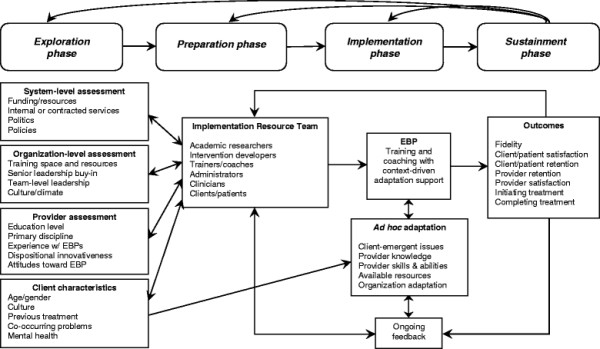
BACKGROUND: Adaptations are often made to evidence-based practices (EBPs) by systems, organizations, and/or service providers in the implementation process. The degree to which core elements of an EBP can be maintained while allowing for local adaptation is unclear. In addition, adaptations may also be needed at the system, policy, or organizational levels to facilitate EBP implementation and sustainment. This paper describes a study of the feasibility and acceptability of an implementation approach, the Dynamic Adaptation Process (DAP), designed to allow for EBP adaptation and system and organizational adaptations in a planned and considered, rather than ad hoc, way. The DAP involves identifying core elements and adaptable characteristics of an EBP, then supporting implementation with specific training on allowable adaptations to the model, fidelity monitoring and support, and identifying the need for and solutions to system and organizational adaptations. In addition, this study addresses a secondary concern, that of improving EBP model fidelity assessment and feedback in real-world settings. METHODS: This project examines the feasibility, acceptability, and utility of the DAP; tests the degree to which fidelity can be maintained using the DAP compared to implementation as usual (IAU); and examines the feasibility of using automated phone or internet-enabled, computer-based technology to assess intervention fidelity and client satisfaction. The study design incorporates mixed methods in order to describe processes and factors associated with variations in both how the DAP itself is implemented and how the DAP impacts fidelity, drift, and adaptation. The DAP model is to be examined by assigning six regions in California (USA) to either the DAP (n=3) or IAU (n=3) to implement an EBP to prevent child neglect. DISCUSSION: The DAP represents a data-informed, collaborative, multiple stakeholder approach to maintain intervention fidelity during the implementation of EBPs in the field by providing support for intervention, system, and organizational adaptation and intervention fidelity to meet local needs. This study is designed to address the real-world implications of EBP implementation in public sector service systems and is relevant for national, state, and local service systems and organizations.
Overview
The claims and statistics of this paper haven’t been checked yet.
Free: it reads the open-access text and checks the first 5 claims that cite a source we can check. Create a free account to check every claim.
Integrity signals
Registry
Cites
Statistics
Figures
Verification
Claims the paper makes
The claims and statistics of this paper haven’t been checked yet.
Free: it reads the open-access text and checks the first 5 claims that cite a source we can check. Create a free account to check every claim.
Claims other papers make about this one
Each is checked against this paper’s own text: does it say what the citing paper says it does?
The cited source says what the claim attributes to it.
In the citing paper
“ongoing adjustment and evaluation of EBT to ensure that a program is response to the local context provides an opportunity to increase intervention effectiveness over time (Aarons et al., 2012; Chambers et al., 2013)”
From User‐centered design for psychosocial intervention development and implementation. (2016) · cites this paper as Aarons et al., 2012
The cited source says what the claim attributes to it.
In the citing paper
“there has been little research focused explicitly on procedures for realizing this goal (Aarons et al., 2012; Lyon et al., 2014c).”
From User‐centered design for psychosocial intervention development and implementation. (2016) · cites this paper as Aarons et al., 2012
The cited source says what the claim attributes to it.
In the citing paper
“The DAP [69] is a multicomponent implementation strategy directly drawn from the EPIS framework.”
From Ten recommendations for using implementation frameworks in research and practice (2020) · cites this paper as [69]
The cited source says what the claim attributes to it.
In the citing paper
“A critical and core component of the DAP is the creation of an Implementation Resource Team that is a multiple stakeholder collaborative designed to support implementation, data interpretation, and explicitly address adaptations during the implementation process.”
From Ten recommendations for using implementation frameworks in research and practice (2020) · cites this paper as [69]
The cited source says what the claim attributes to it.
In the citing paper
“The DAP uses an iterative, data-informed approach to facilitate implementation across each phase of EPIS.”
From Ten recommendations for using implementation frameworks in research and practice (2020) · cites this paper as [69]
Self-check
Percentages, sums and reported differences re-computed from the paper’s own numbers.
The self-check needs the paper’s full text.
Citations
Cites
Qualitative research and evaluation methods
Patton, M. Q. (1980) · Cited by 35,734
Damschroder, L. J., Aron, D. C., Keith, R. E., Kirsh, S. R., Alexander, J. A., & Lowery, J. C. (2009) · Implementation Science · doi:10.1186/1748-5908-4-50 · Cited by 14,496 · cited 1×
“, organization) to effectively implement EBPs [13,14].”
Weighted kappa: nominal scale agreement provision for scaled disagreement or partial credit
Cohen, J. (1968) · Psychological Bulletin · doi:10.1037/h0026256 · Cited by 8,736
Diffusion of Innovations in Service Organizations: Systematic Review and Recommendations
GREENHALGH, T., ROBERT, G., MACFARLANE, F., BATE, P., & KYRIAKIDOU, O. (2004) · The Milbank Quarterly · doi:10.1111/j.0887-378x.2004.00325.x · Cited by 7,448 · cited 1×
“The interplay of characteristics of an intervention with service system and organizational characteristics (system, organization, provider, and client levels) can be complex [12].”
Background(2005) · Cited by 3,748
Advancing a Conceptual Model of Evidence-Based Practice Implementation in Public Service Sectors
Aarons, G. A., Hurlburt, M., & Horwitz, S. M. (2011) · Administration and Policy in Mental Health and Mental Health Services Research · doi:10.1007/s10488-010-0327-7 · Cited by 3,240
Self-citationSchuirmann, D. J. (1987) · Journal of Pharmacokinetics and Biopharmaceutics · doi:10.1007/bf01068419 · Cited by 2,696
Piaget, J. (1976) · Piaget and His School · doi:10.1007/978-3-642-46323-5_2 · Cited by 2,167
Carmichael's Manual of Child Psychology
Sigel, I. E., & Mussen, P. H. (1972) · American Educational Research Journal · doi:10.2307/1161696 · Cited by 2,053
The Handbook of Research Synthesis.
Light, R. J., Cooper, H., & Hedges, L. V. (1994) · Journal of the American Statistical Association · doi:10.2307/2291021 · Cited by 1,868
Research works printed but not linked: 5
- Kauffman Foundation Best Practices Project Kaufman best practices project final report: Closing the quality chasm in child abuse treatment: Identifying and disseminating best practices 2004 Ewing Marion Kauffman Foundation, Kansas
- Rogers EM Diffusions of innovations 1995 4 The Free Press, New York
- Webster New College Dictionary 1995 Houghton Mifflin Company, Boston
- Whitaker D Lutzker J Self-Brown S Edwards A Implementing and evidence-based program for the prevention of child maltreatment: The SafeCare® program Report on Emotional & Behavioral Disorders in Youth 2008 8 55 62
- Fraser D QSR NVivo reference guide 2000 QSR International, Melbourne
Cited by
Items 401–489 of 489
Novel Approaches to Preserving Utility in Privacy Enhancing \nTechnologies
Mohammady, M. (2020) · Spectrum Research Repository (Concordia University) · Cited by 1
Stewart-Tufescu, A. (2018) · Mspace (University of Manitoba) · Cited by 1
Kangeri, B. (2021) · SU+ Digital Repository (Strathmore University) · Cited by 1
Dabblers, bedazzlers, or total makeovers: Clinician modification to a CBT approach
Meza, R. R. (2017) · ResearchWorks at the University of Washington (University of Washington)
Extending Implications of Study Findings on Real-World Implementation
Chambers, D. (2018) · Journal of Oncology Practice · doi:10.1200/jop.2017.029082
Translational Research: Bridging the Chasm Between New Knowledge and Useful Knowledge
Kemp, L. (2019) · Handbook of Research Methods in Health Social Sciences · doi:10.1007/978-981-10-2779-6_72-1
An Exploratory Approach to Understanding Opioid Treatment of Mothers
Storie, S. (2019) · Scholars' Bank (University of Oregon)
Get up! Stand up! (version 2) : an evaluation of a school-based social skills programme
O'Meara, B. (2020) · Mary Immaculate Research Repository (Mary Immaculate College)
dos Santos, I., & Fernando, L. (2020)
Bayer, E., Kurianov, N., Аразиковна, Г. Н., & Grishina, A. (2020) · E3S Web of Conferences · doi:10.1051/e3sconf/202021018007
Implementation Science: Developing a Common Understanding for Use in Mental Health
Gutner, C. A., & Wells, S. Y. (2021) · Elsevier eBooks · doi:10.1016/b978-0-12-818697-8.00086-8
Overview of Intervention Delivery
(2021) · Wiley eBooks · doi:10.1002/9781119610113.ch6
Introduction to Intervention Research
(2021) · Wiley eBooks · doi:10.1002/9781119610113.ch1
Setswe, G., Ndebele, F., Pienaar, J., Wasunna, B., Ncube, V., Maja, L., Sherr, K., Barnhart, S., & Feldacker, C. (2023) · Research Square · doi:10.21203/rs.3.rs-2731828/v1
RetractedPerspectives and Opinions in Health Services: 2022
Cioffi, A., Alaeddini, F., Robakowska, M., Ślęzak, D., & Makanga, P. T. (2023) · Frontiers research topics · doi:10.3389/978-2-8325-3814-2
Chambers, D. (2023) · Oxford University Press eBooks · doi:10.1093/oso/9780197660690.002.0009
Lemire, C., Chiasson-Roussel, M., Marianne, P., Myre-Bisaillon, J., & Martinez-Manningham, E. (2024) · Canadian Journal of Education / Revue canadienne de l éducation · doi:10.53967/cje-rce.6145
Escobar-DeMarco, J. L., Nguyen, P. H., Kundu, G., Kabir, R., Ali, M., Ireen, S., Ash, D. M., Mahmud, Z., Sununtnasuk, C., Menon, P., et al. (2024) · Maternal and Child Nutrition · doi:10.1111/mcn.13750
“…disruptions due to major systematic crises occur, continuing service delivery requires understanding the intervention paths that have been disrupted and adapting in response to those disruptions as crises permit (Aarons et al., 2012; WHO Regional Office for South ‐ East Asia, UNICEF, UNFPA, 2020).”
InfluentialNicosia, F. M., Zamora, K. A., Ashcraft, L. E., Krautner, G., Groot, M., Kinosian, B. P., Schubert, C. C., Chhatre, S., Moriarty, H., Intrator, O. K., et al. (2025) · Implementation Science Communications · doi:10.1186/s43058-025-00698-w
Arnold, T. L., Giorlando, K. K., Barnett, A. P., Gaudiano, B. A., Antonaccio, C. M., Elwy, A. R., Edet, P. P., Ward, L. M., Whiteley, L., Bailey, S., et al. (2025) · JMIR Research Protocols · doi:10.2196/65921
“This model systematically helps define the core elements of an intervention and collects information regarding the different ways evidence-based interventions can be adapted to be delivered for diverse populations and contexts [32,33].”
Herce, M. E., Cassidy, C. A., Munson, A., Edwards, J. K., Rutstein, S. E., Matoga, M., Kumwenda, C., Simon, K., van Oosterhout, J. J., Cox, C. M., et al. (2025) · Implementation Science Communications · doi:10.1186/s43058-025-00762-5
“2) [41, 46].”
Li, J., Yu, Y., Melgarejo, M., Schetter, P. L., Suhrheinrich, J., & Stahmer, A. C. (2025) · Journal of Policy and Practice in Intellectual Disabilities · doi:10.1111/jppi.70019
Sebastian, R. A., Shattuck, D. G., Ramos, M. M., & Willging, C. E. (2025) · Implementation Science Communications · doi:10.1186/s43058-025-00784-z
“The DAP is an iterative approach to operationalizing the EPIS Framework that focuses on data-informed and context-specific adaptation and implementation of practices by a local implementation resource team [31].”
Fredens, M., Terkildsen, M. D., Grønkjær, M., Toft, U., Hawkins, J. L., & Nielsen, C. P. (2026) · BMC Health Services Research · doi:10.1186/s12913-026-15030-y
“…increasingly suggest that flexibility in implementation strategies and processes can complement rather than compromise fidelity, enabling necessary adaptations to meet local contextual needs without necessarily under-mining intervention integrity [15–17 , 21 ]. the implementation strategies.”
InfluentialArterburn, D. E., Wellman, R., Courcoulas, A. P., Anau, J., Hsu, C. W., Tavakkoli, A., Fischer, G. S., Ahmed, B. H., Eavey, J., Luce, C., et al. (2025) · Obesity Science & Practice · doi:10.1002/osp4.70091
“The implementation design was guided by the EPIS model (exploration,preparation,implementation,andsustainment)[33, 34].”
Adoption, Implementation, Scale-up, and Long-term Use of Evidence-Based Health Interventions
Vinson, C., & Chambers, D. (2025) · Oxford University Press eBooks · doi:10.1093/oxfordhb/9780198882442.013.0017
Faiela, C., Moon, T. D., Sidat, M., & Sevene, E. (2024) · Figshare · doi:10.6084/m9.figshare.26315501
Brewer, S. K., Corbin, C. M., Baumann, A. A., Stirman, S. W., Jones, J. M., Pullmann, M. D., & Lyon, A. R. (2024) · Figshare · doi:10.6084/m9.figshare.26734956
Ford, J. H., Nora, A., & Crnich, C. J. (2024) · Figshare · doi:10.6084/m9.figshare.26652624
Brewer, S. K., Corbin, C. M., Baumann, A. A., Stirman, S. W., Jones, J. M., Pullmann, M. D., & Lyon, A. R. (2024) · Figshare · doi:10.6084/m9.figshare.26734962
Wilson, S. N., Noble, H. E., Ordoñez, W. J. N., Wong, G. Z., Rodríguez, M. J., Checa, D. O., Warne, M., Senturia, K., & LaGrone, L. N. (2024) · Figshare · doi:10.6084/m9.figshare.26580857
Bumbarger, B. K. (2016) · Griffith Research Online · doi:10.25904/1912/877
Schoenberg, N. E., Sherman, D. L., Pfammatter, A. F., Roberts, M. K., Chih, M., Vos, S. C., & Spring, B. (2022) · Figshare · doi:10.6084/m9.figshare.21524027
Ford, J. H., Nora, A., & Crnich, C. J. (2024) · Figshare · doi:10.6084/m9.figshare.26652621
Brewer, S. K., Corbin, C. M., Baumann, A. A., Stirman, S. W., Jones, J. M., Pullmann, M. D., & Lyon, A. R. (2024) · Figshare · doi:10.6084/m9.figshare.26734959
Wilson, S. N., Noble, H. E., Ordoñez, W. J. N., Wong, G. Z., Rodríguez, M. J., Checa, D. O., Warne, M., Senturia, K., & LaGrone, L. N. (2024) · Figshare · doi:10.6084/m9.figshare.26580860
Ahmad, S. Z., Ivers, N., Zenlea, I. S., Parsons, J. A., Shah, B. R., Mukerji, G., Punthakee, Z., & Shulman, R. M. (2024) · Figshare · doi:10.6084/m9.figshare.26694822
Brewer, S. K., Corbin, C. M., Baumann, A. A., Stirman, S. W., Jones, J. M., Pullmann, M. D., & Lyon, A. R. (2024) · Figshare · doi:10.6084/m9.figshare.26734953
Olakunde, B. O., Itanyi, I. U., Olawepo, J. O., Liu, L., Afonne, C., Idemili-Aronu, N., Lasebikan, N. N., Onyeka, T., Dim, C. C., Chigbu, C. O., et al. (2024) · Figshare · doi:10.6084/m9.figshare.26691805
Self-citationLane-Fall, M. B., Christakos, A., Russell, G. C., Hose, B.-Z., Dauer, E. D., Greilich, P. E., Hong Mershon, B., Potestio, C. P., Pukenas, E., Kimberly, J. R., et al. (2021) · Figshare · doi:10.6084/m9.figshare.14788587
Brewer, S. K., Corbin, C. M., Baumann, A. A., Stirman, S. W., Jones, J. M., Pullmann, M. D., & Lyon, A. R. (2024) · Figshare · doi:10.6084/m9.figshare.26734950
Ford, J. H., Nora, A., & Crnich, C. J. (2024) · Figshare · doi:10.6084/m9.figshare.26652627
Additional file 1 of Application of the FRAME-IS to a multifaceted implementation strategy
Schoenthaler, A., Calle, F. D. L., León, E. D., Garcia, M., Colella, D., Nay, J., & Dapkins, I. P. (2024) · Figshare · doi:10.6084/m9.figshare.25951801
Wilson, S. N., Noble, H., Ordoñez, W. J. N., Wong, G. Z., Rodríguez, M. J., Checa, D. O., Warne, M., Senturia, K., & LaGrone, L. N. (2024) · Figshare · doi:10.6084/m9.figshare.26580851
Broadfoot, L. M. (2023) · Enlighten: Theses (The University of Glasgow) · doi:10.5525/gla.thesis.83978
Olakunde, B. O., Itanyi, I. U., Olawepo, J. O., Liu, L., Afonne, C., Idemili-Aronu, N., Lasebikan, N. N., Onyeka, T., Dim, C. C., Chigbu, C. O., et al. (2024) · Figshare · doi:10.6084/m9.figshare.26691796
Self-citationOlakunde, B. O., Itanyi, I. U., Olawepo, J. O., Liu, L., Afonne, C., Idemili-Aronu, N., Lasebikan, N. N., Onyeka, T., Dim, C. C., Chigbu, C. O., et al. (2024) · Figshare · doi:10.6084/m9.figshare.26691799
Self-citationAhmad, S. Z., Ivers, N., Zenlea, I. S., Parsons, J. A., Shah, B. R., Mukerji, G., Punthakee, Z., & Shulman, R. M. (2024) · Figshare · doi:10.6084/m9.figshare.26694819
Schwarz, U. V. T., Giannotta, F., Neher, M., Zetterlund, J., & Hasson, H. (2021) · Figshare · doi:10.6084/m9.figshare.14228080
Olakunde, B. O., Itanyi, I. U., Olawepo, J. O., Liu, L., Afonne, C., Idemili-Aronu, N., Lasebikan, N. N., Onyeka, T., Dim, C. C., Chigbu, C. O., et al. (2024) · Figshare · doi:10.6084/m9.figshare.26691802
Self-citationWilson, S. N., Noble, H. E., Ordoñez, W. J. N., Wong, G. Z., Rodríguez, M. J., Checa, D. O., Warne, M., Senturia, K., & LaGrone, L. N. (2024) · Figshare · doi:10.6084/m9.figshare.26580854
Schoenberg, N. E., Sherman, D. L., Pfammatter, A. F., Roberts, M. K., Chih, M., Vos, S. C., & Spring, B. (2022) · Figshare · doi:10.6084/m9.figshare.21524030
Ford, J. H., Nora, A., & Crnich, C. J. (2024) · Figshare · doi:10.6084/m9.figshare.26652630
Additional file 2 of Application of the FRAME-IS to a multifaceted implementation strategy
Schoenthaler, A., Calle, F. D. L., León, E. D., Garcia, M., Colella, D., Nay, J., & Dapkins, I. P. (2024) · Figshare · doi:10.6084/m9.figshare.25951954
Sarfan, L. D., Agnew, E. R., Diaz, M., Dong, L., Fisher, K., Spencer, J. M., Howlett, S. A., Hache, R. E., Callaway, C. A., Kilbourne, A. M., et al. (2024) · Figshare · doi:10.6084/m9.figshare.26575673
Ford, J. H., Nora, A., & Crnich, C. J. (2024) · Figshare · doi:10.6084/m9.figshare.26652633
EXAMINING RTI MODELS AND EVIDENCE-BASED INTERVENTIONS IN ELEMENTARY SCHOOLS
Bixler, K. (2020) · IUScholarWorks (Indiana University)
Näyttöön perustuvan toiminnan johtaminen - implementoinnin työkalumalli neuvolan esihenkilöille
Prittinen, S. (2025) · Theseus (Ammattikorkeakoulujen)
Case example for Chapter 12: Adapting interventions for different contexts and populations
Jean Gajardo, J. (2025) · Elsevier eBooks · doi:10.1016/b978-0-443-21664-0.09979-7
Research Priorities Concerning Formal and Informal Learning in Low- and Middle-Income Countries
Robinson, J. A., Cunha, J. M. D., & Baguma, P. (2026) · Frontiers research topics · doi:10.3389/978-2-8325-4542-3
Karl, J. A., & Fischer, R. (2024) · OSF Preprints (OSF Preprints)
Ahmad, S. Z. (2024) · TSpace (University of Toronto)
Roy, R., Larson, S. C., Eggers, M. R., Golden, A., Humble, S., Anbari, A. B., Peterson, L. L., & Housten, A. J. (2026) · Women s Health Reports · doi:10.1177/26884844261431997
Aldana-López, J. A., (11622220), R. S.-A., Durand-Arias, S., Carmona-Huerta, J., Cárdenas-García, E., Arámbula-Román, J. C., Metcalfe, J. D., Swanson, S., Keleher, J., Villafuerte-Jacob, E., et al. (2026) · Pilot and Feasibility Studies · doi:10.1186/s40814-026-01809-7
“We apply the Dynamic Adaptation Process (DAP) model [13], an implementation science framework that allows for structured, iterative adaptations to evidence-based practices while maintaining fidelity to their core components.”
Parmasad, V., Solomon, D. B., Wiegmann, D., Schweizer-Looby, M., & Safdar, N. (2026) · medRxiv · doi:10.64898/2026.04.28.26351921
Translating Science into Practice Using University-State Government Partnerships: The EPIS Model
Welsh, J. A., Gayles, J. G., Chilenski, S. M., Spaw, R., Pennington, M., & Greenberg, M. T. (2026) · Prevention Science · doi:10.1007/s11121-026-01919-x
Fiori, K. P., & Plum, A. (2026) · Annals of Global Health · doi:10.5334/aogh.5047
Embracing complexity: An opportunity for developmental evaluation
Biroscak, B. J., & Hovmand, P. S. (2026) · Journal of Clinical and Translational Science · doi:10.1017/cts.2026.10767
“The dynamic adaptation process (DAP) explicitly acknowledges that interventions must be tailored to local context during rollout [15].”
Miller, A. P., Saldana, C. D. R., Kiene, S. M., Menya, E., Figge, C. J., Sentongo, H. L., Byansi, W., Mugamba, S., Kalani, K., Tuhebwe, D., et al. (2026) · PLOS Global Public Health · doi:10.1371/journal.pgph.0006566
“It is also supported by implementation science, which increasingly emphasizes collaborative, context-sensitive adaptation as a key enabler of successful and sustainable intervention delivery research [53–55].”
Effects of a postpartum depression intervention: subgroup analyses from a cluster randomized trial
Tandon, S. D., Diebold, A., Kan, A., & Ciolino, J. D. (2026) · Frontiers in Psychiatry · doi:10.3389/fpsyt.2026.1752138
“In fact, there is growing consensus that evidence-based interventions such as MB should consider adaptations to account for different organization, provider, and client-level characteristics (23) while ensuring that core elements of MB are delivered with high fi delity (24).”
Harmonizing intervention, context, and implementation strategies with Context-Driven Co-Design (CD2)
Birken, S. A., Haines, E. R., Wagi, C. R., Morris, B. B., Weaver, K. E., Lisborg, K. M., Landes, S. J., Curran, G. M., Bender, M., Fernández, M. E., et al. (2026) · Implementation Science Communications · doi:10.1186/s43058-026-01020-y
“…from the Systems Analysis and Improvement Approach (SAIA), Designing for Dissemination and Sustainability [4], and the Dynamic Adaptation Process [5], which endeavor to engage health-care professionals to promote implementation but blur the lines between the roles of researchers and the…”
Taking Mental Health Technology Kits from Concept to Practice: Considering a Community Approach
Burgess, E. R., Chung, C.-F., Burleson, W., Reddy, M. C., & Munson, S. A. (2026) · ACM Interactive Health Conference · doi:10.1145/3786579.3804920
Valued outcomes across stakeholders of parenting programs in SwedenPreprint
Pettersson, K., Liedgren, P., Giannotta, F., & Schwarz, U. V. T. (2026) · Research Square · doi:10.21203/rs.3.rs-10164392/v1
Aung, T., Osterhage, K. P., Graham, A. K., Proctor, E. K., Lyon, A. R., & Munson, S. A. (2026) · Implementation Science Communications · doi:10.1186/s43058-026-01035-5
“IS traditionally assesses fit with users and context at structured timepoints, although there are frameworks that support more flexible adaption of EBPs including the Dynamic Adaptation Process [30], Learning Health Systems [31], and Dynamic Sustainability Framework [32].”
Elyoseph, Z., Rafaeli, A. K., Beiman, N., Sweetland, A. C., Wainberg, M. L., & Levi‐Belz, Y. (2026) · Computers in Human Behavior Artificial Humans · doi:10.1016/j.chbah.2026.100364
Connolly, S. (2025) · Digital Commons - URI (University of Rhode Island) · doi:10.23860/diss-4447
Correa-Méndez, M., Chambers, D., & Neta, G. I. (2026) · Implementation Science Communications · doi:10.1186/s43058-026-01039-1
Mindful Classrooms: Teachers Co-Designing and Implementing Mindfulness Interventions
Phan, M. L. (2026) · Digital Commons - USU (Utah State University) · doi:10.26076/64zc-8x04
Johnson, A. K., Devlin, S. A., Barkowski, C., Goldstein, A., Latz, E., Campbell, R. K., Sun, J., Wolfe, B. L., Quasebarth, M., Safarloo, A., et al. (2026) · PLoS ONE · doi:10.1371/journal.pone.0355623
“Adaptations will be informed by qualitative data collected through interviews and focus groups with PPIL administrators, staff, providers, and patients and guided by the Dynamic Adaptation Process (DAP) [11].”
Tabak, R. G., Kemner, A. L., Okpetu, E. I., Lindley, K. J., López, J. D., Marshall, T., Nwaozuru, U., Ojji, O. I., Ocholi, E. F., Orji, A. I., et al. (2026) · Translational Behavioral Medicine · doi:10.1093/tbm/ibag037
Rapadas, C. C., Goshgarian-Miller, S., Yamane, R., Ching, D. L. C., Primack, Z., Yoshizumi-Kim, N., Palafu, T., Chin, S. K., Almanza, P., Park, A. L., et al. (2026) · Translational Issues in Psychological Science · doi:10.1037/tps0000529
Whitaker, D. J., Weeks, E. A., Self‐Brown, S., O’Connor, M. H., Rao, N., Koreis, J. E., & Willging, C. E. (2026) · Prevention Science · doi:10.1007/s11121-026-01977-1
Self-citationBoshkoski, J. (2026) · Lehigh Preserve
Ahmed, K. Y., Blystad, A., Fadnes, L. T., Kumar, B., Hasha, W., & Díaz, E. (2026) · International Journal of Environmental Research and Public Health · doi:10.3390/ijerph23101275
“Although regular follow-ups and fi eld observations are known to enhance participant retention and satisfaction, also other studies fi nd that they are also re-source-intensive [41,42].”
Rahmadani, E., Armanto, D., & Sitompul, P. (2026) · International Journal of Learning Teaching and Educational Research · doi:10.26803/ijlter.25.10.2
Nicholson, J., Heyman, M., English, K., & Biebel, K. (2022) · doi:10.3389/fpsyt.2022.801065.s002
Anderson, D. M., Birken, S. A., Bartram, J. K., & Freeman, M. C. (2022) · doi:10.3389/frhs.2022.896234.s001
Metadata
- Authors
- Aarons, G. A., Green, A. E., Palinkas, L. A., Self-Brown, S., Whitaker, D. J., Lutzker, J. R., Silovsky, J. F., Hecht, D. B., & Chaffin, M. J.
- Affiliations
- University of California San Diego (US)
- University of Southern California (US)
- Georgia State University (US)
- University of Oklahoma Health Sciences Center (US)
- Corresponding author
- Aarons, Gregory A
- ORCID
- Venue
- Implementation Science
- Published
- 2012-04-18
- Volume
- 7
- Issue
- 1
- Pages
- 32-32
- ISSN
- 1748-5908 (ISSN-L)
- PMC
- PMC3436717
- OpenAlex
- W2062957857
- Cited by
- 449
- References
- 60
- Citations by year
- 2026: 24 · 2025: 33 · 2024: 67 · 2023: 42 · 2022: 46 · 2021: 40 · 2020: 36 · 2019: 41 · 2018: 30 · 2017: 20 · 2016: 17 · 2015: 20 · 2014: 14 · 2013: 13 · 2012: 3
- FWCI
- 28.44
- Type
- journal article
- Language
- en
- Open access
- gold
- doi.org
- Licence
- Locations
- Implementation Science (publishedVersion, cc-by)
- Europe PMC (PubMed Central) (publishedVersion, cc-by)
- PubMed Central (publishedVersion, cc-by)
- PubMed (publishedVersion)
- Digital Archive @ GSU (submittedVersion, cc-by)
- DOAJ (DOAJ: Directory of Open Access Journals) (submittedVersion)
- eScholarship (California Digital Library) (submittedVersion)
- Counseling And Psychological Services Dissertations (Georgia State University) (submittedVersion, cc-by)
- Funders
- Centers for Disease Control and Prevention (R01CE001556)
- National Institute of Mental Health (R01MH092950, P30MH074678, R01CE001556, R25MH080916)
- Topics
- Health Sciences › Health Professions › General Health Professions › Health Policy Implementation Science
- Health Sciences › Health Professions › General Health Professions › Health Sciences Research and Education
- Social Sciences › Sociology and Political Science › Child Welfare and Adoption
- Keywords
- child abuse intervention, child neglect prevention, intervention fidelity, fidelity monitoring, drift, organizational adaptation, system adaptation, feasibility and acceptability, client satisfaction
- MeSH terms
- California, Child, Child Abuse, Child Health Services, Child Welfare, Feasibility Studies, Humans, Telephone, Internet, Evidence-Based Practice
About these checks
Registry, retraction, Cites and statistics results are computed, not judged, with one exception: a printed reference that no index lists is read once by a model before it counts as a citation error. Claims are extracted by a model and kept only when their quote appears verbatim in the text; each cited source is then checked, with a model’s help, for whether it says what the claim relies on. Those verdicts can be wrong — read the claim’s quote and the cited source before relying on one.
Statistics and arithmetic are recomputed, not judged.
Confidence bands are shown only for fields calibrated on our annotated test set. None is calibrated yet, so no band is shown.
What counts as a claim ›How we measure confidence ›How we check this ›
Are you an author, or do you see a problem with this page? Request a review
Data sources
Bibliographic data: Semantic Scholar, OpenAlex, Crossref.
Contains information from the Semantic Scholar Academic Graph Datasets, made available under the ODC Attribution License (ODC-BY 1.0).
Semantic Scholar’s data is described in: Kinney, R., et al. (2023). The Semantic Scholar Open Data Platform. arXiv:2301.10140.
