

A qualitative systematic review of studies using the normalization process theory to research implementation processes
Open accessThe DOI matches its Crossref record; 69 of the 69 references it cites were found in a registry or an index.
Abstract
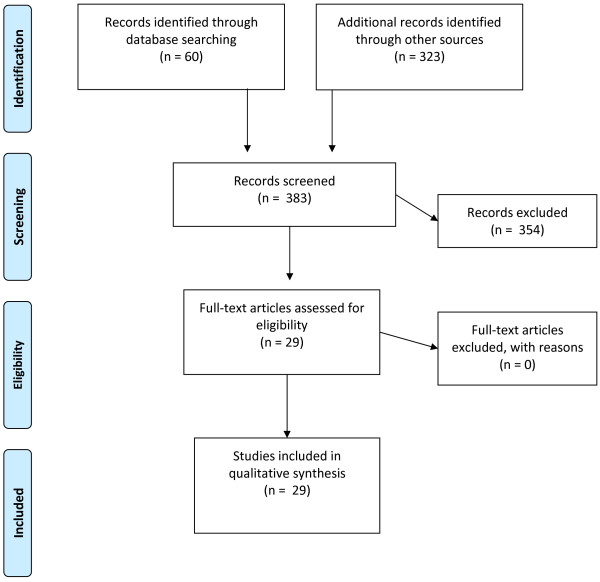
BACKGROUND: There is a well-recognized need for greater use of theory to address research translational gaps. Normalization Process Theory (NPT) provides a set of sociological tools to understand and explain the social processes through which new or modified practices of thinking, enacting, and organizing work are implemented, embedded, and integrated in healthcare and other organizational settings. This review of NPT offers readers the opportunity to observe how, and in what areas, a particular theoretical approach to implementation is being used. In this article we review the literature on NPT in order to understand what interventions NPT is being used to analyze, how NPT is being operationalized, and the reported benefits, if any, of using NPT. METHODS: Using a framework analysis approach, we conducted a qualitative systematic review of peer-reviewed literature using NPT. We searched 12 electronic databases and all citations linked to six key NPT development papers. Grey literature/unpublished studies were not sought. Limitations of English language, healthcare setting and year of publication 2006 to June 2012 were set. RESULTS: Twenty-nine articles met the inclusion criteria; in the main, NPT is being applied to qualitatively analyze a diverse range of complex interventions, many beyond its original field of e-health and telehealth. The NPT constructs have high stability across settings and, notwithstanding challenges in applying NPT in terms of managing overlaps between constructs, there is evidence that it is a beneficial heuristic device to explain and guide implementation processes. CONCLUSIONS: NPT offers a generalizable framework that can be applied across contexts with opportunities for incremental knowledge gain over time and an explicit framework for analysis, which can explain and potentially shape implementation processes. This is the first review of NPT in use and it generates an impetus for further and extended use of NPT. We recommend that in future NPT research, authors should explicate their rationale for choosing NPT as their theoretical framework and, where possible, involve multiple stakeholders including service users to enable analysis of implementation from a range of perspectives.
Overview
The claims and statistics of this paper haven’t been checked yet.
Free: it reads the open-access text and checks the first 5 claims that cite a source we can check. Create a free account to check every claim.
Integrity signals
Registry
Cites
Statistics
Figures
Verification
Claims the paper makes
The claims and statistics of this paper haven’t been checked yet.
Free: it reads the open-access text and checks the first 5 claims that cite a source we can check. Create a free account to check every claim.
Claims other papers make about this one
Each is checked against this paper’s own text: does it say what the citing paper says it does?
The source backs part of the claim, not all of it — or backs it for a different population, condition or comparison.
In the citing paper
“Although evaluation frameworks may be considered in a category of their own, theories, models and frameworks from the other four categories can also be applied for evaluation purposes because they specify concepts and constructs that may be operationalized and measured.”
From Making sense of implementation theories, models and frameworks (2015) · cites this paper as [129]
Experimental — accuracy not yet measuredThe source backs part of the claim, not all of it — or backs it for a different population, condition or comparison.
In the citing paper
“McEvoy et al. [17] pointed to the ways that early studies using NPT did little work to justify the choice of theory, called for the prospective application of NPT to data analysis and collection and stressed the importance of moving beyond single stakeholder perspectives.”
From Using Normalization Process Theory in feasibility studies and process evaluations of complex healthcare interventions: a systematic review (2018) · cites this paper as [17]
Experimental — accuracy not yet measuredThe cited source says what the claim attributes to it.
In the citing paper
“For instance, Theoretical Domains Framework (e.g. [127,128]), and Normalization Process Theory [129] and COM-B (e.g. [130,131]) have all been widely used as evaluation frameworks.”
From Making sense of implementation theories, models and frameworks (2015) · cites this paper as [129]
The cited source says what the claim attributes to it.
In the citing paper
“McEvoy et al. [17] pointed to the ways that early studies using NPT did little work to justify the choice of theory, called for the prospective application of NPT to data analysis and collection and stressed the importance of moving beyond single stakeholder perspectives.”
From Using Normalization Process Theory in feasibility studies and process evaluations of complex healthcare interventions: a systematic review (2018) · cites this paper as [17]
The cited source says what the claim attributes to it.
In the citing paper
“A review by McEvoy et al. [17], published in 2014, provided a qualitative synthesis of 29 early and heterogeneous studies in which NPT was used.”
From Using Normalization Process Theory in feasibility studies and process evaluations of complex healthcare interventions: a systematic review (2018) · cites this paper as [17]
5 more claims about this paper
Create a free account to see every claim other papers make about this one.
Self-check
Percentages, sums and reported differences re-computed from the paper’s own numbers.
The self-check needs the paper’s full text.
Citations
Cites
The theory of planned behavior
Ajzen, I. (1991) · Organizational Behavior and Human Decision Processes · doi:10.1016/0749-5978(91)90020-t · Cited by 90,587
Liberati, A., Altman, D. G., Tetzlaff, J., Mulrow, C., Gøtzsche, P. C., Ioannidis, J. P. A., Clarke, M., Devereaux, P. J., Kleijnen, J., & Moher, D. (2009) · PLoS Medicine · doi:10.1371/journal.pmed.1000100 · Cited by 28,164
Communities of Practice: Learning, Meaning, and Identity
Wenger, E. (1998) · doi:10.1017/cbo9780511803932 · Cited by 23,500
Liberati, A., Altman, D. G., Tetzlaff, J., Mulrow, C., Gotzsche, P. C., Ioannidis, J. P. A., Clarke, M., Devereaux, P. J., Kleijnen, J., & Moher, D. (2009) · BMJ · doi:10.1136/bmj.b2700 · Cited by 17,648
Reassembling the Social: An Introduction to Actor-Network-Theory
Latour, B. (2005) · doi:10.1093/oso/9780199256044.001.0001 · Cited by 16,778
Qualitative research in health care: Analysing qualitative data
Pope, C. (2000) · BMJ · doi:10.1136/bmj.320.7227.114 · Cited by 8,131
Reassembling the social: An introduction to actor‐network‐theory
Turnbull, J. (2008) · New Zealand Geographer · doi:10.1111/j.1745-7939.2008.00151_4.x · Cited by 7,617
Diffusion of Innovations in Service Organizations: Systematic Review and Recommendations
GREENHALGH, T., ROBERT, G., MACFARLANE, F., BATE, P., & KYRIAKIDOU, O. (2004) · The Milbank Quarterly · doi:10.1111/j.0887-378x.2004.00325.x · Cited by 7,448
Qualitative data analysis for applied policy research
(2002) · Analyzing Qualitative Data · doi:10.4324/9780203413081-14 · Cited by 4,964 · cited 1×
“, the four NPT constructs), we adopted a framework analysis approach [26].”
Qualitative data analysis for applied policy research
Ritchie, J., & Spencer, L. (2010) · Analyzing qualitative data · doi:10.4324/9780203413081_chapter_9 · Cited by 4,800
Gibbs, G. (2007) · doi:10.4135/9781849208574 · Cited by 4,299
Gluesing, J. C. (2012) · Leadership in Science and Technology: A Reference Handbook · doi:10.4135/9781412994231.n14 · Cited by 3,210
(2009) · The SAGE Glossary of the Social and Behavioral Sciences · doi:10.4135/9781412972024.n747 · Cited by 2,442
Implementing, Embedding, and Integrating Practices: An Outline of Normalization Process Theory
May, C., & Finch, T. (2009) · Sociology · doi:10.1177/0038038509103208 · Cited by 2,115
The Meaning of Translational Research and Why It Matters
Woolf, S. H. (2008) · JAMA · doi:10.1001/jama.2007.26 · Cited by 1,910
Murray, E., Treweek, S., Pope, C., MacFarlane, A., Ballini, L., Dowrick, C., Finch, T., Kennedy, A., Mair, F., O'Donnell, C., et al. (2010) · BMC Medicine · doi:10.1186/1741-7015-8-63 · Cited by 1,478
Self-citationDevelopment of a theory of implementation and integration: Normalization Process Theory
May, C. R., Mair, F., Finch, T., MacFarlane, A., Dowrick, C., Treweek, S., Rapley, T., Ballini, L., Ong, B. N., Rogers, A., et al. (2009) · Implementation Science · doi:10.1186/1748-5908-4-29 · Cited by 1,409
Self-citationUsing evidenceHow research can inform public services
Nutley, S. M., Walter, I., & Davies, H. T. O. (2007) · Policy Press eBooks · doi:10.1332/policypress/9781861346650.001.0001 · Cited by 1,335
Using Evidence: How Research Can Inform Public Services
Nutley, S., Walter, I., & Davies, H. T. O. (2007) · Bristol University Press eBooks · doi:10.46692/9781847422323 · Cited by 1,299
Appraising the Evidence: Reviewing Disparate Data Systematically
Hawker, S., Payne, S., Kerr, C., Hardey, M., & Powell, J. (2002) · Qualitative Health Research · doi:10.1177/1049732302238251 · Cited by 1,216 · cited 2×
“[27] (see Additional file 3: Quality Appraisal Tool), each of the 29 papers was subjected to a quality appraisal process undertaken by three of the authors (RM, AMacF and LB).”
Planning and Studying Improvement in Patient Care: The Use of Theoretical Perspectives
GROL, R. P. T. M., BOSCH, M. C., HULSCHER, M. E. J. L., ECCLES, M. P., & WENSING, M. (2007) · The Milbank Quarterly · doi:10.1111/j.1468-0009.2007.00478.x · Cited by 943 · cited 1×
“As suggested by Grol et al. [56] and Murray et al. [10], there is scope for NPT to be used during the planning stages of implementation projects to explore the real-world context in which the work will take place.”
Using evidence: How research can inform public services
Nutley, S. M., Walter, I., & Davies, H. T. O. (2007) · doi:10.2307/j.ctt9qgwt1 · Cited by 808
May, C., Finch, T., Mair, F., Ballini, L., Dowrick, C., Eccles, M., Gask, L., MacFarlane, A., Murray, E., Rapley, T., et al. (2007) · BMC Health Services Research · doi:10.1186/1472-6963-7-148 · Cited by 768
Self-citationSociological Practice: Linking Theory and Social Research
Bulmer, M., & Layder, D. (2001) · Canadian Journal of Sociology / Cahiers canadiens de sociologie · doi:10.2307/3341515 · Cited by 713
Vollmar, H. C., Mayer, H., Ostermann, T., Butzlaff, M. E., Sandars, J. E., Wilm, S., & Rieger, M. A. (2010) · Implementation Science · doi:10.1186/1748-5908-5-1 · Cited by 693
Towards a general theory of implementation
May, C. (2013) · Implementation Science · doi:10.1186/1748-5908-8-18 · Cited by 656
Davies, P., Walker, A. E., & Grimshaw, J. M. (2010) · Implementation Science · doi:10.1186/1748-5908-5-14 · Cited by 619
Layder, D. (1998) · doi:10.4135/9781849209946 · Cited by 585
Mair, F. S., May, C., O’Donnell, C., Finch, T., Sullivan, F., & Murray, E. (2012) · Bulletin of the World Health Organization · doi:10.2471/blt.11.099424 · Cited by 553
Self-citationAn implementation research agenda
Eccles, M. P., Armstrong, D., Baker, R., Cleary, K., Davies, H., Davies, S., Glasziou, P., Ilott, I., Kinmonth, A.-L., Leng, G., et al. (2009) · Implementation Science · doi:10.1186/1748-5908-4-18 · Cited by 481
A rational model for assessing and evaluating complex interventions in health care
May, C. (2006) · BMC Health Services Research · doi:10.1186/1472-6963-6-86 · Cited by 447
Gallacher, K., May, C. R., Montori, V. M., & Mair, F. S. (2011) · The Annals of Family Medicine · doi:10.1370/afm.1249 · Cited by 356 · cited 7×
“For Coherence, there was a clear emphasis on understanding and conceptualization of interventions and their work (n = 8) [15,19,32,34,35,37,41,45]; For Cognitive Participation, the emphasis was on notions of legitimation and buy-in, both in terms of the individuals involved and involving others (n = 8) [15,19,28,32,34…”
InfluentialSelf-citationHelfrich, C. D., Damschroder, L. J., Hagedorn, H. J., Daggett, G. S., Sahay, A., Ritchie, M., Damush, T., Guihan, M., Ullrich, P. M., & Stetler, C. B. (2010) · Implementation Science · doi:10.1186/1748-5908-5-82 · Cited by 306
Why is it difficult to implement e-health initiatives? A qualitative study
Murray, E., Burns, J., May, C., Finch, T., O'Donnell, C., Wallace, P., & Mair, F. (2011) · Implementation Science · doi:10.1186/1748-5908-6-6 · Cited by 270 · cited 10×
“For Coherence, there was a clear emphasis on understanding and conceptualization of interventions and their work (n = 8) [15,19,32,34,35,37,41,45]; For Cognitive Participation, the emphasis was on notions of legitimation and buy-in, both in terms of the individuals involved and involving others (n = 8) [15,19,28,32,34…”
InfluentialSelf-citationMay, C. R., Finch, T. L., Ballini, L., MacFarlane, A. E., Mair, F. S., Murray, E. M., Treweek, S., & Rapley, T. (2011) · Arrow@dit (Dublin Institute of Technology) · doi:10.34961/10032 · Cited by 235
Self-citationUsing a Theory-Driven Conceptual Framework in Qualitative Health Research
MacFarlane, A., & O’Reilly-de Brún, M. (2012) · Qualitative Health Research · doi:10.1177/1049732311431898 · Cited by 227
Self-citationIntegrating telecare for chronic disease management in the community: What needs to be done?
May, C. R., Finch, T. L., Cornford, J., Exley, C., Gately, C., Kirk, S., Jenkings, K. N., Osbourne, J., Robinson, A. L., Rogers, A., et al. (2011) · BMC Health Services Research · doi:10.1186/1472-6963-11-131 · Cited by 220
Self-citationMay, C. R., Mair, F. S., Dowrick, C. F., & Finch, T. L. (2007) · BMC Family Practice · doi:10.1186/1471-2296-8-42 · Cited by 183
Self-citationBarriers to apply cardiovascular prediction rules in primary care: a postal survey
Eichler, K., Zoller, M., Tschudi, P., & Steurer, J. (2007) · BMC Family Practice · doi:10.1186/1471-2296-8-1 · Cited by 167
Elwyn, G., Légaré, F., Weijden, T. V. D., Edwards, A., & May, C. (2008) · Implementation Science · doi:10.1186/1748-5908-3-57 · Cited by 159
Models of transitional care for young people with complex health needs: a scoping review
Watson, R., Parr, J. R., Joyce, C., May, C., & Le Couteur, A. S. (2011) · Child: Care, Health and Development · doi:10.1111/j.1365-2214.2011.01293.x · Cited by 143
Finch, T. L., Mair, F. S., O’Donnell, C., Murray, E., & May, C. R. (2012) · BMC Medical Research Methodology · doi:10.1186/1471-2288-12-69 · Cited by 127 · cited 7×
“[15], the theory has been developed to offer transparent and transferable explanations for”
InfluentialSelf-citationUnderstanding factors that inhibit or promote the utilization of telecare in chronic lung disease
Mair, F. S., Hiscock, J., & Beaton, S. C. (2008) · Chronic Illness · doi:10.1177/1742395308092482 · Cited by 115 · cited 10×
“[50] NPM A framework approach to data analysis was used.”
InfluentialSelf-citationImplementing a stepped-care approach in primary care: results of a qualitative study
Franx, G., Oud, M., de Lange, J., Wensing, M., & Grol, R. (2012) · Implementation Science · doi:10.1186/1748-5908-7-8 · Cited by 106 · cited 8×
“[35] NPT Related findings to NPT constructs.”
InfluentialNutley, S., Morton, S., Jung, T., & Boaz, A. (2010) · Evidence & Policy · doi:10.1332/174426410x502275 · Cited by 103
Development and formative evaluation of the e-Health Implementation Toolkit (e-HIT)
Murray, E., May, C., & Mair, F. (2010) · BMC Medical Informatics and Decision Making · doi:10.1186/1472-6947-10-61 · Cited by 96 · cited 7×
“For Coherence, there was a clear emphasis on understanding and conceptualization of interventions and their work (n = 8) [15,19,32,34,35,37,41,45]; For Cognitive Participation, the emphasis was on notions of legitimation and buy-in, both in terms of the individuals involved and involving others (n = 8) [15,19,28,32,34…”
InfluentialSelf-citationBlakeman, T., Protheroe, J., Chew-Graham, C., Rogers, A., & Kennedy, A. (2012) · British Journal of General Practice · doi:10.3399/bjgp12x636056 · Cited by 96 · cited 7×
“For Coherence, there was a clear emphasis on understanding and conceptualization of interventions and their work (n = 8) [15,19,32,34,35,37,41,45]; For Cognitive Participation, the emphasis was on notions of legitimation and buy-in, both in terms of the individuals involved and involving others (n = 8) [15,19,28,32,34…”
InfluentialSticky knowledge: A possible model for investigating implementation in healthcare contexts
Elwyn, G., Taubert, M., & Kowalczuk, J. (2007) · Implementation Science · doi:10.1186/1748-5908-2-44 · Cited by 93
Sanders, T., Foster, N. E., & Ong, B. N. (2011) · BMC Medicine · doi:10.1186/1741-7015-9-49 · Cited by 84
Embedding effective depression care: using theory for primary care organisational and systems change
Gunn, J. M., Palmer, V. J., Dowrick, C. F., Herrman, H. E., Griffiths, F. E., Kokanovic, R., Blashki, G. A., Hegarty, K. L., Johnson, C. L., Potiriadis, M., et al. (2010) · Implementation Science · doi:10.1186/1748-5908-5-62 · Cited by 76
Exploring implementation and sustainability of models of care: can theory help?
Forster, D. A., Newton, M., McLachlan, H. L., & Willis, K. (2011) · BMC Public Health · doi:10.1186/1471-2458-11-s5-s8 · Cited by 75
Gask, L., Bower, P., Lovell, K., Escott, D., Archer, J., Gilbody, S., Lankshear, A. J., Simpson, A. E., & Richards, D. A. (2010) · Implementation Science · doi:10.1186/1748-5908-5-15 · Cited by 75
Kennedy, A., Chew-Graham, C., Blakeman, T., Bowen, A., Gardner, C., Protheroe, J., Rogers, A., & Gask, L. (2010) · Implementation Science · doi:10.1186/1748-5908-5-7 · Cited by 66 · cited 7×
“For Coherence, there was a clear emphasis on understanding and conceptualization of interventions and their work (n = 8) [15,19,32,34,35,37,41,45]; For Cognitive Participation, the emphasis was on notions of legitimation and buy-in, both in terms of the individuals involved and involving others (n = 8) [15,19,28,32,34…”
InfluentialHarris, J. K., Provan, K. G., Johnson, K. J., & Leischow, S. J. (2012) · Implementation Science · doi:10.1186/1748-5908-7-69 · Cited by 59
Beyond the limits of clinical governance? The case of mental health in English primary care
Gask, L., Rogers, A., Campbell, S., & Sheaff, R. (2008) · BMC Health Services Research · doi:10.1186/1472-6963-8-63 · Cited by 55
Spangaro, J., Poulos, R. G., & Zwi, A. B. (2011) · Violence and Victims · doi:10.1891/0886-6708.26.1.130 · Cited by 48
MacFarlane, A., O’Donnell, C., Mair, F., O’Reilly-de Brún, M., de Brún, T., Spiegel, W., van den Muijsenbergh, M., van Weel-Baumgarten, E., Lionis, C., Burns, N., et al. (2012) · Implementation Science · doi:10.1186/1748-5908-7-111 · Cited by 47
Self-citationInsulin in general practice - barriers and enablers for timely initiation.
Furler, J., Spitzer, O., Young, D. Y. L., & Best, J. D. (2011) · PubMed · Cited by 43
Atkins, S., Lewin, S., Ringsberg, K. C., & Thorson, A. (2011) · BMC Health Services Research · doi:10.1186/1472-6963-11-275 · Cited by 42
Ehrlich, C., Kendall, E. A., & John, W. S. (2012) · Collegian Journal of the Royal College of Nursing Australia · doi:10.1016/j.colegn.2012.04.006 · Cited by 37
Opinion leaders and changes over time: a survey
Doumit, G. D., Wright, F. C., Graham, I. D., Smith, A., & Grimshaw, J. (2011) · Implementation Science · doi:10.1186/1748-5908-6-117 · Cited by 33
In-MINDD Team, O’Donnell, C. A., Browne, S., Pierce, M., McConnachie, A., Deckers, K., van Boxtel, M. P. J., Manera, V., Köhler, S., Redmond, M., et al. (2015) · Pilot and Feasibility Studies · doi:10.1186/s40814-015-0035-x · Cited by 31
Self-citationImplementing clinical guidelines for bipolar disorder
Morriss, R. K. (2008) · Psychology and Psychotherapy Theory Research and Practice · doi:10.1348/147608308x278105 · Cited by 29
Bouamrane, M.-M., Osbourne, J. A., & Mair, F. S. (2011) · International Conference on Pervasive Computing Technologies for Healthcare · doi:10.4108/icst.pervasivehealth.2011.246039 · Cited by 25
Self-citationTelehealth in practice: using Normalisation Process Theory to bridge the translational gap
Morrison, D., & Mair, F. S. (2011) · Primary Care Respiratory Journal · doi:10.4104/pcrj.2011.00092 · Cited by 24
Self-citationGodden, D., & King, G. (2011) · Primary Care Respiratory Journal · doi:10.4104/pcrj.2011.00063 · Cited by 24
James, D. M. (2011) · Implementation Science · doi:10.1186/1748-5908-6-95 · Cited by 22
Process evaluation of infertility management in primary care: has open access HSG been normalized?
Wilkes, S., & Rubin, G. (2009) · Primary Health Care Research & Development · doi:10.1017/s1463423609990168 · Cited by 10
May, C. R., Finch, T., Ballini, L., MacFarlane, A., Mair, F., Murray, E., Treweek, S., & Rapley, T. (2011) · BMC Health Services Research · doi:10.1186/1472-6963-11-245 · Cited by 3 · cited 10×
“[31] NPT Presented NPT to potential and actual users for review.”
InfluentialSelf-citation
Cited by
Making sense of implementation theories, models and frameworks
Nilsen, P. (2015) · Implementation Science · doi:10.1186/s13012-015-0242-0 · Cited by 4,447
A systematic review of the use of the Consolidated Framework for Implementation Research
Kirk, M. A., Kelley, C., Yankey, N., Birken, S. A., Abadie, B., & Damschroder, L. (2015) · Implementation Science · doi:10.1186/s13012-016-0437-z · Cited by 1,496
May, C. R., Cummings, A., Girling, M., Bracher, M., Mair, F. S., May, C. M., Murray, E., Myall, M., Rapley, T., & Finch, T. (2018) · Implementation Science · doi:10.1186/s13012-018-0758-1 · Cited by 683
“’s [17] review of NPT studies, we found that authors were justifying their choice of theory, and NPT was more frequently embedded in study protocols and thus being operationalised prospectively.”
BackgroundInfluentialSelf-citationUsing the Knowledge to Action Framework in practice: a citation analysis and systematic review
Field, B., Booth, A., Ilott, I., & Gerrish, K. (2014) · Implementation Science · doi:10.1186/s13012-014-0172-2 · Cited by 454
“Conventional views support the use of theories, models and conceptual frameworks to underpin the process of change, yet in practice, their application seems more limited [40,43-45].”
InfluentialFinch, T. L., Girling, M., May, C. R., Mair, F. S., Murray, E., Treweek, S., McColl, E., Steen, I. N., Cook, C., Vernazza, C. R., et al. (2018) · BMC Medical Research Methodology · doi:10.1186/s12874-018-0591-x · Cited by 337
Self-citation
Metadata
- Authors
- McEvoy, R., Ballini, L., Maltoni, S., O’Donnell, C. A., Mair, F. S., & MacFarlane, A.
- Affiliations
- University of Limerick (IE)
- Agenzia Sanitaria e Sociale Regionale (IT)
- University of Glasgow (GB)
- Corresponding author
- McEvoy, Rachel
- ORCID
- Venue
- Implementation Science
- Published
- 2014-01-02
- Volume
- 9
- Issue
- 1
- Pages
- 2-2
- ISSN
- 1748-5908 (ISSN-L)
- PMC
- PMC3905960
- OpenAlex
- W2107174149
- Cited by
- 413
- References
- 69
- Citations by year
- 2026: 24 · 2025: 30 · 2024: 60 · 2023: 36 · 2022: 38 · 2021: 40 · 2020: 45 · 2019: 28 · 2018: 35 · 2017: 22 · 2016: 25 · 2015: 19 · 2014: 11
- FWCI
- 4.37
- Type
- journal article
- Language
- en
- Open access
- gold
- doi.org
- Licence
- Locations
- Implementation Science (publishedVersion, cc-by)
- Europe PMC (PubMed Central) (publishedVersion, cc-by)
- PubMed Central (publishedVersion, cc-by)
- PubMed (publishedVersion)
- ENLIGHTEN (Jurnal Bimbingan dan Konseling Islam) (acceptedVersion)
- University of Limerick Institutional Repository (University of Limerick) (acceptedVersion, other-oa)
- Arrow@dit (Dublin Institute of Technology) (submittedVersion, cc-by-nc-sa)
- Lenus, The Irish Health Repository (Dr Steevens Hospital Library) (submittedVersion)
- Topics
- Health Sciences › Health Professions › General Health Professions › Health Policy Implementation Science
- Health Sciences › Health Professions › General Health Professions › Health Sciences Research and Education
- Health Sciences › Medicine › Public Health, Environmental and Occupational Health › Clinical practice guidelines implementation
- Keywords
- Normalization Process Theory, implementation research, implementation theory, complex interventions, healthcare implementation, e-health, telemedicine, stakeholder engagement
- MeSH terms
- Health Services Administration, Health Services Research, Humans, Models, Theoretical, Practice Patterns, Physicians', Systems Theory, Policy
About these checks
Registry, retraction, Cites and statistics results are computed, not judged, with one exception: a printed reference that no index lists is read once by a model before it counts as a citation error. Claims are extracted by a model and kept only when their quote appears verbatim in the text; each cited source is then checked, with a model’s help, for whether it says what the claim relies on. Those verdicts can be wrong — read the claim’s quote and the cited source before relying on one.
Statistics and arithmetic are recomputed, not judged.
Confidence bands are shown only for fields calibrated on our annotated test set. None is calibrated yet, so no band is shown.
What counts as a claim ›How we measure confidence ›How we check this ›
Are you an author, or do you see a problem with this page? Request a review
Data sources
Bibliographic data: Semantic Scholar, OpenAlex, Crossref.
Contains information from the Semantic Scholar Academic Graph Datasets, made available under the ODC Attribution License (ODC-BY 1.0).
Semantic Scholar’s data is described in: Kinney, R., et al. (2023). The Semantic Scholar Open Data Platform. arXiv:2301.10140.
