

In vivo measurement of apolipoprotein E from the brain interstitial fluid using microdialysis
Open accessThe DOI matches its Crossref record; 27 of the 28 references it cites were found in a registry or an index.
Abstract
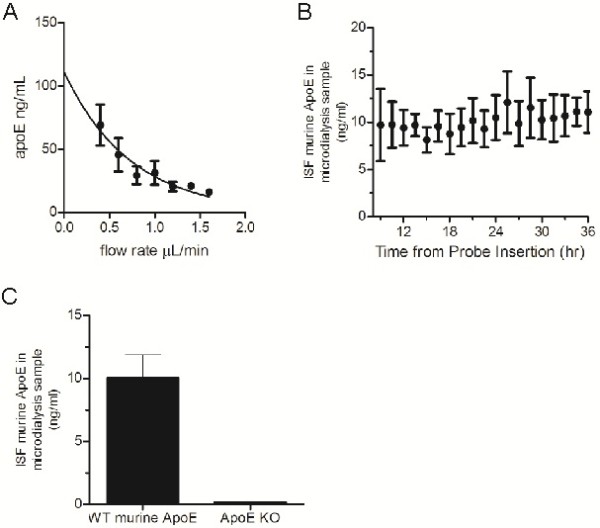
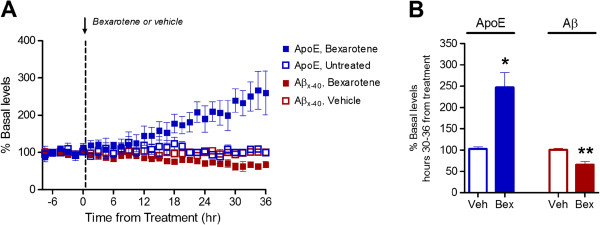
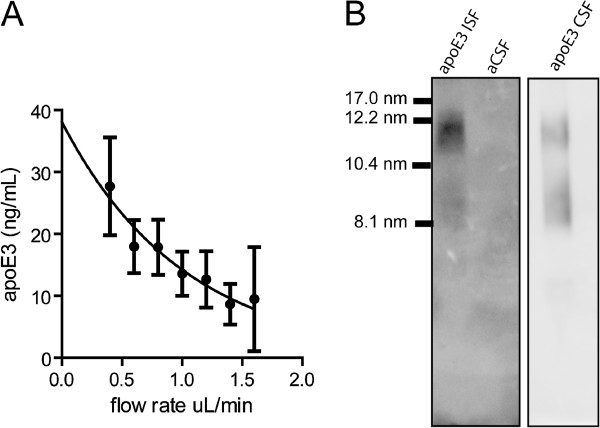
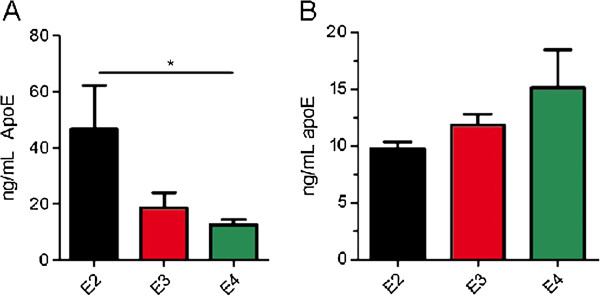
Background: The APOE4 allele variant is the strongest known genetic risk factor for developing late-onset Alzheimer’s disease. The link between apolipoprotein E (apoE) and Alzheimer’s disease is likely due in large part to the impact of apoE on the metabolism of amyloid β (Aβ) within the brain. Manipulation of apoE levels and lipidation within the brain has been proposed as a therapeutic target for the treatment of Alzheimer’s disease. However, we know little about the dynamic regulation of apoE levels and lipidation within the central nervous system. We have developed an assay to measure apoE levels in the brain interstitial fluid of awake and freely moving mice using large molecular weight cut-off microdialysis probes. Results: We were able to recover apoE using microdialysis from human cerebrospinal fluid (CSF) in vitro and mouse brain parenchyma in vivo . Microdialysis probes were inserted into the hippocampus of wild-type mice and interstitial fluid was collected for 36 hours. Levels of apoE within the microdialysis samples were determined by ELISA. The levels of apoE were found to be relatively stable over 36 hours. No apoE was detected in microdialysis samples from apoE KO mice. Administration of the RXR agonist bexarotene increased ISF apoE levels while ISF Aβ levels were decreased. Extrapolation to zero-flow analysis allowed us to determine the absolute recoverable concentration of apoE3 in the brain ISF of apoE3 KI mice. Furthermore, analysis of microdialysis samples by non-denaturing gel electrophoresis determined lipidated apoE particles in microdialysis samples were consistent in size with apoE particles from CSF. Finally, we found that the concentration of apoE in the brain ISF was dependent upon apoE isoform in human apoE KI mice, following the pattern apoE2>apoE3>apoE4. Conclusions: We are able to collect lipidated apoE from the brain of awake and freely moving mice and monitor apoE levels over the course of several hours from a single mouse. Our technique enables assessment of brain apoE dynamics under physiological and pathophysiological conditions and in response to therapeutic interventions designed to affect apoE levels and lipidation within the brain.
Overview
The claims and statistics of this paper haven’t been checked yet.
Free: it reads the open-access text and checks the first 5 claims that cite a source we can check. Create a free account to check every claim.
Integrity signals
Registry
Cites
Statistics
Figures
Verification
Claims the paper makes
The claims and statistics of this paper haven’t been checked yet.
Free: it reads the open-access text and checks the first 5 claims that cite a source we can check. Create a free account to check every claim.
Claims other papers make about this one
Each is checked against this paper’s own text: does it say what the citing paper says it does?
The source backs part of the claim, not all of it — or backs it for a different population, condition or comparison.
In the citing paper
“However, levels of apoE in human cerebrospinal fluid do display genotype-dependent pattern similar to the pattern in plasma, further murine interstitial fluid was observed to have genotype-dependent apoE levels similar to the pattern in cerebrospinal fluid [105,112,113].”
From Plasma levels of apolipoprotein E, APOE genotype and risk of dementia and ischemic heart disease: A review (2016) · cites this paper as [112]
Experimental — accuracy not yet measuredThe cited source says what the claim attributes to it.
In the citing paper
“However, levels of apoE in human cerebrospinal fluid do display genotype-dependent pattern similar to the pattern in plasma, further murine interstitial fluid was observed to have genotype-dependent apoE levels similar to the pattern in cerebrospinal fluid [105,112,113].”
From Plasma levels of apolipoprotein E, APOE genotype and risk of dementia and ischemic heart disease: A review (2016) · cites this paper as [112]
The cited source says what the claim attributes to it.
In the citing paper
“and in murine interstitial fluid a similar genotype-dependent pattern as in cerebrospinal fluid was observed.65”
From Plasma levels of apolipoprotein E, APOE genotype, and all-cause and cause-specific mortality in 105 949 individuals from a white general population cohort (2019) · cites this paper as [65]
The cited source says what the claim attributes to it.
In the citing paper
“ApoE level in the hippocampal interstitial fluid of mice has been shown to be dependent upon the APOE 2/3/4 polymorphism [51].”
From Genome-wide analysis identifies novel loci influencing plasma apolipoprotein E concentration and Alzheimer’s disease risk (2023) · cites this paper as [51]
The cited source says what the claim attributes to it.
In the citing paper
“Several research groups have tried to reproduce Cramer's initial study in various different AD models, with disparate results [18][19][20][21][22][23].”
4 more claims about this paper
Create a free account to see every claim other papers make about this one.
Self-check
Percentages, sums and reported differences re-computed from the paper’s own numbers.
The self-check needs the paper’s full text.
Citations
Cites
Apolipoprotein E and Alzheimer disease: risk, mechanisms and therapy
Liu, C.-C., Kanekiyo, T., Xu, H., & Bu, G. (2013) · Nature Reviews Neurology · doi:10.1038/nrneurol.2012.263 · Cited by 3,459 · cited 1×
“Previous studies indicate that apoE affects the metabolism and oligomerization of Aβ within the brain [3,4,24] as well as influences a variety of other biological processes [2].”
BackgroundSynaptic Activity Regulates Interstitial Fluid Amyloid-β Levels In Vivo
Cirrito, J. R., Yamada, K. A., Finn, M. B., Sloviter, R. S., Bales, K. R., May, P. C., Schoepp, D. D., Paul, S. M., Mennerick, S., & Holtzman, D. M. (2005) · Neuron · doi:10.1016/j.neuron.2005.10.028 · Cited by 1,265 · cited 1×
“In AD, microdialysis has been instrumental in studying the dynamics of Aβ production and clearance in vivo [3,11-14].”
BackgroundSelf-citationHuman ApoE isoforms differentially regulate brain amyloid-β peptide clearance
Castellano, J. M., Kim, J., Stewart, F. R., Jiang, H., DeMattos, R. B., Patterson, B. W., Fagan, A. M., Morris, J. C., Mawuenyega, K. G., Cruchaga, C., et al. (2011) · Science Translational Medicine · doi:10.1126/scitranslmed.3002156 · Cited by 1,242 · cited 3×
“Previous studies indicate that apoE affects the metabolism and oligomerization of Aβ within the brain [3,4,24] as well as influences a variety of other biological processes [2].”
BackgroundSelf-citationApoE-Directed Therapeutics Rapidly Clear β-Amyloid and Reverse Deficits in AD Mouse Models
Cramer, P. E., Cirrito, J. R., Wesson, D. W., Lee, C. Y. D., Karlo, J. C., Zinn, A. E., Casali, B. T., Restivo, J. L., Goebel, W. D., James, M. J., et al. (2012) · Science · doi:10.1126/science.1217697 · Cited by 1,050 · cited 4×
“Recent studies have therapeutically targeted the levels and lipidation of apoE to enhance clearance of Aβ from the brain [8].”
BackgroundInfluentialSelf-citationNeuronal activity regulates the regional vulnerability to amyloid-β deposition
Bero, A. W., Yan, P., Roh, J. H., Cirrito, J. R., Stewart, F. R., Raichle, M. E., Lee, J.-M., & Holtzman, D. M. (2011) · Nature Neuroscience · doi:10.1038/nn.2801 · Cited by 880 · cited 1×
“In AD, microdialysis has been instrumental in studying the dynamics of Aβ production and clearance in vivo [3,11-14].”
BackgroundSelf-citationApolipoprotein E and Apolipoprotein E Receptors: Normal Biology and Roles in Alzheimer Disease
Holtzman, D. M., Herz, J., & Bu, G. (2012) · Cold Spring Harbor Perspectives in Medicine · doi:10.1101/cshperspect.a006312 · Cited by 782 · cited 4×
“Previous studies indicate that apoE affects the metabolism and oligomerization of Aβ within the brain [3,4,24] as well as influences a variety of other biological processes [2].”
BackgroundInfluentialSelf-citationRoh, J. H., Huang, Y., Bero, A. W., Kasten, T., Stewart, F. R., Bateman, R. J., & Holtzman, D. M. (2012) · Science Translational Medicine · doi:10.1126/scitranslmed.3004291 · Cited by 563 · cited 1×
“In AD, microdialysis has been instrumental in studying the dynamics of Aβ production and clearance in vivo [3,11-14].”
BackgroundSelf-citationOverexpression of ABCA1 reduces amyloid deposition in the PDAPP mouse model of Alzheimer disease
Wahrle, S. E., Jiang, H., Parsadanian, M., Kim, J., Li, A., Knoten, A., Jain, S., Hirsch-Reinshagen, V., Wellington, C. L., Bales, K. R., et al. (2008) · Journal of Clinical Investigation · doi:10.1172/jci33622 · Cited by 407 · cited 2×
“ApoE particles in the CSF or secreted by cultured astrocytes are a heterogeneous mixture that vary in size depending upon the degree of lipidation [5,18-20].”
BackgroundSelf-citationMandrekar-Colucci, S., Karlo, J. C., & Landreth, G. E. (2012) · The Journal of Neuroscience · doi:10.1523/jneurosci.5268-11.2012 · Cited by 394 · cited 1×
“receptor agonists may be an effective therapeutic target for AD [8,17].”
BackgroundSelf-citationCirrito, J. R., May, P. C., O'Dell, M. A., Taylor, J. W., Parsadanian, M., Cramer, J. W., Audia, J. E., Nissen, J. S., Bales, K. R., Paul, S. M., et al. (2003) · The Journal of Neuroscience · doi:10.1523/jneurosci.23-26-08844.2003 · Cited by 394 · cited 2×
“In AD, microdialysis has been instrumental in studying the dynamics of Aβ production and clearance in vivo [3,11-14].”
BackgroundResultSelf-citation
Cited by
Items 101–140 of 140
Microglia-derived APOE2 improves remyelination even in the presence of endogenous APOE4
Nolt, G. L., Golden, L. R., Thorpe, S. P., Funnell, J. L., Stephens, I. O., Hernandez, G., MacLean, S. M., Lucido, C. C., Brock, C. R., Pallerla, A. V., et al. (2025) · Journal of Neuroinflammation · doi:10.1186/s12974-025-03639-5 · Cited by 5
“This corresponds with previous literature showing an ApoE isoform dependence on ApoE concentration in the brain (E2 >E3 >E4) [41, 76, 77].”
Generation of novel anti‐apo E monoclonal antibodies that selectively recognize apo E isoforms
Ohgita, T., Sakai, K., Fukui, N., Namba, N., Nakano, M., Kiguchi, Y., Morita, I., Oyama, H., Yamaki, K., Nagao, K., et al. (2024) · FEBS Letters · doi:10.1002/1873-3468.14858 · Cited by 5
Sabherwal, S., Föcking, M., English, J. A., Fitzsimons, S., Hryniewiecka, M., Wynne, K. J., Scaife, C., Healy, C., Cannon, M. D., Belton, O., et al. (2019) · Schizophrenia Research · doi:10.1016/j.schres.2019.05.002 · Cited by 6
Nashed, M. G., Chatterjee, D., Nguyen, D., Oleinichenko, D., Diwan, M., & Nóbrega, J. N. (2019) · Psychopharmacology · doi:10.1007/s00213-019-05324-x · Cited by 4
Parrot, S., Corscadden, A., Lallemant, L., Benyamine, H., Comte, J., Huguet-Lachon, A., Gourdon, G., & Gomes-Pereira, M. (2021) · ACS Chemical Neuroscience · doi:10.1021/acschemneuro.1c00634 · Cited by 4
Yi, L., Wang, X., Girardi, C. S., Fitz, N. F., Koldamova, R. P., & Lefterov, I. M. (2025) · Cells · doi:10.3390/cells14241970 · Cited by 3
“Importantly, the effects on APOE and APOE-HDL in the brain and ISF and CSF of human subjects were independently validated in multiple studies [8,15,73–75].”
ApoE expression across the CNS: Who, What, Where, When, and How (much)?
Nolt, G. L., Lucido, C. C., Smith, L. M., & Johnson, L. A. (2026) · Molecular Neurodegeneration Advances · doi:10.1186/s44477-026-00028-x · Cited by 2
Cao, Q., Jackson, H. D., Duncan, A., Cui, Y., Higginbotham, H., Lesnik, S., Jo, Y., Yu, J., White, F. M., & Cima, M. J. (2026) · Lab on a Chip · doi:10.1039/d6lc00038j · Cited by 2
Nuclear receptors in age-related diseases: From mechanisms to drug discovery
Zhang, L., Li, X., Ren, C., Hao, Y., Deng, Y., Pan, H., Kim, Y.-B., Fan, S., Huang, C., Ge, G., et al. (2026) · Ageing Research Reviews · doi:10.1016/j.arr.2026.103125 · Cited by 1
Youth-associated protein TIMP2 regulates microglial state and function in healthy and aged mice
Hemmer, B. M., Philippi, S. M., Ferreira, A. C., Petridis, S. F., Phan, A., & Castellano, J. M. (2026) · Nature Communications · doi:10.1038/s41467-026-74906-z · Cited by 1
Self-citationMené, P. G. (2014) · RECERCAT (Consorci de Serveis Universitaris de Catalunya) · Cited by 1
The Cellular Context of Estradiol Regulation in the Zebra Finch Auditory Forebrain
Ikeda, M. Z. (2016) · Scholarworks (University of Massachusetts Amherst) · doi:10.7275/9047986.0 · Cited by 1
Marchese, L., Battaglia, M., Mangione, P. P., Relini, A., Codroico, G., Raimondi, S., Forneris, F., Faravelli, S., Leonardini, B., Canale, C., et al. (2026) · bioRxiv (Cold Spring Harbor Laboratory) · doi:10.64898/2026.05.29.728721 · Cited by 1
Modulating ApoE with Tissue Specific siRNAs in Alzheimer’s Disease
Ferguson, C. (2021) · University of Massachusetts Medical School · doi:10.13028/qk23-zg81
Production, Accumulation and Clearance of Amyloid-beta After Experimental Traumatic Brain Injury
Washington, P. M. (2013) · DigitalGeorgetown (Georgetown University Library)
Stukas, K. S. C. (2014) · cIRcle (University of British Columbia) · doi:10.14288/1.0166993
Apolipoprotein E and Mitochondria-associated Endoplasmic Reticulum Dysfunction
Tambini, M. D. (2016)
Alzheimer’s Disease Therapeutics Targeting Apolipoprotein E
Liao, F., & Holtzman, D. M. (2016) · Elsevier eBooks · doi:10.1016/b978-0-12-802173-6.00010-1
Self-citationInteracciones entre IGF-I y apoE: Implicaciones en la Enfermedad de Alzheimer
Labrador, R. H. (2019) · Hispana
The Role of Apolipoprotein E in Alzheimer Disease: From Therapy to Mechanism
Huynh, T. V. (2020) · Open Scholarship Institutional Repository (Washington University in St. Louis) · doi:10.7936/4axz-tr29
Brain microdialysis and applications to drug therapy in severe traumatic brain injury
Ketharanathan, N., Rohlwink, U. K., Figaji, A., Wildschut, E. D., Tibboel, D., & de Lange, E. C. M. (2022) · Elsevier eBooks · doi:10.1016/b978-0-12-823036-7.00041-4
O potencial do uso off label do bexaroteno na doença de alzheimer: uma revisão
de Souza, E. S., Cedro, P. É. P., & Mendes, T. P. S. (2023) · Revista Científica Eletrônica do Conselho Regional de Farmácia da Bahia · doi:10.4322/rce-crf-ba.e02022303
APOE2 Heterozygosity Reduces Hippocampal Soluble Amyloid-β42 Levels in Non-Hyperlipidemic Mice
Valencia‐Olvera, A. C., Balu, D., Moore, A., Shah, M., Ainis, R., Xiang, B., Saleh, Y., Cai, D., LaDu, M. J., & Tai, L. M. (2024) · Journal of Alzheimer s Disease · doi:10.3233/jad-231210
Differential Effects of Aβ Peptides on the Plasmin-Dependent Degradation of ApoE3 and ApoE4
Kemeh, M. M., Furnelli, A. J., & Lazo, N. D. (2025) · ACS Chemical Neuroscience · doi:10.1021/acschemneuro.5c00065
Microneedles-Based Interstitial Fluid Extraction for Systemic Lupus Erythematosus Monitoring
Lazim, N. A. M., Saleh, S. M., & Muhamad, I. I. (2025) · Series in bioengineering · doi:10.1007/978-981-96-3916-8_12
Johnson, N. R., Wang, A. C.-J., Coughlan, C. M., Sillau, S., Lucero, E., Viltz, L., Markham, N. E., Allen, C., Dhanasekaran, A. R., Chial, H. J., et al. (2022) · Figshare · doi:10.6084/m9.figshare.20193570
Johnson, N. R., Wang, A. C.-J., Coughlan, C. M., Sillau, S., Lucero, E., Viltz, L., Markham, N. E., Allen, C., Dhanasekaran, A. R., Chial, H. J., et al. (2022) · Figshare · doi:10.6084/m9.figshare.20193564
脳標的化核酸分子送達キャリア開発へのアプローチ : 内因性物質のリガンドへの応用研究
Tamaru, M. (2014) · Institutional Repositories DataBase (IRDB) · doi:10.14943/doctoral.k11419
Johnson, N. R., Wang, A. C.-J., Coughlan, C. M., Sillau, S., Lucero, E., Viltz, L., Markham, N. E., Allen, C., Dhanasekaran, A. R., Chial, H. J., et al. (2022) · Figshare · doi:10.6084/m9.figshare.20193558
Novel Insight into Regulation of Glymphatic Flow with Implications for Traumatic Brain Injury
Plog, B. A., & Nedergaard, M. (2017) · UR Research (University of Rochester)
LIPID DROPLET TARGETING AND FUNCTION OF APOLIPOPROTEIN E
Windham, I. A. (2023) · Carolina Digital Repository (University of North Carolina at Chapel Hill) · doi:10.17615/yant-mg96
APOE genotype differentially modulates prion pathology in a mouse model
Lizińczyk, A. M., Pankiewicz, J. E., Cullina, W. L., Franco, L. A., Sullivan, P. M., & Sadowski, M. J. (2026) · Acta Neuropathologica Communications · doi:10.1186/s40478-025-02207-5
“Consistent with several published studies, we found the brain level of apoE protein is APOE -genotype dependent, with ε2/ε2 NBH and ε4/ε4 NBH animals representing opposite ends of the spectrum [27, 61, 106, 113].”
InfluentialHanbouch, L. (2017) · theses.fr (ABES) · doi:10.70675/c4d2c894zf69dz4ae4z9ab1zf4135d0efa12
Lallemant, L. (2023) · theses.fr (ABES) · doi:10.70675/7b68e0b6z008bz491fza549ze45dd170cde2
Microglial APOE Across Alzheimer’s Disease-Relevant Pathologies
Nolt, G. L. (2026) · UKnowledge (University of Kentucky) · doi:10.13023/etd.2026.311
Apoprotein E: Structural insights functionality and genetic variability
Tewari, S., & Ranade, S. D. (2026) · Elsevier eBooks · doi:10.1016/b978-0-443-40563-1.00008-9
Measuring Amyloid-β in the Brain Using Microdialysis
Edwards, H. M., Walsh, E. N., Harrigan, R. T., McFarland, N. H., Doherty, B. M., Yuede, C. M., & Cirrito, J. R. (2026) · Neuromethods · doi:10.1007/978-1-0716-5122-3_4
Self-citationSavignac, C., St‐Onge, F., Villeneuve, S., Badhwar, A., Taliun, S. A. G., Farhan, S., Geddes, M. R., Medina, Y. I., Poirier, J., Spreng, R. N., et al. (2026) · Cell Reports Medicine · doi:10.1016/j.xcrm.2026.102943
Roudi, S., Estupiñan, H. Y., Saher, O., Barradas, C., Inganäs, E., Le, H., Frengen, N. S., Grochowski, R., Pavlova, S., Månsson, R., et al. (2026) · bioRxiv (Cold Spring Harbor Laboratory) · doi:10.64898/2026.08.28.747711
“…based on general HDL biophysical parameters, with mouse CSF ApoE concentration extrapolated from the microdialysis measurements in mice (~6 µg/mL) [60]; however, no studies have directly measured HDL-like lipoprotein particle number or concentration in mouse CSF. Critically, when albumin binding…”
Metadata
- Authors
- Ulrich, J. D., Burchett, J. M., Restivo, J. L., Schuler, D. R., Verghese, P. B., Mahan, T. E., Landreth, G. E., Castellano, J. M., Jiang, H., Cirrito, J. R., & Holtzman, D. M.
- Affiliations
- Washington University in St. Louis (US)
- Case Western Reserve University (US)
- Corresponding author
- Holtzman, David M
- ORCID
- Venue
- Molecular Neurodegeneration
- Published
- 2013-04-19
- Volume
- 8
- Issue
- 1
- Pages
- 13-13
- ISSN
- 1750-1326 (ISSN-L)
- PMC
- PMC3640999
- OpenAlex
- W2111289935
- Cited by
- 128
- References
- 28
- Citations by year
- 2026: 8 · 2025: 6 · 2024: 7 · 2023: 9 · 2022: 18 · 2021: 7 · 2020: 6 · 2019: 10 · 2018: 8 · 2017: 11 · 2016: 13 · 2015: 11 · 2014: 13 · 2013: 1
- FWCI
- 8.80
- Type
- journal article
- Language
- en
- Open access
- gold
- doi.org
- Licence
- cc-by
- Locations
- Molecular Neurodegeneration (publishedVersion, cc-by)
- Europe PMC (PubMed Central) (publishedVersion, cc-by)
- PubMed Central (publishedVersion, cc-by)
- PubMed (publishedVersion)
- Digital Commons@Becker (Washington University School of Medicine) (submittedVersion)
- Funders
- Ellison Medical Foundation
- Cure Alzheimer's Fund
- National Institute on Aging (K01 AG029254, R37AG13956, R01AG042513, R37AG013956)
- National Institute of Neurological Disorders and Stroke (P01 NS07496901, P01NS074969)
- Topics
- Life Sciences › Neuroscience › Cellular and Molecular Neuroscience › Alzheimer's disease research and treatments
- Life Sciences › Neuroscience › Neurology › Neuroinflammation and Neurodegeneration Mechanisms
- Health Sciences › Medicine › Clinical Neurology › Cerebrospinal fluid and hydrocephalus
- Keywords
- apolipoprotein E, brain interstitial fluid, microdialysis, APOE ε4, Alzheimer's disease, amyloid-beta, APOE isoforms, ApoE-deficient mice, bexarotene, RXR agonists, hippocampus, cerebrospinal fluid, in vivo measurement
- MeSH terms
- Alzheimer Disease, Animals, Apolipoproteins E, Brain, Brain Chemistry, Cerebrospinal Fluid, Enzyme-Linked Immunosorbent Assay, Humans, Mice, Inbred C57BL, Blotting, Western, Microdialysis, Protein Isoforms, Extracellular Fluid, Mice, Gene Knock-In Techniques
About these checks
Registry, retraction, Cites and statistics results are computed, not judged, with one exception: a printed reference that no index lists is read once by a model before it counts as a citation error. Claims are extracted by a model and kept only when their quote appears verbatim in the text; each cited source is then checked, with a model’s help, for whether it says what the claim relies on. Those verdicts can be wrong — read the claim’s quote and the cited source before relying on one.
Statistics and arithmetic are recomputed, not judged.
Confidence bands are shown only for fields calibrated on our annotated test set. None is calibrated yet, so no band is shown.
What counts as a claim ›How we measure confidence ›How we check this ›
Are you an author, or do you see a problem with this page? Request a review
Data sources
Bibliographic data: Semantic Scholar, OpenAlex, Crossref.
Contains information from the Semantic Scholar Academic Graph Datasets, made available under the ODC Attribution License (ODC-BY 1.0).
Semantic Scholar’s data is described in: Kinney, R., et al. (2023). The Semantic Scholar Open Data Platform. arXiv:2301.10140.
