

Inference of complex biological networks: distinguishability issues and optimization-based solutions
Open accessThe DOI matches its Crossref record; 97 of the 98 references it cites were found in a registry or an index.
Abstract
BACKGROUND: The inference of biological networks from high-throughput data has received huge attention during the last decade and can be considered an important problem class in systems biology. However, it has been recognized that reliable network inference remains an unsolved problem. Most authors have identified lack of data and deficiencies in the inference algorithms as the main reasons for this situation. RESULTS: We claim that another major difficulty for solving these inference problems is the frequent lack of uniqueness of many of these networks, especially when prior assumptions have not been taken properly into account. Our contributions aid the distinguishability analysis of chemical reaction network (CRN) models with mass action dynamics. The novel methods are based on linear programming (LP), therefore they allow the efficient analysis of CRNs containing several hundred complexes and reactions. Using these new tools and also previously published ones to obtain the network structure of biological systems from the literature, we find that, often, a unique topology cannot be determined, even if the structure of the corresponding mathematical model is assumed to be known and all dynamical variables are measurable. In other words, certain mechanisms may remain undetected (or they are falsely detected) while the inferred model is fully consistent with the measured data. It is also shown that sparsity enforcing approaches for determining 'true' reaction structures are generally not enough without additional prior information. CONCLUSIONS: The inference of biological networks can be an extremely challenging problem even in the utopian case of perfect experimental information. Unfortunately, the practical situation is often more complex than that, since the measurements are typically incomplete, noisy and sometimes dynamically not rich enough, introducing further obstacles to the structure/parameter estimation process. In this paper, we show how the structural uniqueness and identifiability of the models can be guaranteed by carefully adding extra constraints, and that these important properties can be checked through appropriate computation methods.
Overview
The claims and statistics of this paper haven’t been checked yet.
Free: it reads the open-access text and checks the first 5 claims that cite a source we can check. Create a free account to check every claim.
Integrity signals
Registry
Cites
Statistics
Figures
Verification
Claims the paper makes
The claims and statistics of this paper haven’t been checked yet.
Free: it reads the open-access text and checks the first 5 claims that cite a source we can check. Create a free account to check every claim.
Claims other papers make about this one
Each is checked against this paper’s own text: does it say what the citing paper says it does?
The source backs part of the claim, not all of it — or backs it for a different population, condition or comparison.
In the citing paper
“More importantly, uniqueness and distinguishability of models can be guaranteed by carefully adding extra constraints and/or prior knowledge.”
From Reverse engineering and identification in systems biology: strategies, perspectives and challenges (2014) · cites this paper as [181]
Experimental — accuracy not yet measuredThe cited source says what the claim attributes to it.
In the citing paper
“Their results show that, in addition to the obstacles identified by Prill et al. [94] (lack of data and deficiencies in the inference algorithms), we must be also aware of fundamental problems related to the uniqueness and distinguishability of these networks (even for the utopian case of fully observed networks with no noise).”
From Reverse engineering and identification in systems biology: strategies, perspectives and challenges (2014) · cites this paper as [181]
In the citing paper
“However, Szederkenyi et al. [181] show that the sparsity assumption alone is not enough to ensure uniqueness.”
From Reverse engineering and identification in systems biology: strategies, perspectives and challenges (2014) · cites this paper as [181]
In the citing paper
“Moreover, in the case of linear dynamic genetic network models, too sparse structures can be harmful.”
From Reverse engineering and identification in systems biology: strategies, perspectives and challenges (2014) · cites this paper as [181]
Self-check
Percentages, sums and reported differences re-computed from the paper’s own numbers.
The self-check needs the paper’s full text.
Citations
Cites
System Identification: Theory for the User
Lennart Ljung, A. (1987) · Cited by 17,690
The Large-Scale Organization of Metabolic Networks
Jeong, H., Tombor, B., Albert, R., Oltvai, Z. N., & Barabási, A.-L. (2000) · Nature · doi:10.1038/35036627 · Cited by 4,972 · cited 1×
“gene expression [5-13], signal transduction [14-17] and metabolic networks [18-25].”
BackgroundAn Introduction to Systems Biology: Design Principles of Biological Circuits
Alon, U. (2006) · doi:10.1201/9781420011432 · Cited by 2,825
Modeling and Simulation of Genetic Regulatory Systems: A Literature Review
de Jong, H. (2002) · Journal of Computational Biology · doi:10.1089/10665270252833208 · Cited by 2,663 · cited 1×
“During the last decade, many methods have been developed to solve the network-inference (sometimes called reverse-engineering [4]) problems arising in e.g. gene expression [5-13], signal transduction [14-17] and metabolic networks [18-25].”
MethodDonoho, D. L. (2006) · Communications on Pure and Applied Mathematics · doi:10.1002/cpa.20132 · Cited by 2,490 · cited 1×
“There exist certain conditions under which the problem can be solved in polynomial time [83] but these are often not fulfilled in the case of CRNs.”
BackgroundComputational systems biology.
Kitano, H. (2002) · Nature · doi:10.1038/nature01254 · Cited by 2,209
Bang-Jensen, J., & Gutin, G. (2002) · doi:10.1007/978-1-4471-3886-0 · Cited by 1,856
Qualitative Theory of Differential Equations
(1961) · Princeton University Press eBooks · doi:10.1515/9781400875955 · Cited by 1,480
Reverse engineering of biological complexity
Csete, M. E., & Doyle, J. C. (2002) · Science · doi:10.1126/science.1069981 · Cited by 1,215
Genome-Scale Reconstruction of the Saccharomyces cerevisiae Metabolic Network
Förster, J., Famili, I., Fu, P., Palsson, B. Ø., & Nielsen, J. (2003) · Genome Research · doi:10.1101/gr.234503 · Cited by 1,069 · cited 1×
“gene expression [5-13], signal transduction [14-17] and metabolic networks [18-25].”
BackgroundHorn, F., & Jackson, R. (1972) · Archive for Rational Mechanics and Analysis · doi:10.1007/bf00251225 · Cited by 1,014 · cited 3×
“In this paper, we consider the widely used reaction kinetic formalism, where dynamic models of biological networks are described by a set of ordinary differential equations (see, e.g. [28-30] and the related literature).”
BackgroundMethodBellman, R., & Åström, K. J. (1970) · Mathematical Biosciences · doi:10.1016/0025-5564(70)90132-x · Cited by 871
Metabolic network structure determines key aspects of functionality and regulation
Stelling, J., Klamt, S., Bettenbrock, K., Schuster, S., & Gilles, E. D. (2002) · Nature · doi:10.1038/nature01166 · Cited by 802 · cited 1×
“gene expression [5-13], signal transduction [14-17] and metabolic networks [18-25].”
BackgroundHow to infer gene networks from expression profiles
Bansal, M., Belcastro, V., Ambesi‐Impiombato, A., & di Bernardo, D. (2007) · Molecular Systems Biology · doi:10.1038/msb4100120 · Cited by 766 · cited 1×
“gene expression [5–13], signal transduction [14–17] and metabolic networks [18–25].”
BackgroundGene regulatory network inference: Data integration in dynamic models—A review
Hecker, M., Lambeck, S., Toepfer, S., van Someren, E., & Guthke, R. (2009) · Biosystems · doi:10.1016/j.biosystems.2008.12.004 · Cited by 755 · cited 1×
“gene expression [5-13], signal transduction [14-17] and metabolic networks [18-25].”
BackgroundRevealing strengths and weaknesses of methods for gene network inference
Marbach, D., Prill, R. J., Schaffter, T., Mattiussi, C., Floreano, D., & Stolovitzky, G. (2010) · Proceedings of the National Academy of Sciences · doi:10.1073/pnas.0913357107 · Cited by 752 · cited 2×
“gene expression [5–13], signal transduction [14–17] and metabolic networks [18–25].”
BackgroundMethodFeinberg, M. (1987) · Chemical Engineering Science · doi:10.1016/0009-2509(87)80099-4 · Cited by 744 · cited 2×
“The above characterization naturally gives rise to the following graph structure (often called ‘ Feinberg-Horn-Jackson graph ’ or simply reaction graph) of a CRN [29].”
BackgroundMethodPerspectives on system identification
Ljung, L. (2010) · Annual Reviews in Control · doi:10.1016/j.arcontrol.2009.12.001 · Cited by 707
Metabolic networks in motion: 13 C‐based flux analysis
Sauer, U. (2006) · Molecular Systems Biology · doi:10.1038/msb4100109 · Cited by 660
On global identifiability for arbitrary model parametrizations
Ljung, L., & Glad, T. (1994) · Automatica · doi:10.1016/0005-1098(94)90029-9 · Cited by 643
Network component analysis: Reconstruction of regulatory signals in biological systems
Liao, J. C., Boscolo, R., Yang, Y.-L., Tran, L. M., Sabatti, C., & Roychowdhury, V. P. (2003) · Proceedings of the National Academy of Sciences · doi:10.1073/pnas.2136632100 · Cited by 601 · cited 1×
“The importance of identifiability has been recognized previously in systems biology, too [14,61-64].”
BackgroundSystem identification (2nd ed.): theory for the user
Lennart Ljung, A. (1999) · Prentice Hall PTR eBooks · Cited by 594
Ronen, M., Rosenberg, R., Shraiman, B. I., & Alon, U. (2002) · Proceedings of the National Academy of Sciences · doi:10.1073/pnas.152046799 · Cited by 532 · cited 1×
“gene expression [5-13], signal transduction [14-17] and metabolic networks [18-25].”
BackgroundMetabolomics and systems biology: making sense of the soup
KELL, D. (2004) · Current Opinion in Microbiology · doi:10.1016/j.mib.2004.04.012 · Cited by 529 · cited 1×
“gene expression [5-13], signal transduction [14-17] and metabolic networks [18-25].”
BackgroundDAISY: A new software tool to test global identifiability of biological and physiological systems
Bellu, G., Saccomani, M. P., Audoly, S., & D’Angiò, L. (2007) · Computer Methods and Programs in Biomedicine · doi:10.1016/j.cmpb.2007.07.002 · Cited by 452 · cited 1×
“Computer algebra tools can be successfully used for the symbolic computations needed for identifiability and distinguishability testing of complex models [57-60].”
MethodSystem identifiability based on the power series expansion of the solution
Pohjanpalo, H. (1978) · Mathematical Biosciences · doi:10.1016/0025-5564(78)90063-9 · Cited by 440
Towards a rigorous assessment of systems biology models: the DREAM3 challenges
Prill, R. J., Marbach, D., Saez-Rodriguez, J., Sorger, P. K., Alexopoulos, L. G., Xue, X., Clarke, N. D., Altan-Bonnet, G., & Stolovitzky, G. (2010) · PLoS ONE · doi:10.1371/journal.pone.0009202 · Cited by 439 · cited 2×
“Prill et al [27] further explored the issue of intrinsic impediments to network inference, designating identifiability of certain network edges and systematic false positives as the main barriers.”
BackgroundPerspectives on System Identification
Ljung, L. (2008) · IFAC Proceedings Volumes · doi:10.3182/20080706-5-kr-1001.01215 · Cited by 438
Reverse engineering gene networks: integrating genetic perturbations with dynamical modeling
Tegnér, J., Yeung, M. K. S., Hasty, J., & Collins, J. J. (2003) · Proceedings of the National Academy of Sciences · doi:10.1073/pnas.0933416100 · Cited by 433 · cited 1×
“gene expression [5-13], signal transduction [14-17] and metabolic networks [18-25].”
BackgroundLi, S., Assmann, S. M., & Albert, R. (2006) · PLoS Biology · doi:10.1371/journal.pbio.0040312 · Cited by 418 · cited 1×
“gene expression [5-13], signal transduction [14-17] and metabolic networks [18-25].”
BackgroundA methodology for the structural and functional analysis of signaling and regulatory networks
Klamt, S., Saez-Rodriguez, J., Lindquist, J. A., Simeoni, L., & Gilles, E. D. (2006) · BMC Bioinformatics · doi:10.1186/1471-2105-7-56 · Cited by 395 · cited 1×
“During the last decade, many methods have been developed to solve the network-inference (sometimes called reverse-engineering [4]) problems arising in e.g. gene expression [5-13], signal transduction [14-17] and metabolic networks [18-25].”
MethodSTOLOVITZKY, G., MONROE, D., & CALIFANO, A. (2007) · Annals of the New York Academy of Sciences · doi:10.1196/annals.1407.021 · Cited by 377 · cited 1×
“In this context, it is particularly worth mentioning the DREAM initiative (Dialogue for Reverse Engineering Assessments and Methods) [26], which targeted the problems of cellular network inference and quantitative model building in systems biology.”
Linear Programming-1: Introduction.
Dave, U., Dantzig, G. B., & Thapa, M. N. (1998) · The Journal of the Operational Research Society · doi:10.2307/3010109 · Cited by 324
Systems biology: parameter estimation for biochemical models
Ashyraliyev, M., Fomekong‐Nanfack, Y., Kaandorp, J. A., & Blom, J. G. (2009) · The FEBS Journal · doi:10.1111/j.1742-4658.2008.06844.x · Cited by 323 · cited 1×
“However, and despite a number of works illustrating ways to test the structural and practical identifiability of models [65-67], a significant portion of modeling studies in systems biology continue to ignore this key property.”
BackgroundA test case of correlation metric construction of a reaction pathway from measurements
Arkin, A., Shen, P., & Ross, J. (1997) · Science · doi:10.1126/science.277.5330.1275 · Cited by 291 · cited 1×
“During the last decade, many methods have been developed to solve the network-inference (sometimes called reverse-engineering [4]) problems arising in e.g. gene expression [5-13], signal transduction [14-17] and metabolic networks [18-25].”
MethodÉrdi, P., & Tóth, J. I. (1992) · Medical Entomology and Zoology · Cited by 286
Classic and contemporary approaches to modeling biochemical reactions
Chen, W. W., Niepel, M., & Sorger, P. K. (2010) · Genes & Development · doi:10.1101/gad.1945410 · Cited by 286 · cited 1×
“The importance of identifiability has been recognized previously in systems biology, too [14,61-64].”
BackgroundIdentifiability of State Space Models
Walter, E. (1982) · Lecture Notes in Biomathematics · doi:10.1007/978-3-642-61823-9 · Cited by 278
Essays on Control: Perspectives in the Theory and its Applications
(1993) · CERN Document Server (European Organization for Nuclear Research) · doi:10.1007/978-1-4612-0313-1 · Cited by 269
Werhli, A. V., & Husmeier, D. (2007) · Statistical Applications in Genetics and Molecular Biology · doi:10.2202/1544-6115.1282 · Cited by 263 · cited 1×
“Additionally, the value of prior information in biological network inference was clearly shown in [69,70] by applying Bayesian network models.”
Model predictive control techniques for hybrid systems
Camacho, E. F., Ramirez, D. R., Limon, D., Muñoz de la Peña, D., & Alamo, T. (2010) · Annual Reviews in Control · doi:10.1016/j.arcontrol.2010.02.002 · Cited by 249
Linking data to models: data regression
Jaqaman, K., & Danuser, G. (2006) · Nature Reviews Molecular Cell Biology · doi:10.1038/nrm2030 · Cited by 243 · cited 1×
“However, and despite a number of works illustrating ways to test the structural and practical identifiability of models [65-67], a significant portion of modeling studies in systems biology continue to ignore this key property.”
BackgroundParameter identifiability of nonlinear systems: the role of initial conditions
Pia Saccomani, M., Audoly, S., & D'Angiò, L. (2003) · Automatica · doi:10.1016/s0005-1098(02)00302-3 · Cited by 230 · cited 1×
“Further theoretical developments in the field include the identifiability conditions of rational function state space models [43], the possible effect of initial conditions on identifiability [44], and the application of Lie-algebras [45].”
Identifiability of Parametric Models
(1987) · Elsevier eBooks · doi:10.1016/c2013-0-03836-4 · Cited by 228 · cited 1×
“Identifiability analysis studies whether there is a theoretical chance of uniquely determining the parameters of a mathematical model assuming perfect noise-free measurements and error-free modeling [33-35].”
BackgroundSimilarity transformation approach to identifiability analysis of nonlinear compartmental models
Vajda, S., Godfrey, K. R., & Rabitz, H. (1989) · Mathematical Biosciences · doi:10.1016/0025-5564(89)90024-2 · Cited by 225 · cited 2×
“In [38] a similarity transformation approach is proposed that gives necessary and sufficient conditions on local and global identifiability through the checking of nonlinear controllability and observability conditions.”
BackgroundNetwork inference using informative priors
Mukherjee, S., & Speed, T. P. (2008) · Proceedings of the National Academy of Sciences · doi:10.1073/pnas.0802272105 · Cited by 221 · cited 1×
“Additionally, the value of prior information in biological network inference was clearly shown in [69,70] by applying Bayesian network models.”
System Identification: Theory for the User, 2nd Edition (Ljung, L.; 1999) [On the Shelf]
Simpkins, A. (2012) · IEEE Robotics & Automation Magazine · doi:10.1109/mra.2012.2192817 · Cited by 214
Mathematical models of chemical reactions
Érdi, P. (1989) · Cited by 207
On the identifiability and distinguishability of nonlinear parametric models
Walter, E., & Pronzato, L. (1996) · Mathematics and Computers in Simulation · doi:10.1016/0378-4754(95)00123-9 · Cited by 186
Global approaches to identifiability testing for linear and nonlinear state space models
Walter, E., & Lecourtier, Y. (1982) · Mathematics and Computers in Simulation · doi:10.1016/0378-4754(82)90645-0 · Cited by 184 · cited 1×
“A similar but more general method uses the generating series or Volterra-series coefficients of the system which is the nonlinear generalization of the Laplace-transform method used for linear systems [37].”
MethodSystems biology: The reincarnation of systems theory applied in biology?
Wolkenhauer, O. (2001) · Briefings in Bioinformatics · doi:10.1093/bib/2.3.258 · Cited by 183 · cited 1×
“During the last decade, the wide availability of high-throughput biological data has made it possible to produce new knowledge via a systems biology approach [1-3].”
BackgroundAn Algebraic Approach to Linear and Nonlinear Control
Fliess, M., & Glad, S. T. (1993) · Birkhäuser Boston eBooks · doi:10.1007/978-1-4612-0313-1_8 · Cited by 181
Zak, D. E., Gonye, G. E., Schwaber, J. S., & Doyle, F. J. (2003) · Genome Research · doi:10.1101/gr.1198103 · Cited by 177 · cited 1×
“The importance of identifiability has been recognized previously in systems biology, too [14,61-64].”
BackgroundMathematical models in microbial systems biology
Stelling, J. (2004) · Current Opinion in Microbiology · doi:10.1016/j.mib.2004.08.004 · Cited by 164 · cited 1×
“During the last decade, the wide availability of highthroughput biological data has made it possible to produce new knowledge via a systems biology approach [1-3].”
BackgroundMathematical and computational techniques to deduce complex biochemical reaction mechanisms
Crampin, E. J., Schnell, S., & McSharry, P. E. (2004) · Progress in Biophysics and Molecular Biology · doi:10.1016/j.pbiomolbio.2004.04.002 · Cited by 163
Robust dynamical network structure reconstruction
Yuan, Y., Stan, G.-B. V., Warnick, S. C., & Gonçalves, J. M. (2011) · Automatica · doi:10.1016/j.automatica.2011.03.008 · Cited by 163 · cited 1×
“During the last decade, many methods have been developed to solve the network-inference (sometimes called reverse-engineering [4]) problems arising in e.g. gene expression [5-13], signal transduction [14-17] and metabolic networks [18-25].”
MethodLinking the genes: inferring quantitative gene networks from microarray data
de la Fuente, A., Brazhnik, P., & Mendes, P. (2002) · Trends in Genetics · doi:10.1016/s0168-9525(02)02692-6 · Cited by 161
Yue, H., Brown, M., Knowles, J., Wang, H., Broomhead, D. S., & Kell, D. B. (2006) · Molecular BioSystems · doi:10.1039/b609442b · Cited by 148
Identifiability of chemical reaction networks
Craciun, G., & Pantea, C. (2008) · Journal of Mathematical Chemistry · doi:10.1007/s10910-007-9307-x · Cited by 146 · cited 3×
“Geometric conditions for the indistinguishability of CRNs are given in [55] with a related comment in [56].”
BackgroundMethodParameter estimation and optimal experimental design
Banga, J. R., & Balsa-Canto, E. (2008) · Essays in Biochemistry · doi:10.1042/bse0450195 · Cited by 141
Self-citationMathematical modeling of gene expression: a guide for the perplexed biologist
Ay, A., & Arnosti, D. N. (2011) · Critical Reviews in Biochemistry and Molecular Biology · doi:10.3109/10409238.2011.556597 · Cited by 139 · cited 1×
“gene expression [5-13], signal transduction [14-17] and metabolic networks [18-25].”
BackgroundSubnetwork analysis reveals dynamic features of complex (bio)chemical networks
Conradi, C., Flockerzi, D., Raisch, J., & Stelling, J. (2007) · Proceedings of the National Academy of Sciences · doi:10.1073/pnas.0705731104 · Cited by 120 · cited 3×
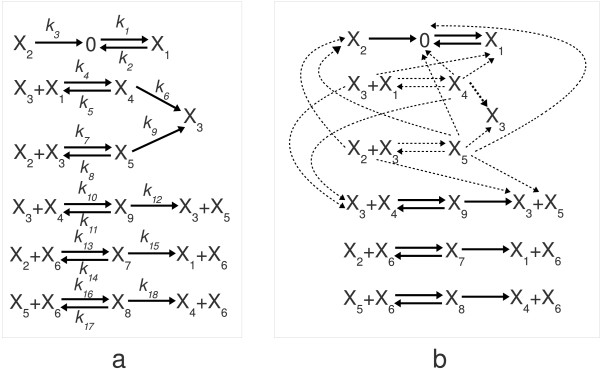
“…elements of A k are (the diagonal ones can be computed using the column conservation property): Since there are no parameter values published in [90], we used the following randomly selected rate coefficients: k = [4.1 3.2 6.7 7.3 3.8 2.4 4.5 5.1 6.2 7.7 8.6 9.5 2.4 4.9 5.8 10.2 6.3 8.5] T .”
BackgroundMethodInfluentialA generalized model of the repressilator
Müller, S., Hofbauer, J., Endler, L., Christoph Flamm, A., Stefanie Widder, A., & Schuster, P. M. (2006) · Journal of Mathematical Biology · doi:10.1007/s00285-006-0035-9 · Cited by 104 · cited 2×
“Similarly to [91], we make the following assumptions: cooperative regulator binding, genes are present in constant amounts, transcription and translation are modeled by single-step kinetics, and finally, proteins are degraded by first order reactions.”
BackgroundMargaria, G., Riccomagno, E., Chappell, M. J., & Wynn, H. P. (2001) · Mathematical Biosciences · doi:10.1016/s0025-5564(01)00079-7 · Cited by 102 · cited 2×
“The appearance of differential algebra meth-ods in systems and control theory [39,40] opened the possibility for new types of identifiability tests that have gained significant popularity [41-43].”
BackgroundSmall-scale copy number variation and large-scale changes in gene expression
Mileyko, Y., Joh, R. I., & Weitz, J. S. (2008) · Proceedings of the National Academy of Sciences · doi:10.1073/pnas.0806239105 · Cited by 102 · cited 3×
“(a) The core and non-core reactions of the dense realization of the positive feedback motif are shown in this subfigure with a randomly selected parametrization that is different from the one given in [87].”
BackgroundInfluentialInference of gene networks from temporal gene expression profiles
Bansal, M., & di Bernardo, D. (2007) · IET Systems Biology · doi:10.1049/iet-syb:20060079 · Cited by 92
Identifiability and distinguishability of first-order reaction systems
Vajda, S., & RABITZ, H. A. (1988) · The Journal of Physical Chemistry · doi:10.1021/j100314a024 · Cited by 89 · cited 1×
“The authors treat general nonlinear CRNs in [51,52] and [53] where it is shown that for thermodynamically meaningful models, nonlinearity reduces the chance of indistinguishability compared to the linear case [54].”
BackgroundCorrection: Towards a Rigorous Assessment of Systems Biology Models: The DREAM3 Challenges
Prill, R. J., Marbach, D., Saez-Rodriguez, J., Sorger, P. K., Alexopoulos, L. G., Xue, X., Clarke, N. D., Altan-Bonnet, G., & Stolovitzky, G. (2010) · PLoS ONE · doi:10.1371/annotation/f633213a-dc4f-4bee-b6c5-72d50e7073b8 · Cited by 85
Identifiability and distinguishability testing via computer algebra
Raksanyi, A., Lecourtier, Y., Walter, E., & Venot, A. (1985) · Mathematical Biosciences · doi:10.1016/0025-5564(85)90100-2 · Cited by 79 · cited 1×
“Computer algebra tools can be successfully used for the symbolic computations needed for identifiability and distinguishability testing of complex models [57-60].”
MethodModular analysis of signal transduction networks
(2004) · IEEE Control Systems · doi:10.1109/mcs.2004.1316652 · Cited by 75 · cited 1×
“gene expression [5-13], signal transduction [14-17] and metabolic networks [18-25].”
BackgroundFinding complex balanced and detailed balanced realizations of chemical reaction networks
Szederkényi, G., & Hangos, K. M. (2011) · Journal of Mathematical Chemistry · doi:10.1007/s10910-011-9804-9 · Cited by 74 · cited 3×
“Moreover, it was shown in [73] that finding detailed balanced and complex balanced realizations of CRNs is a simple linear programming (LP) problem.”
BackgroundSelf-citationIntegration of logic and heuristic knowledge in MINLP optimization for process synthesis
Raman, R., & Grossmann, I. E. (1992) · Computers & Chemical Engineering · doi:10.1016/0098-1354(92)85003-q · Cited by 70 · cited 1×
“Moreover, it contains the procedures to obtain core reactions of a network and its sparse and dense representations, which rely on standard methods of linear programming (LP) and mixed integer linear programming (MILP) [75-78].”
MethodComputing sparse and dense realizations of reaction kinetic systems
Szederkényi, G. (2009) · Journal of Mathematical Chemistry · doi:10.1007/s10910-009-9525-5 · Cited by 67 · cited 2×
“Computing dense realizations is treated originally also in a MILP-framework in [72].”
BackgroundMethodSelf-citationOptimization meets systems biology
Wang, Y., Zhang, X., & Chen, L. (2010) · BMC Systems Biology · doi:10.1186/1752-0509-4-s2-s1 · Cited by 66 · cited 1×
“Moreover, it contains the procedures to obtain core reactions of a network and its sparse and dense representations, which rely on standard methods of linear programming (LP) and mixed integer linear programming (MILP) [75-78].”
MethodWalter, E., Lecourtier, Y., & Happel, J. A. (1984) · IEEE Transactions on Automatic Control · doi:10.1109/tac.1984.1103379 · Cited by 63 · cited 1×
“While identifiability is the property of a certain parameterized model, a related notion called distinguishability addresses the problem whether two or more parameterized models (with the same or with different structure) can produce the same output for any allowed input [46-48].”
BackgroundInferring stable genetic networks from steady-state data
Zavlanos, M. M., Julius, A. A., Boyd, S., & Pappas, G. J. (2011) · Automatica · doi:10.1016/j.automatica.2011.02.006 · Cited by 63 · cited 1×
“Example 4: sparse linear gene regulation network models For structural identification, gene regulation networks are often modeled as linear time-invariant systems [84,93] of the form where A Î ℝ n×n contains the connectivity information of the network.”
BackgroundSaccomani, M. P., Audoly, S., Bellu, G., & D’Angiò, L. (2010) · Computers in Biology and Medicine · doi:10.1016/j.compbiomed.2010.02.004 · Cited by 54 · cited 1×
“Computer algebra tools can be successfully used for the symbolic computations needed for identifiability and distinguishability testing of complex models [57-60].”
MethodLinear conjugacy of chemical reaction networks
Johnston, M. D., & Siegel, D. (2011) · Journal of Mathematical Chemistry · doi:10.1007/s10910-011-9817-4 · Cited by 51 · cited 2×
“However, a constructive optimization-based approach for the study of dynamically equivalent (or similar) reaction networks is a recent development [71-74], which we further extend in this paper.”
BackgroundExact and Approximate Sparse Solutions of Underdetermined Linear Equations
Jokar, S., & Pfetsch, M. E. (2008) · SIAM Journal on Scientific Computing · doi:10.1137/070686676 · Cited by 50
Identifiability and indistinguishability of nonlinear pharmacokinetic models
Godfrey, K. R., Chapman, M. J., & Vajda, S. (1994) · Journal of Pharmacokinetics and Biopharmaceutics · doi:10.1007/bf02353330 · Cited by 50 · cited 1×
“The authors treat general nonlinear CRNs in [51,52] and [53] where it is shown that for thermodynamically meaningful models, nonlinearity reduces the chance of indistinguishability compared to the linear case [54].”
BackgroundIdentifiability and Distinguishability of General Reaction Systems
Vajda, S., & RABITZ, H. A. (1994) · The Journal of Physical Chemistry · doi:10.1021/j100071a016 · Cited by 50 · cited 2×
“…that although the structural uniqueness of a CRN definitely reduces the degree of non-identifiability (since zero and non-zero parameters are separated), it does not necessarily imply structural identifiability [53], and this latter property has to be checked by further numerical methods [31,32].”
BackgroundA Unique Transformation from Ordinary Differential Equations to Reaction Networks
Soliman, S., & Heiner, M. (2010) · PLoS ONE · doi:10.1371/journal.pone.0014284 · Cited by 48 · cited 1×
“A related problem, namely the non-unique structure of Petri nets associated to reaction network dynamics, is studied in [68].”
BackgroundThomas, R., Paredes, C. J., Mehrotra, S., Hatzimanikatis, V., & Papoutsakis, E. T. (2007) · BMC Bioinformatics · doi:10.1186/1471-2105-8-228 · Cited by 37 · cited 1×
“During the last decade, many methods have been developed to solve the network-inference (sometimes called reverse-engineering [4]) problems arising in e.g. gene expression [5-13], signal transduction [14-17] and metabolic networks [18-25].”
MethodStructural identifiability analysis via symmetries of differential equations
Yates, J. W. T., Evans, N. D., & Chappell, M. J. (2009) · Automatica · doi:10.1016/j.automatica.2009.07.009 · Cited by 37 · cited 1×
“Further theoretical developments in the field include the identifiability conditions of rational function state space models [43], the possible effect of initial conditions on identifiability [44], and the application of Lie-algebras [45].”
久野, 誉. (1999) · オペレーションズ・リサーチ : 経営の科学 · Cited by 36
Multicore software technologies
Kim, H. G., & Bond, R. (2009) · IEEE Signal Processing Magazine · doi:10.1109/msp.2009.934141 · Cited by 35
Structural indistinguishability between uncontrolled (autonomous) nonlinear analytic systems
Evans, N. D., Chappell, M. J., Chapman, M. J., & Godfrey, K. R. (2004) · Automatica · doi:10.1016/j.automatica.2004.06.002 · Cited by 33
Schaber, J., & Klipp, E. (2011) · Current Opinion in Biotechnology · doi:10.1016/j.copbio.2010.09.014 · Cited by 33 · cited 2×
“During the last decade, many methods have been developed to solve the network-inference (sometimes called reverse-engineering [4]) problems arising in e.g. gene expression [5-13], signal transduction [14-17] and metabolic networks [18-25].”
BackgroundMethodStructural identifiability and indistinguishability of compartmental models
Yates, J. W. T., Jones, R. O., Walker, M., & Cheung, S. (2009) · Expert Opinion on Drug Metabolism & Toxicology · doi:10.1517/17425250902773426 · Cited by 31 · cited 1×
“The literature about identifiability and distinguishability of biological and chemical system models is relatively wide: Compartmental systems (that form a special subclass of general mass-action networks) are studied in [38,49,50].”
BackgroundMaximal and minimal realizations of reaction kinetic systems: computation and propertiesPreprint
Szederkényi, G., Hangos, K. M., & Péni, T. (2010) · arXiv (Cornell University) · doi:10.48550/arxiv.1005.2913 · Cited by 28 · cited 7×
“However, a constructive optimization-based approach for the study of dynamically equivalent (or similar) reaction networks is a recent development [71-74], which we further extend in this paper.”
BackgroundInfluentialSelf-citationStructural parameter identifiability analysis for dynamic reaction networks
Davidescu, F. P., & Jørgensen, S. B. (2008) · Chemical Engineering Science · doi:10.1016/j.ces.2008.06.009 · Cited by 28 · cited 1×
“The authors treat general nonlinear CRNs in [51,52] and [53] where it is shown that for thermodynamically meaningful models, nonlinearity reduces the chance of indistinguishability compared to the linear case [54].”
BackgroundMargaria, G., Riccomagno, E., & White, L. J. (2004) · Journal of Mathematical Biology · doi:10.1007/s00285-003-0261-3 · Cited by 25 · cited 1×
“The appearance of differential algebra methods in systems and control theory [39,40] opened the possibility for new types of identifiability tests that have gained significant popularity [41-43].”
On the uniqueness of linear compartmental systems
Pohjanpalo, H., & Wahlström, B. G. (1977) · International Journal of Systems Science · doi:10.1080/00207727708942068 · Cited by 20 · cited 1×
“The literature about identifiability and distinguishability of biological and chemical system models is relatively wide: Compartmental systems (that form a special subclass of general mass-action networks) are studied in [38,49,50].”
BackgroundDilão, R., & Muraro, D. (2010) · PLoS ONE · doi:10.1371/journal.pone.0010743 · Cited by 17 · cited 2×
“It is clearly shown in [92] that kinetic models with simple mass-action kinetics very effectively describe complex dynamics in genetic regulatory networks, therefore we follow the same modeling methodology.”
BackgroundMethodComment on “identifiability of chemical reaction networks” by G. Craciun and C. Pantea
Szederkényi, G. (2008) · Journal of Mathematical Chemistry · doi:10.1007/s10910-008-9499-8 · Cited by 15 · cited 1×
“Geometric conditions for the indistinguishability of CRNs are given in [55] with a related comment in [56].”
MethodSelf-citationMass action realizations of reaction kinetic system models on various time scales
Hangos, K. M., & Szederkényi, G. (2011) · Journal of Physics Conference Series · doi:10.1088/1742-6596/268/1/012009 · Cited by 13 · cited 1×
“Here we briefly summarize the already published results corresponding to the computation of preferred dynamically equivalent CRN realizations (more details of these methods can be found in the publications [71-73,81]).”
Self-citationSoftware for solving identification and identifiability problems, E.G. in compartmental systems
Pohjanpalo, H., & Wahlström, B. G. (1982) · Mathematics and Computers in Simulation · doi:10.1016/0378-4754(82)90648-6 · Cited by 11 · cited 1×
“Computer algebra tools can be successfully used for the symbolic computations needed for identifiability and distinguishability testing of complex models [57-60].”
Method
Research works printed but not linked: 4
- Walter E Pronzato L Identification of Parametric Models 1997 Springer
- Diop S Fliess M On nonlinear observability First European Control Conference, ECC'91, Grenoble 1991 152 157
- Floudas C Nonlinear and Mixed-Integer Optimization 1995 Oxford University Press
- Bang-Jensen J Gutin G Digraphs: Theory, Algorithms and Applications 2001 Springer
Cited by
Structural identifiability of systems biology models: a critical comparison of methods
Chis, O.-T., Banga, J. R., & Balsa-Canto, E. (2011) · PLoS ONE · doi:10.1371/journal.pone.0027755 · Cited by 448
“It should be noted that this may be rather complicated since the solution may not be unique [56].”
BackgroundSelf-citationPapili Gao, N., Ud-Dean, S. M. M., Gandrillon, O., & Gunawan, R. (2018) · Bioinformatics · doi:10.1093/bioinformatics/btx575 · Cited by 235
Reverse engineering and identification in systems biology: strategies, perspectives and challenges
Villaverde, A. F., & Banga, J. R. (2014) · Journal of The Royal Society Interface · doi:10.1098/rsif.2013.0505 · Cited by 229
“However, Szederkenyi et al. [181] show that the sparsity assumption alone is not enough to ensure uniqueness.”
BackgroundSelf-citationFundamental limitations of network reconstruction from temporal data
Angulo, M. T., Moreno, J. A., Lippner, G., Barabási, A.-Ĺ., & Liu, Y. (2017) · Journal of The Royal Society Interface · doi:10.1098/rsif.2016.0966 · Cited by 94
BioPreDyn-bench: a suite of benchmark problems for dynamic modelling in systems biology
Villaverde, A. F., Henriques, D., Smallbone, K., Bongard, S., Schmid, J., Cicin-Sain, D., Crombach, A., Sáez-Rodríguez, J., Mauch, K., Balsa‐Canto, E., et al. (2015) · BMC Systems Biology · doi:10.1186/s12918-015-0144-4 · Cited by 88
“In large biological models identifiability issues are the norm rather than the exception [9,42,45-54].”
BackgroundSelf-citation
Metadata
- Authors
- Szederkényi, G., Banga, J. R., & Alonso, A. A.
- Affiliations
- Consejo Superior de Investigaciones Científicas (ES)
- Corresponding author
- Szederkényi, Gábor
- Banga, Julio R
- Venue
- BMC Systems Biology
- Published
- 2011
- Volume
- 5
- Issue
- 1
- Pages
- 177
- ISSN
- 1752-0509 (ISSN-L)
- PMC
- PMC3305990
- OpenAlex
- W2122950891
- Cited by
- 78
- References
- 98
- Citations by year
- 2026: 1 · 2023: 2 · 2022: 2 · 2021: 5 · 2020: 1 · 2019: 6 · 2018: 6 · 2017: 6 · 2016: 8 · 2015: 12 · 2014: 13 · 2013: 9 · 2012: 6
- FWCI
- 3.76
- Type
- journal article
- Language
- en
- Open access
- gold
- doi.org
- Licence
- cc-by
- Locations
- BMC Systems Biology (publishedVersion, cc-by)
- PubMed Central (publishedVersion, cc-by)
- PubMed (publishedVersion)
- DIGITAL.CSIC (Spanish National Research Council (CSIC)) (submittedVersion)
- SZTAKI Publication Repository (Hungarian Academy of Sciences) (submittedVersion)
- Funders
- European Commission (212754)
- Eidgenössische Technische Hochschule Zürich
- Hungarian Scientific Research Fund (K83440)
- Ministerio de Ciencia e Innovación
- Magyar Tudományos Akadémia Számítástechnikai és Automatizálási Kutatóintézet
- FP7 Food, Agriculture and Fisheries, Biotechnology
- Topics
- Life Sciences › Biochemistry, Genetics and Molecular Biology › Molecular Biology › Gene Regulatory Network Analysis
- Life Sciences › Biochemistry, Genetics and Molecular Biology › Molecular Biology › Microbial Metabolic Engineering and Bioproduction
- Life Sciences › Biochemistry, Genetics and Molecular Biology › Molecular Biology › Bioinformatics and Genomic Networks
- Keywords
- biological network inference, chemical reaction networks, mass action kinetics, structural identifiability, linear programming, sparsity constraints, parameter estimation, systems biology
- MeSH terms
- Algorithms, Computer Simulation, Yeasts, Linear Models, Systems Biology, Gene Regulatory Networks, Metabolic Networks and Pathways
About these checks
Registry, retraction, Cites and statistics results are computed, not judged, with one exception: a printed reference that no index lists is read once by a model before it counts as a citation error. Claims are extracted by a model and kept only when their quote appears verbatim in the text; each cited source is then checked, with a model’s help, for whether it says what the claim relies on. Those verdicts can be wrong — read the claim’s quote and the cited source before relying on one.
Statistics and arithmetic are recomputed, not judged.
Confidence bands are shown only for fields calibrated on our annotated test set. None is calibrated yet, so no band is shown.
What counts as a claim ›How we measure confidence ›How we check this ›
Are you an author, or do you see a problem with this page? Request a review
Data sources
Bibliographic data: Semantic Scholar, OpenAlex, Crossref.
Contains information from the Semantic Scholar Academic Graph Datasets, made available under the ODC Attribution License (ODC-BY 1.0).
Semantic Scholar’s data is described in: Kinney, R., et al. (2023). The Semantic Scholar Open Data Platform. arXiv:2301.10140.
