

The DOI matches its Crossref record; 31 of the 31 references it cites were found in a registry or an index; 1 of the 38 sources its claims cite were checked for support.
A 13-hour laboratory school study of lisdexamfetamine dimesylate in school-aged children with attention-deficit/hyperactivity disorder
Open accessAbstract
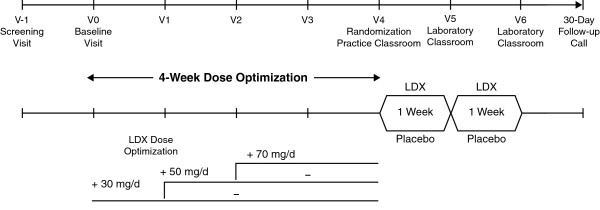
BACKGROUND: Lisdexamfetamine dimesylate (LDX) is indicated for the treatment of attention-deficit/hyperactivity disorder (ADHD) in children 6 to 12 years of age and in adults. In a previous laboratory school study, LDX demonstrated efficacy 2 hours postdose with duration of efficacy through 12 hours. The current study further characterizes the time course of effect of LDX. METHODS: Children aged 6 to 12 years with ADHD were enrolled in a laboratory school study. The multicenter study consisted of open-label, dose-optimization of LDX (30, 50, 70 mg/d, 4 weeks) followed by a randomized, placebo-controlled, 2-way crossover phase (1 week each). Efficacy measures included the SKAMP (deportment [primary] and attention [secondary]) and PERMP (attempted/correct) scales (secondary) measured at predose and at 1.5, 2.5, 5, 7.5, 10, 12, and 13 hours postdose. Safety measures included treatment-emergent adverse events (AEs), physical examination, vital signs, and ECGs. RESULTS: A total of 117 subjects were randomized and 111 completed the study. Compared with placebo, LDX demonstrated significantly greater efficacy at each postdose time point (1.5 hours to 13.0 hours), as measured by SKAMP deportment and attention scales and PERMP (P < .005). The most common treatment-emergent AEs during dose optimization were decreased appetite (47%), insomnia (27%), headache (17%), irritability (16%), upper abdominal pain (16%), and affect lability (10%), which were less frequent in the crossover phase (6%, 4%, 5%, 1%, 2%, and 0% respectively). CONCLUSION: In school-aged children (6 to 12 years) with ADHD, efficacy of LDX was maintained from the first time point (1.5 hours) up to the last time point assessed (13.0 hours). LDX was generally well tolerated, resulting in typical stimulant AEs. TRIAL REGISTRATION: Official Title: A Phase IIIb, Randomized, Double-Blind, Multi-Center, Placebo-Controlled, Dose-Optimization, Cross-Over, Analog Classroom Study to Assess the Time of Onset of Vyvanse (Lisdexamfetamine Dimesylate) in Pediatric Subjects Aged 6-12 With Attention-Deficit/Hyperactivity Disorder. ClinicalTrials.gov Identifier: NCT00500149 http://clinicaltrials.gov/ct2/show/NCT00500149.
Overview
AI snapshot
Written from the paper’s full text.
TL;DR
In school-aged children with ADHD, lisdexamfetamine dimesylate maintained efficacy versus placebo from 1.5 to 13.0 hours postdose in a laboratory school crossover study. It was generally well tolerated, with typical stimulant adverse events.
Key findings
- Among 117 randomized subjects (111 completed), LDX was significantly better than placebo at every postdose time point from 1.5 to 13.0 hours on SKAMP deportment (primary), SKAMP attention, and PERMP attempted/correct (SKAMP-D P < .005; SKAMP-A P ≤ .001; PERMP P < .0001).
- SKAMP-D LS mean difference for LDX vs placebo was -0.45 (95% CI -0.62, -0.28; P < .0001) at 1.5 hours and -0.26 (-0.43, -0.08; P < .005) at 13.0 hours; the mean over the treatment day was -0.74 (-0.85, -0.63; P < .0001).
- During dose optimization, common treatment-emergent AEs were decreased appetite (47%), insomnia (27%), headache (17%), irritability (16%), upper abdominal pain (16%), and affect lability (10%); in the crossover phase these were 6%, 4%, 5%, 1%, 2%, and 0%, respectively.
- During crossover, 82.3% were rated improved on LDX vs 19.5% on placebo by CGI-I; ADHD-RS-IV total LS mean change was -25.8 for LDX vs -8.7 for placebo.
Methods
- Randomized, double-blind, multicenter, placebo-controlled, dose-optimization, 2-way crossover laboratory school study at 7 US sites; enrolled children aged 6–12 years with DSM-IV-TR ADHD combined or hyperactive-impulsive subtype, baseline ADHD-RS-IV ≥ 28, and IQ ≥ 80.
- After open-label dose optimization to LDX 30, 50, or 70 mg/d over 4 weeks, subjects received 1 week LDX at optimized dose and 1 week placebo in randomized order; assessments occurred predose and at 1.5, 2.5, 5, 7.5, 10, 12, and 13 hours postdose.
- Primary efficacy was SKAMP-D; secondary measures included SKAMP-A, SKAMP quality of work, SKAMP total, PERMP-A/C, ADHD-RS-IV, and CGI-I; analysis used a linear mixed model with sequence, period, and treatment as fixed effects and subject-within-sequence as random effect (ITT n = 113; safety n = 129).
Limitations
- Stated: short treatment and assessment phases may underestimate TEAEs; severe comorbid psychiatric conditions were excluded; open-label dose optimization limits interpretation; no measurements beyond 13 hours postdose; high baseline severity, no inattentive-type ADHD group, and under-representation of minority populations limit generalizability.
- Stated: pharmacokinetic data were not collected, so pharmacologic effects could not be correlated with blood levels.
- Evident from the text: the sample was predominantly male (76.0%) and Caucasian (70.5%), and the crossover treatment periods were only 1 week each, so long-term safety and durability are not addressed.
Model-written summary. Check it against the paper before relying on it.
Integrity signals
Registry
Cites
Statistics
Figures
Verification
Claims the paper makes
38 Own result · 16 No full text of the sources · 11 Own method · 8 Own interpretation · 4 Sources not found · 3 Not checked yet · 3 No basis given · 1 Partly supported · accuracy not yet measured
The cited sources support only part of this claim — read each source’s verdict below.
In the paper
“While there may be multiple factors that contributed to the higher ratings, the group differences may be, in part, related to residual drug from the previous treatment day as has been seen in another study with an amphetamine-based long-acting stimulant [32].”
§ A 13-hour laboratory school study of lisdexamfetamine dimesylate in school-aged children with attention-deficit/hyperactivity disorder > Discussion
What the sources say
- Partly supportedcites [32] McCracken JT, Biederman J, Greenhill LL, Swanson JM, McGough JJ, Spencer TJ, Posner K, Wigal S, Pataki C, Zhang Y, Tulloch S: Analog classroom assessment of a once-daily mixed amphetamine formulation, SLI381 (Adderall XR), in children with ADHD. J Am Acad Child Adolesc Psychiatry. 2003, 42: 673-683. 10.1097/01.CHI.0000046863.56865.FE. sourceExperimental — accuracy not yet measured
The Discussion (page unavailable) reports higher behavior-problem ratings at the first assessment in the active-treatment groups, supporting the citation as an example of a similar predose pattern with an amphetamine-based stimulant. It cautiously suggests a possible morning rebound effect, but does not attribute the ratings to residual drug from the previous treatment day. The study examined SLI381 (Adderall XR), not LDX. (LLM, conf=0.87)
hedgedconditional- Asserted: passes — The authors put it forward as true.
- Checkable: passes — It can be checked against evidence.
- Load-bearing: unclear — It is unclear whether the paper’s conclusions depend on it.
- Based: passes — The paper gives a reason why it holds.
- Partly supported
A result the paper reports from its own data — it cites no other source for it, so there is none to check. The quote shows it is in the paper.
In the paper
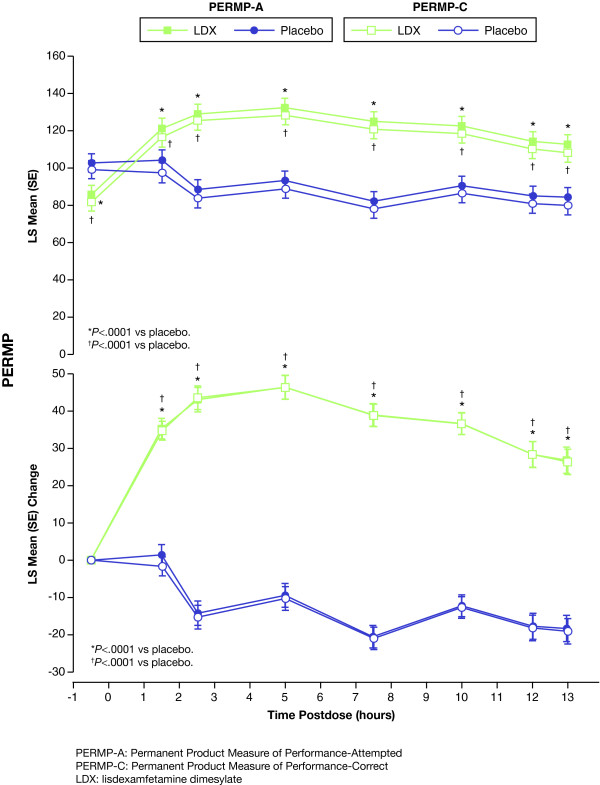
“LDX showed separation from placebo at all postdose time points for both the PERMP-A [(Figure 3), actual and change from predose, top and bottom, respectively] and PERMP-C [(Figure 3), actual and change from predose, top and bottom, respectively] score analyses (as measured by LS mean [SE]; P < .0001 for all time points).”
§ A 13-hour laboratory school study of lisdexamfetamine dimesylate in school-aged children with attention-deficit/hyperactivity disorder > Results > Efficacy assessments
plaindirect- Asserted: passes — The authors put it forward as true.
- Checkable: passes — It can be checked against evidence.
- Load-bearing: passes — The paper’s conclusions depend on it.
- Based: passes — The paper gives a reason why it holds.
- Rests on an assumption: There is no carryover effect between the 1-week LDX and placebo treatment periods in the crossover design.
- Rests on an assumption: The dose-optimization phase identifies a stable optimal dose that remains effective and tolerable during the double-blind phase.
- Rests on an assumption: The laboratory school setting is a valid analog for real-world classroom behavior and ADHD symptom control.
A result the paper reports from its own data — it cites no other source for it, so there is none to check. The quote shows it is in the paper.
In the paper
“For PERMP-A and PERMP-C, efficacy was shown at each postdose time point, at 1.5 hours and continuing up to and including 13.0 hours (Figures 3).”
§ A 13-hour laboratory school study of lisdexamfetamine dimesylate in school-aged children with attention-deficit/hyperactivity disorder > Results > Efficacy assessments
plaindirect- Asserted: passes — The authors put it forward as true.
- Checkable: passes — It can be checked against evidence.
- Load-bearing: passes — The paper’s conclusions depend on it.
- Based: passes — The paper gives a reason why it holds.
- Rests on an assumption: There is no carryover effect between the 1-week LDX and placebo treatment periods in the crossover design.
- Rests on an assumption: The dose-optimization phase identifies a stable optimal dose that remains effective and tolerable during the double-blind phase.
- Rests on an assumption: The laboratory school setting is a valid analog for real-world classroom behavior and ADHD symptom control.
A result the paper reports from its own data — it cites no other source for it, so there is none to check. The quote shows it is in the paper.
In the paper
“LS mean (SE) PERMP-A and PERMP-C scores for LDX groups [85.54 (4.88) and 81.86 (4.84), respectively] were significantly different from placebo groups [102.43 (4.88) and 99.17 (4.84), respectively; P < .005] at predose assessments (Figures 3).”
§ A 13-hour laboratory school study of lisdexamfetamine dimesylate in school-aged children with attention-deficit/hyperactivity disorder > Results > Efficacy assessments
plaincorrelational- Asserted: passes — The authors put it forward as true.
- Checkable: passes — It can be checked against evidence.
- Load-bearing: unclear — It is unclear whether the paper’s conclusions depend on it.
- Based: passes — The paper gives a reason why it holds.
- Rests on an assumption: There is no carryover effect between the 1-week LDX and placebo treatment periods in the crossover design.
- Rests on an assumption: The dose-optimization phase identifies a stable optimal dose that remains effective and tolerable during the double-blind phase.
- Rests on an assumption: The laboratory school setting is a valid analog for real-world classroom behavior and ADHD symptom control.
A result the paper reports from its own data — it cites no other source for it, so there is none to check. The quote shows it is in the paper.
In the paper
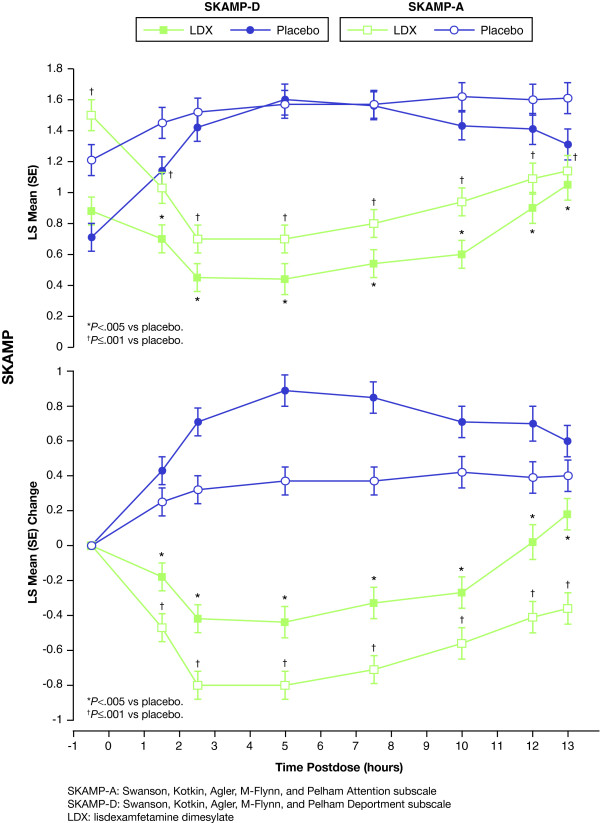
“There was significant separation of LDX from placebo at all postdose time points for the SKAMP-D score analysis (as measured by LS mean [SE]; P < .005 for all time points) (Table 2) and [(Figure 2) top].”
§ A 13-hour laboratory school study of lisdexamfetamine dimesylate in school-aged children with attention-deficit/hyperactivity disorder > Results > Efficacy assessments
plaindirect- Asserted: passes — The authors put it forward as true.
- Checkable: passes — It can be checked against evidence.
- Load-bearing: passes — The paper’s conclusions depend on it.
- Based: passes — The paper gives a reason why it holds.
- Rests on an assumption: There is no carryover effect between the 1-week LDX and placebo treatment periods in the crossover design.
- Rests on an assumption: The dose-optimization phase identifies a stable optimal dose that remains effective and tolerable during the double-blind phase.
- Rests on an assumption: The laboratory school setting is a valid analog for real-world classroom behavior and ADHD symptom control.
A result the paper reports from its own data — it cites no other source for it, so there is none to check. The quote shows it is in the paper.
In the paper
“The mean score difference in LS means (95% CI) of LDX vs placebo was -0.74 (-0.85, -0.63; P < .0001).”
§ A 13-hour laboratory school study of lisdexamfetamine dimesylate in school-aged children with attention-deficit/hyperactivity disorder > Results > Efficacy assessments
plain- Asserted: passes — The authors put it forward as true.
- Checkable: passes — It can be checked against evidence.
- Load-bearing: passes — The paper’s conclusions depend on it.
- Based: passes — The paper gives a reason why it holds.
- Rests on an assumption: There is no carryover effect between the 1-week LDX and placebo treatment periods in the crossover design.
- Rests on an assumption: The dose-optimization phase identifies a stable optimal dose that remains effective and tolerable during the double-blind phase.
- Rests on an assumption: The laboratory school setting is a valid analog for real-world classroom behavior and ADHD symptom control.
A result the paper reports from its own data — it cites no other source for it, so there is none to check. The quote shows it is in the paper.
In the paper
“No subject discontinued due to lack of efficacy of active treatment.”
§ A 13-hour laboratory school study of lisdexamfetamine dimesylate in school-aged children with attention-deficit/hyperactivity disorder > Results > Subjects
plain- Asserted: passes — The authors put it forward as true.
- Checkable: passes — It can be checked against evidence.
- Load-bearing: unclear — It is unclear whether the paper’s conclusions depend on it.
- Based: passes — The paper gives a reason why it holds.
A result the paper reports from its own data — it cites no other source for it, so there is none to check. The quote shows it is in the paper.
In the paper
“Compared with placebo, LDX demonstrated significantly greater efficacy at each postdose time point (1.5 hours to 13.0 hours), as measured by SKAMP deportment and attention scales and PERMP (P < .005).”
§ A 13-hour laboratory school study of lisdexamfetamine dimesylate in school-aged children with attention-deficit/hyperactivity disorder > Abstract > Results
boosteddirectn = 117 ·- Asserted: passes — The authors put it forward as true.
- Checkable: passes — It can be checked against evidence.
- Load-bearing: passes — The paper’s conclusions depend on it.
- Based: passes — The paper gives a reason why it holds.
- Rests on an assumption: There is no carryover effect between the 1-week LDX and placebo treatment periods in the crossover design.
- Rests on an assumption: The dose-optimization phase identifies a stable optimal dose that remains effective and tolerable during the double-blind phase.
- Rests on an assumption: The laboratory school setting is a valid analog for real-world classroom behavior and ADHD symptom control.
A result the paper reports from its own data — it cites no other source for it, so there is none to check. The quote shows it is in the paper.
In the paper
“For SKAMP-A, LDX demonstrated significant efficacy compared with placebo at 1.5 hours (the first postdose time point measured) and continuing through all time points up to and including 13.0 hours postdose (the last time point measured).”
- Also stated in: § Efficacy assessments · boosted
“LDX showed complete separation from placebo at all postdose time points for the SKAMP-A score analysis (as measured by LS mean (SE) and LS mean change (SE) from predose; P ≤ .001 vs placebo for all time points; Table 2 and [(Figure 2), top and bottom], respectively).”
§ A 13-hour laboratory school study of lisdexamfetamine dimesylate in school-aged children with attention-deficit/hyperactivity disorder > Results > Efficacy assessments
boosteddirect- Asserted: passes — The authors put it forward as true.
- Checkable: passes — It can be checked against evidence.
- Load-bearing: passes — The paper’s conclusions depend on it.
- Based: passes — The paper gives a reason why it holds.
- Also stated in: § Efficacy assessments · boosted
A result the paper reports from its own data — it cites no other source for it, so there is none to check. The quote shows it is in the paper.
In the paper
“During the double-blind crossover period, the investigator deemed that the TEAEs were related to study drug in 20 subjects (17.4%) in the LDX group and 8 subjects (7.0%) in the placebo group.”
§ A 13-hour laboratory school study of lisdexamfetamine dimesylate in school-aged children with attention-deficit/hyperactivity disorder > Results > Safety assessment
plaindirectn = 20- Asserted: passes — The authors put it forward as true.
- Checkable: passes — It can be checked against evidence.
- Load-bearing: unclear — It is unclear whether the paper’s conclusions depend on it.
- Based: passes — The paper gives a reason why it holds.
- It may state two separate claims as one. 35
- The quote only partly states this claim. 2
- Probably not a substantial claim. 12
A result the paper reports from its own data — it cites no other source for it, so there is none to check. The quote shows it is in the paper.
In the paper
“The differences in LS means (95% CI) of LDX vs placebo at 1.5 hours and 13.0 hours were -0.45 (-0.62, -0.28; P < .0001) and -0.26 (-0.43, -0.08; P < .005), respectively.”
§ A 13-hour laboratory school study of lisdexamfetamine dimesylate in school-aged children with attention-deficit/hyperactivity disorder > Results > Efficacy assessments
plain- Asserted: passes — The authors put it forward as true.
- Checkable: passes — It can be checked against evidence.
- Load-bearing: passes — The paper’s conclusions depend on it.
- Based: passes — The paper gives a reason why it holds.
It may state two separate claims as one.
- Rests on an assumption: There is no carryover effect between the 1-week LDX and placebo treatment periods in the crossover design.
- Rests on an assumption: The dose-optimization phase identifies a stable optimal dose that remains effective and tolerable during the double-blind phase.
- Rests on an assumption: The laboratory school setting is a valid analog for real-world classroom behavior and ADHD symptom control.
A result the paper reports from its own data — it cites no other source for it, so there is none to check. The quote shows it is in the paper.
In the paper
“Twelve of the 18 study discontinuations (Table 1) occurred during dose optimization while each subject was receiving 30 mg/d LDX (8 due to AEs, 1 due to protocol violation, and 3 due to withdrawal of consent). Six discontinuations occurred during the crossover phase: 2 while the subject was receiving LDX (protocol violation, withdrawal of consent), and 4 while the subjects were receiving placebo (”
§ A 13-hour laboratory school study of lisdexamfetamine dimesylate in school-aged children with attention-deficit/hyperactivity disorder > Results > Subjects
plain- Asserted: passes — The authors put it forward as true.
- Checkable: passes — It can be checked against evidence.
- Load-bearing: unclear — It is unclear whether the paper’s conclusions depend on it.
- Based: passes — The paper gives a reason why it holds.
It may state two separate claims as one.
A result the paper reports from its own data — it cites no other source for it, so there is none to check. The quote shows it is in the paper.
In the paper
“At baseline, all subjects were diagnosed with the combined ADHD subtype and had a mean (SD) ADHD-RS-IV total score of 42.4 (7.1).”
§ A 13-hour laboratory school study of lisdexamfetamine dimesylate in school-aged children with attention-deficit/hyperactivity disorder > Results > Subjects
plainn = 129- Asserted: passes — The authors put it forward as true.
- Checkable: passes — It can be checked against evidence.
- Load-bearing: unclear — It is unclear whether the paper’s conclusions depend on it.
- Based: passes — The paper gives a reason why it holds.
It may state two separate claims as one.
A result the paper reports from its own data — it cites no other source for it, so there is none to check. The quote shows it is in the paper.
In the paper
“Post hoc analysis of SKAMP-D scores in the LDX group showed that significant improvement relative to predose was seen at all postdose time points except 12 and 13 hours. At 12 and 13 hours postdose, SKAMP-D scores in this group were numerically worse but not statistically different from predose levels. Conversely, SKAMP-D scores were significantly worse than predose at all postdose time points in”
§ A 13-hour laboratory school study of lisdexamfetamine dimesylate in school-aged children with attention-deficit/hyperactivity disorder > Results > Efficacy assessments
plain- Asserted: passes — The authors put it forward as true.
- Checkable: passes — It can be checked against evidence.
- Load-bearing: unclear — It is unclear whether the paper’s conclusions depend on it.
- Based: passes — The paper gives a reason why it holds.
It may state two separate claims as one.
- Rests on an assumption: There is no carryover effect between the 1-week LDX and placebo treatment periods in the crossover design.
- Rests on an assumption: The dose-optimization phase identifies a stable optimal dose that remains effective and tolerable during the double-blind phase.
- Rests on an assumption: The laboratory school setting is a valid analog for real-world classroom behavior and ADHD symptom control.
A result the paper reports from its own data — it cites no other source for it, so there is none to check. The quote shows it is in the paper.
In the paper
“The most common treatment-emergent AEs during dose optimization were decreased appetite (47%), insomnia (27%), headache (17%), irritability (16%), upper abdominal pain (16%), and affect lability (10%), which were less frequent in the crossover phase (6%, 4%, 5%, 1%, 2%, and 0% respectively).”
§ A 13-hour laboratory school study of lisdexamfetamine dimesylate in school-aged children with attention-deficit/hyperactivity disorder > Abstract > Results
plaincorrelationaln = 117- Asserted: passes — The authors put it forward as true.
- Checkable: passes — It can be checked against evidence.
- Load-bearing: unclear — It is unclear whether the paper’s conclusions depend on it.
- Based: passes — The paper gives a reason why it holds.
It may state two separate claims as one.
A result the paper reports from its own data — it cites no other source for it, so there is none to check. The quote shows it is in the paper.
In the paper
“LDX demonstrated significant improvement on the SKAMP-D compared with placebo, at 1.5 hours (the first postdose time point measured; primary endpoint) and continuing through all time points up to and including 13.0 hours postdose (the last time point measured; key secondary endpoint).”
§ A 13-hour laboratory school study of lisdexamfetamine dimesylate in school-aged children with attention-deficit/hyperactivity disorder > Results > Efficacy assessments
boosteddirect- Asserted: passes — The authors put it forward as true.
- Checkable: passes — It can be checked against evidence.
- Load-bearing: passes — The paper’s conclusions depend on it.
- Based: passes — The paper gives a reason why it holds.
It may state two separate claims as one.
- Rests on an assumption: There is no carryover effect between the 1-week LDX and placebo treatment periods in the crossover design.
- Rests on an assumption: The dose-optimization phase identifies a stable optimal dose that remains effective and tolerable during the double-blind phase.
- Rests on an assumption: The laboratory school setting is a valid analog for real-world classroom behavior and ADHD symptom control.
A claim is checked only against the cited paper’s full text, never its abstract, and none is available for its sources.
In the paper
“The AEs reported here were similar in nature to those reported in studies of other stimulants and included decreased appetite, insomnia, headache, irritability, upper abdominal pain, and affect lability [10,13,27-29].”
§ A 13-hour laboratory school study of lisdexamfetamine dimesylate in school-aged children with attention-deficit/hyperactivity disorder > Discussion
What the sources say
- Not checked — no full text of the sourcecites [10] Biederman J, Krishnan S, Zhang Y, McGough JJ, Findling RL: Efficacy and tolerability of lisdexamfetamine dimesylate (NRP-104) in children with attention-deficit/hyperactivity disorder: a phase III, multicenter, randomized, double-blind, forced-dose, parallel-group study. Clin Ther. 2007, 29: 450-463. 10.1016/S0149-2918(07)80083-X. source
- Not checked — no full text of the sourcecites [13] Biederman J, Boellner SW, Childress A, Lopez FA, Krishnan S, Zhang Y: Lisdexamfetamine dimesylate and mixed amphetamine salts extended-release in children with ADHD: a double-blind, placebo-controlled, crossover analog classroom study. Biol Psychiatry. 2007, 62: 970-976. 10.1016/j.biopsych.2007.04.015. source
- Not checked — no full text of the sourcecites [27] Wigal S, Swanson JM, Feifel D, Sangal RB, Elia J, Casat CD, Zeldis JB, Conners CK: A double-blind, placebo-controlled trial of dexmethylphenidate hydrochloride and d, l-threo-methylphenidate hydrochloride in children with attention-deficit/hyperactivity disorder. J Am Acad Child Adolesc Psychiatry. 2004, 43: 1406-1414. 10.1097/01.chi.0000138351.98604.92. source
- Not checked — no full text of the sourcecites [28] Biederman J, Lopez FA, Boellner SW, Chandler MC: A randomized, double-blind, placebo-controlled, parallel-group study of SLI381 (Adderall XR) in children with attention-deficit/hyperactivity disorder. Pediatrics. 2002, 110: 258-266. 10.1542/peds.110.2.258. source
- Not checked — no full text of the sourcecites [29] Wolraich ML, Greenhill LL, Pelham W, Swanson J, Wilens T, Palumbo D, Atkins M, McBurnett K, Bukstein O, August G: Randomized, controlled trial of OROS methylphenidate once a day in children with attention-deficit/hyperactivity disorder. Pediatrics. 2001, 108: 883-892. 10.1542/peds.108.4.883. source
plain- Asserted: passes — The authors put it forward as true.
- Checkable: passes — It can be checked against evidence.
- Load-bearing: unclear — It is unclear whether the paper’s conclusions depend on it.
- Based: passes — The paper gives a reason why it holds.
It may state two separate claims as one.
A result the paper reports from its own data — it cites no other source for it, so there is none to check. The quote shows it is in the paper.
In the paper
“The differences in LS means (95% CI) of LDX vs placebo in PERMP-C at 1.5 hours and 13 hours were 19.10 (12.25, 25.94) and 28.14 (21.46, 34.83), respectively (both, P < .0001).”
§ A 13-hour laboratory school study of lisdexamfetamine dimesylate in school-aged children with attention-deficit/hyperactivity disorder > Results > Efficacy assessments
plain- Asserted: passes — The authors put it forward as true.
- Checkable: passes — It can be checked against evidence.
- Load-bearing: passes — The paper’s conclusions depend on it.
- Based: passes — The paper gives a reason why it holds.
It may state two separate claims as one.
- Rests on an assumption: There is no carryover effect between the 1-week LDX and placebo treatment periods in the crossover design.
- Rests on an assumption: The dose-optimization phase identifies a stable optimal dose that remains effective and tolerable during the double-blind phase.
- Rests on an assumption: The laboratory school setting is a valid analog for real-world classroom behavior and ADHD symptom control.
A result the paper reports from its own data — it cites no other source for it, so there is none to check. The quote shows it is in the paper.
In the paper
“There were no new TEAEs with an incidence ≥ 10% during the double-blind crossover period.”
- Also stated in: § Safety assessment · plain
“No TEAEs during the crossover phase resulted in discontinuations.”
§ A 13-hour laboratory school study of lisdexamfetamine dimesylate in school-aged children with attention-deficit/hyperactivity disorder > Results > Safety assessment
plain- Asserted: passes — The authors put it forward as true.
- Checkable: passes — It can be checked against evidence.
- Load-bearing: unclear — It is unclear whether the paper’s conclusions depend on it.
- Based: passes — The paper gives a reason why it holds.
It may state two separate claims as one.
- Also stated in: § Safety assessment · plain
A result the paper reports from its own data — it cites no other source for it, so there is none to check. The quote shows it is in the paper.
In the paper
“Overall mean difference (95% CI) for placebo vs LDX was analyzed by optimized dose groups for SKAMP-D, SKAMP-A, SKAMP quality of work, and SKAMP total scores (Table 3), and these scores across optimized dose groups during the open-label, nonrandomized phase of this study were found to be consistent.”
§ A 13-hour laboratory school study of lisdexamfetamine dimesylate in school-aged children with attention-deficit/hyperactivity disorder > Results > Dose analysis
plaindirect- Asserted: passes — The authors put it forward as true.
- Checkable: passes — It can be checked against evidence.
- Load-bearing: passes — The paper’s conclusions depend on it.
- Based: passes — The paper gives a reason why it holds.
It may state two separate claims as one. The quote only partly states this claim.
None of the sources cited for this claim have been checked yet.
In the paper
“Small decreases in weight from baseline were observed and were consistent with the known effect of psychostimulants [21-23].”
§ A 13-hour laboratory school study of lisdexamfetamine dimesylate in school-aged children with attention-deficit/hyperactivity disorder > Results > Safety assessment
What the sources say
- Not checked yetcites [21] Adderall XR [package insert]. 2007, Wayne, PA: Shire US Inc
- Not checked yetcites [22] Concerta [package insert]. 2008, Titusville, NJ: McNeil Pediatrics
- Not checked yetcites [23] Focalin XR [package insert]. 2008, East Hanover, NJ: Novartis Pharmaceuticals Corporation
boostedcorrelationaln = 115- Asserted: passes — The authors put it forward as true.
- Checkable: passes — It can be checked against evidence.
- Load-bearing: unclear — It is unclear whether the paper’s conclusions depend on it.
- Based: passes — The paper gives a reason why it holds.
It may state two separate claims as one.
A result the paper reports from its own data — it cites no other source for it, so there is none to check. The quote shows it is in the paper.
In the paper
“No deaths or serious AEs were reported during this study.”
§ A 13-hour laboratory school study of lisdexamfetamine dimesylate in school-aged children with attention-deficit/hyperactivity disorder > Results > Safety assessment
plain- Asserted: passes — The authors put it forward as true.
- Checkable: passes — It can be checked against evidence.
- Load-bearing: unclear — It is unclear whether the paper’s conclusions depend on it.
- Based: passes — The paper gives a reason why it holds.
It may state two separate claims as one.
A result the paper reports from its own data — it cites no other source for it, so there is none to check. The quote shows it is in the paper.
In the paper
“The differences in LS means (95% CI) of LDX vs placebo in PERMP-A at 1.5 hours and 13.0 hours were 16.97 (9.39, 24.56) and 28.28 (21.51, 35.04), respectively (both, P < .0001).”
§ A 13-hour laboratory school study of lisdexamfetamine dimesylate in school-aged children with attention-deficit/hyperactivity disorder > Results > Efficacy assessments
plain- Asserted: passes — The authors put it forward as true.
- Checkable: passes — It can be checked against evidence.
- Load-bearing: passes — The paper’s conclusions depend on it.
- Based: passes — The paper gives a reason why it holds.
It may state two separate claims as one.
- Rests on an assumption: There is no carryover effect between the 1-week LDX and placebo treatment periods in the crossover design.
- Rests on an assumption: The dose-optimization phase identifies a stable optimal dose that remains effective and tolerable during the double-blind phase.
- Rests on an assumption: The laboratory school setting is a valid analog for real-world classroom behavior and ADHD symptom control.
A result the paper reports from its own data — it cites no other source for it, so there is none to check. The quote shows it is in the paper.
In the paper
“Most subjects reported mild or moderate TEAEs during this phase; 5 subjects (3.9%) reported severe TEAEs (blunted affect, insomnia, increased insomnia, and irritability each reported in 1 subject; accidental overdose and upper abdominal pain both reported in the same subject).”
§ A 13-hour laboratory school study of lisdexamfetamine dimesylate in school-aged children with attention-deficit/hyperactivity disorder > Results > Safety assessment
plainn = 5- Asserted: passes — The authors put it forward as true.
- Checkable: passes — It can be checked against evidence.
- Load-bearing: unclear — It is unclear whether the paper’s conclusions depend on it.
- Based: passes — The paper gives a reason why it holds.
It may state two separate claims as one.
A result the paper reports from its own data — it cites no other source for it, so there is none to check. The quote shows it is in the paper.
In the paper
“Consistent with prior clinical studies of LDX, ECG interval data exhibited no clinically meaningful trends.”
- Also stated in: § Safety assessment · plain
“However, no subject had a QT, QTcF, or QTcB interval ≥ 480 msec or a change from baseline > 60 msec.”
§ A 13-hour laboratory school study of lisdexamfetamine dimesylate in school-aged children with attention-deficit/hyperactivity disorder > Results > Safety assessment
plain- Asserted: passes — The authors put it forward as true.
- Checkable: passes — It can be checked against evidence.
- Load-bearing: passes — The paper’s conclusions depend on it.
- Based: passes — The paper gives a reason why it holds.
It may state two separate claims as one. The quote only partly states this claim.
- Also stated in: § Safety assessment · plain
None of the sources cited for this claim have been checked yet.
In the paper
“Modest increases in mean SBP, DBP, and pulse were observed, consistent with the known effects of psychostimulants: typically increases of 2 to 4 mm Hg in blood pressure and 3 to 6 bpm in heart rate are reported [21-23].”
§ A 13-hour laboratory school study of lisdexamfetamine dimesylate in school-aged children with attention-deficit/hyperactivity disorder > Discussion
What the sources say
- Not checked yetcites [21] Adderall XR [package insert]. 2007, Wayne, PA: Shire US Inc
- Not checked yetcites [22] Concerta [package insert]. 2008, Titusville, NJ: McNeil Pediatrics
- Not checked yetcites [23] Focalin XR [package insert]. 2008, East Hanover, NJ: Novartis Pharmaceuticals Corporation
plaindirect- Asserted: passes — The authors put it forward as true.
- Checkable: passes — It can be checked against evidence.
- Load-bearing: unclear — It is unclear whether the paper’s conclusions depend on it.
- Based: passes — The paper gives a reason why it holds.
It may state two separate claims as one.
What the paper did — it cites no source for this, so there is none to check. The quote shows it is in the paper.
In the paper
“This randomized, double-blind, multicenter, placebo-controlled, dose-optimization, crossover, laboratory school study of LDX was conducted at 7 study sites in the United States.”
§ A 13-hour laboratory school study of lisdexamfetamine dimesylate in school-aged children with attention-deficit/hyperactivity disorder > Materials and methods
plain- Asserted: passes — The authors put it forward as true.
- Checkable: passes — It can be checked against evidence.
- Load-bearing: passes — The paper’s conclusions depend on it.
- Based: passes — The paper gives a reason why it holds.
Probably not a substantial claim. It may state two separate claims as one.
In the paper
“The SKAMP scale is a validated rating scale that assesses manifestations of ADHD in a classroom setting through several subscales, including deportment (behavior) and attention [14].”
§ A 13-hour laboratory school study of lisdexamfetamine dimesylate in school-aged children with attention-deficit/hyperactivity disorder > Materials and methods > Outcome measures
What the sources say
- Not matchedcites [14] Wigal SB, Gupta S, Guinta D, Swanson JM: Reliability and validity of the SKAMP rating scale in a laboratory school setting. Psychopharmacol Bull. 1998, 34: 47-53.
Couldn’t be matched to a paper in Crossref, so it can’t be checked.
plain- Asserted: passes — The authors put it forward as true.
- Checkable: passes — It can be checked against evidence.
- Load-bearing: passes — The paper’s conclusions depend on it.
- Based: passes — The paper gives a reason why it holds.
Probably not a substantial claim.
- Not matched
In the paper
“As in the previous study, LDX was generally well tolerated, with an AE profile similar to that of other extended-release stimulant products [10].”
§ A 13-hour laboratory school study of lisdexamfetamine dimesylate in school-aged children with attention-deficit/hyperactivity disorder > Background
What the sources say
- Not checked — no full text of the sourcecites [10] Biederman J, Krishnan S, Zhang Y, McGough JJ, Findling RL: Efficacy and tolerability of lisdexamfetamine dimesylate (NRP-104) in children with attention-deficit/hyperactivity disorder: a phase III, multicenter, randomized, double-blind, forced-dose, parallel-group study. Clin Ther. 2007, 29: 450-463. 10.1016/S0149-2918(07)80083-X. source
plain- Asserted: passes — The authors put it forward as true.
- Checkable: passes — It can be checked against evidence.
- Load-bearing: fails — The paper’s conclusions may not depend on it.
- Based: passes — The paper gives a reason why it holds.
Probably not a substantial claim. The paper’s conclusions may not depend on it. It may state two separate claims as one.
What the paper did — it cites no source for this, so there is none to check. The quote shows it is in the paper.
In the paper
“All study activities were performed in accordance with the principles of the International Conference on Harmonization Good Clinical Practice, 18th World Medical Assembly (Helsinki 1964), and amendments of the 29th (Tokyo 1975), the 35th (Venice 1983), the 41st (Hong Kong 1989), and the 48th (South Africa 1996) World Medical Assemblies.”
§ A 13-hour laboratory school study of lisdexamfetamine dimesylate in school-aged children with attention-deficit/hyperactivity disorder > Materials and methods
plain- Asserted: passes — The authors put it forward as true.
- Checkable: passes — It can be checked against evidence.
- Load-bearing: fails — The paper’s conclusions may not depend on it.
- Based: passes — The paper gives a reason why it holds.
Probably not a substantial claim. The paper’s conclusions may not depend on it.
What the paper did — it cites no source for this, so there is none to check. The quote shows it is in the paper.
In the paper
“The primary population for efficacy assessments was the intent-to-treat population (ITT) population, which consisted of all randomized subjects who received at least 1 dose of study medication with at least 1 postrandomization measurement of the primary efficacy variable (mean SKAMP-D score over the course of a day) available for analysis.”
§ A 13-hour laboratory school study of lisdexamfetamine dimesylate in school-aged children with attention-deficit/hyperactivity disorder > Materials and methods > Statistical analyses
plain- Asserted: passes — The authors put it forward as true.
- Checkable: passes — It can be checked against evidence.
- Load-bearing: passes — The paper’s conclusions depend on it.
- Based: passes — The paper gives a reason why it holds.
Probably not a substantial claim.
In the paper
“In a previous laboratory school study, LDX demonstrated efficacy 2 hours postdose with duration of efficacy through 12 hours.”
- Also stated in: § Background · plain
“A 6-week, randomized, double-blind, crossover study in a laboratory school setting [13] similar to the current study showed that LDX was significantly more effective in reducing ADHD symptoms compared with placebo (P < .0001), as measured by the Swanson, Kotkin, Agler, M-Flynn, and Pelham deportment (SKAMP-D) subscale throughout the day [14].”
§ A 13-hour laboratory school study of lisdexamfetamine dimesylate in school-aged children with attention-deficit/hyperactivity disorder > Abstract > Background
What the sources say
- Not checked — no full text of the sourcecites [13] Biederman J, Boellner SW, Childress A, Lopez FA, Krishnan S, Zhang Y: Lisdexamfetamine dimesylate and mixed amphetamine salts extended-release in children with ADHD: a double-blind, placebo-controlled, crossover analog classroom study. Biol Psychiatry. 2007, 62: 970-976. 10.1016/j.biopsych.2007.04.015. source
boosteddirect- Asserted: passes — The authors put it forward as true.
- Checkable: passes — It can be checked against evidence.
- Load-bearing: passes — The paper’s conclusions depend on it.
- Based: passes — The paper gives a reason why it holds.
It may state two separate claims as one.
- Also stated in: § Background · plain
In the paper
“A second 4-week, multicenter, randomized, double-blind, placebo-controlled, parallel-group trial in children with ADHD evaluated the efficacy and safety of LDX (30, 50, and 70 mg/d) over 4 weeks of treatment [10].”
§ A 13-hour laboratory school study of lisdexamfetamine dimesylate in school-aged children with attention-deficit/hyperactivity disorder > Background
What the sources say
- Not checked — no full text of the sourcecites [10] Biederman J, Krishnan S, Zhang Y, McGough JJ, Findling RL: Efficacy and tolerability of lisdexamfetamine dimesylate (NRP-104) in children with attention-deficit/hyperactivity disorder: a phase III, multicenter, randomized, double-blind, forced-dose, parallel-group study. Clin Ther. 2007, 29: 450-463. 10.1016/S0149-2918(07)80083-X. source
plain- Asserted: passes — The authors put it forward as true.
- Checkable: passes — It can be checked against evidence.
- Load-bearing: passes — The paper’s conclusions depend on it.
- Based: passes — The paper gives a reason why it holds.
Probably not a substantial claim.
What the paper did — it cites no source for this, so there is none to check. The quote shows it is in the paper.
In the paper
“A total of 129 subjects were enrolled and entered the open-label, dose-optimization phase (Table 1). Of these, 117 (90.7%) were randomized to the double-blind crossover phase, 113 (87.6%) were included in the ITT population, and 111 (86.0%) completed the study.”
§ A 13-hour laboratory school study of lisdexamfetamine dimesylate in school-aged children with attention-deficit/hyperactivity disorder > Results > Subjects
plainn = 129- Asserted: passes — The authors put it forward as true.
- Checkable: passes — It can be checked against evidence.
- Load-bearing: passes — The paper’s conclusions depend on it.
- Based: passes — The paper gives a reason why it holds.
It may state two separate claims as one.
What the paper did — it cites no source for this, so there is none to check. The quote shows it is in the paper.
In the paper
“Subjects were randomized to receive daily LDX treatment (at the optimized dose) for 1 week followed by daily placebo capsules (identical in appearance to LDX capsules) for 1 week, or vice versa.”
§ A 13-hour laboratory school study of lisdexamfetamine dimesylate in school-aged children with attention-deficit/hyperactivity disorder > Materials and methods > Administration of study drug
plain- Asserted: passes — The authors put it forward as true.
- Checkable: passes — It can be checked against evidence.
- Load-bearing: passes — The paper’s conclusions depend on it.
- Based: passes — The paper gives a reason why it holds.
Probably not a substantial claim.
What the paper did — it cites no source for this, so there is none to check. The quote shows it is in the paper.
In the paper
“Four of the 117 subjects in the randomized population were not included in the ITT population because they did not have at least 1 SKAMP-D score available after randomization.”
§ A 13-hour laboratory school study of lisdexamfetamine dimesylate in school-aged children with attention-deficit/hyperactivity disorder > Results > Subjects
plaindirectn = 117- Asserted: passes — The authors put it forward as true.
- Checkable: passes — It can be checked against evidence.
- Load-bearing: fails — The paper’s conclusions may not depend on it.
- Based: passes — The paper gives a reason why it holds.
Probably not a substantial claim. The paper’s conclusions may not depend on it.
None of the sources cited for this claim have been checked yet.
In the paper
“Stimulants are the mainstay of pharmacotherapy for attention-deficit/hyperactivity disorder (ADHD). Their safety and efficacy have been well documented [1-3].”
§ A 13-hour laboratory school study of lisdexamfetamine dimesylate in school-aged children with attention-deficit/hyperactivity disorder > Background
What the sources say
- Not checked — no full text of the sourcecites [1] Pliszka SR, Crismon ML, Hughes CW, Conners CK, Emslie GJ, Jensen PS, McCracken JT, Swanson JM, Lopez M, the Texas Consensus Conference Panel on Pharmacotherapy of Childhood Attention-Deficit/Hyperactivity Disorder: The Texas Children's Medication Algorithm Project: revision of the algorithm for pharmacotherapy of attention-deficit/hyperactivity disorder. J Am Acad Child Adolesc Psychiatry. 2006, 45: 642-657. 10.1097/01.chi.0000215326.51175.eb. source
- Not checked — no full text of the sourcecites [2] Dulcan M, the Work Group on Quality Issues: Practice parameters for the assessment and treatment of children, adolescents, and adults with attention-deficit/hyperactivity disorder. J Am Acad Child Adolesc Psychiatry. 1997, 36 (10 suppl): 85S-121S. source
- Not matchedcites [3] Stein MA, Baren M: Welcome progress in the diagnosis and treatment of ADHD in adolescence. Contemp Pediatr. 2003, 20: 83-110.
Couldn’t be matched to a paper in Crossref, so it can’t be checked.
boosted- Asserted: passes — The authors put it forward as true.
- Checkable: passes — It can be checked against evidence.
- Load-bearing: fails — The paper’s conclusions may not depend on it.
- Based: passes — The paper gives a reason why it holds.
Probably not a substantial claim. The paper’s conclusions may not depend on it. It may state two separate claims as one.
In the paper
“LDX was generally well tolerated with adverse events (AEs) similar to those seen with other once-daily stimulants [13].”
§ A 13-hour laboratory school study of lisdexamfetamine dimesylate in school-aged children with attention-deficit/hyperactivity disorder > Background
What the sources say
- Not checked — no full text of the sourcecites [13] Biederman J, Boellner SW, Childress A, Lopez FA, Krishnan S, Zhang Y: Lisdexamfetamine dimesylate and mixed amphetamine salts extended-release in children with ADHD: a double-blind, placebo-controlled, crossover analog classroom study. Biol Psychiatry. 2007, 62: 970-976. 10.1016/j.biopsych.2007.04.015. source
plain- Asserted: passes — The authors put it forward as true.
- Checkable: passes — It can be checked against evidence.
- Load-bearing: unclear — It is unclear whether the paper’s conclusions depend on it.
- Based: passes — The paper gives a reason why it holds.
It may state two separate claims as one.
What the paper did — it cites no source for this, so there is none to check. The quote shows it is in the paper.
In the paper
“Since the study had a crossover design and assessed duration of efficacy, the last observation carried forward (LOCF) method was not a valid approach for data that were incomplete because of discontinuation or unavailability. Therefore, incomplete data due to these reasons were set as missing for purposes of statistical analysis.”
§ A 13-hour laboratory school study of lisdexamfetamine dimesylate in school-aged children with attention-deficit/hyperactivity disorder > Materials and methods > Statistical analyses
plaindirect- Asserted: passes — The authors put it forward as true.
- Checkable: passes — It can be checked against evidence.
- Load-bearing: passes — The paper’s conclusions depend on it.
- Based: passes — The paper gives a reason why it holds.
It may state two separate claims as one.
A conclusion the paper draws from its own results — it cites no other source for it, so there is none to check. The quote shows it is in the paper.
In the paper
“LDX was generally well tolerated, resulting in typical stimulant AEs.”
§ A 13-hour laboratory school study of lisdexamfetamine dimesylate in school-aged children with attention-deficit/hyperactivity disorder > Abstract > Conclusion
plaindirect- Asserted: passes — The authors put it forward as true.
- Checkable: passes — It can be checked against evidence.
- Load-bearing: passes — The paper’s conclusions depend on it.
- Based: passes — The paper gives a reason why it holds.
It may state two separate claims as one.
In the paper
“Efficacy in LDX-treated subjects compared with placebo was significant beginning at 2 hours postdose and lasted up to 12 hours postdose, the last time point measured.”
§ A 13-hour laboratory school study of lisdexamfetamine dimesylate in school-aged children with attention-deficit/hyperactivity disorder > Background
What the sources say
- Not checked — no full text of the sourcecites [13] Biederman J, Boellner SW, Childress A, Lopez FA, Krishnan S, Zhang Y: Lisdexamfetamine dimesylate and mixed amphetamine salts extended-release in children with ADHD: a double-blind, placebo-controlled, crossover analog classroom study. Biol Psychiatry. 2007, 62: 970-976. 10.1016/j.biopsych.2007.04.015. source
plaindirect- Asserted: passes — The authors put it forward as true.
- Checkable: passes — It can be checked against evidence.
- Load-bearing: passes — The paper’s conclusions depend on it.
- Based: passes — The paper gives a reason why it holds.
It may state two separate claims as one.
What the paper did — it cites no source for this, so there is none to check. The quote shows it is in the paper.
In the paper
“SKAMP assessments were performed by observers who were provided with training to help ensure reliability.”
§ A 13-hour laboratory school study of lisdexamfetamine dimesylate in school-aged children with attention-deficit/hyperactivity disorder > Materials and methods > Administration of study drug
plain- Asserted: passes — The authors put it forward as true.
- Checkable: passes — It can be checked against evidence.
- Load-bearing: fails — The paper’s conclusions may not depend on it.
- Based: passes — The paper gives a reason why it holds.
Probably not a substantial claim. The paper’s conclusions may not depend on it.
In the paper
“Of the 7 study sites, 1 site was also a site from the previous LDX analog classroom study. Per the principal investigator of that site, there was no subject overlap and, therefore, no subjects with prior exposure to LDX from clinical trials were included in this study [Previous exposure clarification. Personal Communication with AC. Childress on December 8, 2008].”
§ A 13-hour laboratory school study of lisdexamfetamine dimesylate in school-aged children with attention-deficit/hyperactivity disorder > Results > Subjects
What the sources say
- Not matchedcites [Previous exposure clarification. Personal Communication with AC. Childress on December 8, 2008]
Couldn’t be matched to a paper in Crossref, so it can’t be checked.
plain- Asserted: passes — The authors put it forward as true.
- Checkable: passes — It can be checked against evidence.
- Load-bearing: unclear — It is unclear whether the paper’s conclusions depend on it.
- Based: passes — The paper gives a reason why it holds.
It may state two separate claims as one.
- Not matched
What the paper did — it cites no source for this, so there is none to check. The quote shows it is in the paper.
In the paper
“According to the prespecified statistical analysis plan, efficacy analyses were based on the ITT population of 113 subjects and safety analyses were based on the safety population of 129 subjects.”
§ A 13-hour laboratory school study of lisdexamfetamine dimesylate in school-aged children with attention-deficit/hyperactivity disorder > Results > Subjects
plainn = 113- Asserted: passes — The authors put it forward as true.
- Checkable: passes — It can be checked against evidence.
- Load-bearing: fails — The paper’s conclusions may not depend on it.
- Based: passes — The paper gives a reason why it holds.
Probably not a substantial claim. The paper’s conclusions may not depend on it. It may state two separate claims as one.
In the paper
“Consistent with laboratory school study designs, the short treatment duration and assessment phases may provide an underestimate of the number and severity of TEAEs typically seen with lengthier treatment of ADHD.”
- Also stated in: § Discussion · hedged
“Typical of ADHD studies, subjects with severe comorbid psychiatric conditions were excluded. This may have selected for a study population that under-represents psychiatric comorbidities generally seen in ADHD populations [34].”
- Also stated in: § Discussion · hedged
“Other limitations that may affect the ability to generalize these findings include the uniformly high level of baseline severity of the study subjects, the lack of a group of subjects with inattentive type ADHD, and the under-representation of minority populations.”
§ A 13-hour laboratory school study of lisdexamfetamine dimesylate in school-aged children with attention-deficit/hyperactivity disorder > Discussion
What the sources say
- Not checked — no full text of the sourcecites [34] Spencer TJ, Biederman J, Mick E: Attention-deficit/hyperactivity disorder: diagnosis, lifespan, comorbidities, and neurobiology. J Pediatr Psychol. 2007, 32: 631-642. 10.1093/jpepsy/jsm005. source
hedgedconditional- Asserted: passes — The authors put it forward as true.
- Checkable: passes — It can be checked against evidence.
- Load-bearing: passes — The paper’s conclusions depend on it.
- Based: passes — The paper gives a reason why it holds.
It may state two separate claims as one.
- Also stated in: § Discussion · hedged
What the paper did — it cites no source for this, so there is none to check. The quote shows it is in the paper.
In the paper
“Strengths of the study included the use of a controlled laboratory school setting, ratings by trained investigators, and dose optimization, which mimicked dose titration in clinical practice.”
- Also stated in: § Discussion · plain
“The blinded design of the crossover phase allowed a more valid assessment of patients at their optimized dosage of LDX versus placebo.”
- Also stated in: § Discussion · plain
“Reliability and validity of SKAMP and PERMP scales were other strengths as well as their inclusion as subjective and objective evaluations of efficacy, respectively.”
§ A 13-hour laboratory school study of lisdexamfetamine dimesylate in school-aged children with attention-deficit/hyperactivity disorder > Discussion
plain- Asserted: passes — The authors put it forward as true.
- Checkable: passes — It can be checked against evidence.
- Load-bearing: passes — The paper’s conclusions depend on it.
- Based: passes — The paper gives a reason why it holds.
Probably not a substantial claim. It may state two separate claims as one.
- Also stated in: § Discussion · plain
In the paper
“This study expanded and further refined findings from a previous laboratory school study, due to a larger sample size (129 vs 52), and additional time points assessed predose and 13-hour measurements (-0.5 to 13 hours in this study vs 1 to 12 hours) [13].”
§ A 13-hour laboratory school study of lisdexamfetamine dimesylate in school-aged children with attention-deficit/hyperactivity disorder > Discussion
What the sources say
- Not checked — no full text of the sourcecites [13] Biederman J, Boellner SW, Childress A, Lopez FA, Krishnan S, Zhang Y: Lisdexamfetamine dimesylate and mixed amphetamine salts extended-release in children with ADHD: a double-blind, placebo-controlled, crossover analog classroom study. Biol Psychiatry. 2007, 62: 970-976. 10.1016/j.biopsych.2007.04.015. source
plaindirect- Asserted: passes — The authors put it forward as true.
- Checkable: passes — It can be checked against evidence.
- Load-bearing: passes — The paper’s conclusions depend on it.
- Based: passes — The paper gives a reason why it holds.
It may state two separate claims as one.
In the paper
“In healthy adult volunteers, the plasma concentrations showed intact LDX levels reaching their maximum concentration at 1.1 hours after ingestion and then declined to 0 by 5 hours postdose.”
§ A 13-hour laboratory school study of lisdexamfetamine dimesylate in school-aged children with attention-deficit/hyperactivity disorder > Discussion
What the sources say
- Not checked — no full text of the sourcecites [24] Krishnan SM, Stark JG: Multiple daily-dose pharmacokinetics of lisdexamfetamine dimesylate in healthy adult volunteers. Curr Med Res Opin. 2008, 24: 33-40. source
plain- Asserted: passes — The authors put it forward as true.
- Checkable: passes — It can be checked against evidence.
- Load-bearing: passes — The paper’s conclusions depend on it.
- Based: passes — The paper gives a reason why it holds.
It may state two separate claims as one.
In the paper
“In the previous study, treatment effects were observed beginning at 2 hours postdose and continued until 12 hours postdose.”
§ A 13-hour laboratory school study of lisdexamfetamine dimesylate in school-aged children with attention-deficit/hyperactivity disorder > Discussion
What the sources say
- Not checked — no full text of the sourcecites [13] Biederman J, Boellner SW, Childress A, Lopez FA, Krishnan S, Zhang Y: Lisdexamfetamine dimesylate and mixed amphetamine salts extended-release in children with ADHD: a double-blind, placebo-controlled, crossover analog classroom study. Biol Psychiatry. 2007, 62: 970-976. 10.1016/j.biopsych.2007.04.015. source
plaindirect- Asserted: passes — The authors put it forward as true.
- Checkable: passes — It can be checked against evidence.
- Load-bearing: unclear — It is unclear whether the paper’s conclusions depend on it.
- Based: passes — The paper gives a reason why it holds.
It may state two separate claims as one.
A conclusion the paper draws from its own results — it cites no other source for it, so there is none to check. The quote shows it is in the paper.
In the paper
“This study demonstrated an onset of action for LDX at 1.5 hours (the first postdose time point measured), with duration of efficacy up to 13 hours postdose as assessed during the crossover treatment period.”
§ A 13-hour laboratory school study of lisdexamfetamine dimesylate in school-aged children with attention-deficit/hyperactivity disorder > Discussion
boosteddirect- Asserted: passes — The authors put it forward as true.
- Checkable: passes — It can be checked against evidence.
- Load-bearing: passes — The paper’s conclusions depend on it.
- Based: passes — The paper gives a reason why it holds.
It may state two separate claims as one.
In the paper
“However, mean plasma levels of d-amphetamine reached their maximum at 3.7 hours and did not approach 0 until 72 hours following the final dose.”
§ A 13-hour laboratory school study of lisdexamfetamine dimesylate in school-aged children with attention-deficit/hyperactivity disorder > Discussion
What the sources say
- Not checked — no full text of the sourcecites [24] Krishnan SM, Stark JG: Multiple daily-dose pharmacokinetics of lisdexamfetamine dimesylate in healthy adult volunteers. Curr Med Res Opin. 2008, 24: 33-40. source
plain- Asserted: passes — The authors put it forward as true.
- Checkable: passes — It can be checked against evidence.
- Load-bearing: passes — The paper’s conclusions depend on it.
- Based: passes — The paper gives a reason why it holds.
It may state two separate claims as one.
A conclusion the paper draws from its own results — it cites no other source for it, so there is none to check. The quote shows it is in the paper.
In the paper
“These findings suggest that LDX may provide effective symptom control in children with ADHD throughout the day and that continues to afterschool activities and family time.”
§ A 13-hour laboratory school study of lisdexamfetamine dimesylate in school-aged children with attention-deficit/hyperactivity disorder > Conclusion
hedgedconditional- Asserted: passes — The authors put it forward as true.
- Checkable: passes — It can be checked against evidence.
- Load-bearing: passes — The paper’s conclusions depend on it.
- Based: passes — The paper gives a reason why it holds.
It may state two separate claims as one.
- Rests on an assumption: ADHD symptoms may extend beyond the school day and continue into afterschool activities and family interactions.
The paper relies on this without support.
There is no carryover effect between the 1-week LDX and placebo treatment periods in the crossover design.
“Subjects were randomized to receive daily LDX treatment (at the optimized dose) for 1 week followed by daily placebo capsules (identical in appearance to LDX capsules) for 1 week, or vice versa.”
The paper relies on this without support.
The dose-optimization phase identifies a stable optimal dose that remains effective and tolerable during the double-blind phase.
“Optimal dose was defined as the dose that produced a reduction in ADHD-RS-IV score ≥ 30% and CGI-Improvement (CGI-I) score of 1 or 2 and had tolerable side effects.”
The paper relies on this without support.
The laboratory school setting is a valid analog for real-world classroom behavior and ADHD symptom control.
“This randomized, double-blind, multicenter, placebo-controlled, dose-optimization, crossover, laboratory school study of LDX was conducted at 7 study sites in the United States.”
The paper relies on this without support.
ADHD symptoms may extend beyond the school day and continue into afterschool activities and family interactions.
“The symptoms of ADHD may extend beyond the school day and continue into afterschool activities and family interactions.”
Claims other papers make about this one
Each is checked against this paper’s own text: does it say what the citing paper says it does?
The source backs part of the claim, not all of it — or backs it for a different population, condition or comparison.
In the citing paper
“The profile of d-amphetamine delivery by LDX underlies the long daily duration of action of LDX in relieving the hyperactive, inattentive, and impulsive symptoms experienced by patients with ADHD.3,4”
From Lisdexamfetamine prodrug activation by peptidase-mediated hydrolysis in the cytosol of red blood cells (2014) · cites this paper as [3]
Experimental — accuracy not yet measuredThe source backs part of the claim, not all of it — or backs it for a different population, condition or comparison.
In the citing paper
“Statistically significant improvements were noted on the SKAMP deportment rating, SKAMP attention, and Permanent Product Measure of Performance scales (P < 0.001).”
From Update on optimal use of lisdexamfetamine in the treatment of ADHD (2013) · cites this paper as [33]
Experimental — accuracy not yet measuredIn the citing paper
“Multiple randomized, double-blind, placebo-controlled trials have shown LDX to be an effective treatment for children, adolescents and adults with ADHD, with a tolerability and safety profile consistent with the known effects of psychostimulant therapy [9–15].”
Citations
Cites
Diagnostic and Statistical Manual of Mental Disorders (DSM-IV)
Hu, R. J. (2003) · Elsevier eBooks · doi:10.1016/b0-12-226870-9/01070-4 · Cited by 9,168
(1976) · Medical Entomology and Zoology · Cited by 8,899
(1998) · Cited by 2,026
Pliszka, S. (2007) · Journal of the American Academy of Child & Adolescent Psychiatry · doi:10.1097/chi.0b013e318054e724 · Cited by 1,765
Guy, W. L. (2025) · Springer Reference Medizin · doi:10.1007/978-3-662-65186-5_300379 · Cited by 1,441
Kaufman Brief Intelligence Test
(2012) · Springer eBooks · doi:10.1007/springerreference_183806 · Cited by 1,089
Conners' rating scales-revised : technical manual
Conners, C. K. (1997) · Medical Entomology and Zoology · Cited by 1,004
Solanto, M. V. (1998) · Behavioural Brain Research · doi:10.1016/s0166-4328(97)00175-7 · Cited by 677
Attention-Deficit/Hyperactivity Disorder: Diagnosis, Lifespan, Comorbidities, and Neurobiology
Spencer, T. J., Biederman, J., & Mick, E. (2007) · Journal of Pediatric Psychology · doi:10.1093/jpepsy/jsm005 · Cited by 634
Dulcan, M. (1997) · Journal of the American Academy of Child & Adolescent Psychiatry · doi:10.1097/00004583-199710001-00007 · Cited by 628
Cited by
Sorted by citations
Amphetamine, past and present – a pharmacological and clinical perspective
Heal, D. J., Smith, S. L., Gosden, J., & Nutt, D. (2013) · Journal of Psychopharmacology · doi:10.1177/0269881113482532 · Cited by 653
ADHD Treatments, Sleep, and Sleep Problems: Complex Associations
Stein, M. A., Weiss, M., & Hlavaty, L. (2012) · Neurotherapeutics · doi:10.1007/s13311-012-0130-0 · Cited by 165
Hodgkins, P., Shaw, M., Coghill, D., & Hechtman, L. (2012) · European Child & Adolescent Psychiatry · doi:10.1007/s00787-012-0286-5 · Cited by 147
Wigal, T., Brams, M., Gasior, M., Gao, J., Squires, L., Giblin, J., & 316 Study Group (2010) · Behavioral and Brain Functions · doi:10.1186/1744-9081-6-34 · Cited by 136
Self-citationPrasad, V., Brogan, E., Mulvaney, C. A., Grainge, M. J., Stanton, W., & Sayal, K. S. (2012) · European Child & Adolescent Psychiatry · doi:10.1007/s00787-012-0346-x · Cited by 149
Metadata
- Authors
- the 311 Study Group, Wigal, S. B., Kollins, S. H., Childress, A. C., & Squires, L.
- Affiliations
- University of California, Irvine (US)
- Duke Medical Center (US)
- Center for Psychiatry and Behavioral Medicine (US)
- Corresponding author
- Wigal, Sharon B
- Venue
- Child and Adolescent Psychiatry and Mental Health
- Published
- 2009-06-09
- Volume
- 3
- Issue
- 1
- Pages
- 17-17
- ISSN
- 1753-2000 (ISSN-L)
- PMC
- PMC2704174
- OpenAlex
- W2023262882
- Cited by
- 110
- References
- 31
- Citations by year
- 2026: 2 · 2025: 1 · 2024: 1 · 2023: 1 · 2022: 2 · 2021: 3 · 2020: 2 · 2019: 4 · 2018: 4 · 2017: 3 · 2016: 4 · 2015: 4 · 2014: 11 · 2013: 18 · 2012: 13
- FWCI
- 8.68
- Type
- journal article
- Language
- en
- Open access
- gold
- doi.org
- Licence
- Locations
- Child and Adolescent Psychiatry and Mental Health (publishedVersion, cc-by)
- PubMed Central (publishedVersion, cc-by)
- PubMed (publishedVersion)
- DOAJ (DOAJ: Directory of Open Access Journals) (submittedVersion, cc-by-sa)
- eScholarship (California Digital Library) (submittedVersion)
- eScholarship (California Digital Library) (submittedVersion, cc-by)
- Topics
- Health Sciences › Medicine › Psychiatry and Mental health › Attention Deficit Hyperactivity Disorder
- Health Sciences › Medicine › Pharmacology (medical) › Pharmacology and Obesity Treatment
- Health Sciences › Medicine › Pediatrics, Perinatology and Child Health › Pharmaceutical studies and practices
- Keywords
- lisdexamfetamine dimesylate, attention deficit hyperactivity disorder, school-aged children, time course of drug effects, stimulant efficacy, deportment, attention, dose optimization, adverse events, stimulant side effects, classroom setting, pharmacokinetics, placebo-controlled crossover trial, adults
About these checks
Registry, retraction, Cites and statistics results are computed, not judged, with one exception: a printed reference that no index lists is read once by a model before it counts as a citation error. Claims are extracted by a model and kept only when their quote appears verbatim in the text; each cited source is then checked, with a model’s help, for whether it says what the claim relies on. Those verdicts can be wrong — read the claim’s quote and the cited source before relying on one.
A language model drew the claims from the paper on 2026-10-10, under version 3 of the claim definition (model deepseek-v4.1-flash, prompt extract-v3).
A second model labelled each claim on 2026-10-10 (model jev-1.13-20260917, definition revision gold-guideline-v0.2).
Cited sources are checked with a language model’s help (gpt-6-sol).
Statistics and arithmetic are recomputed, not judged.
Confidence bands are shown only for fields calibrated on our annotated test set. None is calibrated yet, so no band is shown.
What counts as a claim ›How we measure confidence ›How we check this ›
Are you an author, or do you see a problem with this page? Request a review
