

The DOI matches its Crossref record; 50 of the 51 references it cites were found in a registry or an index, and 1 are not checked yet.
Ticks and associated pathogens collected from dogs and cats in Belgium
Open accessAbstract
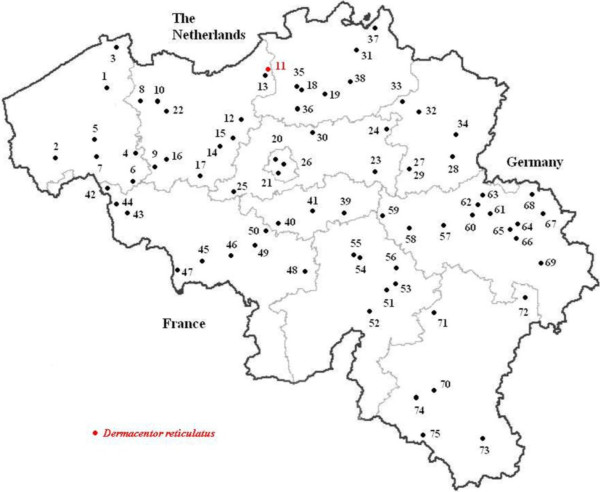
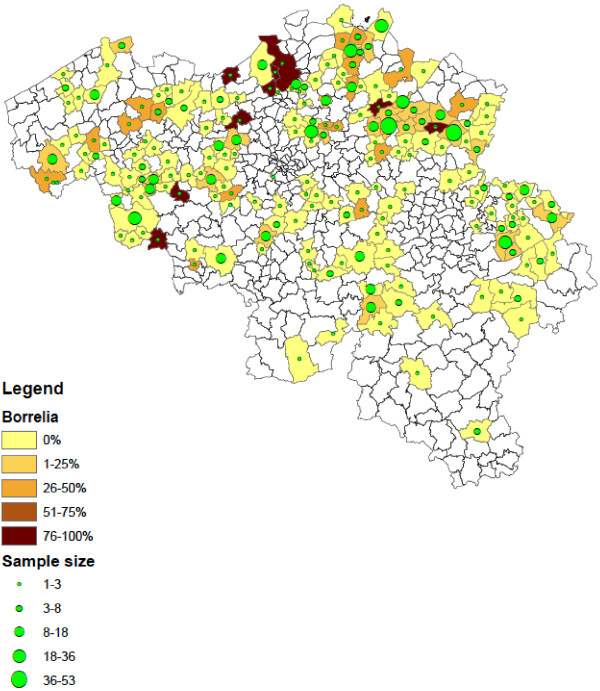
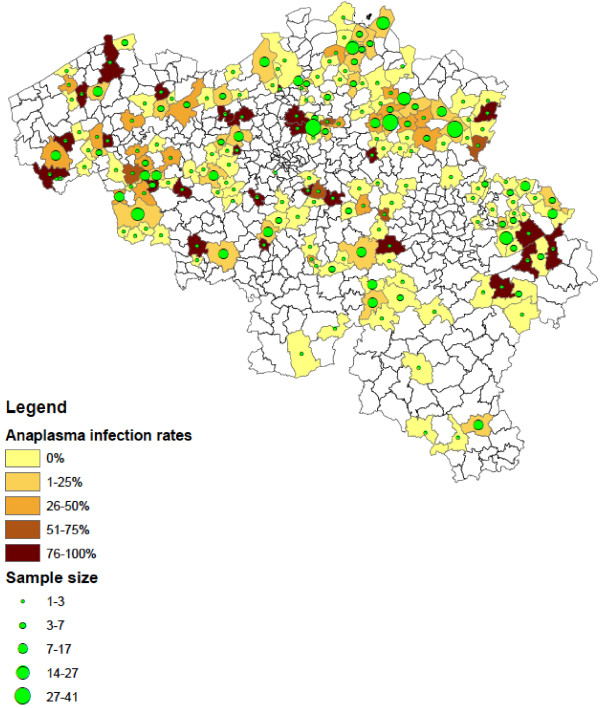
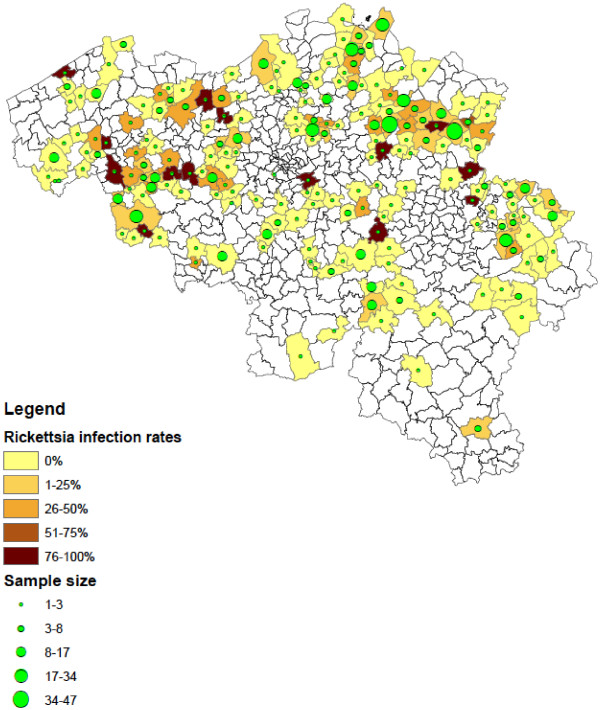
BACKGROUND: Although Ixodes spp. are the most common ticks in North-Western Europe, recent reports indicated an expanding geographical distribution of Dermacentor reticulatus in Western Europe. Recently, the establishment of a D. reticulatus population in Belgium was described. D. reticulatus is an important vector of canine and equine babesiosis and can transmit several Rickettsia species, Coxiella burnetii and tick-borne encephalitis virus (TBEV), whilst Ixodes spp. are vectors of pathogens causing babesiosis, borreliosis, anaplasmosis, rickettsiosis and TBEV. METHODS: A survey was conducted in 2008-2009 to investigate the presence of different tick species and associated pathogens on dogs and cats in Belgium. Ticks were collected from dogs and cats in 75 veterinary practices, selected by stratified randomization. All collected ticks were morphologically determined and analysed for the presence of Babesia spp., Borrelia spp., Anaplasma phagocytophilum and Rickettsia DNA. RESULTS: In total 2373 ticks were collected from 647 dogs and 506 cats. Ixodes ricinus (76.4%) and I. hexagonus (22.6%) were the predominant species. Rhipicephalus sanguineus (0.3%) and D. reticulatus (0.8%) were found in low numbers on dogs only. All dogs infested with R. sanguineus had a recent travel history, but D. reticulatus were collected from a dog without a history of travelling abroad. Of the collected Ixodes ticks, 19.5% were positive for A. phagocytophilum and 10.1% for Borrelia spp. (B. afzelii, B. garinii, B. burgdorferi s.s., B. lusitaniae, B. valaisiana and B. spielmanii). Rickettsia helvetica was found in 14.1% of Ixodes ticks. All Dermacentor ticks were negative for all the investigated pathogens, but one R. sanguineus tick was positive for Rickettsia massiliae. CONCLUSION: D. reticulatus was confirmed to be present as an indigenous parasite in Belgium. B. lusitaniae and R. helvetica were detected in ticks in Belgium for the first time.
Overview
The claims and statistics of this paper haven’t been checked yet.
Run the check — free, no account needed. It reads the open-access text and checks the sources it cites.
Integrity signals
Registry
Cites
Statistics
Figures
Verification
Claims the paper makes
The claims and statistics of this paper haven’t been checked yet.
Run the check — free, no account needed. It reads the open-access text and checks the sources it cites.
Claims other papers make about this one
Each is checked against this paper’s own text: does it say what the citing paper says it does?
The cited source says what the claim attributes to it.
In the citing paper
“The spectrum of detected pathogens was compatible to those reported recently in dog-associated ticks collected in Germany, Italy, Belgium and Poland [20–23].”
From Tick-borne pathogens in ticks collected from dogs, Latvia, 2011–2016 (2019) · cites this paper as [22]
The cited source says what the claim attributes to it.
In the citing paper
“Interestingly, in studies of pet-associated ticks, Rickettsia spp. was detected in 18.4 and 14.1% of Ixodes ticks in Italy and Belgium, respectively, while over 50% of I. ricinus were positive for Rickettsia spp. in Poland and Germany; also, Dermacentor ticks were pathogen-negative in Belgium, but 39% of D. reticulatus were found to be Rickettsia–positive in the study in Germany [20–23].”
From Tick-borne pathogens in ticks collected from dogs, Latvia, 2011–2016 (2019) · cites this paper as [22]
Self-check
Percentages, sums and reported differences re-computed from the paper’s own numbers.
The self-check needs the paper’s full text.
Citations
Cites
Rapid and simple method for purification of nucleic acids
Boom, R., Sol, C. J. A., Salimans, M. M. M., Jansen, C. L., Dillen, P. M. E. W., & van der Noordaa, J. (1990) · Journal of Clinical Microbiology · doi:10.1128/jcm.28.3.495-503.1990 · Cited by 5,285
Ticks and tick-borne diseases: a one health perspective
Dantas-Torres, F., Chomel, B. B., & Otranto, D. (2012) · Trends in Parasitology · doi:10.1016/j.pt.2012.07.003 · Cited by 1,159
Multiplex Real-Time PCR for Detection of Anaplasma phagocytophilum and Borrelia burgdorferi
Courtney, J. W., Kostelnik, L. M., Zeidner, N. S., & Massung, R. F. (2004) · Journal of Clinical Microbiology · doi:10.1128/jcm.42.7.3164-3168.2004 · Cited by 498
Human Granulocytic Anaplasmosis
Bakken, J. S., & Dumler, J. S. (2015) · Infectious Disease Clinics of North America · doi:10.1016/j.idc.2015.02.007 · Cited by 429
Rauter, C., & Härtung, T. (2005) · Applied and Environmental Microbiology · doi:10.1128/aem.71.11.7203-7216.2005 · Cited by 376
Tick-borne infectious diseases of dogs
Shaw, S. E., Day, M. J., Birtles, R. J., & Breitschwerdt, E. B. (2001) · Trends in Parasitology · doi:10.1016/s1471-4922(00)01856-0 · Cited by 343
The expanding Lyme Borrelia complex—clinical significance of genomic species?
Stanek, G., & Reiter, M. (2011) · Clinical Microbiology and Infection · doi:10.1111/j.1469-0691.2011.03492.x · Cited by 335
An empirical quantitative framework for the seasonal population dynamics of the tick Ixodes ricinus
Randolph, S., Green, R. M., Hoodless, A. N., & Peacey, M. (2002) · International Journal for Parasitology · doi:10.1016/s0020-7519(02)00030-9 · Cited by 332
Updates on Borrelia burgdorferi sensu lato complex with respect to public health
Rudenko, N., Golovchenko, M., Grubhoffer, L., & Oliver, J. H. (2011) · Ticks and Tick-borne Diseases · doi:10.1016/j.ttbdis.2011.04.002 · Cited by 327
Ticks and Associated Pathogens Collected from Domestic Animals in the Netherlands
Nijhof, A. M., Bodaan, C. J., Postigo, M., Nieuwenhuijs, H., Opsteegh, M., Franssen, L., Jebbink, F., & Jongejan, F. (2007) · Vector-Borne and Zoonotic Diseases · doi:10.1089/vbz.2007.0130 · Cited by 245
Research works printed but not linked: 1
- Arthur DR: British ticks. 1963, London: Butterworth & Co.
Cited by
Sorted by citations
Lv, J., Wu, S., Zhang, Y., Chen, Y., Feng, C., Yuan, X., Jia, G., Deng, J., Wang, C., Wang, Q., et al. (2014) · Parasites & Vectors · doi:10.1186/1756-3305-7-93 · Cited by 360
Dermacentor reticulatus: a vector on the rise
Földvári, G., Široký, P., Szekeres, S., Majoros, G., & Sprong, H. (2016) · Parasites & Vectors · doi:10.1186/s13071-016-1599-x · Cited by 285
Parasites of domestic owned cats in Europe: co-infestations and risk factors
Beugnet, F., Bourdeau, P. J., Chalvet‐Monfray, K., Cozma, V., Farkas, R., Guillot, J., Halos, L., Joachim, A., Losson, B., Miró, G., et al. (2014) · Parasites & Vectors · doi:10.1186/1756-3305-7-291 · Cited by 199
Self-citationThe occurrence of the Dermacentor reticulatus tick--its expansion to new areas and possible causes.
Karbowiak, G. (2014) · PubMed · Cited by 90
Cull, B., Pietzsch, M. E., Hansford, K. M., Gillingham, E. L., & Medlock, J. M. (2018) · Ticks and Tick-borne Diseases · doi:10.1016/j.ttbdis.2018.01.011 · Cited by 89
Metadata
- Authors
- Claerebout, E., Losson, B., Cochez, C., Casaert, S., Dalemans, A.-C., De Cat, A., Madder, M., Saegerman, C., Heyman, P., & Lempereur, L.
- Affiliations
- Ghent University (BE)
- University of Liège (BE)
- Queen Astrid Military Hospital (BE)
- Bayer (Belgium) (BE)
- University of Pretoria (ZA)
- Corresponding author
- Claerebout, Edwin
- Venue
- Parasites & Vectors
- Published
- 2013-06-19
- Volume
- 6
- Issue
- 1
- Pages
- 183-183
- ISSN
- 1756-3305 (ISSN-L)
- PMC
- PMC3688525
- OpenAlex
- W2145640364
- Cited by
- 119
- References
- 50
- Citations by year
- 2026: 3 · 2025: 3 · 2024: 2 · 2023: 11 · 2022: 6 · 2021: 7 · 2020: 14 · 2019: 6 · 2018: 13 · 2017: 13 · 2016: 15 · 2015: 14 · 2014: 11 · 2013: 1
- FWCI
- 11.61
- Type
- journal article
- Language
- en
- Open access
- gold
- doi.org
- Licence
- Locations
- Parasites & Vectors (publishedVersion, cc-by)
- Europe PMC (PubMed Central) (publishedVersion, cc-by)
- PubMed Central (publishedVersion, cc-by)
- PubMed (publishedVersion)
- Ghent University Academic Bibliography (Ghent University) (submittedVersion, other-oa)
- Open Repository and Bibliography (University of Liège) (submittedVersion, other-oa)
- UpSpace Institutional Repository (University of Pretoria) (submittedVersion, cc-by)
- Funders
- Universiteit Utrecht
- Univerza v Ljubljani
- Rijksinstituut voor Volksgezondheid en Milieu
- Topics
- Life Sciences › Immunology and Microbiology › Parasitology › Vector-borne infectious diseases
- Health Sciences › Medicine › Infectious Diseases › Bartonella species infections research
- Health Sciences › Medicine › Infectious Diseases › Viral Infections and Vectors
- Keywords
- tick-borne pathogens, Dermacentor reticulatus, Ixodes ricinus, Ixodes hexagonus, Rhipicephalus sanguineus, dogs, cats, Rickettsia helvetica, Borrelia, Anaplasma phagocytophilum, Rickettsia massiliae, tick-borne encephalitis virus, babesiosis, borreliosis, anaplasmosis, Rickettsia, Belgium
- MeSH terms
- Animals, Babesia, Belgium, Borrelia, Cat Diseases, Cats, Dog Diseases, Dogs, Female, Male, Rickettsia, Tick Infestations, Ticks, Anaplasma phagocytophilum
About these checks
Registry, retraction, Cites and statistics results are computed, not judged, with one exception: a printed reference that no index lists is read once by a model before it counts as a citation error. Claims are extracted by a model and kept only when their quote appears verbatim in the text; each cited source is then checked, with a model’s help, for whether it says what the claim relies on. Those verdicts can be wrong — read the claim’s quote and the cited source before relying on one.
Statistics and arithmetic are recomputed, not judged.
Confidence bands are shown only for fields calibrated on our annotated test set. None is calibrated yet, so no band is shown.
What counts as a claim ›How we measure confidence ›How we check this ›
Are you an author, or do you see a problem with this page? Request a review
