

The DOI matches its Crossref record; 50 of the 51 references it cites were found in a registry or an index, and 1 are not checked yet.
Ticks and associated pathogens collected from dogs and cats in Belgium
Open accessAbstract
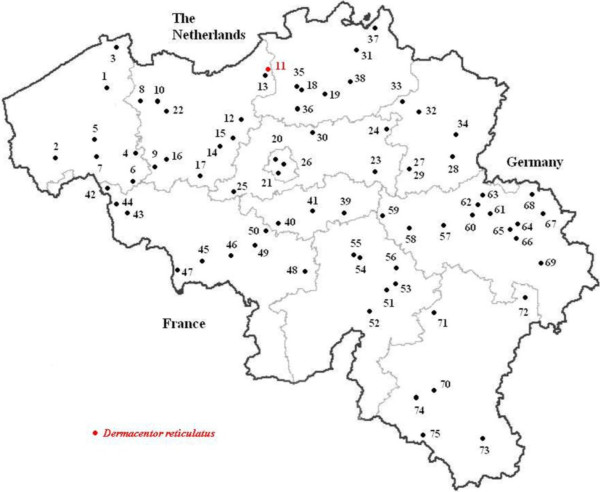
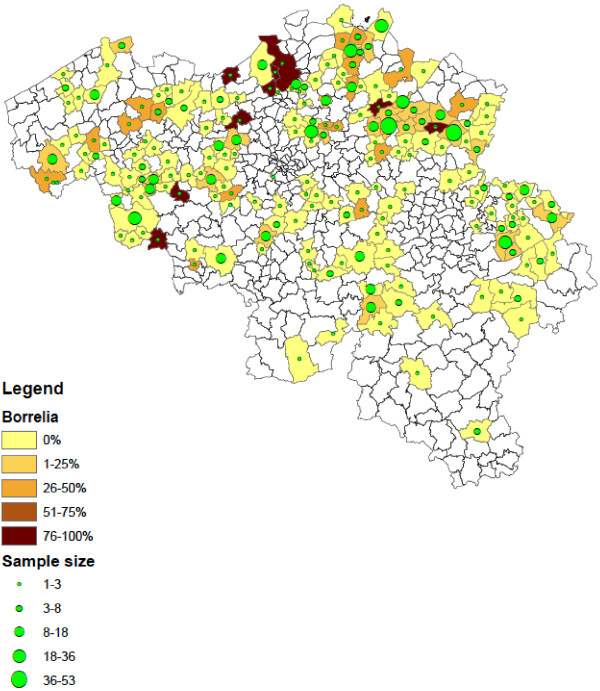
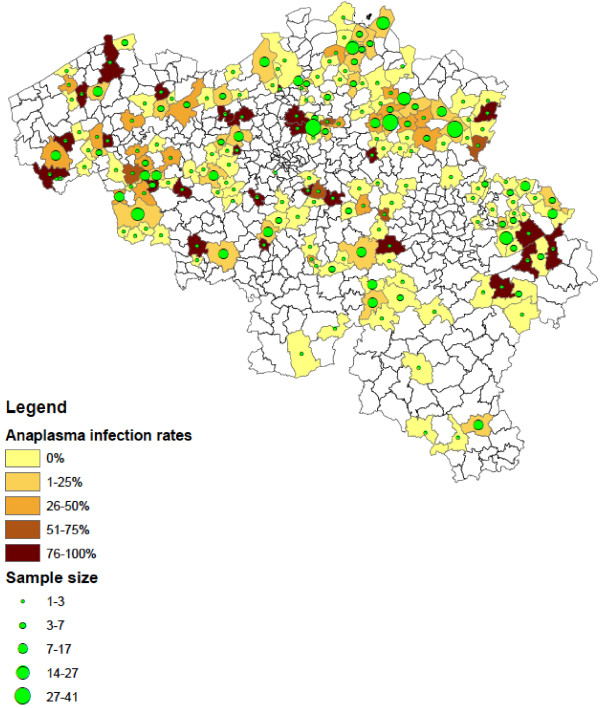
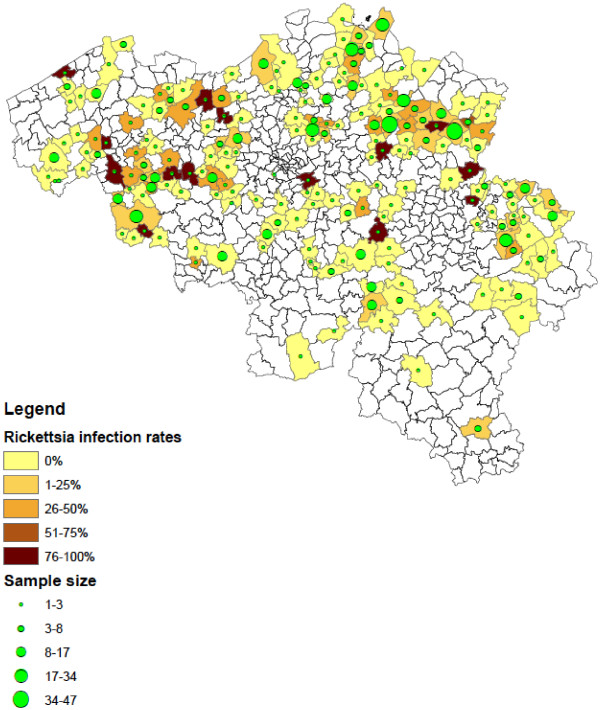
BACKGROUND: Although Ixodes spp. are the most common ticks in North-Western Europe, recent reports indicated an expanding geographical distribution of Dermacentor reticulatus in Western Europe. Recently, the establishment of a D. reticulatus population in Belgium was described. D. reticulatus is an important vector of canine and equine babesiosis and can transmit several Rickettsia species, Coxiella burnetii and tick-borne encephalitis virus (TBEV), whilst Ixodes spp. are vectors of pathogens causing babesiosis, borreliosis, anaplasmosis, rickettsiosis and TBEV. METHODS: A survey was conducted in 2008-2009 to investigate the presence of different tick species and associated pathogens on dogs and cats in Belgium. Ticks were collected from dogs and cats in 75 veterinary practices, selected by stratified randomization. All collected ticks were morphologically determined and analysed for the presence of Babesia spp., Borrelia spp., Anaplasma phagocytophilum and Rickettsia DNA. RESULTS: In total 2373 ticks were collected from 647 dogs and 506 cats. Ixodes ricinus (76.4%) and I. hexagonus (22.6%) were the predominant species. Rhipicephalus sanguineus (0.3%) and D. reticulatus (0.8%) were found in low numbers on dogs only. All dogs infested with R. sanguineus had a recent travel history, but D. reticulatus were collected from a dog without a history of travelling abroad. Of the collected Ixodes ticks, 19.5% were positive for A. phagocytophilum and 10.1% for Borrelia spp. (B. afzelii, B. garinii, B. burgdorferi s.s., B. lusitaniae, B. valaisiana and B. spielmanii). Rickettsia helvetica was found in 14.1% of Ixodes ticks. All Dermacentor ticks were negative for all the investigated pathogens, but one R. sanguineus tick was positive for Rickettsia massiliae. CONCLUSION: D. reticulatus was confirmed to be present as an indigenous parasite in Belgium. B. lusitaniae and R. helvetica were detected in ticks in Belgium for the first time.
Overview
The claims and statistics of this paper haven’t been checked yet.
Run the check — free, no account needed. It reads the open-access text and checks the sources it cites.
Integrity signals
Registry
Cites
Statistics
Figures
Verification
Claims the paper makes
The claims and statistics of this paper haven’t been checked yet.
Run the check — free, no account needed. It reads the open-access text and checks the sources it cites.
Claims other papers make about this one
Each is checked against this paper’s own text: does it say what the citing paper says it does?
The cited source says what the claim attributes to it.
In the citing paper
“The spectrum of detected pathogens was compatible to those reported recently in dog-associated ticks collected in Germany, Italy, Belgium and Poland [20–23].”
From Tick-borne pathogens in ticks collected from dogs, Latvia, 2011–2016 (2019) · cites this paper as [22]
The cited source says what the claim attributes to it.
In the citing paper
“Interestingly, in studies of pet-associated ticks, Rickettsia spp. was detected in 18.4 and 14.1% of Ixodes ticks in Italy and Belgium, respectively, while over 50% of I. ricinus were positive for Rickettsia spp. in Poland and Germany; also, Dermacentor ticks were pathogen-negative in Belgium, but 39% of D. reticulatus were found to be Rickettsia–positive in the study in Germany [20–23].”
From Tick-borne pathogens in ticks collected from dogs, Latvia, 2011–2016 (2019) · cites this paper as [22]
Self-check
Percentages, sums and reported differences re-computed from the paper’s own numbers.
The self-check needs the paper’s full text.
Citations
Cites
Rapid and simple method for purification of nucleic acids
Boom, R., Sol, C. J. A., Salimans, M. M. M., Jansen, C. L., Dillen, P. M. E. W., & van der Noordaa, J. (1990) · Journal of Clinical Microbiology · doi:10.1128/jcm.28.3.495-503.1990 · Cited by 5,285
Ticks and tick-borne diseases: a one health perspective
Dantas-Torres, F., Chomel, B. B., & Otranto, D. (2012) · Trends in Parasitology · doi:10.1016/j.pt.2012.07.003 · Cited by 1,159
Multiplex Real-Time PCR for Detection of Anaplasma phagocytophilum and Borrelia burgdorferi
Courtney, J. W., Kostelnik, L. M., Zeidner, N. S., & Massung, R. F. (2004) · Journal of Clinical Microbiology · doi:10.1128/jcm.42.7.3164-3168.2004 · Cited by 498
Human Granulocytic Anaplasmosis
Bakken, J. S., & Dumler, J. S. (2015) · Infectious Disease Clinics of North America · doi:10.1016/j.idc.2015.02.007 · Cited by 429
Rauter, C., & Härtung, T. (2005) · Applied and Environmental Microbiology · doi:10.1128/aem.71.11.7203-7216.2005 · Cited by 376
Tick-borne infectious diseases of dogs
Shaw, S. E., Day, M. J., Birtles, R. J., & Breitschwerdt, E. B. (2001) · Trends in Parasitology · doi:10.1016/s1471-4922(00)01856-0 · Cited by 343
The expanding Lyme Borrelia complex—clinical significance of genomic species?
Stanek, G., & Reiter, M. (2011) · Clinical Microbiology and Infection · doi:10.1111/j.1469-0691.2011.03492.x · Cited by 335
An empirical quantitative framework for the seasonal population dynamics of the tick Ixodes ricinus
Randolph, S., Green, R. M., Hoodless, A. N., & Peacey, M. (2002) · International Journal for Parasitology · doi:10.1016/s0020-7519(02)00030-9 · Cited by 332
Updates on Borrelia burgdorferi sensu lato complex with respect to public health
Rudenko, N., Golovchenko, M., Grubhoffer, L., & Oliver, J. H. (2011) · Ticks and Tick-borne Diseases · doi:10.1016/j.ttbdis.2011.04.002 · Cited by 327
Ticks and Associated Pathogens Collected from Domestic Animals in the Netherlands
Nijhof, A. M., Bodaan, C. J., Postigo, M., Nieuwenhuijs, H., Opsteegh, M., Franssen, L., Jebbink, F., & Jongejan, F. (2007) · Vector-Borne and Zoonotic Diseases · doi:10.1089/vbz.2007.0130 · Cited by 245
Research works printed but not linked: 1
- Arthur DR: British ticks. 1963, London: Butterworth & Co.
Cited by
Sorted by citations
Lv, J., Wu, S., Zhang, Y., Chen, Y., Feng, C., Yuan, X., Jia, G., Deng, J., Wang, C., Wang, Q., et al. (2014) · Parasites & Vectors · doi:10.1186/1756-3305-7-93 · Cited by 360
Dermacentor reticulatus: a vector on the rise
Földvári, G., Široký, P., Szekeres, S., Majoros, G., & Sprong, H. (2016) · Parasites & Vectors · doi:10.1186/s13071-016-1599-x · Cited by 285
Parasites of domestic owned cats in Europe: co-infestations and risk factors
Beugnet, F., Bourdeau, P. J., Chalvet‐Monfray, K., Cozma, V., Farkas, R., Guillot, J., Halos, L., Joachim, A., Losson, B., Miró, G., et al. (2014) · Parasites & Vectors · doi:10.1186/1756-3305-7-291 · Cited by 199
Self-citationThe occurrence of the Dermacentor reticulatus tick--its expansion to new areas and possible causes.
Karbowiak, G. (2014) · PubMed · Cited by 90
Cull, B., Pietzsch, M. E., Hansford, K. M., Gillingham, E. L., & Medlock, J. M. (2018) · Ticks and Tick-borne Diseases · doi:10.1016/j.ttbdis.2018.01.011 · Cited by 89
Jongejan, F., Ringenier, M., Putting, M., Berger, L., Burgers, S., Kortekaas, R., Lenssen, J., van Roessel, M., Wijnveld, M., & Madder, M. (2015) · Parasites & Vectors · doi:10.1186/s13071-015-0841-2 · Cited by 87
Self-citationPrevalence of pathogens in ticks collected from humans through citizen science in Belgium
Lernout, T., Regge, N. D., Tersago, K., Fonville, M., Suin, V., & Sprong, H. (2019) · Parasites & Vectors · doi:10.1186/s13071-019-3806-z · Cited by 85
Hornok, S., Sándor, A. D., Beck, R., Farkas, R., Béati, L., Kontschán, J., Takács, N., Földvári, G., Silaghi, C., Meyer-Kayser, E., et al. (2017) · Parasites & Vectors · doi:10.1186/s13071-017-2424-x · Cited by 78
Review: Sentinels of tick-borne encephalitis risk
Imhoff, M., Hagedorn, P., Schulze, Y., Hellenbrand, W., Pfeffer, M., & Niedrig, M. (2015) · Ticks and Tick-borne Diseases · doi:10.1016/j.ttbdis.2015.05.001 · Cited by 77
Obsomer, V., Wirtgen, M., Linden, A. S., Claerebout, E., Heyman, P., Heylen, D., Madder, M., Maris, J., Lebrun, M., Tack, W., et al. (2013) · Parasites & Vectors · doi:10.1186/1756-3305-6-190 · Cited by 74
Self-citationBessas, A., Leulmi, H., Bitam, I., Zaidi, S., Aït-Oudhia, K., Raoult, D., & Parola, P. (2016) · Comparative Immunology Microbiology and Infectious Diseases · doi:10.1016/j.cimid.2016.01.002 · Cited by 73
Davies, S., Abdullah, S., Helps, C. R., Tasker, S., Newbury, H., & Wall, R. L. (2017) · Veterinary Parasitology · doi:10.1016/j.vetpar.2017.07.033 · Cited by 71
Molecular detection of bacterial and parasitic pathogens in hard ticks from Portugal
Maia, C., Ferreira, A., Nunes, M., Vieira, M. L., Campino, L., & Cardoso, L. (2014) · Ticks and Tick-borne Diseases · doi:10.1016/j.ttbdis.2014.01.009 · Cited by 71
Species of ticks and carried pathogens in owned dogs in Spain: results of a one-year national survey
Estrada-Peña, A., Roura, X., Sainz, A., Miró, G., & Solano-Gallego, L. (2017) · Ticks and Tick-borne Diseases · doi:10.1016/j.ttbdis.2017.02.001 · Cited by 66
Detection of tick-borne pathogens in ticks from dogs and cats in different European countries
Geurden, T., Becskei, C., Six, R. H., Maeder, S. J., Latrofa, M. S., Otranto, D., & Farkas, R. (2018) · Ticks and Tick-borne Diseases · doi:10.1016/j.ttbdis.2018.06.013 · Cited by 64
Mierzejewska, E. J., Welc-Faleciak, R., Karbowiak, G., Kowalec, M., Behnke, J. M., & Bajer, A. (2015) · Experimental and Applied Acarology · doi:10.1007/s10493-015-9889-0 · Cited by 64
Çetinkaya, H., Matur, E., Akyazi, İ., Ekiz, E. E., Aydin, L., & Toparlak, M. (2016) · Ticks and Tick-borne Diseases · doi:10.1016/j.ttbdis.2016.02.021 · Cited by 61
Ticks from cats in the United States: Patterns of infestation and infection with pathogens
Little, S. E., Barrett, A. W., Nagamori, Y., Herrin, B. H., Normile, D. M., Heaney, K., & Armstrong, R. (2018) · Veterinary Parasitology · doi:10.1016/j.vetpar.2018.05.002 · Cited by 60
Król, N., Obiegala, A., Pfeffer, M., Lonc, E., & Kiewra, D. (2016) · Parasites & Vectors · doi:10.1186/s13071-016-1632-0 · Cited by 60
Infection withBabesia microtiin humans with non-specific symptoms in North East Poland
Moniuszko-Malinowska, A. M., Święcicka, I., Dunaj, J., Zajkowska, J. M., Czupryna, P., Zambrowski, G., Chmielewska–Badora, J., Żukiewicz-Sobczak, W. A., Świerzbińska, R., Rutkowski, K., et al. (2016) · Scandinavian Journal of Infectious Diseases · doi:10.3109/23744235.2016.1164339 · Cited by 58
Duplan, F., Davies, S., Filler, S., Abdullah, S., Keyte, S., Newbury, H., Helps, C. R., Wall, R. L., & Tasker, S. (2018) · Parasites & Vectors · doi:10.1186/s13071-018-2789-5 · Cited by 58
Pennisi, M. G., Hofmann‐Lehmann, R., Radford, A. D., Tasker, S., Belák, S., Addie, D., Boucraut‐Baralon, C., Egberink, H. F., Frymus, T., Gruffydd-Jones, T., et al. (2017) · Journal of Feline Medicine and Surgery · doi:10.1177/1098612x17706462 · Cited by 55
Khatat, S. E. H., Daminet, S., Duchateau, L., Elhachimi, L., Kachani, M., & Sahibi, H. (2021) · Frontiers in Veterinary Science · doi:10.3389/fvets.2021.686644 · Cited by 54
Ticks and associated pathogens collected from cats in Sicily and Calabria (Italy)
Pennisi, M. G., Persichetti, M. F., Serrano, L., Altet, L., Reale, S., Gulotta, L., & Solano‐Gallego, L. (2015) · Parasites & Vectors · doi:10.1186/s13071-015-1128-3 · Cited by 53
Scouts, forests, and ticks: Impact of landscapes on human-tick contacts
Keukeleire, M. D., Vanwambeke, S., Somassè, E., Kabamba, B., Luyasu, V., & Robert, A. R. (2015) · Ticks and Tick-borne Diseases · doi:10.1016/j.ttbdis.2015.05.008 · Cited by 52
A national survey of Ixodidae ticks on privately owned dogs in Italy
Maurelli, M. P., Pepe, P., Colombo, L., Armstrong, R., Battisti, E., Morgoglione, M. E., Counturis, D., Rinaldi, L., Cringoli, G., Ferroglio, E., et al. (2018) · Parasites & Vectors · doi:10.1186/s13071-018-2994-2 · Cited by 46
Dong, X., Chen, X., Liu, N., Dumler, S. J., & Zhāng, Y.-Z. (2014) · Ticks and Tick-borne Diseases · doi:10.1016/j.ttbdis.2014.05.011 · Cited by 45
Tick-borne pathogens in ticks collected from dogs, Latvia, 2011–2016
Namina, A., Capligina, V., Seleznova, M., Krumins, R., Aleinikova, D., Kivrane, A., Akopjana, S., Lazovska, M., Berzina, I., & Ranka, R. (2019) · BMC Veterinary Research · doi:10.1186/s12917-019-2149-5 · Cited by 37
Buczek, A. M., & Buczek, W. (2020) · Animals · doi:10.3390/ani11010006 · Cited by 42
Irwin, P. (2014) · Trends in Parasitology · doi:10.1016/j.pt.2013.12.001 · Cited by 38
Saegerman, C., Humblet, M., Leandri, M., Gonzalez, G., Heyman, P., Sprong, H., L’Hostis, M., Moutailler, S., Bonnet, S. I., Haddad, N., et al. (2023) · Viruses · doi:10.3390/v15030791 · Cited by 36
Self-citationThe role of companion animals in the environmental circulation of tick-borne bacterial pathogens
Skotarczak, B. (2018) · Annals of Agricultural and Environmental Medicine · doi:10.26444/aaem/93381 · Cited by 36
A nationwide survey of ixodid tick species recovered from domestic dogs and cats in Japan in 2011
Iwakami, S., Ichikawa, Y., & INOKUMA, H. (2014) · Ticks and Tick-borne Diseases · doi:10.1016/j.ttbdis.2014.05.008 · Cited by 33
Geurden, T., Becskei, C., Farkas, R., Lin, D., & Rugg, D. (2017) · Veterinary Parasitology · doi:10.1016/j.vetpar.2017.03.008 · Cited by 33
Zanet, S., Battisti, E., Pepe, P., Ciucă, L., Colombo, L., Trisciuoglio, A., Ferroglio, E., Cringoli, G., Rinaldi, L., & Maurelli, M. P. (2020) · BMC Veterinary Research · doi:10.1186/s12917-020-2263-4 · Cited by 32
Król, N., Kiewra, D., Szymanowski, M., & Lonc, E. (2015) · Veterinary Parasitology · doi:10.1016/j.vetpar.2015.09.028 · Cited by 31
Hansford, K. M., Phipps, L. P., Cull, B., Pietzsch, M. E., & Medlock, J. M. (2016) · Veterinary Record · doi:10.1136/vr.104061 · Cited by 30
Distribution of ticks in Bosnia and Herzegovina
Omeragić, J., Šerić – Haračić, S., Klarić Soldo, D., Kapo, N., Fejzić, N., Škapur, V., & Medlock, J. (2022) · Ticks and Tick-borne Diseases · doi:10.1016/j.ttbdis.2021.101870 · Cited by 27
Geurden, T., Becskei, C., Grace, S., Strübe, C., Doherty, P., Liebenberg, J. E., Mahabir, S. P., Slootmans, N., Lloyd, A., & Six, R. H. (2016) · Veterinary Parasitology · doi:10.1016/j.vetpar.2016.03.024 · Cited by 27
Buczek, A. M., Bartosik, K., & Zając, Z. (2014) · Parasites & Vectors · doi:10.1186/1756-3305-7-245 · Cited by 27
Jongejan, F., de Jong, S., Voskuilen, T., van den Heuvel, L., Bouman, R., Heesen, H., Ijzermans, C., & Berger, L. (2019) · Parasites & Vectors · doi:10.1186/s13071-019-3373-3 · Cited by 25
Raccoons contraband – The metazoan parasite fauna of free-ranging raccoons in central Europe
Peter, N., Dörge, D. D., Cunze, S., Schantz, A. V., Skaljic, A., Rueckert, S., & Klimpel, S. (2023) · International Journal for Parasitology Parasites and Wildlife · doi:10.1016/j.ijppaw.2023.01.003 · Cited by 25
Li, S., Colson, V., Lejeune, P., Speybroeck, N., & Vanwambeke, S. (2015) · Environmental Modelling & Software · doi:10.1016/j.envsoft.2015.06.001 · Cited by 25
Ticks on dogs and cats: A pet owner-based survey in a rural town in northeastern Switzerland
Eichenberger, R. M., Deplazes, P., & Mathis, A. (2015) · Ticks and Tick-borne Diseases · doi:10.1016/j.ttbdis.2015.01.007 · Cited by 25
Biernat, B., Stańczak, J., Michalik, J., Sikora, B., & Wierzbicka, A. (2015) · Ticks and Tick-borne Diseases · doi:10.1016/j.ttbdis.2015.10.001 · Cited by 25
Spatial tick bite exposure and associated risk factors in Scandinavia
Jore, S., Vanwambeke, S., Slunge, D., Boman, A., Krogfelt, K. A., Jepsen, M. T., & Vold, L. (2020) · Infection Ecology & Epidemiology · doi:10.1080/20008686.2020.1764693 · Cited by 25
Dumont, P., Chester, T. S., Gale, B., Soll, M. D., Fourie, J., & Beugnet, F. (2015) · Parasites & Vectors · doi:10.1186/s13071-015-0681-0 · Cited by 24
Zhou, J., Wang, T., Qiu, T., Chen, Z., Ma, X., Zhang, L., & Zou, J. (2020) · BMC Cancer · doi:10.1186/s12885-020-6713-y · Cited by 23
Geurden, T., Becskei, C., Vatta, A. F., Slootmans, N., von Reitzenstein, M., King, V. L., Lin, D., & Rugg, D. (2017) · Veterinary Parasitology · doi:10.1016/j.vetpar.2017.02.028 · Cited by 21
Kang, Y., Cong, W., Qin, S., Shan, X., Gao, Y., Wang, C., & Ai-dong, Q. (2016) · Vector-Borne and Zoonotic Diseases · doi:10.1089/vbz.2016.1993 · Cited by 20
Otranto, D., Dantas‐Torres, F., Napoli, E., Basano, F. S., Deuster, K., Pollmeier, M., Capelli, G., & Brianti, E. (2017) · Veterinary Parasitology · doi:10.1016/j.vetpar.2017.10.023 · Cited by 20
Rohdich, N., Zschiesche, E., Wolf, O., Loehlein, W., Pobel, T., Gil, M. J., & Roepke, R. K. A. (2018) · Parasites & Vectors · doi:10.1186/s13071-018-3175-z · Cited by 19
Dumitrache, M. O., Botond, K. J., Dantas‐Torres, F., Latrofa, M. S., D’Amico, G., Sándor, A. D., & Mihalca, A. D. (2014) · Parasites & Vectors · doi:10.1186/1756-3305-7-97 · Cited by 18
Vatta, A. F., Everett, W. R., Holzmer, S. J., Cherni, J. A., King, V. L., Rugg, D., & Geurden, T. (2017) · Veterinary Parasitology · doi:10.1016/j.vetpar.2017.02.026 · Cited by 18
Roczeń-Karczmarz, M., Dudko, P., Demkowska‐Kutrzepa, M., Meisner, M., Studzińska, M. B., Junkuszew, A., SOPIŃSKA, A., & Tomczuk, K. (2018) · Medycyna Weterynaryjna · doi:10.21521/mw.6107 · Cited by 18
Lotilaner - a novel formulation for cats provides systemic tick and flea control
Wright, I. P. (2018) · Parasites & Vectors · doi:10.1186/s13071-018-2970-x · Cited by 17
Walker, M. D. (2018) · Systematic and Applied Acarology · doi:10.11158/saa.23.4.9 · Cited by 16
Prevalence of Anaplasma phagocytophilum in humans in Belgium for the period 2013–2016.
Hing, M., den Bossche, D. V., Lernout, T., Cochez, C., Pirnay, J., & Heuninckx, W. (2018) · Acta Clinica Belgica · doi:10.1080/17843286.2018.1491928 · Cited by 16
Self-citationGeebelen, L., Lernout, T., Kabamba, B., Saegeman, V., Sprong, H., Gucht, S. V., Beutels, P., Speybroeck, N., & Tersago, K. (2017) · Archives of Public Health · doi:10.1186/s13690-017-0202-z · Cited by 15
Hing, M., Woestyn, S., Bosterhaut, B. V., Desbonnet, Y., Heyman, P., Cochez, C., Silaghi, C., Sprong, H., Fournier, P., Raoult, D., et al. (2014) · New Microbes and New Infections · doi:10.1002/nmi2.65 · Cited by 14
Self-citationPrevalence of pathogenic bacteria in Ixodes ricinus ticks in Central Bohemia
Klubal, R., Kopecký, J., Nesvorná, M., Sparagano, O. A. E., Thomayerova, J., & Hubert, J. (2015) · Experimental and Applied Acarology · doi:10.1007/s10493-015-9988-y · Cited by 14
Adjadj, N. R., Cargnel, M., Ribbens, S., Quinet, C., Malandrin, L., Mignon, B. R., & Mori, M. (2023) · Ticks and Tick-borne Diseases · doi:10.1016/j.ttbdis.2023.102146 · Cited by 14
Kouam, M. K., Payne, V. K., Miégoué, E., Tendonkeng, F., Lemoufouet, J., Jean Raphael, K. A. N. A., Boukila, B., Pamo, E. T., & Bertine, M. N. M. (2015) · Journal of Pathogens · doi:10.1155/2015/516869 · Cited by 14
Scheid, P. L., Speck, S., Schwarzenberger, R., Litzinger, M., Balczun, C., & Dobler, G. (2016) · Ticks and Tick-borne Diseases · doi:10.1016/j.ttbdis.2016.07.002 · Cited by 13
Rehbein, S., Fourie, J., de Vos, C., Anderson, A., Larsen, D. L., & Jeannin, P. (2016) · Parasitology Research · doi:10.1007/s00436-016-4924-6 · Cited by 12
Becskei, C., Liebenberg, J. E., Thys, M., & Mahabir, S. P. (2020) · Parasites & Vectors · doi:10.1186/s13071-020-3949-y · Cited by 12
Probst, J., Springer, A., Fingerle, V., & Strübe, C. (2024) · Parasites & Vectors · doi:10.1186/s13071-024-06193-w · Cited by 12
Cvejić, D., Hellmann, K., Petry, G., Ringeisen, H., Hamburg, H., Farkas, R., Blazejak, K., & Mencke, N. (2022) · Current Research in Parasitology and Vector-Borne Diseases · doi:10.1016/j.crpvbd.2022.100099 · Cited by 12
Karshima, S. N., Ahmed, M. I., Mohammed, K. M., & Pam, V. A. (2022) · Journal of Vector Borne Diseases · doi:10.4103/0972-9062.364756 · Cited by 12
Wyk, C.-L. V., Mtshali, S., Ramatla, T. A., Lekota, K. E., Xuan, X., & Thekisoe, O. M. M. (2023) · Veterinary Parasitology Regional Studies and Reports · doi:10.1016/j.vprsr.2023.100969 · Cited by 12
Molecular evidence for bacterial pathogens in Ixodes ricinus ticks infesting Shetland ponies
Skotarczak, B., Wodecka, B., Rymaszewska, A., & Adamska, M. (2016) · Experimental and Applied Acarology · doi:10.1007/s10493-016-0027-4 · Cited by 12
Hovius, K. E., de Bruin, A., Schouls, L. M., Hovius, J. W., Dekker, N., & Sprong, H. (2018) · Parasites & Vectors · doi:10.1186/s13071-018-2806-8 · Cited by 12
Becskei, C., Lin, D., Rugg, D., & Geurden, T. (2017) · Veterinary Parasitology · doi:10.1016/j.vetpar.2017.03.009 · Cited by 11
Kocoń, A., Asman, M., Nowak-Chmura, M., Witecka, J., Kłyś, M., & Solarz, K. (2020) · Scientific Reports · doi:10.1038/s41598-020-72981-w · Cited by 11
Robert, K., Gestel, M. V., Lathouwers, M., Fonville, M., Sprong, H., Matthysen, E., & Heylen, D. (2025) · BMC Public Health · doi:10.1186/s12889-025-23221-1 · Cited by 10
Kocoń, A., Asman, M., Nowak-Chmura, M., Witecka, J., & Rączka, G. (2022) · Scientific Reports · doi:10.1038/s41598-022-11973-4 · Cited by 10
Ixodid ticks in the Western Ukraine
Levytska, V. A., & Mushynskyi, А. B. (2020) · Науковий вісник Львівського національного університету ветеринарної медицини та біотехнологій імені С.З. Ґжицького · doi:10.32718/nvlvet9730 · Cited by 10
HIGH PREVALENCE OF EHRLICHIA CANIS IN DOGS IN VAN, TURKEY
Ayan, A., Kılınç, Ö. O., ERDOGAN, S., Akyıldız, G., Bia, M. M., & LEE, D. (2020) · Applied Ecology and Environmental Research · doi:10.15666/aeer/1801_19531960 · Cited by 10
Vacek, Z., Cukor, J., Vacek, S., Václavík, T., Kybicová, K., Bartoška, J., Mahlerová, K., & Montoya-Molina, S. (2022) · Forest Ecology and Management · doi:10.1016/j.foreco.2022.120676 · Cited by 9
Survey on tick infestation in stray dogs in localities of Malaysia
Yan, L. Y., Peng, T. L., & Goni, M. D. (2023) · Veterinary Parasitology Regional Studies and Reports · doi:10.1016/j.vprsr.2023.100952 · Cited by 9
Becskei, C., Geurden, T., Erasmus, H., Cuppens, O., Mahabir, S. P., & Six, R. H. (2016) · Parasites & Vectors · doi:10.1186/s13071-016-1377-9 · Cited by 9
Keyte, S., Abdullah, S., James, K., Newbury, H., Helps, C. R., Tasker, S., & Wall, R. L. (2021) · Veterinary Record · doi:10.1002/vetr.12 · Cited by 9
Ticks Infesting Dogs in Khyber Pakhtunkhwa, Pakistan: Detailed Epidemiological and Molecular Report
Zeb, J., Song, B., Senbill, H., Aziz, M. U., Hussain, S., Khan, M. A., Qadri, I., Cabezas‐Cruz, A., de la Fuente, J., & Sparagano, O. A. E. (2023) · Pathogens · doi:10.3390/pathogens12010098 · Cited by 9
Becskei, C., Geurden, T., Liebenberg, J. E., Cuppens, O., Mahabir, S. P., & Six, R. H. (2016) · Parasites & Vectors · doi:10.1186/s13071-016-1376-x · Cited by 9
Schantz, A. V., Dörge, D. D., Peter, N., & Klimpel, S. (2023) · International Journal for Parasitology Parasites and Wildlife · doi:10.1016/j.ijppaw.2023.10.004 · Cited by 8
Geurden, T., Borowski, S., Wozniakiewicz, M., King, V. L., Fourie, J., & Liebenberg, J. E. (2017) · Parasites & Vectors · doi:10.1186/s13071-017-2259-5 · Cited by 8
Serra, V., Krey, V., Daschkin, C., Cafiso, A., Sassera, D., Maxeiner, H.-G., Modeo, L., Nicolaus, C., Bandi, C., & Bazzocchi, C. (2019) · Pathogens and Global Health · doi:10.1080/20477724.2019.1651568 · Cited by 8
Seroprevalence Rates of Tick-Borne Pathogens in Cats from Southern Bulgaria
Tsachev, I., Baymakova, M. P., Zlateva, N., Kundurzhiev, T., & Solano‐Gallego, L. (2020) · Vector-Borne and Zoonotic Diseases · doi:10.1089/vbz.2020.2628 · Cited by 7
Sipin, Q., Mustaffa-Kamal, F., Watanabe, M., Rani, P. A. M. A., Low, V. L., & Aziz, N. A. A. (2020) · Comparative Immunology Microbiology and Infectious Diseases · doi:10.1016/j.cimid.2020.101563 · Cited by 7
Humblet, M., Losson, B., & Saegerman, C. (2020) · Scientific and Technical Review (World Organisation for Animal Health) · doi:10.20506/rst.39.3.3175 · Cited by 7
Self-citationPanteleienko, O. V., Makovska, I. F., & Tsarenko, T. M. (2022) · Regulatory Mechanisms in Biosystems · doi:10.15421/022257 · Cited by 7
Gaito, A., Gjivoje, V., Lutz, S., & Baxter, B. (2014) · Infection and Drug Resistance · doi:10.2147/idr.s68742 · Cited by 7
Król, N., Obiegala, A., Kretschmar, F. M., Hamel, D., & Pfeffer, M. (2019) · Ticks and Tick-borne Diseases · doi:10.1016/j.ttbdis.2019.02.004 · Cited by 7
Rousseau, R., Delooz, L., Dion, E., Quinet, C., & Vanwambeke, S. (2021) · Ticks and Tick-borne Diseases · doi:10.1016/j.ttbdis.2021.101814 · Cited by 6
Prullage, J., Pfefferkorn, A., Knaus, M., Frost, J., Mitchell, E. B., & Tielemans, E. (2021) · Parasite · doi:10.1051/parasite/2021019 · Cited by 6
León, M. C., Molina‐Garza, Z. J., Hernández, R. M., & Galavíz-Silva, L. (2021) · Revista Mexicana de Ciencias Pecuarias · doi:10.22319/rmcp.v12i1.5283 · Cited by 6
14. A resource-based habitat concept for tick-borne diseases
Vanwambeke, S., Li, S., & Hartemink, N. (2016) · Wageningen Academic Publishers eBooks · doi:10.3920/978-90-8686-838-4_14 · Cited by 6
Is babesiosis a rare zoonosis in Spain? Its impact on the Spanish Health System over 23 years
Almeida, H., López‐Bernús, A., Rodríguez-Alonso, B., Alonso‐Sardón, M., Romero‐Alegría, Á., Tirado, V. V., Pardo‐Lledías, J., Muro, A., & Belhassen‐García, M. (2023) · PLoS ONE · doi:10.1371/journal.pone.0280154 · Cited by 6
Blootstelling aan Anaplasma phagocytophilum bij twee honden in België
Khatat, S. E. H., Defauw, P., Marynissen, S. J. J., de Maele, I. V., van Dongen, A. M., & Daminet, S. (2015) · Vlaams Diergeneeskundig Tijdschrift · doi:10.21825/vdt.v84i1.16621 · Cited by 5
Fedoniuk, L. Y., Pryvrotska, I. B., & Podobivskiy, S. S. (2020) · Ukrainian Journal of Ecology · doi:10.15421/2020_288 · Cited by 4
Metadata
- Authors
- Claerebout, E., Losson, B., Cochez, C., Casaert, S., Dalemans, A.-C., De Cat, A., Madder, M., Saegerman, C., Heyman, P., & Lempereur, L.
- Affiliations
- Ghent University (BE)
- University of Liège (BE)
- Queen Astrid Military Hospital (BE)
- Bayer (Belgium) (BE)
- University of Pretoria (ZA)
- Corresponding author
- Claerebout, Edwin
- Venue
- Parasites & Vectors
- Published
- 2013-06-19
- Volume
- 6
- Issue
- 1
- Pages
- 183-183
- ISSN
- 1756-3305 (ISSN-L)
- PMC
- PMC3688525
- OpenAlex
- W2145640364
- Cited by
- 119
- References
- 50
- Citations by year
- 2026: 3 · 2025: 3 · 2024: 2 · 2023: 11 · 2022: 6 · 2021: 7 · 2020: 14 · 2019: 6 · 2018: 13 · 2017: 13 · 2016: 15 · 2015: 14 · 2014: 11 · 2013: 1
- FWCI
- 11.61
- Type
- journal article
- Language
- en
- Open access
- gold
- doi.org
- Licence
- Locations
- Parasites & Vectors (publishedVersion, cc-by)
- Europe PMC (PubMed Central) (publishedVersion, cc-by)
- PubMed Central (publishedVersion, cc-by)
- PubMed (publishedVersion)
- Ghent University Academic Bibliography (Ghent University) (submittedVersion, other-oa)
- Open Repository and Bibliography (University of Liège) (submittedVersion, other-oa)
- UpSpace Institutional Repository (University of Pretoria) (submittedVersion, cc-by)
- Funders
- Universiteit Utrecht
- Univerza v Ljubljani
- Rijksinstituut voor Volksgezondheid en Milieu
- Topics
- Life Sciences › Immunology and Microbiology › Parasitology › Vector-borne infectious diseases
- Health Sciences › Medicine › Infectious Diseases › Bartonella species infections research
- Health Sciences › Medicine › Infectious Diseases › Viral Infections and Vectors
- Keywords
- tick-borne pathogens, Dermacentor reticulatus, Ixodes ricinus, Ixodes hexagonus, Rhipicephalus sanguineus, dogs, cats, Rickettsia helvetica, Borrelia, Anaplasma phagocytophilum, Rickettsia massiliae, tick-borne encephalitis virus, babesiosis, borreliosis, anaplasmosis, Rickettsia, Belgium
- MeSH terms
- Animals, Babesia, Belgium, Borrelia, Cat Diseases, Cats, Dog Diseases, Dogs, Female, Male, Rickettsia, Tick Infestations, Ticks, Anaplasma phagocytophilum
About these checks
Registry, retraction, Cites and statistics results are computed, not judged, with one exception: a printed reference that no index lists is read once by a model before it counts as a citation error. Claims are extracted by a model and kept only when their quote appears verbatim in the text; each cited source is then checked, with a model’s help, for whether it says what the claim relies on. Those verdicts can be wrong — read the claim’s quote and the cited source before relying on one.
Statistics and arithmetic are recomputed, not judged.
Confidence bands are shown only for fields calibrated on our annotated test set. None is calibrated yet, so no band is shown.
What counts as a claim ›How we measure confidence ›How we check this ›
Are you an author, or do you see a problem with this page? Request a review
