

Uncovering steroidopathy in women with autism: a latent class analysis
Open accessThe DOI matches its Crossref record; 88 of the 90 references it cites were found in a registry or an index.
Abstract
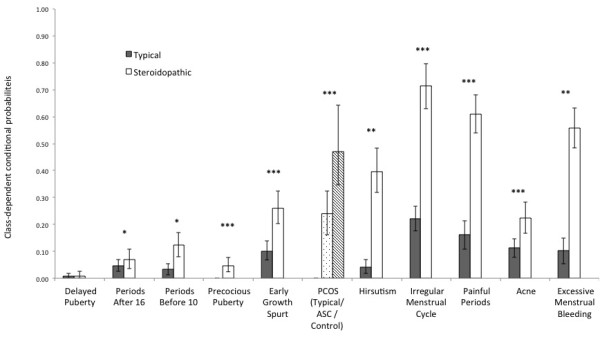
BACKGROUND: Prenatal exposure to increased androgens has been implicated in both polycystic ovary syndrome (PCOS) and autism spectrum conditions (ASC), suggesting that PCOS may be increased among women with ASC. One study suggested elevated steroidopathic symptoms ('steroidopathy') in women with ASC. As the symptoms are not independent, we conducted a latent class analysis (LCA). The objectives of the current study are: (1) to test if these findings replicate in a larger sample; and (2) to use LCA to uncover affected clusters of women with ASC. METHODS: We tested two groups of women, screened using the Autism Spectrum Quotient - Group 1: n = 415 women with ASC (mean age 36.39 ± 11.98 years); and Group 2: n = 415 controls (mean age 39.96 ± 11.92 years). All participants completed the Testosterone-related Medical Questionnaire online. A multiple-group LCA was used to identify differences in latent class structure between women with ASC and controls. RESULTS: There were significant differences in frequency of steroid-related conditions and symptoms between women with ASC and controls. A two-class semi-constrained model best fit the data. Based on response patterns, we identified the classes as 'Typical' and 'Steroidopathic'. The prevalence of the 'Steroidopathic' class was significantly increased within the ASC group (ΔG (2) = 15, df =1, P = 0.0001). In particular, we confirmed higher frequencies of epilepsy, amenorrhea, dysmenorrhea, severe acne, gender dysphoria, and transsexualism, and differences in sexual preference in women with ASC. CONCLUSIONS: Women with ASC are at increased risk for symptoms and conditions linked to steroids. LCA revealed this steroidopathy despite the apparent underdiagnosis of PCOS.
Overview
The claims and statistics of this paper haven’t been checked yet.
Free: it reads the open-access text and checks the first 5 claims that cite a source we can check. Create a free account to check every claim.
Integrity signals
Registry
Cites
Statistics
Figures
Verification
Claims the paper makes
The claims and statistics of this paper haven’t been checked yet.
Free: it reads the open-access text and checks the first 5 claims that cite a source we can check. Create a free account to check every claim.
Claims other papers make about this one
Each is checked against this paper’s own text: does it say what the citing paper says it does?
The source backs part of the claim, not all of it — or backs it for a different population, condition or comparison.
In the citing paper
“For example, elevated prenatal androgens have been strongly associated with ASD risk for more than a decade (26–35) leading some to hypothesize that EDCs that alter androgen action may be contributory.”
From Endocrine Disruption of Vasopressin Systems and Related Behaviors (2017) · cites this paper as [35]
Experimental — accuracy not yet measuredIn the citing paper
“and that women with ASD are at risk for disorders related to steroids [82].”
From The contribution of environmental exposure to the etiology of autism spectrum disorder (2019) · cites this paper as [82]
Self-check
Percentages, sums and reported differences re-computed from the paper’s own numbers.
The self-check needs the paper’s full text.
Citations
Cites
Nylund, K. L., Asparouhov, T., & Muthén, B. O. (2007) · Structural Equation Modeling: A Multidisciplinary Journal · doi:10.1080/10705510701575396 · Cited by 11,415
Baron-Cohen, S., Wheelwright, S., Skinner, R., Martin, J., & Clubley, E. (2001) · Journal of Autism and Developmental Disorders · doi:10.1023/a:1005653411471 · Cited by 6,450
Self-citationPathogenesis and pathophysiology of endometriosis
Burney, R. O., & Giudice, L. C. (2012) · Fertility and Sterility · doi:10.1016/j.fertnstert.2012.06.029 · Cited by 1,590 · cited 1×
“Consequently, variation in the steroidogenic pathway in females with ASC would be expected to also result in symptoms or conditions related to abnormal levels of progesterone and/ or estradiol, such as endometriosis [41] or steroid-sensitive cancers.”
Sex differences in the brain: implications for explaining autism
Baron-Cohen, S., Knickmeyer, R. C., & Belmonte, M. K. (2005) · Science · doi:10.1126/science.1115455 · Cited by 1,145 · cited 1×
“Elevated levels of prenatal androgens such as fetal testosterone (FT) during a critical period are hypothesized to contribute to the etiology of ASC [10] as FT shapes neurological development [11-13].”
Self-citationWhy are autism spectrum conditions more prevalent in males?
Baron-Cohen, S., Lombardo, M. V., Auyeung, B., Ashwin, E., Chakrabarti, B., & Knickmeyer, R. (2011) · PLoS Biology · doi:10.1371/journal.pbio.1001081 · Cited by 754 · cited 1×
“Elevated levels of prenatal androgens such as fetal testosterone (FT) during a critical period are hypothesized to contribute to the etiology of ASC [10] as FT shapes neurological development [11-13].”
Self-citationTuchman, R., & Rapin, I. (2002) · The Lancet Neurology · doi:10.1016/s1474-4422(02)00160-6 · Cited by 706 · cited 1×
“While the co-morbidity of epilepsy and autism is well established [73], few efforts have been made to explain the increased risk for epilepsy among females with autism [74] and the peak prevalence of epilepsy at adolescence [73] among individuals with ASC.”
Autistic-like behaviour in Scn1a+/− mice and rescue by enhanced GABA-mediated neurotransmission
Han, S., Tai, C., Westenbroek, R. E., Yu, F. H., Cheah, C. S., Potter, G. B., Rubenstein, J. L., Scheuer, T., de la Iglesia, H. O., & Catterall, W. A. (2012) · Nature · doi:10.1038/nature11356 · Cited by 643 · cited 2×
“Furthermore, this phenotype can be rescued with clonazepam, a positive allosteric modulator of the GABAA receptor that shares a binding site with allopregnanolone [75,76].”
Suppression of TH17 differentiation and autoimmunity by a synthetic ROR ligand
Solt, L. A., Kumar, N., Nuhant, P., Wang, Y., Lauer, J. L., Liu, J., Istrate, M. A., Kamenecka, T. M., Roush, W. R., Vidović, D., et al. (2011) · Nature · doi:10.1038/nature10075 · Cited by 508 · cited 1×
“Additionally, CYP19A1 has been identified as a target of transcriptional regulators such as RORA, which is associated with autism [2], autoimmunity [22] and early age at menarche [23].”
Amiet, C., Gourfinkel-An, I., Bouzamondo, A., Tordjman, S., Baulac, M., Lechat, P., Mottron, L., & Cohen, D. (2008) · Biological Psychiatry · doi:10.1016/j.biopsych.2008.04.030 · Cited by 499 · cited 1×
“While the co-morbidity of epilepsy and autism is well established [73], few efforts have been made to explain the increased risk for epilepsy among females with autism [74] and the peak prevalence of epilepsy at adolescence [73] among individuals with ASC.”
Premature Adrenarche - A Common Condition with Variable Presentation
Utriainen, P., Laakso, S., Liimatta, J., Jääskeläinen, J., & Voutilainen, R. (2015) · Hormone Research in Paediatrics · doi:10.1159/000369458 · Cited by 473
Cited by
Sex/Gender Differences and Autism: Setting the Scene for Future Research
Lai, M.-C., Lombardo, M. V., Auyeung, B., Chakrabarti, B., & Baron-Cohen, S. (2015) · Journal of the American Academy of Child & Adolescent Psychiatry · doi:10.1016/j.jaac.2014.10.003 · Cited by 1,120
Self-citationThe contribution of environmental exposure to the etiology of autism spectrum disorder
Bölte, S., Girdler, S., & Marschik, P. B. (2019) · Cellular and Molecular Life Sciences · doi:10.1007/s00018-018-2988-4 · Cited by 509
Greenberg, D. M., Warrier, V., Allison, C., & Baron-Cohen, S. (2018) · Proceedings of the National Academy of Sciences · doi:10.1073/pnas.1811032115 · Cited by 416
Self-citationSex differences in autism spectrum disorder: a review
Ferri, S. L., Abel, T., & Brodkin, E. S. (2018) · Current Psychiatry Reports · doi:10.1007/s11920-018-0874-2 · Cited by 392
Gender dysphoria and autism spectrum disorder: A narrative review
Van Der Miesen, A. I. R., Hurley, H., & De Vries, A. L. C. (2016) · International Review of Psychiatry · doi:10.3109/09540261.2015.1111199 · Cited by 223
“Eight original data studies reported on co-occurrence rates (de Vries et al., 2010; Jones et al., 2012; Pasterski et al., 2014; Pohl et al., 2014; Skagerberg et al., 2015; Strang et al., 2014; van der Miesen et al., in preparation a, b).”
The role of sex-differential biology in risk for autism spectrum disorder
Werling, D. M. (2016) · Biology of Sex Differences · doi:10.1186/s13293-016-0112-8 · Cited by 208
Baron-Cohen, S., Tsompanidis, A., Auyeung, B., Nørgaard-Pedersen, B., Hougaard, D. M., Abdallah, M., Cohen, A., & Pohl, A. (2020) · Molecular Psychiatry · doi:10.1038/s41380-019-0454-9 · Cited by 200
“[18, 69] and shown in associations of foetal testosterone to autistic traits in a separate cohort [70].”
BackgroundSelf-citationUnderstanding autism in the light of sex/gender
Lai, M.-C., Baron-Cohen, S., & Buxbaum, J. D. (2015) · Molecular Autism · doi:10.1186/s13229-015-0021-4 · Cited by 146
“female-specific characteristics of autism [13-15]; issues related to potentially ‘missed’ females on the spectrum,”
Self-citationAttenuation of Typical Sex Differences in 800 Adults with Autism vs. 3,900 Controls
Baron-Cohen, S., Cassidy, S., Auyeung, B., Allison, C., Achoukhi, M., Robertson, S., Pohl, A., & Lai, M.-C. (2014) · PLoS ONE · doi:10.1371/journal.pone.0102251 · Cited by 177
Self-citationKosidou, K., Dalman, C., Widman, L., Arver, S., Lee, B. K., Magnusson, C., & Gardner, R. M. (2016) · Molecular Psychiatry · doi:10.1038/mp.2015.183 · Cited by 145
Imaging sex/gender and autism in the brain: Etiological implications
Lai, M., Lerch, J. P., Floris, D. L., Ruigrok, A. N. V., Pohl, A., Lombardo, M. V., & Baron‐Cohen, S. (2017) · Journal of Neuroscience Research · doi:10.1002/jnr.23948 · Cited by 140
Self-citationvan Rentergem, J. A. A., Deserno, M. K., & Geurts, H. M. (2021) · Clinical Psychology Review · doi:10.1016/j.cpr.2021.102033 · Cited by 143
Increased prevalence of non-communicable physical health conditions among autistic adults
Weir, E., Allison, C., Warrier, V., & Baron-Cohen, S. (2021) · Autism · doi:10.1177/1362361320953652 · Cited by 104
Self-citationPolycystic ovary syndrome and autism: A test of the prenatal sex steroid theory
Cherskov, A., Pohl, A., Allison, C., Zhang, H., Payne, R. A., & Baron-Cohen, S. (2018) · Translational Psychiatry · doi:10.1038/s41398-018-0186-7 · Cited by 114
Self-citationSex differences in brain plasticity: a new hypothesis for sex ratio bias in autism
Mottron, L., Duret, P., Mueller, S., Moore, R. D., Forgeot d’Arc, B., Jacquemont, S., & Xiong, L. (2015) · Molecular Autism · doi:10.1186/s13229-015-0024-1 · Cited by 94
May, T., Pang, K., & Williams, K. J. (2017) · International Journal of Transgenderism · doi:10.1080/15532739.2016.1241976 · Cited by 82
Transidentities and autism spectrum disorder: A systematic review
Bouzy, J., Brunelle, J., Cohen, D., & Condat, A. (2023) · Psychiatry Research · doi:10.1016/j.psychres.2023.115176 · Cited by 91
Corbett, B. A., Vandekar, S., Muscatello, R. A., & Tanguturi, Y. C. (2020) · Autism Research · doi:10.1002/aur.2406 · Cited by 98
Katsigianni, M., Karageorgiou, V., Lambrinoudaki, I. V., & Siristatidis, C. S. (2019) · Molecular Psychiatry · doi:10.1038/s41380-019-0398-0 · Cited by 79
Menstruation and menopause in autistic adults: Periods of importance?
Groenman, A. P., Torenvliet, C., Radhoe, T. A., van Rentergem, J. A. A., & Geurts, H. M. (2021) · Autism · doi:10.1177/13623613211059721 · Cited by 79
“Previous studies have suggested that the hormonal balance is different in autistic women (e.g. Gasser et al., 2020; Ingudomnukul et al., 2007; Pohl et al., 2014), which could cause the increase in menopausal complaints in autistic women.”
Prenatal hyperandrogenic environment induced autistic-like behavior in rat offspring
Xu, X., Zhang, H., Shou, X., Li, J., Jing, W.-L., Zhou, Y., Qian, Y., Han, S., Zhang, R., & Han, J. (2014) · Physiology & Behavior · doi:10.1016/j.physbeh.2014.09.014 · Cited by 70
“One recent study consisting of 415 women with autism spectrum conditions (ASC) and 415 normally developed controls revealed that women with ASC were at higher risks for gender dysphoria, transsexualism and differences in sexual preference [52].”
Physical health of autistic girls and women: a scoping review
Kassee, C., Babinski, S., Tint, A., Lunsky, Y., Brown, H. K., Ameis, S. H., Szatmari, P., Lai, M.-C., & Einstein, G. (2020) · Molecular Autism · doi:10.1186/s13229-020-00380-z · Cited by 60
An investigation of the diet, exercise, sleep, BMI, and health outcomes of autistic adults
Weir, E., Allison, C., Ong, K. K., & Baron-Cohen, S. (2021) · Molecular Autism · doi:10.1186/s13229-021-00441-x · Cited by 58
Self-citationRebuli, M. E., Gibson, P., Rhodes, C. L., Cushing, B. S., & Patisaul, H. B. (2016) · General and Comparative Endocrinology · doi:10.1016/j.ygcen.2016.04.018 · Cited by 57
Risk of Cancer in Children, Adolescents, and Young Adults with Autistic Disorder
Chiang, H., Liu, C., Hu, Y., Chen, S., Hu, L., Shen, C.-C., Yeh, C., Chen, T., & Gau, S. S. (2014) · The Journal of Pediatrics · doi:10.1016/j.jpeds.2014.10.029 · Cited by 58
“Elevated fetal testosterone17 and other steroidogenic activity18 have been proposed to contribute to the development of ASD.”
InfluentialEndocrine Disruption of Vasopressin Systems and Related Behaviors
Patisaul, H. B. (2017) · Frontiers in Endocrinology · doi:10.3389/fendo.2017.00134 · Cited by 58
Autistic mothers’ perinatal well-being and parenting styles
Hampton, S., Allison, C. L., Aydin, E., Baron‐Cohen, S., & Holt, R. (2022) · Autism · doi:10.1177/13623613211065544 · Cited by 51
Self-citationDubey, P., Thakur, B., Rodriguez, S., Cox, J., Sanchez, S., Fonseca, A., Reddy, S., Clegg, D., & Dwivedi, A. K. (2021) · Translational Psychiatry · doi:10.1038/s41398-021-01699-8 · Cited by 45
Corbett, B. A., Muscatello, R. A., Kim, A., Vandekar, S., Duffus, S. H., Sparks, S., & Tanguturi, Y. C. (2022) · Autism Research · doi:10.1002/aur.2786 · Cited by 59
Rotem, R. S., Nguyen, V. T., Chodick, G., Davidovitch, M., Shalev, V., Hauser, R. B., Coull, B. A., Bellavia, A., & Weisskopf, M. G. (2020) · American Journal of Epidemiology · doi:10.1093/aje/kwaa219 · Cited by 46
Medical symptoms and conditions in autistic women
Simantov, T., Pohl, A. L., Tsompanidis, A., Weir, E. M., Lombardo, M. V., Ruigrok, A. N. V., Smith, P. L., Allison, C. L., Baron‐Cohen, S., & Uzefovsky, F. (2021) · Autism · doi:10.1177/13623613211022091 · Cited by 47
Self-citationKooij, J. J. S., de Jong, M., Agnew‐Blais, J. C., Amoretti, S., Madsen, K. B., Barclay, I., Bölte, S., Skoglund, C. B., Broughton, T., Carucci, S., et al. (2025) · Frontiers in Global Women s Health · doi:10.3389/fgwh.2025.1613628 · Cited by 45
Bonazzi, G., Peyroux, É., Jurek, L., Souiller, L., Zufferey, A., Giroudon, C., Nourredine, M., & Demily, C. (2025) · Autism in Adulthood · doi:10.1089/aut.2024.0202 · Cited by 45
The Link Between Autism and Sex-Related Neuroanatomy, and Associated Cognition and Gene Expression
Floris, D. L., Peng, H., Warrier, V., Lombardo, M. V., Pretzsch, C. M., Moreau, C. A., Tsompanidis, A., Gong, W., Mennes, M., Llera, A., et al. (2022) · American Journal of Psychiatry · doi:10.1176/appi.ajp.20220194 · Cited by 38
“Conditions related to androgen/ estrogen imbalances in females (e.g., polycystic ovary syndrome) have previously been linked to autism likelihood in both mothers and their children (97 – 100).”
Self-citationCorbett, B. A., Muscatello, R. A., Tanguturi, Y. C., McGinn, E., & Ioannou, S. (2019) · Journal of Autism and Developmental Disorders · doi:10.1007/s10803-019-04192-w · Cited by 48
Kallitsounaki, A., & Williams, D. M. (2022) · Archives of Sexual Behavior · doi:10.1007/s10508-022-02386-5 · Cited by 37
Typical Pubertal Timing in an Australian Population of Girls and Boys with Autism Spectrum Disorder
May, T., Pang, K. C., O’Connell, M. A., & Williams, K. J. (2017) · Journal of Autism and Developmental Disorders · doi:10.1007/s10803-017-3281-3 · Cited by 32
O’Nions, E., Brown, J. M., Buckman, J. E. J., Charlton, R. A., Cooper, C., Baou, C. E., Happe, F. G. E., Hoare, S., Lewer, D., Manthorpe, J., et al. (2024) · The Lancet Regional Health - Europe · doi:10.1016/j.lanepe.2024.100907 · Cited by 33
Maternal steroid levels and the autistic traits of the mother and infant
Tsompanidis, A., Aydin, E., Padaigaitė, E., Richards, G., Allison, C. L., Hackett, G. A., Austin, T., Holt, R., & Baron‐Cohen, S. (2021) · Molecular Autism · doi:10.1186/s13229-021-00453-7 · Cited by 27
Self-citationTan, D. W., Russell-Smith, S. N., Simons, J. M., Maybery, M. T., Leung, D., Ng, H. L. H., & Whitehouse, A. J. O. (2015) · PLOS ONE · doi:10.1371/journal.pone.0131780 · Cited by 27
Dora, M., Grabski, B., & Dobroczyński, B. (2021) · Psychiatria Polska · doi:10.12740/pp/onlinefirst/113009 · Cited by 45
“W systematycznym przeglądzie medycznych baz danych pod tym kątem Van Der Miesen i wsp. [34] cytują badania, w których współwystępowanie GD i ASD wynosi od 3,8% [35] do 21,3% [36], w zależności od kryteriów włączenia.”
Charlton, R. A., Happe, F. G. E., Shand, A. J., Mandy, W., & Stewart, G. R. (2025) · Journal of Women s Health · doi:10.1089/jwh.2024.0784 · Cited by 22
The genetics of autism and steroid-related traits in prenatal and postnatal life
Tsompanidis, A., Warrier, V., & Baron‐Cohen, S. (2023) · Frontiers in Endocrinology · doi:10.3389/fendo.2023.1126036 · Cited by 22
Self-citationBłażewicz, A., Szymańska, I., Dolliver, W. R., Suchocki, P., Turło, J., Makarewicz, A., & Skórzyńska-Dziduszko, K. (2020) · Nutrients · doi:10.3390/nu12113581 · Cited by 22
Sex/gender differences in neurology and psychiatry: Autism
Ruigrok, A. N. V., & Lai, M. (2020) · Handbook of clinical neurology · doi:10.1016/b978-0-444-64123-6.00020-5 · Cited by 21
Genomic conflicts and sexual antagonism in human health: insights from oxytocin and testosterone
Mökkönen, M., & Crespi, B. J. (2015) · Evolutionary Applications · doi:10.1111/eva.12244 · Cited by 18
Wellness Efforts for Autistic Women
Tint, A., Hamdani, Y., Sawyer, A., Desarkar, P., Ameis, S. H., Bardikoff, N., & Lai, M. (2018) · Current Developmental Disorders Reports · doi:10.1007/s40474-018-0148-z · Cited by 19
Swierczynski, A. (2019) · SciMedicine Journal · doi:10.28991/scimedj-2019-0102-5 · Cited by 19
Effects of oxytocin administration on salivary sex hormone levels in autistic and neurotypical women
Procyshyn, T. L., Lombardo, M. V., Lai, M., Auyeung, B., Crockford, S. K., Deakin, J., Soubramanian, S., Sule, A., Baron‐Cohen, S., & Bethlehem, R. A. I. (2020) · Molecular Autism · doi:10.1186/s13229-020-00326-5 · Cited by 17
Self-citationMamun, A. A., Geng, P., Wang, S., Shao, C., & Xiao, J. (2024) · Pharmacological Research · doi:10.1016/j.phrs.2024.107559 · Cited by 16
Río, J. P. D., Tsompanidis, A., Gaspar, P. A., Maturana, A., Rojas, G., Dagnino‐Subiabre, A., Olea, A., Maliqueo, M. A., Echiburú, B., de Guevara, A. L., et al. (2025) · Frontiers in Neuroendocrinology · doi:10.1016/j.yfrne.2025.101188 · Cited by 15
Self-citationSex differences in placenta-derived markers and later autistic traits in children
Tsompanidis, A., Blanken, L. M. E., Broere-Brown, Z. A., van Rijn, B. B., Baron‐Cohen, S., & Tiemeier, H. W. (2023) · Translational Psychiatry · doi:10.1038/s41398-023-02552-w · Cited by 16
Self-citationGroenman, A. P., der Oord, S. V., & Geurts, H. M. (2024) · Archives of Women s Mental Health · doi:10.1007/s00737-023-01414-0 · Cited by 14
“Moreover, although our results are likely suggestive of an earlier pubertal development in ASC, but in contrast with previous research (Corbett et al. 2020; Pohl et al. 2014), this was not reflected in an earlier age of menarche in autistic girls, possibly due to our relatively small sample.”
InfluentialTan, D. W., Maybery, M. T., Clarke, M. W., Lorenzo, R. D., Evans, M. O., Mancinone, M., Panos, C., & Whitehouse, A. (2018) · PLoS ONE · doi:10.1371/journal.pone.0198779 · Cited by 14
Changes and Challenges of puberty in Adolescents with Autism Spectrum Disorder
Hamdan, M. A. (2022) · Dirasat: Educational Sciences · doi:10.35516/edu.v49i4.3352 · Cited by 15
Understanding autistic youths’ menstrual product preferences and caregivers’ product choices
Lundy, K. M., Fischer, A. J., Illapperuma-Wood, C. R., & Schultz, B. K. (2024) · Autism · doi:10.1177/13623613241275280 · Cited by 11
“Autistic menstruators also report more bleeding issues and intense and frequent abdominal pain (Pohl et al., 2014; Toy et al., 2016).”
Autistic traits in women with primary dysmenorrhea: a case–control study
Toy, H., Hergüner, A., Simsek, S., & Hergüner, S. (2016) · Neuropsychiatric Disease and Treatment · doi:10.2147/ndt.s114439 · Cited by 15
Association between early androgens and autistic traits: A systematic review and meta-analysis
Coscini, N., Williams, K., Chew, D., Pang, K. C., O’Connell, M. A., & May, T. (2021) · Research in Autism Spectrum Disorders · doi:10.1016/j.rasd.2021.101789 · Cited by 10
Lacroix, A., Tzang, C.-C., Yu, J., Jacob, B. K., Alexandrovsky, M., Winge-Breen, A., Rodak, T., & Lai, M. (2025) · Frontiers in Neuroendocrinology · doi:10.1016/j.yfrne.2025.101229 · Cited by 11
Autism, menstruation and mental health- a scoping review and a call to action
Skommer, J., & Gunesh, K. (2025) · Frontiers in Global Women s Health · doi:10.3389/fgwh.2025.1531934 · Cited by 9
“…therapeutic engagement are likely affected by interacting with generic and autism-speci fi c healthcare system and societal factors. menstrual disorders (42, 53, 54, 56), and some authors propose that hormonal differences, such as increased androgen levels, may contribute to this phenomenon (82).”
Landon, S. (2016) · UEL Research Repository (University of East London) · doi:10.15123/pub.5531 · Cited by 9
“16 Pollmann et al. (2010) Netherlands 195 couples, married on average 10 months romantically involved for average of 6.8 years. Mean age husbands 33, wives 30 Questionnaire: More autistic traits associated with lower relationship satisfaction for husbands but not for wives. Mediated by responsiveness towards partner,…”
InfluentialThe prenatal sex steroid theory of autism after 25 years
Baron‐Cohen, S., Tsompanidis, A., Srivastava, D. P., Mill, J. S., Lancaster, M. A., Adhya, D., Adhya, D., Al-Rubaie, O., Allison, C. L., Auyeung, B., et al. (2026) · Nature Human Behaviour · doi:10.1038/s41562-026-02437-0 · Cited by 4
“Autistic women are more likely to report symptoms related to hyperandroge-naemia in adulthood, such as acne and history of hirsutism 88,89 , and to be diagnosed with hyperandrogenic conditions such as polycystic ovary syndrome 50 .”
Self-citationMaternal androgens and autism spectrum disorder in the MARBLES prospective cohort study
Granillo, L., Iosif, A., Goodrich, A. J., Snyder, N. W., & Schmidt, R. J. (2022) · Research in Autism · doi:10.1016/j.rasd.2022.102054 · Cited by 4
Rea, H. M., Clawson, A., Hudac, C. M., Santhosh, M., Bernier, R., Earl, R. K., Pelphrey, K. A., Webb, S. J., & Neuhaus, E. (2023) · Developmental Psychobiology · doi:10.1002/dev.22415 · Cited by 4
Sex differences in neurological and psychiatric diseases
Arnold, A. P., Abdulai-Saiku, S., Chesselet, M., Dubal, D. B., Gold, S. M., McCullough, L. D., Shaw, C. K., & Werling, D. M. (2022) · Elsevier eBooks · doi:10.1016/b978-0-323-85654-6.00034-4 · Cited by 6
Rynkiewicz, A., Ferensztajn‐Rochowiak, E., Moseley, R. L., Turner‐Cobb, J. M., Hadjikhani, N. K., Lacroix, A., Curran, A. B., Sohl, K., & Darmochwał-Kolarz, D. (2025) · Psychiatria i Psychologia Kliniczna · doi:10.15557/pipk.2024.0045 · Cited by 3
Menstruation and Menopause in autistic adults: Periods of importance?Preprint
Groenman, A. P., Torenvliet, C., Radhoe, T. A., van Rentergem, J. A. A., & Geurts, H. M. (2021) · PsyArXiv (OSF Preprints) · doi:10.31234/osf.io/kn8xe · Cited by 3
Hormonal contraceptives and autism epidemics
Donhauser, J. (2020) · Medical Hypotheses · doi:10.1016/j.mehy.2020.109729 · Cited by 2
Recognising and Responding to Physical and Mental Health Issues in Neurodivergent WomenPreprint
Kelly, C. A., Martin, R., & Taylor, R. (2023) · Qeios · doi:10.32388/nfb3fk.11 · Cited by 2
“Like I Wasn’t in Control of Myself”: Menstruation Experiences of Autistic Young Adults
Kiddey, J., & Charlton, R. A. (2026) · Women s Reproductive Health · doi:10.1080/23293691.2025.2593849 · Cited by 1
“…(abdominal cramping, pain, nausea, vomiting, and fatigue) has also been reported as more common among autistic than non-autistic people (44.4% of autistic people, 28% of non-autistic people in Ingudomnukul et al., 2007; and 39.3% of autistic people, 26.3% of non-autistic in Pohl et al., 2014).”
InfluentialDemasculinized digit ratios in a sample of boys with childhood autism
Hampson, E., Waxman, S. E., & Nicolson, R. (2026) · Hormones and Behavior · doi:10.1016/j.yhbeh.2026.105950 · Cited by 1
May, T., Vollenhoven, B., & Williams, K. J. (2021) · Research in Autism · doi:10.1016/j.rasd.2021.101858 · Cited by 2
"Camouflaging" in Women with Autistic Traits: Measures, Mechanisms, and Mental Health Implications
Beck, J. S. (2019) · ScholarsArchive (Brigham Young University) · Cited by 4
Ren, Y., Zhang, J., Chen, T., Chen, J., Yan, L., Liu, T., Yang, L., Liu, C., Liu, X., & Liu, B.-Q. (2023) · Twin Research and Human Genetics · doi:10.1017/thg.2023.48 · Cited by 1
“Current observational studies suggest a correlation between dysmenorrhea and epilepsy (Ingudomnukul et al., 2007; Octaviana et al., 2022; Pohl et al., 2014).”
Sukhapure, M. (2019) · Otago University Research Archive (University of Otago) · Cited by 7
Clawson, A., Phan, J., Baldwin, S. A., Wallace, G. L., Persky, R., Kenworthy, L. E., Khuu, A., Jack, A., Webb, S. J., Pelphrey, K. A., et al. (2023) · PsyArXiv (OSF Preprints) · doi:10.31234/osf.io/jbtge · Cited by 1
Recognising and Responding to Physical and Mental Health Issues in Neurodivergent FemalesPreprint
Kelly, C. A., Martin, R., & Taylor, R. (2023) · Qeios · doi:10.32388/nfb3fk.7 · Cited by 1
Recognising and Responding to Physical and Mental Health Issues in Neurodivergent FemalesPreprint
Kelly, C. A., Martin, R., & Taylor, R. (2023) · Qeios · doi:10.32388/nfb3fk.8 · Cited by 1
Mellan olika världar Hur några flickor i gymnasiesärskolan upplevt sin skoltid
Ekman, C. (2015) · Gothenburg University Publications Electronic Archive (Gothenburg University)
Saure, E. (2018)
Adhya, D., Massrali, A., Paul, A., Kotter, M., Carroll, J. S., Srivastava, D. P., Price, J., & Baron‐Cohen, S. (2020) · Cambridge University Press eBooks · doi:10.1017/9781108131797.010
Self-citationBaron‐Cohen, S. (2020) · The Cognitive Psychology Bulletin · doi:10.53841/bpscog.2020.1.5.8
Self-citationBaron‐Cohen, S. (2020) · Developmental Psychology Forum · doi:10.53841/bpsdev.2020.1.91.5
Self-citationRecognising and Managing Medical Issues in Neurodiverse FemalesPreprint
Kelly, C. A., Martin, R., & Taylor, R. (2023) · Qeios · doi:10.32388/nfb3fk
Recognising Physical and Mental Health Issues in Neurodivergent Females: Opinion PiecePreprint
Kelly, C. A., Martin, R., & Taylor, R. (2023) · Qeios · doi:10.32388/nfb3fk.2
Recognising Physical and Mental Health Issues in Neurodivergent Females: Opinion PiecePreprint
Kelly, C. A., Martin, R., & Taylor, R. (2023) · Qeios · doi:10.32388/nfb3fk.3
Recognising Physical and Mental Health Issues in Neurodivergent Females: Opinion PiecePreprint
Kelly, C. A., Martin, R., & Taylor, R. (2023) · Qeios · doi:10.32388/nfb3fk.4 · Cited by 1
Recognising Physical and Mental Health Issues in Neurodivergent Females: Opinion PiecePreprint
Kelly, C. A., Martin, R., & Taylor, R. (2023) · Qeios · doi:10.32388/nfb3fk.5
Recognising Physical and Mental Health Issues in Neurodivergent Females: Opinion PiecePreprint
Kelly, C. A., Martin, R., & Taylor, R. (2023) · Qeios · doi:10.32388/nfb3fk.6
Recognising and Responding to Physical and Mental Health Issues in Neurodivergent WomenPreprint
Kelly, C. A., Martin, R., & Taylor, R. (2023) · Qeios · doi:10.32388/nfb3fk.10
Recognising and Responding to Physical and Mental Health Issues in Neurodivergent WomenPreprint
Kelly, C. A., Martin, R., Taylor, R., & Doherty, M. (2023) · Qeios · doi:10.32388/nfb3fk.9
Otizmli Bireylerde Mensturasyon Özellikleri, Ağrı ve Genital Hijyen Davranışları: Ön Çalışma
Taş, S. A., Yeşilyurt, S. Y., Mecit, Z., Mert, E., & Yıldız, S. (2025) · Gümüşhane Üniversitesi Sağlık Bilimleri Dergisi · doi:10.37989/gumussagbil.1610917
Ferenc, K. (2025) · Family Upbringing · doi:10.61905/wwr/208456
Steroidopathies and hormonal imbalance in children and adolescents with autism spectrum disorder
de Giambattista, C., Ventura, P., Cortese, S., Trerotoli, P., Gioia, A. D., & Margari, L. (2025) · JCPP Advances · doi:10.1002/jcv2.70070
Additional file 1 of Maternal steroid levels and the autistic traits of the mother and infant
Tsompanidis, A., Aydin, E., Padaigaitė, E., Richards, G., Allison, C. L., Hackett, G. A., Austin, T., Holt, R., & Baron‐Cohen, S. (2021) · Figshare · doi:10.6084/m9.figshare.14936640
Self-citationWeir, E. M., Allison, C. L., Ong, K. K., & Baron‐Cohen, S. (2021) · Figshare · doi:10.6084/m9.figshare.14561475
Self-citationAdditional file 1 of Physical health of autistic girls and women: a scoping review
Kassee, C., Babinski, S., Tint, A., Lunsky, Y., Brown, H. K., Ameis, S. H., Szatmári, P., Lai, M., & Einstein, G. (2020) · Figshare · doi:10.6084/m9.figshare.13151886
Kallitsounaki, A. (2022) · Kent Academic Repository (University of Kent) · doi:10.22024/unikent/01.02.94951
Weir, E. M., Allison, C. L., Ong, K. K., & Baron‐Cohen, S. (2021) · Figshare · doi:10.6084/m9.figshare.14561472
Self-citationDhungel, A., Bora, R., & Sharma, C. (2026) · Frontiers in Neuroendocrinology · doi:10.1016/j.yfrne.2026.101285
Metadata
- Authors
- Pohl, A., Cassidy, S., Auyeung, B., & Baron-Cohen, S.
- Affiliations
- University of Cambridge (GB)
- Corresponding author
- Pohl, Alexa
- Venue
- Molecular Autism
- Published
- 2014
- Volume
- 5
- Issue
- 1
- Pages
- 27
- ISSN
- 2040-2392 (ISSN-L)
- PMC
- PMC4022124
- OpenAlex
- W2108214864
- Cited by
- 97
- References
- 90
- Citations by year
- 2026: 4 · 2025: 9 · 2024: 4 · 2023: 15 · 2022: 9 · 2021: 12 · 2020: 13 · 2019: 4 · 2018: 8 · 2017: 2 · 2016: 7 · 2015: 6 · 2014: 4
- FWCI
- 3.53
- Type
- journal article
- Language
- en
- Open access
- gold
- doi.org
- Licence
- cc-by
- Locations
- Molecular Autism (publishedVersion, cc-by)
- Europe PMC (PubMed Central) (publishedVersion, cc-by)
- PubMed Central (publishedVersion, cc-by)
- PubMed (publishedVersion)
- Pure (Coventry University) (publishedVersion, other-oa)
- Coventry University Open Collections (Coventry university) (submittedVersion)
- Edinburgh Research Explorer (University of Edinburgh) (submittedVersion, other-oa)
- The Open Collections (Coventry University) (submittedVersion)
- Funders
- Wellcome Trust
- National Institute for Health and Care Research
- Medical Research Council
- Trinity College, University of Cambridge
- Topics
- Life Sciences › Neuroscience › Cognitive Neuroscience › Autism Spectrum Disorder Research
- Health Sciences › Medicine › Endocrinology, Diabetes and Metabolism › Sexual Differentiation and Disorders
- Health Sciences › Medicine › Reproductive Medicine › Ovarian function and disorders
- Keywords
- autism spectrum disorder, autistic women, polycystic ovary syndrome, prenatal androgen exposure, epilepsy, amenorrhea, dysmenorrhea, acne, gender dysphoria, transsexualism, sexual preference, latent class structure
About these checks
Registry, retraction, Cites and statistics results are computed, not judged, with one exception: a printed reference that no index lists is read once by a model before it counts as a citation error. Claims are extracted by a model and kept only when their quote appears verbatim in the text; each cited source is then checked, with a model’s help, for whether it says what the claim relies on. Those verdicts can be wrong — read the claim’s quote and the cited source before relying on one.
Statistics and arithmetic are recomputed, not judged.
Confidence bands are shown only for fields calibrated on our annotated test set. None is calibrated yet, so no band is shown.
What counts as a claim ›How we measure confidence ›How we check this ›
Are you an author, or do you see a problem with this page? Request a review
Data sources
Bibliographic data: Semantic Scholar, OpenAlex, Crossref.
Contains information from the Semantic Scholar Academic Graph Datasets, made available under the ODC Attribution License (ODC-BY 1.0).
Semantic Scholar’s data is described in: Kinney, R., et al. (2023). The Semantic Scholar Open Data Platform. arXiv:2301.10140.
