

Prolonged use of a proton pump inhibitor reduces microbial diversity: implications for Clostridium difficile susceptibility
Open accessThe DOI matches its Crossref record; 56 of the 57 references it cites were found in a registry or an index.
Abstract
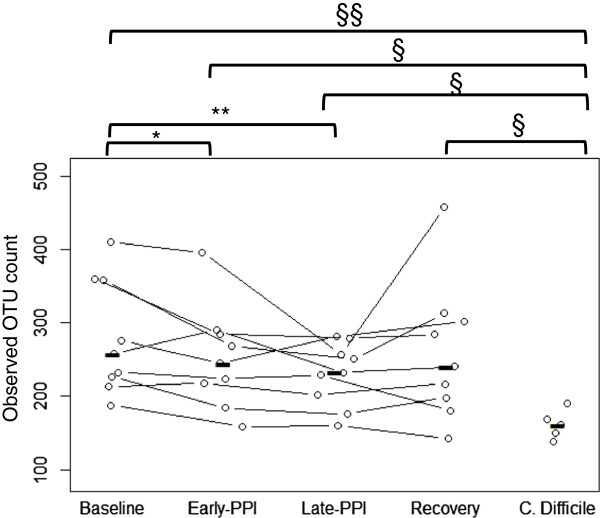
BACKGROUND: The role of the gut microbiome in arresting pathogen colonization and growth is important for protection against Clostridium difficile infection (CDI). Observational studies associate proton pump inhibitor (PPI) use and CDI incidence. We hypothesized that PPI use affected the distal gut microbiome over time, an effect that would be best explored by time-longitudinal study of healthy subjects on PPI in comparison to treatment-naïve CDI subjects. This study enrolled nine healthy human subjects and five subjects with treatment-naïve CDI. After random assignment to a low (20 mg/day) or high (2× 20 mg/day) dose group, fecal samples were collected from the nine healthy subjects before, during, and after 28 days of PPI use. This was done in conjunction with pre-treatment fecal collection from CDI subjects. High-throughput sequencing (16S rRNA) was performed on time-longitudinal samples to assess changes to the healthy gut microbiome associated with prolonged PPI usage. The healthy samples were then compared to the CDI subjects to explore changes over time to the gut microbiome associated with PPI use and potentially related to CDI. RESULTS: We report that PPI usage at low and high dosages, administered for 28 days, resulted in decreases to observed operational taxonomic unit (OTU) counts after both 1 week and 1 month. This decrease resulted in observed OTU levels that were similar to those found in treatment-naïve CDI patients, which was partly reversible after a 1 month recovery period. We did not detect a dose-dependent difference in OTU levels nor did we detect significant changes in taxa previously reported to be affected by PPI treatment. CONCLUSION: While our observation of diminishing observed OTU counts during PPI therapy is a preliminary finding in a small cohort, our hypothesis that PPIs disrupt the healthy human gut microbiome is supported in this group. We conclude that decreases in observed species counts were reversible after cessation of PPI usage within 1 month. This finding may be a potential explanation for the association between prolonged PPI usage and CDI incidence.
Overview
The claims and statistics of this paper haven’t been checked yet.
Free: it reads the open-access text and checks the first 5 claims that cite a source we can check. Create a free account to check every claim.
Integrity signals
Registry
Cites
Statistics
Figures
Verification
Claims the paper makes
The claims and statistics of this paper haven’t been checked yet.
Free: it reads the open-access text and checks the first 5 claims that cite a source we can check. Create a free account to check every claim.
Claims other papers make about this one
Each is checked against this paper’s own text: does it say what the citing paper says it does?
In the citing paper
“PPIs, for instance, enrich Firmicutes and oral taxa like Streptococcus salivarius and Micrococcaceae, expand Veillonella and Enterocloster, and reduce overall diversity, a profile linked to Clostridioides difficile infection and adverse metabolic shifts.43,92–97”
From Gut dysbiosis in oncology: a risk factor for immunoresistance (2026) · doi:10.1038/s41422-025-01212-6 · cites this paper as [96]
Self-check
Percentages, sums and reported differences re-computed from the paper’s own numbers.
The self-check needs the paper’s full text.
Citations
Cites
KEGG: Kyoto Encyclopedia of Genes and Genomes
Kanehisa, M. (2000) · Nucleic Acids Research · doi:10.1093/nar/28.1.27 · Cited by 37,077
QIIME allows analysis of high-throughput community sequencing data
Caporaso, J. G., Kuczynski, J., Stombaugh, J., Bittinger, K., Bushman, F. D., Costello, E. K., Fierer, N., Peña, A. G., Goodrich, J. K., Gordon, J. I., et al. (2010) · Nature Methods · doi:10.1038/nmeth.f.303 · Cited by 34,887
The SILVA ribosomal RNA gene database project: improved data processing and web-based tools
Quast, C., Pruesse, E., Yilmaz, P., Gerken, J., Schweer, T., Yarza, P., Peplies, J., & Glöckner, F. O. (2012) · Nucleic Acids Research · doi:10.1093/nar/gks1219 · Cited by 33,055 · cited 1×
“difficile representatives, 72 sequences and appropriate taxonomy were downloaded from SILVA SSU r117 [52] by searching the online version of r117 for “clostridium difficile” for non-repetitive reference sequences (Ref(NR)).”
MethodKEGG: Kyoto Encyclopedia of Genes and Genomes
Ogata, H., Goto, S., Sato, K., Fujibuchi, W., Bono, H., & Kanehisa, M. (1999) · Nucleic Acids Research · doi:10.1093/nar/27.1.29 · Cited by 31,232
Schloss, P. D., Westcott, S. L., Ryabin, T., Hall, J. R., Hartmann, M., Hollister, E. B., Lesniewski, R. A., Oakley, B. B., Parks, D. H., Robinson, C. J., et al. (2009) · Applied and Environmental Microbiology · doi:10.1128/aem.01541-09 · Cited by 19,549 · cited 1×
“1 [50].”
UPARSE: highly accurate OTU sequences from microbial amplicon reads
Edgar, R. C. (2013) · Nature Methods · doi:10.1038/nmeth.2604 · Cited by 16,707 · cited 1×
“Briefly, after quality-filtering using Trimmomatic, paired 16S reads were de-replicated and singletons and chimeras were removed and clustered by similarity with representative sequence selection with USEARCH, part of the UPARSE package [48].”
MethodGreengenes, a Chimera-Checked 16S rRNA Gene Database and Workbench Compatible with ARB
DeSantis, T. Z., Hugenholtz, P., Larsen, N., Rojas, M., Brodie, E. L., Keller, K., Huber, T., Dalevi, D., Hu, P., & Andersen, G. L. (2006) · Applied and Environmental Microbiology · doi:10.1128/aem.03006-05 · Cited by 10,891
Predictive functional profiling of microbial communities using 16S rRNA marker gene sequences
Langille, M. G. I., Zaneveld, J., Caporaso, J. G., McDonald, D., Knights, D., Reyes, J. A., Clemente, J. C., Burkepile, D. E., Vega Thurber, R. L., Knight, R., et al. (2013) · Nature Biotechnology · doi:10.1038/nbt.2676 · Cited by 9,116
Ultra-high-throughput microbial community analysis on the Illumina HiSeq and MiSeq platforms
Caporaso, J. G., Lauber, C. L., Walters, W. A., Berg-Lyons, D., Huntley, J., Fierer, N., Owens, S. M., Betley, J., Fraser, L., Bauer, M., et al. (2012) · The ISME Journal · doi:10.1038/ismej.2012.8 · Cited by 8,839 · cited 1×
“3 uM V3-V5 barcoded primers [46] targeting 357 F and 926R (5′AATGA TACGGCGACCACCGAGATCTACACTATGGTAATT GTCCTACGGGAGGCAGCAG3′ and 5′CAAGCAGA AGACGGCATACGAGATGCCGCATTCGATXXXXXXX XXXXXCCGTCAATTCMTTTRAGT3′, respectively) of the bacterial 16S gene, along with Kapa HiFi Hotstart Ready Mix (Kapa Biosystem).”
MethodQuality-filtering vastly improves diversity estimates from Illumina amplicon sequencing
Bokulich, N. A., Subramanian, S., Faith, J. J., Gevers, D., Gordon, J. I., Knight, R., Mills, D. A., & Caporaso, J. G. (2013) · Nature Methods · doi:10.1038/nmeth.2276 · Cited by 4,401 · cited 1×
“Quality control of 16S reads can strongly effect ecological diversity metrics such as alpha- and beta-diversity, with filtering of low quality reads playing an important role in reducing the count of spurious OTU detection [47].”
Background
Research works printed but not linked: 2
- FDA: FDA Drug Safety Communication: Clostridium difficile-associated diarrhea can be associated with stomach acid drugs known as proton pump inhibitors (PPIs). United States: 2012.
- Meyer D, Dimitriadou E, Hornik K, Weingessel K, Leisch L: e1071: Misc Functions of the Department of Statistics (e1071), TU Wien. R package version 1.6-3; 2014.
Cited by
Items 101–162 of 162
Microbiome measurement: Possibilities and pitfalls
Radjabzadeh, D., Uitterlinden, A. G., & Kraaij, R. (2017) · Best Practice & Research Clinical Gastroenterology · doi:10.1016/j.bpg.2017.10.008 · Cited by 12
Liu, X., Wang, X., Mao, T., Yin, X., Wei, Z., Fu, J., Wu, J., & Li, X. (2023) · Annals of Medicine · doi:10.1080/07853890.2023.2231852 · Cited by 12
“in addition, long-term use of PPi may induce changes in the gut microbiome, including a reduction in microbial diversity, which causes an increasing risk of Gc [28,29].”
BackgroundSystems approaches for the clinical diagnosis of Clostridioides difficile infection
Wu, Q., & Savidge, T. (2020) · Translational research · doi:10.1016/j.trsl.2020.03.006 · Cited by 11
Jankovic, K., Gralnek, I. M., & Awadie, H. (2024) · Annual Review of Medicine · doi:10.1146/annurev-med-050223-112834 · Cited by 13
Szemes, K., Farkas, N., Sipos, Z., Bor, R., Fábián, A., Szepes, Z., Farkas, K., Molnár, T., Schäfer, E., Szamosi, T., et al. (2024) · Biomedicines · doi:10.3390/biomedicines12010158 · Cited by 8
“Long-term use of PPIs taken in the absence of appropriate indications can result in unnecessary side effects, drug interactions, and costs; therefore, the indication for, and duration of, PPI treatment must be considered responsibly in everyday practice.”
BackgroundWang, K., Bell, J. S., Tan, E. C. K., Gilmartin‐Thomas, J., Dooley, M. J., & Ilomäki, J. (2019) · Drugs & Aging · doi:10.1007/s40266-019-00704-6 · Cited by 10
Shibano, M., Takahashi, M., Nakatsukasa, H., Ishigami, Y., Toyokawa, T., Taira, K., Kawaguchi, T., Nakamura, Y., & Kaneda, H. (2025) · Immunotherapy · doi:10.1080/1750743x.2025.2491300 · Cited by 7
Adami, G. R., Tangney, C., SCHWARTZ, J. L., & Dang, K. C. (2020) · Molecules · doi:10.3390/molecules25204753 · Cited by 7
“Diet [98,99], gut/oral health [100,101], and drugs [102,103] may further influence gut and oral microbiota.”
BackgroundIntake of Proton-Pump Inhibitors and Gastric Cancer within the Stomach Cancer Pooling (StoP) Project
Sassano, M., Mariani, M., Pelucchi, C., Lunet, N., Morais, S., Martín, V., Moreno, V. R., Curado, M. P., Dias‐Neto, E., Leja, M., et al. (2023) · Cancer Epidemiology Biomarkers & Prevention · doi:10.1158/1055-9965.epi-23-0241 · Cited by 9
Madka, V., Kumar, G., Pathuri, G., Panneerselvam, J., Zhang, Y., Ganta, V., Lightfoot, S. A., Lubet, R. A., Suen, C. S., Steele, V. E., et al. (2021) · Cancer Prevention Research · doi:10.1158/1940-6207.capr-21-0057 · Cited by 7
Seto, C. T., Jeraldo, P., Orenstein, R., Chia, N., & DiBaise, J. K. (2016) · Microbiome · doi:10.1186/s40168-016-0158-1 · Cited by 8
“After publication of this article [1], an error was reported in the ‘Methods’ section of the article under the subheading ‘DNA extraction and library preparation’.”
Self-citationSalami, A. T., Odukanmi, O. A., Oshode, O. O., & Olaleye, S. B. (2017) · Food Bioscience · doi:10.1016/j.fbio.2017.12.015 · Cited by 6
Are Proton Pump Inhibitors Affecting Intestinal Microbiota Health?
Melgar, S., & Nieuwdorp, M. (2015) · Gastroenterology · doi:10.1053/j.gastro.2015.08.039 · Cited by 6
The Proton Pump Inhibitors Use and COVID-19 from Prior to Vaccination Perspective: A Review
Ksiądzyna, D., & Szeląg, A. (2022) · Digestive Diseases · doi:10.1159/000527501 · Cited by 4
Madej, J., Atanassova, T., McGuire, S., Cohen, B., Weidner, M., Zhang, Y., & Horton, D. B. (2023) · Pediatric Allergy and Immunology · doi:10.1111/pai.14042 · Cited by 4
Gut Microbiome Changes After Neoadjuvant Chemotherapy and Surgery in Patients with Gastric Cancer
Žukauskaitė, K., Baušys, B., Horvath, A., Sabaliauskaitė, R., Šeštokaitė, A., Mlynska, A., Jarmalaitė, S., Stadlbauer, V., Baušys, R., & Baušys, A. (2024) · Cancers · doi:10.3390/cancers16234074 · Cited by 4
Okeahialam, C., Rabaan, A. A., & Bolhuis, A. (2021) · Journal of Infection Prevention · doi:10.1177/17571774211012780 · Cited by 6
“…this outcome is uncertain but may be related to the excess burden among older patients of ther CDI risk factors, inclu - ing clinical co-morbidities and exposure to proton pump inhibitors and histamine 2 ( 2) antago ists (Kwok et al, 2012; Rotman and Bishop, 2013; Seto et al, 2014) The Figure 2.”
BackgroundCompositional Analysis of the Human Microbiome in Cancer Research
Morales, E., Chen, J., & Greathouse, K. L. (2019) · Methods in molecular biology · doi:10.1007/978-1-4939-9027-6_16 · Cited by 5
Proton pump inhibitors (ppi): towards rational prescription
Rodríguez, B. G., & Caballero, F. C. (2020) · Revista Andaluza de Patología Digestiva · doi:10.37352/2020436.1 · Cited by 8
Jaroenlapnopparat, A., Prasitsumrit, V., Ponvilawan, B., Waitayangkoon, P., & Charoenngam, N. (2024) · Journal of Gastroenterology and Hepatology · doi:10.1111/jgh.16807 · Cited by 3
“27 Lastly, cirrhotic patients have immune dysfunctions, a propensity for increasing bacterial translocation, and intestinal permeability.”
Fiala, O., Buti, S., Fujita, K., de Liaño, A. G., Fukuokaya, W., Kimura, T., Yanagisawa, T., Giannatempo, P., Angel, M. O., Mennitto, A., et al. (2025) · Clinical & Experimental Metastasis · doi:10.1007/s10585-025-10335-4 · Cited by 4
“PPIs represent another type of drugs with significant impact on gut microbiota including changes in composition and reduction of diversity [29–31].”
Seo, H., Park, J. Y., You, H. S., Kim, B. J., & Kim, J. G. (2025) · Journal of Personalized Medicine · doi:10.3390/jpm15040144 · Cited by 4
“Previous studies have demonstrated that short-term PPI use affects the gut microbiome but that it tends to recover to a baseline state approximately 2–4 weeks after discontinuation [35–37].”
Uğraklı, M., Koçak, M. Z., Dinç, G., Genç, T. B., Çağlayan, M., Uğraklı, S., Hendem, E., Er, M. M., Çağlayan, D., Eryılmaz, M. K., et al. (2023) · Journal of Cancer Research and Clinical Oncology · doi:10.1007/s00432-023-04844-6 · Cited by 4
Kuba, K., Miyazaki, S., & Umemura, Y. (1983) · PubMed · Cited by 4
A Functional Metabolomics Framework to Track Microbiome Drug MetabolismPreprint
Shah, A. K. P. M., Grießhammer, A., Stincone, P., Kalinski, J. J., Walter, A., Wang, M., Maier, L., & Petras, D. (2026) · bioRxiv (Cold Spring Harbor Laboratory) · doi:10.64898/2026.01.30.702925 · Cited by 4
Alves, E., Gurupadayya, B., & Prabhakaran, P. (2025) · Clinical Cancer Drugs · doi:10.2174/012212697x375313250623163944 · Cited by 2
Reveles, K. R., Young, E. H., Zeidan, A. R., & Dong, Q. (2021) · Elsevier eBooks · doi:10.1016/b978-0-12-815962-0.00017-2 · Cited by 2
Bloqueadores ácidos competitivos de potasio (PCABs): estado del arte
Díaz, J. A. U., Regino, W. O., Cheng, H. G. C., Fernández, H. M., Piscoya, A., Ordoñez, J. S. F., & Parra, L. O. (2025) · Revista de Gastroenterología del Perú · doi:10.47892/rgp.2025.451.1873 · Cited by 2
Kozlov, R. S., Shelygin, Y. A., Veselov, A. V., Dekhnich, A. V., Zubareva, N., Ershova, O. N., Кулабухов, В. В., Попов, Д. А., Reshedko, G., & Yakushin, S. B. (2018) · Clinical Microbiology and Antimicrobial Chemotherapy · doi:10.36488/cmac.2018.2.76-124 · Cited by 2
Editorial: further evidence that proton pump inhibitors may impact on the gut microbiota
Walker, A. W., & Flint, H. J. (2016) · Alimentary Pharmacology & Therapeutics · doi:10.1111/apt.13596 · Cited by 3
Proton Pump Inhibitors and Gastric Cancer: A Large-Scale Propensity Score-Matched Analysis
Huh, C. W., Son, N., Gwon, S. H., Koh, H. B., Yun, H., & Jung, D. H. (2026) · Gut and Liver · doi:10.5009/gnl250603 · Cited by 1
Fulfilling the Promise of Microbiomics to Revolutionize Medicine
Testerman, T. L. (2015) · Journal of Microbiology & Experimentation · doi:10.15406/jmen.2015.02.00050 · Cited by 1
“Evidence suggests that increased microbiome diversity contributes to disease and allergy resistance [32-35], but how much diversity is needed and how can diversity be generated? Creating defined mixtures of hundreds of species in a stable form is a daunting proposition, though not impossible.”
BackgroundDas Mikrobiom als Drehscheibe für Nebenwirkungen der Protonenpumpenhemmer-Therapie
Horvath, A., & Stadlbauer, V. (2020) · Zentralblatt für Chirurgie - Zeitschrift für Allgemeine Viszeral- Thorax- und Gefäßchirurgie · doi:10.1055/a-1312-7587 · Cited by 1
“Clostridiumdifficile-Infektionen sind laut einer Metaanalyse von 56 Studien mit insgesamt ca. 350000 Patientinnen und Patienten etwa 2- mal häufiger bei Menschen mit PPI-Therapie verglichen mit Menschen ohne PPI-Therapie.”
BackgroundInfluentialGrundmann, O. (2020) · EMJ Microbiology & Infectious Diseases · doi:10.33590/emjmicrobiolinfectdis/20-00050 · Cited by 1
Muller, C., Tapaskar, N., & Kavitt, R. T. (2019) · Springer eBooks · doi:10.1007/978-3-030-27592-1_14 · Cited by 1
It’s time to rethink your approach to C diff infection
Zukauckas (2020) · The Journal of Family Practice · doi:10.12788/jfp.0021 · Cited by 1
“The mechanism is thought to be an interruption in the protection provided by stomach acid, and use over time may reduce the diversity of flora within the gut microbiome.(13) The data demonstrating an association between acid-suppression therapy and CDI is conflicting, which may be a result of confounding factors such…”
BackgroundElgadi, A. M., Mahmoud, A. H., Alabidi, A. F., Albarghathi, Z. A., Mohammed, N. E., Mohamed, I. E., Bukhatwa, S., & Elmabsout, A. A. (2022) · World Journal of Advanced Research and Reviews · doi:10.30574/wjarr.2022.13.1.0755 · Cited by 1
Acid suppression and effects on the gastrointestinal microbiome
Korus, H., & Vakil, N. B. (2023) · Elsevier eBooks · doi:10.1016/b978-0-323-95070-1.00011-4 · Cited by 1
Ciucci, S., Durán, C., Palladini, A., Ijaz, U. Z., Sterbini, F. P., Masucci, L., Cammarota, G., Ianiro, G., Spuul, P., Schroeder, M., et al. (2020) · bioRxiv (Cold Spring Harbor Laboratory) · doi:10.1101/2020.03.24.005587 · Cited by 1
Are Proton Pump Inhibitors Affecting Intestinal Microbiota Health
Toussaint, N. C. (2015)
Clostridium difficile Infection
Stewart, D. B. (2016) · Springer eBooks · doi:10.1007/978-3-319-25970-3_53
Vila, A. (2018) · DalSpace (Dalhousie University)
Occurrences of infections caused by the bacteria clostridium difficile on the territory of Belgrade
Uzelac-Škorić, A., Uzelac, M., Škorić, M., Durlević, D., Maris, S., & Milić, M. (2019) · Zdravstvena zastita · doi:10.5937/zz1903013u
“difficile je kod starijih osoba, što je povezano sa slabljenjem imunog sistema, promenama u crevnoj flori koja se javlja u toj starosnoj dobi (17), i sa većim brojem komorbiditetnih oboljenja (18), poduženom hospitalizacijom, kao i sa povećanom upotrebom antibiotika (19) i drugih lekova (20).”
BackgroundCOVID-19 and proton pump inhibitor use: Imperative for caution in prescription
Nwokediuko, S. C. (2020) · Nigerian Journal of Gastroenterology and Hepatology · doi:10.4103/2251-0079.302903
Baima, D. C. (2020) · Digital Library of Theses and Dissertations (Universidade de São Paulo) · doi:10.11606/t.5.2020.tde-01072021-115140
Which impact for proton pump inhibitors in SARS-COV-2 pneumonia
Mazzeo, G., Aronne, L., Mariniello, D. F., Allocca, V., Palma, M. I., Cerqua, F. S., Iadevaia, C., Costigliola, A., Parrella, R., Bianco, A., et al. (2021) · Monaldi Archives for Chest Disease · doi:10.4081/monaldi.2021.1803
“enable colonization of some enteric pathogens [22].”
Control of Clostridium difficile Infection by Defined Microbial Communities
Collins, J., & Auchtung, J. M. (2018) · ASM Press eBooks · doi:10.1128/9781555819705.ch11 · Cited by 1
Dupont, A. W., & Khurana, S. (2020) · Faculty Opinions – Post-Publication Peer Review of the Biomedical Literature · doi:10.3410/f.732670634.793579191
Cotter, P. D., & Barton, W. (2019) · Faculty Opinions – Post-Publication Peer Review of the Biomedical Literature · doi:10.3410/f.726708065.793567416
Proton Pump Inhibitors in the COVID-19 Pandemic
Евгеньевна, К. Т., Маловичко, И. С., Gnilitskaya, V. B., Христуленко, А. Л., & Федоровна, Я. Н. (2022) · The Russian Archives of Internal Medicine · doi:10.20514/2226-6704-2022-12-4-245-253
Medicinal-microbial interactions and ways of correcting iatrogenic intestinal dysbiosis
Бакулин, И. Г., & Serkova, M. Y. (2023) · Экспериментальная и клиническая гастроэнтерология · doi:10.31146/1682-8658-ecg-207-11-26-35 · Cited by 1
Willard, M. D. (2023) · Small Animal Critical Care Medicine · doi:10.1016/b978-0-323-76469-8.00162-3
Inibidores de bomba de prótons, segurança e efeitos adversos: revisão sistemática
Pinto, A. B. D. A., Franco, L. O. A., & de Faria, R. J. (2023) · Programa de Iniciação Científica - PIC/UniCEUB - Relatórios de Pesquisa · doi:10.5102/pic.n0.2021.8973
Rosa, I. R., Santos, F. A. C. D., Bernardo, P. A. V. D. C., & de Oliveira, R. D. C. S. (2023) · Brazilian Journal of Health Review · doi:10.34119/bjhrv6n4-331
Medical Therapy for Gastroesophageal Reflux Disease
Klein, J. A., & Kavitt, R. T. (2023) · Springer eBooks · doi:10.1007/978-3-031-48241-0_8
Klein, J. A., & Kavitt, R. T. (2025) · Springer eBooks · doi:10.1007/978-3-032-08179-7_3
A Petal-Inspired Magnetic Multilayer Flexible Robot for Gastric Applications
Zhang, Z., Li, Y., Zhao, Y., Liu, Y., Zhao, X., & Yang, L. (2025) · IEEE International Conference on Cyborg and Bionic Systems (CBS) · doi:10.1109/cbs65871.2025.11267643
“of minerals and vitamins [2].”
Impact of proton pump inhibitor use on microbiota and diversity
Alsharef, A. S., Alsaedi, E. A. H., Almohmmadi, G. T., Alahmadi, K., Alhemshy, L. Z., Albugami, M. K., Alghanim, W. S., Alharbi, S. S., Alahmadi, Y. K., Aljohani, Y. S., et al. (2025) · International Journal of Community Medicine and Public Health · doi:10.18203/2394-6040.ijcmph20254453
Prosty, C. J., Pilon, Y., Lee, J. J., Lee, T. C., & McDonald, E. G. (2026) · medRxiv · doi:10.64898/2026.07.22.26358694
Fang, S., Yang, X., & Liu, F. (2026) · Frontiers in Medicine · doi:10.3389/fmed.2026.1959574
“…may gradually reverse after discontinuation of the medication; however, the rate of recovery and whether the microbiota can fully return to baseline levels remain influenced by multiple factors, including individual differences, baseline microbiota status, and duration of use (9, 39, 40).”
Metadata
- Authors
- Seto, C. T., Jeraldo, P., Orenstein, R., Chia, N., & DiBaise, J. K.
- Affiliations
- Mayo Clinic (US)
- Corresponding author
- Chia, Nicholas
- DiBaise, John K
- Venue
- Microbiome
- Published
- 2014-11-25
- Volume
- 2
- Issue
- 1
- Pages
- 10-10
- ISSN
- 2049-2618 (ISSN-L)
- PMC
- PMC4242847
- OpenAlex
- W2097319008
- Cited by
- 163
- References
- 57
- Citations by year
- 2026: 5 · 2025: 10 · 2024: 8 · 2023: 16 · 2022: 6 · 2021: 13 · 2020: 24 · 2019: 14 · 2018: 12 · 2017: 22 · 2016: 19 · 2015: 13
- FWCI
- 12.65
- Type
- journal article
- Language
- en
- Update notices
- correction (2016-02-22)
- Open access
- gold
- doi.org
- Licence
- cc-by
- Locations
- Microbiome (publishedVersion, cc-by)
- Europe PMC (PubMed Central) (publishedVersion, cc-by)
- PubMed Central (publishedVersion, cc-by)
- PubMed (publishedVersion)
- Funders
- National Cancer Institute (R01CA179243)
- Topics
- Health Sciences › Medicine › Infectious Diseases › Clostridium difficile and Clostridium perfringens research
- Life Sciences › Biochemistry, Genetics and Molecular Biology › Molecular Biology › Gut microbiota and health
- Health Sciences › Medicine › Gastroenterology › Gastrointestinal motility and disorders
- Keywords
- proton pump inhibitors, Clostridium difficile infection, gut microbiota, microbial diversity, operational taxonomic units, fecal microbiota
About these checks
Registry, retraction, Cites and statistics results are computed, not judged, with one exception: a printed reference that no index lists is read once by a model before it counts as a citation error. Claims are extracted by a model and kept only when their quote appears verbatim in the text; each cited source is then checked, with a model’s help, for whether it says what the claim relies on. Those verdicts can be wrong — read the claim’s quote and the cited source before relying on one.
Statistics and arithmetic are recomputed, not judged.
Confidence bands are shown only for fields calibrated on our annotated test set. None is calibrated yet, so no band is shown.
What counts as a claim ›How we measure confidence ›How we check this ›
Are you an author, or do you see a problem with this page? Request a review
Data sources
Bibliographic data: Semantic Scholar, OpenAlex, Crossref.
Contains information from the Semantic Scholar Academic Graph Datasets, made available under the ODC Attribution License (ODC-BY 1.0).
Semantic Scholar’s data is described in: Kinney, R., et al. (2023). The Semantic Scholar Open Data Platform. arXiv:2301.10140.
