

Prolonged use of a proton pump inhibitor reduces microbial diversity: implications for Clostridium difficile susceptibility
Open accessThe DOI matches its Crossref record; 56 of the 57 references it cites were found in a registry or an index.
Abstract
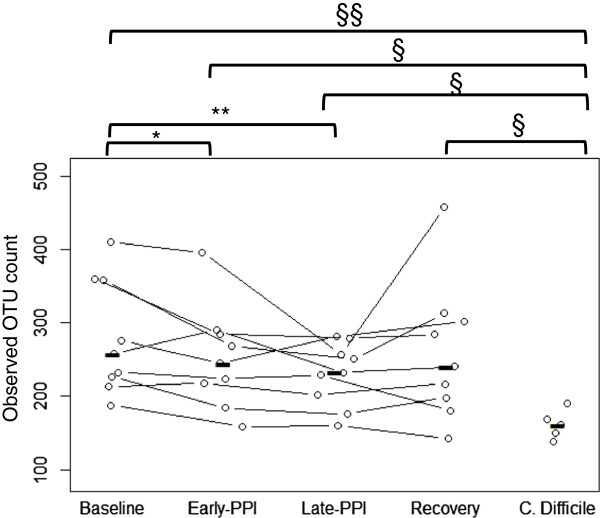
BACKGROUND: The role of the gut microbiome in arresting pathogen colonization and growth is important for protection against Clostridium difficile infection (CDI). Observational studies associate proton pump inhibitor (PPI) use and CDI incidence. We hypothesized that PPI use affected the distal gut microbiome over time, an effect that would be best explored by time-longitudinal study of healthy subjects on PPI in comparison to treatment-naïve CDI subjects. This study enrolled nine healthy human subjects and five subjects with treatment-naïve CDI. After random assignment to a low (20 mg/day) or high (2× 20 mg/day) dose group, fecal samples were collected from the nine healthy subjects before, during, and after 28 days of PPI use. This was done in conjunction with pre-treatment fecal collection from CDI subjects. High-throughput sequencing (16S rRNA) was performed on time-longitudinal samples to assess changes to the healthy gut microbiome associated with prolonged PPI usage. The healthy samples were then compared to the CDI subjects to explore changes over time to the gut microbiome associated with PPI use and potentially related to CDI. RESULTS: We report that PPI usage at low and high dosages, administered for 28 days, resulted in decreases to observed operational taxonomic unit (OTU) counts after both 1 week and 1 month. This decrease resulted in observed OTU levels that were similar to those found in treatment-naïve CDI patients, which was partly reversible after a 1 month recovery period. We did not detect a dose-dependent difference in OTU levels nor did we detect significant changes in taxa previously reported to be affected by PPI treatment. CONCLUSION: While our observation of diminishing observed OTU counts during PPI therapy is a preliminary finding in a small cohort, our hypothesis that PPIs disrupt the healthy human gut microbiome is supported in this group. We conclude that decreases in observed species counts were reversible after cessation of PPI usage within 1 month. This finding may be a potential explanation for the association between prolonged PPI usage and CDI incidence.
Overview
The claims and statistics of this paper haven’t been checked yet.
Free: it reads the open-access text and checks the first 5 claims that cite a source we can check. Create a free account to check every claim.
Integrity signals
Registry
Cites
Statistics
Figures
Verification
Claims the paper makes
The claims and statistics of this paper haven’t been checked yet.
Free: it reads the open-access text and checks the first 5 claims that cite a source we can check. Create a free account to check every claim.
Claims other papers make about this one
Each is checked against this paper’s own text: does it say what the citing paper says it does?
In the citing paper
“PPIs, for instance, enrich Firmicutes and oral taxa like Streptococcus salivarius and Micrococcaceae, expand Veillonella and Enterocloster, and reduce overall diversity, a profile linked to Clostridioides difficile infection and adverse metabolic shifts.43,92–97”
From Gut dysbiosis in oncology: a risk factor for immunoresistance (2026) · doi:10.1038/s41422-025-01212-6 · cites this paper as [96]
Self-check
Percentages, sums and reported differences re-computed from the paper’s own numbers.
The self-check needs the paper’s full text.
Citations
Cites
KEGG: Kyoto Encyclopedia of Genes and Genomes
Kanehisa, M. (2000) · Nucleic Acids Research · doi:10.1093/nar/28.1.27 · Cited by 37,077
QIIME allows analysis of high-throughput community sequencing data
Caporaso, J. G., Kuczynski, J., Stombaugh, J., Bittinger, K., Bushman, F. D., Costello, E. K., Fierer, N., Peña, A. G., Goodrich, J. K., Gordon, J. I., et al. (2010) · Nature Methods · doi:10.1038/nmeth.f.303 · Cited by 34,887
The SILVA ribosomal RNA gene database project: improved data processing and web-based tools
Quast, C., Pruesse, E., Yilmaz, P., Gerken, J., Schweer, T., Yarza, P., Peplies, J., & Glöckner, F. O. (2012) · Nucleic Acids Research · doi:10.1093/nar/gks1219 · Cited by 33,055 · cited 1×
“difficile representatives, 72 sequences and appropriate taxonomy were downloaded from SILVA SSU r117 [52] by searching the online version of r117 for “clostridium difficile” for non-repetitive reference sequences (Ref(NR)).”
MethodKEGG: Kyoto Encyclopedia of Genes and Genomes
Ogata, H., Goto, S., Sato, K., Fujibuchi, W., Bono, H., & Kanehisa, M. (1999) · Nucleic Acids Research · doi:10.1093/nar/27.1.29 · Cited by 31,232
Schloss, P. D., Westcott, S. L., Ryabin, T., Hall, J. R., Hartmann, M., Hollister, E. B., Lesniewski, R. A., Oakley, B. B., Parks, D. H., Robinson, C. J., et al. (2009) · Applied and Environmental Microbiology · doi:10.1128/aem.01541-09 · Cited by 19,549 · cited 1×
“1 [50].”
UPARSE: highly accurate OTU sequences from microbial amplicon reads
Edgar, R. C. (2013) · Nature Methods · doi:10.1038/nmeth.2604 · Cited by 16,707 · cited 1×
“Briefly, after quality-filtering using Trimmomatic, paired 16S reads were de-replicated and singletons and chimeras were removed and clustered by similarity with representative sequence selection with USEARCH, part of the UPARSE package [48].”
MethodGreengenes, a Chimera-Checked 16S rRNA Gene Database and Workbench Compatible with ARB
DeSantis, T. Z., Hugenholtz, P., Larsen, N., Rojas, M., Brodie, E. L., Keller, K., Huber, T., Dalevi, D., Hu, P., & Andersen, G. L. (2006) · Applied and Environmental Microbiology · doi:10.1128/aem.03006-05 · Cited by 10,891
Predictive functional profiling of microbial communities using 16S rRNA marker gene sequences
Langille, M. G. I., Zaneveld, J., Caporaso, J. G., McDonald, D., Knights, D., Reyes, J. A., Clemente, J. C., Burkepile, D. E., Vega Thurber, R. L., Knight, R., et al. (2013) · Nature Biotechnology · doi:10.1038/nbt.2676 · Cited by 9,116
Ultra-high-throughput microbial community analysis on the Illumina HiSeq and MiSeq platforms
Caporaso, J. G., Lauber, C. L., Walters, W. A., Berg-Lyons, D., Huntley, J., Fierer, N., Owens, S. M., Betley, J., Fraser, L., Bauer, M., et al. (2012) · The ISME Journal · doi:10.1038/ismej.2012.8 · Cited by 8,839 · cited 1×
“3 uM V3-V5 barcoded primers [46] targeting 357 F and 926R (5′AATGA TACGGCGACCACCGAGATCTACACTATGGTAATT GTCCTACGGGAGGCAGCAG3′ and 5′CAAGCAGA AGACGGCATACGAGATGCCGCATTCGATXXXXXXX XXXXXCCGTCAATTCMTTTRAGT3′, respectively) of the bacterial 16S gene, along with Kapa HiFi Hotstart Ready Mix (Kapa Biosystem).”
MethodQuality-filtering vastly improves diversity estimates from Illumina amplicon sequencing
Bokulich, N. A., Subramanian, S., Faith, J. J., Gevers, D., Gordon, J. I., Knight, R., Mills, D. A., & Caporaso, J. G. (2013) · Nature Methods · doi:10.1038/nmeth.2276 · Cited by 4,401 · cited 1×
“Quality control of 16S reads can strongly effect ecological diversity metrics such as alpha- and beta-diversity, with filtering of low quality reads playing an important role in reducing the count of spurious OTU detection [47].”
Background
Research works printed but not linked: 2
- FDA: FDA Drug Safety Communication: Clostridium difficile-associated diarrhea can be associated with stomach acid drugs known as proton pump inhibitors (PPIs). United States: 2012.
- Meyer D, Dimitriadou E, Hornik K, Weingessel K, Leisch L: e1071: Misc Functions of the Department of Statistics (e1071), TU Wien. R package version 1.6-3; 2014.
Cited by
McDonald, L. C., Gerding, D. N., Johnson, S., Bakken, J. S., Carroll, K. C., Coffin, S. E., Dubberke, E. R., Garey, K. W., Gould, C. V., Kelly, C., et al. (2018) · Clinical Infectious Diseases · doi:10.1093/cid/cix1085 · Cited by 2,690
Proton pump inhibitors alter the composition of the gut microbiota
Jackson, M. A., Goodrich, J. K., Maxan, M.-E., Freedberg, D. E., Abrams, J. A., Poole, A. C., Sutter, J. L., Welter, D., Ley, R. E., Bell, J. T., et al. (2016) · Gut · doi:10.1136/gutjnl-2015-310861 · Cited by 895
Gut microbiome interactions with drug metabolism, efficacy, and toxicity
Wilson, I. D., & Nicholson, J. K. (2017) · Translational Research · doi:10.1016/j.trsl.2016.08.002 · Cited by 656
The Microbiome of Aseptically Collected Human Breast Tissue in Benign and Malignant Disease
Hieken, T. J., Chen, J., Hoskin, T. L., Walther-Antonio, M., Johnson, S., Ramaker, S., Xiao, J., Radisky, D. C., Knutson, K. L., Kalari, K. R., et al. (2016) · Scientific Reports · doi:10.1038/srep30751 · Cited by 494
Self-citationFreedberg, D. E., Toussaint, N. C., Chen, S. P., Ratner, A. J., Whittier, S., Wang, T. C., Wang, H. H., & Abrams, J. A. (2015) · Gastroenterology · doi:10.1053/j.gastro.2015.06.043 · Cited by 322
Trifan, A., Stanciu, C., Girleanu, I., Stoica, O. C., Singeap, A. M., Maxim, R., Chiriac, S. A., Ciobica, A., & Boiculese, L. (2017) · World Journal of Gastroenterology · doi:10.3748/wjg.v23.i35.6500 · Cited by 286
Systematic review: human gut dysbiosis induced by non-antibiotic prescription medications
Le Bastard, Q., Al‐Ghalith, G. A., Grégoire, M., Chapelet, G., Javaudin, F., Dailly, E., Batard, E., Knights, D., & Montassier, E. (2018) · Alimentary Pharmacology & Therapeutics · doi:10.1111/apt.14451 · Cited by 263
“difficile.(32) In a trial with 12 healthy volunteers, Freedberg et al found that a 4-week regimen of PPI medication (omeprazole 40 mg twice) was not associated with within-individual changes in diversity.”
The risks of long-term use of proton pump inhibitors: a critical review
Jaynes, M., & Kumar, A. B. (2019) · Therapeutic Advances in Drug Safety · doi:10.1177/2042098618809927 · Cited by 254
Brusselaers, N., Wahlin, K., Engstrand, L., & Lagergren, J. (2017) · BMJ Open · doi:10.1136/bmjopen-2017-017739 · Cited by 204
Increased Risk of COVID-19 Among Users of Proton Pump Inhibitors
Almario, C. V., Chey, W. D., & Spiegel, B. M. R. (2020) · American Journal of Gastroenterology · doi:10.14309/ajg.0000000000000798 · Cited by 190
“This effect is likely related to PPI-induced hypochlorhydria, which impairs the body’s proximal defense against ingested bacteria and viruses (1), and may also occur because prolonged use of PPIs reduces microbial diversity in the gut (7), an effect believed to enable colonization of some enteric pathogens (8).”
BackgroundA comparison of the gut microbiome between long‐term users and non‐users of proton pump inhibitors
Clooney, A. G., Bernstein, C. N., Leslie, W. D., Vagianos, K., Sargent, M., Laserna‐Mendieta, E. J., Claesson, M. J., & Targownik, L. E. (2016) · Alimentary Pharmacology & Therapeutics · doi:10.1111/apt.13568 · Cited by 166
“2 Cholesterol reducing agents 38 (12) 28 (8) >0.”
BackgroundInfluence of Proton-Pump Inhibitors on the Luminal Microbiota in the Gastrointestinal Tract
Tsuda, A., Suda, W., Morita, H., Takanashi, K., Takagi, A., Koga, Y., & Hattori, M. (2015) · Clinical and Translational Gastroenterology · doi:10.1038/ctg.2015.20 · Cited by 164
Reshaping the gut microbiota: Impact of low calorie sweeteners and the link to insulin resistance?
Nettleton, J. E., Reimer, R. A., & Shearer, J. (2016) · Physiology & Behavior · doi:10.1016/j.physbeh.2016.04.029 · Cited by 179
Clostridium difficile Infection
Sharma, S., Nakajima, K., & Shukla, P. J. (2015) · New England Journal of Medicine · doi:10.1056/nejmc1506004 · Cited by 197
A longitudinal study of the diabetic skin and wound microbiome
Gardiner, M., Vicaretti, M., Sparks, J., Bansal, S., Bush, S., Liu, M., Darling, A., Harry, E., & Burke, C. M. (2017) · PeerJ · doi:10.7717/peerj.3543 · Cited by 144
“One possible effect is increased infection susceptibility 436 (Seto et al. 2014), and it is intriguing to consider whether decreased skin microbiome diversity 437 could be contributing to the high incidence of skin and wound infections associated with this 438 disease (Peleg et al. 2007).”
BackgroundProton pump inhibitors and risk of gastric cancer: population-based cohort study
Abrahami, D., McDonald, E. G., Schnitzer, M. E., Barkun, A. N., Suissa, S., & Azoulay, L. (2021) · Gut · doi:10.1136/gutjnl-2021-325097 · Cited by 146
Vincent, C., Miller, M. A., Edens, T. J., Mehrotra, S., Dewar, K., & Manges, A. R. (2016) · Microbiome · doi:10.1186/s40168-016-0156-3 · Cited by 124
Fecal Microbiota Analysis: An Overview of Sample Collection Methods and Sequencing Strategies
Thomas, V., Clark, J., & Doré, J. (2015) · Future Microbiology · doi:10.2217/fmb.15.87 · Cited by 123
Grams, J. M., & Garvey, W. T. (2015) · Current Obesity Reports · doi:10.1007/s13679-015-0155-x · Cited by 146
Mechanisms of proton pump inhibitor‐induced hypomagnesemia
Gommers, L. M. M., Hoenderop, J. G. J., & de Baaij, J. H. F. (2022) · Acta Physiologica · doi:10.1111/apha.13846 · Cited by 167
Macke, L., Schulz, C., Koletzko, L., & Malfertheiner, P. (2020) · Alimentary Pharmacology & Therapeutics · doi:10.1111/apt.15604 · Cited by 118
Lai, C. Y., Sung, J., Cheng, F., Tang, W., Wong, S. H., Chan, P. K. S., Kamm, M. A., Sung, J. J. Y., Kaplan, G., Chan, F. K. L., et al. (2019) · Alimentary Pharmacology & Therapeutics · doi:10.1111/apt.15116 · Cited by 118
Consensus report: faecal microbiota transfer – clinical applications and procedures
König, J., Siebenhaar, A., Högenauer, C., Arkkila, P., Nieuwdorp, M., Norén, T., Ponsioen, C. Y., Rosien, U., Rossen, N. G., Satokari, R., et al. (2017) · Alimentary Pharmacology & Therapeutics · doi:10.1111/apt.13868 · Cited by 114
“affect the microbiome, in particular proton pump inhibitors (PPIs).(95) PPIs are associated with an increased risk of small bowel bacterial overgrowth.”
BackgroundAntibiotic and acid-suppression medications during early childhood are associated with obesity
Stark, C. M., Susi, A., Emerick, J., & Nylund, C. M. (2019) · Gut · doi:10.1136/gutjnl-2017-314971 · Cited by 115
Kiecka, A., & Szczepanik, M. (2023) · Pharmacological Reports · doi:10.1007/s43440-023-00489-x · Cited by 138
“after 28 days of PPIs in healthy volunteers, there was no change in the amount of Faecalibacterium, but there was a decrease in OTU in the fecal microbiota [39].”
BackgroundIntestinal Dysbiosis Secondary to Proton-Pump Inhibitor Use
Naito, Y., Kashiwagi, K., Takagi, T., Andoh, A., & Inoue, R. (2018) · Digestion · doi:10.1159/000481813 · Cited by 107
Gut Microbiota Has a Widespread and Modifiable Effect on Host Gene Regulation
Richards, A. L., Muehlbauer, A. L., Alazizi, A., Burns, M. B., Findley, A. S., Messina, F., Gould, T. J., Cascardo, C. A., Piqué-Regi, R., Blekhman, R., et al. (2019) · mSystems · doi:10.1128/msystems.00323-18 · Cited by 130
“Then for each candidate location l we collect all the ATAC-seq fragments which are partitioned into four binds depending on the fragment length: 1) [39-99], 2) [100-139], 3) [140-179], 4) [180-250].”
BackgroundMethodSmall Intestinal Bacterial Overgrowth
Adike, A., & DiBaise, J. K. (2017) · Gastroenterology Clinics of North America · doi:10.1016/j.gtc.2017.09.008 · Cited by 125
Self-citationGuh, A. Y., Adkins, S. H., Li, Q., Bulens, S. N., Farley, M. M., Smith, Z., Holzbauer, S., Whitten, T., Phipps, E. C., Hancock, E. B., et al. (2017) · Open Forum Infectious Diseases · doi:10.1093/ofid/ofx171 · Cited by 98
“The short duration of PPI use might partially explain why we did not detect an association, given that the disruption of the intestinal microbiome could be more pronounced with prolonged PPI use [28].”
BackgroundHorvath, A., Rainer, F., Bashir, M., Leber, B., Schmerboeck, B., Klymiuk, I., Groselj-Strele, A., Durdevic, M., Freedberg, D. E., Abrams, J. A., et al. (2019) · Scientific Reports · doi:10.1038/s41598-019-48352-5 · Cited by 93
Freedberg, D. E., Lamousé-Smith, E. S., Lightdale, J. R., Jin, Z., Yang, Y.-X., & Abrams, J. A. (2015) · Clinical Infectious Diseases · doi:10.1093/cid/civ432 · Cited by 88
Johnson, D. A., Katz, P. O., Armstrong, D., Cohen, H., Delaney, B. C., Howden, C. W., Katelaris, P., Tutuian, R. I., & Castell, D. O. (2017) · Drugs · doi:10.1007/s40265-017-0712-6 · Cited by 99
“Notably, however, the spore form, which is commonly the infective form of the organism, is not susceptible to gastric acid [111].”
BackgroundMaintenance proton pump inhibition therapy and risk of oesophageal cancer
Brusselaers, N., Engstrand, L., & Lagergren, J. (2018) · Cancer Epidemiology · doi:10.1016/j.canep.2018.02.004 · Cited by 80
Hale, V. L., Jeraldo, P., Mundy, M. B., Yao, J. Z., Keeney, G., Scott, N. E., Cheek, E. H., Davidson, J., Greene, M., Martinez, C., et al. (2018) · Methods · doi:10.1016/j.ymeth.2018.04.024 · Cited by 81
“…expression, and interactions include tumor location and stage, patient medications (ranging from proton-pump inhibitors to antidepressants to statins and allergy medications) [68,69], smoking history [70], BMI [70], and surgical preparation (a subset of patients received MiraLAX preparation) [71].”
BackgroundSelf-citationBloomfield, L., & Riley, T. V. (2016) · Infectious Diseases and Therapy · doi:10.1007/s40121-016-0117-y · Cited by 95
“The use of PPIs appears to be particularly significant for the subset of CA-CDI that is not associated with prior antimicrobial exposure [60], indicating that the disruption to the microbiota, which occurs following exposure to a PPI [69–71], may be sufficient to cause disease in the absence of antimicrobial therapy.”
BackgroundArriola, V., Tischendorf, J., Musuuza, J., Barker, A., Rozelle, J. W., & Safdar, N. (2016) · Infection Control & Hospital Epidemiology · doi:10.1017/ice.2016.194 · Cited by 77
“Several conventional risk factors include older age, antibiotic exposure, prolonged hospitalization, immunocompromising condition, or serious underlying illness.7 Recent literature has demonstrated an association between proton pump inhibitor (PPI) use and increased risk of CDI.”
BackgroundInfluentialSalk, H. M., Simon, W. L., Lambert, N. D., Kennedy, R. B., Grill, D. E., Kabat, B. F., & Poland, G. A. (2016) · PLoS ONE · doi:10.1371/journal.pone.0162803 · Cited by 75
Zhu, J., Sun, C., Li, M., Hu, G., Zhao, X., & Chen, W. (2023) · Gut · doi:10.1136/gutjnl-2023-330168 · Cited by 93
Gut Microbiota Composition Associated with Clostridioides difficile Colonization and Infection
Martínez, E. D., Taminiau, B., Rodriguez, C., & Daube, G. (2022) · Pathogens · doi:10.3390/pathogens11070781 · Cited by 75
Salivary microbiome with gastroesophageal reflux disease and treatment
Kawar, N. I., Park, S. G., SCHWARTZ, J. L., Callahan, N. F., Obrez, A., Yang, B. J., Chen, Z., & Adami, G. R. (2021) · Scientific Reports · doi:10.1038/s41598-020-80170-y · Cited by 78
Side effects of long-term use of proton pump inhibitors: practical considerations
Castellana, C., Pecere, S., Furnari, M., Telese, A., Matteo, M. V., Haidry, R. J., & Eusebi, L. H. (2021) · Polskie Archiwum Medycyny Wewnętrznej · doi:10.20452/pamw.15997 · Cited by 90
Approach to the diagnosis and management of dysbiosis
Alagiakrishnan, K., Morgadinho, J., & Halverson, T. (2024) · Frontiers in Nutrition · doi:10.3389/fnut.2024.1330903 · Cited by 93
Sleeping with the enemy: Clostridium difficile infection in the intensive care unit
Prechter, F., Katzer, K., Bauer, M. W., & Stallmach, A. (2017) · Critical Care · doi:10.1186/s13054-017-1819-6 · Cited by 69
“Combined with evidence that prolonged use of PPIs reduces microbial diversity and thus increases susceptibility for CDI [65], we consider medication with PPI another major risk factor.”
BackgroundFaleck, D. M., Salmasian, H., Furuya, Y. E., Larson, E., Abrams, J. A., & Freedberg, D. E. (2016) · The American Journal of Gastroenterology · doi:10.1038/ajg.2016.343 · Cited by 75
Gut microbiota impact on stroke outcome: Fad or fact?
Winek, K., Meisel, A., & Dirnagl, U. (2016) · Journal of Cerebral Blood Flow & Metabolism · doi:10.1177/0271678x16636890 · Cited by 60
Proton-Pump Inhibitor Use and the Risk of Community-Associated Clostridium difficile Infection
Inghammar, M., Svanström, H., Voldstedlund, M., Melbye, M., Hviid, A. P., Mølbak, K., & Pasternak, B. (2021) · Clinical Infectious Diseases · doi:10.1093/cid/ciaa1857 · Cited by 73
“In a small study (n = 9), Seto et al [28] found decreased fecal microbial diversity during a 28-day treatment course of PPIs, which was partly reversed at follow-up after 4 weeks.”
BackgroundProton pump inhibitors and risk of colorectal cancer
Abrahami, D., McDonald, E. G., Schnitzer, M. E., Barkun, A. N., Suissa, S., & Azoulay, L. (2021) · Gut · doi:10.1136/gutjnl-2021-325096 · Cited by 60
Pechal, A., Lin, K., Allen, S., & Reveles, K. R. (2016) · BMC Infectious Diseases · doi:10.1186/s12879-016-2027-8 · Cited by 65
“, proton pump inhibitors [PPIs]) [20].”
Wurm, P., Spindelboeck, W., Krause, R., Plank, J., Fuchs, G., Bashir, M., Petritsch, W., Halwachs, B., Langner, C., Högenauer, C., et al. (2017) · Critical Care Medicine · doi:10.1097/ccm.0000000000002310 · Cited by 55
Discontinuing Long-Term PPI Therapy: Why, With Whom, and How?
Targownik, L. E. (2018) · The American Journal of Gastroenterology · doi:10.1038/ajg.2018.29 · Cited by 62
Schnoll‐Sussman, F. H., Niec, R. E., & Katz, P. O. (2020) · Gastrointestinal Endoscopy Clinics of North America · doi:10.1016/j.giec.2019.12.005 · Cited by 64
The gut microbiome in psychiatry: A primer for clinicians
Ameringen, M. V., Turna, J., Patterson, B. A., Pipe, A., Mao, R. Q., Anglin, R., & Surette, M. G. (2019) · Depression and Anxiety · doi:10.1002/da.22936 · Cited by 54
Wiese, G. N., Biruete, A., Moorthi, R. N., Moe, S. M., Lindemann, S. R., & Gallant, K. M. H. (2020) · Journal of Renal Nutrition · doi:10.1053/j.jrn.2020.04.007 · Cited by 49
Therapeutic Approach to Adult Fibrotic Lung Diseases
Adegunsoye, A., & Strek, M. E. (2016) · CHEST Journal · doi:10.1016/j.chest.2016.07.027 · Cited by 52
Anjewierden, S., Han, Z., Foster, C. B., Pant, C., & Deshpande, A. (2019) · Infection Control and Hospital Epidemiology · doi:10.1017/ice.2019.23 · Cited by 49
Gut Microbial Predictors of Type 2 Diabetes Remission Following Bariatric Surgery
Davies, N., O'Sullivan, J. M., Plank, L. D., & Murphy, R. (2020) · Obesity Surgery · doi:10.1007/s11695-020-04684-0 · Cited by 52
Clinical Implications of Emerging Data on the Safety of Proton Pump Inhibitors
Schnoll‐Sussman, F. H., & Katz, P. O. (2017) · Current Treatment Options in Gastroenterology · doi:10.1007/s11938-017-0115-5 · Cited by 48
Clostridioides difficile Infection
Stewart, D. B. (2020) · Clinics in Colon and Rectal Surgery · doi:10.1055/s-0040-1701228 · Cited by 43
Morales, E., Hanson, B., Greathouse, K. L., Cruz-Munoz, N. F. D. L., & Messiah, S. E. (2020) · Obesity Reviews · doi:10.1111/obr.13025 · Cited by 46
Hung, Y., Lee, J., Tsai, B., Wu, J.-L., Liu, H.-C., Liu, H.-C., Lin, H.-J., Tsai, P.-J., & Ko, W. (2019) · Journal of Microbiology Immunology and Infection · doi:10.1016/j.jmii.2019.07.004 · Cited by 47
Shah, A., Talley, N. J., Koloski, N. A., Macdonald, G. A., Kendall, B. J., Shanahan, E. R., Walker, M. M., Keely, S., Jones, M. P., Morrison, M., et al. (2020) · Alimentary Pharmacology & Therapeutics · doi:10.1111/apt.15786 · Cited by 42
Durán, C., Ciucci, S., Palladini, A., Ijaz, U. Z., Zippo, A. G., Sterbini, F. P., Masucci, L., Cammarota, G., Ianiro, G., Spuul, P., et al. (2021) · Nature Communications · doi:10.1038/s41467-021-22135-x · Cited by 50
Paulson, J. N., Talukder, H., & Bravo, H. C. (2017) · bioRxiv (Cold Spring Harbor Laboratory) · doi:10.1101/099457 · Cited by 39
Vila-Leahey, A., Oldford, S. A., Marignani, P. A., Wang, J., Haidl, I. D., & Marshall, J. S. (2016) · OncoImmunology · doi:10.1080/2162402x.2016.1151591 · Cited by 41
Acid‐suppression medications and bacterial gastroenteritis: a population‐based cohort study
Wei, L., Ratnayake, L., Phillips, G., McGuigan, C. C., Morant, S. V., Flynn, R., Mackenzie, I. S., & MacDonald, T. M. (2017) · British Journal of Clinical Pharmacology · doi:10.1111/bcp.13205 · Cited by 42
Lepczyńska, M., & Dzika, E. (2019) · Gut Pathogens · doi:10.1186/s13099-019-0287-8 · Cited by 43
Poly, T. N., Lin, M., Syed-Abdul, S., Huang, C., Yang, H., & Li, Y. (2022) · Cancers · doi:10.3390/cancers14133052 · Cited by 45
“pylori-related chronic gastritis and atrophy per se have a potential effect on the gastric mucosa and gut microbiota [45,46].”
BackgroundHorvath, A., Leber, B., Feldbacher, N., Steinwender, M., Komarova, I., Rainer, F., Blesl, A., & Stadlbauer, V. (2020) · Scientific Reports · doi:10.1038/s41598-020-59550-x · Cited by 42
Baek, Y., Kang, E. J., Hong, S., Park, S., Kim, J. H., & Shin, J. (2021) · International Journal of Cancer · doi:10.1002/ijc.33892 · Cited by 41
“First, we redefined new PPI users, given the great variability in time between studies to restore the gut microbiome after PPI or antibiotic use.(15,16) We applied 30-day and 90-day washout windows before the exposure ascertainment window (30 days before and on the date of ICI initiation [cohort entry]; Figure S2B,C).”
BackgroundMethodResultInfluentialControl of Clostridium difficile Infection by Defined Microbial Communities
Collins, J., & Auchtung, J. M. (2017) · Microbiology Spectrum · doi:10.1128/microbiolspec.bad-0009-2016 · Cited by 44
“Use of proton pump inhibiters (37), inflammatory bowel disease (38), and advancing age (39) are also risk factors, likely due to changes to the gut microbiota (40, 41), and in the latter case, reduced efficacy of the immune system (39).”
BackgroundRecurrent Clostridium difficile infection and the microbiome
Almeida, R., Gerbaba, T. K., & Petrof, E. O. (2015) · Journal of Gastroenterology · doi:10.1007/s00535-015-1099-3 · Cited by 39
“Nevertheless, PPIs have been shown to affect the gastric microbiota [60], and a small pilot study recently found that PPI use decreased the diversity of the colonic microbiota [61]; as such, the effects of PPIs on the gut microbiome and rCDI warrant further investigation.”
Acid-Suppressive Therapy and Risk of Infections: Pros and Cons
Fisher, L., & Fisher, A. (2017) · Clinical Drug Investigation · doi:10.1007/s40261-017-0519-y · Cited by 43
Horvath, A., Baušys, A., Sabaliauskaitė, R., Stratilatovas, E., Jarmalaitė, S., Schuetz, B., Stiegler, P., Baušys, R., Stadlbauer, V., & Strupas, K. (2020) · Annals of Surgical Oncology · doi:10.1245/s10434-020-08678-1 · Cited by 36
Impact of non-antibiotic drugs on the human intestinal microbiome
Bastard, Q. L., Berthelot, L., Soulillou, J., & Montassier, E. (2021) · Expert Review of Molecular Diagnostics · doi:10.1080/14737159.2021.1952075 · Cited by 35
“exposed nine healthy volunteers to 28 days of PPI treatment and observed that α diversity was significantly reduced after both one week and one month of PPI treatment and for both low and high PPI dose groups [23].”
BackgroundFossmark, R., & Olaisen, M. (2024) · Microorganisms · doi:10.3390/microorganisms12061110 · Cited by 34
“Seto et al. [13] examined nine healthy volunteers at days 0, 7, 28 and 56 after randomization to omeprazole 20 mg × 1 or 20 mg × 2 for 4 weeks and found reduced α -diversity (observed operational taxonomic unit (OTU) count), whereas no significant differences at any taxonomic level were found.”
BackgroundDoll, M. E., Marra, A. R., Apisarnthanarak, A., Al-Maani, A. S., Abbas, S. M., & Rosenthal, V. (2020) · International Journal of Infectious Diseases · doi:10.1016/j.ijid.2020.10.039 · Cited by 35
Fiala, O., Buti, S., Takeshita, H., Okada, Y., Massari, F., Anguera, G., Dionese, M., Scagliarini, S., Büttner, T., Fornarini, G., et al. (2023) · Cancer Immunology Immunotherapy · doi:10.1007/s00262-023-03518-z · Cited by 31
“It has been shown that PPI use can induce marked alterations to the intestinal micro-biome including changes in composition, reduction of the alpha diversity, small intestinal bacterial overgrowth and manifestation of oral bacteria in more distal parts of the intestine [30–32].”
BackgroundSuja Rani, S., Prajapati, J. B., Joshi, C. G., Sreeja, V., Gohel, M. K., Trivedi, S. S., Patel, R., Pandya, H. V., Singh, U. S., Phatak, A. G., et al. (2015) · Frontiers in Microbiology · doi:10.3389/fmicb.2015.00944 · Cited by 32
“, 2008), and Clostridium difficile infection (Seto et al., 2014).”
BackgroundThe Safety of Long-term Daily Usage of a Proton Pump Inhibitor: A Literature Review
Abbas, M. K., Zaidi, A. R. Z., Robert, C. A., Thiha, S., & Malik, B. H. (2019) · Cureus · doi:10.7759/cureus.5563 · Cited by 31
Ciricillo, J., Haslam, D. B., Blum, S., Kim, M., Liu, C., Paulsen, G. C., Courter, J., & Danziger‐Isakov, L. A. (2016) · Transplant Infectious Disease · doi:10.1111/tid.12584 · Cited by 26
“difficile survival (22), alterations of the gut microbiome (23), or an interaction between antibiotics and PPIs (24), the mechanism remains unclear.”
BackgroundGut dysbiosis in oncology: a risk factor for immunoresistance
(2026) · doi:10.1038/s41422-025-01212-6 · Cited by 24
Seo, S. I., You, S. C., Park, C. H., Kim, T., Ko, Y. S., Kim, Y., Yoo, J. J., Kim, J., & Shin, W. G. (2020) · Journal of Gastroenterology and Hepatology · doi:10.1111/jgh.14983 · Cited by 28
Park, Y. H., Seong, J. M., Cho, S., Han, H. W., Kim, J. Y., An, S. H., & Gwak, H. S. (2019) · Journal of Gastroenterology · doi:10.1007/s00535-019-01598-2 · Cited by 24
Vintilă, B. I., Arseniu, A. M., Morgovan, C., Butucă, A., Bîrluțiu, V., Dobrea, C. M., Rus, L. L., Ghibu, S., Bereanu, A. S., Arseniu, R., et al. (2024) · Antibiotics · doi:10.3390/antibiotics13020144 · Cited by 20
Omeprazole Minimally Alters the Fecal Microbial Community in Six Cats: A Pilot Study
Schmid, S. M., Suchodolski, J. S., Price, J. M., & Tolbert, M. K. (2018) · Frontiers in Veterinary Science · doi:10.3389/fvets.2018.00079 · Cited by 27
“Appl Environ Microbiol (1997) 63(10):3741.”
Weiss, K., Louie, T., Miller, M. A., Mullane, K. M., Crook, D. W., & Gorbach, S. L. (2015) · BMJ Open Gastroenterology · doi:10.1136/bmjgast-2014-000028 · Cited by 19
Cerri, S., Taminiau, B., de Lusancay, A. H., Lecoq, L., Amory, H., Daube, G., & Cesarini, C. (2020) · Journal of Veterinary Internal Medicine · doi:10.1111/jvim.15937 · Cited by 19
Hatanaka, T., Kakizaki, S., Hiraoka, A., Tada, T., Hirooka, M., Kariyama, K., Tani, J., Atsukawa, M., Takaguchi, K., Itobayashi, E., et al. (2023) · Hepatology Research · doi:10.1111/hepr.13905 · Cited by 20
Impact of Long-Term Proton Pump Inhibitor Therapy on Gut Microbiota in F344 Rats: Pilot Study
Shin, C. M., Kim, N., Kim, Y. S., Nam, R. H., Park, J. H., Lee, D. H., Seok, Y., Kim, Y.-R., Kim, J.-H., Kim, J. M., et al. (2016) · Gut and Liver · doi:10.5009/gnl15529 · Cited by 19
“However, a recent study reported diminishing observed OTU counts during PPI therapy, which was reversible after cessation of PPI usage within 1 month.(28) To date, there is limited evidence, and further studies are needed.”
BackgroundDysbiosis, Spleen Qi, Phlegm, and Complex Difficulties
Greenwood, M. T. (2017) · Medical Acupuncture · doi:10.1089/acu.2017.1226 · Cited by 18
“11 But drug effects may be just one facet of an emerging phenomenon, in which the unforeseen consequences of various biologic technologies are beginning to surface.”
The effect of omeprazole treatment on the gut microflora and neutrophil function
Kostrzewska, M., Swidnicka-Siergiejko, A. K., Olszańska, D., Jurkowska, G., Garley, M., Ratajczak–Wrona, W., Jabłońska, E., Jamiołkowski, J., & Dâbrowski, A. (2017) · Clinics and Research in Hepatology and Gastroenterology · doi:10.1016/j.clinre.2017.01.004 · Cited by 16
Howden, C. W., Katz, P. O., DeVault, K. R., Metz, D. C., Tamene, D., Smith, N. N., Hunt, B., Chang, Y., & Spechler, S. J. (2024) · Alimentary Pharmacology & Therapeutics · doi:10.1111/apt.18458 · Cited by 23
“However, in the absence of atrophic gastritis, the role of hypergastrinaemia as a risk factor for gastric malignancy in humans is inconclusive [37].”
Schumacher, J., Müller, P., Sulzer, J., Faber, F., Molitor, B., & Maier, L. (2025) · Gut Microbes · doi:10.1080/19490976.2025.2519697 · Cited by 19
“10,17,19,20 While the direct inhibitory effects of broad-spectrum antibiotics on the gut microbiome have been known for decades, 21 how PPIs cause changes in the gut microbiome composition remains largely unexplored.”
Dóra, D., Weiss, G. J., Megyesfalvi, Z., Gálffy, G., Dulka, E., Kerpel-Fronius, A., Berta, J., Moldvay, J., Döme, B., & Lohinai, Z. (2023) · Cancers · doi:10.3390/cancers15205091 · Cited by 15
“The rudimental effects of PPI and H-blocker administration on the gut microbiome have been extensively studied [60,61].”
BackgroundRisk of gastric cancer among long-term proton pump inhibitor users: a population-based cohort study
Kim, J. W., Jung, H., Lee, B., Shin, C. M., Gong, E. J., Hong, J., Youn, Y. H., & Lee, K. J. (2023) · European Journal of Clinical Pharmacology · doi:10.1007/s00228-023-03580-7 · Cited by 15
“Second, long-term PPI use may lead to dysbiosis and reduced microbial diversity [27, 28], and changes to the gut microbiota could contribute to an increased risk of GC [29].”
BackgroundUeberschaer, H., & Allescher, H. (2017) · Zeitschrift für Gastroenterologie · doi:10.1055/s-0042-121265 · Cited by 16
“Hepato-gastroenterology 2015; 62: 268–272 [98] Seto CT, Jeraldo P, Orenstein R et al.”
Mallia, G., Toen, J. V., Rousseau, J., Jacob, L., Boerlin, P., Greer, A., Metcalf, D. S., & Weese, J. S. (2018) · Journal of Hospital Infection · doi:10.1016/j.jhin.2018.01.020 · Cited by 12
Clostridioides difficile Infection among Cirrhotic Patients with Variceal Bleeding
Voicu, M. N., Popescu, F., Florescu, D. N., Rogoveanu, I., Turcu-Ştiolică, A., Gheonea, D. I., Iovănescu, V. F., Iordache, S., Cazacu, S. M., & Ungureanu, B. S. (2021) · Antibiotics · doi:10.3390/antibiotics10060731 · Cited by 12
Jordan, S., Hui, N., Doudle, M., Papen, M. V., Naik, A., Lu, C., Nolan, G., & Cooper, M. (2021) · ANZ Journal of Surgery · doi:10.1111/ans.17411 · Cited by 11
Andrei, C., Zanfirescu, A., Ormeneanu, V.-P., & Negreș, S. (2025) · Antibiotics · doi:10.3390/antibiotics14020138 · Cited by 13
Metadata
- Authors
- Seto, C. T., Jeraldo, P., Orenstein, R., Chia, N., & DiBaise, J. K.
- Affiliations
- Mayo Clinic (US)
- Corresponding author
- Chia, Nicholas
- DiBaise, John K
- Venue
- Microbiome
- Published
- 2014-11-25
- Volume
- 2
- Issue
- 1
- Pages
- 10-10
- ISSN
- 2049-2618 (ISSN-L)
- PMC
- PMC4242847
- OpenAlex
- W2097319008
- Cited by
- 163
- References
- 57
- Citations by year
- 2026: 5 · 2025: 10 · 2024: 8 · 2023: 16 · 2022: 6 · 2021: 13 · 2020: 24 · 2019: 14 · 2018: 12 · 2017: 22 · 2016: 19 · 2015: 13
- FWCI
- 12.65
- Type
- journal article
- Language
- en
- Update notices
- correction (2016-02-22)
- Open access
- gold
- doi.org
- Licence
- cc-by
- Locations
- Microbiome (publishedVersion, cc-by)
- Europe PMC (PubMed Central) (publishedVersion, cc-by)
- PubMed Central (publishedVersion, cc-by)
- PubMed (publishedVersion)
- Funders
- National Cancer Institute (R01CA179243)
- Topics
- Health Sciences › Medicine › Infectious Diseases › Clostridium difficile and Clostridium perfringens research
- Life Sciences › Biochemistry, Genetics and Molecular Biology › Molecular Biology › Gut microbiota and health
- Health Sciences › Medicine › Gastroenterology › Gastrointestinal motility and disorders
- Keywords
- proton pump inhibitors, Clostridium difficile infection, gut microbiota, microbial diversity, operational taxonomic units, fecal microbiota
About these checks
Registry, retraction, Cites and statistics results are computed, not judged, with one exception: a printed reference that no index lists is read once by a model before it counts as a citation error. Claims are extracted by a model and kept only when their quote appears verbatim in the text; each cited source is then checked, with a model’s help, for whether it says what the claim relies on. Those verdicts can be wrong — read the claim’s quote and the cited source before relying on one.
Statistics and arithmetic are recomputed, not judged.
Confidence bands are shown only for fields calibrated on our annotated test set. None is calibrated yet, so no band is shown.
What counts as a claim ›How we measure confidence ›How we check this ›
Are you an author, or do you see a problem with this page? Request a review
Data sources
Bibliographic data: Semantic Scholar, OpenAlex, Crossref.
Contains information from the Semantic Scholar Academic Graph Datasets, made available under the ODC Attribution License (ODC-BY 1.0).
Semantic Scholar’s data is described in: Kinney, R., et al. (2023). The Semantic Scholar Open Data Platform. arXiv:2301.10140.
