

Prolonged use of a proton pump inhibitor reduces microbial diversity: implications for Clostridium difficile susceptibility
Open accessThe DOI matches its Crossref record; 56 of the 57 references it cites were found in a registry or an index.
Abstract
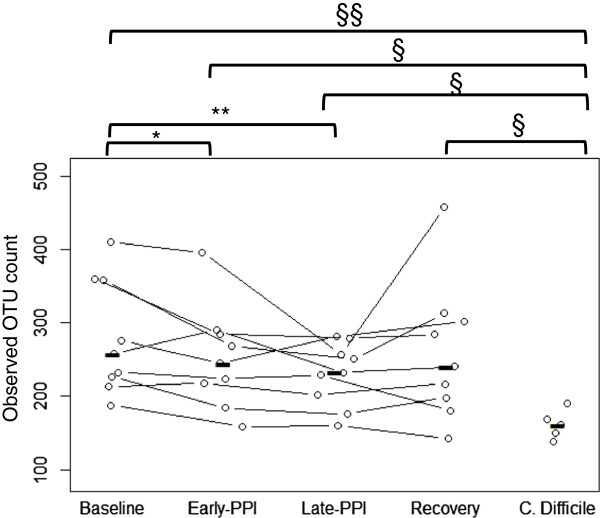
BACKGROUND: The role of the gut microbiome in arresting pathogen colonization and growth is important for protection against Clostridium difficile infection (CDI). Observational studies associate proton pump inhibitor (PPI) use and CDI incidence. We hypothesized that PPI use affected the distal gut microbiome over time, an effect that would be best explored by time-longitudinal study of healthy subjects on PPI in comparison to treatment-naïve CDI subjects. This study enrolled nine healthy human subjects and five subjects with treatment-naïve CDI. After random assignment to a low (20 mg/day) or high (2× 20 mg/day) dose group, fecal samples were collected from the nine healthy subjects before, during, and after 28 days of PPI use. This was done in conjunction with pre-treatment fecal collection from CDI subjects. High-throughput sequencing (16S rRNA) was performed on time-longitudinal samples to assess changes to the healthy gut microbiome associated with prolonged PPI usage. The healthy samples were then compared to the CDI subjects to explore changes over time to the gut microbiome associated with PPI use and potentially related to CDI. RESULTS: We report that PPI usage at low and high dosages, administered for 28 days, resulted in decreases to observed operational taxonomic unit (OTU) counts after both 1 week and 1 month. This decrease resulted in observed OTU levels that were similar to those found in treatment-naïve CDI patients, which was partly reversible after a 1 month recovery period. We did not detect a dose-dependent difference in OTU levels nor did we detect significant changes in taxa previously reported to be affected by PPI treatment. CONCLUSION: While our observation of diminishing observed OTU counts during PPI therapy is a preliminary finding in a small cohort, our hypothesis that PPIs disrupt the healthy human gut microbiome is supported in this group. We conclude that decreases in observed species counts were reversible after cessation of PPI usage within 1 month. This finding may be a potential explanation for the association between prolonged PPI usage and CDI incidence.
Overview
The claims and statistics of this paper haven’t been checked yet.
Free: it reads the open-access text and checks the first 5 claims that cite a source we can check. Create a free account to check every claim.
Integrity signals
Registry
Cites
Statistics
Figures
Verification
Claims the paper makes
The claims and statistics of this paper haven’t been checked yet.
Free: it reads the open-access text and checks the first 5 claims that cite a source we can check. Create a free account to check every claim.
Claims other papers make about this one
Each is checked against this paper’s own text: does it say what the citing paper says it does?
In the citing paper
“PPIs, for instance, enrich Firmicutes and oral taxa like Streptococcus salivarius and Micrococcaceae, expand Veillonella and Enterocloster, and reduce overall diversity, a profile linked to Clostridioides difficile infection and adverse metabolic shifts.43,92–97”
From Gut dysbiosis in oncology: a risk factor for immunoresistance (2026) · doi:10.1038/s41422-025-01212-6 · cites this paper as [96]
Self-check
Percentages, sums and reported differences re-computed from the paper’s own numbers.
The self-check needs the paper’s full text.
Citations
Cites
KEGG: Kyoto Encyclopedia of Genes and Genomes
Kanehisa, M. (2000) · Nucleic Acids Research · doi:10.1093/nar/28.1.27 · Cited by 37,077
QIIME allows analysis of high-throughput community sequencing data
Caporaso, J. G., Kuczynski, J., Stombaugh, J., Bittinger, K., Bushman, F. D., Costello, E. K., Fierer, N., Peña, A. G., Goodrich, J. K., Gordon, J. I., et al. (2010) · Nature Methods · doi:10.1038/nmeth.f.303 · Cited by 34,887
The SILVA ribosomal RNA gene database project: improved data processing and web-based tools
Quast, C., Pruesse, E., Yilmaz, P., Gerken, J., Schweer, T., Yarza, P., Peplies, J., & Glöckner, F. O. (2012) · Nucleic Acids Research · doi:10.1093/nar/gks1219 · Cited by 33,055 · cited 1×
“difficile representatives, 72 sequences and appropriate taxonomy were downloaded from SILVA SSU r117 [52] by searching the online version of r117 for “clostridium difficile” for non-repetitive reference sequences (Ref(NR)).”
MethodKEGG: Kyoto Encyclopedia of Genes and Genomes
Ogata, H., Goto, S., Sato, K., Fujibuchi, W., Bono, H., & Kanehisa, M. (1999) · Nucleic Acids Research · doi:10.1093/nar/27.1.29 · Cited by 31,232
Schloss, P. D., Westcott, S. L., Ryabin, T., Hall, J. R., Hartmann, M., Hollister, E. B., Lesniewski, R. A., Oakley, B. B., Parks, D. H., Robinson, C. J., et al. (2009) · Applied and Environmental Microbiology · doi:10.1128/aem.01541-09 · Cited by 19,549 · cited 1×
“1 [50].”
UPARSE: highly accurate OTU sequences from microbial amplicon reads
Edgar, R. C. (2013) · Nature Methods · doi:10.1038/nmeth.2604 · Cited by 16,707 · cited 1×
“Briefly, after quality-filtering using Trimmomatic, paired 16S reads were de-replicated and singletons and chimeras were removed and clustered by similarity with representative sequence selection with USEARCH, part of the UPARSE package [48].”
MethodGreengenes, a Chimera-Checked 16S rRNA Gene Database and Workbench Compatible with ARB
DeSantis, T. Z., Hugenholtz, P., Larsen, N., Rojas, M., Brodie, E. L., Keller, K., Huber, T., Dalevi, D., Hu, P., & Andersen, G. L. (2006) · Applied and Environmental Microbiology · doi:10.1128/aem.03006-05 · Cited by 10,891
Predictive functional profiling of microbial communities using 16S rRNA marker gene sequences
Langille, M. G. I., Zaneveld, J., Caporaso, J. G., McDonald, D., Knights, D., Reyes, J. A., Clemente, J. C., Burkepile, D. E., Vega Thurber, R. L., Knight, R., et al. (2013) · Nature Biotechnology · doi:10.1038/nbt.2676 · Cited by 9,116
Ultra-high-throughput microbial community analysis on the Illumina HiSeq and MiSeq platforms
Caporaso, J. G., Lauber, C. L., Walters, W. A., Berg-Lyons, D., Huntley, J., Fierer, N., Owens, S. M., Betley, J., Fraser, L., Bauer, M., et al. (2012) · The ISME Journal · doi:10.1038/ismej.2012.8 · Cited by 8,839 · cited 1×
“3 uM V3-V5 barcoded primers [46] targeting 357 F and 926R (5′AATGA TACGGCGACCACCGAGATCTACACTATGGTAATT GTCCTACGGGAGGCAGCAG3′ and 5′CAAGCAGA AGACGGCATACGAGATGCCGCATTCGATXXXXXXX XXXXXCCGTCAATTCMTTTRAGT3′, respectively) of the bacterial 16S gene, along with Kapa HiFi Hotstart Ready Mix (Kapa Biosystem).”
MethodQuality-filtering vastly improves diversity estimates from Illumina amplicon sequencing
Bokulich, N. A., Subramanian, S., Faith, J. J., Gevers, D., Gordon, J. I., Knight, R., Mills, D. A., & Caporaso, J. G. (2013) · Nature Methods · doi:10.1038/nmeth.2276 · Cited by 4,401 · cited 1×
“Quality control of 16S reads can strongly effect ecological diversity metrics such as alpha- and beta-diversity, with filtering of low quality reads playing an important role in reducing the count of spurious OTU detection [47].”
BackgroundBurden of Gastrointestinal Disease in the United States: 2012 Update
Peery, A. F., Dellon, E. S., Lund, J., Crockett, S. D., McGowan, C. E., Bulsiewicz, W. J., Gangarosa, L. M., Thiny, M. T., Stizenberg, K., Morgan, D. R., et al. (2012) · Gastroenterology · doi:10.1053/j.gastro.2012.08.002 · Cited by 2,015
Multivariate analyses in microbial ecology
Ramette, A. (2007) · FEMS Microbiology Ecology · doi:10.1111/j.1574-6941.2007.00375.x · Cited by 1,928 · cited 1×
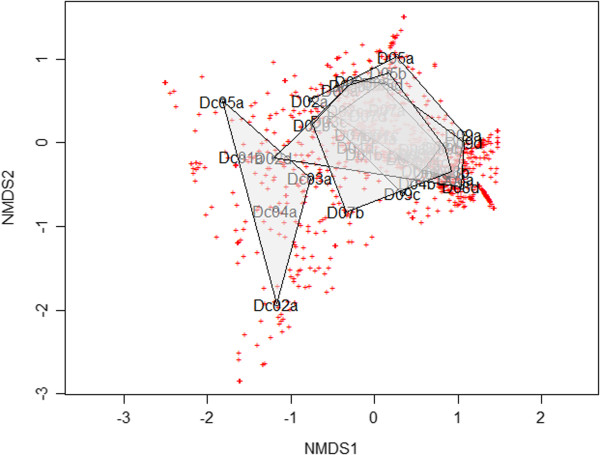
“NMDS uses rank-order of pairwise distances in a distance matrix and is a more robust technique for measuring relatedness of samples [55].”
MethodBayesian community-wide culture-independent microbial source tracking
Knights, D., Kuczynski, J., Charlson, E. S., Zaneveld, J., Mozer, M. C., Collman, R. G., Bushman, F. D., Knight, R., & Kelley, S. T. (2011) · Nature Methods · doi:10.1038/nmeth.1650 · Cited by 1,856
Compositional dissimilarity as a robust measure of ecological distance
Faith, D. P., Minchin, P. R., & Belbin, L. (1987) · Vegetatio · doi:10.1007/bf00038687 · Cited by 1,554 · cited 1×
“NMDS was selected to analyze the between-sample distances of the community matrix [54].”
MethodCompositional dissimilarity as a robust measure of ecological distance
Faith, D. P., Minchin, P. R., & Belbin, L. (1987) · Theory and models in vegetation science · doi:10.1007/978-94-009-4061-1_6 · Cited by 1,449
Microbiota-liberated host sugars facilitate post-antibiotic expansion of enteric pathogens
Ng, K. M., Ferreyra, J. A., Higginbottom, S. K., Lynch, J. B., Kashyap, P. C., Gopinath, S., Naidu, N., Choudhury, B., Weimer, B. C., Monack, D. M., et al. (2013) · Nature · doi:10.1038/nature12503 · Cited by 1,035 · cited 1×
“difficile bacterial load [34].”
Decreased Diversity of the Fecal Microbiome in Recurrent Clostridium difficile–Associated Diarrhea
Chang, J. Y., Antonopoulos, D. A., Kalra, A., Tonelli, A., Khalife, W. T., Schmidt, T. M., & Young, V. B. (2008) · The Journal of Infectious Diseases · doi:10.1086/525047 · Cited by 1,010 · cited 1×
“The loss of colonic microbial diversity is a characteristic feature of CDI [23,24].”
BackgroundBile Salts and Glycine as Cogerminants for Clostridium difficile Spores
Sorg, J. A., & Sonenshein, A. L. (2008) · Journal of Bacteriology · doi:10.1128/jb.01765-07 · Cited by 711 · cited 1×
“In contrast, secondary bile salts such as deoxycholate prevent vegetative growth [38,40].”
BackgroundProton Pump Inhibitor and Histamine 2 Receptor Antagonist Use and Vitamin B12Deficiency
Lam, J. R., Schneider, J. L., Zhao, W., & Corley, D. A. (2013) · JAMA · doi:10.1001/jama.2013.280490 · Cited by 582 · cited 3×
“Howden C: Vitamin B12 levels during prolonged treatment with proton pump inhibitors.”
BackgroundRisk of Clostridium difficile Infection With Acid Suppressing Drugs and Antibiotics: Meta-Analysis
Kwok, C. S., Arthur, A. K., Anibueze, C. I., Singh, S., Cavallazzi, R., & Loke, Y. K. (2012) · American Journal of Gastroenterology · doi:10.1038/ajg.2012.108 · Cited by 581
Clostridium difficile-associated diarrhea and proton pump inhibitor therapy: a meta-analysis
Janarthanan, S., Ditah, I., Adler, D. G., & Ehrinpreis, M. N. (2012) · American Journal of Gastroenterology · doi:10.1038/ajg.2012.179 · Cited by 538
A mouse model of clostridium difficile-associated disease
Chen, X., Katchar, K., Goldsmith, J. D., Nanthakumar, N., Cheknis, A., Gerding, D. N., & Kelly, C. P. (2008) · Gastroenterology · doi:10.1053/j.gastro.2008.09.002 · Cited by 510 · cited 1×
“Loss of microbial diversity is a consistent feature in CDI patients [32] and animal models of antibiotic-mediated CDI [33].”
BackgroundAntharam, V. C., Li, E. C., Ishmael, A., Sharma, A., Mai, V., Rand, K. H., & Wang, G. P. (2013) · Journal of Clinical Microbiology · doi:10.1128/jcm.00845-13 · Cited by 485 · cited 1×
“The loss of colonic microbial diversity is a characteristic feature of CDI [23,24].”
BackgroundProton Pump Inhibitors Exacerbate NSAID-Induced Small Intestinal Injury by Inducing Dysbiosis
Wallace, J. L., Syer, S., Denou, E., de Palma, G., Vong, L., McKnight, W., Jury, J., Bolla, M., Bercik, P., Collins, S. M., et al. (2011) · Gastroenterology · doi:10.1053/j.gastro.2011.06.075 · Cited by 460 · cited 1×
“Prolonged use of PPIs has been linked to changes in the microbial community composition of the upper intestinal tract in vitro [10,11,26,27].”
BackgroundRole of the Intestinal Microbiota in Resistance to Colonization by Clostridium difficile
Britton, R. A., & Young, V. B. (2014) · Gastroenterology · doi:10.1053/j.gastro.2014.01.059 · Cited by 446 · cited 2×
“difficile, glycine appears to alter the ratio of deconjugated (primary bile salts) to conjugated (secondary bile salts) in the intestine [22].”
BackgroundEpidemiology of Community-Associated Clostridium difficile Infection, 2009 Through 2011
Chitnis, A. S., Holzbauer, S. M., Belflower, R. M., Winston, L. G., Bamberg, W. M., Lyons, C., Farley, M. M., Dumyati, G. K., Wilson, L. E., Beldavs, Z. G., et al. (2013) · JAMA Internal Medicine · doi:10.1001/jamainternmed.2013.7056 · Cited by 405
Proton Pump Inhibitor Use and the Risk of Small Intestinal Bacterial Overgrowth: A Meta-analysis
Lo, W., & Chan, W. W. (2013) · Clinical Gastroenterology and Hepatology · doi:10.1016/j.cgh.2012.12.011 · Cited by 353 · cited 2×
“Prolonged use of PPIs has been linked to changes in the microbial community composition of the upper intestinal tract in vitro [10,11,26,27].”
BackgroundIncreased Incidence of Small Intestinal Bacterial Overgrowth During Proton Pump Inhibitor Therapy
Lombardo, L., Foti, M., Ruggia, O., & Chiecchio, A. (2010) · Clinical Gastroenterology and Hepatology · doi:10.1016/j.cgh.2009.12.022 · Cited by 350 · cited 2×
“Prolonged use of PPIs has been linked to changes in the microbial community composition of the upper intestinal tract in vitro [10,11,26,27].”
BackgroundSorg, J. A., & Sonenshein, A. L. (2010) · Journal of Bacteriology · doi:10.1128/jb.00610-10 · Cited by 332 · cited 1×
“Chenodeoxycholate, a primary bile salt, inhibits germination and protects the small intestine by inhibiting production of vegetative forms, until spores reach the anaerobic environment of the large bowel [42].”
BackgroundSchubert, A. M., Rogers, M. A. M., Ring, C., Mogle, J., Petrosino, J. P., Young, V. B., Aronoff, D. M., & Schloss, P. D. (2014) · mBio · doi:10.1128/mbio.01021-14 · Cited by 318 · cited 1×
“Microbiome analysis of the feces has been shown to improve the ability to distinguish CDI status when comparing cases with both diarrheal and non-diarrheal controls [25].”
BackgroundAdverse Effects of Long-Term Proton Pump Inhibitor Therapy
Sheen, E., & Triadafilopoulos, G. (2011) · Digestive Diseases and Sciences · doi:10.1007/s10620-010-1560-3 · Cited by 307 · cited 1×
“Specifically, their prolonged use has been associated with iron [4] and vitamin B12 [5,6] deficiencies, hypomagnesemia [7], osteoporosis-related fractures [8,9], small intestinal bacterial overgrowth [10,11], and community-acquired pneumonia [12,13].”
BackgroundRole of competition for nutrients in suppression of Clostridium difficile by the colonic microflora
Wilson, K. H., & Perini, F. (1988) · Infection and Immunity · doi:10.1128/iai.56.10.2610-2614.1988 · Cited by 294 · cited 1×
“difficile in utilization of available amino acids [35], monomeric glucose, N-acetylglucosamine, and sialic acids [36].”
BackgroundTheisen, J., Nehra, D., Citron, D., Johansson, J., Hagen, J. A., Crookes, P. F., DeMeester, S. R., Bremner, C. G., DeMeester, T. R., & Peters, J. H. (2000) · Journal of Gastrointestinal Surgery · doi:10.1016/s1091-255x(00)80032-3 · Cited by 217 · cited 1×
“After severe disruption of gut microbial populations by PPI-induced hypochlorhydria, secondary bile salts are significantly reduced, allowing unrestricted vegetative growth [41].”
BackgroundOmeprazole: The first proton pump inhibitor
Lindberg, P., Brändström, A., Wallmark, B., Mattsson, H., Rikner, L., & Hoffmann, K. (1990) · Medicinal Research Reviews · doi:10.1002/med.2610100102 · Cited by 213 · cited 1×
“[3], epidemiological studies have linked PPIs to several nutritional, metabolic, and infectious disorders.”
BackgroundAcid-Suppressive Medications and Risk of Bone Loss and Fracture in Older Adults
Yu, E. W., Blackwell, T., Ensrud, K. E., Hillier, T. A., Lane, N. E., Orwoll, E., & Bauer, D. C. (2008) · Calcified Tissue International · doi:10.1007/s00223-008-9170-1 · Cited by 210 · cited 1×
“Specifically, their prolonged use has been associated with iron [4] and vitamin B12 [5,6] deficiencies, hypomagnesemia [7], osteoporosis-related fractures [8,9], small intestinal bacterial overgrowth [10,11], and community-acquired pneumonia [12,13].”
BackgroundLong-term Safety Concerns with Proton Pump Inhibitors
Ali, T., Roberts, D. N., & Tierney, W. M. (2009) · The American Journal of Medicine · doi:10.1016/j.amjmed.2009.04.014 · Cited by 199 · cited 1×
“Specifically, their prolonged use has been associated with iron [4] and vitamin B12 [5,6] deficiencies, hypomagnesemia [7], osteoporosis-related fractures [8,9], small intestinal bacterial overgrowth [10,11], and community-acquired pneumonia [12,13].”
BackgroundMetabolism of Bile Salts in Mice Influences Spore Germination in Clostridium difficile
Giel, J. L., Sorg, J. A., Sonenshein, A. L., & Zhu, J. (2010) · PLoS ONE · doi:10.1371/journal.pone.0008740 · Cited by 194
Martínez, I., Muller, C. E., & Walter, J. (2013) · PLoS ONE · doi:10.1371/journal.pone.0069621 · Cited by 181 · cited 1×
“Our findings are consistent with past longitudinal studies of the GI microbiome that indicate stable individual microbial communities [29].”
ResultGarcia-Mazcorro, J. F., Suchodolski, J. S., Jones, K. R., Clark-Price, S. C., Dowd, S. E., Minamoto, Y., Markel, M., Steiner, J. M., & Dossin, O. (2012) · FEMS Microbiology Ecology · doi:10.1111/j.1574-6941.2012.01331.x · Cited by 149 · cited 1×
“and Bacteroides-Prevotella-Porphyromonas in the male dogs only [30].”
BackgroundAssociation Between Proton Pump Inhibitor Use and Anemia: A Retrospective Cohort Study
Sarzynski, E. M., Puttarajappa, C. M., Xie, Y., Grover, M., & Laird-Fick, H. S. (2011) · Digestive Diseases and Sciences · doi:10.1007/s10620-011-1589-y · Cited by 120 · cited 1×
“Specifically, their prolonged use has been associated with iron [4] and vitamin B12 [5,6] deficiencies, hypomagnesemia [7], osteoporosis-related fractures [8,9], small intestinal bacterial overgrowth [10,11], and community-acquired pneumonia [12,13].”
BackgroundMapping Interactions between Germinants and Clostridium difficile Spores
Howerton, A., Ramirez, N., & Abel-Santos, E. (2011) · Journal of Bacteriology · doi:10.1128/jb.00980-10 · Cited by 117 · cited 1×
“In contrast, secondary bile salts such as deoxycholate prevent vegetative growth [38,40].”
BackgroundVitamin B12 Levels During Prolonged Treatment With Proton Pump Inhibitors
Howden, C. W. (2000) · Journal of Clinical Gastroenterology · doi:10.1097/00004836-200001000-00006 · Cited by 116 · cited 3×
“Howden C: Vitamin B12 levels during prolonged treatment with proton pump inhibitors.”
BackgroundGastric acid reduction leads to an alteration in lower intestinal microflora
Kanno, T., Matsuki, T., Oka, M., Utsunomiya, H., Inada, K., Magari, H., Inoue, I., Maekita, T., Ueda, K., Enomoto, S., et al. (2009) · Biochemical and Biophysical Research Communications · doi:10.1016/j.bbrc.2009.02.109 · Cited by 113
Proton Pump Inhibitors and Risk for Recurrent Clostridium difficile Infection Among Inpatients
Freedberg, D. E., Salmasian, H., Friedman, C., & Abrams, J. A. (2013) · American Journal of Gastroenterology · doi:10.1038/ajg.2013.333 · Cited by 112 · cited 1×
“Furthermore, several recent studies have found an association between the use of PPIs and the development of Clostridium difficile infection (CDI) [14-18].”
BackgroundProton pump inhibitors as a risk factor for recurrence of Clostridium-difficile-associated diarrhea
Kim, J. W. (2010) · World Journal of Gastroenterology · doi:10.3748/wjg.v16.i28.3573 · Cited by 110
Pérez-Cobas, A. E., Artacho, A., Ott, S. J., Moya, A., Gosalbes, M. J., & Latorre, A. (2014) · Frontiers in Microbiology · doi:10.3389/fmicb.2014.00335 · Cited by 105 · cited 1×
“Loss of microbial diversity is a consistent feature in CDI patients [32] and animal models of antibiotic-mediated CDI [33].”
Backgroundde Vries, F., Cooper, A., Cockle, S. M., van Staa, T. P., & Cooper, C. C. (2009) · Osteoporosis International · doi:10.1007/s00198-009-0891-4 · Cited by 102
Proton Pump Inhibitors and the Risk for Hospital-Acquired Clostridium difficile Infection
Barletta, J. F., El‐Ibiary, S. Y., Davis, L. E., Nguyen, B. Q., & Raney, C. R. K. (2013) · Mayo Clinic Proceedings · doi:10.1016/j.mayocp.2013.07.004 · Cited by 76 · cited 1×
“Furthermore, several recent studies have found an association between the use of PPIs and the development of Clostridium difficile infection (CDI) [14-18].”
BackgroundIn Vitro Killing of Nosocomial Pathogens by Acid and Acidified Nitrite
Rao, A., Jump, R. L. P., Pultz, N. J., Pultz, M. J., & Donskey, C. J. (2006) · Antimicrobial Agents and Chemotherapy · doi:10.1128/aac.01506-05 · Cited by 71 · cited 1×
“difficile spores are unaffected by gastric acidity [21].”
BackgroundProton pump inhibitor-induced hypomagnesemia: A new challenge
Florentin, M. (2012) · World Journal of Nephrology · doi:10.5527/wjn.v1.i6.151 · Cited by 56 · cited 1×
“Specifically, their prolonged use has been associated with iron [4] and vitamin B12 [5,6] deficiencies, hypomagnesemia [7], osteoporosis-related fractures [8,9], small intestinal bacterial overgrowth [10,11], and community-acquired pneumonia [12,13].”
BackgroundYamamoto-Osaki, T., Kamiya, S., Sawamura, S., Kai, M., & Ozawa, A. (1994) · Journal of Medical Microbiology · doi:10.1099/00222615-40-3-179 · Cited by 55 · cited 1×
“difficile in utilization of available amino acids [35], monomeric glucose, N-acetylglucosamine, and sialic acids [36].”
BackgroundNerandzic, M. M., Pultz, M. J., & Donskey, C. J. (2009) · Antimicrobial Agents and Chemotherapy · doi:10.1128/aac.00252-09 · Cited by 54 · cited 1×
“difficile spore germination in gastric contents was increased by nutrient supplementation as opposed to PPI use but did not compare germination efficacy with and without PPI [44].”
BackgroundToxin production by Clostridium difficile in a defined medium with limited amino acids
Yamakawa, K., Kamiya, S., MENG, X. Q., Karasawa, T., & NAKAMURA, S. (1994) · Journal of Medical Microbiology · doi:10.1099/00222615-41-5-319 · Cited by 44 · cited 1×
“difficile toxin production [39].”
Jonkers, D. M. A. E., Stobberingh, E. E., & Stockbrügger, R. W. (1996) · Journal of Antimicrobial Chemotherapy · doi:10.1093/jac/37.1.145 · Cited by 29 · cited 1×
“In contrast, omeprazole can inhibit the growth of many gut microbial species [31].”
BackgroundStewart, D. B., & Hegarty, J. P. (2013) · Journal of Medical Microbiology · doi:10.1099/jmm.0.059709-0 · Cited by 26 · cited 1×
“difficile possess enhanced toxin production in the presence of omeprazole, independent of final pH [45].”
BackgroundStewart, D. B., & Hegarty, J. P. (2013) · Journal of Medical Microbiology · doi:10.1099/jmm.0.069260-0 · Cited by 20
Research works printed but not linked: 2
- FDA: FDA Drug Safety Communication: Clostridium difficile-associated diarrhea can be associated with stomach acid drugs known as proton pump inhibitors (PPIs). United States: 2012.
- Meyer D, Dimitriadou E, Hornik K, Weingessel K, Leisch L: e1071: Misc Functions of the Department of Statistics (e1071), TU Wien. R package version 1.6-3; 2014.
Cited by
McDonald, L. C., Gerding, D. N., Johnson, S., Bakken, J. S., Carroll, K. C., Coffin, S. E., Dubberke, E. R., Garey, K. W., Gould, C. V., Kelly, C., et al. (2018) · Clinical Infectious Diseases · doi:10.1093/cid/cix1085 · Cited by 2,690
Proton pump inhibitors alter the composition of the gut microbiota
Jackson, M. A., Goodrich, J. K., Maxan, M.-E., Freedberg, D. E., Abrams, J. A., Poole, A. C., Sutter, J. L., Welter, D., Ley, R. E., Bell, J. T., et al. (2016) · Gut · doi:10.1136/gutjnl-2015-310861 · Cited by 895
Gut microbiome interactions with drug metabolism, efficacy, and toxicity
Wilson, I. D., & Nicholson, J. K. (2017) · Translational Research · doi:10.1016/j.trsl.2016.08.002 · Cited by 656
The Microbiome of Aseptically Collected Human Breast Tissue in Benign and Malignant Disease
Hieken, T. J., Chen, J., Hoskin, T. L., Walther-Antonio, M., Johnson, S., Ramaker, S., Xiao, J., Radisky, D. C., Knutson, K. L., Kalari, K. R., et al. (2016) · Scientific Reports · doi:10.1038/srep30751 · Cited by 494
Self-citationFreedberg, D. E., Toussaint, N. C., Chen, S. P., Ratner, A. J., Whittier, S., Wang, T. C., Wang, H. H., & Abrams, J. A. (2015) · Gastroenterology · doi:10.1053/j.gastro.2015.06.043 · Cited by 322
Metadata
- Authors
- Seto, C. T., Jeraldo, P., Orenstein, R., Chia, N., & DiBaise, J. K.
- Affiliations
- Mayo Clinic (US)
- Corresponding author
- Chia, Nicholas
- DiBaise, John K
- Venue
- Microbiome
- Published
- 2014-11-25
- Volume
- 2
- Issue
- 1
- Pages
- 10-10
- ISSN
- 2049-2618 (ISSN-L)
- PMC
- PMC4242847
- OpenAlex
- W2097319008
- Cited by
- 163
- References
- 57
- Citations by year
- 2026: 5 · 2025: 10 · 2024: 8 · 2023: 16 · 2022: 6 · 2021: 13 · 2020: 24 · 2019: 14 · 2018: 12 · 2017: 22 · 2016: 19 · 2015: 13
- FWCI
- 12.65
- Type
- journal article
- Language
- en
- Update notices
- correction (2016-02-22)
- Open access
- gold
- doi.org
- Licence
- cc-by
- Locations
- Microbiome (publishedVersion, cc-by)
- Europe PMC (PubMed Central) (publishedVersion, cc-by)
- PubMed Central (publishedVersion, cc-by)
- PubMed (publishedVersion)
- Funders
- National Cancer Institute (R01CA179243)
- Topics
- Health Sciences › Medicine › Infectious Diseases › Clostridium difficile and Clostridium perfringens research
- Life Sciences › Biochemistry, Genetics and Molecular Biology › Molecular Biology › Gut microbiota and health
- Health Sciences › Medicine › Gastroenterology › Gastrointestinal motility and disorders
- Keywords
- proton pump inhibitors, Clostridium difficile infection, gut microbiota, microbial diversity, operational taxonomic units, fecal microbiota
About these checks
Registry, retraction, Cites and statistics results are computed, not judged, with one exception: a printed reference that no index lists is read once by a model before it counts as a citation error. Claims are extracted by a model and kept only when their quote appears verbatim in the text; each cited source is then checked, with a model’s help, for whether it says what the claim relies on. Those verdicts can be wrong — read the claim’s quote and the cited source before relying on one.
Statistics and arithmetic are recomputed, not judged.
Confidence bands are shown only for fields calibrated on our annotated test set. None is calibrated yet, so no band is shown.
What counts as a claim ›How we measure confidence ›How we check this ›
Are you an author, or do you see a problem with this page? Request a review
Data sources
Bibliographic data: Semantic Scholar, OpenAlex, Crossref.
Contains information from the Semantic Scholar Academic Graph Datasets, made available under the ODC Attribution License (ODC-BY 1.0).
Semantic Scholar’s data is described in: Kinney, R., et al. (2023). The Semantic Scholar Open Data Platform. arXiv:2301.10140.
