

The DOI matches its Crossref record; 92 of the 93 references it cites were found in a registry or an index, and 1 are not checked yet.
The prion hypothesis in Parkinson's disease: Braak to the future
Open accessAbstract
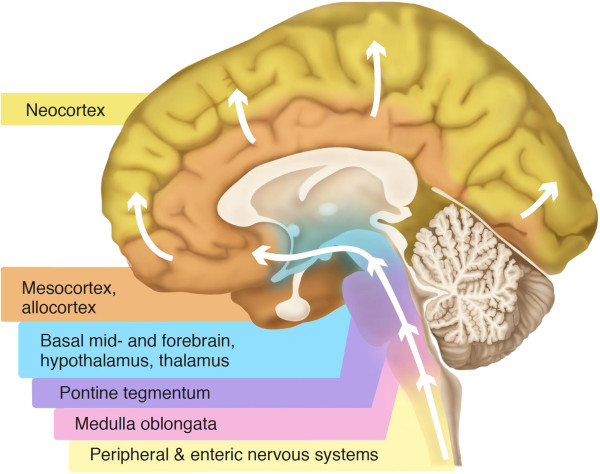
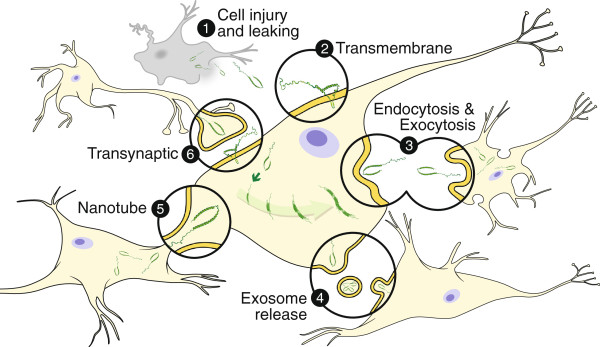
Parkinson's disease (PD) is a progressive neurodegenerative disorder typified by the presence of intraneuronal inclusions containing aggregated alpha synuclein (αsyn). The progression of parkinsonian pathology and clinical phenotype has been broadly demonstrated to follow a specific pattern, most notably described by Braak and colleagues. In more recent times it has been hypothesized that αsyn itself may be a critical factor in mediating transmission of disease pathology from one brain area to another. Here we investigate the growing body of evidence demonstrating the ability of αsyn to spread transcellularly and induce pathological aggregation affecting neurons by permissive templating and provide a critical analysis of some irregularities in the hypothesis that the progression of PD pathology may be mediated by such a prion-like process. Finally we discuss some key questions that remain unanswered which are vital to determining the potential contribution of a prion-like process to the pathogenesis of PD.
Overview
The claims and statistics of this paper haven’t been checked yet.
Run the check — free, no account needed. It reads the open-access text and checks the sources it cites.
Integrity signals
Registry
Cites
Statistics
Figures
Verification
Claims the paper makes
The claims and statistics of this paper haven’t been checked yet.
Run the check — free, no account needed. It reads the open-access text and checks the sources it cites.
Claims other papers make about this one
Each is checked against this paper’s own text: does it say what the citing paper says it does?
In the citing paper
“It has been suggested that alpha-synuclein could act like a prion protein during PD pathogenesis.In this theory pathologic, misfolded alpha-synuclein is an 'infectious' protein spreading pathology by forming a template that seeds misfolding for nearby alpha-synuclein protein, turning the previously healthy protein into a pathogenic protein (Jucker and Walker, 2013;Visanji et al., 2013).”
From The Gut-Brain Axis in Parkinson’s Disease: Possibilities for Food-Based Therapies (2017) · cites this paper as Visanji et al., 2013
Self-check
Percentages, sums and reported differences re-computed from the paper’s own numbers.
The self-check needs the paper’s full text.
Citations
Cites
Staging of brain pathology related to sporadic Parkinson’s disease
Braak, H., Tredici, K. D., Rüb, U., de Vos, R. A. I., Jansen Steur, E. N. H., & Braak, E. (2003) · Neurobiology of Aging · doi:10.1016/s0197-4580(02)00065-9 · Cited by 10,777
Prusiner, S. B. (1998) · Proceedings of the National Academy of Sciences · doi:10.1073/pnas.95.23.13363 · Cited by 5,373
Novel Proteinaceous Infectious Particles Cause Scrapie
Prusiner, S. B. (1982) · Science · doi:10.1126/science.6801762 · Cited by 5,221
Luk, K. C., Kehm, V., Carroll, J., Zhang, B., O’Brien, P., Trojanowski, J. Q., & Lee, V. M.-Y. (2012) · Science · doi:10.1126/science.1227157 · Cited by 2,563
Pan, K. M., Baldwin, M. A., Nguyen, J. T., Gasset, M., Serban, A. V., Groth, D., Mehlhorn, I., Huang, Z., Fletterick, R. J., & Cohen, F. E. (1993) · Proceedings of the National Academy of Sciences · doi:10.1073/pnas.90.23.10962 · Cited by 2,281
Li, J.-Y., Englund, E., Holton, J. L., Soulet, D., Hagell, P., Lees, A. J., Lashley, T., Quinn, N. P., Rehncrona, S., Björklund, A., et al. (2008) · Nature Medicine · doi:10.1038/nm1746 · Cited by 1,845
Lewy body–like pathology in long-term embryonic nigral transplants in Parkinson's disease
Kordower, J. H., Chu, Y., Hauser, R. A., Freeman, T. B., & Olanow, C. W. (2008) · Nature Medicine · doi:10.1038/nm1747 · Cited by 1,722
Braak, H., R�b, U., Gai, W. P., & Del Tredici, K. (2003) · Journal of Neural Transmission · doi:10.1007/s00702-002-0808-2 · Cited by 1,683
Inclusion formation and neuronal cell death through neuron-to-neuron transmission of α-synuclein
Desplats, P., Lee, H.-J., Bae, E.-J., Patrick, C., Rockenstein, E., Crews, L., Spencer, B., Masliah, E., & Lee, S.-J. (2009) · Proceedings of the National Academy of Sciences · doi:10.1073/pnas.0903691106 · Cited by 1,485
Braak, H., de Vos, R. A. I., Bohl, J., & Del Tredici, K. (2006) · Neuroscience Letters · doi:10.1016/j.neulet.2005.11.012 · Cited by 1,354
Cited by
Sorted by citations
Items 201–285 of 285
Hurtado, J. C., Berrío, J. P., Nunes, R. B., & de Oliveira, A. A. (2017) · Stem Cell Reviews and Reports · doi:10.1007/s12015-017-9798-1 · Cited by 4
El‐Mansoury, B., Smimih, K., Khiat, A. E., Fatimi, H. E., Aimrane, A., Baz, S. E., Elmourid, A., Saad, F. E.-Z., Ghachi, H. E., Khanouchi, M., et al. (2023) · Advances in medical diagnosis, treatment, and care (AMDTC) book series · doi:10.4018/978-1-6684-5156-4.ch017 · Cited by 4
Decoding the Role of Nuclear Sirtuins in Parkinson’s Pathogenesis
Patel, D., Soni, R., & Shah, J. (2024) · ACS Chemical Neuroscience · doi:10.1021/acschemneuro.4c00507 · Cited by 4
Recent advances in understanding the lymphatic and glymphatic systems of the brain
Simka, M. (2015) · Phlebological Review · doi:10.5114/pr.2015.57465 · Cited by 4
Chlorogenic acid as a neuroprotectant
Soni, R., Sharma, N., Shah, J., & Khairnar, A. (2024) · Coffee in Health and Disease Prevention · doi:10.1016/b978-0-443-13868-3.00026-0 · Cited by 3
Ikewaki, N., Hegde, M. L., Rao, K. S. J., Raghavan, K., Yamamoto, N., Ichiyama, K., Senthilkumar, R., Preethy, S., & Abraham, S. J. (2025) · Future Neurology · doi:10.1080/14796708.2025.2505398 · Cited by 3
Lechner, S. A., Barnett, D. G. S., Gammie, S. C., & Kelm‐Nelson, C. A. (2024) · BMC Neuroscience · doi:10.1186/s12868-024-00857-0 · Cited by 3
Han, F., Liu, M., Jiao, Q., Du, X., Yan, C., Chen, X., & Jiang, H. F. (2025) · Neuroscience Bulletin · doi:10.1007/s12264-025-01509-x · Cited by 3
Something wicked this way comes: huntingtin
Spada, A. R. L. (2014) · Nature Neuroscience · doi:10.1038/nn.3770 · Cited by 3
Jellinger, K. A. (2014) · Elsevier eBooks · doi:10.1016/b978-0-12-386456-7.04605-0 · Cited by 3
Morén, C., González‐Casacuberta, I., Navarro‐Otano, J., Juárez‐Flores, D. L., Vilas, D., Garrabou, G., Milisenda, J. C., Pont‐Sunyer, C., Catalán‐García, M., Guitart‐Mampel, M., et al. (2017) · Parkinson s Disease · doi:10.1155/2017/9816095 · Cited by 4
Prion-Like Propagation in Neurodegenerative Diseases
Peelaerts, W., Baekelandt, V., & Brundin, P. (2018) · Elsevier eBooks · doi:10.1016/b978-0-12-811304-2.00008-0 · Cited by 3
Cardiac sympathetic denervation could be associated with dysphagia in Parkinson's disease
Youn, J., Umemoto, G., Oh, E., Park, J., Jang, W., Oh, Y., Kim, H.-T., Cho, J. W., Fujioka, S., & Tsuboi, Y. (2022) · Frontiers in Neurology · doi:10.3389/fneur.2022.1010006 · Cited by 3
The genetics of phospholipase A2 induced redox signaling in neuroinflammation and neuronal diseases
Maiti, A. K. (2023) · Elsevier eBooks · doi:10.1016/b978-0-323-95698-7.00017-6 · Cited by 2
Targeting TLR4 in Parkinson's disease: mechanisms and therapeutic prospects
Dong, S., Lu, J., Wu, L., Wang, S., 宫玉波, Hu, J., Liu, Y., & Chen, X. (2026) · International Immunopharmacology · doi:10.1016/j.intimp.2026.116780 · Cited by 2
An Overview of Stem Cell Therapies for Parkinson’s Disease
Faour, S., & Ashok, A. (2021) · UTSC s Journal of Natural Sciences · doi:10.33137/jns.v2i1.35890 · Cited by 2
A role of the gastrointestinal tract microbiota in the pathogenesis of Parkinson’s disease
Alifirova, V. M., Жукова, Н. Г., Zhukova, I. A., Latypova, A. V., Titova, M. A., Mironova, Y. S., Izhboldina, O., Никитина, М. А., & Петров, В. А. (2016) · S S Korsakov Journal of Neurology and Psychiatry · doi:10.17116/jnevro2016116111174-179 · Cited by 2
Dahbour, S. S., Subuh, A., Haddad, R., Al-Samardali, T., & Dahbour, A. (2021) · The Egyptian Journal of Neurology Psychiatry and Neurosurgery · doi:10.1186/s41983-021-00352-x · Cited by 2
Grondin, R., Ai, Y., Hardy, P., Butt, M. T., Nelson, B. D., Lemmon, J. D., Bumcrot, D. A., Gash, D. M., Gerhardt, G. A., & Zhang, Z. (2016) · Journal of neurosurgery · doi:10.3171/2016.2.jns152295 · Cited by 2
Amyloid fibrils are nanoparticles that target lysosomes.
Jakhria, T. (2014) · UPT. Syiah Kuala University Library (Syiah Kuala University) · Cited by 2
Gastrointestinal Disturbances in Parkinson’s Disease Including the Management of Sialorrhea
Jost, W. H., & Klingelhoefer, L. (2022) · Cambridge University Press eBooks · doi:10.1017/9781009039291.014 · Cited by 1
Applying Joint Graph Embedding to Study Alzheimer’s Neurodegeneration Patterns in Volumetric Data
He, R., Tward, D. J., & Initiative, A. D. N. (2023) · Neuroinformatics · doi:10.1007/s12021-023-09634-6 · Cited by 1
Verde, C. D., Jayanti, S. D., El-Khobar, K. E., Stanford, J. A., Tiribelli, C., & Gazzin, S. (2025) · International Journal of Molecular Sciences · doi:10.3390/ijms26146881 · Cited by 3
Protein misfolding and neurodegeneration: Mechanisms, implications, and therapeutic strategies
Shah, A., Karthikeyan, T., Hashem, S., Kumar, R., Bhat, A. A., & Macha, M. A. (2025) · Advances in protein chemistry and structural biology · doi:10.1016/bs.apcsb.2025.08.012 · Cited by 2
Cognitive Decline in Parkinson's Disease: Theories and Implications for Rehabilitation
Brown, K. A., Summers Dale, K. L., & Spencer Kristie, A. (2022) · International Journal of Neurodegenerative Disorders · doi:10.23937/2643-4539/1710022 · Cited by 1
Hartkamp, N. (2022) · Ärztliche Psychotherapie · doi:10.21706/aep-17-4-266 · Cited by 1
Shabanov, P. D., Иванович, В. В., Savelieva, L. P., & Romashova, Y. E. (2023) · Reviews on Clinical Pharmacology and Drug Therapy · doi:10.17816/rcf334925 · Cited by 1
History and Latest Concepts of Lewy Body Disease and Dementia with Lewy Bodies
Kosaka, K. (2016) · Springer eBooks · doi:10.1007/978-4-431-55948-1_1 · Cited by 1
Verma, M., Basu, S., Singh, M., Rachana, R., Kaur, S., & Goel, N. (2020) · Advances in medical diagnosis, treatment, and care (AMDTC) book series · doi:10.4018/978-1-7998-1317-0.ch008 · Cited by 1
"A GREAT PERTURBATION IN NATURE" : PARKINSON'S DISEASE AND SLEEP DISORDERS
Ylikoski, A. (2016) · Työväentutkimus Vuosikirja · Cited by 1
Elmabruk, A. S. M. (2018) · Human Biology · Cited by 1
Progressive models of Parkinson's disease : behavioural and neurochemical analyses
Alvarsson, A. (2015) · Figshare
Derkinderen, P., & Damier, P. (2015) · Elsevier eBooks · doi:10.1016/b978-2-294-74232-3.00003-9
Zebrafish as a translational model of Parkinson's disease : a study of microRNAs
Trollope, L. (2015) · White Rose eTheses Online (University of Leeds, The University of Sheffield, University of York)
Murphy, R. R., & Leverenz, J. B. (2016) · Cambridge University Press eBooks · doi:10.1017/9781139924771.019
Medical Treatment of Parkinson’s Disease
Valadas, A., & Ferreira, J. J. (2017) · Springer eBooks · doi:10.1007/978-3-7091-1628-9_14
Cheboraka, T. (2018) · Family Medicine · doi:10.30841/2307-5112.3.2018.146693
Saeed, U. (2018) · TSpace (University of Toronto)
Anisotropia fracionada na substância negra não é um biomarcador diagnóstico para doença de Parkinson
Hirata, F. D. C. C. (2019) · Digital Library of Theses and Dissertations (Universidade de São Paulo) · doi:10.11606/t.5.2019.tde-15012019-102222
Clinical and pathophysiological aspects of non-motor manifestations of Parkinson's disease
Никитина, М. А., Жукова, Н. Г., Bragina, E. Y., Alifirova, V. M., Zhukova, I. A., Gomboeva, D. E., Kolupaeva, E., & Zhalsanova, I. Z. (2020) · Bulletin of Siberian Medicine · doi:10.20538/1682-0363-2019-4-222-232
Mobile Health Analytics for Senior Care: A Data Mining and Deep Learning Approach
Yu, S. (2019) · UA Campus Repository (The University of Arizona)
Monitoring alpha-synuclein aggregation and transmission in an in vivo model of Parkinson’s disease
Prasad, V. (2020) · RWTH Publications (RWTH Aachen) · doi:10.18154/rwth-2020-09732
Nanobody-basierter Sensor für die Zell-zu-Zell-Übertragung von α-Synuclein bei Morbus Parkinson
Gerdes, C. (2021) · eDiss (Georg-August-Universität Göttingen) · doi:10.53846/goediss-8594
Action of Herbal Products in Suppressing Parkinson’s Disorder
Devi, M. S., & Lakshmanan, K. (2022) · Nutritional neurosciences · doi:10.1007/978-981-16-8158-5_19
TAKAHASHI, J. C., & Morizane, A. (2019) · Faculty Opinions – Post-Publication Peer Review of the Biomedical Literature · doi:10.3410/f.734318078.793555630
Idiopathisches Parkinson-Syndrom
Orellana, A. (2021) · Springer eBooks · doi:10.1007/978-3-662-62583-5_1
Validität human-transgener Mausmodelle für die Parkinson-Krankheit und die Lewy-Körper-Demenz
Pülm, A. L. (2022) · eDiss (Georg-August-Universität Göttingen) · doi:10.53846/goediss-9356
Mechanisms of development of constipation in Parkinson’s disease and therapeutic approaches
Катунина, Е. А., Shipilova, N. N., & Katunin, D. A. (2022) · S S Korsakov Journal of Neurology and Psychiatry · doi:10.17116/jnevro202212208121
Alpha-synuclein-associated alterations at the synapse in models of Parkinson’s disease
Santos, P. I. (2023) · eDiss (Georg-August-Universität Göttingen) · doi:10.53846/goediss-10050
Analyse von Tränenflüssigkeit als Biomarkerquelle beim idiopathischen Parkinsonsyndrom
Paul, H. L. J. (2024) · eDiss (Georg-August-Universität Göttingen) · doi:10.53846/goediss-10491
Imaging Studies Play a Pivotal Role in Elucidating the Pathophysiology of Parkinson Disease
Yamada, K. (2024) · Radiology · doi:10.1148/radiol.241285
Castellani, R. J. (2025) · Elsevier eBooks · doi:10.1016/b978-0-323-99651-8.00024-7
Neuropathologie et physiopathsologie
Codron, P., & Derkinderen, P. (2025) · Elsevier eBooks · doi:10.1016/b978-2-294-78712-6.00003-8
Neuropathologie et physiopathologie
Joyon, N., Leclerc, J., Derkinderen, P., Meissner, W. G., & Duyckaerts, C. J. (2020) · Elsevier eBooks · doi:10.1016/b978-2-294-76802-6.00003-7
Ologunagba, T. I., Yusuff, A. A., & Kade, I. J. (2025) · Comparative Clinical Pathology · doi:10.1007/s00580-025-03728-0
Non-human primate models of Parkinson’s disease and related synucleinopathies
Chocarro, J., & Lanciego, J. L. (2025) · Handbook of behavioral neuroscience · doi:10.1016/b978-0-443-21992-4.00005-1
Lechner, S., Barnett, D. G. S., Gammie, S. C., & Kelm‐Nelson, C. A. (2024) · Figshare · doi:10.6084/m9.figshare.26688419
Pérez-Acuña, D., Rhee, K. H., Shin, S. J., Ahn, J., Lee, J.-Y., & Lee, S.-J. (2024) · Figshare · doi:10.6084/m9.figshare.26590688
Lechner, S., Barnett, D. G. S., Gammie, S. C., & Kelm‐Nelson, C. A. (2024) · Figshare · doi:10.6084/m9.figshare.26688404
Lechner, S., Barnett, D. G. S., Gammie, S. C., & Kelm‐Nelson, C. A. (2024) · Figshare · doi:10.6084/m9.figshare.26688410
Lumpkin, C. J., Patel, H., Potts, G. K., Chaurasia, S., Gibilisco, L., Srivastava, G. P., Lee, J. Y., Brown, N. J., Amarante, P., Williams, J. D., et al. (2024) · Figshare · doi:10.6084/m9.figshare.25885128
Lumpkin, C. J., Patel, H., Potts, G. K., Chaurasia, S., Gibilisco, L., Srivastava, G. P., Lee, J. Y., Brown, N. J., Amarante, P., Williams, J. D., et al. (2024) · Figshare · doi:10.6084/m9.figshare.25884924
Lechner, S., Barnett, D. G. S., Gammie, S. C., & Kelm‐Nelson, C. A. (2024) · Figshare · doi:10.6084/m9.figshare.26688416
Lechner, S., Barnett, D. G. S., Gammie, S. C., & Kelm‐Nelson, C. A. (2024) · Figshare · doi:10.6084/m9.figshare.26688407
Lechner, S., Barnett, D. G. S., Gammie, S. C., & Kelm‐Nelson, C. A. (2024) · Figshare · doi:10.6084/m9.figshare.26688413
A Cross Talk Between Natural Biomolecules and Neuroglia
Iman, T., Akram, R., Tehreem, A., Asghar, A., Mustafa, M., & Iqbal, J. (2026) · IGI Global eBooks · doi:10.4018/979-8-3373-4139-2.ch001
Liu, Z., Wang, K., Xie, H., & Gao, X. (2026) · Acta Neurologica Belgica · doi:10.1007/s13760-026-03006-y
Guk, J., Lokominienė, R. K., Nečiporenko, A., & Jatužis, D. (2026) · Frontiers in Nutrition · doi:10.3389/fnut.2026.1773331
Alexandersen, C. G., Brynildsen, J. K., Prigent, A., Tamborrino, M., Mantziou, A., Kurgat, K., Henderson, M. X., & Bassett, D. S. (2026) · bioRxiv (Cold Spring Harbor Laboratory) · doi:10.64898/2026.03.27.714785
Fenyi, A. (2019) · theses.fr (ABES) · doi:10.70675/ca9a766cz5bd3z49d3z8d07z7df9d1133f88
Contrôle de la mitophagie dans la maladie de Parkinson : Dialogue fonctionnel entre XBP1 et PINK1
Manaa, W. E. (2019) · theses.fr (ABES) · doi:10.70675/3428bd72z68cdz42f6za6d1z35ce71263711
Étude moléculaire de l'inflammation chronique dans la maladie de Parkinson
Compagnion, A. (2019) · theses.fr (ABES) · doi:10.70675/04ca138dz3131z4e24z884czbba2f7954a99
Van, K. T. (2025) · theses.fr (ABES) · doi:10.70675/32a1a6cez5dd3z42c0za2eaz2e57807081a6
Bhattacharya, A., Almohaimeed, H. M., Aggad, W. S., Almars, . I., Altowaijri, O. M. A., Waggas, H. A., Bauthman, N. M., Mohammedsaleh, Z. M., ALMatrafi, T. A., Saleh, F. M., et al. (2026) · Acta Neuropathologica Communications · doi:10.1186/s40478-026-02335-6
Propagation of α-synuclein pathology: models, mechanisms and future goals
Zolin, A., Weber, S. A., Xie, Y. X., & Burré, J. (2026) · Molecular Neurodegeneration Advances · doi:10.1186/s44477-026-00038-9
Zhao, X., McCarter, S. J., Gupta, V. K., Grant, K. M., Louis, E. K. S., Kantarci, K., Savica, R., Hill, M., Vuong, H. E., Staley, C. M., et al. (2026) · Frontiers in Microbiomes · doi:10.3389/frmbi.2026.1834726
Parkinson’s disease—Crucial advances and on-going challenges
Söderbom, G. (2026) · International review of neurobiology · doi:10.1016/bs.irn.2026.08.019
Zebrafish models provide insight into the biological classification of Parkinson's disease
Mohamed, W., & Outeiro, T. F. (2026) · Elsevier eBooks · doi:10.1016/b978-0-443-27702-3.00032-7
Metadata
- Authors
- Visanji, N. P., Brooks, P. L., Hazrati, L.-N., & Lang, A. E.
- Affiliations
- Toronto Western Hospital (CA)
- University of Toronto (CA)
- Corresponding author
- Lang, Anthony E
- Venue
- Acta Neuropathologica Communications
- Published
- 2013-05-08
- Volume
- 1
- Issue
- 1
- Pages
- 2-2
- ISSN
- 2051-5960 (ISSN-L)
- PMC
- PMC3776210
- OpenAlex
- W2159340140
- Cited by
- 278
- References
- 92
- Citations by year
- 2026: 11 · 2025: 20 · 2024: 23 · 2023: 23 · 2022: 27 · 2021: 23 · 2020: 29 · 2019: 22 · 2018: 18 · 2017: 20 · 2016: 21 · 2015: 22 · 2014: 14 · 2013: 5
- FWCI
- 2.69
- Type
- journal article
- Language
- en
- Open access
- gold
- doi.org
- Licence
- cc-by
- Locations
- Acta Neuropathologica Communications (publishedVersion, cc-by)
- Europe PMC (PubMed Central) (publishedVersion, cc-by)
- PubMed Central (publishedVersion, cc-by)
- PubMed (publishedVersion)
- TSpace (University of Toronto) (submittedVersion)
- eScholarship@McGill (McGill) (submittedVersion, cc-by)
- Topics
- Health Sciences › Medicine › Clinical Neurology › Parkinson's Disease Mechanisms and Treatments
- Life Sciences › Neuroscience › Cellular and Molecular Neuroscience › Alzheimer's disease research and treatments
- Life Sciences › Biochemistry, Genetics and Molecular Biology › Molecular Biology › Nuclear Receptors and Signaling
- Keywords
- Parkinson's disease, prion hypothesis, alpha-synuclein, prion-like propagation, templating, Braak staging, neurodegeneration, alpha-synuclein aggregation, disease progression
- MeSH terms
- Animals, Humans, Models, Neurological, Parkinson Disease, Prions, Severity of Illness Index
About these checks
Registry, retraction, Cites and statistics results are computed, not judged, with one exception: a printed reference that no index lists is read once by a model before it counts as a citation error. Claims are extracted by a model and kept only when their quote appears verbatim in the text; each cited source is then checked, with a model’s help, for whether it says what the claim relies on. Those verdicts can be wrong — read the claim’s quote and the cited source before relying on one.
Statistics and arithmetic are recomputed, not judged.
Confidence bands are shown only for fields calibrated on our annotated test set. None is calibrated yet, so no band is shown.
What counts as a claim ›How we measure confidence ›How we check this ›
Are you an author, or do you see a problem with this page? Request a review
