

Neuronal injury biomarkers and prognosis in ADNI subjects with normal cognition
Open accessThe DOI matches its Crossref record; 41 of the 41 references it cites were found in a registry or an index.
Abstract
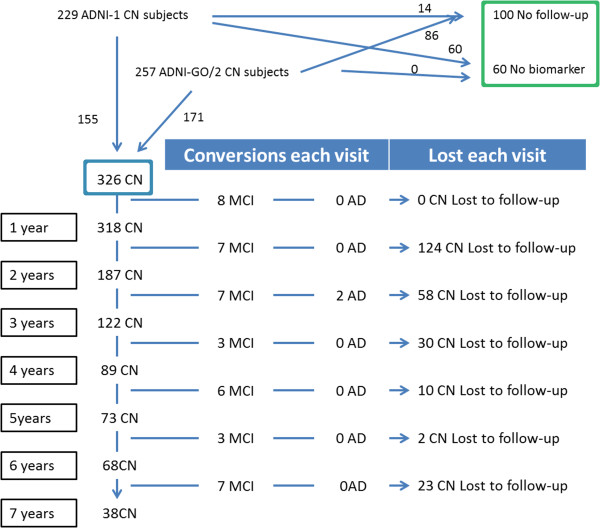
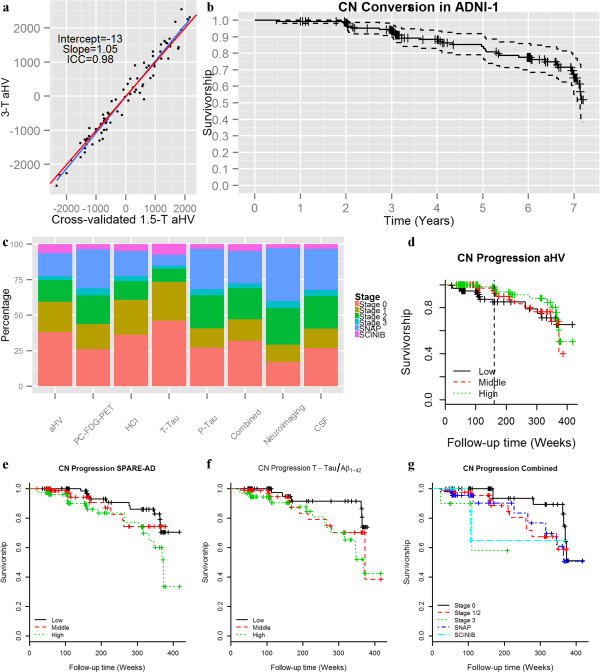
INTRODUCTION: Based on previous studies, a preclinical classification for Alzheimer's disease (AD) has been proposed. However, 1) specificity of the different neuronal injury (NI) biomarkers has not been studied, 2) subjects with subtle cognitive impairment but normal NI biomarkers (SCINIB) have not been included in the analyses and 3) progression to mild cognitive impairment (MCI) or dementia of the AD type (DAT), referred to here as MCI/DAT, varies between studies. Therefore, we analyzed data from 486 cognitively normal (CN) and 327 DAT subjects in the AD Neuroimaging Initiative (ADNI)-1/GO/2 cohorts. RESULTS: In the ADNI-1 cohort (median follow-up of 6 years), 6.3% and 17.0% of the CN subjects developed MCI/DAT after 3 and 5 years follow-up, respectively. NI biomarker cutoffs [structural magnetic resonance imaging (MRI), fluorodeoxyglucose positron emission tomography (FDG-PET) and cerebrospinal fluid (CSF) tau] were established in DAT patients and memory composite scores were calculated in CN subjects in a cross-sectional sample (n = 160). In the complete longitudinally followed CN ADNI cohort (n = 326, median follow-up of 2 years), CSF and MRI values predicted an increased conversion to MCI/DAT. Different NI biomarkers showed important disagreements for classifying subjects as abnormal NI [kappa = (-0.05)-(0.33)] and into AD preclinical groups. SCINIB subjects (5.0%) were more prevalent than AD preclinical stage 3 subjects (3.4%) and showed a trend for increased progression to MCI/DAT. CONCLUSIONS: Different NI biomarkers lead to different classifications of ADNI subjects, while structural MRI and CSF tau measures showed the strongest predictive value for progression to MCI/DAT. The newly defined SCINIB category of ADNI subjects is more prevalent than AD preclinical stage individuals.
Overview
The claims and statistics of this paper haven’t been checked yet.
Free: it reads the open-access text and checks the first 5 claims that cite a source we can check. Create a free account to check every claim.
Integrity signals
Registry
Cites
Statistics
Figures
Verification
Claims the paper makes
The claims and statistics of this paper haven’t been checked yet.
Free: it reads the open-access text and checks the first 5 claims that cite a source we can check. Create a free account to check every claim.
Claims other papers make about this one
Each is checked against this paper’s own text: does it say what the citing paper says it does?
The source backs part of the claim, not all of it — or backs it for a different population, condition or comparison.
In the citing paper
“The rate of cognitive decline is significantly greater for cognitively impaired and CU individuals who have abnormalities in both an amyloid biomarker and a second biomarker type (which could be CSF T-tau or P-tau, atrophy, or hypometabolism) in comparison to individuals who have neither or only one of these biomarker abnormalities [30–35,39,40,42–45].”
From NIA‐AA Research Framework: Toward a biological definition of Alzheimer's disease (2018) · cites this paper as [43]
Experimental — accuracy not yet measuredThe source backs part of the claim, not all of it — or backs it for a different population, condition or comparison.
In the citing paper
“However, the combination of an abnormal MRI, CSF T-tau, or FDG PET study with an abnormal amyloid biomarker provides much more powerful prediction of future cognitive decline [30–35,39,40,42–45] than an abnormal amyloid study alone.”
From NIA‐AA Research Framework: Toward a biological definition of Alzheimer's disease (2018) · cites this paper as [43]
Experimental — accuracy not yet measuredThe cited source says what the claim attributes to it.
In the citing paper
“These differences may result in discordances [36,43,115,119,159].”
From NIA‐AA Research Framework: Toward a biological definition of Alzheimer's disease (2018) · cites this paper as [43]
Self-check
Percentages, sums and reported differences re-computed from the paper’s own numbers.
The self-check needs the paper’s full text.
Citations
Cites
McKhann, G., Drachman, D., Folstein, M., Katzman, R., Price, D., & Stadlan, E. M. (1984) · Neurology · doi:10.1212/wnl.34.7.939 · Cited by 27,915
McKhann, G. M., Knopman, D. S., Chertkow, H., Hyman, B. T., Jack, C. R., Kawas, C. H., Klunk, W. E., Koroshetz, W. J., Manly, J. J., Mayeux, R., et al. (2011) · Alzheimer's & Dementia · doi:10.1016/j.jalz.2011.03.005 · Cited by 18,657
Self-citationMild Cognitive Impairment: Clinical Characterization and Outcome
Petersen, R. C., Smith, G. E., Waring, S. C., Ivnik, R. J., Tangalos, E. G., & Kokmen, E. (1999) · Archives of Neurology · doi:10.1001/archneur.56.3.303 · Cited by 8,980
Sperling, R. A., Aisen, P. S., Beckett, L. A., Bennett, D. A., Craft, S., Fagan, A. M., Iwatsubo, T., Jack, C. R., Kaye, J., Montine, T. J., et al. (2011) · Alzheimer's & Dementia · doi:10.1016/j.jalz.2011.03.003 · Cited by 7,155
Self-citationJack, C. R., Knopman, D. S., Jagust, W. J., Petersen, R. C., Weiner, M. W., Aisen, P. S., Shaw, L. M., Vemuri, P., Wiste, H. J., Weigand, S. D., et al. (2013) · The Lancet Neurology · doi:10.1016/s1474-4422(12)70291-0 · Cited by 4,396
Self-citationGreicius, M. D., Srivastava, G., Reiss, A. L., & Menon, V. (2004) · Proceedings of the National Academy of Sciences · doi:10.1073/pnas.0308627101 · Cited by 3,684 · cited 1×
“correlation as well as PC-FDG-PET and aHV, as described previously [31,32].”
Hyman, B. T., Phelps, C. H., Beach, T. G., Bigio, E. H., Cairns, N. J., Carrillo, M. C., Dickson, D. W., Duyckaerts, C., Frosch, M. P., Masliah, E., et al. (2012) · Alzheimer's & Dementia · doi:10.1016/j.jalz.2011.10.007 · Cited by 3,092
Self-citationMontine, T. J., Phelps, C. H., Beach, T. G., Bigio, E. H., Cairns, N. J., Dickson, D. W., Duyckaerts, C., Frosch, M. P., Masliah, E., Mirra, S. S., et al. (2012) · Acta Neuropathologica · doi:10.1007/s00401-011-0910-3 · Cited by 2,894 · cited 1×
“Alzheimer’s disease (AD) is the most common neurodegenerative disease (ND), characterized and diagnosed by the presence of tau neurofibrillary tangles and amyloid plaques in the central nervous system [1].”
Self-citationAlzheimer's Disease Neuroimaging Initiative (ADNI)
Petersen, R. C., Aisen, P. S., Beckett, L. A., Donohue, M. C., Gamst, A. C., Harvey, D. J., Jack, C. R., Jagust, W. J., Shaw, L. M., Toga, A. W., et al. (2010) · Neurology · doi:10.1212/wnl.0b013e3181cb3e25 · Cited by 2,572
Self-citationWithin-subject template estimation for unbiased longitudinal image analysis
Reuter, M., Schmansky, N. J., Rosas, H. D., & Fischl, B. (2012) · NeuroImage · doi:10.1016/j.neuroimage.2012.02.084 · Cited by 2,356 · cited 1×
“edu/) [25,26].”
Cited by
NIA‐AA Research Framework: Toward a biological definition of Alzheimer's disease
Jack, C. R., Bennett, D. A., Blennow, K., Carrillo, M. C., Dunn, B., Haeberlein, S. B., Holtzman, D. M., Jagust, W., Jessen, F., Karlawish, J., et al. (2018) · Alzheimer's & Dementia · doi:10.1016/j.jalz.2018.02.018 · Cited by 10,537
“These differences may result in discordances [36,43,115,119,159].”
Self-citationPreclinical Alzheimer’s Disease: Definition, Natural History, and Diagnostic Criteria
Dubois, B., Hampel, H., Feldman, H. H., Scheltens, P., Aisen, P., Andrieu, S., Bakardjian, H., Benali, H., Bertram, L., Blennow, K., et al. (2016) · Alzheimer's & Dementia · doi:10.1016/j.jalz.2016.02.002 · Cited by 1,925
Self-citationThe Evolution of Preclinical Alzheimer’s Disease: Implications for Prevention Trials
Sperling, R., Mormino, E., & Johnson, K. (2014) · Neuron · doi:10.1016/j.neuron.2014.10.038 · Cited by 725
Molecular genetics of early-onset Alzheimer’s disease revisited
Cacace, R., Sleegers, K., & Van Broeckhoven, C. (2016) · Alzheimer's & Dementia · doi:10.1016/j.jalz.2016.01.012 · Cited by 617
“A recent study shows that also tau tangles correlate well with AD diagnosis, showing the strongest predictive value for progression to AD [148].”
White matter hyperintensities and imaging patterns of brain ageing in the general population
Habes, M., Erus, G., Toledo, J. B., Zhang, T., Bryan, N., Launer, L. J., Rosseel, Y., Janowitz, D., Doshi, J., Van der Auwera, S., et al. (2016) · Brain · doi:10.1093/brain/aww008 · Cited by 422
Self-citationWeiner, M. W., Veitch, D. P., Aisen, P. S., Beckett, L. A., Cairns, N. J., Green, R. C., Harvey, D., Jack, C. R., Jagust, W., Morris, J. C., et al. (2017) · Alzheimer's & Dementia · doi:10.1016/j.jalz.2016.11.007 · Cited by 315
Self-citationLewczuk, P., Riederer, P., O’Bryant, S. E., Verbeek, M. M., Dubois, B., Visser, P. J., Jellinger, K. A., Engelborghs, S., Ramirez, A., Parnetti, L., et al. (2018) · The World Journal of Biological Psychiatry · doi:10.1080/15622975.2017.1375556 · Cited by 307
Self-citationSuspected non-Alzheimer disease pathophysiology — concept and controversy
Jack, C. R., Knopman, D. S., Chételat, G., Dickson, D., Fagan, A. M., Frisoni, G. B., Jagust, W., Mormino, E. C., Petersen, R. C., Sperling, R. A., et al. (2016) · Nature Reviews Neurology · doi:10.1038/nrneurol.2015.251 · Cited by 306
“Some studies used imaging alone 1,8–11 , others CSF biomarkers alone 12–14 , others CSF biomarkers combined with imaging 15 . stages 0 or 1.”
Self-citationThe Alzheimer's Disease Neuroimaging Initiative 2 PET Core: 2015
Jagust, W. J., Landau, S. M., Koeppe, R. A., Reiman, E. M., Chen, K., Mathis, C. A., Price, J. C., Foster, N. L., & Wang, A. Y. (2015) · Alzheimer's & Dementia · doi:10.1016/j.jalz.2015.05.001 · Cited by 300
“…of AD-related cerebral hypometabolism, including either HCIs or a posterior cingulate region-of-interest measurement, were less helpful than an MRI sum-mary metric of early brain atrophy and CSF p-tau/A b 1–42 ratios in predicting the subsequent progression to the clinical stages of AD [32].”
Self-citationJack, C. R., Wiste, H. J., Weigand, S. D., Knopman, D. S., Mielke, M. M., Vemuri, P., Lowe, V., Senjem, M. L., Gunter, J. L., Reyes, D., et al. (2015) · Brain · doi:10.1093/brain/awv283 · Cited by 254
Self-citationEEG evidence of compensatory mechanisms in preclinical Alzheimer’s disease
Gaubert, S., Raimondo, F., Houot, M., Corsi, M.-C., Naccache, L., Diego Sitt, J., Hermann, B., Oudiette, D., Gagliardi, G., Habert, M.-O., et al. (2019) · Brain · doi:10.1093/brain/awz150 · Cited by 235
“Moreover, very few studies of early stages of Alzheimer’s disease consider neurodegeneration information when selecting subjects, whereas it has been suggested that studies combining an abnormal amyloid biomarker with an abnormal neurodegeneration biomarker provide much more powerful prediction of future cognitive dec…”
Magnetic resonance imaging in Alzheimer’s disease neuroimaging initiative 2
Jack, C. R., Barnes, J., Bernstein, M. A., Borowski, B. J., Brewer, J., Clegg, S., Dale, A. M., Carmichael, O., Ching, C., DeCarli, C., et al. (2015) · Alzheimer's & Dementia · doi:10.1016/j.jalz.2015.05.002 · Cited by 220
Self-citationShen, X., Ma, S., Vemuri, P., Simon, G., Initiative, T. A. D. N., Weiner, M. W., Aisen, P. S. S., Petersen, R. C., Jack, C. R., Saykin, A. J., et al. (2020) · Scientific Reports · doi:10.1038/s41598-020-59669-x · Cited by 201
Self-citationSubtle Cognitive Decline and Biomarker Staging in Preclinical Alzheimer’s Disease
Edmonds, E. C., 1, F. T. A. D. N. I., Delano-Wood, L., Galasko, D. R., Salmon, D. P., & Bondi, M. W. (2015) · Journal of Alzheimer's Disease · doi:10.3233/jad-150128 · Cited by 195
Dong, A., Toledo, J. B., Honnorat, N., Doshi, J., Varol, E., Sotiras, A., Wolk, D., Trojanowski, J. Q., Davatzikos, C., & Initiative, F. T. A. D. N. (2016) · Brain · doi:10.1093/brain/aww319 · Cited by 176
Self-citationPART, a distinct tauopathy, different from classical sporadic Alzheimer disease.
Jellinger, K. A., Alafuzoff, I., Attems, J., Beach, T. G., Cairns, N. J., Crary, J. F., Dickson, D. W., Hof, P. R., Hyman, B. T., Jack, C. R., et al. (2015) · Acta Neuropathologica · doi:10.1007/s00401-015-1407-2 · Cited by 171
“At this point in the introduction of molecular imaging for tau (tau PET), SNAP has not been addressed; however, there are CSF studies on both Aβ and tau that have come to largely the same conclusions of the imaging biomarker studies [44, 52–54].”
Self-citationRabinovici, G. D., Carrillo, M. C., Forman, M., DeSanti, S., Miller, D. S., Kozauer, N., Petersen, R. C., Randolph, C., Knopman, D. S., Smith, E. E., et al. (2017) · Alzheimer's & Dementia: Translational Research & Clinical Interventions · doi:10.1016/j.trci.2016.09.002 · Cited by 153
Knopman, D. S., Haeberlein, S. B., Carrillo, M. C., Hendrix, J. A., Kerchner, G., Margolin, R., Maruff, P., Miller, D. S., Tong, G., Tome, M. B., et al. (2018) · Alzheimer's & Dementia · doi:10.1016/j.jalz.2018.03.002 · Cited by 143
Self-citationObjective subtle cognitive difficulties predict future amyloid accumulation and neurodegeneration
Thomas, K. R., Bangen, K. J., Weigand, A. J., Edmonds, E. C., Wong, C. G., Cooper, S., Delano‐Wood, L., Bondi, M. W., & Initiative, A. D. N. (2019) · Neurology · doi:10.1212/wnl.0000000000008838 · Cited by 147
Moss, D. E. (2020) · International Journal of Molecular Sciences · doi:10.3390/ijms21103438 · Cited by 147
Measuring cognition and function in the preclinical stage of Alzheimer's disease
Weintraub, S., Carrillo, M. C., Farias, S. T., Goldberg, T. E., Hendrix, J. A., Jaeger, J., Knopman, D. S., Langbaum, J. B., Park, D. C., Ropacki, M. T., et al. (2018) · Alzheimer's & Dementia: Translational Research & Clinical Interventions · doi:10.1016/j.trci.2018.01.003 · Cited by 120
Mormino, E. C., & Papp, K. V. (2018) · Journal of Alzheimer's Disease · doi:10.3233/jad-179928 · Cited by 117
“Unlike CSF and PET measures of Amyloid which are highly correlated [18], markers of ND vary in their associations which makes this dimension of the NIA-AA 2011 research framework less straightforward to implement and interpret than classification along the Aβ dimension [70].”
Alzheimer's disease cerebrospinal fluid biomarker in cognitively normal subjects
Toledo, J. B., Zetterberg, H., van Harten, A. C., Glodzik, L., Martinez-Lage, P., Bocchio-Chiavetto, L., Rami, L., Hansson, O., Sperling, R., Engelborghs, S., et al. (2015) · Brain · doi:10.1093/brain/awv199 · Cited by 136
Self-citationPredicting progression from normal cognition to mild cognitive impairment for individuals at 5 years
Albert, M., Zhu, Y., Moghekar, A., Mori, S., Miller, M. I., Soldan, A., Pettigrew, C., Selnes, O., Li, S., & Wang, M.-C. (2018) · Brain · doi:10.1093/brain/awx365 · Cited by 118
Is amyloid-β harmful to the brain? Insights from human imaging studies
Jagust, W. (2016) · Brain · doi:10.1093/brain/awv326 · Cited by 110
Self-citationGordon, B. A., Blazey, T., Su, Y., Fagan, A. M., Holtzman, D. M., Morris, J. C., & Benzinger, T. L. S. (2016) · JAMA Neurology · doi:10.1001/jamaneurol.2016.2642 · Cited by 105
Alzheimer’s Disease Biomarkers and Future Decline in Cognitive Normal Older Adults
Dumurgier, J., Hanseeuw, B. J., Hatling, F. B., Judge, K. A., Schultz, A. P., Chhatwal, J. P., Blacker, D., Sperling, R. A., Johnson, K. A., Hyman, B. T., et al. (2017) · Journal of Alzheimer's Disease · doi:10.3233/jad-170511 · Cited by 89
“A study based on ADNI subjects reported that structural MRI and CSF Tau had the strongest predictive value for progression from normal to MCI [36].”
Vos, S. J. B., Gordon, B. A., Su, Y., Visser, P. J., Holtzman, D. M., Morris, J. C., Fagan, A. M., & Benzinger, T. L. S. (2016) · Neurobiology of Aging · doi:10.1016/j.neurobiolaging.2016.03.025 · Cited by 98
Jack, C. R. (2014) · Acta Neuropathologica · doi:10.1007/s00401-014-1362-3 · Cited by 88
Self-citationBilello, M., Doshi, J., Nabavizadeh, S. A., Toledo, J. B., Erus, G., Xie, S. X., Trojanowski, J. Q., Han, X., & Davatzikos, C. (2015) · Journal of Alzheimer’s Disease · doi:10.3233/jad-150400 · Cited by 92
“We have previously shown that AD imaging-based spatial patterns of brain atrophy, evaluated with sophisticated pattern analysis and recognition methods, may be useful in discriminating among NC individuals who are likely to be stable versus those who will show cognitive decline [37, 38].”
Self-citationToledo, J. B., Bjerke, M., Da, X., Landau, S. M., Foster, N. L., Jagust, W., Jack, C., Weiner, M., Davatzikos, C., Shaw, L. M., et al. (2015) · JAMA Neurology · doi:10.1001/jamaneurol.2014.4829 · Cited by 88
Self-citationEbenau, J. L., Pelkmans, W., Verberk, I. M. W., Verfaillie, S. C. J., van den Bosch, K. A., van Leeuwenstijn, M., Collij, L. E., Scheltens, P., Prins, N. D., Barkhof, F., et al. (2022) · Neurology · doi:10.1212/wnl.0000000000200035 · Cited by 75
Challenges associated with biomarker‐based classification systems for Alzheimer's disease
Illán‐Gala, I., Pegueroles, J., Montal, V., Vilaplana, E., Carmona‐Iragui, M., Alcolea, D., Dickerson, B. C., Sánchez‐Valle, R., de Leon, M. J., Blesa, R., et al. (2018) · Alzheimer's & Dementia: Diagnosis, Assessment & Disease Monitoring · doi:10.1016/j.dadm.2018.03.004 · Cited by 62
Casanova, R., Barnard, R., Gaussoin, S. A., Saldana, S. J., Hayden, K. M., Manson, J. E., Wallace, R. B., Rapp, S. R., Resnick, S. M., Espeland, M. A., et al. (2018) · NeuroImage · doi:10.1016/j.neuroimage.2018.08.040 · Cited by 62
Plasma proteins related to inflammatory diet predict future cognitive impairment
Duggan, M. R., Butler, L., Peng, Z., Daya, G. N., Moghekar, A., An, Y., Rapp, S. R., Hayden, K. M., Shadyab, A. H., Natale, G., et al. (2023) · Molecular Psychiatry · doi:10.1038/s41380-023-01975-7 · Cited by 57
Suspected non-Alzheimer's pathology – Is it non-Alzheimer's or non-amyloid?
Dani, M., Brooks, D. J., & Edison, P. (2017) · Ageing Research Reviews · doi:10.1016/j.arr.2017.02.003 · Cited by 56
Memory, executive, and multidomain subtle cognitive impairment: Clinical and biomarker findings
Toledo, J. B., Bjerke, M., Chen, K., Rozycki, M., Jack, C. R., Weiner, M. W., Arnold, S. E., Reiman, E. M., Davatzikos, C. A., Shaw, L. M. J., et al. (2015) · Neurology · doi:10.1212/wnl.0000000000001738 · Cited by 53
Self-citationAllison, S. L., Koscik, R. L., Cary, R. P., Jonaitis, E. M., Rowley, H. A., Chin, N. A., Zetterberg, H., Blennow, K., Carlsson, C. M., Asthana, S., et al. (2019) · NeuroImage Clinical · doi:10.1016/j.nicl.2019.101895 · Cited by 45
Jiao, F., Yi, F., Wang, Y., Zhang, S., Guo, Y., Du, W., Gao, Y., Ren, J., Zhang, H., Liu, L., et al. (2020) · Frontiers in Aging Neuroscience · doi:10.3389/fnagi.2020.00212 · Cited by 45
“CSF AD-specific pathological protein test and PET have become internationally recognized biomarker diagnoses in living patients (Prestia et al., 2013; Toledo et al., 2014; Vos et al., 2015).”
BackgroundHabes, M., Toledo, J. B., Resnick, S. M., Doshi, J., Van der Auwera, S., Erus, G., Janowitz, D., Hegenscheid, K., Homuth, G., Völzke, H., et al. (2016) · American Journal of Neuroradiology · doi:10.3174/ajnr.a4805 · Cited by 44
Self-citationRecent imaging advances in neurology
Rocchi, L., Niccolini, F., & Politis, M. (2015) · Journal of Neurology · doi:10.1007/s00415-015-7711-x · Cited by 40
Pan, F., Huang, L., Chen, K., Zhao, Q., & Guo, Q. (2020) · BMC Neurology · doi:10.1186/s12883-020-01657-9 · Cited by 40
Self-citationBangen, K. J., Himali, J. J., Beiser, A., Nation, D. A., Libon, D. J., Fox, C. S., Seshadri, S. S., Wolf, P. A., McKee, A. C., Au, R., et al. (2016) · Journal of Alzheimer s Disease · doi:10.3233/jad-160163 · Cited by 38
Zhao, Y., Tudorascu, D. L., López, O. L., Cohen, A. D., Mathis, C. A., Aizenstein, H. J., Price, J. C., Kuller, L. H., Kamboh, M. I., DeKosky, S. T., et al. (2017) · JAMA Neurology · doi:10.1001/jamaneurol.2017.3029 · Cited by 37
Dang, C., Harrington, K. D., Lim, Y. Y., Ames, D., Hassenstab, J., Laws, S. M., Yassi, N., Hickey, M., Rainey-Smith, S., Robertson, J., et al. (2018) · Journal of Alzheimer’s Disease · doi:10.3233/jad-180507 · Cited by 31
Joint associations of β-amyloidosis and cortical thickness with cognition
Knopman, D. S., Lundt, E. S., Therneau, T. M., Vemuri, P., Lowe, V. J., Kantarci, K., Gunter, J. L., Senjem, M. L., Mielke, M. M., Machulda, M. M., et al. (2018) · Neurobiology of Aging · doi:10.1016/j.neurobiolaging.2018.01.017 · Cited by 30
Self-citationKnopman, D. S., Jack, C. R., Lundt, E. S., Weigand, S. D., Vemuri, P., Lowe, V. J., Kantarci, K., Gunter, J. L., Senjem, M. L., Mielke, M. M., et al. (2016) · Neurobiology of Aging · doi:10.1016/j.neurobiolaging.2016.06.003 · Cited by 26
Self-citationDecreased hippocampal metabolism in high‐amyloid mild cognitive impairment
Hanseeuw, B. J., Schultz, A. P., Betensky, R. A., Sperling, R. A., & Johnson, K. A. (2016) · Alzheimer s & Dementia · doi:10.1016/j.jalz.2016.06.2357 · Cited by 29
Patterns of Cortical and Subcortical Amyloid Burden across Stages of Preclinical Alzheimer’s Disease
Edmonds, E. C., Bangen, K. J., Delano‐Wood, L., Nation, D. A., Furst, A. J., Salmon, D. P., Bondi, M. W., & Initiative, A. D. N. (2016) · Journal of the International Neuropsychological Society · doi:10.1017/s1355617716000928 · Cited by 30
Furr, J. W., Morales‐Scheihing, D., Manwani, B., Lee, J., & McCullough, L. D. (2019) · NeuroMolecular Medicine · doi:10.1007/s12017-019-08568-0 · Cited by 29
Jacquemont, T., Fallani, F. D. V., Bertrand, A., Epelbaum, S., Routier, A., Dubois, B., Hampel, H. J., Durrleman, S., & Colliot, O. (2017) · Neurobiology of Aging · doi:10.1016/j.neurobiolaging.2017.03.023 · Cited by 28
Bertens, D., Tijms, B. M., Vermunt, L., Prins, N. D., Scheltens, P., Visser, P. J., & Initiative, A. D. N. (2017) · Alzheimer s & Dementia Translational Research & Clinical Interventions · doi:10.1016/j.trci.2017.08.005 · Cited by 29
Predicting Alzheimer’s Disease Using Combined Imaging-Whole Genome SNP Data
Kong, D., Initiative, A. F. T. A. D. N., Giovanello, K. S., Wang, Y., Lin, W., Lee, E., Fan, Y., Murali Doraiswamy, P., & Zhu, H. (2015) · Journal of Alzheimer's Disease · doi:10.3233/jad-150164 · Cited by 26
The clinical importance of suspected non-Alzheimer disease pathophysiology
Vos, S. J. B., Delvenne, A., Jack, C. R., Thal, D. R., & Visser, P. J. (2024) · Nature Reviews Neurology · doi:10.1038/s41582-024-00962-y · Cited by 25
“A study that compared several such markers in people with NC-SNAP found that structural MRI volumes and CSF t-tau were better predictors of an increased likelihood of progression to MCI or clinical AD dementia than were CSF p-tau181 and FDG PET markers 33,34 .”
Self-citationBiomarkers and Tools for Predicting Alzheimer’s Disease in the Preclinical Stage
Li, T.-R., Yang, Q. Z., Hu, X., & Han, Y. (2021) · Current Neuropharmacology · doi:10.2174/1570159x19666210524153901 · Cited by 24
“According to recent clinical and animal studies [33-44], the current mainstream view indicates that elevated brain Aβ deposition alone is probably insufficient to produce serious cognitive changes, while the NFTs and/or neurodegeneration are the real culprits.”
Zuroff, L. R., Wisse, L. E. M., Glenn, T. W., Xie, S. X., Nasrallah, I. M., Habes, M., Dubroff, J. G., de Florès, R., Xie, L., Yushkevich, P. A., et al. (2022) · Journal of Alzheimer s Disease Reports · doi:10.3233/adr-220013 · Cited by 22
Self-citationDuggan, M. R., Yang, Z., Cui, Y., Dark, H. E., Wen, J., Erus, G., Hohman, T. J., Chen, J., Lewis, A., Moghekar, A., et al. (2024) · Alzheimer s & Dementia · doi:10.1002/alz.14142 · Cited by 21
“5 22 Voxel-based morphometry (VBM) analyses were used to visualize voxel-wise tissue volumes of R indices and SPARE-AD, and to test associations with individual plasma proteins.”
MethodSelf-citationComputer‐assisted prediction of clinical progression in the earliest stages of AD
Rhodius‐Meester, H. F. M., Liedes, H., Koikkalainen, J. R., Wolfsgruber, S., Coll‐Padrós, N., Kornhuber, J., Peters, O., Jessen, F., Kleineidam, L., Molinuevo, J. L., et al. (2018) · Alzheimer s & Dementia Diagnosis Assessment & Disease Monitoring · doi:10.1016/j.dadm.2018.09.001 · Cited by 20
Kim, J., Kim, J., Park, Y., Yoo, H., Kim, J. P., Jang, H., Park, H., & Seo, S. W. (2024) · Communications Biology · doi:10.1038/s42003-024-05787-5 · Cited by 17
“This would be an important consideration, as previous studies investigating the trajectories of preclinical AD have shown that only 13.5% – 22.9% of these patients progress to cognitive decline 50 – 52 .”
MethodInfluentialLi, T., Dong, Q., Jiang, X., Kang, G., Li, X., Xie, Y., Jiang, J., & Han, Y. (2021) · NeuroImage Clinical · doi:10.1016/j.nicl.2021.102900 · Cited by 16
Hohman, T. J., Dumitrescu, L. C., Oksol, A., Wagener, M. A., Gifford, K. A., Jefferson, A. L., & Initiative, A. D. N. (2017) · PLoS ONE · doi:10.1371/journal.pone.0188501 · Cited by 15
Pan, F., Huang, Q., Huang, C., Lu, Y. W., Cui, L., Huang, L., Guan, Y., Xie, F., & Guo, Q. (2025) · Alzheimer s & Dementia · doi:10.1002/alz.70005 · Cited by 14
“9,10 The discrepancies among these indicators of N may be attributed to their distinct characteristics.”
Preclinical Alzheimer’s Disease: Implications for Refinement of the Concept
Vos, S. J. B., & Visser, P. J. (2018) · Journal of Alzheimer s Disease · doi:10.3233/jad-179943 · Cited by 14
Martersteck, A., Sridhar, J., Coventry, C., Weıntraub, S., Mesulam, M. M., & Rogalski, E. J. (2021) · Alzheimer s & Dementia · doi:10.1002/alz.12445 · Cited by 13
Total Brain and Hippocampal Volumes and Cognition in Older American Indians: The Strong Heart Study
Cholerton, B., Omidpanah, A., Madhyastha, T. M., Grabowski, T. J., Suchy‐Dicey, A. M., Shibata, D. K., Nelson, L. A., Verney, S. P., Howard, B. V., Longstreth, W. T., Jr., et al. (2017) · Alzheimer Disease & Associated Disorders · doi:10.1097/wad.0000000000000203 · Cited by 13
The prognostic value of ATN Alzheimer biomarker profiles in cognitively normal individuals
Vos, S. J. B., & Duara, R. (2019) · Neurology · doi:10.1212/wnl.0000000000007223 · Cited by 12
The Dementia SomaSignal Test (dSST): A plasma proteomic predictor of 20‐year dementia risk
Duggan, M. R., Paterson, C., Lü, Y., Biegel, H., Dark, H. E., Cordon, J., Bilgel, M., Kaneko, N., Shibayama, M., Kato, S., et al. (2025) · Alzheimer s & Dementia · doi:10.1002/alz.14549 · Cited by 12
Self-citationPlasma GDF15 affects long-term dementia risk and alters neuroimmune signaling
Blew, C., Duggan, M. R., Tsitsipatis, D., Gómez, G., Rodriguez-Hernandez, Z., Pilling, L. C., Chen, J., Jacobsen, E. M., Dark, H. E., Lu, Y., et al. (2026) · Science Advances · doi:10.1126/sciadv.aec7614 · Cited by 11
Self-citationYousefzadeh‐Nowshahr, E., Winter, G., Bohn, P., Kneer, K., Arnim, C. A. F. V., Otto, M., Solbach, C., Anderl‐Straub, S., Polivka, D., Fissler, P., et al. (2022) · PLoS ONE · doi:10.1371/journal.pone.0266906 · Cited by 10
Elkana, O., Beheshti, I., & Initiative, A. D. N. (2025) · Journal of Neurology · doi:10.1007/s00415-025-13414-4 · Cited by 9
“This extended observation period allowed for a nuanced understanding of how brain biomarkers evolve over time and how they relate to clinical progression from cognitive health to mild cognitive impairment [38–40].”
SPARE-Tau: A flortaucipir machine-learning derived early predictor of cognitive decline
Toledo, J. B., Rashid, T., Liu, H., Launer, L. J., Shaw, L. M. J., Heckbert, S. R., Weiner, M. W., Seshadri, S. S., Habes, M., & Initiative, A. D. N. (2022) · PLoS ONE · doi:10.1371/journal.pone.0276392 · Cited by 9
Self-citationChoi, U.-S., Park, J. Y., Lee, J. J., Choi, K. Y., Won, S., & Lee, K. H. (2023) · Cerebral Cortex · doi:10.1093/cercor/bhad331 · Cited by 8
Detection of emerging neurodegeneration using Bayesian linear mixed-effect modeling
Cobigo, Y., Goh, M. S., Wolf, A. A., Staffaroni, A. M., Kornak, J., Miller, B. L., Rabinovici, G. D., Seeley, W. W., Spina, S., Boxer, A. L., et al. (2022) · NeuroImage Clinical · doi:10.1016/j.nicl.2022.103144 · Cited by 8
“…for Y. Cobigo et al. prediction because many prior studies have shown that structural imaging can predict the onset of dementia in patients at risk Toledo et al. (2014), and dementia represents a more reliable outcome compared with MCI, because a portion of MCI patients revert to normal,…”
Discordant Alzheimer's neurodegenerative biomarkers and their clinical outcomes
Guo, Y., Li, H., Tan, L., Chen, S., Yang, Y., Ma, Y., Zuo, C., Dong, Q., Tan, L., Yu, J., et al. (2020) · Annals of Clinical and Translational Neurology · doi:10.1002/acn3.51196 · Cited by 8
Chen, G., Xia, X., Xie, J., Cao, Y., Yuan, C., Yu, G., Wei, S., Duan, Y., Cai, Y., Wang, S., et al. (2025) · Journal of Hazardous Materials · doi:10.1016/j.jhazmat.2025.137187 · Cited by 7
China Registry Study on Cognitive Impairment in the Elderly: Protocol of a Prospective Cohort Study
Zhu, Y., Pan, D., He, L., Rong, X., Li, H., Li, Y., Pi, Y., Xu, Y., & Tang, Y. (2021) · Frontiers in Aging Neuroscience · doi:10.3389/fnagi.2021.797704 · Cited by 6
Protective Factors Modulate the Risk of Beta Amyloid in Alzheimer’s Disease
Zhou, B., Tanabe, K., Kojima, S., Teramukai, S., Fukushima, M., & Initiative, T. A. D. N. (2020) · Behavioural Neurology · doi:10.1155/2020/7029642 · Cited by 6
Stocks, J. K., Popuri, K., Heywood, A. A., Tosun, D., Alpert, K., Beg, M. F., Rosen, H. J., Wang, L., & Initiative, A. D. N. (2022) · Alzheimer s & Dementia Diagnosis Assessment & Disease Monitoring · doi:10.1002/dad2.12304 · Cited by 5
Cognitive Decline in Preclinical Stage 2 Alzheimer Disease and Implications for Prevention Trials
Mormino, E. C., & Papp, K. V. (2016) · JAMA Neurology · doi:10.1001/jamaneurol.2016.0281 · Cited by 5
Subjective cognitive decline and cerebral-cognitive reserve in late age
Sidenkova, A. P., Calabrese, V., Tomasello, M., & Fritsch, T. (2023) · Translational Medicine of Aging · doi:10.1016/j.tma.2023.11.001 · Cited by 4
The Ethics of Biomarker-Based Preclinical Diagnosis of Alzheimer’s Disease
Kurz, A., & Lautenschlager, N. T. (2018) · Neuromethods · doi:10.1007/978-1-4939-7674-4_17 · Cited by 3
Brain Age: A Promising Biomarker for Understanding Aging in the Context of Cognitive ReservePreprint
Beheshti, I. (2025) · medRxiv · doi:10.1101/2025.01.22.25320988 · Cited by 3
“Moreover, detecting the onset of MCI from a cognitively healthy state remains a significant challenge due to the subtle nature of morphological and cognitive changes in the early stages [40-42].”
Robust Biomarkers: Methodologically Tracking Causal Processes in Alzheimer’s Measurement
Keyser, V., & Sarry, L. (2020) · Boston studies in the philosophy of science · doi:10.1007/978-3-030-29179-2_13 · Cited by 2
[Incidence of fainting during the procedure of a simple extraction].
Kolokoudias, M., Zografos, J., & Merenditis, N. (1989) · PubMed · Cited by 2
Tchistiakova, E. (2016) · TSpace (University of Toronto) · Cited by 1
Advancing Causal Analytics Using Biomedical Data
Shen, X. (2024) · University of Minnesota Digital Conservancy (University of Minnesota) · Cited by 1
Mild cognitive impairment : improved identification and a novel cognitive intervention.
Wang, Y. C. (2015) · UC Research Repository (University of Canterbury) · doi:10.26021/7082
Powers, R. E., & Herrington, H. (2015) · Springer eBooks · doi:10.1007/978-3-319-18377-0_16
Molecular Imaging in Alzheimer Clinical Trials
Schmidt, M. E., Matthews, D. C., & Staelens, S. G. (2016) · Elsevier eBooks · doi:10.1016/b978-0-12-802173-6.00020-4
Contribution of C5aR1 to Neuroinflammation and Neuronal Dysfunction in Alzheimer’s Disease
Hernandez, M. X. (2017) · eScholarship (California Digital Library)
Analyzing Heterogeneity in Neuroimaging with Probabilistic Multivariate Clustering Approaches
Dong, A. (2017) · ScholarlyCommons (University of Pennsylvania)
Kösel, J. (2018) · OPen Access Repositorium der Universität Ulm (OPARU) (Ulm University) · doi:10.18725/oparu-10785
Espinosa, S., & Paola, M. (2017) · LA Referencia (Red Federada de Repositorios Institucionales de Publicaciones Científicas)
Guo, Y., Li, H., Tan, L., Chen, S.-D., Yang, Y., Ma, Y., Zuo, C., Dong, Q., Tan, L., & Yu, J. (2020) · Research Square · doi:10.21203/rs.3.rs-18282/v1
Guo, Y., Li, H., Tan, L., Chen, S.-D., Yang, Y., Ma, Y., Zuo, C., Dong, Q., Tan, L., & Yu, J. (2020) · Research Square · doi:10.21203/rs.3.rs-21398/v1
Brain age prediction improves the early detection of Alzheimer’s disease in East Asian elderlyPreprint
Choi, U.-S., Park, J. Y., Lee, J. J., Choi, K. Y., Won, S., & Lee, K. H. (2023) · medRxiv · doi:10.1101/2023.02.28.23286588
Bourassa, P. (2020) · Corpus Université Laval (Université Laval)
Metadata
- Authors
- Toledo, J. B., Weiner, M. W., Wolk, D. A., Da, X., Chen, K., Arnold, S. E., Jagust, W., Jack, C., Reiman, E. M., Davatzikos, C., Shaw, L. M., Trojanowski, J. Q., & Initiative, F. T. A. D. N.
- Affiliations
- University of Pennsylvania (US)
- San Francisco VA Medical Center (US)
- Banner Alzheimer’s Institute (US)
- University of California, Berkeley (US)
- Mayo Clinic (US)
- Corresponding author
- Trojanowski, John Q
- ORCID
- Venue
- Acta Neuropathologica Communications
- Published
- 2014-03-06
- Volume
- 2
- Issue
- 1
- Pages
- 26-26
- ISSN
- 2051-5960 (ISSN-L)
- PMC
- PMC4008258
- OpenAlex
- W2112010296
- Cited by
- 89
- References
- 41
- Citations by year
- 2026: 1 · 2025: 4 · 2024: 3 · 2023: 4 · 2022: 7 · 2021: 4 · 2020: 9 · 2019: 5 · 2018: 11 · 2017: 10 · 2016: 15 · 2015: 13 · 2014: 2
- FWCI
- 10.17
- Type
- journal article
- Language
- en
- Open access
- gold
- doi.org
- Licence
- Locations
- Acta Neuropathologica Communications (publishedVersion, cc-by)
- Europe PMC (PubMed Central) (publishedVersion, cc-by)
- PubMed Central (publishedVersion, cc-by)
- PubMed (publishedVersion)
- Funders
- U.S. Department of Defense (U01 AG024904, W81XWH, W81XWH-12-2-, W81XWH-12, W81XWH1220012, AG024904)
- Foundation for the National Institutes of Health (W81XWH-12-2-0012, U01AG024904, Grant U01 AG024904, AG024904)
- Alzheimer's Association (U01 AG024904, W81XWH-12-2-0012)
- Bristol-Myers Squibb (U01 AG024904, AG024904, W81XWH-12-2-0012)
- Eli Lilly and Company (U01 AG024904, AG024904, W81XWH-12-2-0012)
- Pfizer (AG024904, W81XWH-12-2-0012, U01 AG024904)
- Biogen (W81XWH-12-2-0012, U01 AG024904, AG024904)
- F. Hoffmann-La Roche (W81XWH-12-2-0012, AG024904, U01 AG024904)
- Medpace (U01 AG024904)
- Meso Scale Diagnostics (U01 AG024904, AG024904, W81XWH-12-2-0012)
- Synarc (U01 AG024904)
- Alzheimer's Disease Neuroimaging Initiative (W81XWH-12-2–0012, U01AG024904, AG024904, W81XWH-12-2-, Department of Defense award number W81XWH-12-2-0012)
- BioClinica (U01 AG024904, W81XWH-12-2-0012, AG024904)
- Novartis Pharmaceuticals Corporation (W81XWH-12-2-0012, U01 AG024904, AG024904)
- Northern California Institute for Research and Education (U01 AG024904, W81XWH-12-2-0012)
- Eisai (W81XWH-12-2-0012, U01 AG024904, AG024904)
- Servier (AG024904, W81XWH-12-2-0012, U01 AG024904)
- IXICO (AG024904, W81XWH-12-2-0012, U01 AG024904)
- National Institutes of Health (3u01ag024904-10s2, W81XWH, W81XWH-12-2-0012, U01-AG024904, Grant U01 AG024904, AG024904)
- Genentech (W81XWH-12-2-0012, AG024904, U01 AG024904)
- University of California, Los Angeles
- University of California, San Diego
- Canadian Institutes of Health Research (U01 AG024904, W81XWH-12-2-0012)
- National Institute on Aging (U01-AG-024904, W81XWH-12-2–0012, AG 024904, P30AG019610)
- National Institute of Biomedical Imaging and Bioengineering (W81XWH-12-2-0012, U01 AG024904, P41EB015922, AG024904)
- Topics
- Health Sciences › Medicine › Psychiatry and Mental health › Dementia and Cognitive Impairment Research
- Life Sciences › Neuroscience › Cellular and Molecular Neuroscience › Alzheimer's disease research and treatments
- Health Sciences › Medicine › Oncology › Cancer-related cognitive impairment studies
- Keywords
- Alzheimer's disease, preclinical Alzheimer's disease, Alzheimer's dementia, cerebrospinal fluid tau, structural MRI, FDG-PET, biomarker cut-off values, ADNI cohort
- MeSH terms
- Aged, Aged, 80 and over, Alzheimer Disease, Brain, Cognition, Cross-Sectional Studies, Female, Humans, Male, Neuropsychological Tests, Peptide Fragments, Psychiatric Status Rating Scales, Radionuclide Imaging, Time Factors, Cohort Studies, Biomarkers, Databases, Factual, Amyloid beta-Peptides, tau Proteins, Disease Progression, Fluorodeoxyglucose F18, Cognitive Dysfunction
About these checks
Registry, retraction, Cites and statistics results are computed, not judged, with one exception: a printed reference that no index lists is read once by a model before it counts as a citation error. Claims are extracted by a model and kept only when their quote appears verbatim in the text; each cited source is then checked, with a model’s help, for whether it says what the claim relies on. Those verdicts can be wrong — read the claim’s quote and the cited source before relying on one.
Statistics and arithmetic are recomputed, not judged.
Confidence bands are shown only for fields calibrated on our annotated test set. None is calibrated yet, so no band is shown.
What counts as a claim ›How we measure confidence ›How we check this ›
Are you an author, or do you see a problem with this page? Request a review
Data sources
Bibliographic data: Semantic Scholar, OpenAlex, Crossref.
Contains information from the Semantic Scholar Academic Graph Datasets, made available under the ODC Attribution License (ODC-BY 1.0).
Semantic Scholar’s data is described in: Kinney, R., et al. (2023). The Semantic Scholar Open Data Platform. arXiv:2301.10140.
