

The DOI matches its Crossref record; 76 of the 76 references it cites were found in a registry or an index.
Beyond intracranial pressure: optimization of cerebral blood flow, oxygen, and substrate delivery after traumatic brain injury
Open accessAbstract
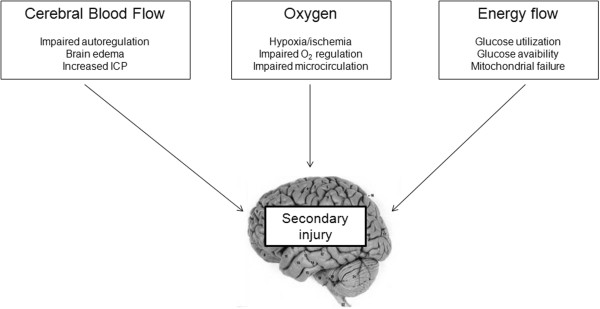
Monitoring and management of intracranial pressure (ICP) and cerebral perfusion pressure (CPP) is a standard of care after traumatic brain injury (TBI). However, the pathophysiology of so-called secondary brain injury, i.e., the cascade of potentially deleterious events that occur in the early phase following initial cerebral insult-after TBI, is complex, involving a subtle interplay between cerebral blood flow (CBF), oxygen delivery and utilization, and supply of main cerebral energy substrates (glucose) to the injured brain. Regulation of this interplay depends on the type of injury and may vary individually and over time. In this setting, patient management can be a challenging task, where standard ICP/CPP monitoring may become insufficient to prevent secondary brain injury. Growing clinical evidence demonstrates that so-called multimodal brain monitoring, including brain tissue oxygen (PbtO2), cerebral microdialysis and transcranial Doppler among others, might help to optimize CBF and the delivery of oxygen/energy substrate at the bedside, thereby improving the management of secondary brain injury. Looking beyond ICP and CPP, and applying a multimodal therapeutic approach for the optimization of CBF, oxygen delivery, and brain energy supply may eventually improve overall care of patients with head injury. This review summarizes some of the important pathophysiological determinants of secondary cerebral damage after TBI and discusses novel approaches to optimize CBF and provide adequate oxygen and energy supply to the injured brain using multimodal brain monitoring.
Overview
The claims and statistics of this paper haven’t been checked yet.
Run the check — free, no account needed. It reads the open-access text and checks the sources it cites.
Integrity signals
Registry
Cites
Statistics
Figures
Verification
Claims the paper makes
The claims and statistics of this paper haven’t been checked yet.
Run the check — free, no account needed. It reads the open-access text and checks the sources it cites.
Claims other papers make about this one
Each is checked against this paper’s own text: does it say what the citing paper says it does?
The source backs part of the claim, not all of it — or backs it for a different population, condition or comparison.
In the citing paper
“Regarding the general pathophysiology of TBI, the first stages of brain injury after head trauma are characterized by direct tissue damage and impaired regulation of cerebral blood flow (hypoperfusion or hyperperfusion) and metabolism (93,97).”
From Pituitary Dysfunction After Traumatic Brain Injury: A Clinical and Pathophysiological Approach (2015) · cites this paper as [93]
Experimental — accuracy not yet measured
Self-check
Percentages, sums and reported differences re-computed from the paper’s own numbers.
The self-check needs the paper’s full text.
Citations
Cites
Moderate and severe traumatic brain injury in adults
Maas, A. I., Stocchetti, N., & Bullock, R. (2008) · The Lancet Neurology · doi:10.1016/s1474-4422(08)70164-9 · Cited by 2,123
Raichle, M. E., & Mintun, M. A. (2006) · Annual Review of Neuroscience · doi:10.1146/annurev.neuro.29.051605.112819 · Cited by 1,630
A Trial of Intracranial-Pressure Monitoring in Traumatic Brain Injury
Chesnut, R. M., Temkin, N. R., Carney, N., DIKMEN, S. S., Rondina, C., Videtta, W., Petroni, G. J., Lujan, S., Pridgeon, J., Barber, J. K., et al. (2012) · New England Journal of Medicine · doi:10.1056/nejmoa1207363 · Cited by 1,353
Steiner, L. A., Czosnyka, M., Piechnik, S. K., Smielewski, P., Chatfield, D. A., Menon, D. K., & Pickard, J. D. (2002) · Critical Care Medicine · doi:10.1097/00003246-200204000-00002 · Cited by 783
Prevention of secondary ischemic insults after severe head injury
Robertson, C. S., Valadka, A. B., Hannay, H. J., Contant, C. F., Gopinath, S. P., Cormio, M., Uzura, M., & Grossman, R. G. (1999) · Critical Care Medicine · doi:10.1097/00003246-199910000-00002 · Cited by 748
Bergsneider, M., Hovda, D. A., Shalmon, E., Kelly, D. F., Vespa, P. M., Martin, N. A., Phelps, M. E., McArthur, D. L., Caron, M., Kraus, J. F., et al. (1997) · Journal of neurosurgery · doi:10.3171/jns.1997.86.2.0241 · Cited by 639
Vespa, P. M., Bergsneider, M., Hattori, N., Wu, H.-M., Huang, S., Martin, N. A., Glenn, T. C., McArthur, D. L., & Hovda, D. A. (2005) · Journal of Cerebral Blood Flow & Metabolism · doi:10.1038/sj.jcbfm.9600073 · Cited by 637
Juul, N., Morris, G. F., Marshall, S. B., _, _., & Marshall, L. F. (2000) · Journal of neurosurgery · doi:10.3171/jns.2000.92.1.0001 · Cited by 564
Blood lactate is an important energy source for the human brain.
van Hall, G., Stømstad, M., Rasmussen, P., Jans, Ø., Zaar, M., Gam, C., Quistorff, B., Secher, N. H., & Nielsen, H. B. (2009) · Journal of Cerebral Blood Flow & Metabolism · doi:10.1038/jcbfm.2009.35 · Cited by 522
Jespersen, S. N., & Østergaard, L. (2011) · Journal of Cerebral Blood Flow & Metabolism · doi:10.1038/jcbfm.2011.153 · Cited by 500
Brain Oxygen Tension in Severe Head Injury
van den Brink, W. A., van Santbrink, H., Steyerberg, E. W., Avezaat, C. J. J., Suazo, J. A. C., Hogesteeger, C., Jansen, W. J., Kloos, L. M. H., Vermeulen, J., & Maas, A. I. R. (2000) · Neurosurgery · doi:10.1097/00006123-200004000-00018 · Cited by 438
Oddo, M., Schmidt, J. M., Carrera, E., Badjatia, N., Connolly, E. S., Presciutti, M., Ostapkovich, N. D., Levine, J. M., Roux, P. L., & Mayer, S. A. (2008) · Critical Care Medicine · doi:10.1097/ccm.0b013e31818f4026 · Cited by 419
Self-citationSpecialist neurocritical care and outcome from head injury
Patel, H. C., Menon, D. K., Tebbs, S., Hawker, R., Hutchinson, P. J., & Kirkpatrick, P. J. (2002) · Intensive Care Medicine · doi:10.1007/s00134-002-1235-4 · Cited by 397
Timofeev, I. S., Carpenter, K. L. H., Nortje, J., Al-Rawi, P. G., O’Connell, M. T., Czosnyka, M., Smielewski, P. S., Pickard, J. D., Menon, D. K., Kirkpatrick, P. J., et al. (2011) · Brain · doi:10.1093/brain/awq353 · Cited by 390
Singh, I. N., Sullivan, P. G., Deng, Y., Mbye, L. H., & Hall, E. D. (2006) · Journal of Cerebral Blood Flow & Metabolism · doi:10.1038/sj.jcbfm.9600297 · Cited by 367
Hillered, L., Vespa, P. M., & Hovda, D. A. (2005) · Journal of Neurotrauma · doi:10.1089/neu.2005.22.3 · Cited by 365
Cerebral autoregulation following head injury
Czosnyka, M., Smielewski, P., Piechnik, S. K., Steiner, L. A., & Pickard, J. D. (2001) · Journal of neurosurgery · doi:10.3171/jns.2001.95.5.0756 · Cited by 346
Diffusion limited oxygen delivery following head injury*
Menon, D. K., Coles, J., Gupta, A. K., Fryer, T. D., Smielewski, P. S., Chatfield, D. A., Aigbirhio, F. I., Skepper, J. N., Minhas, P. S., Hutchinson, P. J., et al. (2004) · Critical Care Medicine · doi:10.1097/01.ccm.0000127777.16609.08 · Cited by 337
IX. Cerebral Perfusion Thresholds
Bratton, S. L., Chestnut, R. M., Ghajar, J., Hammond, F. M., Harris, O. A., Härtl, R., Manley, G. T., Nemecek, A. N., Newell, D. W., Rosenthal, G., et al. (2007) · Journal of Neurotrauma · doi:10.1089/neu.2007.9987 · Cited by 332
Bouma, G. J., Muizelaar, J. P., Bandoh, K., & Marmarou, A. (1992) · Journal of neurosurgery · doi:10.3171/jns.1992.77.1.0015 · Cited by 329
Lactate is a Preferential Oxidative Energy Substrate over Glucose for Neurons in Culture
Bouzier-Sore, A.-K., Voisin, P., Canioni, P., Magistretti, P. J., & Pellerin, L. (2003) · Journal of Cerebral Blood Flow & Metabolism · doi:10.1097/01.wcb.0000091761.61714.25 · Cited by 328
Coles, J., Minhas, P. S., Fryer, T. D., Smielewski, P. S., Aigbirihio, F. I., Donovan, T., Downey, S. P. M. J., Williams, G. B., Chatfield, D., Matthews, J. C., et al. (2002) · Critical Care Medicine · doi:10.1097/00003246-200209000-00002 · Cited by 298
Glenn, T. C., Kelly, D. F., Boscardin, W. J., McArthur, D. L., Vespa, P., Oertel, M., Hovda, D. A., Bergsneider, M., Hillered, L., & Martin, N. A. (2003) · Journal of Cerebral Blood Flow & Metabolism · doi:10.1097/01.wcb.0000089833.23606.7f · Cited by 296
Muench, E., Horn, P., Bauhuf, C., Roth, H., Philipps, M., Hermann, P., Quintel, M., Schmiedek, P., & Vajkoczy, P. (2007) · Critical Care Medicine · doi:10.1097/01.ccm.0000275392.08410.dd · Cited by 293
Lactate: A Preferred Fuel for Human Brain Metabolism in Vivo
Smith, D., Pernet, A., Hallett, W. A., Bingham, E., Marsden, P. K., & Amiel, S. A. (2003) · Journal of Cerebral Blood Flow & Metabolism · doi:10.1097/01.wcb.0000063991.19746.11 · Cited by 282
Rosenthal, G., Hemphill, J. C., Sorani, M. D., Martin, C., Morabito, D. J., Obrist, W. D., & Manley, G. T. (2008) · Critical Care Medicine · doi:10.1097/ccm.0b013e3181743d77 · Cited by 277
Hyperventilation following head injury: Effect on ischemic burden and cerebral oxidative metabolism*
Coles, J., Fryer, T. D., Coleman, M. R., Smielewski, P. S., Gupta, A. K., Minhas, P. S., Aigbirhio, F. I., Chatfield, D. A., Williams, G. B., Boniface, S. J., et al. (2007) · Critical Care Medicine · doi:10.1097/01.ccm.0000254066.37187.88 · Cited by 273
Schurr, A., Payne, R. S., Miller, J. J., & Rigor, B. M. (1997) · Brain Research · doi:10.1016/s0006-8993(96)01106-7 · Cited by 262
Fluid thresholds and outcome from severe brain injury*
Clifton, G. L., Miller, E. R., Choi, S. C., & Levin, H. S. (2002) · Critical Care Medicine · doi:10.1097/00003246-200204000-00003 · Cited by 260
Warner, D. S. (1993) · Journal of Neurosurgical Anesthesiology · doi:10.1097/00008506-199301000-00018 · Cited by 252
Vajkoczy, P., Roth, H., Horn, P., Lücke, T., Thomé, C., Hübner, U., Martin, G. T., Zappletal, C., Klar, E., Schilling, L., et al. (2000) · Journal of neurosurgery · doi:10.3171/jns.2000.93.2.0265 · Cited by 226
Ichaï, C., Armando, G., Orban, J., Berthier, F., Rami, L., Samat-Long, C., Grimaud, D., & Leverve, X. M. (2008) · Intensive Care Medicine · doi:10.1007/s00134-008-1283-5 · Cited by 225
Protection by lactate of cerebral function during hypoglycaemia
Maran, A., CRANSTON, I. C., Lomas, J., Amiel, S. A., & Macdonald, I. A. (1994) · The Lancet · doi:10.1016/s0140-6736(94)90876-1 · Cited by 221
Brain tissue oxygen and outcome after severe traumatic brain injury: A systematic review*
Maloney-Wilensky, E., Gracias, V., Itkin, A., Hoffman, K., Bloom, S., Yang, W., Christian, S., & Leroux, P. (2009) · Critical Care Medicine · doi:10.1097/ccm.0b013e3181a009f8 · Cited by 220
Jaeger, M., Schuhmann, M. U., Soehle, M., & Meixensberger, J. (2006) · Critical Care Medicine · doi:10.1097/01.ccm.0000218413.51546.9e · Cited by 214
Gallagher, C., Carpenter, K. L. H., Grice, P., Howe, D. J., Mason, A., Timofeev, I. S., Menon, D. K., Kirkpatrick, P. J., Pickard, J. D., Sutherland, G. R., et al. (2009) · Brain · doi:10.1093/brain/awp202 · Cited by 201
Ract, C., Moigno, S. L., Bruder, N. J., & Vigué, B. (2007) · Intensive Care Medicine · doi:10.1007/s00134-007-0558-6 · Cited by 193
Oddo, M., Levine, J. M., Mackenzie, L., Frangos, S. G., Feihl, F., Kasner, S. E., Katsnelson, M. J., Pukenas, B. A., MacMurtrie, E., Maloney‐Wilensky, E., et al. (2011) · Neurosurgery · doi:10.1227/neu.0b013e3182287ca7 · Cited by 191
Self-citationGlial swelling following human cerebral contusion: an ultrastructural study
Bullock, R., Maxwell, W. L., Graham, D. I., Teasdale, G. M., & Adams, J. H. (1991) · Journal of Neurology, Neurosurgery & Psychiatry · doi:10.1136/jnnp.54.5.427 · Cited by 186
Schwarzmaier, S. M., Kim, S.-W., Trabold, R., & Plesnila, N. (2009) · Journal of Neurotrauma · doi:10.1089/neu.2009.1114 · Cited by 173
Jaeger, M., Dengl, M., Meixensberger, J., & Schuhmann, M. U. (2010) · Critical Care Medicine · doi:10.1097/ccm.0b013e3181d45530 · Cited by 164
Nortje, J., Coles, J., Timofeev, I. S., Fryer, T. D., Aigbirhio, F. I., Smielewski, P. S., Outtrim, J. G., Chatfield, D. A., Pickard, J. D., Hutchinson, P. J., et al. (2008) · Critical Care Medicine · doi:10.1097/01.ccm.0000292014.60835.15 · Cited by 156
Brain Lactate Metabolism in Humans With Subarachnoid Hemorrhage
Oddo, M., Levine, J. M., Frangos, S. G., Maloney‐Wilensky, E., Carrera, E., Daniel, R. T., Levivier, M., Magistretti, P. J., & LeRoux, P. D. (2012) · Stroke · doi:10.1161/strokeaha.111.648568 · Cited by 155
Self-citationX. Brain Oxygen Monitoring and Thresholds
Bratton, S. L., Chestnut, R. M., Ghajar, J., Hammond, F. M., Harris, O. A., Härtl, R., Manley, G. T., Nemecek, A. N., Newell, D. W., Rosenthal, G., et al. (2007) · Journal of Neurotrauma · doi:10.1089/neu.2007.9986 · Cited by 155
Stein, S. C., Georgoff, P. E., Meghan, S., Mirza, K. L., & Falaky, O. E. (2009) · Journal of neurosurgery · doi:10.3171/2009.8.jns09738 · Cited by 153
Budohoski, K. P., Czosnyka, M., de Riva, N., Smielewski, P. S., Pickard, J. D., Menon, D. K., Kirkpatrick, P. J., & Lavinio, A. (2012) · Neurosurgery · doi:10.1227/neu.0b013e318260feb1 · Cited by 153
Choi, I.-Y., Lee, P., Kim, S., & Rolf Gruetter, A. (2001) · Journal of Cerebral Blood Flow & Metabolism · doi:10.1097/00004647-200106000-00003 · Cited by 153
Tight glycemic control increases metabolic distress in traumatic brain injury
Vespa, P. M., McArthur, D. L., Stein, N., Huang, S., Shao, W., Filippou-Frye, M., Etchepare, M., Glenn, T. C., & Hovda, D. A. (2012) · Critical Care Medicine · doi:10.1097/ccm.0b013e31824e0fcc · Cited by 140
Rodríguez‐Baeza, A., Reina, F., Poca, M. A., Martí, M., & Garnacho, A. (2003) · The Anatomical Record Part A Discoveries in Molecular Cellular and Evolutionary Biology · doi:10.1002/ar.a.10069 · Cited by 134
Anemia and brain oxygen after severe traumatic brain injury
Oddo, M., Levine, J. M., Kumar, M. A., Iglesias, K., Frangos, S. G., Maloney‐Wilensky, E., & Roux, P. D. L. (2012) · Intensive Care Medicine · doi:10.1007/s00134-012-2593-1 · Cited by 132
Self-citationRosenthal, G., Sanchez-Mejia, R. O., Phan, N., Hemphill, J. C., Martin, C., & Manley, G. T. (2010) · Journal of neurosurgery · doi:10.3171/2010.6.jns091360 · Cited by 127
NICEM consensus on neurological monitoring in acute neurological disease
Andrews, P., Citerio, G., Longhi, L. G., Polderman, K. H., Sahuquillo, J., Vajkoczy, P., & Neuro-Intensive Care and Emergency Medicine (NICEM) Section of the European Society of Intensive Care Medicine (2008) · Intensive Care Medicine · doi:10.1007/s00134-008-1103-y · Cited by 119
DOPPENBERG, E. M. R. (1998) · Surgical Neurology · doi:10.1016/s0090-3019(97)00355-8 · Cited by 114
Rangel-Castilla, L., Rivera‐Lara, L., Gopinath, S. P., Swank, P. R., Valadka, A. B., & Robertson, C. S. (2010) · Journal of Neurotrauma · doi:10.1089/neu.2010.1339 · Cited by 97
Transcranial Doppler to Screen on Admission Patients With Mild to Moderate Traumatic Brain Injury
Bouzat, P., Francony, G., Decléty, P., Genty, C., Kaddour, A., Bessou, P., Brun, J., Jacquot, C., Chabardès, S., Bosson, J., et al. (2011) · Neurosurgery · doi:10.1227/neu.0b013e31820cd43e · Cited by 97
Self-citationGlucose control after severe brain injury
Oddo, M., Schmidt, J. M., Mayer, S. A., & Chioléro, R. L. (2008) · Current Opinion in Clinical Nutrition & Metabolic Care · doi:10.1097/mco.0b013e3282f37b43 · Cited by 85
Self-citationBrain Tissue Oxygen Monitoring and Hyperoxic Treatment in Patients with Traumatic Brain Injury
Beynon, C., Kiening, K. L., Orakcioglu, B., Unterberg, A. W., & Sakowitz, O. W. (2012) · Journal of Neurotrauma · doi:10.1089/neu.2012.2365 · Cited by 83
Erythropoietin 2nd cerebral protection after acute injuries: A double-edged sword?
Velly, L. J., Pellegrini, L., Guillet, B. A., Bruder, N. J., & Pisano, P. S. (2010) · Pharmacology & Therapeutics · doi:10.1016/j.pharmthera.2010.08.002 · Cited by 82
Does induced hypertension reduce cerebral ischaemia within the traumatized human brain?
Coles, J., Steiner, L. A., Johnston, A. J., Fryer, T. D., Coleman, M. R., Smieleweski, P., Chatfield, D. A., Aigbirhio, F. I., Williams, G. B., Boniface, S. J., et al. (2004) · Brain · doi:10.1093/brain/awh268 · Cited by 82
Brain multimodality monitoring
Oddo, M., Villa, F., & Citerio, G. (2012) · Current Opinion in Critical Care · doi:10.1097/mcc.0b013e32835132a5 · Cited by 74
Self-citationOddo, M., Nduom, E. K.-E., Frangos, S. G., Mackenzie, L., Chen, I., Maloney‐Wilensky, E., Kofke, W. A., Levine, J. M., & LeRoux, P. D. (2010) · Neurosurgery · doi:10.1227/01.neu.0000371979.48809.d9 · Cited by 67
Self-citationSoehle, M., Jaeger, M., & Meixensberger, J. (2003) · Neurological Research · doi:10.1179/016164103101201580 · Cited by 65
Does Tissue Oxygen-Tension Reliably Reflect Cerebral Oxygen Delivery and Consumption?
Scheufler, K.-M., Röhrborn, H. J., & Zentner, J. (2002) · Anesthesia & Analgesia · doi:10.1097/00000539-200210000-00046 · Cited by 59
Chen, S.-F., Richards, H., Śmielewski, P., Johnström, P., Salvador, R., Pickard, J., & Harris, N. (2004) · Journal of Cerebral Blood Flow and Metabolism · doi:10.1097/01.wcb.0000129415.34520.47 · Cited by 59
Relationship between brain tissue oxygen tension and CT perfusion: feasibility and initial results.
Hemphill, J. C., Smith, W. S., Sonne, D. C., Morabito, D. J., & Manley, G. T. (2005) · PubMed Central · Cited by 57
Magnoni, S., Tedesco, C., Carbonara, M., Pluderi, M., Colombo, A., & Stocchetti, N. (2012) · Critical Care Medicine · doi:10.1097/ccm.0b013e318246bd45 · Cited by 51
Effect of osmotic agents on regional cerebral blood flow in traumatic brain injury
Scalfani, M. T., Dhar, R., Zazulia, A. R., Videen, T. O., & Diringer, M. N. (2011) · Journal of Critical Care · doi:10.1016/j.jcrc.2011.10.008 · Cited by 50
Bedside microdialysis for early detection of cerebral hypoxia in traumatic brain injury
Sarrafzadeh, A. S., Sakowitz, O. W., Callsen, T. A., Lanksch, W., & Unterberg, A. W. (2000) · Neurosurgical FOCUS · doi:10.3171/foc.2000.9.5.2 · Cited by 43
The Characteristics of Laser-Doppler Flowmetry for the Measurement of Regional Cerebral Blood Flow
Fukuda, O., Endo, S., Kuwayama, N., Harada, J., & Takaku, A. (1995) · Neurosurgery · doi:10.1227/00006123-199502000-00016 · Cited by 41
Vespa, P. M. (2006) · Current Opinion in Critical Care · doi:10.1097/01.ccx.0000216577.57180.bd · Cited by 40
Ultrastructural study of brain microvessels in patients with traumatic cerebral contusions
Vaz, R. M., Sarmento, A., Borges, N., Cruz, C., & Azevedo, I. (1997) · Acta Neurochirurgica · doi:10.1007/bf01844754 · Cited by 34
Bouzat, P., Francony, G., Thomas, S., Valable, S., Mauconduit, F., Fevre, M.-C., Barbier, E., Bernaudin, M., Lahrech, H., & Payen, J. (2011) · Critical Care Medicine · doi:10.1097/ccm.0b013e31821cb7b2 · Cited by 31
Self-citationBouzat, P., Millet, A., Boué, Y., Pernet‐Gallay, K., Trouvé-Buisson, T., Gaide‐Chevronnay, L., Barbier, E., & Payen, J. (2013) · Critical Care Medicine · doi:10.1097/ccm.0b013e31827ca64e · Cited by 29
Self-citationIntensive Insulin Therapy in Brain Injury: A Meta-Analysis
Zafar, S. N., Iqbal, A., Farez, M., Kamatkar, S., & de Moya, M. A. (2011) · Journal of Neurotrauma · doi:10.1089/neu.2010.1724 · Cited by 28
Neuromonitoring after major neurosurgical procedures.
Messerer, M., Rt, D., & Oddo, M. (2012) · PubMed · Cited by 21
Self-citationLaser-Doppler Examination of the Blood Supply in Pericranial Flaps
Miles, B. A., Davis, S. L., Crandall, C. G., & Ellis, E. (2010) · Journal of Oral and Maxillofacial Surgery · doi:10.1016/j.joms.2009.12.024 · Cited by 11
Cited by
Sorted by citations
Acute Management of Traumatic Brain Injury
Vella, M. A., Crandall, M. L., & Patel, M. B. (2017) · Surgical Clinics of North America · doi:10.1016/j.suc.2017.06.003 · Cited by 361
Pituitary Dysfunction After Traumatic Brain Injury: A Clinical and Pathophysiological Approach
Tanriverdi, F., Schneider, H. J., Aimaretti, G., Masel, B. E., Casanueva, F. F., & Kelestimur, F. (2015) · Endocrine Reviews · doi:10.1210/er.2014-1065 · Cited by 218
Evensen, K. B., & Eide, P. K. (2020) · Fluids and Barriers of the CNS · doi:10.1186/s12987-020-00195-3 · Cited by 179
Transcranial Doppler to Predict Neurologic Outcome after Mild to Moderate Traumatic Brain Injury
Bouzat, P., Alméras, L., Manhes, P., Sanders, L., Levrat, A., David, J., Cinotti, R., Chabanne, R., Gloaguen, A., Bobbia, X., et al. (2016) · Anesthesiology · doi:10.1097/aln.0000000000001165 · Cited by 98
Self-citationQuintard, H., Patet, C., Zerlauth, J.-B., Suys, T., Bouzat, P., Pellerin, L., Meuli, R. A., Magistretti, P. J., & Oddo, M. (2015) · Journal of Neurotrauma · doi:10.1089/neu.2015.4057 · Cited by 88
Self-citation
Metadata
- Authors
- Bouzat, P., Sala, N., Payen, J.-F., & Oddo, M.
- Affiliations
- Centre Hospitalier Universitaire Vaudois (CH)
- Université Joseph Fourier (FR)
- Corresponding author
- Oddo, Mauro
- Venue
- Annals of Intensive Care
- Publisher
- Elsevier BV
- Published
- 2013
- Volume
- 3
- Issue
- 1
- Pages
- 23
- ISSN
- 2110-5820 (ISSN-L)
- PMC
- PMC3716965
- OpenAlex
- W2104099050
- Cited by
- 126
- References
- 76
- Citations by year
- 2026: 5 · 2025: 9 · 2024: 13 · 2023: 9 · 2022: 11 · 2021: 17 · 2020: 9 · 2019: 6 · 2018: 3 · 2017: 8 · 2016: 11 · 2015: 12 · 2014: 11 · 2013: 2
- FWCI
- 7.62
- Type
- journal article
- Language
- en
- Open access
- gold
- doi.org
- Licence
- Locations
- Annals of Intensive Care (publishedVersion, cc-by)
- Europe PMC (PubMed Central) (publishedVersion, cc-by)
- PubMed Central (publishedVersion, cc-by)
- PubMed (publishedVersion)
- IRIS (submittedVersion)
- SERVAL (Université de Lausanne) (submittedVersion, other-oa)
- Topics
- Health Sciences › Medicine › Clinical Neurology › Traumatic Brain Injury and Neurovascular Disturbances
- Health Sciences › Medicine › Clinical Neurology › Traumatic Brain Injury Research
- Health Sciences › Medicine › Clinical Neurology › Intracerebral and Subarachnoid Hemorrhage Research
- Keywords
- traumatic brain injury, secondary brain injury, cerebral blood flow, cerebral oxygen delivery, intracranial pressure, cerebral perfusion pressure, multimodal brain monitoring, cerebral oxygenation, cerebral microdialysis, transcranial Doppler, cerebral hypoxia
About these checks
Registry, retraction, Cites and statistics results are computed, not judged, with one exception: a printed reference that no index lists is read once by a model before it counts as a citation error. Claims are extracted by a model and kept only when their quote appears verbatim in the text; each cited source is then checked, with a model’s help, for whether it says what the claim relies on. Those verdicts can be wrong — read the claim’s quote and the cited source before relying on one.
Statistics and arithmetic are recomputed, not judged.
Confidence bands are shown only for fields calibrated on our annotated test set. None is calibrated yet, so no band is shown.
What counts as a claim ›How we measure confidence ›How we check this ›
Are you an author, or do you see a problem with this page? Request a review
