

The DOI matches its Crossref record; 52 of the 53 references it cites were found in a registry or an index.
MONKEY: identifying conserved transcription-factor binding sites in multiple alignments using a binding site-specific evolutionary model
Open accessAbstract
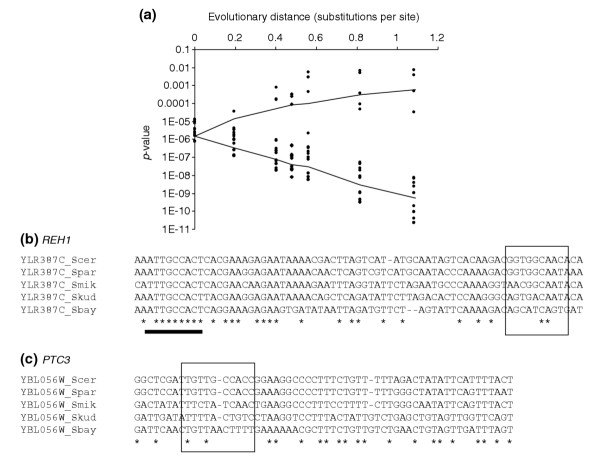
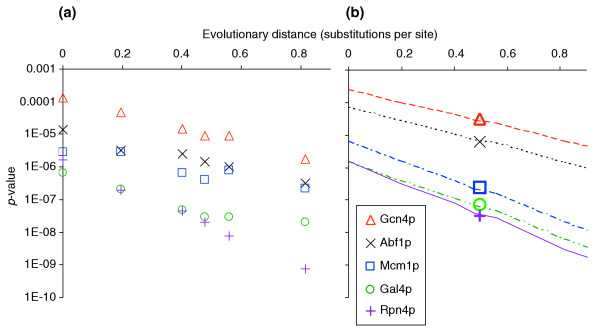
We introduce a method (MONKEY) to identify conserved transcription-factor binding sites in multispecies alignments. MONKEY employs probabilistic models of factor specificity and binding-site evolution, on which basis we compute the likelihood that putative sites are conserved and assign statistical significance to each hit. Using genomes from the genus Saccharomyces , we illustrate how the significance of real sites increases with evolutionary distance and explore the relationship between conservation and function.
Overview
The claims and statistics of this paper haven’t been checked yet.
Run the check — free, no account needed. It reads the open-access text and checks the sources it cites.
Integrity signals
Registry
Cites
Statistics
Figures
Verification
Claims the paper makes
The claims and statistics of this paper haven’t been checked yet.
Run the check — free, no account needed. It reads the open-access text and checks the sources it cites.
Claims other papers make about this one
Each is checked against this paper’s own text: does it say what the citing paper says it does?
In the citing paper
“there is an inverse relationship between the degeneracy of columns within an RNAcompete motif and the evolutionary conservation of the matching bases within the predicted binding site in transcripts”
From A compendium of RNA-binding motifs for decoding gene regulation (2013) · cites this paper as [23]
Self-check
Percentages, sums and reported differences re-computed from the paper’s own numbers.
The self-check needs the paper’s full text.
Citations
Cites
Thompson, J. D., Higgins, D. G., & Gibson, T. J. (1994) · Nucleic Acids Research · doi:10.1093/nar/22.22.4673 · Cited by 64,617
Cluster analysis and display of genome-wide expression patterns
Eisen, M. B., Spellman, P. T., Brown, P. O., & Botstein, D. (1998) · Proceedings of the National Academy of Sciences · doi:10.1073/pnas.95.25.14863 · Cited by 16,184
Self-citationEvolutionary trees from DNA sequences: A maximum likelihood approach.
Felsenstein, J. (1981) · Journal of Molecular Evolution · doi:10.1007/bf01734359 · Cited by 14,571
Evolution of Protein Molecules
JUKES, T. H., & CANTOR, C. R. (1969) · Mammalian Protein Metabolism · doi:10.1016/b978-1-4832-3211-9.50009-7 · Cited by 11,032
Dating of the human–ape splitting by a molecular clock of mitochondrial DNA.
Hasegawa, M., Kishino, H., & Yano, T.-A. (1985) · Journal of Molecular Evolution · doi:10.1007/bf02101694 · Cited by 8,687
PAML: a program package for phylogenetic analysis by maximum likelihood
Yang, Z. (1997) · Computer applications in the biosciences · doi:10.1093/bioinformatics/13.5.555 · Cited by 5,377
Genomic Expression Programs in the Response of Yeast Cells to Environmental Changes
Gasch, A. P., Spellman, P. T., Kao, C. M., Carmel-Harel, O., Eisen, M. B., Storz, G., Botstein, D., & Brown, P. O. (2000) · Molecular Biology of the Cell · doi:10.1091/mbc.11.12.4241 · Cited by 4,815
Self-citationIntegrated Genomic and Proteomic Analyses of a Systematically Perturbed Metabolic Network
Ideker, T., Thorsson, V., Ranish, J. A., Christmas, R., Buhler, J., Eng, J. K., Bumgarner, R., Goodlett, D. R., Aebersold, R., & Hood, L. (2001) · Science · doi:10.1126/science.292.5518.929 · Cited by 2,050
Genome-Wide Location and Function of DNA Binding Proteins
Ren, B., Robert, F., Wyrick, J. J., Aparicio, O. M., Jennings, E. G., Simon, I., Zeitlinger, J., Schreiber, J., Hannett, N. M., Kanin, E. I., et al. (2000) · Science · doi:10.1126/science.290.5500.2306 · Cited by 1,768
Sequencing and comparison of yeast species to identify genes and regulatory elements
Kellis, M., Patterson, N. J., Endrizzi, M. G., Birren, B. W., & Lander, E. S. (2003) · Nature · doi:10.1038/nature01644 · Cited by 1,751
Cited by
Sorted by citations
Items 101–153 of 153
From Biophysics to Evolutionary Genetics: Statistical Aspects of Gene Regulation
Lässig, M. (2007) · Biological and medical physics series · doi:10.1007/978-3-540-35306-5_12 · Cited by 9
TRANSCRIPTION BINDING SITE PREDICTION USING MARKOV MODELS
Abnizova, I., Rust, A. G., Robinson, M., Boekhorst, R. T., & Gilks, W. R. (2006) · Journal of Bioinformatics and Computational Biology · doi:10.1142/s0219720006001813 · Cited by 9
Palumbo, M. J., & Newberg, L. A. (2010) · Nucleic Acids Research · doi:10.1093/nar/gkq330 · Cited by 9
Abnizova, I., & Gilks, W. R. (2006) · Briefings in Bioinformatics · doi:10.1093/bib/bbk004 · Cited by 10
Unsupervised Learning in Genome Informatics
Wong, K., Li, Y., & Zhang, Z. (2016) · Springer eBooks · doi:10.1007/978-3-319-24211-8_15 · Cited by 8
A primer on thermodynamic-based models for deciphering transcriptional regulatory logic
Dresch, J. M., Richards, M., & Ay, A. A. (2013) · Biochimica et Biophysica Acta (BBA) - Gene Regulatory Mechanisms · doi:10.1016/j.bbagrm.2013.04.011 · Cited by 8
Malin, J., Ezer, D., Ma, X., Mount, S., Karathia, H., Park, S. G., Adryan, B., & Hannenhalli, S. S. (2015) · bioRxiv (Cold Spring Harbor Laboratory) · doi:10.1101/024398 · Cited by 7
Moses, A. M., & Sinha, S. (2009) · Springer eBooks · doi:10.1007/978-0-387-92738-1_7 · Cited by 7
Self-citationLOESS correction for length variation in gene set-based genomic sequence analysis
Aboukhalil, A., & Bulyk, M. L. (2012) · Bioinformatics · doi:10.1093/bioinformatics/bts155 · Cited by 7
Evolution of gene regulation of pluripotency - the case for wiki tracks at genome browsers
Fuellen, G., & Struckmann, S. (2010) · Biology Direct · doi:10.1186/1745-6150-5-67 · Cited by 7
ANFIS-based fuzzy systems for searching dna-protein binding sitesPreprint
Wang, D., Alhamdoosh, M., & Pedrycz, W. (2016) · bioRxiv (Cold Spring Harbor Laboratory) · doi:10.1101/058800 · Cited by 7
Interpreting noncoding genetic variation in complex traits and human disease
Ward, L. D., & Kellis, M. (2012) · Nature Biotechnology · doi:10.1038/nbt.2422 · Cited by 6
Modelling the transcription factor DNA-binding affinity using genome-wide ChIP-based dataPreprint
Alhamdoosh, M., & Wang, D. (2016) · bioRxiv (Cold Spring Harbor Laboratory) · doi:10.1101/061978 · Cited by 6
xREI: a phylo-grammar visualization webserver
Barquist, L., & Holmes, I. H. (2008) · Nucleic Acids Research · doi:10.1093/nar/gkn283 · Cited by 5
The Statistical Power of Phylogenetic Motif Models
Hawkins, J., & Bailey, T. L. (2008) · Lecture notes in computer science · doi:10.1007/978-3-540-78839-3_10 · Cited by 5
Combining phylogenetic footprinting with motif models incorporating intra-motif dependencies
Nettling, M., Treutler, H., Cerquides, J., & Große, I. (2017) · BMC Bioinformatics · doi:10.1186/s12859-017-1495-1 · Cited by 4
An expanded codebook of human transcription factor DNA-binding specificity
Jolma, A., Laverty, K. U., Fathi, A., Yang, A. W. H., Yellan, I., Vorontsov, I. E., Inukai, S., Kribelbauer, J. F., Gralak, A. J., Razavi, R., et al. (2026) · Nature · doi:10.1038/s41586-026-10798-9 · Cited by 17
Characterization of the promoter region of the murine Catsper2 gene
Contreras‐Marciales, A. D. P., López‐Guzmán, S. F., Benítez‐Hess, M. L., Oviedo, N., & Hernández‐Sánchez, J. (2022) · FEBS Open Bio · doi:10.1002/2211-5463.13518 · Cited by 4
Alam, A., Duncan, A. G., Mitchell, J. A., & Moses, A. M. (2023) · bioRxiv (Cold Spring Harbor Laboratory) · doi:10.1101/2023.04.09.536185 · Cited by 5
Self-citationFu, H., Yang, L., & Zhang, X. (2017) · Current Genomics · doi:10.2174/1389202918666170228143619 · Cited by 3
Probabilistic Methods and Rate Heterogeneity
Pupko, T., & Mayrose, I. (2010) · doi:10.1002/9780470556757.ch11 · Cited by 3
Lu, Y., Wu, Y., Liu, Y., Li, Y., Jing, R., & Li, M. (2021) · Human Mutation · doi:10.1002/humu.24203 · Cited by 2
Transcription Factor Binding Site Identification by Phylogenetic Footprinting
Hu, H., & Li, X. (2010) · Computational biology · doi:10.1007/978-1-84996-196-7_6 · Cited by 2
Chapter 11 Regulatory Variation and Evolution: Implications for Disease
Dermitzakis, E. T. (2008) · Advances in genetics · doi:10.1016/s0065-2660(07)00011-9 · Cited by 2
Karmaker, A., Yoon, K., Doderer, M. S., Kruzelock, R. P., & Kwek, S. S. (2007) · Berichte aus der medizinischen Informatik und Bioinformatik/Journal of integrative bioinformatics · doi:10.1515/jib-2007-59 · Cited by 2
A catalog of nonsynonymous polymorphism on mouse Chromosome 16
Kidd, J. M., Trevarthen, K. C., Tefft, D. L., Cheng, Z., Mooney, M., & Adams, M. D. (2005) · Mammalian Genome · doi:10.1007/s00335-005-0085-0 · Cited by 2
Gross, T., & Becker, A. (2021) · bioRxiv (Cold Spring Harbor Laboratory) · doi:10.1101/2021.03.02.433508 · Cited by 2
Comparison of Promoter Sequences Based on Inter Motif Distance
Meera, A., & Rangarajan, L. (2011) · International Journal of Software Science and Computational Intelligence · doi:10.4018/ijssci.2011070105 · Cited by 1
Blanchette, M. (2012) · BMC Bioinformatics · doi:10.1186/1471-2105-13-s19-s2 · Cited by 1
Statistical techniques for biological motif discovery
Keich, U., & Nagarajan, N. (2007) · Cited by 1
Unrealistic phylogenetic trees may improve phylogenetic footprinting
Nettling, M., Treutler, H., Cerquides, J., & Große, I. (2017) · Bioinformatics · doi:10.1093/bioinformatics/btx033 · Cited by 1
Genome evolution and regulatory network structure in bacteria
Molina, N. (2010) · edoc (University of Basel) · doi:10.5451/unibas-005551395 · Cited by 1
Evolution of cis-Regulatory Sequences in Drosophila
He, X., & Sinha, S. (2010) · Methods in molecular biology · doi:10.1007/978-1-60761-854-6_18 · Cited by 1
Computational Models of Function and Evolution of cis-Regulatory Sequences
He, X. (2009) · Illinois Digital Environment for Access to Learning and Scholarship (University of Illinois at Urbana-Champaign)
Probabilistic model-based approach to evolutionary analysis of non-coding sequences
Kim, J. (2010) · Illinois Digital Environment for Access to Learning and Scholarship (University of Illinois at Urbana-Champaign)
Computational regulatory genomics: motifs, networks, and dynamics
Kellis, M., & Kheradpour, P. (2012) · DSpace@MIT (Massachusetts Institute of Technology)
Liu, X., & Clarke, N. D. (2009) · Lecture notes in computer science · doi:10.1007/978-3-642-04744-2_19
A Statistical Model Of Transcription Factor Binding Site Gain And Loss
Diehl, A. G. (2010) · eCommons (Cornell University)
Drawid, A. (2009) · Rutgers University Community Repository (Rutgers University) · doi:10.7282/t3ft8m9x
Karmaker, A., Harris, S. E., & Kwek, S. S. (2007) · OMICS A Journal of Integrative Biology · doi:10.1089/omi.2007.0028
Distance conservation of transcription regulatory motifs in saccharomyces cerevisiae promoters
Qin, D., Lü, J., Ding, C., Zhang, Y., Ji, M., & Bai, H. (2010) · International Conference on Biomedical Engineering and Informatics (BMEI) · doi:10.1109/bmei.2010.5639789
Levers and fulcrums: progress in cis-regulatory motif models
Birney, E. (2008) · Nature Methods · doi:10.1038/nmeth0408-297
Human Upstream and Mouse Upstream : Databases ofPromoter Sequences in the Human and Mouse Genomes
Leykin, I., Kao, M. J., & Wong, W. H. (2005) · OMICS A Journal of Integrative Biology · doi:10.1089/omi.2005.9.220
MINING DNA ELEMENTS INVOLVED IN TARGETING OF CHROMATIN MODIFIERS
Philip, P. (2014) · DiVA at Umeå University (Umeå University)
Modeling p53 transcriptional regulation
Riley, T. (2008) · Rutgers University Community Repository (Rutgers University) · doi:10.7282/t31836rn
On computational strategies for regulatory element and regulatory polymorphism detection
Montgomery, S. B. (2010) · cIRcle (University of British Columbia) · doi:10.14288/1.0093020
Topics in Computational Genomics
Zhang, M. Q., & Smith, A. D. (2013) · Springer eBooks · doi:10.1007/978-3-642-38951-1_3
Chisholm, A. D. (2006) · Faculty Opinions – Post-Publication Peer Review of the Biomedical Literature · doi:10.3410/f.1010592.373770
Comparison of Promoter Sequences Based on Inter Motif Distance
Meera, A., & Rangarajan, L. (2012) · IGI Global eBooks · doi:10.4018/978-1-4666-2651-5.ch025
Moses, A. M., Stajich, J., Gasch, A. P., & Knowles, D. A. (2025) · Genetics · doi:10.1093/genetics/iyaf209
Self-citationFAIRsharing record for: SwissRegulon
FAIRsharing Team (2018) · FAIRsharing.org · doi:10.25504/fairsharing.7fnx38
Metadata
- Authors
- Moses, A. M., Chiang, D. Y., Pollard, D. A., Iyer, V. N., & Eisen, M. B.
- Affiliations
- University of California, Berkeley (US)
- Lawrence Berkeley National Laboratory (US)
- Corresponding author
- Eisen, Michael B
- Venue
- Genome Biology
- Published
- 2004-11-30
- Volume
- 5
- Issue
- 12
- Pages
- R98-R98
- ISSN
- 1465-6906 (ISSN-L)
- 1474-760X
- PMC
- PMC545801
- OpenAlex
- W2109314645
- Cited by
- 153
- References
- 53
- Citations by year
- 2026: 1 · 2025: 1 · 2023: 1 · 2022: 1 · 2021: 4 · 2018: 1 · 2017: 4 · 2016: 4 · 2015: 3 · 2014: 4 · 2013: 6 · 2012: 12
- FWCI
- 6.29
- Type
- journal article
- Language
- en
- Open access
- gold
- doi.org
- Locations
- Genome biology (publishedVersion, cc-by)
- PubMed Central (publishedVersion)
- PubMed (publishedVersion)
- University of North Texas Digital Library (University of North Texas) (submittedVersion)
- OSTI OAI (U.S. Department of Energy Office of Scientific and Technical Information) (submittedVersion)
- Funders
- National Human Genome Research Institute (R01HG002779)
- Topics
- Life Sciences › Biochemistry, Genetics and Molecular Biology › Molecular Biology › Genomics and Chromatin Dynamics
- Life Sciences › Biochemistry, Genetics and Molecular Biology › Molecular Biology › Genomics and Phylogenetic Studies
- Life Sciences › Biochemistry, Genetics and Molecular Biology › Molecular Biology › Fungal and yeast genetics research
- Keywords
- transcription factor binding sites, conserved binding sites, binding site evolution, Saccharomyces, phylogenetic distance
- MeSH terms
- Binding Sites, DNA, DNA-Binding Proteins, DNA, Fungal, Biological Evolution, Gene Expression Regulation, Models, Genetic, Saccharomyces cerevisiae, Software, Species Specificity, Transcription Factors, Sequence Alignment, Conserved Sequence, Saccharomyces cerevisiae Proteins
About these checks
Registry, retraction, Cites and statistics results are computed, not judged, with one exception: a printed reference that no index lists is read once by a model before it counts as a citation error. Claims are extracted by a model and kept only when their quote appears verbatim in the text; each cited source is then checked, with a model’s help, for whether it says what the claim relies on. Those verdicts can be wrong — read the claim’s quote and the cited source before relying on one.
Statistics and arithmetic are recomputed, not judged.
Confidence bands are shown only for fields calibrated on our annotated test set. None is calibrated yet, so no band is shown.
What counts as a claim ›How we measure confidence ›How we check this ›
Are you an author, or do you see a problem with this page? Request a review
