

Regulatory interdependence of myeloid transcription factors revealed by Matrix RNAi analysis
Open accessThe DOI matches its Crossref record; 41 of the 41 references it cites were found in a registry or an index.
Abstract
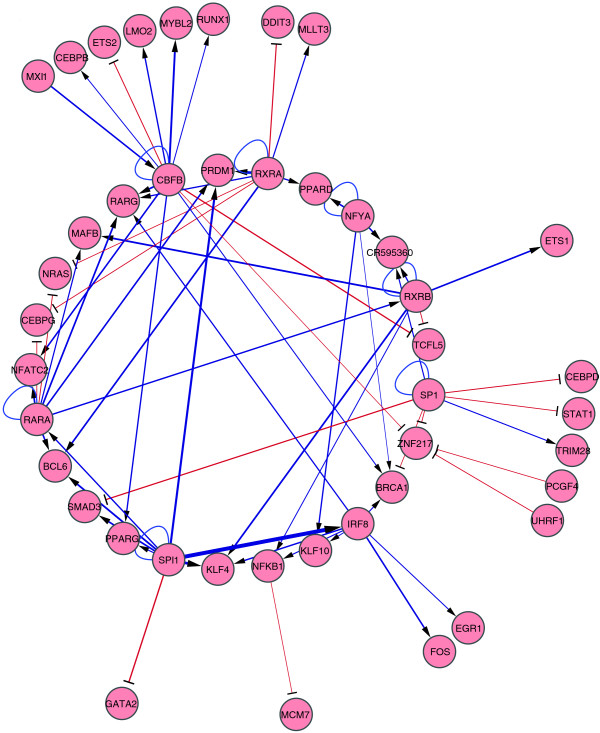
BACKGROUND: With the move towards systems biology, we need sensitive and reliable ways to determine the relationships between transcription factors and their target genes. In this paper we analyze the regulatory relationships between 78 myeloid transcription factors and their coding genes by using the matrix RNAi system in which a set of transcription factor genes are individually knocked down and the resultant expression perturbation is quantified. RESULTS: Using small interfering RNAs we knocked down the 78 transcription factor genes in monocytic THP-1 cells and monitored the perturbation of the expression of the same 78 transcription factors and 13 other transcription factor genes as well as 5 non-transcription factor genes by quantitative real-time RT-PCR, thereby building a 78 x 96 matrix of perturbation and measurement. This approach identified 876 cases where knockdown of one transcription factor significantly affected the expression of another (from a potential 7,488 combinations). Our study also revealed cell-type-specific transcriptional regulatory networks in two different cell types. CONCLUSIONS: By considering whether the targets of a given transcription factor are naturally up- or downregulated during phorbol 12-myristate 13-acetate-induced differentiation, we could classify these edges as pro-differentiative (229), anti-differentiative (76) or neither (571) using expression profiling data obtained in the FANTOM4 study. This classification analysis suggested that several factors could be involved in monocytic differentiation, while others such as MYB and the leukemogenic fusion MLL-MLLT3 could help to maintain the initial undifferentiated state by repressing the expression of pro-differentiative factors or maintaining expression of anti-differentiative factors.
Overview
The claims and statistics of this paper haven’t been checked yet.
Free: it reads the open-access text and checks the first 5 claims that cite a source we can check. Create a free account to check every claim.
Integrity signals
Registry
Cites
Statistics
Figures
Verification
Claims the paper makes
The claims and statistics of this paper haven’t been checked yet.
Free: it reads the open-access text and checks the first 5 claims that cite a source we can check. Create a free account to check every claim.
Claims other papers make about this one
Each is checked against this paper’s own text: does it say what the citing paper says it does?
The source backs part of the claim, not all of it — or backs it for a different population, condition or comparison.
In the citing paper
“THP1 has been reported to be a suitable model to study monocyte network (16) and also has been demonstrated to yield high efficiencies in siRNA transfections (16,27).”
From Establishment of single-cell screening system for the rapid identification of transcriptional modulators involved in direct cell reprogramming (2012) · cites this paper as [27]
Experimental — accuracy not yet measured
Self-check
Percentages, sums and reported differences re-computed from the paper’s own numbers.
The self-check needs the paper’s full text.
Citations
Cites
R: A Language and Environment for Statistical Computing
R Core Team (2025) · doi:10.32614/r.manuals · Cited by 352,181
Analysis of Relative Gene Expression Data Using Real-Time Quantitative PCR and the 2−ΔΔCT Method
Livak, K. J., & Schmittgen, T. D. (2001) · Methods · doi:10.1006/meth.2001.1262 · Cited by 180,860
Cytoscape: A software Environment for integrated models of biomolecular interaction networks
Shannon, P., Markiel, A., Ozier, O., Baliga, N. S., Wang, J. T., Ramage, D., Amin, N., Schwikowski, B., & Ideker, T. (2003) · Genome Research · doi:10.1101/gr.1239303 · Cited by 51,888
Statistical significance for genomewide studies
Storey, J. D., & Tibshirani, R. (2003) · Proceedings of the National Academy of Sciences · doi:10.1073/pnas.1530509100 · Cited by 9,692 · cited 1×
“Because multiple testing errors were expected, FDR analysis was performed with the P-values computed from the Student t-tests by applying the Storey correction approach [38] with the QVALUE program [39] and the R software environment for statistical computing [40].”
The Oct4 and Nanog transcription network regulates pluripotency in mouse embryonic stem cells
Loh, Y.-H., Wu, Q., Chew, J.-L., Vega, V. B., Zhang, W., Chen, X., Bourque, G., George, J., Leong, B., Liu, J., et al. (2006) · Nature Genetics · doi:10.1038/ng1760 · Cited by 2,437
Establishment and characterization of a human acute monocytic leukemia cell line (THP‐1)
Tsuchiya, S., Yamabe, M., Yamaguchi, Y., Kobayashi, Y., Konno, T., & Tada, K. (1980) · International Journal of Cancer · doi:10.1002/ijc.2910260208 · Cited by 2,254
Robertson, G., Hirst, M., Bainbridge, M., Bilenky, M., Zhao, Y., Zeng, T., Euskirchen, G., Bernier, B., Varhol, R., Delaney, A., et al. (2007) · Nature Methods · doi:10.1038/nmeth1068 · Cited by 1,454 · cited 2×
“ChIP analysis, in particular ChIP-seq [2,11], is becoming a gold standard for determining TF-target gene associations; however, these are currently limited by the number of ChIPquality antibodies available.”
Transcription regulation and animal diversity
Levine, M., & Tjian, R. (2003) · Nature · doi:10.1038/nature01763 · Cited by 1,309 · cited 1×
“Indeed, transcriptional regulation occurs through interaction between multiple distantly located regulatory sites that are bound by several different TFs [14,33,34], as represented by enhanceosomes, in mammalian systems.”
Zhang, X., Odom, D. T., Koo, S.-H., Conkright, M. D., Canettieri, G., Best, J., Chen, H., Jenner, R., Herbolsheimer, E., Jacobsen, E., et al. (2005) · Proceedings of the National Academy of Sciences · doi:10.1073/pnas.0501076102 · Cited by 992
Shivdasani, R. A., Fujiwara, Y., McDevitt, M. A., & Orkin, S. H. (1997) · The EMBO Journal · doi:10.1093/emboj/16.13.3965 · Cited by 674
ID helix-loop-helix proteins in cell growth, differentiation and tumorigenesis
Norton, J. D. (2000) · Journal of Cell Science · doi:10.1242/jcs.113.22.3897 · Cited by 665
The FANTOM Consortium, & Riken Omics Science Center (2009) · Nature Genetics · doi:10.1038/ng.375 · Cited by 427
Self-citationThorsteinsdottir, U., Sauvageau, G., Hough, M. R., Dragowska, W., Lansdorp, P. M., Lawrence, H. J., Largman, C., & Humphries, R. K. (1997) · Molecular and Cellular Biology · doi:10.1128/mcb.17.1.495 · Cited by 325
MafB is an inducer of monocytic differentiation
Kelly, L. M. (2000) · The EMBO Journal · doi:10.1093/emboj/19.9.1987 · Cited by 305
Zeitlinger, J., Zinzen, R. P., Stark, A., Kellis, M., Zhang, H., Young, R. A., & Levine, M. (2007) · Genes & Development · doi:10.1101/gad.1509607 · Cited by 286
Identification of conserved regulatory elements by comparative genome analysis
Lenhard, B., Sandelin, A., Mendoza, L., Engström, P., Jareborg, N., & Wasserman, W. W. (2003) · Journal of Biology · doi:10.1186/1475-4924-2-13 · Cited by 272
Sato, M., Taniguchi, T., & Tanaka, N. (2001) · Cytokine & Growth Factor Reviews · doi:10.1016/s1359-6101(00)00032-0 · Cited by 162
Weisz, A., Marx, P., Sharf, R., Appella, E., Driggers, P. H., Ozato, K., & Levi, B. Z. (1992) · Journal of Biological Chemistry · doi:10.1016/s0021-9258(19)74081-2 · Cited by 152
Transcriptional network dynamics in macrophage activation
Nilsson, R., Bajić, V. B., Suzuki, H., di Bernardo, D., Björkegren, J., Katayama, S., Reid, J. F., Sweet, M. J., Gariboldi, M., Carninci, P., et al. (2006) · Genomics · doi:10.1016/j.ygeno.2006.03.022 · Cited by 134
Self-citationChen, Q., & Ross, A. C. (2004) · Experimental Cell Research · doi:10.1016/j.yexcr.2004.02.017 · Cited by 129
Perry, P., Sauer, S., Billon, N., Richardson, W. D., Spivakov, M., Warnes, G., Livesey, F. J., Merkenschlager, M., Fisher, A. G., & Azuara, V. (2004) · PubMed · Cited by 116
Overexpression of HOXA10 perturbs human lymphomyelopoiesis in vitro and in vivo
Buske, C., Feuring-Buske, M., Antonchuk, J., Rosten, P., Hogge, D. E., Eaves, C. J., & Humphries, R. K. (2001) · Blood · doi:10.1182/blood.v97.8.2286 · Cited by 112
Combinatorial regulation of transcription I: General aspects of transcriptional control
Ernst, P., & Smale, S. T. (1995) · Immunity · doi:10.1016/1074-7613(95)90139-6 · Cited by 100
Smits, R., Hofland, N., Edelmann, W., Geugien, M., Jagmohan-Changur, S., Albuquerque, C., Breukel, C., Kucherlapati, R., Kielman, M. F., & Fodde, R. (2000) · Genes, Chromosomes and Cancer · doi:10.1002/1098-2264(2000)9999:9999<::aid-gcc1033>3.0.co;2-r · Cited by 91
Perry, P., Sauer, S., Billon, N., Richardson, W. D., Spivakov, M., Warnes, G., Livesey, F. J., Merkenschlager, M., Fisher, A. G., & Azuara, V. (2004) · Cell Cycle · doi:10.4161/cc.3.12.1346 · Cited by 85
Backup in gene regulatory networks explains differences between binding and knockout results
Gitter, A., Siegfried, Z., Klutstein, M., Fornes, O., Oliva, B., Simon, I., & Bar‐Joseph, Z. (2009) · Molecular Systems Biology · doi:10.1038/msb.2009.33 · Cited by 84
Lulli, V., Romania, P., Morsilli, O., Gabbianelli, M., Pagliuca, A., Mazzeo, S., Testa, U., Peschle, C., & Marziali, G. (2005) · Cell Death and Differentiation · doi:10.1038/sj.cdd.4401811 · Cited by 64
Taketani, T., Taki, T., Ono, R., Kobayashi, Y., Ida, K., & Hayashi, Y. (2002) · Genes Chromosomes and Cancer · doi:10.1002/gcc.10077 · Cited by 61
Tillmanns, S., Otto, C., Jaffray, E., Du Roure, C., Bakri, Y., Vanhille, L., Sarrazin, S., Hay, R. T., & Sieweke, M. H. (2007) · Molecular and Cellular Biology · doi:10.1128/mcb.01811-06 · Cited by 55
Odero, M. D., Zeleznik-Le, N. J., Chinwalla, V., & Rowley, J. D. (2000) · Genes, Chromosomes and Cancer · doi:10.1002/1098-2264(2000)9999:9999<::aid-gcc1040>3.0.co;2-z · Cited by 52
Dawson, M., Elstner, E., Kizaki, M., Chen, D., Pakkala, S., Kerner, B., & Koeffler, H. (1994) · Blood · doi:10.1182/blood.v84.2.446.446 · Cited by 49
Distinct palindromic extensions of the 5’‐TTC…GAA‐3’ motif allow STAT6 binding in vivo
Kraus, J., Börner, C., & Höllt, V. (2002) · The FASEB Journal · doi:10.1096/fj.02-0482fje · Cited by 48
Hemmi, H., & Breitman, T. R. (1985) · PubMed · Cited by 45
Tanaka, T., Tomaru, Y., Nomura, Y., Miura, H., Suzuki, M., & Hayashizaki, Y. (2004) · Nucleic Acids Research · doi:10.1093/nar/gkh597 · Cited by 42
Self-citationLacraz, S. F., Dayer, J., Nicod, L. P., & Welgus, H. G. (1994) · Journal of Biological Chemistry · doi:10.1016/s0021-9258(17)37397-0 · Cited by 39
Tomaru, Y., Nakanishi, M., Miura, H., Kimura, Y., Ohkawa, H., Ohta, Y., Hayashizaki, Y., & Suzuki, M. (2009) · Nucleic Acids Research · doi:10.1093/nar/gkn1028 · Cited by 35
Self-citationKawagoe, H., Kawagoe, R., & Sano, K. (2001) · Leukemia · doi:10.1038/sj.leu.2402262 · Cited by 34
Nakanishi, M., Tomaru, Y., Miura, H., Hayashizaki, Y., & Suzuki, M. (2008) · Nucleic Acids Research · doi:10.1093/nar/gkn066 · Cited by 24
Self-citationTomaru, Y., Kondo, S., Suzuki, M., & Hayashizaki, Y. (2003) · Biochemical and Biophysical Research Communications · doi:10.1016/j.bbrc.2003.08.148 · Cited by 21
Self-citationBalaji, S., Iyer, L. M., Babu, M. M., & Aravind, L. (2008) · Trends in Genetics · doi:10.1016/j.tig.2008.04.006 · Cited by 17
Miura, H., Tomaru, Y., Nakanishi, M., Kondo, S., Hayashizaki, Y., & Suzuki, M. (2008) · Nucleic Acids Research · doi:10.1093/nar/gkn978 · Cited by 13
Self-citation
Research works printed but not linked: 1
- GenBank: CR595360 http://www.ncbi.nlm.nih.gov/nuccore/50476167
Cited by
Papili Gao, N., Ud-Dean, S. M. M., Gandrillon, O., & Gunawan, R. (2018) · Bioinformatics · doi:10.1093/bioinformatics/btx575 · Cited by 235
Zhao, L., Glazov, E. A., Pattabiraman, D. R., Alowaidi, F., Zhang, P., Brown, M. A., Leo, P. J., & Gonda, T. J. (2011) · Nucleic Acids Research · doi:10.1093/nar/gkr024 · Cited by 107
Temporal dynamics and transcriptional control using single-cell gene expression analysis
Kouno, T., de Hoon, M., Mar, J. C., Tomaru, Y., Kawano, M., Carninci, P., Suzuki, H., Hayashizaki, Y., & Shin, J. W. (2013) · Genome Biology · doi:10.1186/gb-2013-14-10-r118 · Cited by 62
Self-citationNuclear Pore Complex Protein Mediated Nuclear Localization of Dicer Protein in Human Cells
Ando, Y., Tomaru, Y., Morinaga, A., Burroughs, A. M., Kawaji, H., Kubosaki, A., Kimura, R., Tagata, M., Ino, Y., Hirano, H., et al. (2011) · PLoS ONE · doi:10.1371/journal.pone.0023385 · Cited by 45
Self-citationThe AAA+ATPase RUVBL2 is essential for the oncogenic function of c-MYB in acute myeloid leukemia
Armenteros-Monterroso, E., Zhao, L., Gasparoli, L., Brooks, T., Pearce, K., Mansour, M. R., Martens, J. H. A., de Boer, J., & Williams, O. (2019) · Leukemia · doi:10.1038/s41375-019-0495-8 · Cited by 43
Metadata
- Authors
- Tomaru, Y., Simon, C., Forrest, A. R., Miura, H., Kubosaki, A., Hayashizaki, Y., & Suzuki, M.
- Affiliations
- RIKEN (JP)
- Griffith University (AU)
- Corresponding author
- Suzuki, Masanori
- Venue
- Genome biology
- Published
- 2009-11-02
- Volume
- 10
- Issue
- 11
- Pages
- R121-R121
- ISSN
- 1465-6906 (ISSN-L)
- 1474-760X
- PMC
- PMC2810662
- OpenAlex
- W2157252884
- Semantic Scholar
- 1ff2f081a6b3990132518c10d96a6c936722920b
- Cited by
- 21
- References
- 41
- Citations by year
- 2025: 3 · 2024: 1 · 2023: 2 · 2021: 1 · 2019: 2 · 2017: 1 · 2015: 1 · 2014: 2 · 2013: 1 · 2012: 1
- FWCI
- 0.94
- Type
- journal article
- Language
- en
- Open access
- gold
- doi.org
- Licence
- cc-by
- creativecommons.org/licenses/by/2.0/ (tdm)
- creativecommons.org/licenses/by/2.0/ (vor)
- Locations
- Genome biology (publishedVersion, cc-by)
- PubMed Central (publishedVersion, cc-by)
- PubMed (publishedVersion)
- Griffith Research Online (submittedVersion, cc-by)
- Funders
- Ministry of Education, Culture, Sports, Science and Technology
- National Health and Medical Research Council (428261)
- RIKEN
- Topics
- Life Sciences › Biochemistry, Genetics and Molecular Biology › Molecular Biology › Gene Regulatory Network Analysis
- Life Sciences › Biochemistry, Genetics and Molecular Biology › Molecular Biology › Genomics and Chromatin Dynamics
- Life Sciences › Biochemistry, Genetics and Molecular Biology › Molecular Biology › Bioinformatics and Genomic Networks
- Keywords
- transcriptional regulatory networks, gene knockdown, monocyte differentiation, THP-1 cells, PMA-induced differentiation, MYB, leukemogenesis, cell type-specific gene regulation
- MeSH terms
- Cell Differentiation, Gene Expression Regulation, Humans, Models, Biological, Models, Genetic, Monocytes, Transcription Factors, Transcription, Genetic, Transfection, Reverse Transcriptase Polymerase Chain Reaction, Gene Expression Profiling, RNA Interference, RNA, Small Interfering, Gene Regulatory Networks
About these checks
Registry, retraction, Cites and statistics results are computed, not judged, with one exception: a printed reference that no index lists is read once by a model before it counts as a citation error. Claims are extracted by a model and kept only when their quote appears verbatim in the text; each cited source is then checked, with a model’s help, for whether it says what the claim relies on. Those verdicts can be wrong — read the claim’s quote and the cited source before relying on one.
Statistics and arithmetic are recomputed, not judged.
Confidence bands are shown only for fields calibrated on our annotated test set. None is calibrated yet, so no band is shown.
What counts as a claim ›How we measure confidence ›How we check this ›
Are you an author, or do you see a problem with this page? Request a review
Data sources
Bibliographic data: Semantic Scholar, OpenAlex, Crossref.
Contains information from the Semantic Scholar Academic Graph Datasets, made available under the ODC Attribution License (ODC-BY 1.0).
Semantic Scholar’s data is described in: Kinney, R., et al. (2023). The Semantic Scholar Open Data Platform. arXiv:2301.10140.
