

The DOI matches its Crossref record; 30 of the 30 references it cites were found in a registry or an index.
Gene ontology analysis for RNA-seq: accounting for selection bias
Open accessAbstract
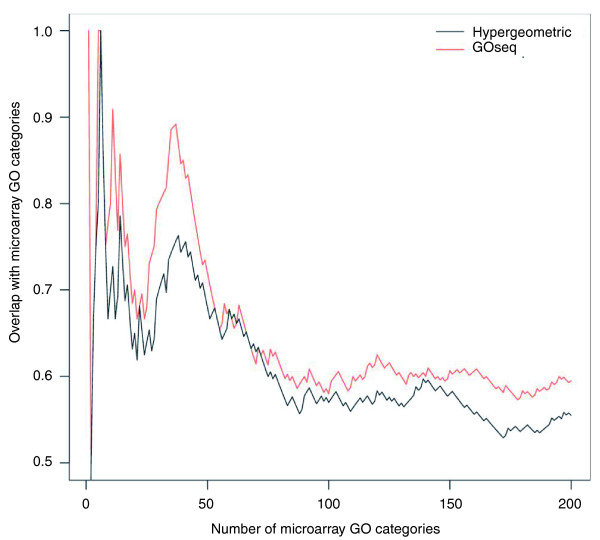
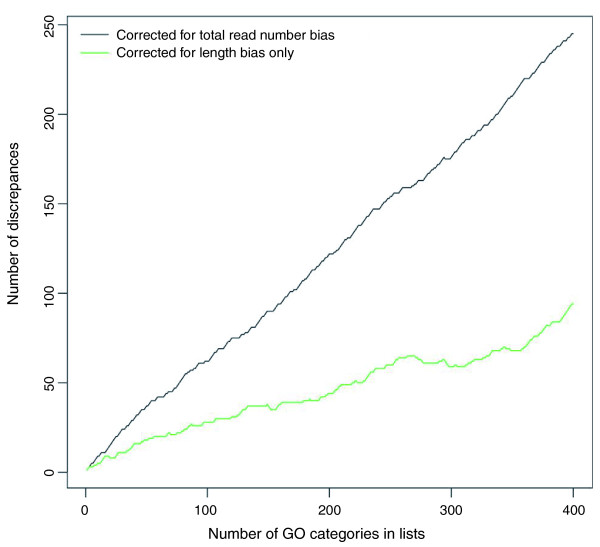
We present GOseq, an application for performing Gene Ontology (GO) analysis on RNA-seq data. GO analysis is widely used to reduce complexity and highlight biological processes in genome-wide expression studies, but standard methods give biased results on RNA-seq data due to over-detection of differential expression for long and highly expressed transcripts. Application of GOseq to a prostate cancer data set shows that GOseq dramatically changes the results, highlighting categories more consistent with the known biology.
Overview
The claims and statistics of this paper haven’t been checked yet.
Run the check — free, no account needed. It reads the open-access text and checks the sources it cites.
Integrity signals
Registry
Cites
Statistics
Figures
Verification
Claims the paper makes
The claims and statistics of this paper haven’t been checked yet.
Run the check — free, no account needed. It reads the open-access text and checks the sources it cites.
Claims other papers make about this one
Each is checked against this paper’s own text: does it say what the citing paper says it does?
In the citing paper
“Compared to the hypergeometric and Fisher’s tests, GOSeq has an advantage for RNA-seq data in that it explicitly accounts for the detection bias of long and highly expressed transcripts.”
From Gene expression elucidates functional impact of polygenic risk for schizophrenia (2016) · cites this paper as [111]
Self-check
Percentages, sums and reported differences re-computed from the paper’s own numbers.
The self-check needs the paper’s full text.
Citations
Cites
Controlling the False Discovery Rate: A Practical and Powerful Approach to Multiple Testing
Benjamini, Y., & Hochberg, Y. (1995) · Journal of the Royal Statistical Society Series B: Statistical Methodology · doi:10.1111/j.2517-6161.1995.tb02031.x · Cited by 109,482
Subramanian, A., Tamayo, P., Mootha, V. K., Mukherjee, S., Ebert, B. L., Gillette, M. A., Paulovich, A., Pomeroy, S. L., Golub, T. R., Lander, E. S., et al. (2005) · Proceedings of the National Academy of Sciences · doi:10.1073/pnas.0506580102 · Cited by 53,625
Gene Ontology: tool for the unification of biology
Ashburner, M., Ball, C. A., Blake, J. A., Botstein, D., Butler, H., Cherry, J. M., Davis, A. P., Dolinski, K., Dwight, S. S., Eppig, J. T., et al. (2000) · Nature Genetics · doi:10.1038/75556 · Cited by 43,206
Robinson, M. D., McCarthy, D. J., & Smyth, G. K. (2010) · Bioinformatics · doi:10.1093/bioinformatics/btp616 · Cited by 41,364
Self-citationSystematic and integrative analysis of large gene lists using DAVID bioinformatics resources
Huang, D. W., Sherman, B. T., & Lempicki, R. A. (2009) · Nature Protocols · doi:10.1038/nprot.2008.211 · Cited by 35,890
Ultrafast and memory-efficient alignment of short DNA sequences to the human genome.
Langmead, B., Trapnell, C., Pop, M., & Salzberg, S. L. (2009) · Genome Biology · doi:10.1186/gb-2009-10-3-r25 · Cited by 21,849
Mapping and quantifying mammalian transcriptomes by RNA-Seq
Mortazavi, A., Williams, B. A., McCue, K., Schaeffer, L., & Wold, B. (2008) · Nature Methods · doi:10.1038/nmeth.1226 · Cited by 13,696
A scaling normalization method for differential expression analysis of RNA-seq data
Robinson, M. D., & Oshlack, A. (2010) · Genome Biology · doi:10.1186/gb-2010-11-3-r25 · Cited by 7,876
Self-citationlimma: Linear Models for Microarray Data
Smyth, G. K. (2005) · Statistics for Biology and Health · doi:10.1007/0-387-29362-0_23 · Cited by 5,796
Self-citationAlternative isoform regulation in human tissue transcriptomes
Wang, E. T., Sandberg, R., Luo, S., Khrebtukova, I., Zhang, L., Mayr, C., Kingsmore, S. F., Schroth, G. P., & Burge, C. B. (2008) · Nature · doi:10.1038/nature07509 · Cited by 5,181
Research works printed but not linked: 1
- Barnard GA: Contribution to the discussion of Professor Bartlet's paper. J Roy Stat Soc Series B (Methodological). 1963, 25: 294-
Cited by
Sorted by citations
Items 1,001–1,009 of 1,009
Transcriptional profiling of normal, stenotic, and regurgitant human aortic valves
Greene, C. L., Jaatinen, K. J., Wang, H., Koyano, T. K., Bilbao, M. S., & Woo, Y. J. (2020) · Genes · doi:10.3390/genes11070789 · Cited by 30
Exogenous artificial DNA forms chromatin structure with active transcription in yeast
Zhou, J., Zhang, C., Wei, R., Han, M., Wang, S., Yang, K., Zhang, L., Chen, W., Wen, M., Li, C., et al. (2022) · Science China Life Sciences · doi:10.1007/s11427-021-2044-x · Cited by 24
Peng, Y., Chu, Y., Chen, Z., Zhou, W., Wan, S., Xiao, Y., Zhang, Y., & Li, J. (2020) · World Journal of Surgical Oncology · doi:10.1186/s12957-020-01909-5 · Cited by 21
Guo, J., Wang, Z., Qu, L., Hu, Y., & Lu, D. (2022) · BMC Plant Biology · doi:10.1186/s12870-022-03822-3 · Cited by 18
Deletion of Abi3/Gngt2 influences age-progressive amyloid β and tau pathologies in distinctive ways
Ibanez, K. R., McFarland, K. N., Phillips, J., Allen, M., Lessard, C. B., Zobel, L., De La Cruz, E. G., Shah, S., Vo, Q., Wang, X., et al. (2022) · Alzheimer's Research & Therapy · doi:10.1186/s13195-022-01044-1 · Cited by 18
Transcriptome dynamics and hub genes of green alga Nannochloris sp. JB17 under NaHCO3 stress
Wang, M., Ye, X., Wang, Y., Su, D., Liu, S., & Bu, Y. (2021) · Algal Research · doi:10.1016/j.algal.2021.102185 · Cited by 17
Liang, Y., Gong, Z., Wang, J., Zheng, J., Ma, Y., Min, L., Chen, Q., Li, Z., Qu, Y., Chen, Q., et al. (2021) · Plants · doi:10.3390/plants10112517 · Cited by 12
Guo, W., Gou, X., Yu, L., Zhang, Q., Yang, P., Pang, M., Pang, X., Pang, C., Wei, Y., & Zhang, X. (2023) · Frontiers in Neurology · doi:10.3389/fneur.2023.1129470 · Cited by 10
Establishing the relationship between brain cellular senescence and brain structure
Lund, A. N., Kopell, B. H., Golestani, N., Vornholt, E., Thompson, R. C., Liharska, L. E., Luo, Y., Cheng, E., Park, Y. J., Fennessy, B., et al. (2026) · Cell · doi:10.1016/j.cell.2025.10.014 · Cited by 6
Metadata
- Authors
- Young, M. D., Wakefield, M. J., Smyth, G. K., & Oshlack, A.
- Affiliations
- Walter and Eliza Hall Institute of Medical Research (AU)
- Corresponding author
- Oshlack, Alicia
- Venue
- Genome Biology
- Published
- 2010-02-04
- Volume
- 11
- Issue
- 2
- Pages
- R14-R14
- ISSN
- 1465-6906 (ISSN-L)
- 1474-760X
- PMC
- PMC2872874
- OpenAlex
- W2107060225
- Cited by
- 7,107
- References
- 30
- Citations by year
- 2026: 284 · 2025: 495 · 2024: 690 · 2023: 713 · 2022: 918 · 2021: 1008 · 2020: 849 · 2019: 657 · 2018: 476 · 2017: 385 · 2016: 229 · 2015: 160 · 2014: 95 · 2013: 58 · 2012: 44
- FWCI
- 18.77
- Type
- journal article
- Language
- en
- Open access
- gold
- doi.org
- Locations
- Genome biology (publishedVersion, cc-by)
- Europe PMC (PubMed Central) (publishedVersion, cc-by)
- PubMed Central (publishedVersion, cc-by)
- PubMed (publishedVersion)
- Minerva Access (University of Melbourne) (submittedVersion, cc-by)
- Topics
- Life Sciences › Biochemistry, Genetics and Molecular Biology › Molecular Biology › Bioinformatics and Genomic Networks
- Life Sciences › Biochemistry, Genetics and Molecular Biology › Molecular Biology › Genomics and Phylogenetic Studies
- Life Sciences › Biochemistry, Genetics and Molecular Biology › Molecular Biology › Gene expression and cancer classification
- Keywords
- gene ontology enrichment, RNA-seq, selection bias, differential gene expression, prostate cancer, gene expression analysis
- MeSH terms
- Androgens, Humans, Male, Prostatic Neoplasms, Gene Expression Regulation, Neoplastic, Bias, Sequence Analysis, RNA, Cell Line, Tumor, Genome-Wide Association Study
About these checks
Registry, retraction, Cites and statistics results are computed, not judged, with one exception: a printed reference that no index lists is read once by a model before it counts as a citation error. Claims are extracted by a model and kept only when their quote appears verbatim in the text; each cited source is then checked, with a model’s help, for whether it says what the claim relies on. Those verdicts can be wrong — read the claim’s quote and the cited source before relying on one.
Statistics and arithmetic are recomputed, not judged.
Confidence bands are shown only for fields calibrated on our annotated test set. None is calibrated yet, so no band is shown.
What counts as a claim ›How we measure confidence ›How we check this ›
Are you an author, or do you see a problem with this page? Request a review
