

Transcriptome analysis of human tissues and cell lines reveals one dominant transcript per gene
Open accessThe DOI matches its Crossref record; 60 of the 62 references it cites were found in a registry or an index.
Abstract
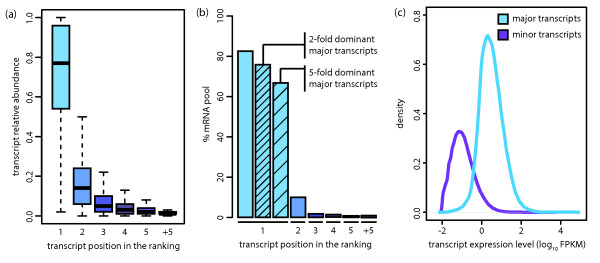
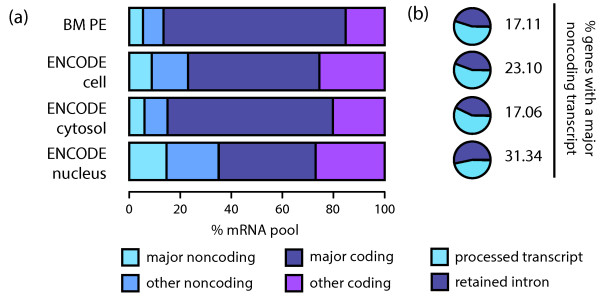
Background: RNA sequencing has opened new avenues for the study of transcriptome composition. Significant evidence has accumulated showing that the human transcriptome contains in excess of a hundred thousand different transcripts. However, it is still not clear to what extent this diversity prevails when considering the relative abundances of different transcripts from the same gene. Results: Here we show that, in a given condition, most protein coding genes have one major transcript expressed at significantly higher level than others, that in human tissues the major transcripts contribute almost 85 percent to the total mRNA from protein coding loci, and that often the same major transcript is expressed in many tissues. We detect a high degree of overlap between the set of major transcripts and a recently published set of alternatively spliced transcripts that are predicted to be translated utilizing proteomic data. Thus, we hypothesize that although some minor transcripts may play a functional role, the major ones are likely to be the main contributors to the proteome. However, we still detect a non-negligible fraction of protein coding genes for which the major transcript does not code a protein. Conclusions: Overall, our findings suggest that the transcriptome from protein coding loci is dominated by one transcript per gene and that not all the transcripts that contribute to transcriptome diversity are equally likely to contribute to protein diversity. This observation can help to prioritize candidate targets in proteomics research and to predict the functional impact of the detected changes in variation studies.
Overview
The claims and statistics of this paper haven’t been checked yet.
Free: it reads the open-access text and checks the first 5 claims that cite a source we can check. Create a free account to check every claim.
Integrity signals
Registry
Cites
Statistics
Figures
Verification
Claims the paper makes
The claims and statistics of this paper haven’t been checked yet.
Free: it reads the open-access text and checks the first 5 claims that cite a source we can check. Create a free account to check every claim.
Claims other papers make about this one
Each is checked against this paper’s own text: does it say what the citing paper says it does?
The cited source says what the claim attributes to it.
In the citing paper
“More specifically, for genes with multiple isoforms, many are expressed at an extremely low level in comparison to the most abundant isoforms (Gonzàlez-Porta et al., 2013) (Figure 3A).”
From Impact of Alternative Splicing on the Human Proteome (2017) · cites this paper as Gonzàlez-Porta et al., 2013
The cited source says what the claim attributes to it.
In the citing paper
“A recent result that has a potentially significant impact on interpretation of proteomic data is the finding that most genes, in a given cell-type, likely express only a single ‘dominant’ transcript70,71.”
From Decoding neuroproteomics: integrating the genome, translatome and functional anatomy (2014) · cites this paper as [70]
In the citing paper
“The relevance of gene-level analyses is also supported by recent surveys of transcription, which have shown that each gene tends to have a dominant isoform that accounts for far more of the total expression for that gene than any of the remaining isoforms [46,47].”
From voom: precision weights unlock linear model analysis tools for RNA-seq read counts (2014) · cites this paper as [47]
Self-check
Percentages, sums and reported differences re-computed from the paper’s own numbers.
The self-check needs the paper’s full text.
Citations
Cites
Controlling the False Discovery Rate: A Practical and Powerful Approach to Multiple Testing
Benjamini, Y., & Hochberg, Y. (1995) · Journal of the Royal Statistical Society Series B: Statistical Methodology · doi:10.1111/j.2517-6161.1995.tb02031.x · Cited by 109,482 · cited 1×
“05 (Benjamini and Hochberg correction [57]) was used as a threshold for the identification of significant GO terms.”
MethodSystematic and integrative analysis of large gene lists using DAVID bioinformatics resources
Huang, D. W., Sherman, B. T., & Lempicki, R. A. (2009) · Nature Protocols · doi:10.1038/nprot.2008.211 · Cited by 35,890 · cited 1×
“GO analyses were performed with the DAVID software [55, 56].”
MethodUltrafast and memory-efficient alignment of short DNA sequences to the human genome.
Langmead, B., Trapnell, C., Pop, M., & Salzberg, S. L. (2009) · Genome Biology · doi:10.1186/gb-2009-10-3-r25 · Cited by 21,849
An integrated encyclopedia of DNA elements in the human genome
The ENCODE Project Consortium (2012) · Nature · doi:10.1038/nature11247 · Cited by 18,072
Trapnell, C., Williams, B. A., Pertea, G., Mortazavi, A., Kwan, G., van Baren, M. J., Salzberg, S. L., Wold, B. J., & Pachter, L. (2010) · Nature Biotechnology · doi:10.1038/nbt.1621 · Cited by 15,556
Huang, D. W., Sherman, B. T., & Lempicki, R. A. (2009) · Nucleic Acids Research · doi:10.1093/nar/gkn923 · Cited by 14,108 · cited 1×
“GO analyses were performed with the DAVID software [55, 56].”
MethodMapping and quantifying mammalian transcriptomes by RNA-Seq
Mortazavi, A., Williams, B. A., McCue, K., Schaeffer, L., & Wold, B. (2008) · Nature Methods · doi:10.1038/nmeth.1226 · Cited by 13,696 · cited 1×
“Recently, applications of high throughput sequencing to RNA, known as RNA-seq [2], have opened new avenues for the study of transcriptome composition [3].”
BackgroundRNA-Seq: a revolutionary tool for transcriptomics
Wang, Z., Gerstein, M., & Snyder, M. (2009) · Nature Reviews Genetics · doi:10.1038/nrg2484 · Cited by 13,174 · cited 12×
“Most protein coding genes express one dominant transcript First, examining only the tissue data, and similarly to previous RNA-seq-based transcriptome studies, we detect more than one transcript for approximately 85% of the studied genes (83.70% to 89.95%, SD = 1.84, Additional File 2 - Table S1) and a total of 105,45…”
BackgroundInfluentialTopHat: discovering splice junctions with RNA-Seq
Trapnell, C., Pachter, L., & Salzberg, S. L. (2009) · Bioinformatics · doi:10.1093/bioinformatics/btp120 · Cited by 11,617
Landscape of transcription in human cells
Djebali, S., Davis, C. A., Merkel, A., Dobin, A., Lassmann, T., Mortazavi, A., Tanzer, A., Lagarde, J., Lin, W., Schlesinger, F., et al. (2012) · Nature · doi:10.1038/nature11233 · Cited by 5,187 · cited 2×
“[13], but in most cases the major transcripts are dominating the transcriptome.”
BackgroundSelf-citation
Research works printed but not linked: 1
- Taneri B Snyder B Gaasterland T Distribution of alternatively spliced transcript isoforms within human and mouse transcriptomes. J OMICS Res 2011 14 1 5
Cited by
Items 201–265 of 265
Generative modeling for RNA splicing predictions and designPreprint
Wu, D., Maus, N., Jha, A., Yang, K., Wales-McGrath, B. D., Jewell, S., Tangiyan, A., Choi, P. S., Gardner, J. R., & Barash, Y. (2025) · eLife · doi:10.7554/elife.106043.1 · Cited by 8
Two isoforms of Rel gene involved in the immune regulation of pearl oyster Pinctada fucata martensii
Chen, H., Chen, G., Chen, Z., Lu, X., Fu, S., Liao, W., Jiao, Y., Wang, Q., Yang, C., & Deng, Y. (2025) · Fish & Shellfish Immunology · doi:10.1016/j.fsi.2025.110895 · Cited by 2
TEx-MST: tissue expression profiles of MANE select transcripts
Tung, K.-F., & Lin, W. (2022) · Database · doi:10.1093/database/baac089 · Cited by 3
“As reported previously, many proteincoding genes have a single dominant transcript (40, 41),”
BackgroundVom humanen Genom zum humanen Proteom
Muñoz, J., & Heck, A. J. R. (2014) · Angewandte Chemie · doi:10.1002/ange.201406545 · Cited by 2
The Role of Noncoding mRNA Isoforms in the Regulation of Gene Expression
Filatova, E. N., & Utkin, O. V. (2018) · Russian Journal of Genetics · doi:10.1134/s1022795418080057 · Cited by 2
Bitton, D. A., Atkinson, S. R., Rallis, C., Smith, G. C., Ellis, D., Jeffares, D. C., Chen, Y. Y. C., Małecki, M., Codlin, S., Lubas, M., et al. (2014) · bioRxiv (Cold Spring Harbor Laboratory) · doi:10.1101/010033 · Cited by 2
“A recent analysis of human transcriptomes, however, has revealed that most protein-coding genes express only one dominant transcript that contributes to the proteome in multiple tissues (Gonzalez-Porta et al. 2013).”
InfluentialGenome-wide characterization of differential transcript usage in Arabidopsis thalianaPreprint
Vaneechoutte, D., Estrada, A. R., Lin, Y.-C., Loraine, A. E., & Vandepoele, K. (2017) · bioRxiv (Cold Spring Harbor Laboratory) · doi:10.1101/136770 · Cited by 2
“Human protein-coding genes often have an isoform expressed at a significantly higher level than others and it is therefore referred to as dominant (Trapnell et al., 2010; Gonzalez-Porta et al., 2013).”
BackgroundHeterogeneous and Novel Transcript Expression in Single Cells of Patient-Derived ccRCC OrganoidsPreprint
Karakulak, T., Zajac, N., Bolck, H. A., Bratus-Neuenschwander, A., Zhang, Q., Qi, W., Basu, D., Oltra, T. C., Rehrauer, H., von Mering, C., et al. (2024) · bioRxiv (Cold Spring Harbor Laboratory) · doi:10.1101/2024.03.15.585271 · Cited by 3
“These dominant transcripts can be tissue-specific (Ezkurdia et al. 2015; Gonzàlez-Porta et al. 2013; Tung et al. 2022).”
BackgroundGenerative modeling for RNA splicing prediction and designPreprint
Wu, D., Maus, N., Jha, A., Yang, K., Wales-McGrath, B. D., Jewell, S., Tangiyan, A., Choi, P. S., Gardner, J. R., & Barash, Y. (2026) · eLife · doi:10.7554/elife.106043 · Cited by 10
RNA-Seq Analysis Reveals Localization-Associated Alternative Splicing across 13 Cell Lines
Zeng, C., & Hamada, M. (2020) · Genes · doi:10.3390/genes11070820 · Cited by 17
Wang, H., Li, A., An, C., Che, S., Huang, R. S., Liu, S., & Zhuang, Z. (2025) · International Journal of Biological Macromolecules · doi:10.1016/j.ijbiomac.2025.144156 · Cited by 1
Babič, T., Đeri, B. B., Pavlovic, D., Dragičević, S., Despotović, J., Karanović, J., & Nikolić, A. (2025) · Cancer Informatics · doi:10.1177/11769351251396250 · Cited by 1
“6 .”
Dawson, H. D., Chen, C. T., Ragonese, J., Smith, A. D., & Lunney, J. K. (2025) · BMC Genomics · doi:10.1186/s12864-025-12388-x · Cited by 1
“Although it has been suggested that most proteins have a single isoform [57] and that many splice variants are not translated into proteins, there are multiple splice variants for 72% of annotated human genes and 205,000 transcripts had protein-coding potential (> 10 transcripts per gene).”
annotation and visualisation of extreme changes in splicing from RNA-seq experiments with SwitchSeq
Gonz, M. (2014) · Cited by 1
Role of transcription factors in hepatocellular carcinoma
Shinde, S. D., Kulkarni, N., Sahu, B., Kalia, K., & Behera, S. K. (2022) · Elsevier eBooks · doi:10.1016/b978-0-323-98807-0.00007-7 · Cited by 1
Steinbach, A., Kun, J., Urban, P. P., Palkovics, T., Polgár, B., & Schneider, G. (2024) · Pathogens · doi:10.3390/pathogens13050386 · Cited by 1
“4.1 tool [40].”
InfluentialMolecular impact of nicotine and smoking exposure on the developing and adult mouse brain
González‐Padilla, D., Eagles, N. J., Cano, M., Pertea, G., Jaffe, A. E., Maynard, K. R., Hancock, D. B., Handa, J. T., Martinowich, K., & Collado‐Torres, L. (2026) · Addiction Neuroscience · doi:10.1016/j.addicn.2026.100270 · Cited by 2
Awe, O. I., Makolo, A. U., & Fatumo, S. (2017) · doi:10.1109/ireehi.2017.8350465 · Cited by 1
“We now understand the transcriptome of human brain cells (4) and some other cells.”
BackgroundProtein speciation is likely to increase the chance of proteins to be determined in 2‐DE/MS
Kwiatkowski, M., Hotze, M., Schumacher, J., Asif, A. R., Pittol, J. M. R., Brenig, B., Ramljak, S., Zischler, H., & Herlyn, H. (2022) · Electrophoresis · doi:10.1002/elps.202000393 · Cited by 1
“Indeed, many proteins have only a single dominant isoform despite the occurrence of additional transcript variants [31, 33].”
BackgroundAPPRIS principal isoforms and MANE Select transcripts in clinical variant interpretationPreprint
del Pozo, F. C., Rodrı́guez, J. M., Vázquez, J., & Tress, M. L. (2021) · bioRxiv (Cold Spring Harbor Laboratory) · doi:10.1101/2021.09.17.460749 · Cited by 1
“Even the 5-fold dominant transcript variants from the transcriptomics experiment [24] coincided less than 80% of the time with the main proteomics isoform, while the two-fold dominant transcripts fared even more poorly.”
BackgroundObstacles to Studying Alternative Splicing Using scRNA-seqPreprint
Westoby, J., Artemov, P., Hemberg, M., & Ferguson‐Smith, A. C. (2019) · bioRxiv (Cold Spring Harbor Laboratory) · doi:10.1101/797951 · Cited by 1
“Bulk RNA-seq studies have shown that most genes have a ‘major’, highly abundant isoform, and will sometimes additionally have ‘minor’, more lowly expressed isoforms [12, 13].”
BackgroundResultCLN3 transcript complexity revealed by long-read RNA sequencing analysisPreprint
Zhang, H.-Y., Minnis, C. J., Gustavsson, E. K., Ryten, M., & Mole, S. (2023) · bioRxiv (Cold Spring Harbor Laboratory) · doi:10.1101/2023.10.12.562062 · Cited by 1
FAIRsharing record for: The Human Protein Atlas
FAIRsharing Team, et al. (2015) · FAIRsharing.org · doi:10.25504/fairsharing.j0t0pe · Cited by 1
Mass Spectrometry and Affinity Based Methods for Analysis of Proteins and Proteomes
Sundberg, M. (2015) · Uppsala University Publications (Uppsala University) · Cited by 1
High-throughput RNA sequencing: a step forward in transcriptome analysis
Okonechnikov, K. (2016) · Universitätsbibliothek der FU Berlin Hochschulschriftenstelle u. Dokumentenserver · doi:10.17169/refubium-13309 · Cited by 1
transcript usage from RNA-seq data: isoform pre-ltering improves performance of count-based methods
Soneson, C., Matthes, K. L., Nowicka, M., Law, C. W., & Robinson, M. D. (2015)
Fluorescent Labeling, Co-Tracking, and Quantification of RNA In Cellulo.
Custer, T. (2016) · Deep Blue (University of Michigan)
Ait-hamlat, A., Zea, D. J., Labeeuw, A., Polit, L., Richard, H., & Laine, É. (2017) · bioRxiv (Cold Spring Harbor Laboratory) · doi:10.1101/119891
Large-scale study of rna processing alterations in multiple cancers
Singh, B. (2017) · Repositori digital de la UPF (Universitat Pompeu Fabra)
Validation of antibodies for tissue based immunoassays
Andersson, S. (2015) · Uppsala University Publications (Uppsala University)
Characterization of clinically relevant RNA alterations for personalized cancer medicine
Alonso, T., & Luis, J. J. Q. (2019) · Repositori digital de la UPF (Universitat Pompeu Fabra)
Fallatah, H. (2019) · Carleton University's Institutional Repository (MacOdrum Library, Carleton University) · doi:10.22215/etd/2019-13952
Splicing and Alternative Splicing and the Impact of Mechanics
Mierke, C. T. (2020) · Biological and medical physics, biomedical engineering · doi:10.1007/978-3-030-58532-7_13
Xia, C., Dai, R., Yu, J., Zhang, C., Wong, M., & Liu, C. (2021) · Research Square · doi:10.21203/rs.3.rs-1184033/v1
“The functional role of alternative transcripts has been reported to vary from little evidence for protein isoforms due to AS [10-12] to extensive production of protein isoforms in mammalians using quantitative proteomics [13, 14] or ribosome-associated transcripts [15].”
BackgroundGrand Celebration: 10th Anniversary of the Human Genome Project
Rampelotto, P. H., Burn, J., Lupski, J., & Nelson, K. (2016) · MDPI eBooks · doi:10.3390/books978-3-03842-170-2
Cheng, C. (2019) · Faculty Opinions – Post-Publication Peer Review of the Biomedical Literature · doi:10.3410/f.733639975.793555626
Fast recontruction of compact context-specific network modelsPreprint
Pacheco, M. P. (2018) · Thesis Commons (OSF Preprints) · doi:10.31237/osf.io/8xcwa
Xia, W., Jiang, H., Guo, H., Liu, Y., & Gou, X. (2022) · Gene · doi:10.1016/j.gene.2022.146733
Single Transcript-Level Metabolic Responsive Landscape of Human Liver TranscriptomePreprint
Jiang, C., Li, P., Ma, Y., Yoneda, N., Nishiwaki, M., Ohnishi, Y., Suemizu, H., & Cao, H. (2023) · bioRxiv (Cold Spring Harbor Laboratory) · doi:10.1101/2023.07.06.544842
Zhao, Y., Ehteramyan, M., Li, Y., Bai, X., Huang, L., Gao, Y., Angbohang, A., Yang, X., Lynham, S., Margariti, A., et al. (2023) · bioRxiv (Cold Spring Harbor Laboratory) · doi:10.1101/2023.12.09.570916
AKTAS, S. H. (2024) · Indian Journal of Experimental Biology · doi:10.56042/ijeb.v62i03.2203
Okafor, M. T. (2024) · International Journal of Medicine and Health Development · doi:10.4103/ijmh.ijmh_20_24
Mandal, S. D., & Mukherjee, S. (2025) · Journal of Biosciences · doi:10.1007/s12038-025-00509-3 · Cited by 1
Dawson, H. D., Chen, C. T., Ragonese, J., Smith, A. D., & Lunney, J. K. (2025) · Research Square · doi:10.21203/rs.3.rs-6856588/v1
Keszthelyi, M., Légrádi, R., Pálya, D., Köles, T., Regős, Á., Menyhárd, D. K., & Tory, K. (2025) · Scientific Reports · doi:10.1038/s41598-025-10711-w · Cited by 1
“Expression level-and conservation-based isoform selection often contradict the sequence length-based ones 35,39,43,44 .”
Cataloging the potential functional diversity of Cacna1e splice variants using long-read sequencing
Bhuiyan, S. A., Tyson, J. R., Belmadani, M., Sicherman, J., Snutch, T. P., & Pavlidis, P. (2025) · BMC Genomics · doi:10.1186/s12864-025-11887-1 · Cited by 1
“As many transcripts are expressed at low levels, we consider genes with multiple “appreciably” expressed splice variants as stronger candidates for having FDSIs [36].”
Kuzudisli, C., Qaqish, B. F., Bakır-Güngör, B., & Yousef, M. (2025) · doi:10.1109/ubmk67458.2025.11206851
“This is due to the fact that a single gene can represent different transcripts, i.e., is capable of producing multiple different mRNAs [2].”
de la Fuente, L., Arzalluz-Luque, Á., Tardáguila, M., del Risco, H., Martí, C., Tarazona, S., Salguero, P., Scott, R., Lerma, A., Alastrue-Agudo, A., et al. (2020) · Figshare · doi:10.6084/m9.figshare.12324434
Additional file 1 of Obstacles to detecting isoforms using full-length scRNA-seq data
Westoby, J., Artemov, P., Hemberg, M., & Ferguson‐Smith, A. C. (2020) · Figshare · doi:10.6084/m9.figshare.12023475
Tiberi, S., & Robinson, M. D. (2020) · Figshare · doi:10.6084/m9.figshare.11992356
Additional file 1 of SRTdb: an omnibus for human tissue and cancer-specific RNA transcripts
Shi, Q., Liu, T., Hu, W., Zhiao, C., He, X., & Li, S. (2022) · Figshare · doi:10.6084/m9.figshare.19663680
Tiberi, S., & Robinson, M. D. (2020) · Figshare · doi:10.6084/m9.figshare.11992359
Wang, Z., Tian, W., Wang, D., Guo, Y., Cheng, Z., Zhang, Y., Li, X., Zhi, Y., Li, D., 李转见, et al. (2024) · Figshare · doi:10.6084/m9.figshare.24425800
de la Fuente, L., Arzalluz-Luque, Á., Tardáguila, M., del Risco, H., Martí, C., Tarazona, S., Salguero, P., Scott, R., Lerma, A., Alastrue-Agudo, A., et al. (2020) · Figshare · doi:10.6084/m9.figshare.12324455
Additional file 2 of Obstacles to detecting isoforms using full-length scRNA-seq data
Westoby, J., Artemov, P., Hemberg, M., & Ferguson‐Smith, A. C. (2020) · Figshare · doi:10.6084/m9.figshare.12023481
Bai, Y., Wang, M., Zhao, J., Bai, H., Zhang, X., Wang, J., Ke, Q., Qu, A., Pu, F., Zheng, W., et al. (2022) · Figshare · doi:10.6084/m9.figshare.19359654
Bénitière, F. (2024) · theses.fr (ABES) · doi:10.70675/a3e412c0z2333z4c62zb12ezf5e361ef1275
Awasthi, D., Verma, P., & Pandit, S. B. (2026) · bioRxiv (Cold Spring Harbor Laboratory) · doi:10.64898/2026.04.29.721330
Glycolysis and glycolytic enzymes in acute myeloid leukemia: Warburg and beyond
Seiler, K., Mady, Y. H., Torbett, B. E., Sarry, J., & Tschan, M. P. (2026) · Frontiers in Pharmacology · doi:10.3389/fphar.2026.1823211 · Cited by 1
Recursive mutational robustness in cancer through intra- and inter-genic compensationPreprint
Dandage, R., Hernández-Corchado, A., Madrigal, A., Namini, A. M., Wang, J., Choi, B. G., Goodarzi, H., & Najafabadi, H. S. (2026) · bioRxiv (Cold Spring Harbor Laboratory) · doi:10.64898/2026.05.26.727768
Alternative splicing dysregulation in CAG repeat expansion diseases
Aliyeva, A., Cleary, J. D., Shorrock, H. K., & Berglund, J. A. (2026) · Trends in Neurosciences · doi:10.1016/j.tins.2026.07.006
Chen, N., Pugliano, A., Winter, M., Wu, K., & Annaert, P. (2026) · CPT Pharmacometrics & Systems Pharmacology · doi:10.1002/psp4.70316
“A maximum-abundance approach was chosen over summation and averaging to prevent inflation from shared peptides [28, 29] and dilution by trace variants [30], respectively, thereby preserving the predominant abundance [31, 32].”
Long Noncoding RNAs: Characteristics, Microprotein Production, and Genomic Origins
Haseltine, W. A., & Patarca, R. (2026) · Springer eBooks · doi:10.1007/978-3-032-30270-0_1
Metadata
- Authors
- Gonzàlez-Porta, M., Frankish, A., Rung, J., Harrow, J., & Brazma, A.
- Affiliations
- European Bioinformatics Institute (GB)
- Wellcome Sanger Institute (GB)
- Venue
- Genome Biology
- Published
- 2013-07-01
- Volume
- 14
- Issue
- 7
- Pages
- R70-R70
- ISSN
- 1465-6906 (ISSN-L)
- 1474-760X
- PMC
- PMC4053754
- OpenAlex
- W2104224685
- Semantic Scholar
- 6d476ca3e8d742ef0e02bbec3c980662abc61fef
- Cited by
- 266
- References
- 62
- Citations by year
- 2026: 9 · 2025: 16 · 2024: 21 · 2023: 20 · 2022: 18 · 2021: 15 · 2020: 26 · 2019: 26 · 2018: 21 · 2017: 23 · 2016: 22 · 2015: 26 · 2014: 19 · 2013: 4
- FWCI
- 10.74
- Type
- journal article
- Language
- en
- Open access
- gold
- doi.org
- Licence
- cc-by
- creativecommons.org/licenses/by/2.0/ (tdm)
- creativecommons.org/licenses/by/2.0/ (vor)
- Locations
- Genome biology (publishedVersion, cc-by)
- Europe PMC (PubMed Central) (publishedVersion, cc-by)
- PubMed Central (publishedVersion, cc-by)
- PubMed (publishedVersion)
- Funders
- Wellcome Trust (098051)
- European Commission (261123, 241669)
- National Institutes of Health (5u54hg004555-04)
- National Human Genome Research Institute (U54-HG004555, 5U54HG004555, U41HG007234)
- FP7 Health
- Topics
- Life Sciences › Biochemistry, Genetics and Molecular Biology › Molecular Biology › RNA Research and Splicing
- Life Sciences › Biochemistry, Genetics and Molecular Biology › Molecular Biology › Genomics and Phylogenetic Studies
- Life Sciences › Biochemistry, Genetics and Molecular Biology › Molecular Biology › Single-cell and spatial transcriptomics
- Keywords
- transcriptome, mRNA levels, alternative splicing, protein-coding genes, human tissue, cell lines, proteome, transcriptome diversity
- MeSH terms
- Cell Line, Gene Expression Regulation, Genes, Humans, Organ Specificity, RNA, Messenger, Open Reading Frames, Gene Expression Profiling, RNA, Untranslated
About these checks
Registry, retraction, Cites and statistics results are computed, not judged, with one exception: a printed reference that no index lists is read once by a model before it counts as a citation error. Claims are extracted by a model and kept only when their quote appears verbatim in the text; each cited source is then checked, with a model’s help, for whether it says what the claim relies on. Those verdicts can be wrong — read the claim’s quote and the cited source before relying on one.
Statistics and arithmetic are recomputed, not judged.
Confidence bands are shown only for fields calibrated on our annotated test set. None is calibrated yet, so no band is shown.
What counts as a claim ›How we measure confidence ›How we check this ›
Are you an author, or do you see a problem with this page? Request a review
Data sources
Bibliographic data: Semantic Scholar, OpenAlex, Crossref.
Contains information from the Semantic Scholar Academic Graph Datasets, made available under the ODC Attribution License (ODC-BY 1.0).
Semantic Scholar’s data is described in: Kinney, R., et al. (2023). The Semantic Scholar Open Data Platform. arXiv:2301.10140.
