

The DOI matches its Crossref record; 54 of the 54 references it cites were found in a registry or an index.
Exploration of bacterial community classes in major human habitats
Open accessAbstract
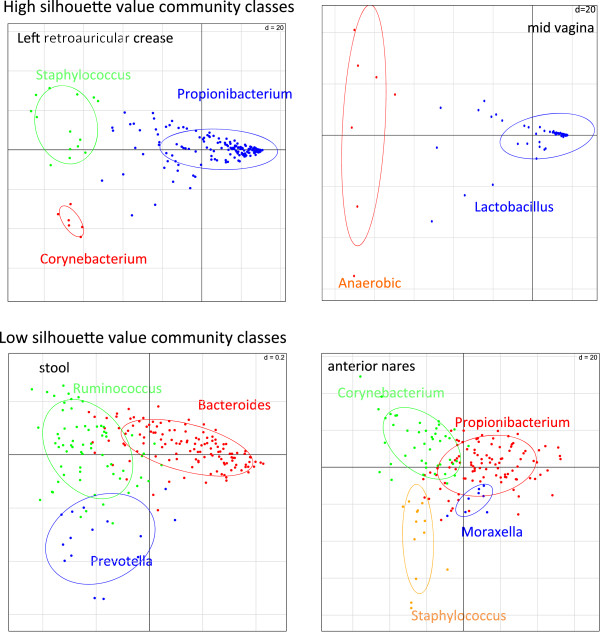
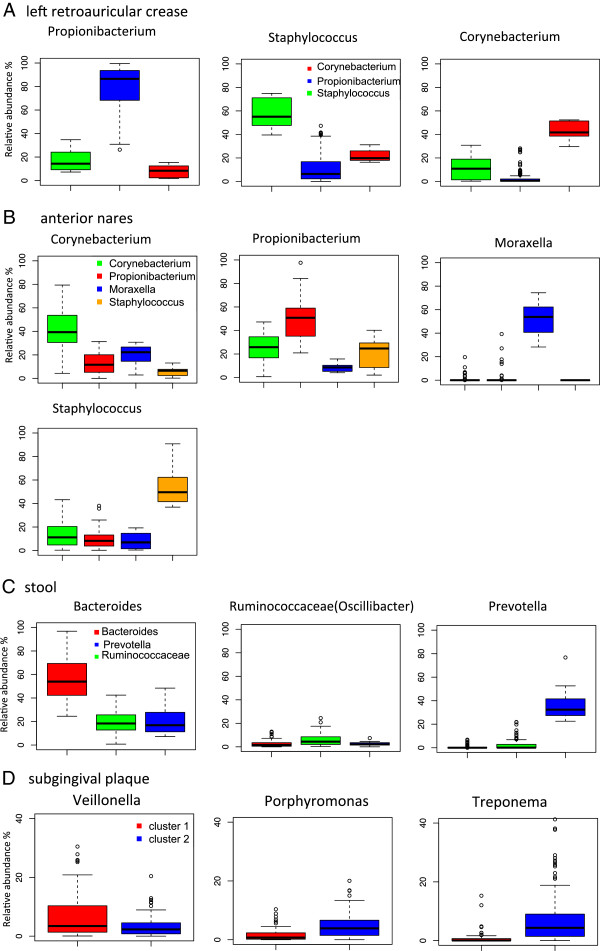
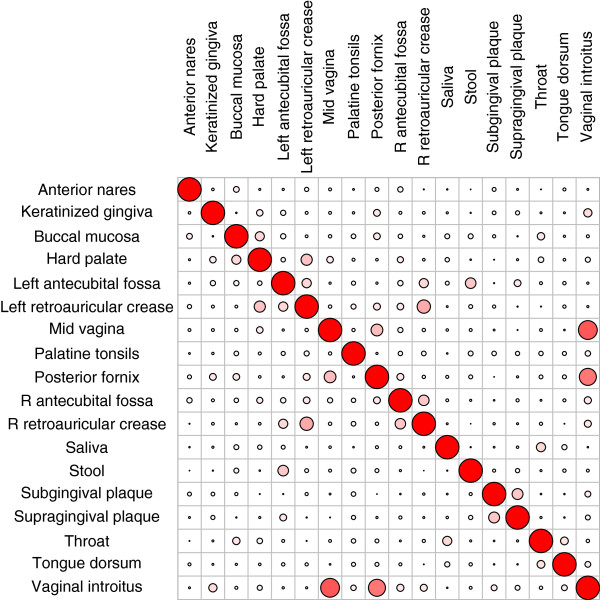
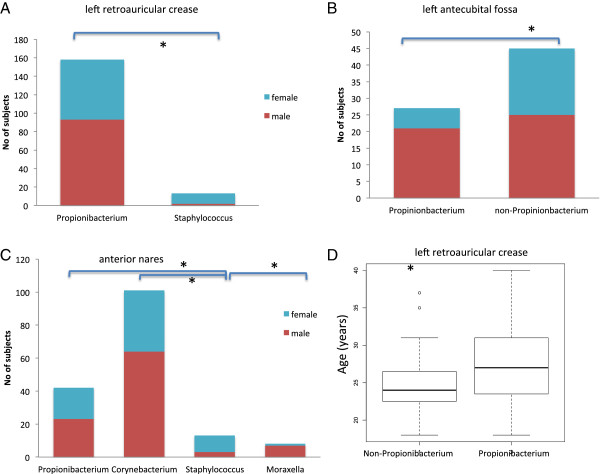
Background: Determining bacterial abundance variation is the first step in understanding bacterial similarity between individuals. Categorization of bacterial communities into groups or community classes is the subsequent step in describing microbial distribution based on abundance patterns. Here, we present an analysis of the groupings of bacterial communities in stool, nasal, skin, vaginal and oral habitats in a healthy cohort of 236 subjects from the Human Microbiome Project. Results: We identify distinct community group patterns in the anterior nares, four skin sites, and vagina at the genus level. We also confirm three enterotypes previously identified in stools. We identify two clusters with low silhouette values in most oral sites, in which bacterial communities are more homogeneous. Subjects sharing a community class in one habitat do not necessarily share a community class in another, except in the three vaginal sites and the symmetric habitats of the left and right retroauricular creases. Demographic factors, including gender, age, and ethnicity, significantly influence community composition in several habitats. Community classes in the vagina, retroauricular crease and stool are stable over approximately 200 days. Conclusion: The community composition, association of demographic factors with community classes, and demonstration of community stability deepen our understanding of the variability and dynamics of human microbiomes. This also has significant implications for experimental designs that seek microbial correlations with clinical phenotypes.
Overview
The claims and statistics of this paper haven’t been checked yet.
Run the check — free, no account needed. It reads the open-access text and checks the sources it cites.
Integrity signals
Registry
Cites
Statistics
Figures
Verification
Claims the paper makes
The claims and statistics of this paper haven’t been checked yet.
Run the check — free, no account needed. It reads the open-access text and checks the sources it cites.
Claims other papers make about this one
Each is checked against this paper’s own text: does it say what the citing paper says it does?
The source backs part of the claim, not all of it — or backs it for a different population, condition or comparison.
In the citing paper
“Prevotella is normally found in only a small percentage of healthy individuals in European and American cohorts [1, 2, 20, 210].”
From The athletic gut microbiota (2020) · cites this paper as [20]
Experimental — accuracy not yet measuredThe source backs part of the claim, not all of it — or backs it for a different population, condition or comparison.
In the citing paper
“The anterior nares are closest to the external environment and are lined with a skin-like keratinized squamous epithelium, including serous and sebaceous glands, the latter of which produces sebum, which leads to the enrichment of lipophilic skin colonizers, including Staphylococcus spp., Propionibacterium spp. and Corynebacterium spp.46,47,48.”
From The microbiota of the respiratory tract: gatekeeper to respiratory health (2017) · cites this paper as [48]
Experimental — accuracy not yet measuredIn the citing paper
“At the phylum level, Lentisphaerae and Acidobacteria, whose functions in the human gut are unknown, were detected after running.”
From The athletic gut microbiota (2020) · cites this paper as [20]
In the citing paper
“According to the alpha diversity analysis, there were few differences in diversity, nevertheless, abundances of certain microbiota members showed differences before and after running.”
From The athletic gut microbiota (2020) · cites this paper as [20]
In the citing paper
“At the species level there was a marked increase in the families Coriobacteriaceae and Succinivibrionaceae.”
From The athletic gut microbiota (2020) · cites this paper as [20]
In the citing paper
“At the genus level, half-marathon running reduced the abundance of fecal Ezakiella, Romboutsia, and Actinobacillus, but increased the abundance of Coprococcus and Ruminococcus bicirculans.”
From The athletic gut microbiota (2020) · cites this paper as [20]
In the citing paper
“Interestingly, the pentose phosphate pathway, a metabolic pathway parallel to glycolysis and involving the oxidation of glucose, was the most enriched pathway after a half-marathon run.”
From The athletic gut microbiota (2020) · cites this paper as [20]
In the citing paper
“Bacteria that are frequently found in other respiratory niches, including Moraxella spp., Dolosigranulum spp. and Streptococcus spp., have also been observed in the anterior nares29,43,48,49.”
From The microbiota of the respiratory tract: gatekeeper to respiratory health (2017) · cites this paper as [48]
Self-check
Percentages, sums and reported differences re-computed from the paper’s own numbers.
The self-check needs the paper’s full text.
Citations
Cites
vegan: Community Ecology Package
Oksanen, J., Simpson, G. L., Blanchet, F. G., Kindt, R., Legendre, P., Minchin, P. R., O’Hara, R. B., Sólymos, P., Stevens, M. H. H., Szöcs, E., et al. (2001) · doi:10.32614/cran.package.vegan · Cited by 27,099
Silhouettes: A graphical aid to the interpretation and validation of cluster analysis
Rousseeuw, P. J. (1987) · Journal of Computational and Applied Mathematics · doi:10.1016/0377-0427(87)90125-7 · Cited by 21,392
Structure, function and diversity of the healthy human microbiome
The Human Microbiome Project Consortium (2012) · Nature · doi:10.1038/nature11234 · Cited by 11,726
Self-citationHuman gut microbes associated with obesity
Ley, R. E., Turnbaugh, P. J., Klein, S., & Gordon, J. I. (2006) · Nature · doi:10.1038/4441022a · Cited by 8,785
SPECIES ASSEMBLAGES AND INDICATOR SPECIES:THE NEED FOR A FLEXIBLE ASYMMETRICAL APPROACH
Dufrêne, M., & Legendre, P. (1997) · Ecological Monographs · doi:10.1890/0012-9615(1997)067[0345:saaist]2.0.co;2 · Cited by 8,537
Hubert, L., & Arabie, P. (1985) · Journal of Classification · doi:10.1007/bf01908075 · Cited by 8,219
Diversity of the Human Intestinal Microbial Flora
Eckburg, P. B., Bik, E. M., Bernstein, C. N., Purdom, E., Dethlefsen, L., Sargent, M., Gill, S. R., Nelson, K. E., & Relman, D. A. (2005) · Science · doi:10.1126/science.1110591 · Cited by 7,913
Human gut microbiome viewed across age and geography
Yatsunenko, T., Rey, F. E., Manary, M. J., Trehan, I., Dominguez-Bello, M. G., Contreras, M., Magris, M., Hidalgo, G., Baldassano, R. N., Anokhin, A. P., et al. (2012) · Nature · doi:10.1038/nature11053 · Cited by 7,815
Enterotypes of the human gut microbiome
MetaHIT Consortium (additional members), Arumugam, M., Raes, J., Pelletier, E., Le Paslier, D., Yamada, T., Mende, D. R., Fernandes, G. R., Tap, J., Bruls, T., et al. (2011) · Nature · doi:10.1038/nature09944 · Cited by 7,548
The ade4 Package: Implementing the Duality Diagram for Ecologists
Dray, S., & Dufour, A. (2007) · Journal of Statistical Software · doi:10.18637/jss.v022.i04 · Cited by 6,740
Linking long-term dietary patterns with gut microbial enterotypes
Wu, G. D., Chen, J., Hoffmann, C., Bittinger, K., Chen, Y.-Y., Keilbaugh, S. A., Bewtra, M., Knights, D., Walters, W. A., Knight, R., et al. (2011) · Science · doi:10.1126/science.1208344 · Cited by 6,513
The Ribosomal Database Project: improved alignments and new tools for rRNA analysis
Cole, J. R., Wang, Q., Cardenas, E., Fish, J., Chai, B., Farris, R. J., Kulam-Syed-Mohideen, A. S., McGarrell, D. M., Marsh, T. L., Garrity, G. M., et al. (2008) · Nucleic Acids Research · doi:10.1093/nar/gkn879 · Cited by 4,873
A dendrite method for cluster analysis
Caliński, T., & Harabasz, J. (1974) · Communications in Statistics · doi:10.1080/03610927408827101 · Cited by 4,480
Vaginal microbiome of reproductive-age women
Ravel, J., Gajer, P., Abdo, Z., Schneider, G. M., Koenig, S. S. K., McCulle, S. L., Karlebach, S., Gorle, R., Russell, J., Tacket, C. O., et al. (2011) · Proceedings of the National Academy of Sciences · doi:10.1073/pnas.1002611107 · Cited by 4,254
Chimeric 16S rRNA sequence formation and detection in Sanger and 454-pyrosequenced PCR ampliconsPreprint
Haas, B. J., Gevers, D., Earl, A. M., Feldgarden, M., Ward, D. V., Giannoukos, G., Ciulla, D., Tabbaa, D., Highlander, S. K., Sodergren, E. J., et al. (2011) · Genome Research · doi:10.1101/gr.112730.110 · Cited by 3,527
Self-citationDewhirst, F. E., Chen, T., Izard, J., Paster, B. J., Tanner, A. C. R., Yu, W.-H., Lakshmanan, A., & Wade, W. G. (2010) · Journal of Bacteriology · doi:10.1128/jb.00542-10 · Cited by 3,352
Interactive Tree Of Life (iTOL): an online tool for phylogenetic tree display and annotation
Letunić, I., & Bork, P. (2006) · Bioinformatics · doi:10.1093/bioinformatics/btl529 · Cited by 3,334
Bacterial Community Variation in Human Body Habitats Across Space and Time
Costello, E. K., Lauber, C. L., Hamady, M., Fierer, N., Gordon, J. I., & Knight, R. (2009) · Science · doi:10.1126/science.1177486 · Cited by 3,231
Topographical and Temporal Diversity of the Human Skin Microbiome
Grice, E. A., Kong, H. H., Conlan, S., Deming, C. B., Davis, J., Young, A. C., Program, N. C. S., Bouffard, G. G., Blakesley, R. W., Murray, P. R., et al. (2009) · Science · doi:10.1126/science.1171700 · Cited by 2,953
A framework for human microbiome research
The Human Microbiome Project Consortium (2012) · Nature · doi:10.1038/nature11209 · Cited by 2,650
Composition, variability, and temporal stability of the intestinal microbiota of the elderly
Claesson, M. J., Cusack, S., O'Sullivan, O., Greene-Diniz, R., de Weerd, H., Flannery, E., Marchesi, J. R., Falush, D., Dinan, T., Fitzgerald, G., et al. (2011) · Proceedings of the National Academy of Sciences · doi:10.1073/pnas.1000097107 · Cited by 1,754
Compositional dissimilarity as a robust measure of ecological distance
Faith, D. P., Minchin, P. R., & Belbin, L. (1987) · Plant Ecology · doi:10.1007/bf00038687 · Cited by 1,586
Temporal Dynamics of the Human Vaginal Microbiota
Gajer, P., Brotman, R. M., Bai, G., Sakamoto, J. M., Schütte, U. M. E., Zhong, X., Koenig, S. S. K., Fu, L., Ma, Z. S., Zhou, X., et al. (2012) · Science Translational Medicine · doi:10.1126/scitranslmed.3003605 · Cited by 1,583
Compositional dissimilarity as a robust measure of ecological distance
Faith, D. P., Minchin, P. R., & Belbin, L. (1987) · Springer eBooks · doi:10.1007/978-94-009-4061-1_6 · Cited by 1,453
Molecular Identification of Bacteria Associated with Bacterial Vaginosis
Fredricks, D. N., Fiedler, T. L., & Marrazzo, J. M. (2005) · New England Journal of Medicine · doi:10.1056/nejmoa043802 · Cited by 1,303
Moving pictures of the human microbiome
Caporaso, J. G., Lauber, C. L., Costello, E. K., Berg-Lyons, D., Gonzalez, A., Stombaugh, J., Knights, D., Gajer, P., Ravel, J., Fierer, N., et al. (2011) · Genome Biology · doi:10.1186/gb-2011-12-5-r50 · Cited by 1,138
The influence of sex, handedness, and washing on the diversity of hand surface bacteria
Fierer, N., Hamady, M., Lauber, C. L., & Knight, R. D. (2008) · Proceedings of the National Academy of Sciences · doi:10.1073/pnas.0807920105 · Cited by 1,127
Kindt, R., & Coe, R. L. (2006) · Cited by 1,024
Biogeography of the ecosystems of the healthy human body
Zhou, Y., Gao, H., Mihindukulasuriya, K. A., Rosa, P. S. L., Wylie, K. M., Vishnivetskaya, T. A., Podar, M., Warner, B., Tarr, P. I., Nelson, D. E., et al. (2013) · Genome biology · doi:10.1186/gb-2013-14-1-r1 · Cited by 689
Self-citationA Core Human Microbiome as Viewed through 16S rRNA Sequence Clusters
Huse, S. M., Ye, Y., Zhou, Y., & Fodor, A. A. (2012) · PLoS ONE · doi:10.1371/journal.pone.0034242 · Cited by 572
Self-citationKoren, O., Knights, D., Gonzalez, A., Waldron, L., Segata, N., Knight, R., Huttenhower, C., & Ley, R. E. (2013) · PLoS Computational Biology · doi:10.1371/journal.pcbi.1002863 · Cited by 508
A Study of the Comparability of External Criteria for Hierarchical Cluster Analysis
Milligan, G. W., & Cooper, M. C. (1986) · Multivariate Behavioral Research · doi:10.1207/s15327906mbr2104_5 · Cited by 482
Hildebrand, F., Nguyen, T. L. A., Brinkman, B. M. N., Yunta, R. G., Cauwe, B., Vandenabeele, P., Liston, A., & Raes, J. (2013) · Genome biology · doi:10.1186/gb-2013-14-1-r4 · Cited by 478
rrnDB: documenting the number of rRNA and tRNA genes in bacteria and archaea
Lee, Z. M.-P., Bussema, C., & Schmidt, T. M. (2008) · Nucleic Acids Research · doi:10.1093/nar/gkn689 · Cited by 453
fossil: Palaeoecological and palaeogeographical analysis tools
Vavrek, M. J. (2011) · Cited by 449
Aagaard, K., Petrosino, J., Keitel, W., Watson, M., Katancik, J., Garcia, N., Patel, S., Cutting, M., Madden, T., Hamilton, H., et al. (2013) · The FASEB Journal · doi:10.1096/fj.12-220806 · Cited by 383
Evaluation and comparison of gene clustering methods in microarray analysis
Thalamuthu, A., Mukhopadhyay, I., Zheng, X., & Tseng, G. C. (2006) · Bioinformatics · doi:10.1093/bioinformatics/btl406 · Cited by 300
Contemporary oral microbiology and immunology
Slots, J., & Taubman, M. A. (1992) · Mosby Year Book · Cited by 289
Influence of the Normal Menstrual Cycle on Vaginal Tissue, Discharge, and Microflora
Eschenbach, D. A., Thwin, S. S., Patton, D. L., Hooton, T. M., Stapleton, A. E., Agnew, K., Winter, C., Meier, A. S., & Stamm, W. E. (2000) · Clinical Infectious Diseases · doi:10.1086/313818 · Cited by 289
(1974) · Communication in Statistics- Theory and Methods · doi:10.1080/03610928308827180 · Cited by 259
Categorization of the gut microbiota: enterotypes or gradients?
Jeffery, I. B., Claesson, M. J., O'Toole, P. W., & Shanahan, F. (2012) · Nature Reviews Microbiology · doi:10.1038/nrmicro2859 · Cited by 238
Skin microbiota: Microbial community structure and its potential association with health and disease
Rosenthal, M., Goldberg, D. E., Aiello, A. E., Larson, E., & Foxman, B. (2011) · Infection Genetics and Evolution · doi:10.1016/j.meegid.2011.03.022 · Cited by 231
Comparing Clusterings - An Overview
Wagner, S., & Wagner, D. (2007) · Repository KITopen (Karlsruhe Institute of Technology) · doi:10.5445/ir/1000011477 · Cited by 227
Analysis of the Gut Microbiota in the Old Order Amish and Its Relation to the Metabolic Syndrome
Zupancic, M. L., Cantarel, B. L., Liu, Z., Drábek, E. F., Ryan, K. A., Cirimotich, S., Jones, C., Knight, R. D., Walters, W. A., Knights, D., et al. (2012) · PLoS ONE · doi:10.1371/journal.pone.0043052 · Cited by 215
A longitudinal study of the vaginal flora over a menstrual cycle
Keane, F., ISON, C. A., & TAYLOR‐ROBINSON, D. (1997) · International Journal of STD & AIDS · doi:10.1258/0956462971920631 · Cited by 171
Oxidation Reduction Potential of Developing Plaque, Periodontal Pockets and Gingival Sulci
Kenney, E. B., & Ash, M. M. (1969) · Journal of Periodontology-Periodontics · doi:10.1902/jop.1969.40.11.630 · Cited by 169
Chimpanzees and humans harbour compositionally similar gut enterotypes
Moeller, A. H., Degnan, P. H., Pusey, A. E., Wilson, M. L., Hahn, B. H., & Ochman, H. (2012) · Nature Communications · doi:10.1038/ncomms2159 · Cited by 146
A poke into the diversity and associations within human anterior nare microbial communities
Wos‐Oxley, M. L., Plumeier, I., von Eiff, C., Taudien, S., Platzer, M., Vilchez‐Vargas, R., Becker, K., & Pieper, D. H. (2010) · The ISME Journal · doi:10.1038/ismej.2010.15 · Cited by 125
Cluster Analysis Extended Rousseeuw et al
Maechler, M., Rousseeuw, P. J., Struyf, A., & Mia Hubert, B. (2014) · Cited by 103
Troccaz, M., Borchard, G., Vuilleumier, C., Raviot-Derrien, S., Niclass, Y., Beccucci, S., & Starkenmann, C. (2008) · Chemical Senses · doi:10.1093/chemse/bjn076 · Cited by 67
Martin, J. C., Sykes, S. M., Young, S., Kota, K., Sanka, R., Sheth, N. U., Orvis, J., Sodergren, E. J., Wang, Z., Weinstock, G. M., et al. (2012) · PLoS ONE · doi:10.1371/journal.pone.0036427 · Cited by 50
Self-citationComplete Genome Sequence of Finegoldia magna, an Anaerobic Opportunistic Pathogen
Goto, T., Yamashita, A., Hirakawa, H., Matsutani, M., Todo, K., Ohshima, K., Toh, H., Miyamoto, K., Kuhara, S., Hattori, M., et al. (2008) · DNA Research · doi:10.1093/dnares/dsm030 · Cited by 50
STATISTICAL ISSUES IN THE CLUSTERING OF GENE EXPRESSION DATA
Goldstein, D. R., Ghosh, D., & Conlon, E. M. (2001) · ScholarWorks@UMassAmherst (University of Massachusetts Amherst) · Cited by 44
A comparison of four clustering methods for brain expression microarray data
Richards, A. L., Holmans, P., O’Donovan, M. C., Owen, M. J., & Jones, L. (2008) · BMC Bioinformatics · doi:10.1186/1471-2105-9-490 · Cited by 37
Research works printed but not linked: 4
- NCBI SRA: HMP 16s rRNA gene. [http://www.ncbi.nlm.nih.gov/sra/?term=SRP002395]
- NCBI BioProject: HMP shotgun data. [http://www.ncbi.nlm.nih.gov/bioproject/48479]
- Maechler M, Rousseeuw P, Struyf A, Hubert M, Hornik K: cluster: Cluster Analysis Basics and Extensions. 2013, R package version 1.14.4.
- HMP Metadata. [http://www.ncbi.nlm.nih.gov/gap/?term=phs000228.v3.p1]
Cited by
Sorted by citations
The microbiota of the respiratory tract: gatekeeper to respiratory health
Man, W. H., de Steenhuijsen Piters, W. A. A., & Bogaert, D. (2017) · Nature Reviews Microbiology · doi:10.1038/nrmicro.2017.14 · Cited by 1,384
Enterotypes in the landscape of gut microbial community composition
Costea, P. I., Hildebrand, F., Arumugam, M., Bäckhed, F., Blaser, M. J., Bushman, F. D., de Vos, W. M., Ehrlich, S. D., Fraser, C. M., Hattori, M., et al. (2017) · Nature Microbiology · doi:10.1038/s41564-017-0072-8 · Cited by 1,138
Self-citationTeo, S. M., Mok, D., Pham, K., Kusel, M., Serralha, M., Troy, N., Holt, B. J., Hales, B. J., Walker, M. L., Hollams, E., et al. (2015) · Cell Host & Microbe · doi:10.1016/j.chom.2015.03.008 · Cited by 953
The Role of Lung and Gut Microbiota in the Pathology of Asthma
Barcik, W., Boutin, R. C. T., Sokołowska, M., & Finlay, B. B. (2020) · Immunity · doi:10.1016/j.immuni.2020.01.007 · Cited by 636
Microbiome and Human Health: Current Understanding, Engineering, and Enabling Technologies
Aggarwal, N., Kitano, S., Puah, G. R. Y., Kittelmann, S., Hwang, I. Y., & Chang, M. W. (2022) · Chemical Reviews · doi:10.1021/acs.chemrev.2c00431 · Cited by 571
Metadata
- Authors
- Zhou, Y., Mihindukulasuriya, K. A., Gao, H., La Rosa, P. S., Wylie, K. M., Martin, J. C., Kota, K., Shannon, W. D., Mitreva, M., Sodergren, E., & Weinstock, G. M.
- Affiliations
- Washington University in St. Louis (US)
- Indiana University School of Medicine (US)
- Corresponding author
- Weinstock, George M
- ORCID
- Venue
- Genome Biology
- Published
- 2014-05-07
- Volume
- 15
- Issue
- 5
- Pages
- R66-R66
- ISSN
- 1465-6906 (ISSN-L)
- 1474-760X
- PMC
- PMC4073010
- OpenAlex
- W2150785952
- Cited by
- 149
- References
- 54
- Citations by year
- 2026: 8 · 2025: 10 · 2024: 10 · 2023: 10 · 2022: 15 · 2021: 21 · 2020: 19 · 2019: 16 · 2018: 4 · 2017: 13 · 2016: 8 · 2015: 11 · 2014: 3
- FWCI
- 4.78
- Type
- journal article
- Language
- en
- Open access
- gold
- doi.org
- Locations
- Genome biology (publishedVersion, cc-by)
- Europe PMC (PubMed Central) (publishedVersion, cc-by)
- PubMed Central (publishedVersion, cc-by)
- PubMed (publishedVersion)
- Digital Commons@Becker (Washington University School of Medicine) (submittedVersion)
- IUScholarWorks (Indiana University) (submittedVersion, cc-by)
- Funders
- National Institutes of Health
- National Human Genome Research Institute (U54HG004968)
- Common Fund
- Topics
- Life Sciences › Biochemistry, Genetics and Molecular Biology › Molecular Biology › Gut microbiota and health
- Physical Sciences › Environmental Science › Ecology › Microbial Community Ecology and Physiology
- Health Sciences › Dentistry › Periodontics › Oral microbiology and periodontitis research
- Keywords
- human microbiome, enterotypes, gut microbiota, nasal microbiota, skin microbiome, vaginal microbiota, oral microbiota, microbial community stability, demographic factors, Human Microbiome Project
- MeSH terms
- Bacteria, Demography, Feces, Female, Humans, Mouth, Nose, Skin, Vagina, Microbiota
About these checks
Registry, retraction, Cites and statistics results are computed, not judged, with one exception: a printed reference that no index lists is read once by a model before it counts as a citation error. Claims are extracted by a model and kept only when their quote appears verbatim in the text; each cited source is then checked, with a model’s help, for whether it says what the claim relies on. Those verdicts can be wrong — read the claim’s quote and the cited source before relying on one.
Statistics and arithmetic are recomputed, not judged.
Confidence bands are shown only for fields calibrated on our annotated test set. None is calibrated yet, so no band is shown.
What counts as a claim ›How we measure confidence ›How we check this ›
Are you an author, or do you see a problem with this page? Request a review
