

Postural control processes during standing and step initiation in autism spectrum disorder
Open accessThe DOI matches its Crossref record; 70 of the 70 references it cites were found in a registry or an index.
Abstract
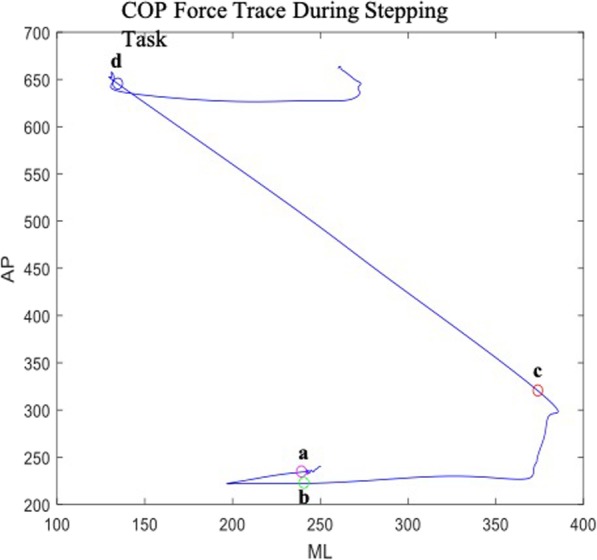
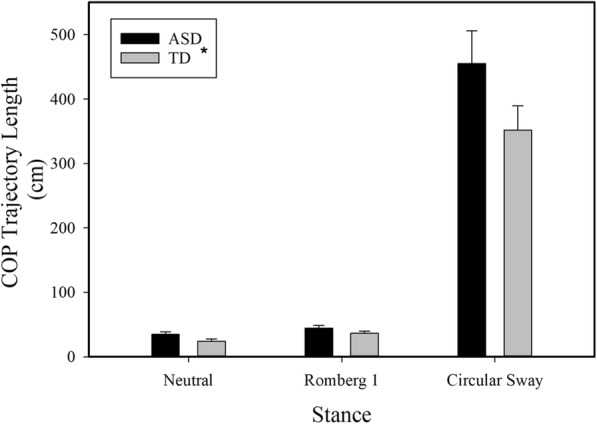
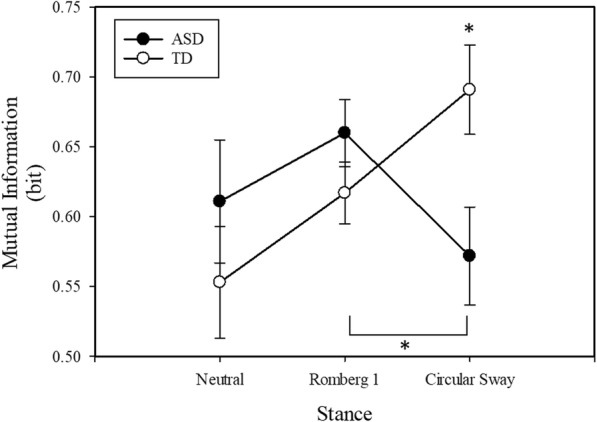
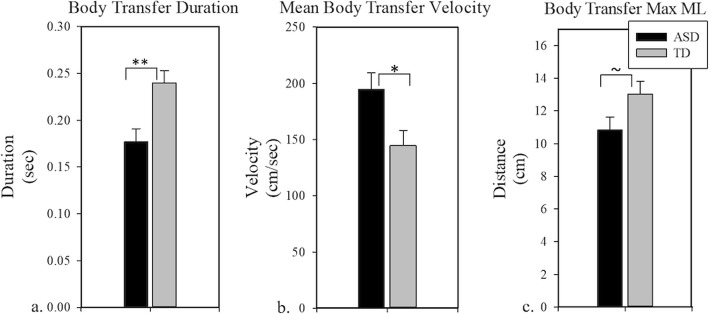
Background: Individuals with autism spectrum disorder (ASD) show a reduced ability to maintain postural stability, though motor control mechanisms contributing to these issues and the extent to which they are associated with other gross motor activities (e.g., stepping) are not yet known. Methods: Seventeen individuals with ASD and 20 typically developing (TD) controls (ages 6–19 years) completed three tests of postural control during standing. During the neutral stance, individuals stood with their feet shoulder width apart. During the Romberg one stance, they stood with feet close together. During the circular sway, participants stood with feet shoulder width apart and swayed in a circular motion. The standard deviation (SD) of their center of pressure (COP) in the mediolateral (ML) and anteroposterior (AP) directions and the COP trajectory length were examined for each stance. We also assessed mutual information (MI), or the shared dependencies between COP in the ML and AP directions. Participants also completed a stepping task in which they stepped forward from one force platform to an adjacent platform. The amplitude and duration of anticipatory postural adjustments (APAs) were examined, as were the maximum lateral sway, duration, and velocity of COP adjustments following the initial step. We examined stepping variables using separate one-way ANCOVAs with height as a covariate. The relationships between postural control and stepping measures and ASD symptom severity were assessed using Spearman correlations with scores on the Autism Diagnostic Observation Schedule–Second Edition (ADOS-2) and the Autism Diagnostic Interview-Revised (ADI-R). Results: Individuals with ASD showed increased COP trajectory length across stance conditions (p = 0.05) and reduced MI during circular sway relative to TD controls (p = 0.02). During stepping, groups did not differ on APA amplitude (p = 0.97) or duration (p = 0.41), but during their initial step, individuals with ASD showed reduced ML sway (p = 0.06), reduced body transfer duration (p < 0.01), and increased body transfer velocity (p = 0.02) compared to controls. Greater neutral stance COP ML variability (r = 0.55, p = 0.02) and decreased lateral sway (r = − 0.55, p = 0.02) when stepping were associated with more severe restricted and repetitive behaviors in participants with ASD. Conclusions: We found that individuals with ASD showed reduced MI during circular sway suggesting a reduced ability to effectively coordinate joint movements during dynamic postural adjustments. Additionally, individuals with ASD showed reduced lateral sway when stepping indicating that motor rigidity may interfere with balance and gait. Postural control and stepping deficits were related to repetitive behaviors in individuals with ASD indicating that motor rigidity and key clinical issues in ASD may represent overlapping pathological processes.
Overview
The claims and statistics of this paper haven’t been checked yet.
Free: it reads the open-access text and checks the first 5 claims that cite a source we can check. Create a free account to check every claim.
Integrity signals
Registry
Cites
Statistics
Figures
Verification
Claims the paper makes
The claims and statistics of this paper haven’t been checked yet.
Free: it reads the open-access text and checks the first 5 claims that cite a source we can check. Create a free account to check every claim.
Claims other papers make about this one
Each is checked against this paper’s own text: does it say what the citing paper says it does?
The source backs part of the claim, not all of it — or backs it for a different population, condition or comparison.
In the citing paper
“Children with ASD generally exhibit an incorrect arrangement of body segments relative to each other [12,13,14].”
From Postural Differences in Speaking Versus Non-Speaking Children with Autism Spectrum Disorder (2025) · cites this paper as [12]
Experimental — accuracy not yet measuredThe source backs part of the claim, not all of it — or backs it for a different population, condition or comparison.
In the citing paper
“Most studies reported deficits, particularly under multisensory or cognitively demanding conditions. [23–25, 28–33, 36]”
From Static and dynamic balance in children and adolescents with autism spectrum disorder compared with typically developing peers: a systematic review and meta-analysis (2026) · cites this paper as [30]
Experimental — accuracy not yet measuredThe source backs part of the claim, not all of it — or backs it for a different population, condition or comparison.
In the citing paper
“Anteroposterior displacement showed a large effect (SMD = 0.97; I2 = 70%), [26, 27, 30, 37, 40, 47, 49]”
From Static and dynamic balance in children and adolescents with autism spectrum disorder compared with typically developing peers: a systematic review and meta-analysis (2026) · cites this paper as [30]
Experimental — accuracy not yet measuredThe cited source says what the claim attributes to it.
In the citing paper
“Bojanek et al. [30] reported reduced motor coordination, linking motor rigidity in ASD to balance deficits and repetitive behaviours.”
The check wasn’t confident either way, so it gives no verdict — never disputed.
In the citing paper
“Other studies have also shown that children on the autism spectrum who walked on their toes also had a reduced range of dorsiflexion motion [4,12,19].”
From Postural Differences in Speaking Versus Non-Speaking Children with Autism Spectrum Disorder (2025) · cites this paper as [12]
Experimental — accuracy not yet measured
2 more claims about this paper
Create a free account to see every claim other papers make about this one.
Self-check
Percentages, sums and reported differences re-computed from the paper’s own numbers.
The self-check needs the paper’s full text.
Citations
Cites
Statistical Power Analysis for the Behavioral Sciences
Muller, K. (1989) · Technometrics · doi:10.1080/00401706.1989.10488618 · Cited by 99,167
Statistical power analysis for the behavioral sciences
(1990) · Computers, Environment and Urban Systems · doi:10.1016/0198-9715(90)90050-4 · Cited by 65,269
Statistical Power Analysis for the Behavioral Sciences (2nd ed.).
Lachenbruch, P. A., & Cohen, J. (1989) · Journal of the American Statistical Association · doi:10.2307/2290095 · Cited by 37,395
Lord, C., Rutter, M., & Le Couteur, A. (1994) · Journal of Autism and Developmental Disorders · doi:10.1007/bf02172145 · Cited by 9,065
Wechsler Abbreviated Scale of Intelligence
Dumont, R., Willis, J. O., Veizel, K., & Zibulsky, J. (2014) · Encyclopedia of Special Education · doi:10.1002/9781118660584.ese2519 · Cited by 5,521
Wechsler Abbreviated Scale of Intelligence
Wechsler, D. (2012) · PsycTESTS Dataset · doi:10.1037/t15170-000 · Cited by 4,596
Human balance and posture control during standing and walking
Winter, D. (1995) · Gait & Posture · doi:10.1016/0966-6362(96)82849-9 · Cited by 3,421
Horak, F. B. (2006) · Age and Ageing · doi:10.1093/ageing/afl077 · Cited by 2,758
The role of the basal ganglia in habit formation
Yin, H. H., & Knowlton, B. J. (2006) · Nature Reviews Neuroscience · doi:10.1038/nrn1919 · Cited by 2,402
Measures of postural steadiness: differences between healthy young and elderly adults
Prieto, T. E., Myklebust, J. B., Hoffmann, R. G., Lovett, E. G., & Myklebust, B. M. (1996) · IEEE Transactions on Biomedical Engineering · doi:10.1109/10.532130 · Cited by 1,863
Habits, Rituals, and the Evaluative Brain
Graybiel, A. M. (2008) · Annual Review of Neuroscience · doi:10.1146/annurev.neuro.29.051605.112851 · Cited by 1,697
Autism Diagnostic Observation Schedule
Lord, C., Rutter, M., Goode, S., Heemsbergen, J., Jordan, H., Mawhood, L., & Schopler, E. (2016) · PsycTESTS Dataset · doi:10.1037/t54175-000 · Cited by 1,678
Standardizing ADOS Scores for a Measure of Severity in Autism Spectrum Disorders
Gotham, K., Pickles, A., & Lord, C. (2009) · Journal of Autism and Developmental Disorders · doi:10.1007/s10803-008-0674-3 · Cited by 1,605
Autism screening questionnaire: diagnostic validity
Berument, S. K., Rutter, M., Lord, C., Pickles, A., & Bailey, A. (1999) · British Journal of Psychiatry · doi:10.1192/bjp.175.5.444 · Cited by 1,464
Unified theory regarding A/P and M/L balance in quiet stance
Winter, D. A., Prince, F., Frank, J. S., Powell, C., & Zabjek, K. F. (1996) · Journal of Neurophysiology · doi:10.1152/jn.1996.75.6.2334 · Cited by 1,163
A clinicopathological study of autism
Bailey, A. (1998) · Brain · doi:10.1093/brain/121.5.889 · Cited by 1,083
Corollary discharge across the animal kingdom
Crapse, T. B., & Sommer, M. A. (2008) · Nature Reviews Neuroscience · doi:10.1038/nrn2457 · Cited by 789
Massion, J. (1994) · Current Opinion in Neurobiology · doi:10.1016/0959-4388(94)90137-6 · Cited by 747
Stabilometric parameters are affected by anthropometry and foot placement
Chiari, L., Rocchi, L., & Cappello, A. (2002) · Clinical Biomechanics · doi:10.1016/s0268-0033(02)00107-9 · Cited by 571
Cerebellar ataxia: abnormal control of interaction torques across multiple joints
Bastian, A. J., Martin, T. A., Keating, J. G., & Thach, W. T. (1996) · Journal of Neurophysiology · doi:10.1152/jn.1996.76.1.492 · Cited by 569
The Cerebellum and Event Timing
IVRY, R. B., SPENCER, R. M., ZELAZNIK, H. N., & DIEDRICHSEN, J. (2002) · Annals of the New York Academy of Sciences · doi:10.1111/j.1749-6632.2002.tb07576.x · Cited by 530
Body weight is a strong predictor of postural stability
Hue, O., Simoneau, M., Marcotte, J., Berrigan, F., Doré, J., Marceau, P., Marceau, S., Tremblay, A., & Teasdale, N. (2007) · Gait & Posture · doi:10.1016/j.gaitpost.2006.07.005 · Cited by 500
Decreased connectivity and cerebellar activity in autism during motor task performance
Mostofsky, S. H., Powell, S. K., Simmonds, D. J., Goldberg, M. C., Caffo, B., & Pekar, J. J. (2009) · Brain · doi:10.1093/brain/awp088 · Cited by 450
Underdevelopment of the postural control system in autism
Minshew, N. J., Sung, K., Jones, B. L., & Furman, J. M. (2004) · Neurology · doi:10.1212/01.wnl.0000145771.98657.62 · Cited by 440
Gait and postural stability in obese and nonobese prepubertal boys
McGraw, B., McClenaghan, B. A., Williams, H. G., Dickerson, J., & Ward, D. S. (2000) · Archives of Physical Medicine and Rehabilitation · doi:10.1053/mr.2000.3782 · Cited by 390
Striatal Volume on Magnetic Resonance Imaging and Repetitive Behaviors in Autism
Hollander, E., Anagnostou, E., Chaplin, W., Esposito, K., Haznedar, M. M., Licalzi, E., Wasserman, S., Soorya, L., & Buchsbaum, M. (2005) · Biological Psychiatry · doi:10.1016/j.biopsych.2005.03.040 · Cited by 379
An MRI study of the basal ganglia in autism
Sears, L. L., Vest, C., Mohamed, S., Bailey, J., Ranson, B. J., & Piven, J. (1999) · Progress in Neuro-Psychopharmacology and Biological Psychiatry · doi:10.1016/s0278-5846(99)00020-2 · Cited by 364
Rojas, D. C., Peterson, E., Winterrowd, E., Reite, M. L., Rogers, S. J., & Tregellas, J. R. (2006) · BMC Psychiatry · doi:10.1186/1471-244x-6-56 · Cited by 360
Progress in Neuro-Psychopharmacology & Biological Psychiatry
Goldman, D. A., & Cohen, P. R. (2012) · Cited by 305
Whitney, E. R., Kemper, T. L., Bauman, M. L., Rosene, D. L., & Blatt, G. J. (2008) · The Cerebellum · doi:10.1007/s12311-008-0043-y · Cited by 268
Postural Stability in Children with Autism Spectrum Disorder
Molloy, C. A., Dietrich, K. N., & Bhattacharya, A. (2003) · Journal of Autism and Developmental Disorders · doi:10.1023/b:jadd.0000006001.00667.4c · Cited by 265
Gait Disturbances in Patients With Autistic Behavior: A Preliminary Study
Vilensky, J. A. (1981) · Archives of Neurology · doi:10.1001/archneur.1981.00510100074013 · Cited by 265
The neurobiology of repetitive behavior: …and men
Langen, M., Durston, S., Kas, M. J. H., van Engeland, H., & Staal, W. G. (2011) · Neuroscience & Biobehavioral Reviews · doi:10.1016/j.neubiorev.2010.02.005 · Cited by 263
Animal models of restricted repetitive behavior in autism
LEWIS, M., TANIMURA, Y., LEE, L., & BODFISH, J. (2007) · Behavioural Brain Research · doi:10.1016/j.bbr.2006.08.023 · Cited by 261
Motor Learning Is Optimally Tuned to the Properties of Motor Noise
van Beers, R. J. (2009) · Neuron · doi:10.1016/j.neuron.2009.06.025 · Cited by 261
Pharmacological treatment effects on eye movement control
Reilly, J. L., Lencer, R., Bishop, J. R., Keedy, S., & Sweeney, J. A. (2008) · Brain and Cognition · doi:10.1016/j.bandc.2008.08.026 · Cited by 248
Motor control and children with autism: deficit of anticipatory function?
Schmitz, C., Martineau, J., Barthélémy, C., & Assaiante, C. (2003) · Neuroscience Letters · doi:10.1016/s0304-3940(03)00644-x · Cited by 212
Khan, A. J., Nair, A., Keown, C. L., Datko, M. C., Lincoln, A. J., & Müller, R.-A. (2015) · Biological Psychiatry · doi:10.1016/j.biopsych.2015.03.024 · Cited by 208
Postural control in children with autism
Kohen-Raz, R., Volkman, F. R., & Cohen, D. J. (1992) · Journal of Autism and Developmental Disorders · doi:10.1007/bf01048244 · Cited by 202
Hass, C. J., Gregor, R. J., Waddell, D. E., Oliver, A., Smith, D. W., Fleming, R. P., & Wolf, S. L. (2004) · Archives of Physical Medicine and Rehabilitation · doi:10.1016/j.apmr.2004.01.020 · Cited by 183
Izawa, J., Pekny, S. E., Marko, M. K., Haswell, C. C., Shadmehr, R., & Mostofsky, S. H. (2012) · Autism Research · doi:10.1002/aur.1222 · Cited by 182
Decreased static and dynamic postural control in children with autism spectrum disorders
Fournier, K. A., Kimberg, C. I., Radonovich, K. J., Tillman, M. D., Chow, J. W., Lewis, M. H., Bodfish, J. W., & Hass, C. J. (2010) · Gait & Posture · doi:10.1016/j.gaitpost.2010.02.007 · Cited by 182
Rinehart, N. J., Tonge, B. J., Bradshaw, J. L., Iansek, R., Enticott, P. G., & McGinley, J. (2006) · European Child & Adolescent Psychiatry · doi:10.1007/s00787-006-0530-y · Cited by 173
Motor Difficulties in Autism Spectrum Disorder: Linking Symptom Severity and Postural Stability
Travers, B. G., Powell, P. S., Klinger, L. G., & Klinger, M. R. (2013) · Journal of Autism and Developmental Disorders · doi:10.1007/s10803-012-1702-x · Cited by 173
Romberg’s sign: Development, adoption, and adaptation in the 19th century
Lanska, D. J., & Goetz, C. G. (2000) · Neurology · doi:10.1212/wnl.55.8.1201 · Cited by 172
Gait in patients with cerebellar ataxia
Palliyath, S., Hallett, M., Thomas, S. L., & Lebiedowska, M. K. (1998) · Movement Disorders · doi:10.1002/mds.870130616 · Cited by 165
Glazebrook, C., Gonzalez, D., Hansen, S., & Elliott, D. (2009) · Autism · doi:10.1177/1362361309105659 · Cited by 156
Organization of voluntary movement
Ghez, C. P., Hening, W., & Gordon, J. (1991) · Current Opinion in Neurobiology · doi:10.1016/s0959-4388(05)80046-7 · Cited by 155
Oldehinkel, M., Mennes, M., Marquand, A., Charman, T., Tillmann, J., Ecker, C., Dell’Acqua, F., Brandeis, D., Banaschewski, T., Baumeister, S., et al. (2019) · Biological Psychiatry: Cognitive Neuroscience and Neuroimaging · doi:10.1016/j.bpsc.2018.11.010 · Cited by 153 · cited 1×
“functional connectivity between cerebellum and motor cortex during rest [52, 53] and gross motor behaviors [54].”
BackgroundGlazebrook, C. M., Elliott, D., & Lyons, J. (2006) · Motor Control · doi:10.1123/mcj.10.3.244 · Cited by 150
Gait Initiation and Dynamic Balance Control in Parkinson’s Disease
Hass, C. J., Waddell, D. E., Fleming, R. P., Juncos, J. L., & Gregor, R. J. (2005) · Archives of Physical Medicine and Rehabilitation · doi:10.1016/j.apmr.2005.05.013 · Cited by 147
Mosconi, M. W., Mohanty, S., Greene, R. K., Cook, E. H., Vaillancourt, D. E., & Sweeney, J. A. (2015) · The Journal of Neuroscience · doi:10.1523/jneurosci.2731-14.2015 · Cited by 145
Self-citationPostural Control Deficits in Autism Spectrum Disorder: The Role of Sensory Integration
Doumas, M., McKenna, R., & Murphy, B. (2015) · Journal of Autism and Developmental Disorders · doi:10.1007/s10803-015-2621-4 · Cited by 142
Influence of Subjects' Height on the Stabilization of Posture
Berger, W., Trippel, M., Discher, M., & Dietz, V. (1992) · Acta Oto-Laryngologica · doi:10.3109/00016489209100778 · Cited by 138
Gait patterns in children with autism
Calhoun, M., Longworth, M., & Chester, V. L. (2011) · Clinical Biomechanics · doi:10.1016/j.clinbiomech.2010.09.013 · Cited by 129
Reaching and Grasping in Autism Spectrum Disorder: A Review of Recent Literature
Sacrey, L.-A. R., Germani, T., Bryson, S. E., & Zwaigenbaum, L. (2014) · Frontiers in Neurology · doi:10.3389/fneur.2014.00006 · Cited by 118
Velocity of centre of pressure excursions as an indicator of postural control systems in children
Riach, C. L., & Starkes, J. (1994) · Gait & Posture · doi:10.1016/0966-6362(94)90004-3 · Cited by 117
Radonovich, K. J., Fournier, K. A., & Hass, C. J. (2013) · Frontiers in Integrative Neuroscience · doi:10.3389/fnint.2013.00028 · Cited by 94
Basal ganglia and autism – a translational perspective
Subramanian, K., Brandenburg, C., Orsati, F., Soghomonian, J., Hussman, J. P., & Blatt, G. J. (2017) · Autism Research · doi:10.1002/aur.1837 · Cited by 88
Wang, Z., Magnon, G. C., White, S. P., Greene, R. K., Vaillancourt, D. E., & Mosconi, M. W. (2015) · Journal of Neurophysiology · doi:10.1152/jn.00661.2014 · Cited by 81
Self-citationMartineau, J., Schmitz, C., Assaiante, C., Blanc, R., & Barthélémy, C. (2004) · Neuroscience Letters · doi:10.1016/j.neulet.2004.06.018 · Cited by 79
Memari, A. H., Ghanouni, P., Shayestehfar, M., & Ghaheri, B. (2014) · Asian Journal of Sports Medicine · doi:10.5812/asjsm.22963 · Cited by 72
Memari, A. H., Ghanouni, P., Gharibzadeh, S., Eghlidi, J., Ziaee, V., & Moshayedi, P. (2013) · Research in Autism Spectrum Disorders · doi:10.1016/j.rasd.2012.09.010 · Cited by 71
Wang, Z., Hallac, R. R., Conroy, K. C., White, S. P., Kane, A. A., Collinsworth, A. L., Sweeney, J. A., & Mosconi, M. W. (2016) · Journal of Neurodevelopmental Disorders · doi:10.1186/s11689-016-9178-1 · Cited by 53
Self-citationBaev, K. V., Greene, K. A., Marciano, F. F., Samanta, J., Shetter, A. G., Smith, K. A., Stacy, M. A., & Spetzler, R. F. (2002) · Progress in Neuro-Psychopharmacology and Biological Psychiatry · doi:10.1016/s0278-5846(02)00201-4 · Cited by 49
Inter-foot coordination dynamics of quiet standing postures
Wang, Z., & Newell, K. M. (2014) · Neuroscience & Biobehavioral Reviews · doi:10.1016/j.neubiorev.2014.08.007 · Cited by 37
Self-citationMcGough, E. L., Kelly, V. E., Weaver, K. E., Logsdon, R. G., McCurry, S. M., Pike, K. C., Grabowski, T. J., & Teri, L. L. (2017) · American Journal of Physical Medicine & Rehabilitation · doi:10.1097/phm.0000000000000881 · Cited by 33
Standing balance on unsteady surfaces in children on the autism spectrum: The effects of IQ
Travers, B. G., Mason, A. H., Gruben, K. G., Dean, D. C., & McLaughlin, K. (2018) · Research in Autism Spectrum Disorders · doi:10.1016/j.rasd.2018.03.008 · Cited by 33
Human Postural Control: Force Plate Experiments and Modelling
Rosenblum, M., Игоревич, Ф. Г., Кууз, Р. А., & Pompe, B. (1998) · Springer eBooks · doi:10.1007/978-3-642-71949-3_17 · Cited by 31 · cited 2×
“MI is a measure of shared dependency between two time series, and the unit is bit [18, 37].”
BackgroundCoordination Patterns of Foot Dynamics in the Control of Upright Standing
Wang, Z., Jordan, K., & Newell, K. M. (2012) · Motor Control · doi:10.1123/mcj.16.3.425 · Cited by 27
Self-citation
Research works printed but not linked: 1
- American Psychiatric Association Diagnostic and Statistical Manual of Mental Disorders (DSM-5®): American Psychiatric Publishing 2013
Cited by
Motor Skill Differences in Autism Spectrum Disorder: a Clinically Focused Review
Zampella, C., Wang, L. A. L., Haley, M., Hutchinson, A. G., & de Marchena, A. B. (2021) · Current Psychiatry Reports · doi:10.1007/s11920-021-01280-6 · Cited by 186
Wang, L. A. L., Petrulla, V., Zampella, C., Waller, R. E., & Schultz, R. T. (2022) · Psychological Bulletin · doi:10.1037/bul0000358 · Cited by 179
Identifying Autism with Head Movement Features by Implementing Machine Learning Algorithms
Zhao, Z., Zhu, Z., Zhang, X., Tang, H., Xing, J., Hu, X., Lu, J., & Qu, X. (2021) · Journal of Autism and Developmental Disorders · doi:10.1007/s10803-021-05179-2 · Cited by 61
Motor skills predict adaptive behavior in autistic children and adolescents
Fears, N. E., Palmer, S. A., & Miller, H. L. (2022) · Autism Research · doi:10.1002/aur.2708 · Cited by 45
“…skills, researchers have measured differences in quiet standing (Lim et al., 2017), leaning (Miller et al., 2019; Wang et al., 2016), stepping (Bojanek et al., 2020), reaching (Glazebrook et al., 2006), grasping (Carment et al., 2020; Mosconi et al., 2015; Travers et al., 2017), catching…”
BackgroundPostural balance control interventions in autism spectrum disorder (ASD): A systematic review
Date, S. S., Munn, E. E., & Frey, G. C. (2024) · Gait & Posture · doi:10.1016/j.gaitpost.2024.01.034 · Cited by 56
Metadata
- Authors
- Bojanek, E. K., Wang, Z., White, S. P., & Mosconi, M. W.
- Affiliations
- University of Kansas (US)
- University of Florida Health (US)
- Emory University (US)
- Corresponding author
- Mosconi, Matthew W.
- Venue
- Journal of Neurodevelopmental Disorders
- Published
- 2020-01-06
- Volume
- 12
- Issue
- 1
- Pages
- 1-1
- ISSN
- 1866-1947 (ISSN-L)
- 1866-1955
- PMC
- PMC6945692
- OpenAlex
- W2999302956
- Cited by
- 57
- References
- 70
- Citations by year
- 2026: 8 · 2025: 11 · 2024: 12 · 2023: 7 · 2022: 8 · 2021: 10 · 2020: 1
- FWCI
- 3.50
- Type
- journal article
- Language
- en
- Open access
- gold
- doi.org
- Licence
- cc-by
- creativecommons.org/licenses/by/4.0/ (tdm)
- creativecommons.org/licenses/by/4.0/ (vor)
- Locations
- Journal of Neurodevelopmental Disorders (publishedVersion, cc-by)
- PubMed Central (publishedVersion, cc-by)
- PubMed (publishedVersion)
- DOAJ (DOAJ: Directory of Open Access Journals) (submittedVersion)
- KU ScholarWorks (The University of Kansas) (submittedVersion, cc-by)
- Funders
- NIH (R01 MH112734-01)
- NIMH (MH092696)
- NICHD (HD090216-01)
- Topics
- Life Sciences › Neuroscience › Cognitive Neuroscience › Autism Spectrum Disorder Research
- Health Sciences › Health Professions › Physical Therapy, Sports Therapy and Rehabilitation › Balance, Gait, and Falls Prevention
- Life Sciences › Neuroscience › Cognitive Neuroscience › Motor Control and Adaptation
- Keywords
- autism spectrum disorder, postural control, center of pressure, anticipatory postural adjustments, stepping, postural stability, mutual information, restricted and repetitive behaviors, ASD severity
- MeSH terms
- Autism Spectrum Disorder, Standing Position, Adolescent, Child, Postural Balance, Female, Gait, Humans, Male, Case-Control Studies, Young Adult
About these checks
Registry, retraction, Cites and statistics results are computed, not judged, with one exception: a printed reference that no index lists is read once by a model before it counts as a citation error. Claims are extracted by a model and kept only when their quote appears verbatim in the text; each cited source is then checked, with a model’s help, for whether it says what the claim relies on. Those verdicts can be wrong — read the claim’s quote and the cited source before relying on one.
Statistics and arithmetic are recomputed, not judged.
Confidence bands are shown only for fields calibrated on our annotated test set. None is calibrated yet, so no band is shown.
What counts as a claim ›How we measure confidence ›How we check this ›
Are you an author, or do you see a problem with this page? Request a review
Data sources
Bibliographic data: Semantic Scholar, OpenAlex, Crossref.
Contains information from the Semantic Scholar Academic Graph Datasets, made available under the ODC Attribution License (ODC-BY 1.0).
Semantic Scholar’s data is described in: Kinney, R., et al. (2023). The Semantic Scholar Open Data Platform. arXiv:2301.10140.
