

Colliding ideals – an interview study of how intervention researchers address adherence and adaptations in replication studies
Open accessThe DOI matches its Crossref record; 56 of the 56 references it cites were found in a registry or an index.
Abstract
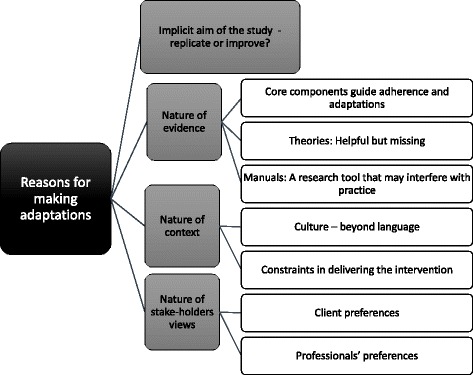
BACKGROUND: For an intervention to be considered evidence-based, findings need to be replicated. When this is done in new contexts (e.g., a new country), adaptations may be needed. Yet, we know little about how researchers approach this. This study aims to explore how researchers reason about adaptations and adherence when conducting replication studies, describe what adaptations they make and how these are reported in scientific journals. METHODS: This was an interview study conducted in 2014 with principal investigators of Swedish replication studies reporting adaptations to an intervention from another country. Studies (n = 36) were identified through a database of 139 Swedish psychosocial and psychological intervention studies. Twenty of the 21 principal investigators agreed to participate in semi-structured telephone interviews, covering 33 interventions. Manifest content analysis was used to identify types of adaptations, and qualitative content analysis was used to explore reasoning and reporting of adaptations and adherence. RESULTS: The most common adaptation was adding components and modifying the content to the target population and setting. When reasoning about adaptations and adherence, the researchers were influenced by four main factors: whether their implicit aim was to replicate or improve an intervention; the nature of evidence outlying the intervention such as manuals, theories and core components; the nature of the context, including approaches to cultural adaptations and constraints in delivering the intervention; and the needs of clients and professionals. Reporting of adaptations in scientific journals involved a conflict between transparency and practical concerns such as word count. CONCLUSIONS: Researchers responsible for replicating interventions in a new country face colliding ideals when trying to protect the internal validity of the study while considering adaptations to ensure that the intervention fits into the context. Implicit assumptions about the role of replication seemed to influence how this conflict was resolved. Some emphasised direct replications as central in the knowledge accumulation process (stressing adherence). Others assumed that interventions generally need to be improved, giving room for adaptations and reflecting an incremental approach to knowledge accumulation. This has implications for design and reporting of intervention studies as well as for how findings across studies are synthesised.
Overview
The claims and statistics of this paper haven’t been checked yet.
Free: it reads the open-access text and checks the first 5 claims that cite a source we can check. Create a free account to check every claim.
Integrity signals
Registry
Cites
Statistics
Figures
Verification
Claims the paper makes
The claims and statistics of this paper haven’t been checked yet.
Free: it reads the open-access text and checks the first 5 claims that cite a source we can check. Create a free account to check every claim.
Claims other papers make about this one
Each is checked against this paper’s own text: does it say what the citing paper says it does?
The source backs part of the claim, not all of it — or backs it for a different population, condition or comparison.
In the citing paper
“The process, nature, and outcomes of modifications to evidence-based programs/practices (EBPs) have often not been well documented, despite considerable recent interest in the field of implementation science [5, 6].”
From The FRAME: an expanded framework for reporting adaptations and modifications to evidence-based interventions (2019) · cites this paper as [5]
Experimental — accuracy not yet measured
Self-check
Percentages, sums and reported differences re-computed from the paper’s own numbers.
The self-check needs the paper’s full text.
Citations
Cites
Rogers, E. M., Singhal, A., & Quinlan, M. M. (2019) · An Integrated Approach to Communication Theory and Research · doi:10.4324/9780203710753-35 · Cited by 37,322
Graneheim, U. H., & Lundman, B. (2004) · Nurse Education Today · doi:10.1016/j.nedt.2003.10.001 · Cited by 20,772 · cited 1×
“of adaptations, and qualitative content analysis with an inductive approach [26] was used to explore rea-”
MethodHoffmann, T. C., Glasziou, P. P., Boutron, I., Milne, R., Perera, R., Moher, D., Altman, D. G., Barbour, V., Macdonald, H., Johnston, M., et al. (2014) · BMJ · doi:10.1136/bmj.g1687 · Cited by 10,548 · cited 1×
“It also underlines the importance of describing interventions, contexts and adaptations in greater detail, as encouraged in recent reporting guidelines [48].”
BackgroundThe Logic of Scientific Discovery.
Hutchison, T. W., & Popper, K. R. (1959) · Economica · doi:10.2307/2550489 · Cited by 7,499
Stanton, B. F., & Rogers, E. M. (1963) · Journal of Farm Economics · doi:10.2307/1235767 · Cited by 6,675
KRISTOF‐BROWN, A. L., ZIMMERMAN, R. D., & JOHNSON, E. C. (2005) · Personnel Psychology · doi:10.1111/j.1744-6570.2005.00672.x · Cited by 4,082 · cited 1×
“, work processes) and people [46], and between interventions and organisation and its members [47], is also applicable in the context of intervention research.”
BackgroundCurran, G. M., Bauer, M., Mittman, B., Pyne, J. M., & Stetler, C. (2012) · Medical Care · doi:10.1097/mlr.0b013e3182408812 · Cited by 4,058
How should meta‐regression analyses be undertaken and interpreted?
Thompson, S. G., & Higgins, J. P. T. (2002) · Statistics in Medicine · doi:10.1002/sim.1187 · Cited by 3,026 · cited 1×
“analysis and mixed treatment comparisons [43].”
Mediators and Mechanisms of Change in Psychotherapy Research
Kazdin, A. E. (2007) · Annual Review of Clinical Psychology · doi:10.1146/annurev.clinpsy.3.022806.091432 · Cited by 2,504
The dynamic sustainability framework: addressing the paradox of sustainment amid ongoing change
Chambers, D. A., Glasgow, R. E., & Stange, K. C. (2013) · Implementation Science · doi:10.1186/1748-5908-8-117 · Cited by 1,724 · cited 1×
“In line with these findings, several researchers argue that adaptations are necessary at all steps of the research-to-practice pathway [21, 22].”
ResultSimultaneous comparison of multiple treatments: Combining direct and indirect evidence.
Caldwell, D. M., Ades, A. E., & Higgins, J. P. T. (2005) · BMJ · doi:10.1136/bmj.331.7521.897 · Cited by 1,600
Standards of Evidence: Criteria for Efficacy, Effectiveness and Dissemination
Flay, B. R., Biglan, A., Boruch, R. F., Castro, F. G., Gottfredson, D., Kellam, S., Mościcki, E. K., Schinke, S., Valentine, J. C., & Ji, P. (2005) · Prevention Science · doi:10.1007/s11121-005-5553-y · Cited by 1,338 · cited 2×
“The approach aligns with the way the research-to-practice pathway is currently set up, with the focus on internal validity before external and the gradual process of establishing efficaciousness through a series of distinct steps, from development of interventions and feasibility studies to direct and conceptual repli…”
BackgroundMethodComplex interventions: how “out of control” can a randomised controlled trial be?
Hawe, P., Shiell, A., & Riley, T. (2004) · BMJ · doi:10.1136/bmj.328.7455.1561 · Cited by 1,244
Culturally adapted mental health intervention: a meta-analytic review
Griner, D., & Smith, T. B. (2006) · Psychotherapy: Theory, Research, Practice, Training · doi:10.1037/0033-3204.43.4.531 · Cited by 1,236
Seventy-five trials and eleven systematic reviews a day: how will we ever keep up?
Bastian, H., Glasziou, P., & Chalmers, I. (2010) · PLoS Medicine · doi:10.1371/journal.pmed.1000326 · Cited by 1,188 · cited 1×
“systematic reviews and meta-analyses, rather than individual studies [3, 4].”
BackgroundShall we Really do it Again? The Powerful Concept of Replication is Neglected in the Social Sciences
Schmidt, S. (2009) · Review of General Psychology · doi:10.1037/a0015108 · Cited by 1,125 · cited 2×
“with different methods or, more commonly, in different contexts, thus investigating the generalisability of the findings [5, 6].”
ResultEvaluation of networks of randomized trials
Salanti, G., Higgins, J. P., Ades, A., & Ioannidis, J. P. (2008) · Statistical Methods in Medical Research · doi:10.1177/0962280207080643 · Cited by 1,078
Issues and challenges in the design of culturally adapted evidence-based interventions
Castro, F. G., Barrera, M., & Holleran Steiker, L. K. (2010) · Annual Review of Clinical Psychology · doi:10.1146/annurev-clinpsy-033109-132032 · Cited by 796
Realist synthesis: illustrating the method for implementation research
Rycroft-Malone, J., McCormack, B., Hutchinson, A. M., DeCorby, K., Bucknall, T. K., Kent, B., Schultz, A., Snelgrove-Clarke, E., Stetler, C. B., Titler, M., et al. (2012) · Implementation Science · doi:10.1186/1748-5908-7-33 · Cited by 742 · cited 1×
“which aims to illuminate what works for whom when and under what circumstances [41, 42].”
BackgroundStirman, S. W., Miller, C. J., Toder, K., & Calloway, A. (2013) · Implementation Science · doi:10.1186/1748-5908-8-65 · Cited by 691 · cited 2×
“’s framework, that is, including adaptations in content, procedure, dosage, setting, format or target population [12].”
BackgroundCulturally adapted psychotherapy and the legitimacy of myth: A direct-comparison meta-analysis.
Benish, S. G., Quintana, S., & Wampold, B. E. (2011) · Journal of Counseling Psychology · doi:10.1037/a0023626 · Cited by 661
What is missing from descriptions of treatment in trials and reviews?
Glasziou, P., Meats, E., Heneghan, C., & Shepperd, S. (2008) · BMJ · doi:10.1136/bmj.39590.732037.47 · Cited by 614
A brief history of research synthesis
Chalmers, I., Hedges, L. V., & Cooper, H. (2002) · Evaluation & the Health Professions · doi:10.1177/0163278702025001003 · Cited by 552 · cited 1×
“systematic reviews and meta-analyses, rather than individual studies [3, 4].”
BackgroundPerepletchikova, F., Treat, T. A., & Kazdin, A. E. (2007) · Journal of Consulting and Clinical Psychology · doi:10.1037/0022-006x.75.6.829 · Cited by 533
Dynamic adaptation process to implement an evidence-based child maltreatment intervention
Aarons, G. A., Green, A. E., Palinkas, L. A., Self-Brown, S., Whitaker, D. J., Lutzker, J. R., Silovsky, J. F., Hecht, D. B., & Chaffin, M. J. (2012) · Implementation Science · doi:10.1186/1748-5908-7-32 · Cited by 449
Weisz, J. R., Kuppens, S., Eckshtain, D., Ugueto, A. M., Hawley, K. M., & Jensen-Doss, A. (2013) · JAMA Psychiatry · doi:10.1001/jamapsychiatry.2013.1176 · Cited by 412 · cited 1×
“For example, a recent meta-analysis evaluating the effects of evidence-based youth psychotherapies showed that the interventions were no longer effective when they were applied, without any adaptations, in other countries [15].”
BackgroundHoffmann, T. C., Erueti, C., & Glasziou, P. P. (2013) · BMJ · doi:10.1136/bmj.f3755 · Cited by 375
Pawson, R., & Manzano-Santaella, A. (2012) · Evaluation · doi:10.1177/1356389012440912 · Cited by 349
Collins, L. M., Dziak, J. J., Kugler, K. C., & Trail, J. B. (2014) · American Journal of Preventive Medicine · doi:10.1016/j.amepre.2014.06.021 · Cited by 335
Design, analysis and presentation of factorial randomised controlled trials
Montgomery, A. A., Peters, T. J., & Little, P. (2003) · BMC Medical Research Methodology · doi:10.1186/1471-2288-3-26 · Cited by 318
Wells, M., Williams, B., Treweek, S., Coyle, J., & Taylor, J. (2012) · Trials · doi:10.1186/1745-6215-13-95 · Cited by 297
Cabassa, L. J., & Baumann, A. A. (2013) · Implementation Science · doi:10.1186/1748-5908-8-90 · Cited by 290
Examining Adaptations of Evidence-Based Programs in Natural Contexts
Moore, J. E., Bumbarger, B. K., & Cooper, B. R. (2013) · The Journal of Primary Prevention · doi:10.1007/s10935-013-0303-6 · Cited by 250 · cited 2×
“This expands previous findings reporting that creating fit between intervention and context is an important reason for why practitioners make adaptations [23, 24].”
BackgroundSteps in Intervention Research: Designing and Developing Social Programs
Fraser, M. W., & Galinsky, M. J. (2010) · Research on Social Work Practice · doi:10.1177/1049731509358424 · Cited by 245 · cited 1×
“The approach aligns with the way the research-to-practice pathway is currently set up, with the focus on internal validity before external and the gradual process of establishing efficaciousness through a series of distinct steps, from development of interventions and feasibility studies to direct and conceptual repli…”
MethodUsing Planned Adaptation to Implement Evidence‐Based Programs with New Populations
Lee, S. J., Altschul, I., & Mowbray, C. T. (2008) · American Journal of Community Psychology · doi:10.1007/s10464-008-9160-5 · Cited by 209
Reinventing fidelity: The transfer of social technology among settings
Bauman, L. J., Stein, R. E. K., & Ireys, H. T. (1991) · American Journal of Community Psychology · doi:10.1007/bf00937995 · Cited by 208 · cited 2×
“It can be argued that this makes direct replication of interventions impossible; instead, re-testing of interventions will involve changes in various aspects of the intervention or context [9].”
BackgroundWiltsey Stirman, S., A Gutner, C., Crits-Christoph, P., Edmunds, J., Evans, A. C., & Beidas, R. S. (2015) · Implementation Science · doi:10.1186/s13012-015-0308-z · Cited by 188
Sundell, K., Beelmann, A., Hasson, H., & von Thiele Schwarz, U. (2016) · Journal of Clinical Child & Adolescent Psychology · doi:10.1080/15374416.2015.1020540 · Cited by 179
Self-citationThomas, J., O’Mara-Eves, A., & Brunton, G. (2014) · Systematic Reviews · doi:10.1186/2046-4053-3-67 · Cited by 177 · cited 1×
“which aims to illuminate what works for whom when and under what circumstances [41, 42].”
BackgroundMediation designs for tobacco prevention research
MacKinnon, D. P., Taborga, M. P., & Morgan-Lopez, A. A. (2002) · Drug and Alcohol Dependence · doi:10.1016/s0376-8716(02)00216-8 · Cited by 162
Adaptation in Dissemination and Implementation Science
Baumann, A. A., Cabassa, L. J., & Stirman, S. W. (2017) · Oxford Scholarship Online · doi:10.1093/oso/9780190683214.003.0017 · Cited by 151
Lewin, S., Hendry, M., Chandler, J., Oxman, A. D., Michie, S., Shepperd, S., Reeves, B. C., Tugwell, P., Hannes, K., Rehfuess, E. A., et al. (2017) · BMC Medical Research Methodology · doi:10.1186/s12874-017-0349-x · Cited by 147 · cited 2×
“The more variation in how the interventions are composed (and the less that is known about it), the greater the challenge of determining how to categorise interventions in systematic reviews [8].”
BackgroundWiltsey Stirman, S., Gamarra, J. M., Bartlett, B. A., Calloway, A., & Gutner, C. A. (2017) · Clinical Psychology: Science and Practice · doi:10.1111/cpsp.12218 · Cited by 138 · cited 2×
“It is also in line with a recent review of adaptations to evidence-based psychotherapies, which concluded that alternative designs are needed to illuminate the impact of specific adaptations, and gives specific design recommendations for how this can be achieved [20].”
ResultTinkering with Perfection: Theory Development in the Intervention Cultural Adaptation Field
Ferrer‐Wreder, L., Sundell, K., & Mansoory, S. (2011) · Child & Youth Care Forum · doi:10.1007/s10566-011-9162-6 · Cited by 132
Self-citationKneale, D., Thomas, J., & Harris, K. (2015) · PLOS ONE · doi:10.1371/journal.pone.0142187 · Cited by 127 · cited 1×
“For example, by integrating program logic models with systematic reviews, core components, change mechanisms and contextual influences can be explicated [39, 40].”
BackgroundAdaptive Clinical Trial Design
Chow, S.-C. (2014) · Annual Review of Medicine · doi:10.1146/annurev-med-092012-112310 · Cited by 124
Rohwer, A., Pfadenhauer, L., Burns, J., Brereton, L., Gerhardus, A., Booth, A., Oortwijn, W., & Rehfuess, E. (2017) · Journal of Clinical Epidemiology · doi:10.1016/j.jclinepi.2016.06.012 · Cited by 121 · cited 1×
“For example, by integrating program logic models with systematic reviews, core components, change mechanisms and contextual influences can be explicated [39, 40].”
BackgroundLeijten, P., Dishion, T. J., Thomaes, S., Raaijmakers, M. A. J., Orobio de Castro, B., & Matthys, W. (2015) · Clinical Psychology: Science and Practice · doi:10.1111/cpsp.12087 · Cited by 89
Sundell, K., Ferrer-Wreder, L., & Fraser, M. W. (2014) · Evaluation & the Health Professions · doi:10.1177/0163278712469813 · Cited by 65
Self-citationTreatment Fidelity in Social Work Intervention Research: A Review of Published Studies
Naleppa, M. J., & Cagle, J. G. (2010) · Research on Social Work Practice · doi:10.1177/1049731509352088 · Cited by 65
Adaptations in a Community-Based Family Intervention: Replication of Two Coding Schemes
Cooper, B. R., Shrestha, G., Hyman, L., & Hill, L. (2016) · The Journal of Primary Prevention · doi:10.1007/s10935-015-0413-4 · Cited by 62 · cited 2×
“This expands previous findings reporting that creating fit between intervention and context is an important reason for why practitioners make adaptations [23, 24].”
BackgroundAssessing and Addressing the Fit of Planned Interventions to the Organizational Context
Nielsen, K. M., & Randall, R. (2015) · Springer eBooks · doi:10.1007/978-94-017-9867-9_12 · Cited by 56 · cited 1×
“, work processes) and people [46], and between interventions and organisation and its members [47], is also applicable in the context of intervention research.”
BackgroundGeneralizing about Public Health Interventions: A Mixed-Methods Approach to External Validity
Leviton, L. C. (2017) · Annual Review of Public Health · doi:10.1146/annurev-publhealth-031816-044509 · Cited by 55
What is the value of replicating other studies?
Park, C. L. (2004) · Research Evaluation · doi:10.3152/147154404781776400 · Cited by 47 · cited 2×
“with different methods or, more commonly, in different contexts, thus investigating the generalisability of the findings [5, 6].”
BackgroundResultHodge, D. R., Jackson, K. F., & Vaughn, M. G. (2010) · Children and Youth Services Review · doi:10.1016/j.childyouth.2010.05.002 · Cited by 39
How useful are randomized controlled trials in a rapidly changing world?
Pérez‐Gómez, A., Mejía‐Trujillo, J., & Mejía, A. (2016) · Cambridge Prisms Global Mental Health · doi:10.1017/gmh.2015.29 · Cited by 11 · cited 1×
“These suggestions are in line with calls for designs that make intervention studies more responsive to societal changes [38].”
Result
Cited by
Wiltsey Stirman, S., Baumann, A. A., & Miller, C. J. (2019) · Implementation Science · doi:10.1186/s13012-019-0898-y · Cited by 1,329
von Thiele Schwarz, U., Aarons, G. A., & Hasson, H. (2019) · BMC Health Services Research · doi:10.1186/s12913-019-4668-y · Cited by 134
“It also includes showing that adaptation happens not only when EBIs are used in practice but also during trials, indicating that intervention researchers also needs to attend to issues related to fidelity and adaptation [27].”
BackgroundSelf-citationRichter, A., Sjunnestrand, M., Strandh, M. R., & Hasson, H. (2022) · International Journal of Environmental Research and Public Health · doi:10.3390/ijerph19063489 · Cited by 198
Self-citationFrom replication to substantiation: A complexity theory perspective
Al‐Hoorie, A. H., Hiver, P. V., Larsen‐Freeman, D., & Lowie, W. M. (2021) · Language Teaching · doi:10.1017/s0261444821000409 · Cited by 49
“In replication of field experiments, there is a constant tension between adherence to and adaptation of experimental protocols (Bauman et al., 1991; Hansen, 2011; von Thiele Schwarz et al., 2018).”
Hill, J., Cuthel, A. M., Lin, P., & Grudzen, C. R. (2020) · Contemporary Clinical Trials Communications · doi:10.1016/j.conctc.2020.100570 · Cited by 28
“While monitoring intervention adaptations is important, its application is not a universal practice [31], and often applied retrospectively [32].”
Background
Metadata
- Authors
- von Thiele Schwarz, U., Förberg, U., Sundell, K., & Hasson, H.
- Affiliations
- Karolinska University Hospital (SE)
- Karolinska Institutet (SE)
- Region Stockholm (SE)
- Venue
- BMC Medical Research Methodology
- Published
- 2018-05-08
- Volume
- 18
- Issue
- 1
- Pages
- 36-36
- ISSN
- 1471-2288 (ISSN-L)
- PMC
- PMC5941334
- OpenAlex
- W2807297007
- Cited by
- 20
- References
- 56
- Citations by year
- 2026: 2 · 2025: 4 · 2023: 1 · 2022: 4 · 2021: 2 · 2020: 3 · 2019: 4
- FWCI
- 3.43
- Type
- journal article
- Language
- en
- Open access
- gold
- doi.org
- Licence
- cc-by
- creativecommons.org/licenses/by/4.0/ (tdm)
- Locations
- BMC Medical Research Methodology (publishedVersion, cc-by)
- Europe PMC (PubMed Central) (publishedVersion, cc-by)
- PubMed Central (publishedVersion, cc-by)
- PubMed (publishedVersion)
- DOAJ (DOAJ: Directory of Open Access Journals) (submittedVersion, cc-by-sa)
- Funders
- Forte: Swedish Research Council for Health, Working Life and Wellfare (2014-0303)
- Swedish National Research Council (2016-01261)
- Socialstyrelsen (-)
- Topics
- Health Sciences › Health Professions › General Health Professions › Health Policy Implementation Science
- Social Sciences › Decision Sciences › Statistics, Probability and Uncertainty › Meta-analysis and systematic reviews
- Social Sciences › Public Administration › Evaluation and Performance Assessment
- Keywords
- intervention replication, intervention adaptation, intervention adherence, evidence-based interventions, cross-cultural adaptation, transparency in research reporting, internal validity, psychosocial interventions, knowledge accumulation
- MeSH terms
- Adaptation, Psychological, Cross-Cultural Comparison, Humans, Interviews as Topic, Research Personnel, Biomedical Research, Evidence-Based Practice, Research Report
About these checks
Registry, retraction, Cites and statistics results are computed, not judged, with one exception: a printed reference that no index lists is read once by a model before it counts as a citation error. Claims are extracted by a model and kept only when their quote appears verbatim in the text; each cited source is then checked, with a model’s help, for whether it says what the claim relies on. Those verdicts can be wrong — read the claim’s quote and the cited source before relying on one.
Statistics and arithmetic are recomputed, not judged.
Confidence bands are shown only for fields calibrated on our annotated test set. None is calibrated yet, so no band is shown.
What counts as a claim ›How we measure confidence ›How we check this ›
Are you an author, or do you see a problem with this page? Request a review
Data sources
Bibliographic data: Semantic Scholar, OpenAlex, Crossref.
Contains information from the Semantic Scholar Academic Graph Datasets, made available under the ODC Attribution License (ODC-BY 1.0).
Semantic Scholar’s data is described in: Kinney, R., et al. (2023). The Semantic Scholar Open Data Platform. arXiv:2301.10140.
