

A systematic review of the clinical application of data-driven population segmentation analysis
Open accessThe DOI matches its Crossref record; 91 of the 91 references it cites were found in a registry or an index.
Abstract
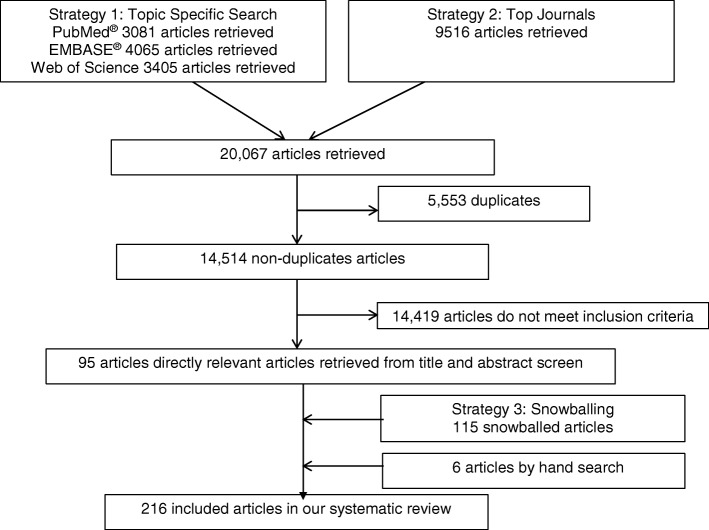
BACKGROUND: Data-driven population segmentation analysis utilizes data analytics to divide a heterogeneous population into parsimonious and relatively homogenous groups with similar healthcare characteristics. It is a promising patient-centric analysis that enables effective integrated healthcare interventions specific for each segment. Although widely applied, there is no systematic review on the clinical application of data-driven population segmentation analysis. METHODS: We carried out a systematic literature search using PubMed, Embase and Web of Science following PRISMA criteria. We included English peer-reviewed articles that applied data-driven population segmentation analysis on empirical health data. We summarized the clinical settings in which segmentation analysis was applied, compared and contrasted strengths, limitations, and practical considerations of different segmentation methods, and assessed the segmentation outcome of all included studies. The studies were assessed by two independent reviewers. RESULTS: We retrieved 14,514 articles and included 216 articles. Data-driven population segmentation analysis was widely used in different clinical contexts. 163 studies examined the general population while 53 focused on specific population with certain diseases or conditions, including psychological, oncological, respiratory, cardiovascular, and gastrointestinal conditions. Variables used for segmentation in the studies are heterogeneous. Most studies (n = 170) utilized secondary data in community settings (n = 185). The most common segmentation method was latent class/profile/transition/growth analysis (n = 96) followed by K-means cluster analysis (n = 60) and hierarchical analysis (n = 50), each having its advantages, disadvantages, and practical considerations. We also identified key criteria to evaluate a segmentation framework: internal validity, external validity, identifiability/interpretability, substantiality, stability, actionability/accessibility, and parsimony. CONCLUSIONS: Data-driven population segmentation has been widely applied and holds great potential in managing population health. The evaluations of segmentation outcome require the interplay of data analytics and subject matter expertise. The optimal framework for segmentation requires further research.
Overview
The claims and statistics of this paper haven’t been checked yet.
Free: it reads the open-access text and checks the first 5 claims that cite a source we can check. Create a free account to check every claim.
Integrity signals
Registry
Cites
Statistics
Figures
Verification
Claims the paper makes
The claims and statistics of this paper haven’t been checked yet.
Free: it reads the open-access text and checks the first 5 claims that cite a source we can check. Create a free account to check every claim.
Self-check
Percentages, sums and reported differences re-computed from the paper’s own numbers.
The self-check needs the paper’s full text.
Citations
Cites
(1998) · DigitalCommons - Kennesaw State University (Kennesaw State University) · Cited by 13,997
Jain, A. K., Murty, M. N., & Flynn, P. J. (1999) · ACM Computing Surveys · doi:10.1145/331499.331504 · Cited by 13,199
Nylund, K. L., Asparouhov, T., & Muthén, B. O. (2007) · Structural Equation Modeling: A Multidisciplinary Journal · doi:10.1080/10705510701575396 · Cited by 11,415
A dendrite method for cluster analysis
Caliński, T., & Harabasz, J. (1974) · Communications in Statistics · doi:10.1080/03610927408827101 · Cited by 4,480
Everitt, B. S., Landau, S., Leese, M., & Stahl, D. (2011) · Wiley Series in Probability and Statistics · doi:10.1002/9780470977811 · Cited by 2,907 · cited 1×
“S e n s i t i v e t o o u t li e r s [ 82 , 83 ] S u p e r v i s e d C l a ss i f i c a t i on D e c i s i on T r ee M e t h o d s ( C H A I D / C A R T ) 10 1 .”
The World Report on Ageing and Health
Beard, J. R., Officer, A. M., & Cassels, A. K. (2016) · The Gerontologist · doi:10.1093/geront/gnw037 · Cited by 2,843
Empirically derived eating patterns using factor or cluster analysis: a review
Newby, P. K., & Tucker, K. L. (2004) · Nutrition Reviews · doi:10.1111/j.1753-4887.2004.tb00040.x · Cited by 1,248
Integrated care: meaning, logic, applications, and implications – a discussion paper
Kodner, D. L., & Spreeuwenberg, C. (2002) · International Journal of Integrated Care · doi:10.5334/ijic.67 · Cited by 1,155 · cited 1×
“…interest in population health and integrated health systems, which aim to organize health services across the care continuum around the needs of individuals, with the ultimate goal to improve the overall health of population by more targeted, effective, and coordinated healthcare services [1 – 3].”
BackgroundPROC LCA: A SAS Procedure for Latent Class Analysis
Lanza, S. T., Collins, L. M., Lemmon, D. R., & Schafer, J. L. (2007) · Structural Equation Modeling: A Multidisciplinary Journal · doi:10.1080/10705510701575602 · Cited by 1,070
Berlin, K. S., Williams, N. A., & Parra, G. R. (2014) · Journal of Pediatric Psychology · doi:10.1093/jpepsy/jst084 · Cited by 986
Latent class models for clustering : a comparison with K-means
Magidson, J., & Vermunt, J. K. (2002) · Data Archiving and Networked Services (DANS) · Cited by 748
A Concise Guide to Market Research
Mooi, E., & Sarstedt, M. (2011) · Springer eBooks · doi:10.1007/978-3-642-12541-6 · Cited by 716
Rokach, L., & Maimon, O. (2006) · Data Mining and Knowledge Discovery Handbook · doi:10.1007/0-387-25465-x_9 · Cited by 594
Yim, O., & Ramdeen, K. T. (2015) · The Quantitative Methods for Psychology · doi:10.20982/tqmp.11.1.p008 · Cited by 548
Dietary patterns and changes in body mass index and waist circumference in adults
Newby, P., Muller, D., Hallfrisch, J., Qiao, N., Andres, R., & Tucker, K. L. (2003) · The American Journal of Clinical Nutrition · doi:10.1093/ajcn/77.6.1417 · Cited by 524
CLUSTERING VALIDATION: RESULTS AND IMPLICATIONS FOR APPLIED ANALYSES
MILLIGAN, G. W. (1996) · Clustering and Classification · doi:10.1142/9789812832153_0010 · Cited by 452 · cited 1×
“For example, one can split a sample into two random subsamples to both of which a cluster analysis is applied independently and the agreement between the two cluster solutions is then assessed [46]), external validity (the performance of segmentation was measured by matching a cluster structure to exogenous informatio…”
BackgroundFitzpatrick, A. M., Teague, W. G., Meyers, D. A., Peters, S. P., Li, X., Li, H., Wenzel, S. E., Aujla, S., Castro, M., Bacharier, L. B., et al. (2011) · Journal of Allergy and Clinical Immunology · doi:10.1016/j.jaci.2010.11.015 · Cited by 446 · cited 1×
“Patients with respiratory conditions 8 Children 6–17 years of age who underwent standardized characterization in Severe Asthma Research Program [68]”
MethodHickendorff, M., Edelsbrunner, P. A., McMullen, J., Schneider, M., & Trezise, K. (2018) · Learning and Individual Differences · doi:10.1016/j.lindif.2017.11.001 · Cited by 324
Latent Class Analysis of Lifestyle Characteristics and Health Risk Behaviors among College Youth
Laska, M. N., Pasch, K. E., Lust, K., Story, M., & Ehlinger, E. (2009) · Prevention Science · doi:10.1007/s11121-009-0140-2 · Cited by 285
Bone mineral density and dietary patterns in older adults: the Framingham Osteoporosis Study,,
Tucker, K. L., Chen, H., Hannan, M. T., Cupples, L. A., Wilson, P. W., Felson, D., & Kiel, D. P. (2002) · The American Journal of Clinical Nutrition · doi:10.1093/ajcn/76.1.245 · Cited by 279
Identifying adult asthma phenotypes using a clustering approach
Siroux, V., Basagaña, X., Boudier, A., Pin, I., Garcia-Aymerich, J., Vesin, A., Slama, R., Jarvis, D., Anto, J. M., Kauffmann, F., et al. (2011) · European Respiratory Journal · doi:10.1183/09031936.00120810 · Cited by 265
Symptom clustering in advanced cancer
Walsh, D., & Rybicki, L. (2006) · Supportive Care in Cancer · doi:10.1007/s00520-005-0899-z · Cited by 264
Wolf, E. J., Miller, M. W., Reardon, A. F., Ryabchenko, K. A., Castillo, D., & Freund, R. (2012) · Archives of General Psychiatry · doi:10.1001/archgenpsychiatry.2011.1574 · Cited by 255
Distinct clinical phenotypes of airways disease defined by cluster analysis
Weatherall, M., Travers, J., Shirtcliffe, P. M., Marsh, S. E., Williams, M. V., Nowitz, M. R., Aldington, S., & Beasley, R. (2009) · European Respiratory Journal · doi:10.1183/09031936.00174408 · Cited by 246
Comparing supervised and unsupervised category learning
Love, B. C. (2002) · Psychonomic Bulletin & Review · doi:10.3758/bf03196342 · Cited by 242
Reedy, J., Wirfalt, E., Flood, A., Mitrou, P. N., Krebs-Smith, S. M., Kipnis, V., Midthune, D., Leitzmann, M., Hollenbeck, A., Schatzkin, A., et al. (2010) · American Journal of Epidemiology · doi:10.1093/aje/kwp393 · Cited by 234
Investigating diversity of clustering methods: An empirical comparison
Gelbard, R., Goldman, O., & Spiegler, I. (2007) · Data & Knowledge Engineering · doi:10.1016/j.datak.2007.01.002 · Cited by 232
Conry, M. C., Morgan, K., Curry, P., McGee, H., Harrington, J., Ward, M., & Shelley, E. (2011) · BMC Public Health · doi:10.1186/1471-2458-11-692 · Cited by 221 · cited 1×
“For example, Conry et al. segmented a cross-sectional, nationally representative sample of individuals aged 18 years and over by their health behaviors [15].”
MethodComparison of Distance Measures in Cluster Analysis with Dichotomous Data
Finch, H. (2021) · Journal of Data Science · doi:10.6339/jds.2005.03(1).192 · Cited by 204
Prospective Study of Major Dietary Patterns and Colorectal Cancer Risk in Women
Terry, P., Hu, F. B., Hansen, H., & Wolk, A. (2001) · American Journal of Epidemiology · doi:10.1093/aje/154.12.1143 · Cited by 194
Application of a Latent Class Analysis to Empirically Define EatingDisorder Phenotypes
Keel, P. K., Fichter, M., Quadflieg, N., Bulik, C. M., Baxter, M. G., Thornton, L., Halmi, K. A., Kaplan, A. S., Strober, M., Woodside, D. B., et al. (2004) · Archives of General Psychiatry · doi:10.1001/archpsyc.61.2.192 · Cited by 181
Everitt, B. J. (1980) · Quality & Quantity · doi:10.1007/bf00154794 · Cited by 172
Adolescent physical activity and sedentary behavior
Nelson, M. C., Gordon-Larsen, P., Adair, L. S., & Popkin, B. M. (2005) · American Journal of Preventive Medicine · doi:10.1016/j.amepre.2004.12.006 · Cited by 170
Using Population Segmentation to Provide Better Health Care for All: The “Bridges to Health” Model
LYNN, J., STRAUBE, B. M., BELL, K. M., JENCKS, S. F., & KAMBIC, R. T. (2007) · The Milbank Quarterly · doi:10.1111/j.1468-0009.2007.00483.x · Cited by 167
Newby, P. K., Muller, D. C., & Tucker, K. L. (2004) · American Journal of Clinical Nutrition · doi:10.1093/ajcn/80.3.759 · Cited by 155
Dietary patterns among older Europeans: the EPIC-Elderly study
Bamia, C., Orfanos, P., Ferrari, P., Overvad, K., Hundborg, H. H., Tjønneland, A., Olsen, A., Kesse, E., Boutron-Ruault, M.-C., Clavel-Chapelon, F., et al. (2005) · British Journal of Nutrition · doi:10.1079/bjn20051456 · Cited by 149
Heterogeneity in Hip Fracture Patients: Age, Functional Status, and Comorbidity
Penrod, J. D., Litke, A., Hawkes, W., Magaziner, J. S., Koval, K. J., Doucette, J. T., Silberzweig, S. B., & Siu, A. L. (2007) · Journal of the American Geriatrics Society · doi:10.1111/j.1532-5415.2007.01078.x · Cited by 132
Hearty, Á. P., & Gibney, M. J. (2008) · British Journal of Nutrition · doi:10.1017/s0007114508014128 · Cited by 130
Identifying groups: a comparison of methodologies
Eshghi, A., Haughton, D., & Legrand, P. (2021) · Journal of Data Science · doi:10.6339/jds.201104_09(2).0009 · Cited by 130
Dietary patterns among a national random sample of British adults
Pryer, J. A., Nichols, R., Elliott, P., Thakrar, B., Brunner, E., & Marmot, M. (2001) · Journal of Epidemiology and Community Health · doi:10.1136/jech.55.1.29 · Cited by 122
Patient Segmentation Analysis Offers Significant Benefits For Integrated Care And Support
Vuik, S. I., Mayer, E. K., & Darzi, A. (2016) · Health Affairs · doi:10.1377/hlthaff.2015.1311 · Cited by 121
Ten-Year Follow-up of Cluster-based Asthma Phenotypes in Adults. A Pooled Analysis of Three Cohorts
Boudier, A., Curjuric, I., Basagaña, X., Hazgui, H., Anto, J. M., Bousquet, J., Bridevaux, P. O., Dupuis-Lozeron, E., Garcia-Aymerich, J., Heinrich, J., et al. (2013) · American Journal of Respiratory and Critical Care Medicine · doi:10.1164/rccm.201301-0156oc · Cited by 119
Patterns of Physical Activity, Sedentary Behavior, and Diet in U.S. Adolescents
Iannotti, R. J., & Wang, J. (2013) · Journal of Adolescent Health · doi:10.1016/j.jadohealth.2013.03.007 · Cited by 117
Guthrie, E., Creed, F., Fernandes, L., Ratcliffe, J., Van der Jagt, J., Martin, J., Howlett, S., Read, N., Barlow, J., Thompson, D., et al. (2003) · Gut · doi:10.1136/gut.52.11.1616 · Cited by 112
Obesogenic Clusters: Multidimensional Adolescent Obesity-related Behaviors in the U.S.
Boone-Heinonen, J., Gordon-Larsen, P., & Adair, L. S. (2008) · Annals of Behavioral Medicine · doi:10.1007/s12160-008-9074-3 · Cited by 110
Adams, M. A., Sallis, J. F., Kerr, J., Conway, T. L., Saelens, B. E., Frank, L. D., Norman, G. J., & Cain, K. L. (2011) · Preventive Medicine · doi:10.1016/j.ypmed.2011.02.020 · Cited by 105
The Journal of Allergy and Clinical Immunology
(1999) · Journal of Allergy and Clinical Immunology · doi:10.1016/s0091-6749(99)70255-1 · Cited by 102
Engeset, D., Alsaker, E., Ciampi, A., & Lund, E. (2005) · European Journal of Clinical Nutrition · doi:10.1038/sj.ejcn.1602129 · Cited by 99
Dietary Patterns and Cardiovascular Risk Factors in Elderly Men: The Zutphen Elderly Study
HUIJBREGTS, P. P. C. W., FESKENS, E. J. M., & KROMHOUT, D. (1995) · International Journal of Epidemiology · doi:10.1093/ije/24.2.313 · Cited by 99
Is depression associated with health risk-related behaviour clusters in adults?
Verger, P., Lions, C., & Ventelou, B. (2009) · The European Journal of Public Health · doi:10.1093/eurpub/ckp057 · Cited by 98
A latent class analysis of cancer risk behaviors among U.S. college students
Kang, J., Ciecierski, C. C., Malin, E. L., Carroll, A. J., Gidea, M., Craft, L. L., Spring, B. J., & Hitsman, B. L. (2014) · Preventive Medicine · doi:10.1016/j.ypmed.2014.03.023 · Cited by 94
Identifying Groups: A Comparison of Methodologies
Eshghi, A., Haughton, D., Legrand, P., et al. (2021) · Journal of Data Science · doi:10.6339/jds.2011.09(2).929 · Cited by 94 · cited 1×
“Each technique is different and has specific properties, which may lead different interpretations of the underlying structure of the data [55].”
BackgroundAdams, M. A., Ding, D., Sallis, J. F., Bowles, H. R., Ainsworth, B. E., Bergman, P., Bull, F. C., Carr, H., Craig, C. L., De Bourdeaudhuij, I., et al. (2013) · International Journal of Behavioral Nutrition and Physical Activity · doi:10.1186/1479-5868-10-34 · Cited by 90
Peretti‐Watel, P., Spire, B., Lert, F., & Obadia, Y. (2006) · Drug and Alcohol Dependence · doi:10.1016/s0376-8716(06)80012-8 · Cited by 83
Harrington, J. M., Dahly, D. L., Fitzgerald, T., Gilthorpe, M. S., & Perry, I. J. (2014) · Public Health Nutrition · doi:10.1017/s1368980014000111 · Cited by 79
Mooi, E., & Sarstedt, M. (2010) · Springer eBooks · doi:10.1007/978-3-642-12541-6_9 · Cited by 77
Patterns of Walkability, Transit, and Recreation Environment for Physical Activity
Adams, M. A., Todd, M. W., Kurka, J. M., Conway, T. L., Cain, K. L., Frank, L. D., & Sallis, J. F. (2015) · American Journal of Preventive Medicine · doi:10.1016/j.amepre.2015.05.024 · Cited by 76
Griffin, B., Sherman, K. A., Jones, M., & Bayl‐Smith, P. (2014) · Annals of Behavioral Medicine · doi:10.1007/s12160-014-9589-8 · Cited by 76
Wirfält, E., Midthune, D., Reedy, J., Mitrou, P., Flood, A., Subar, A. F., Leitzmann, M., Mouw, T., Hollenbeck, A. R., Schatzkin, A., et al. (2009) · European Journal of Clinical Nutrition · doi:10.1038/ejcn.2008.40 · Cited by 72
A primer on the use of cluster analysis or factor analysis to assess co-occurrence of risk behaviors
Hofstetter, H., Dusseldorp, E., van Empelen, P., & Paulussen, T. G. (2014) · Preventive Medicine · doi:10.1016/j.ypmed.2014.07.007 · Cited by 71
A person-centred segmentation study in elderly care: Towards efficient demand-driven care
der Laan, M. E.-V., Offenbeek, V. M., Broekhuis, H., & Slaets, J. P. J. (2014) · Social Science & Medicine · doi:10.1016/j.socscimed.2014.05.012 · Cited by 68 · cited 2×
“Given the global trend of rapidly aging populations and mounting chronic disease burden, the management of population health becomes challenging in view of increasing healthcare services utilization and escalating health-related expenditure, making healthcare resources increasingly strained [5 – 7].”
BackgroundFukuoka, Y., Lindgren, T. G., Rankin, S. H., Cooper, B. A., & Carroll, D. L. (2007) · Quality of Life Research · doi:10.1007/s11136-007-9272-7 · Cited by 66
Siou, G. L., Yasui, Y., Csizmadi, I., McGregor, S., & Robson, P. J. (2011) · American Journal of Epidemiology · doi:10.1093/aje/kwq458 · Cited by 65 · cited 1×
“Many studies used self-reported dietary intake variables (e.g. fiber intake) to derive dietary patterns [28 – 34] As for the sources of data, as shown in Table 2, majority ( n = 170) utilized secondary data originally collected for other research purposes or by someone other than the user (e.g.…”
MethodTrajectories of kinematic risky driving among novice teenagers
Simons‐Morton, B. G., Cheon, K., Guo, F., & Albert, P. S. (2012) · Accident Analysis & Prevention · doi:10.1016/j.aap.2012.10.011 · Cited by 63
Comparative Strategies for Using Cluster Analysis to Assess Dietary Patterns
Bailey, R. L., Gutschall, M. D., Mitchell, D. C., Miller, C. K., Lawrence, F., & Smiciklas‐Wright, H. (2006) · Journal of the American Dietetic Association · doi:10.1016/j.jada.2006.05.012 · Cited by 63
Clustering of Unhealthy Behaviors in the Aerobics Center Longitudinal Study
Héroux, M., Janssen, I., Lee, D.-C., Sui, X., Hebert, J. R., & Blair, S. N. (2012) · Prevention Science · doi:10.1007/s11121-011-0255-0 · Cited by 60
Vuik, S., Mayer, E. K., & Darzi, A. W. (2016) · Population Health Metrics · doi:10.1186/s12963-016-0115-z · Cited by 60 · cited 3×
“Vuik et al. retrieved health service utilization data (e.g. number of non-elective inpatient admissions) from administrative databases to segment a general patient population into homogenous groups with distinct healthcare utilization patterns [6].”
BackgroundInfluentialLow, L. L., Yan, S., Kwan, Y. H., Tan, C. S., & Thumboo, J. (2018) · PLoS ONE · doi:10.1371/journal.pone.0195243 · Cited by 60
Self-citationTypologies of posttraumatic stress disorder in the U.S. adult population
Pietrzak, R. H., El-Gabalawy, R. M., Tsai, J., Sareen, J., Neumeister, A., & Southwick, S. M. (2014) · Journal of Affective Disorders · doi:10.1016/j.jad.2014.03.024 · Cited by 59
Buskirk, T. D. (2018) · Survey Practice · doi:10.29115/sp-2018-0003 · Cited by 59 · cited 2×
“…on s p li t s t h a t d e p e n d on p r e v i o u s s p li t s ; a n e r r o r m a d e i n a h i g h e r s p li t w ill p r o p a g a t e d o w n [ 90 ] U s e r s n ee d t o p r e - s p e c i f y d e p e n d e n t ( o r t a r g e t ) va r i a b l e s A b b r e v i a t i o n s : C H A I D C h i -…”
Neighborhood Environment Profiles for Physical Activity Among Older Adults
Adams, M. A., Sallis, J. F., Conway, T. L., Frank, L. D., Saelens, B. E., Kerr, J., Cain, K. L., & King, A. C. (2012) · American Journal of Health Behavior · doi:10.5993/ajhb.36.6.4 · Cited by 58
Pryer, J. A., Cook, A., & Shetty, P. (2001) · Public Health Nutrition · doi:10.1079/phn200098 · Cited by 56
Cluster Analysis of Elderly Cardiac Patients' Prehospital Symptomatology
Lindgren, T. G., Fukuoka, Y., Rankin, S. H., Cooper, B. A., Carroll, D. L., & Munn, Y. L. (2008) · Nursing Research · doi:10.1097/01.nnr.0000280654.50642.1a · Cited by 55
Bittmann, R. M., & Gelbard, R. M. (2007) · Expert Systems · doi:10.1111/j.1468-0394.2007.00428.x · Cited by 49
Characterization of different groups of elderly according to social engagement activity patterns
Croezen, S., Haveman-Nies, A., Alvarado, V. J., Van't Veer, P., & De Groot, C. P. G. M. (2009) · The Journal of nutrition, health and aging · doi:10.1007/s12603-009-0213-8 · Cited by 46
Chong, J. L., & Matchar, D. B. (2017) · Annals of the Academy of Medicine Singapore · doi:10.47102/annals-acadmedsg.v46n7p287 · Cited by 46 · cited 1×
“This concept of population segmentation allows population health policies to develop and organize around these population segments, with different care programs tailored to each segment [11].”
BackgroundLatent typologies of posttraumatic stress disorder in World Trade Center responders
Horn, S. R. G.-V., Pietrzak, R. H., Schechter, C. B., Bromet, E. J., Katz, C. L., Reissman, D. B., Kotov, R., Crane, M., Harrison, D. J., Herbert, R., et al. (2016) · Journal of Psychiatric Research · doi:10.1016/j.jpsychires.2016.08.018 · Cited by 42
Leclerc, B. S., Bégin, C., Cadieux, É., Goulet, L., Allaire, J.-F., Meloche, J., Leduc, N., & Kergoat, M. (2009) · Canadian Journal of Public Health · doi:10.1007/bf03403944 · Cited by 42
Improving Care for Older Adults: A Model to Segment the Senior Population
Zhou, Y., Wong, W. F., & Li, H. (2014) · The Permanente Journal · doi:10.7812/tpp/14-005 · Cited by 36 · cited 2×
“…expert-driven population segmentation whereby population is divided into “ robust seniors without chronic conditions ” , “ seniors with one or more chronic conditions ” , “ seniors with advanced illness and end-organ failure ” , “ seniors with advanced frailty or at the end of life ” groups [12].”
BackgroundFreeman, K. D., & Bonuck, K. A. (2011) · International Journal of Pediatric Otorhinolaryngology · doi:10.1016/j.ijporl.2011.10.019 · Cited by 31
Mira-Solves, J. J., Orozco-Beltrán, D., Sánchez-Molla, M., & Sánchez García, J. J. (2014) · Atención Primaria · doi:10.1016/s0212-6567(14)70061-7 · Cited by 31
Improving Population Health in US Cities
Stine, N. W., Chokshi, D. A., & Gourevitch, M. N. (2013) · JAMA · doi:10.1001/jama.2012.154302 · Cited by 29 · cited 1×
“…interest in population health and integrated health systems, which aim to organize health services across the care continuum around the needs of individuals, with the ultimate goal to improve the overall health of population by more targeted, effective, and coordinated healthcare services [1 – 3].”
BackgroundLeclerc, B. S., Bégin, C., Cadieux, É., et al. (2010) · PubMed · doi:10.17269/cjph.100.1846 · Cited by 28 · cited 1×
“…of elderly into two subgroups between which a pre-specified dependent variable (incidence of recurrent faller) is distinct and independent variables (history of falls in the past 3 months, Berg balance score, type of housing, alcohol consumption in the past 6 months etc.) are homogeneous [44].”
BackgroundFortv: Decision Support System for Forecasting Television Viewership
Patelis, A., Metaxiotis, K. S., Nikolopoulos, K. I., & Assimakopoulos, V. (2003) · Journal of Computer Information Systems · doi:10.1080/08874417.2003.11647539 · Cited by 27
Miller, K. A., Huh, J., Unger, J. B., Richardson, J. L., Allen, M., Peng, D., & Cockburn, M. (2015) · Preventive Medicine · doi:10.1016/j.ypmed.2015.09.027 · Cited by 26
Review of segmentation process in consumer markets
Jadczaková, V. (2013) · Acta Universitatis Agriculturae et Silviculturae Mendelianae Brunensis · doi:10.11118/actaun201361041215 · Cited by 25
Sedrakyan, A., Heping Zhang, D., Treasure, T., & Krumholz, H. M. (2006) · American Heart Journal · doi:10.1016/j.ahj.2005.05.010 · Cited by 21
Protecting Human Subjects in the Digital Age: Issues and Best Practices of Data Protection
Jamieson, T. H., & Salinas, G. (2018) · Survey Practice · doi:10.29115/sp-2018-0028 · Cited by 18
Developing an empirical typology for regular exercise☆
Norman, G. J., & Velicer, W. F. (2003) · Preventive Medicine · doi:10.1016/j.ypmed.2003.09.011 · Cited by 15
Continuum of Mammography Use among US Women: Classification Tree Analysis
Gjelsvik, A., Rogers, M. L., Clark, M. A., Ombao, H., & Rakowski, W. (2014) · American Journal of Health Behavior · doi:10.5993/ajhb.38.4.2 · Cited by 9
MSD position statement on Choose Health Delaware: Delaware's state health care innovation plan.
(2013) · PubMed · Cited by 2
Research works printed but not linked: 6
- Choose Health Delaware - Delaware’s State Health Care Innovation Plan [Internet]. Choose Heal. Delaware. 2013. Available from: https://www.dhss.delaware.gov/dhcc/cmmi/files/choosehealthplan.pdf 24367874
- Wedel M, Kamakura WA. Market Segmentation - Conceptual and Methodological Foundations [Internet]. 2nd ed. New York City: Springer US; 2000. Available from: https://www.springer.com/gp/book/9780792386353
- Erlich Z Gelbard R Spiegler I Evaluating a positive attribute clustering model for data mining J Comput Inf Syst 2003 43 100 108
- Collins LM, Lanza ST. Latent class and latent transition analysis: with applications in the social, behavioral, and health sciences [internet]. Sci York. 2010;122–23 Available from: https://www.wiley.com/enus/Latent+Class+and+Latent+Transition+Analysis%3A+With+Applications+in+the+Social%2C+Behavioral%2C+and+Health+Sciencesp-9780470228395.
- Huang A. Similarity Measures for Text Document Clustering. New Zeal Comput Sci Res Student Conf. 2008:49–56.
- Duda RO, Hart PE. Pattern classification and scene analysis [internet]. Leonardo 1973;97–99. Available from: https://www.jstor.org/stable/1573081?origin=crossref
Cited by
The “inconvenient truth” about AI in healthcare
Panch, T., Mattie, H., & Celi, L. A. (2019) · npj Digital Medicine · doi:10.1038/s41746-019-0155-4 · Cited by 473
Population segmentation based on healthcare needs: a systematic review
Chong, J. L., Lim, K. K., & Matchar, D. B. (2019) · Systematic Reviews · doi:10.1186/s13643-019-1105-6 · Cited by 117
Ng, S. H.-X., Rahman, N., Ang, I. Y. H., Sridharan, S., Ramachandran, S., Wang, D. D., Tan, C. S., Toh, S.-A. E. S., & Tan, X. Q. (2019) · BMC Health Services Research · doi:10.1186/s12913-019-4239-2 · Cited by 82
Self-citationMakrinioti, H., Fainardi, V., Bønnelykke, K., Čustović, A., Cicutto, L. C., Coleman, C., Eiwegger, T., Kuehni, C. E., Mœller, A., Pedersen, E. S. L., et al. (2024) · European Respiratory Journal · doi:10.1183/13993003.00624-2024 · Cited by 75
Oftedal, S., Vandelanotte, C., & Duncan, M. J. (2019) · International Journal of Environmental Research and Public Health · doi:10.3390/ijerph16132375 · Cited by 67
Metadata
- Authors
- Yan, S., Kwan, Y. H., Tan, C. S., Thumboo, J., & Low, L. L.
- Affiliations
- Duke-NUS Medical School (SG)
- National University of Singapore (SG)
- SingHealth (SG)
- Corresponding author
- Low, Lian Leng
- Venue
- BMC Medical Research Methodology
- Published
- 2018-11-03
- Volume
- 18
- Issue
- 1
- Pages
- 121-121
- ISSN
- 1471-2288 (ISSN-L)
- PMC
- PMC6215625
- OpenAlex
- W2898856363
- Semantic Scholar
- 7ec4d13a96d3ce045a0a9220cb7fe3b2c381ec56
- Cited by
- 99
- References
- 87
- Citations by year
- 2026: 6 · 2025: 17 · 2024: 13 · 2023: 19 · 2022: 10 · 2021: 16 · 2020: 8 · 2019: 10
- FWCI
- 1.57
- Type
- journal article
- Language
- en
- Open access
- gold
- doi.org
- Licence
- cc-by
- creativecommons.org/licenses/by/4.0/ (tdm)
- Locations
- BMC Medical Research Methodology (publishedVersion, cc-by)
- Europe PMC (PubMed Central) (publishedVersion, other-oa)
- PubMed Central (publishedVersion, cc-by)
- PubMed (publishedVersion)
- DOAJ (DOAJ: Directory of Open Access Journals) (acceptedVersion)
- National University of Singapore (submittedVersion)
- Funders
- National University of Singapore
- Topics
- Health Sciences › Health Professions › Health Information Management › Artificial Intelligence in Healthcare
- Social Sciences › Business, Management and Accounting › Marketing › Customer churn and segmentation
- Physical Sciences › Computer Science › Artificial Intelligence › Bayesian Methods and Mixture Models
- Keywords
- patient segmentation, latent class analysis, K-means clustering, hierarchical clustering, population health management, healthcare data analytics
- MeSH terms
- Population Health, Population Health Management, Data Analysis, Delivery of Health Care, Humans, Medical Record Linkage, Reproducibility of Results
About these checks
Registry, retraction, Cites and statistics results are computed, not judged, with one exception: a printed reference that no index lists is read once by a model before it counts as a citation error. Claims are extracted by a model and kept only when their quote appears verbatim in the text; each cited source is then checked, with a model’s help, for whether it says what the claim relies on. Those verdicts can be wrong — read the claim’s quote and the cited source before relying on one.
Statistics and arithmetic are recomputed, not judged.
Confidence bands are shown only for fields calibrated on our annotated test set. None is calibrated yet, so no band is shown.
What counts as a claim ›How we measure confidence ›How we check this ›
Are you an author, or do you see a problem with this page? Request a review
Data sources
Bibliographic data: Semantic Scholar, OpenAlex, Crossref.
Contains information from the Semantic Scholar Academic Graph Datasets, made available under the ODC Attribution License (ODC-BY 1.0).
Semantic Scholar’s data is described in: Kinney, R., et al. (2023). The Semantic Scholar Open Data Platform. arXiv:2301.10140.
