

Single screening versus conventional double screening for study selection in systematic reviews: a methodological systematic review
Open accessThe DOI matches its Crossref record; 18 of the 19 references it cites were found in a registry or an index.
Abstract
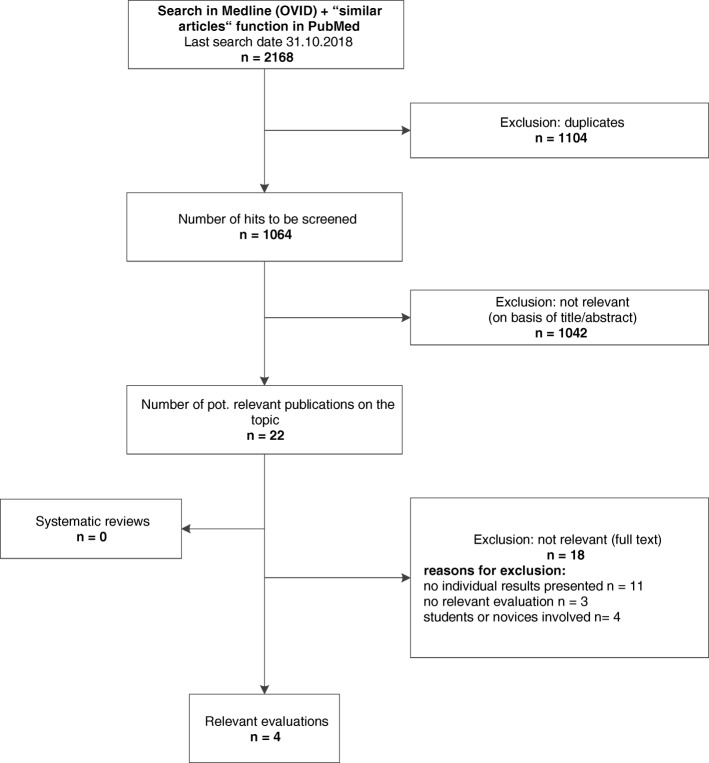
BACKGROUND: Stringent requirements exist regarding the transparency of the study selection process and the reliability of results. A 2-step selection process is generally recommended; this is conducted by 2 reviewers independently of each other (conventional double-screening). However, the approach is resource intensive, which can be a problem, as systematic reviews generally need to be completed within a defined period with a limited budget. The aim of the following methodological systematic review was to analyse the evidence available on whether single screening is equivalent to double screening in the screening process conducted in systematic reviews. METHODS: We searched Medline, PubMed and the Cochrane Methodology Register (last search 10/2018). We also used supplementary search techniques and sources ("similar articles" function in PubMed, conference abstracts and reference lists). We included all evaluations comparing single with double screening. Data were summarized in a structured, narrative way. RESULTS: The 4 evaluations included investigated a total of 23 single screenings (12 sets for screening involving 9 reviewers). The median proportion of missed studies was 5% (range 0 to 58%). The median proportion of missed studies was 3% for the 6 experienced reviewers (range: 0 to 21%) and 13% for the 3 reviewers with less experience (range: 0 to 58%). The impact of missing studies on the findings of meta-analyses had been reported in 2 evaluations for 7 single screenings including a total of 18,148 references. In 3 of these 7 single screenings - all conducted by the same reviewer (with less experience) - the findings would have changed substantially. The remaining 4 of these 7 screenings were conducted by experienced reviewers and the missing studies had no impact or a negligible on the findings of the meta-analyses. CONCLUSIONS: Single screening of the titles and abstracts of studies retrieved in bibliographic searches is not equivalent to double screening, as substantially more studies are missed. However, in our opinion such an approach could still represent an appropriate methodological shortcut in rapid reviews, as long as it is conducted by an experienced reviewer. Further research on single screening is required, for instance, regarding factors influencing the number of studies missed.
Overview
The claims and statistics of this paper haven’t been checked yet.
Free: it reads the open-access text and checks the first 5 claims that cite a source we can check. Create a free account to check every claim.
Integrity signals
Registry
Cites
Statistics
Figures
Verification
Claims the paper makes
The claims and statistics of this paper haven’t been checked yet.
Free: it reads the open-access text and checks the first 5 claims that cite a source we can check. Create a free account to check every claim.
Claims other papers make about this one
Each is checked against this paper’s own text: does it say what the citing paper says it does?
The source backs part of the claim, not all of it — or backs it for a different population, condition or comparison.
In the citing paper
“Previous research suggests that non-experienced reviewers can miss up to 13% of the records in a systematic review, which can significantly impact the results of a metaanalysis (Waffenschmidt et al., 2019).”
From Screening Smarter, Not Harder: A Comparative Analysis of Machine Learning Screening Algorithms and Heuristic Stopping Criteria for Systematic Reviews in Educational Research (2024) · cites this paper as Waffenschmidt et al., 2019
Experimental — accuracy not yet measuredThe cited source says what the claim attributes to it.
In the citing paper
“Single screening is an efficient use of time and resources, but there is a higher risk of missing relevant studies49 50 51”
From PRISMA 2020 explanation and elaboration: updated guidance and exemplars for reporting systematic reviews (2021) · cites this paper as [50]
The cited source says what the claim attributes to it.
In the citing paper
“This approach may be more reliable than single screening but at the expense of increased reviewer time, given the time needed to resolve discrepancies49 50 51”
From PRISMA 2020 explanation and elaboration: updated guidance and exemplars for reporting systematic reviews (2021) · cites this paper as [50]
The cited source says what the claim attributes to it.
In the citing paper
“Single screening is an efficient use of time and resources, but there is a higher risk of missing relevant studies49 50 51”
From PRISMA 2020 explanation and elaboration: updated guidance and exemplars for reporting systematic reviews (2021) · cites this paper as [50]
5 more claims about this paper
Create a free account to see every claim other papers make about this one.
Self-check
Percentages, sums and reported differences re-computed from the paper’s own numbers.
The self-check needs the paper’s full text.
Citations
Cites
Finding What Works in Health Care: Standards for Systematic Reviews
Eden, J., Levit, L. A., Berg, A. O., & Morton, S. C. (2013) · Cited by 948
O’Mara-Eves, A., Thomas, J., McNaught, J., Miwa, M., & Ananiadou, S. (2015) · Systematic Reviews · doi:10.1186/2046-4053-4-5 · Cited by 681
Haby, M. M., Chapman, E., Clark, R., Barreto, J., Reveiz, L., & Lavis, J. N. (2016) · Health Research Policy and Systems · doi:10.1186/s12961-016-0155-7 · Cited by 409
O’Mara-Eves, A., Thomas, J., McNaught, J., Miwa, M., & Ananiadou, S. (2015) · Systematic Reviews · doi:10.1186/s13643-015-0031-5 · Cited by 353
Edwards, P., Clarke, M., DiGuiseppi, C., Pratap, S., Roberts, I., & Wentz, R. (2002) · Statistics in Medicine · doi:10.1002/sim.1190 · Cited by 340 · cited 8×
“Edwards 2002 is the only evaluation with a comparable research question and their results are similar to ours.”
BackgroundMethodResultInfluentialFinding What Works in Health Care: Standards for Systematic Reviews
Committee on Standards for Systematic Reviews of Comparative Effectiveness Research, Board on Health Care Services, & Institute of Medicine (2011) · doi:10.17226/13059 · Cited by 289
Mathes, T., Klaßen, P., & Pieper, D. (2017) · BMC Medical Research Methodology · doi:10.1186/s12874-017-0431-4 · Cited by 240
Self-citationInstitut für Qualität und Wirtschaftlichkeit Im Gesundheitswesen
Culyer, A. J. (2014) · Cited by 189
Shemilt, I., Khan, N., Park, S., & Thomas, J. (2016) · Systematic Reviews · doi:10.1186/s13643-016-0315-4 · Cited by 168 · cited 7×
“Two re-ran the meta-analysis without the missed studies (Pham 2016, Shemilt 2016).”
BackgroundMethodInfluentialDoust, J. A., Pietrzak, E., Sanders, S., & Glasziou, P. P. (2005) · Journal of Clinical Epidemiology · doi:10.1016/j.jclinepi.2004.09.011 · Cited by 106 · cited 4×
“We ultimately included 4 evaluations (Edwards 2002 [12], Doust 2005 [13], Pham 2016 [11], Shemilt 2016 [10]).”
BackgroundMethodInfluential
Research works printed but not linked: 1
- McDonagh M, Peterson K, Raina P, Chang S, Shekelle P. Avoiding bias in selecting studies. Rockville, MD: Agency for Healthcare Research and Quality; 2013. https://effectivehealthcare.ahrq.gov/sites/default/files/pdf/methods-guidance-bias_methods.pdf. 23487864
Cited by
Items 401–500 of 714
Resan, R. K., & Majeed, H. M. (2025) · Journal of Nature and Science of Medicine · doi:10.4103/jnsm.jnsm_199_25 · Cited by 1
Wakefield, D., Dehpour, T., Bambra, C., Davies, J., Murtagh, F. E., & Koffman, J. (2025) · EClinicalMedicine · doi:10.1016/j.eclinm.2025.103697 · Cited by 1
“105,106 A further limitation was the small number of comparable studies for meta-analysis, and high heterogeneity.”
Perspectives on perinatal depression and anxiety screening in primary care: a meta-synthesis
Pham, L., Collins, J. C., Moles, R. J., O’Reilly, C. L., & El‐Den, S. (2026) · Journal of Reproductive and Infant Psychology · doi:10.1080/02646838.2025.2609113 · Cited by 1
“Whilst evidence suggests that single-reviewer title and abstract screening may increase the risk of missing eligible studies (Waffenschmidt et al., 2019), the overall discrepancy of one publication included across both title and abstract ( n = 274), as well as full text screening ( n = 14)…”
Miller, K., Duckworth, L., Regnier, T., Matthews, S. J., Toskin, I., & Shephard, M. D. S. (2026) · BMC Public Health · doi:10.1186/s12889-026-26519-w · Cited by 1
“Study screening and data extraction were independently undertaken by two researchers, achieving high agreement, which improves reliability compared to single screening methods [35].”
Empowerment in Obesity and Behavioral Weight‐Management Programmes: A Scoping Review
Bolland, C., Robins, A., Gray, P. M., & Sindall, P. (2026) · Obesity Reviews · doi:10.1111/obr.70141 · Cited by 1
Kyeremaa, E. A. A., Alorabi, M., Lawthom, C., Scott, S., Smith, C., Stewart, A., & Wright, D. J. (2026) · BMJ Paediatrics Open · doi:10.1136/bmjpo-2026-004519 · Cited by 2
Svensson, J., Linnér, L., Ivarsson, A., & Stambulova, N. B. (2026) · International Review of Sport and Exercise Psychology · doi:10.1080/1750984x.2026.2684923 · Cited by 1
Jóźwiak, Á. B., Imre, A., Józwiak‐Hagymásy, J., Tittmann, J., Nagy, Á., Kovács, S., Kardas, P., van Boven, J. F. M., Mommers, I., & Ágh, T. (2026) · Expert Review of Pharmacoeconomics & Outcomes Research · doi:10.1080/14737167.2026.2691995 · Cited by 2
“This process is conventionally performed independently by at least two human reviewers to minimize the risk of erroneously excluding relevant studies, a requirement that compounds both the time and cost burden [6].”
Nunnery, J. A. (2026) · International Conference on Higher Education Advances (HEAd) · doi:10.4995/head26.2026.21583 · Cited by 1
Fiore, G., Naderi, N., Reed, B., Laird, L. A., & Das‐Gupta, R. (2026) · Aesthetic Surgery Journal Open Forum · doi:10.1093/asjof/ojag140 · Cited by 1
Uwimbabazi, A., Ramasamy, S., Mwamba, T. M., & Syampungani, S. (2026) · Biodegradation · doi:10.1007/s10532-026-10339-1 · Cited by 1
Troup, O., & McCann, B. (2026) · Psychology of sport and exercise · doi:10.1016/j.psychsport.2026.103235 · Cited by 1
Kirby, M. G., Woods, M., Frediani, K., & AlWaer, H. (2026) · Sustainable Cities and Society · doi:10.1016/j.scs.2026.107732 · Cited by 1
Artificial Intelligence in Preconstruction Cost Estimation: A Systematic Review
Abuzaid, H., Bashir, H. A., Dweiri, F. T., & Al‐Shihabi, S. (2026) · Buildings · doi:10.3390/buildings16153050 · Cited by 1
A systematic review of 3D printing of pharmaceutical drug products: Barriers and enablers
Gatt, E., Bartolo, N. S., & Azzopardi, L. M. (2026) · European Journal of Pharmaceutics and Biopharmaceutics · doi:10.1016/j.ejpb.2026.115211 · Cited by 1
Tarani, M. N., Ali, M., Wachidi, W., & Mukti, O. A. (2026) · Proceeding ISETH (International Summit on Science Technology and Humanity) · doi:10.23917/iseth.6973 · Cited by 2
Hall, J. A., & Miller, D. I. (2024) · Cambridge University Press eBooks · doi:10.1017/9781009170123.028 · Cited by 1
Put, V., Kindermans, H. P. J., Hecke, A. V., Cummings, G. G., & Vlaeyen, E. (2025) · Systematic Reviews · doi:10.1186/s13643-025-02939-4 · Cited by 1
“Moreover, by reducing the volume of records requiring manual screening, AI tools can help decrease the potential for labelling errors, which can reach up to 21% among experienced reviewers and 58% among inexperienced ones [56].”
Meta-analytical evidence of a self–other discrepancy in climate change-related risk perceptions
Sandlund, I., Bjälkebring, P., & Bergquist, M. (2026) · Nature Sustainability · doi:10.1038/s41893-025-01717-3 · Cited by 1
Tadina, R., Dirix, H., Ross, V., Khattak, M. W., Neven, A., Peters, B. T., & Brijs, K. (2026) · Healthcare · doi:10.3390/healthcare14030340 · Cited by 1
“Published methodological guidance also recognises that single screening can be acceptable in focused or resource-constrained reviews when supported by verification steps and clear documentation [91].”
Team-based care in small primary care practices: a scoping review
Zein, D., Brown, D., Shelley, D. R., & Chang, J. E. (2026) · BMC Health Services Research · doi:10.1186/s12913-026-14125-w · Cited by 1
“Previous research suggests that a single reviewer process has negligible impact on the findings of reviews [33].”
Hall, S., Cammer, A. L., Chamberlain, S. A., Baskerville, K., Fani, C., Li, Z., & O’Rourke, H. M. (2026) · PLoS ONE · doi:10.1371/journal.pone.0331717 · Cited by 2
“Dual screening is recommended over a single-screening process, as up to 13% of studies can be missed with only one screener [35].”
Darwazeh, D., Clarke, A. C., & Wilson, J. (2026) · World · doi:10.3390/world7030041 · Cited by 1
“Although this data screening approach may not fully eliminate subjectivity, the supervisory validation process and the use of predefined exclusion criteria were implemented to minimize selection bias and enhance procedural consistency [12].”
InfluentialImmersive futures in healthcare: A mapping review of review articles on the metaverse
Rikala, J., Ylönen, M., Solberg, M., Sellberg, C., Heilala, V., Antikainen, T., Munoz, M., Kärkkäinen, T., & Hämäläinen, R. (2026) · Digital Health · doi:10.1177/20552076261431602 · Cited by 1
Ewuoso, C. O., & Chiwarawara, K. (2026) · BMJ Global Health · doi:10.1136/bmjgh-2025-019194 · Cited by 1
Mbatu, R. S., Cummings, C. A., Christopherson, C., & Hayes, J. (2026) · Local Environment · doi:10.1080/13549839.2026.2656615 · Cited by 1
An exploratory review on conceptualizing generative artificial intelligence literacy
Zainal, M. A., Matore, M. E. E. M., & Maat, S. M. (2026) · IAES International Journal of Artificial Intelligence · doi:10.11591/ijai.v15.i2.pp1023-1035 · Cited by 1
“The screening process followed a systematic two-step approach to ensure transparency and reliability [33].”
Hajiakbari, F., Alblas, A. A., Raassens, N., & Bogers, M. L. A. M. (2026) · International Journal of Management Reviews · doi:10.1111/ijmr.70028 · Cited by 1
Musa, C., & Ulph, F. (2026) · European Journal of Human Genetics · doi:10.1038/s41431-026-02128-4 · Cited by 1
Khan, A. S., Arnold, S., Bari, I., Long, I. C., & Paichadze, N. (2026) · International Journal of Health Governance · doi:10.1108/ijhg-09-2025-0166 · Cited by 1
Psychological Resources in Adults with Cancer: A Systematic Review of Quantitative Studies
Bridou, M., & Robieux, L. (2026) · Cancers · doi:10.3390/cancers18152525 · Cited by 1
“…systematic review software (Veritas Health Innovation, Melbourne, Australia; available at www.covidence.org) to help with every stage of the article selection process, for which we adopted a double screening methodology, as this type of approach may be more reliable than single screening [19].”
Mobile Health (mHealth) Apps in Sport Training: A Scoping Review
LIU, J., Dong, Y., Brooks, I. S., Cheung, W. C., Nguyen, V. L., & Jan, Y. (2026) · Sensors · doi:10.3390/s26175394 · Cited by 1
“Prior methodological work indicates that experienced single reviewers miss relatively few eligible studies compared with double screening [152], though this approach means a small number of eligible studies may not have been captured and some extraction errors may not have been caught by a second…”
Kvasnak, K., Brunton, G., Lemonde, M., Chyzzy, B., & Dick, J. A. (2021) · International Health Trends and Perspectives · doi:10.32920/ihtp.v1i2.1438 · Cited by 1
Farrugia, D. M., Vilches, S., & Gerber, A. (2021) · Open Research Europe · doi:10.12688/openreseurope.13796.1 · Cited by 1
Pallin, J. A., McIntosh, C. D., Kavanagh, P. M., Dinneen, S. F., Kearney, P. M., & Buckley, C. M. (2022) · HRB Open Research · doi:10.12688/hrbopenres.13585.1 · Cited by 1
Horwood, M., & Loades, M. E. (2022) · The Open Review · doi:10.47967/tor2022/vol8.11 · Cited by 2
Aigbe, E. O. (2022) · The Open Review · doi:10.47967/tor2022/vol8.12 · Cited by 1
Reece, R., & Merchant, S. (2022) · The Open Review · doi:10.47967/tor2022/vol8.06 · Cited by 2
Quistgaard, M., Myklebust, O. L. P., Aure, T., Austin, S. F., Berring, L. L., Vernal, D. L., & Storebø, O. J. (2023) · BMJ Open · doi:10.1136/bmjopen-2023-073901 · Cited by 2
“41 Additionally, best practice for screening will be followed, 51 by screening the references from the databased independently in duplicate.”
Çavdar, F. A., & Mustafaoğlu, R. (2024) · doi:10.5152/6913 · Cited by 1
Budak, M. İ. (2024) · doi:10.5152/6914 · Cited by 1
Bilimsel Araştırma Makalesinde Tartışma Bölümü Yazımı
Güzeldere, H. K. B. (2024) · doi:10.5152/6910 · Cited by 1
Bilimsel Araştırma Makalesinde Bulgular Bölümü Yazımı
Gülüstan, F. (2024) · doi:10.5152/6909 · Cited by 1
Extent, range, and nature of studies examining sleep in nurses: a scoping review protocol
Baljak, G. R., Marnie, C., Clarke, J., Peters, M. D. J., & Matricciani, L. (2024) · JBI Evidence Synthesis · doi:10.11124/jbies-23-00281 · Cited by 1
Protocol for Meta-Analyses Examining Personalized Adaptive Learning in Undergraduate Mathematics
Hahs‐Vaughn, D. L., Moskal, P. D., Teixeira, K., Muhs, T., Bishop, C., Farotimi, O., & Carassas, C. (2024) · Nordic Journal of Systematic Reviews in Education · doi:10.23865/njsre.v2.6339 · Cited by 1
“Two researchers independently screened titles and abstracts, which is highlighted as a best practice in meta-analysis (Waffenschmidt et al., 2019).”
BackgroundAlemán, E. G. (2023) · e_Buah · Cited by 1
Rapid Evidence Synthesis To Enable Innovation And Adoption in Health and Social CarePreprint
Norman, G., Wilson, P. M., Dumville, J. C., Bower, P., & Cullum, N. A. (2021) · Research Square · doi:10.21203/rs.3.rs-1135135/v1 · Cited by 1
Bekhet, A. H., Jahan, A. M., Bochkezanian, V., Musselman, K. E., & Gorgey, A. S. (2022) · Archives of Physical Medicine and Rehabilitation · doi:10.1016/j.apmr.2022.11.011 · Cited by 1
Heady, N., Watkins, A. J., John, A. M., & Hutchings, H. A. (2023) · Research Square · doi:10.21203/rs.3.rs-3344908/v1 · Cited by 2
Wearable cuffless blood pressure monitoring devices: a commentary
Mbeta, E., McDowell, G., West, J., Hill, J. E., & Sankaranarayanan, R. (2024) · British Journal of Community Nursing · doi:10.12968/bjcn.2024.0022 · Cited by 1
Resilience in victims of stalking and obsessional relational intrusion
Blazey, F. (2021) · Nottingham ePrints (University of Nottingham) · Cited by 1
Adrissi, A. (2024) · ePrints Soton (University of Southampton) · Cited by 1
The life of juggling paid work and informal eldercare: the demand and resource perspective
Lam, W. Y. (2024) · White Rose eTheses Online (University of Leeds, The University of Sheffield, University of York) · Cited by 1
Quince, Z. (2026) · SSRN Electronic Journal · doi:10.2139/ssrn.6500578 · Cited by 1
Fagerberg, P., Sallander, O., Patil, K. V., Thunborg, C., Lundstrom, L., Berg, A., Nyman, A., Borg, N., & Linden, T. K. A. (2026) · medRxiv · doi:10.64898/2026.06.02.26354724 · Cited by 1
Adverse events following cervical manual physical therapy techniques
Kranenburg, R. (2019) · University of Groningen research database (University of Groningen / Centre for Information Technology) · doi:10.33612/diss.108344065
Ikwueme, C. R. (2020) · Digital Commons (Liberty University)
Mediators, confounders and effectiveness of interventions for medication adherence after stroke
Hill, J. E., Harrison, J., Raj, S., Gregary, B., Timoroksa, A.-M., & Gibson, J. M. E. (2020) · British Journal of Neuroscience Nursing · doi:10.12968/bjnn.2020.16.sup5.s18
“2017), the second stage of single reviewer full paper screening was not (Buscemi et al. 2006; Waffenschmidt et al. 2019).”
BackgroundMethodPeddie, N. (2020) · Edinburgh Napier Research Repository (Edinburgh Napier University) · doi:10.17869/enu.2020.2709325
Peterson, A. J. (2019) · LSHTM Research Online (London School of Hygiene and Tropical Medicine) · doi:10.17037/pubs.04660943
A snapshot of statistical methods used in experimental immunoblotting: a scoping review
Gosselin, R. (2022) · 4open · doi:10.1101/2022.04.06.487284
Rapid evidence synthesis to enable innovation and adoption in health and social carePreprint
Norman, G., Wilson, P. M., Dumville, J. C., Bower, P., & Cullum, N. A. (2022) · Research Square · doi:10.21203/rs.3.rs-1135135/v2
A Call to Cease the Use of Slave Analogies in Medical Literature
Edwards, S., Park, J., Benjenk, I., Werner, L., Irondi, O. O., Samant, R., Samant, S., Greaves, T., Pla, R. A., & Sherman, M. (2022) · Annals of Surgery · doi:10.1097/sla.0000000000005442
Effects of Attention and Congruence on Judging True and False COVID-19 News Headlines
Lê, P. H., & Blumenthal, J. V. (2022) · The Open Review · doi:10.47967/tor2022/vol8.08
Collaborating With Passion: Remind Me Why It Was Invited?
Meyer, J. P. (2022) · The Open Review · doi:10.47967/tor2022/vol8.16
Phd Support Groups: From Sceptic to True Believer
Collett, K. (2022) · The Open Review · doi:10.47967/tor2022/vol8.14
Using ArcGIS StoryMaps to prepare learners for fieldwork
Maddison, J., Marsham, S., & Bevana, R. M. (2022) · The Open Review · doi:10.47967/tor2022/vol8.09
Embodiment in African Participatory Music Making
Day, N. K. (2022) · The Open Review · doi:10.47967/tor2022/vol8.10
FATHER ABSENCE AND LIFE HISTORY STRATEGY OUTCOMES AMONG MALAYSIAN WOMEN
ALOYSIUS, M. (2022) · Jurnal Pembangunan Sosial · doi:10.32890/jps2022.25.3
Advanced Research in Pediatric Radiology and Nuclear Medicine
Ng, C. K. C. (2023) · MDPI eBooks · doi:10.3390/books978-3-0365-7958-0
Heady, N. (2023) · Cronfa (Swansea University) · doi:10.23889/suthesis.63857
Gaining Confdence Through Collaboration
Pascual, N. R. (2023) · The Open Review · doi:10.47967/tor2022col/vol8.13a
Pulman, S. (2023) · The Open Review · doi:10.47967/tor2022col/vol8.15
The Collaboration Pyramid – Inspiring Radical innovation That People are More Willing to Adopt
Neild, M. (2023) · The Open Review · doi:10.47967/tor2022col/vol8.17
Luong, R. A. M., Guan, W., Vue, F. C., & Dai, J. (2024) · International Journal of Environmental Research and Public Health · doi:10.3390/ijerph21020177
“…one reviewer was available or remained due to the unexpected withdrawal of the second independent reviewer during the review process, the following steps would be followed to maintain the integrity of the scoping review: In addition, the limitations of one reviewer must be acknowledged [19]. a.”
BackgroundMandaty, F. A., Syaifudin, A., Handayaningtyas, A. D., Komsiyah, K., Kumalasari, D. N., & Sumarno, S. (2023) · Jurnal Pengabdian Ilmu Kesehatan · doi:10.55606/jpikes.v3i3.3189
Addai, K., Serener, B., & Kırıkkaleli, D. (2022) · International Journal of Finance Insurance and Risk Management · doi:10.35808/ijfirm/325
Yang, D. Y., Zhou, Y., Tang, X. T., Zhang, T. Z., Li, Y. L., Zhang, J., & Ma, X. (2024) · doi:10.2196/preprints.59835
Bilimsel Araştırma Makalesinde Başlık Seçimi ve Özet Bölümü Yazımı
Kaya, H. D., & Duman, R. (2024) · doi:10.5152/6904
Argut, S. K., & Sayın, İ. (2024) · doi:10.5152/6902
Veer, P. V. D., & Akgül, A. (2024) · doi:10.5152/6901
Klinik Çalışmalarda Örneklem Belirleme Süreci ve Güç Analizi Uygulaması
Boz, C., & Çalgi, B. (2024) · doi:10.5152/6907
Bilimsel Araştırma Makalesi İçin Dergi Seçimi
Tarakçı, E. (2024) · doi:10.5152/6911
Bilimsel Araştırma Makalesinde Bulunması Gereken Standartlar
Doğan, E. N. K., & Birinci, T. (2024) · doi:10.5152/6903
Bilimsel Araştırma ve Yayın Etiği
Altınay, M. (2024) · doi:10.5152/6915
Was ist eine Literaturübersicht?
Seidlein, A., & Kahl-Scholz, M. (2024) · Palliative Care und Forschung · doi:10.1007/978-3-658-43829-6_2
Enhancing the Methods of a Rapid Virus Testing Study
Acuña-Alonzo, V. (2024) · JAMA Internal Medicine · doi:10.1001/jamainternmed.2024.2999
Korall, A. M. B., Chong, H., Komisar, V., Mackey, D. C., Khan, M., Hoekstra, F., Brown, S. G., Gardner, P., Hames, C., Laing, A. C., et al. (2024) · PLoS ONE · doi:10.1371/journal.pone.0310117
Peeters, R. (2024) · Research Publications (Maastricht University) · doi:10.26481/dis.20250125rp
Surles, S., Noteboom, C., & El-Gayar, O. (2025) · Hawaii International Conference on System Sciences (HICSS) · doi:10.24251/hicss.2025.776 · Cited by 1
Solankee, J., Sumayo, R., & Annaswamy, T. M. (2025) · Interventional Pain Medicine · doi:10.1016/j.inpm.2025.100551
Expert Consensus on Dry Needling Practices for Headache: An International Delphi Study Protocol
Perreault, T., Dommerholt, J., Fernández‐de‐las‐Peñas, C., Arendt‐Nielsen, L., Cagnie, B. J., Antonio, S. D., & Castaldo, M. (2025) · Journal of Clinical Medicine · doi:10.3390/jcm14051740
“To optimize the chances of identifying relevant studies, we used a dual-reviewer title and abstract screening process [71,72].”
Ahern, E., Adedeji, T., Whiston, A., Dillon, S., & Lynn, F. A. (2025) · HRB Open Research · doi:10.12688/hrbopenres.14129.1
Paediatric pain and malnutrition in low-income countries: A narrative review
Mingels, S. (2025) · Nutrition and Health · doi:10.1177/02601060251336823
“Double screening is however generally recommended in the process of systematic review (Mahtani et al., 2020; Waffenschmidt et al., 2019).”
Vembye, M. H., Christensen, J., Bondebjerg, A., & Schytt, F. L. W. (2024) · OSF Preprints (OSF Preprints) · doi:10.31219/osf.io/yrhzm_v1
Vembye, M. H., Christensen, J., Bondebjerg, A., & Schytt, F. L. W. (2025) · OSF Preprints (OSF Preprints) · doi:10.31219/osf.io/yrhzm_v2
Fuloria, N. K., Fuloria, S., Sekar, M., Narain, K., & Kumar, S. (2025) · Elsevier eBooks · doi:10.1016/b978-0-443-30120-9.00001-5
Impact of postnatal depression on families with children under 5 years in the UKPreprint
Nassuna, S., & Bagonza, F. X. (2025) · Research Square · doi:10.21203/rs.3.rs-6739760/v1
Metadata
- Authors
- Waffenschmidt, S., Knelangen, M., Sieben, W., Bühn, S., & Pieper, D.
- Affiliations
- Institute for Quality and Efficiency in Health Care (DE)
- Witten/Herdecke University (DE)
- Corresponding author
- Waffenschmidt, Siw
- Venue
- BMC Medical Research Methodology
- Published
- 2019-06-28
- Volume
- 19
- Issue
- 1
- Pages
- 132-132
- ISSN
- 1471-2288 (ISSN-L)
- PMC
- PMC6599339
- OpenAlex
- W2955273711
- Semantic Scholar
- ffee5cf6b88f24a1bc583d308035058d1fee7eb1
- Cited by
- 626
- References
- 19
- Citations by year
- 2026: 111 · 2025: 106 · 2024: 117 · 2023: 93 · 2022: 88 · 2021: 74 · 2020: 34 · 2019: 3
- FWCI
- 10.08
- Type
- journal article
- Language
- en
- Open access
- gold
- doi.org
- Licence
- cc-by
- creativecommons.org/licenses/by/4.0/ (tdm)
- creativecommons.org/licenses/by/4.0/ (vor)
- Locations
- BMC Medical Research Methodology (publishedVersion, cc-by)
- PubMed Central (publishedVersion, cc-by)
- PubMed (publishedVersion)
- DOAJ (DOAJ: Directory of Open Access Journals) (submittedVersion, cc-by-sa)
- Topics
- Social Sciences › Decision Sciences › Statistics, Probability and Uncertainty › Meta-analysis and systematic reviews
- Social Sciences › Sociology and Political Science › Delphi Technique in Research
- Physical Sciences › Mathematics › Statistics and Probability › Statistical Methods in Epidemiology
- Keywords
- study selection, title and abstract screening, reviewer experience, rapid review
- MeSH terms
- Abstracting and Indexing, Systematic Reviews as Topic, Humans, Information Systems, Publications, Information Storage and Retrieval, PubMed
About these checks
Registry, retraction, Cites and statistics results are computed, not judged, with one exception: a printed reference that no index lists is read once by a model before it counts as a citation error. Claims are extracted by a model and kept only when their quote appears verbatim in the text; each cited source is then checked, with a model’s help, for whether it says what the claim relies on. Those verdicts can be wrong — read the claim’s quote and the cited source before relying on one.
Statistics and arithmetic are recomputed, not judged.
Confidence bands are shown only for fields calibrated on our annotated test set. None is calibrated yet, so no band is shown.
What counts as a claim ›How we measure confidence ›How we check this ›
Are you an author, or do you see a problem with this page? Request a review
Data sources
Bibliographic data: Semantic Scholar, OpenAlex, Crossref.
Contains information from the Semantic Scholar Academic Graph Datasets, made available under the ODC Attribution License (ODC-BY 1.0).
Semantic Scholar’s data is described in: Kinney, R., et al. (2023). The Semantic Scholar Open Data Platform. arXiv:2301.10140.
