

Single screening versus conventional double screening for study selection in systematic reviews: a methodological systematic review
Open accessThe DOI matches its Crossref record; 18 of the 19 references it cites were found in a registry or an index.
Abstract
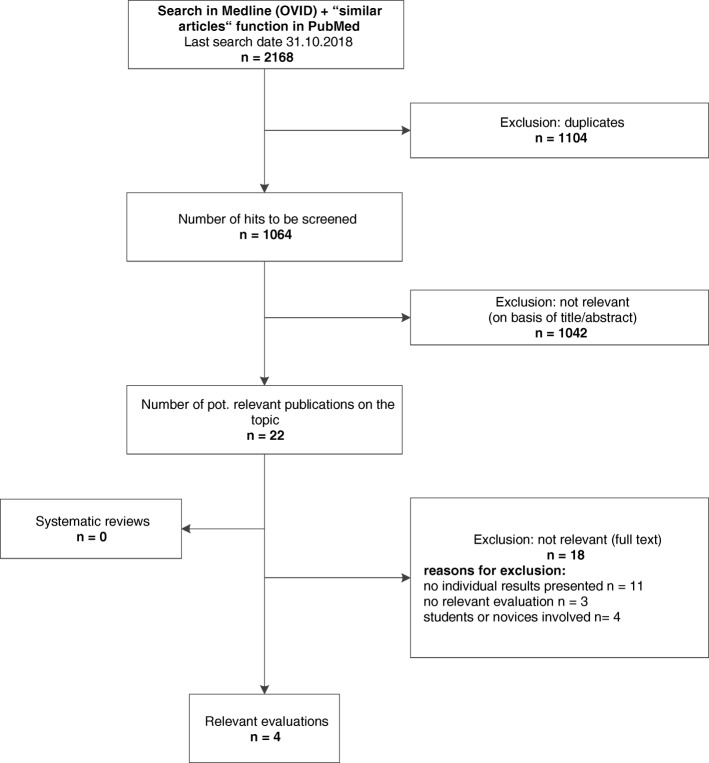
BACKGROUND: Stringent requirements exist regarding the transparency of the study selection process and the reliability of results. A 2-step selection process is generally recommended; this is conducted by 2 reviewers independently of each other (conventional double-screening). However, the approach is resource intensive, which can be a problem, as systematic reviews generally need to be completed within a defined period with a limited budget. The aim of the following methodological systematic review was to analyse the evidence available on whether single screening is equivalent to double screening in the screening process conducted in systematic reviews. METHODS: We searched Medline, PubMed and the Cochrane Methodology Register (last search 10/2018). We also used supplementary search techniques and sources ("similar articles" function in PubMed, conference abstracts and reference lists). We included all evaluations comparing single with double screening. Data were summarized in a structured, narrative way. RESULTS: The 4 evaluations included investigated a total of 23 single screenings (12 sets for screening involving 9 reviewers). The median proportion of missed studies was 5% (range 0 to 58%). The median proportion of missed studies was 3% for the 6 experienced reviewers (range: 0 to 21%) and 13% for the 3 reviewers with less experience (range: 0 to 58%). The impact of missing studies on the findings of meta-analyses had been reported in 2 evaluations for 7 single screenings including a total of 18,148 references. In 3 of these 7 single screenings - all conducted by the same reviewer (with less experience) - the findings would have changed substantially. The remaining 4 of these 7 screenings were conducted by experienced reviewers and the missing studies had no impact or a negligible on the findings of the meta-analyses. CONCLUSIONS: Single screening of the titles and abstracts of studies retrieved in bibliographic searches is not equivalent to double screening, as substantially more studies are missed. However, in our opinion such an approach could still represent an appropriate methodological shortcut in rapid reviews, as long as it is conducted by an experienced reviewer. Further research on single screening is required, for instance, regarding factors influencing the number of studies missed.
Overview
The claims and statistics of this paper haven’t been checked yet.
Free: it reads the open-access text and checks the first 5 claims that cite a source we can check. Create a free account to check every claim.
Integrity signals
Registry
Cites
Statistics
Figures
Verification
Claims the paper makes
The claims and statistics of this paper haven’t been checked yet.
Free: it reads the open-access text and checks the first 5 claims that cite a source we can check. Create a free account to check every claim.
Claims other papers make about this one
Each is checked against this paper’s own text: does it say what the citing paper says it does?
The source backs part of the claim, not all of it — or backs it for a different population, condition or comparison.
In the citing paper
“Previous research suggests that non-experienced reviewers can miss up to 13% of the records in a systematic review, which can significantly impact the results of a metaanalysis (Waffenschmidt et al., 2019).”
From Screening Smarter, Not Harder: A Comparative Analysis of Machine Learning Screening Algorithms and Heuristic Stopping Criteria for Systematic Reviews in Educational Research (2024) · cites this paper as Waffenschmidt et al., 2019
Experimental — accuracy not yet measuredThe cited source says what the claim attributes to it.
In the citing paper
“Single screening is an efficient use of time and resources, but there is a higher risk of missing relevant studies49 50 51”
From PRISMA 2020 explanation and elaboration: updated guidance and exemplars for reporting systematic reviews (2021) · cites this paper as [50]
The cited source says what the claim attributes to it.
In the citing paper
“This approach may be more reliable than single screening but at the expense of increased reviewer time, given the time needed to resolve discrepancies49 50 51”
From PRISMA 2020 explanation and elaboration: updated guidance and exemplars for reporting systematic reviews (2021) · cites this paper as [50]
The cited source says what the claim attributes to it.
In the citing paper
“Single screening is an efficient use of time and resources, but there is a higher risk of missing relevant studies49 50 51”
From PRISMA 2020 explanation and elaboration: updated guidance and exemplars for reporting systematic reviews (2021) · cites this paper as [50]
5 more claims about this paper
Create a free account to see every claim other papers make about this one.
Self-check
Percentages, sums and reported differences re-computed from the paper’s own numbers.
The self-check needs the paper’s full text.
Citations
Cites
Finding What Works in Health Care: Standards for Systematic Reviews
Eden, J., Levit, L. A., Berg, A. O., & Morton, S. C. (2013) · Cited by 948
O’Mara-Eves, A., Thomas, J., McNaught, J., Miwa, M., & Ananiadou, S. (2015) · Systematic Reviews · doi:10.1186/2046-4053-4-5 · Cited by 681
Haby, M. M., Chapman, E., Clark, R., Barreto, J., Reveiz, L., & Lavis, J. N. (2016) · Health Research Policy and Systems · doi:10.1186/s12961-016-0155-7 · Cited by 409
O’Mara-Eves, A., Thomas, J., McNaught, J., Miwa, M., & Ananiadou, S. (2015) · Systematic Reviews · doi:10.1186/s13643-015-0031-5 · Cited by 353
Edwards, P., Clarke, M., DiGuiseppi, C., Pratap, S., Roberts, I., & Wentz, R. (2002) · Statistics in Medicine · doi:10.1002/sim.1190 · Cited by 340 · cited 8×
“Edwards 2002 is the only evaluation with a comparable research question and their results are similar to ours.”
BackgroundMethodResultInfluentialFinding What Works in Health Care: Standards for Systematic Reviews
Committee on Standards for Systematic Reviews of Comparative Effectiveness Research, Board on Health Care Services, & Institute of Medicine (2011) · doi:10.17226/13059 · Cited by 289
Mathes, T., Klaßen, P., & Pieper, D. (2017) · BMC Medical Research Methodology · doi:10.1186/s12874-017-0431-4 · Cited by 240
Self-citationInstitut für Qualität und Wirtschaftlichkeit Im Gesundheitswesen
Culyer, A. J. (2014) · Cited by 189
Shemilt, I., Khan, N., Park, S., & Thomas, J. (2016) · Systematic Reviews · doi:10.1186/s13643-016-0315-4 · Cited by 168 · cited 7×
“Two re-ran the meta-analysis without the missed studies (Pham 2016, Shemilt 2016).”
BackgroundMethodInfluentialDoust, J. A., Pietrzak, E., Sanders, S., & Glasziou, P. P. (2005) · Journal of Clinical Epidemiology · doi:10.1016/j.jclinepi.2004.09.011 · Cited by 106 · cited 4×
“We ultimately included 4 evaluations (Edwards 2002 [12], Doust 2005 [13], Pham 2016 [11], Shemilt 2016 [10]).”
BackgroundMethodInfluential
Research works printed but not linked: 1
- McDonagh M, Peterson K, Raina P, Chang S, Shekelle P. Avoiding bias in selecting studies. Rockville, MD: Agency for Healthcare Research and Quality; 2013. https://effectivehealthcare.ahrq.gov/sites/default/files/pdf/methods-guidance-bias_methods.pdf. 23487864
Cited by
Items 601–700 of 713
Sjögren, J., & Ivanova, O. (2025) · Tampere University Institutional Repository (Tampere University)
Nurse Burnout Group Versus Individual Mindfulness Interventions: A Systematic Review
Diaz, G. C. (2022) · Tuwhera (Auckland University of Technology)
Screening Methods for Downy Mildew Resistance in Maize: A Systematic Review
Kipkoech, M. C., Ndeve, A. D., Bila, J., Fato, P., Nanyangwe, S., Oladiran, K. P., & Lhamine, C. F. (2026) · Genes · doi:10.3390/genes17030350
“This category included widely cited systematic review methodology references such as Page et al. [24], Higgins et al. [30], and Rethlefsen et al. [25], as well as software and tool descriptions by Ouzzani et al. [28] and Waffenschmidt et al. [29].”
Purpose-driven curriculum for 9th-12th grades for adulthood careers & life gratification
Nnadozie, D. K. C. (2025) · Pepperdine Digital Commons (Pepperdine University)
Lumsdon, J., Nyadimo, V., Unda, S. D., Fothergill‐Misbah, N., & Bitta, M. A. (2026) · PLoS ONE · doi:10.1371/journal.pone.0328317 · Cited by 1
“By involving at least two reviewers at both the screening and data extraction stage, the risk of bias was reduced [64,65].”
Towards Multilayered Framework Of Digital Agency: Insights From A Rapid Hybrid Review
Rikala, P., Ylönen, M., Forsman, P., Paloniemi, S., Kärkkäinen, T., & Hämäläinen, R. (2026) · Jyväskylä University Digital Archive (University of Jyväskylä)
Karampatsas, K. (2023) · City Research Online (City University London)
Superusers’ Engagement in Online Mental Health Forums
Liberty, C. (2026) · Lancaster EPrints (Lancaster University) · doi:10.17635/lancaster/thesis/3174
Affengruber, L., Emprechtinger, R., Persad, E., Kleijnen, J., & Gartlehner, G. (2026) · BMC Medical Research Methodology · doi:10.1186/s12874-026-02838-9
“[5].”
Coaches’ definitions of success in sport: A rapid review
Henderson, P., Vickery, W., & Pill, S. (2026) · International Journal of Sports Science & Coaching · doi:10.1177/17479541261432364
Addressing emotionally based school avoidance: causes, consequences, and interventions
(2026) · Frontiers research topics · doi:10.3389/978-2-8325-7786-8
Do time management interventions support wellbeing in the workplace? A systematic review
Young, A. N., Blasi, Z. D., Foley, S., Bourke, A., Cronin, S., Dwyer, A., & Fitzgibbon, J. (2026) · Applied Psychology Health and Well-Being · doi:10.1111/aphw.70149
“To ensure screening efficiency (Edwards et al., 2002; Waffenschmidt et al., 2019), 24% of full articles were double screened by the review team for interrater reliability, and consensus was reached.”
Gualerzi, A. (2024) · Portuguese National Funding Agency for Science, Research and Technology (RCAAP Project by FCT)
Turel, O., Görür, A. K., & Çetinkaya, F. C. (2025) · DergiPark (Istanbul University)
Derdouri, A., Oyama, T., Murayama, Y., & Masago, Y. (2026) · Research Square · doi:10.21203/rs.3.rs-9582053/v1
Economic value of physiotherapy interventions in headache management: a scoping review
Mingels, S., Granitzer, M., Diener, I., & Dankaerts, W. (2026) · BMC Health Services Research · doi:10.1186/s12913-026-14701-0
“Yet, single screening by an experienced reviewer can be an acceptable shortcut with minimal risk of missing relevant studies [59].”
Veloni, M., & Vasiou, A. (2026) · Review of Education · doi:10.1002/rev3.70160
de Oliveira, J. F. S. E., Silva, L. C. G., Maia, D. T. L., Junior, J. B. R. V., Ribeiro, C. A. D., & Costa, D. R. (2026) · Research Society and Development · doi:10.33448/rsd-v15i5.51075
“Independent double screening was adopted because it represents the methodological gold standard for reducing the risk of excluding relevant studies (Waffenschmidt et al., 2019).”
Representative bureaucracy practices in policing: a systematic literature review from 1987 to 2025
Arslan, M. (2026) · Crime Prevention and Community Safety · doi:10.1057/s41300-026-00236-3
“Single screening does not equate to double screening; nevertheless, this methodology may still serve as a suitable expedient in rapid reviews, provided it is executed by a reviewer with substantial expertise (Nama et al. 2021; Waffenschmidt et al. 2019).”
Roine, E., Rissanen, T., Hakulinen, T., & Haaranen, A. (2026) · Scandinavian Journal of Caring Sciences · doi:10.1111/scs.70266
Aygün, Y., Tüfekçi, Ş., Böke, H., Yagin, B., Berktaş, H., Canpolat, B., Turhan, F. H., Norman, G., & Güldoğan, E. (2026) · Frontiers in Psychology · doi:10.3389/fpsyg.2026.1762732
“Two reviewers independently screened all records retrieved from the database searches (Waffenschmidt et al., 2019; Wang et al., 2020).”
Ghari, S., Fu, P., Abhaionmhen, A. O., Mago, V., & Belle, A. B. (2026) · doi:10.2196/preprints.103004
Goossens, E., Kemajou, P. M., Coorevits, P. L., Probst, S., & Beeckman, D. (2026) · BMJ Open · doi:10.1136/bmjopen-2025-113547
“57 Nevertheless, the use of AI-assisted screening introduces important limitations.”
Mbah, V. N., Ugwuanyi, R. C., & Susan, A. N. (2026) · World Journal of Advanced Research and Reviews · doi:10.30574/wjarr.2026.30.3.1588
Maulida, S., & Dewi, D. A. R. (2026) · The ASEAN Journal of Military and Preventive Medicine · doi:10.47353/ajmpm.v3i1.36
Moreno, F. (2026) · Tesis Doctorals en Xarxa (Consorci de Serveis Universitaris de Catalunya)
Portfolio for Professional Doctorate in Health Psychology.
Davies, J. M. (2026) · Staffordshire Online Repository (Staffordshire University)
Murphy, A., Dawes, J., Dunphy, E., & Bacon, G. (2026) · Wellbeing Space and Society · doi:10.1016/j.wss.2026.100431
Sutherland-Stevens, N. A., Chilman, L. B., Lilly, K., Ledger, S. P., & Burritt, L. (2026) · Early Childhood Education Journal · doi:10.1007/s10643-026-02297-3 · Cited by 1
“A further 40% of the titles and abstracts were double reviewed (NSS and SL) to minimize systematic errors and potential selection bias while ensuring consistent application of the inclusion criteria (Glover Takahashi et al., 2014 ; Olofsson et al., 2017 ; Waffenschmidt et al., 2019).”
Sandner, E., Fontana, L., Solomon, M. T., Abdella, S. B., Caracci, E., Stabile, L., Buonanno, G., Simniceanu, A., Jakovljevic, I., Henriques, A., et al. (2026) · Research Square · doi:10.21203/rs.3.rs-10080817/v1
Modelos de predicción de caídas en personas mayores con demencia: una revisión rápida
Nuño-Solínis, R., Fernández, E., Iturburu, M., & Olariu, E. (2026) · Revista Española de Geriatría y Gerontología · doi:10.1016/j.regg.2026.101815
LLM-Enhanced Rapid Review (LLMEn-RR): a methodology proposal
Irace, M. B., Simões, J. L., Argôlo, M., Barbosa, C. E., Nóbrega, L., Martinez, L. F., & de Souza, J. M. (2026) · International Conference on Computer Supported Cooperative Work in Design (CSCWD) · doi:10.1109/cscwd68734.2026.11582469
“In systematic reviews, inter-rater reliability between human experts is rarely absolute, often fluctuating due to cognitive fatigue, attentional lapses, or interpretive subjectivity [35] regarding abstract ambiguity.”
Public health informatics tools for dengue risk management: A systematic review
Alraihan, N. M., French, M., Moore, D. C., & Sedda, L. (2026) · PLOS Digital Health · doi:10.1371/journal.pdig.0001495
“Because complete independent duplicate screening was not undertaken, the possibility of selection error or reviewer bias cannot be fully excluded and should be considered when interpreting the comprehensive-ness of the provided evidence base [88,89].”
Biochar: a green approach for arsenic removal from polluted water and soil, a systematic review
Mehdizadeh, M., Omidi, A., Ogunwumi, O. T., Rop, S., & Masime, J. O. (2026) · Environmental Sustainability · doi:10.1007/s42398-026-00451-6
“The study selection process was conducted by two independent reviewers, who initially screened the titles and abstracts of the identified studies (Waffenschmidt et al. 2019 ).”
The Association Between Mindfulness and Perceived Stress: A Meta‐Analysis
Schutte, N. S., & Rock, A. J. (2026) · Stress and Health · doi:10.1002/smi.70209
“This coder had expertise in the areas of mindfulness and perceived stress, meeting the criterion for accuracy of coding identified by Waffenschmidt et al. 2019.”
Drowning in Evidence: The Meta‐Analysis Boom and the Rigor It Demands
Impellizzeri, F. M., & Shrier, I. (2026) · Scandinavian Journal of Medicine and Science in Sports · doi:10.1111/sms.70353
“When resources or time are limited (e.g., rapid review), one reviewer and a second person validating the response may be considered acceptable but needs to be justified [12].”
Song, D., Guo, J., Rao, X., Hu, X., Gu, X., & Chen, J. (2026) · Journal of Intelligence · doi:10.3390/jintelligence14070150
“Independent screening and predefined procedures for resolving disagreements can reduce potential bias associated with judgments made by a single reviewer (Waffenschmidt et al., 2019).”
Nguyen, R. (2026) · Journal of Racial and Ethnic Health Disparities · doi:10.1007/s40615-026-03104-w
Abu-Ayyash, E. A. S., & Charles, T. (2026) · Current Issues in Language Planning · doi:10.1080/14664208.2026.2704766
Psychosocial Impact on Women Survivors of Sexual Violence in Armed Conflicts: A Systematic Review
Santisteban, N. C., Fernández-Salido, M., & Ferrer, J. G. (2026) · Trauma Violence & Abuse · doi:10.1177/15248380261463271
Atkins, B., Smith, C., Bhattacharya, D., & Scott, S. (2026) · Behavioral Sciences · doi:10.3390/bs16071251
“To ensure accuracy and alleviate risk of bias, two reviewers (BA & SS) will independently review titles and abstracts of articles for full-text review against the inclusion and exclusion criteria (Aromataris et al., 2024; Waffenschmidt et al., 2019).”
Rauxloh, H. (2026) · Communication Methods and Measures · doi:10.1080/19312458.2026.2704557
Nichol, B., McCready, J. L., Gibson, R., Erfani, G., Pollock, D., Munn, Z., Nunn, J., Tomietto, M., & Haighton, C. (2026) · JBI Evidence Synthesis · doi:10.11124/jbies-26-00181
Markonda, L. P., & Spatz, D. L. (2026) · Breastfeeding Medicine · doi:10.1177/15568253261473733
“32,33”
Eshun, I. (2026) · Journal of Aging and Health · doi:10.1177/08982643261474654
What Changed Since 1994: Educator Attitudes Toward Gifted Education
Ozkan, F., Oğurlu, Ü., & Özbey, A. (2026) · Journal of Advanced Academics · doi:10.1177/1932202x261474545
Advancing Data Extraction Workflows for Single-Case Design Meta-Analysis Using Large Language Models
Lou, Y. (2026) · Scholars Archive - University at Albany (University at Albany, State University of New York)
Sowan, B. I., & Massad, B. (2026) · Informatics in Medicine Unlocked · doi:10.1016/j.imu.2026.101794
Teaching the Sterile Start: A Rapid Scoping Review and Proposed START-OR Competency ModelPreprint
Perez, A. D., Pérez, W. A., Pérez, A. R., & Ochoa, A. D. V. (2026) · Research Square · doi:10.20944/preprints202608.0618.v1
Financial Stability Index: A Systematic Literature Review
Irawati, N., Sadalia, I., Nurfitriani, W., Azmi, A., & Erisma, N. (2026) · Proceeding ISETH (International Summit on Science Technology and Humanity) · doi:10.23917/iseth.5825
“Screening titles and abstracts resulted in 1,604 articles for evaluation, of which 892 articles were excluded because they did not meet the topic relevance criteria (Sampson et al., 2020; Thomas et al., 2011; Waffenschmidt et al., 2019; Namikas et al., 2021).”
Kargar, A., Zamani, M. A., & Mohammadnezhad, G. (2026) · Journal of Cheminformatics · doi:10.1186/s13321-026-01291-6
“In a subsequent cross-sectional analysis of 4,709 references from 274 systematic reviews, MEDLINE indexed 86.6% and Embase indexed 88.2% of the included references, whereas the combined indexing rate was 90.2%; notably, 9.8% of the references were indexed in neither database [10].”
InfluentialDelf, A., & Wright, D. J. (2026) · Parkinson s Disease · doi:10.1155/padi/8428752
Moroianu, L.-A., Drăguș, L., Rosca, S., Rusu-Negraia, M., Ardeleanu, V., Vadana, R. N., State, I., Mihu, G., Matei, M. N., & Mitincu-Caramfil, S.-D. (2026) · Diseases · doi:10.3390/diseases14090309
Kirby, K. (2022) · UWE Research Repository (UWE Bristol)
Aguila, M. E. R., Guitones, K. I. M., Arellano, M. Y. B., Rivera, M. B., Evangelista, I. M. B., Tanglao, M. J. B., Ting, J. R. P., Rabano, A. J., Cruz, C. A. K., Lopez, B. A., et al. (2026) · Journal of Neural Transmission · doi:10.1007/s00702-026-03271-4
Fariborzi, H., & Steel, P. (2026) · SSRN Electronic Journal · doi:10.2139/ssrn.7388958
Examining barriers and enablers of local adaptations to coastal floods: A systematic review
Depari, C. D. A. (2026) · Heliyon · doi:10.1016/j.heliyon.2026.e45411
Shatskiy, A. S., Deigheidy, E. M., Masyutina, S. E., & Mamalyga, M. L. (2026) · Complex Issues of Cardiovascular Diseases · doi:10.17802/2306-1278-2026-15-4-153-163
Paul Andrew Bourne, P. (2026) · International Journal of Research and Innovation in Social Science · doi:10.47772/ijriss.2026.100800454
NWambo, J. C., Bifarin, O. O., & Higginbotham, K. (2026) · Nursing Inquiry · doi:10.1111/nin.70164
“Full‐text screening was conducted by one reviewer, with all inclusion decisions subsequently verified by a second independent reviewer; a third reviewer was available to adjudicate unresolved disagreements (Waffenschmidt et al. 2019).”
Evolution of Non‐Financial Reporting in Non‐Profit Organizations: The State of the Art
Meo, B., Giosi, A., & Testarmata, S. (2026) · Corporate Social Responsibility and Environmental Management · doi:10.1002/csr.70935
Masuroh, I. S., & Hamdu, G. (2026) · International Journal of Nusantara Islam · doi:10.15575/ijni.v14i2.54815
“Recent methodological research underscores that dual independent screening significantly improves reliability and reduces subjective exclusion bias (Waffenschmidt et al., 2019).”
Arend, R. B., Peroni, B. Z., Lima, N. L., Garcia, M. C., dos Santos, R. T. F., Kerpel, D., Jung, G. S., Roman, A., Gago, G., da Silva, M. B. C., et al. (2026) · Life · doi:10.3390/life16091538
Bergstra, S. A., van der Pol, J. A., Bierman, F., & Huizinga, T. W. J. (2026) · Annals of the Rheumatic Diseases · doi:10.1016/j.ard.2026.06.038
Guidelines for Meta‐Analytic Structural Equation Modeling: Steps, Resources, and Illustrations
Waheed, H., & Lim, W. M. (2026) · Psychology and Marketing · doi:10.1002/mar.70266
Wang, H. J., Wang, L. S., Tan, J. W. L., Wang, E. S., & Lee, Y. Y. (2026) · Dermatology Research and Practice · doi:10.1155/drp/2160445
Sayekti, S. P., Djuanda, I., Faridah, E. S., Fitriana, W. N. P., & Laelasari, E. (2026) · AL-TANZIM JURNAL MANAJEMEN PENDIDIKAN ISLAM · doi:10.33650/al-tanzim.v10i4.14731
“Studies identified through the literature search were screened using eligibility criteria established a priori in the review protocol to minimize selection bias and ensure consistency in the inclusion process (Waffenschmidt et al., 2019).”
Corso, M., Ead, L., Brunton, G., Négrini, S., Tricco, A. C., & Côté, P. (2026) · Journal of Clinical Epidemiology · doi:10.1016/j.jclinepi.2026.112542 · Cited by 1
An, L., Ramdane, S., Kim, T., Wang, C., Grushka, J., Deckelbaum, D., Wong, E. G., & Jastaniah, A. (2026) · BMJ Open · doi:10.1136/bmjopen-2025-116075
Molloy, E., Dann, S.-A., Cross‐Sudworth, F., Delicate, A., Tadros, A., Bicknell, S., Morton, V. H., Kenyon, S. L., & Jones, L. (2026) · International Journal for Equity in Health · doi:10.1186/s12939-026-03019-2
Kim, J. (2026) · Korean Journal of Medical Ethics · doi:10.35301/ksme.2026.29.3.163
Selecting the optimal study design!
Albabtain, M. A., AlRasheed, M. M., Arafat, A. A., Breitinger, H., Breitinger, U., Elsisi, G. H., Gaber, A., Gumaa, M., Hozien, M., Abdelghany, R. M., et al. (2026) · Elsevier eBooks · doi:10.1016/b978-0-443-45595-7.00015-7
Pediatric Radiology: Adapting Imaging Protocols for Younger Populations
Muatiri, A. G. H. A. (2024) · Review of Contemporary Philosophy
Jarvis, D. (2025) · Nottingham ePrints (University of Nottingham)
What We Talk About When We Talk About Agency: A Systematic Review of Agency in Video Games
XU, X., Beeston, J., & Denisova, A. (2026) · Proceedings of the ACM on Human-Computer Interaction · doi:10.1145/3831310
E-Comic Berbasis Etnomatematika dalam Pembelajaran Matematika : Systematic Literature Review
Haryono, E. D., Refianti, R., & Fitriyana, N. (2026) · Prosiding Silampari Conference of Life Sciences and Techonology (Silamparilist)
Raines, S., Dixon, B., Johns, R., & Mbatu, R. S. (2026) · Local Environment · doi:10.1080/13549839.2026.2742926
Hope, D., & Cleland, J. (2026) · Medical Teacher · doi:10.1080/0142159x.2026.2740177
Temmink, S. J. M., Bode, C., ten Klooster, P. M., & Vonkeman, H. E. (2026) · Pain Management Nursing · doi:10.1016/j.pmn.2026.09.015
Yamamoto, K., Tanikawa, T., & Kuzuoka, H. (2026) · Discover Artificial Intelligence · doi:10.1007/s44163-026-02469-5
“Single-person screening may miss eligible studies; one methods review reported a median miss rate of 5 percent [158], although the number missed in our review is unknown.”
Frazer-McKee, G., Raynard, E. P., Gignac, N., Dulude, D., & Courbon, B. (2026) · F1000Research · doi:10.12688/f1000research.180485.1
Nunnery, J. A. (2026) · Journal of Higher Education Theory and Practice · doi:10.33423/5tg2ts54
“…missing information rather than failing at the task, and a workflow that forces every record into a binary yes or no, as an automated classifier will by default, suppresses the signal that would tell a reader where a review rests on thin ground (Waffenschmidt et al., 2019; Z. Wang et al., 2020).”
Little, T. J., White, K., Minard, M., Minix, A. L., Polley, T., Shriberg, D., & Brooks, J. E. (2026) · Psychology in the Schools · doi:10.1002/pits.70210
Cullen, G. L. (2026) · Edinburgh Napier Research Repository (Edinburgh Napier University) · doi:10.17869/enu.2026.5286151
Blood Flow Restriction Training in Seniors: An Alternative to High-Load Resistance Training
Kasicki, K., & Błażejewski, G. (2026) · Journal of Clinical Medicine · doi:10.3390/jcm15208079
“Title and abstract screening was performed by a single reviewer; single screening misses a median of approximately 5% of eligible studies [46], although the liberal inclusion rule for uncertain records and the screening of reference lists may have reduced this risk.”
MTHFR C677T and Brain MRI Patterns Across Cognitive and Vascular Disorders: A Systematic Review
Gogu, A. A., Axelerad, A. D., Gogu, A. E., Benta, M. M., Neda-Stepan, O., & Bredicean, A. C. (2026) · Biomedicines · doi:10.3390/biomedicines14102368
“…duplicate screening is the methodological reference standard, and comparative studies show that single screening misses a small but non-negligible proportion of includable records [36]; the single-reviewer design reflects the resources available for this review and is acknowledged as a limitation.”
Shahzad, M., Siddiqui, S., Premji, R., Liu, J. J., He, Y., Ledo, J. M., Nandan, S., dos Santos, A. L. F. A., Lau, H. K. C., Afkhamiaghda, N., et al. (2026) · Journal of Head Trauma Rehabilitation · doi:10.1097/htr.0000000000001219
Residential vs non-residential pain management: a systematic review of patient outcomes
Watters, G. (2026) · International Journal for Advancing Practice · doi:10.12968/ijap.2025.0055
Muttakin, K., Riyadissolihin, A., Sapitri, E. Y., Sa’diyah, K., & Maharani, N. (2026) · J-KIP (Jurnal Keguruan dan Ilmu Pendidikan) · doi:10.25157/j-kip.v7i3.24160
Glymphatic dysfunction across sleep disorders and its cognitive implicationsPreprint
Whitehouse, R. M., Farr, T. D., Li, S., Huckstepp, R. T. R., & Boltze, J. (2026) · medRxiv · doi:10.64898/2026.10.20.26366043
Ülger, M. (2026) · Journal of Urban Management · doi:10.1016/j.jum.2026.100605
A systematic review of quantitative studies testing Nonviolent Communication training interventions
Lazzari, G., Jean, B. R., de la Sablonnière, R., & van Vugt, F. T. (2026) · Frontiers in Psychology · doi:10.3389/fpsyg.2026.1800455
Rathod, B., Baviskar, M. D., & Puri, S. (2026) · Drug Development Research · doi:10.1002/ddr.70400 · Cited by 1
Belgacem, I., Gafsi, N., & Alzughaibi, F. (2026) · Environmental and Sustainability Indicators · doi:10.1016/j.indic.2026.101586
Kemerbay, R., Mamayeva, G., Kasbayeva, G., Kanatova, T., SHERIZATOV, A., & Tumashbay, T. (2026) · Journal of Ethnic and Cultural Studies · doi:10.66815/ejecs/3473
Sahoo, M., Barik, B., & Bhuyan, J. (2026) · International Journal for Research Trends and Innovation · doi:10.56975/ijrti.v11i11.302577
A systematic review of electric vehicle risks and safety challenges
Shaik, M. E., Rahmani, S. A. J., Hassan, A. M. H. A., & Al-Ahmadi, H. M. (2026) · Transportation Research Interdisciplinary Perspectives · doi:10.1016/j.trip.2026.102356
Krishnan, V., Katiyar, V., & Wang, C.-T. (2026) · Journal of Water Process Engineering · doi:10.1016/j.jwpe.2026.111184
Bakhsh, H. (2026) · Journal of Clinical Medicine · doi:10.3390/jcm15218678
Metadata
- Authors
- Waffenschmidt, S., Knelangen, M., Sieben, W., Bühn, S., & Pieper, D.
- Affiliations
- Institute for Quality and Efficiency in Health Care (DE)
- Witten/Herdecke University (DE)
- Corresponding author
- Waffenschmidt, Siw
- Venue
- BMC Medical Research Methodology
- Published
- 2019-06-28
- Volume
- 19
- Issue
- 1
- Pages
- 132-132
- ISSN
- 1471-2288 (ISSN-L)
- PMC
- PMC6599339
- OpenAlex
- W2955273711
- Semantic Scholar
- ffee5cf6b88f24a1bc583d308035058d1fee7eb1
- Cited by
- 626
- References
- 19
- Citations by year
- 2026: 111 · 2025: 106 · 2024: 117 · 2023: 93 · 2022: 88 · 2021: 74 · 2020: 34 · 2019: 3
- FWCI
- 10.08
- Type
- journal article
- Language
- en
- Open access
- gold
- doi.org
- Licence
- cc-by
- creativecommons.org/licenses/by/4.0/ (tdm)
- creativecommons.org/licenses/by/4.0/ (vor)
- Locations
- BMC Medical Research Methodology (publishedVersion, cc-by)
- PubMed Central (publishedVersion, cc-by)
- PubMed (publishedVersion)
- DOAJ (DOAJ: Directory of Open Access Journals) (submittedVersion, cc-by-sa)
- Topics
- Social Sciences › Decision Sciences › Statistics, Probability and Uncertainty › Meta-analysis and systematic reviews
- Social Sciences › Sociology and Political Science › Delphi Technique in Research
- Physical Sciences › Mathematics › Statistics and Probability › Statistical Methods in Epidemiology
- Keywords
- study selection, title and abstract screening, reviewer experience, rapid review
- MeSH terms
- Abstracting and Indexing, Systematic Reviews as Topic, Humans, Information Systems, Publications, Information Storage and Retrieval, PubMed
About these checks
Registry, retraction, Cites and statistics results are computed, not judged, with one exception: a printed reference that no index lists is read once by a model before it counts as a citation error. Claims are extracted by a model and kept only when their quote appears verbatim in the text; each cited source is then checked, with a model’s help, for whether it says what the claim relies on. Those verdicts can be wrong — read the claim’s quote and the cited source before relying on one.
Statistics and arithmetic are recomputed, not judged.
Confidence bands are shown only for fields calibrated on our annotated test set. None is calibrated yet, so no band is shown.
What counts as a claim ›How we measure confidence ›How we check this ›
Are you an author, or do you see a problem with this page? Request a review
Data sources
Bibliographic data: Semantic Scholar, OpenAlex, Crossref.
Contains information from the Semantic Scholar Academic Graph Datasets, made available under the ODC Attribution License (ODC-BY 1.0).
Semantic Scholar’s data is described in: Kinney, R., et al. (2023). The Semantic Scholar Open Data Platform. arXiv:2301.10140.
