

Improved access to and continuity of primary care after attachment to a family physician: longitudinal cohort study on centralized waiting lists for unattached patients in Quebec, Canada
Open accessThe DOI matches its Crossref record; 79 of the 85 references it cites were found in a registry or an index; 44 of the 90 sources its claims cite were checked for support.
Abstract
Background: Having a regular family physician is associated with many benefits. Formal attachment – an administrative patient-family physician agreement – is a popular feature in primary care, intended to improve access to and continuity of care with a family physician. However, little evidence exists about its effectiveness. In Quebec, Canada, where over 20% of the population is unattached, centralized waiting lists help attach patients. This provides a unique opportunity to observe the influence of attachment in previously unattached patients. The aim was to evaluate changes in access to and continuity of primary care associated with attachment to a family physician through Quebec’s centralized waiting lists for unattached patients. Methods: We conducted an observational longitudinal population cohort study, using medical services billing data from public health insurance in the province of Québec, Canada. We included patients attached through centralized waiting lists for unattached patients between 2012 and 2014 (n = 410,140). Our study was informed by Aday and Andersen’s framework for the study of access to health services. We compared outcomes during four 12-month periods: two periods before and two periods after attachment, with T0–2 years as the reference period. Outcome measures were number of primary care visits and Bice-Boxerman Concentration of Care Index at the physician and practice level (for patients with ≥2 visits in a given period). We included age, sex, region remoteness, medical vulnerability, and Charlson Comorbidity Index as covariates in regression models fitted with generalized estimating equations. Results: The number of primary care visits increased by 103% in the first post attachment year and 29% in the second year (p < 0.001). The odds of having all primary care visits concentrated with a single physician increased by 53% in the first year and 22% (p < 0.001) in the second year after attachment. At the practice level, the odds of perfect concentration of care increased by 19% (p < 0.001) and 15% (p < 0.001) respectively, in first and second year after attachment. Conclusion: Our results show an increase in patients’ number of primary care visits and concentration of care at the family physician and practice level after attachment to a family physician. This suggests that attachment may help improve access to and continuity of primary care.
Overview
CoChat Summary
TL;DR
In Quebec, attaching previously unattached patients to a family physician through centralized waiting lists was associated with increased primary care visits and greater concentration of care at both physician and practice levels. The authors conclude attachment may improve realized access and relational continuity, though the observational design and 2-year follow-up limit causal inference.
Key findings
- Primary care visits increased after attachment: adjusted incidence rate ratios were 2.03 (103% increase) in the first post-attachment year and 1.29 (29%) in the second year, compared with T0–2 years (p < 0.001). Mean visits rose from 1.77 pre-attachment to 3.43 in the first post-attachment year and 2.20 in the second.
- Physician-level concentration of care increased: adjusted odds of having all primary care visits concentrated with a single physician rose by 53% in the first post-attachment year and 22% in the second year (p < 0.001). Mean Bice-Boxerman Concentration of Care Index at physician level was 0.56 at T0–2 years, 0.72 at T0 + 1 year, and 0.64 at T0 + 2 years.
- Practice-level concentration also increased: adjusted odds of perfect concentration of care increased by 19% in the first post-attachment year and 15% in the second year (p < 0.001). Mean practice-level index was 0.78 at T0–2 years, 0.84 at T0 + 1 year, and 0.82 at T0 + 2 years.
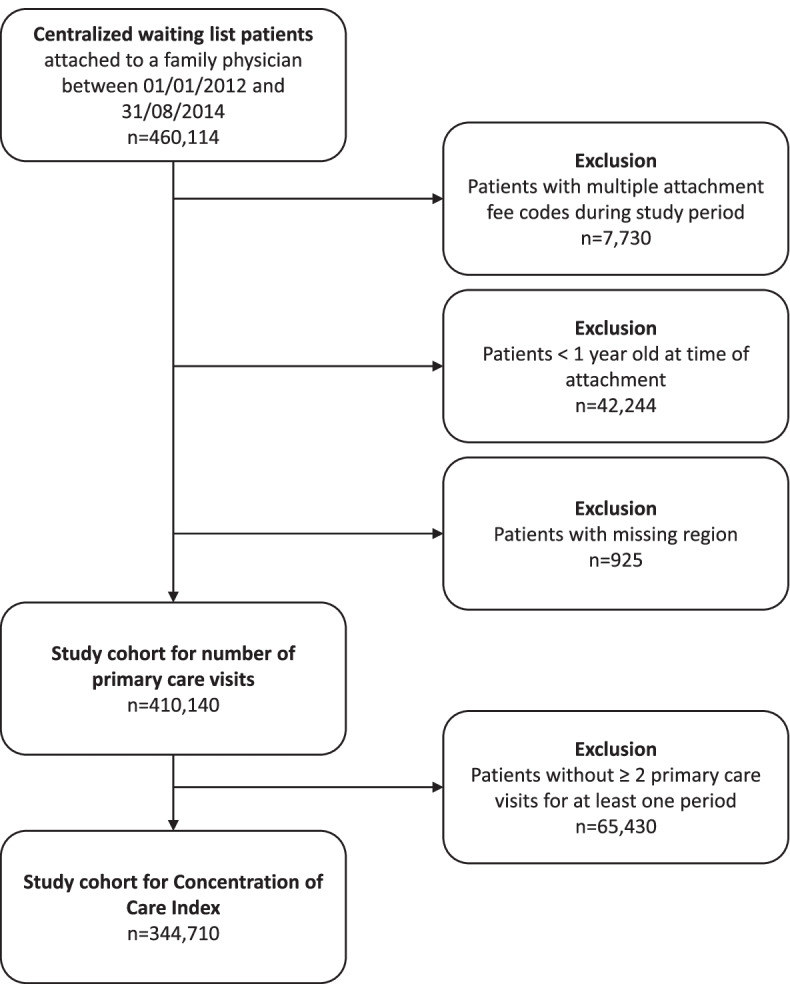
- The cohort included 410,140 patients attached through Quebec’s centralized waiting lists between 2012 and 2014; concentration-of-care analyses included 344,710 patients with two or more primary care visits during at least one time period.
Methods
- Observational longitudinal population cohort using Régie de l’Assurance Maladie du Québec (RAMQ) medical services billing data. Patients were attached through centralized waiting lists between January 1, 2012, and August 31, 2014; outcomes were compared across four 12-month periods: T0–2 years, T0–1 year, T0 + 1 year, and T0 + 2 years, with T0–2 years as reference.
- Outcomes were number of primary care visits and the Bice-Boxerman Concentration of Care Index at physician and practice levels, calculated only for patients with at least two primary care visits in a given period. Covariates were age, sex, region remoteness, medical vulnerability, and Charlson Comorbidity Index.
- Generalized estimating equations were used: negative binomial regression for visit counts and binomial logit models for concentration of care. Statistical significance was assessed at p < 0.01 with 99% confidence intervals.
Limitations
- Stated: administrative billing data lacked patient-level characteristics such as immigration status, ethnicity, and socioeconomic status; the large proportion of non-vulnerable patients (52.5–56.9%) may limit generalizability; the Bice-Boxerman index is spuriously high for low users, and excluding low users may introduce selection bias; data covered fee-for-service physician services only, excluding salaried physicians, private sector, and allied health providers; the observational design lacked a control group, and the 2-year follow-up limits causal and longer-term inference.
- Evident: the pre-post design without a control group cannot rule out historical health-system changes or an illness episode accelerating attachment and utilization; concentration of care remains a proxy for relational continuity rather than a direct measure of the patient-provider relationship.
Model-written summary. Check it against the paper before relying on it.
Integrity signals
Registry
Cites
Statistics
Figures
Verification
Claims the paper makes
19 Valid · 0 Not valid · 13 Not checked · 87 Own results and interpretations
The cited sources support only part of this claim — read each source’s verdict below.
In the paper
“Previous studies compare patients with and without a regular family physician, but these groups have different characteristics that may influence and bias results [5, 7, 10, 19, 22–26].”
§ Improved access to and continuity of primary care after attachment to a family physician: longitudinal cohort study on centralized waiting lists for unattached patients in Quebec, Canada > Background
What the sources say
- Not checked — no full text of the sourcecites [5] McRae I Yen L Gillespie J Douglas K Patient affiliation with GPs in Australia—who is and who is not and does it matter? Health Policy 2011 103 1 16 23 10.1016/j.healthpol.2010.09.002 20888058 source
- Supportedcites [7] Hay C Pacey M Bains N Ardal S Understanding the unattached population in Ontario: evidence from the primary care access survey (PCAS) Healthcare Policy 2010 6 2 33 22043222 PMC3016634 source
The Discussion and Conclusion (page not available in our copy) says patients with and without family doctors differ in demographic characteristics and health status. It also cautions that lower routine-care use among unattached patients may reflect their younger age and better health rather than lack of access alone, supporting the claim that such differences may influence comparisons. (LLM, conf=0.88)
- Supportedcites [10] Fung CS Wong CK Fong DY Lee A Lam CL Having a family doctor was associated with lower utilization of hospital-based health services BMC Health Serv Res 2015 15 1 1 9 10.1186/s12913-015-0705-7 25627936 PMC4312460 source
The Method section defines groups with a regular family doctor and with no regular doctor, which the study compares. The Results report differences in age, sex, and income between those groups; the Results note adjustment for potential confounders, and the Limitations discuss possible bias in between-group differences. (LLM, conf=0.90)
- Not checked — no full text of the sourcecites [19] Awe OA Okpalauwaekwe U Lawal AK Ilesanmi MM Feng C Farag M Association between patient attachment to a regular doctor and self-perceived unmet health care needs in Canada: a population-based analysis of the 2013 to 2014 Canadian community health surveys Int J Health Plann Manag 2019 34 1 309 323 10.1002/hpm.2632 30156709 source
- Not checked — no full text of the sourcecites [22] Mathews M Edwards AC Having a regular doctor: rural, semi-urban and urban differences in Newfoundland Can J Rural Med 2004 9 3 166 15603689
- Not checked — no full text of the sourcecites [23] Jatrana S Crampton P Affiliation with a primary care provider in New Zealand: who is, who isn’t Health Policy 2009 91 3 286 296 10.1016/j.healthpol.2008.12.015 19201046 source
- Not checked — no full text of the sourcecites [24] Mian O Pong R Does better access to FPs decrease the likelihood of emergency department use?: results from the primary care access survey Can Fam Physician 2012 58 11 e658 ee66 23152473 PMC3498040
- Not checked — no full text of the sourcecites [25] Palmer E Leblanc-Duchin D Murray J Atkinson P Emergency department use: is frequent use associated with a lack of primary care provider? Can Fam Physician 2014 60 4 e223 e2e9 24733342 PMC4046533
- Partly supportedcites [26] Ionescu-Ittu R McCusker J Ciampi A Vadeboncoeur A-M Roberge D Larouche D Continuity of primary care and emergency department utilization among elderly people Can Med Assoc J 2007 177 11 1362 1368 10.1503/cmaj.061615 18025427 PMC2072991 sourceExperimental — accuracy not yet measured
The Study population section compares patients with and without a primary physician and reports different median numbers of primary care visits. The Measures section says combining comorbidity indices may reduce confounding bias. The paper does not specifically say that earlier studies comparing these groups were biased by differences in their characteristics. (LLM, conf=0.78)
hedgedstates a possible cause- Asserted: passes — The authors put it forward as true.
- Checkable: passes — It can be checked against evidence.
- Load-bearing: passes — The paper’s conclusions depend on it.
- Based: passes — The paper gives a reason why it holds.
The cited sources support only part of this claim — read each source’s verdict below.
In the paper
“Several studies have examined specific primary care models that attach patients, making it difficult to disentangle the effect attributable to attachment from other features of these delivery models (e.g. team-based care, after-hours care) [37–41].”
§ Improved access to and continuity of primary care after attachment to a family physician: longitudinal cohort study on centralized waiting lists for unattached patients in Quebec, Canada > Background
What the sources say
- Supportedcites [37] Singh J, Dahrouge S, Green M. The impact of the adoption of a patient rostering model on primary care access and continuity of care in urban family practices in Ontario, Canada. BMC Fam Pract. 2019;20(52):1–14. PMC6474046 30999868 source
The Background says earlier studies compared enrolment models but did not disentangle the effect of patient rostering from a change in remuneration. The Strengths and limitations section says this study’s design allowed it to examine rostering separately from a change to capitation payment. These passages support the citing sentence’s general point that other model features can obscure the effect of attachment. (LLM, conf=0.88)
- Partly supportedcites [38] Tiagi R Chechulin Y The effect of rostering with a patient enrolment model on emergency department utilization Healthc Policy 2014 9 4 105 121 24973487 PMC4749888 sourceExperimental — accuracy not yet measured
Our copy clearly supplies the first half of the attributed point: Tiagi and Chechulin (2014) is a study of a specific patient-attaching delivery model (Ontario PEMs), and it treats the model as a bundle — the Résumé (p. 3) lists 'continuity of primary care or improved primary care access with after-hours care - all features of PEMs', the Discussion (p. 13) notes rostered patients also gain after-hours and telephone-advisory access, and the difference-in-difference interaction term is defined as 'the intervention (enrolment with PEM) effect' (Methodology, p. 6), i.e. an estimate for the model as a whole rather than attachment in isolation. But the paper nowhere states that such studies make it difficult to disentangle the attachment effect from other model features: its stated limitations concern patient selection/cream-skimming and the absence of ACG/DGG risk adjusters (Methodology p. 7; Discussion p. 14), and its criticism of earlier work is that it was cross-sectional or single-ED questionnaire-based (Résumé p. 4). It even attributes its 3.5% reduction to rostering/continuity itself (Discussion pp. 13-14). The 'difficult to disentangle' characterization is therefore not this source's claim. (LLM, conf=0.62)
- Supportedcites [39] McAlister FA Bakal JA Green L Bahler B Lewanczuk R The effect of provider affiliation with a primary care network on emergency department visits and hospital admissions Can Med Assoc J 2018 190 10 E276 EE84 10.1503/cmaj.170385 29530868 PMC5849446 source
The Results describe patients on primary care network rosters, compared with patients receiving conventional primary care. The Limitations state that the study could not assess the incremental benefits of particular care elements, supporting the point that it cannot isolate the effect of attachment from other features of the model. (LLM, conf=0.87)
- Supportedcites [40] Héroux J Moodie EE Strumpf E Coyle N Tousignant P Diop M Marginal structural models for skewed outcomes: identifying causal relationships in health care utilization Stat Med 2014 33 7 1205 1221 10.1002/sim.6020 24167024 PMC5340564 source
The Introduction identifies this as a study of patient registration in Québec Family Medicine Groups, and §3.1 describes those groups as physicians working with clinical and administrative staff to care for registered patients. The paper therefore serves as an example of a study examining attachment within a broader primary care model; the difficulty of separating the model’s features is the citing authors’ framing. (LLM, conf=0.86)
- Not checked — no full text of the sourcecites [41] Carter R Lévesque JF Harper S Quesnel-Vallée A Measuring the effect of family medicine group enrolment on avoidable visits to emergency departments by patients with diabetes in Quebec, Canada J Eval Clin Pract 2017 23 2 369 376 10.1111/jep.12627 27578689 source
plain- Asserted: passes — The authors put it forward as true.
- Checkable: passes — It can be checked against evidence.
- Load-bearing: passes — The paper’s conclusions depend on it.
- Based: passes — The paper gives a reason why it holds.
- Supported
Every source the paper cites for this claim was checked and supports it.
In the paper
“This large proportion of healthy patients attached through the centralized waiting lists is slightly lower than reported in a previous study (about 70% non-vulnerable patients attached through centralized waiting lists) [44].”
§ Improved access to and continuity of primary care after attachment to a family physician: longitudinal cohort study on centralized waiting lists for unattached patients in Quebec, Canada > Discussion > Strengths and limitations
What the sources say
- Supportedcites [44] Breton M Brousselle A Boivin A Roberge D Pineault R Berbiche D Who gets a family physician through centralized waiting lists? BMC Fam Pract 2015 16 1 10 10.1186/s12875-014-0220-7 25649074 PMC4328670 source
The Abstract Results report that, after the financial-incentive changes, 70% of patients enrolled with a family physician through centralized waiting lists were non-vulnerable. The comparison that the citing study’s proportion was slightly lower is the citing authors’ own finding, not a finding attributed to this source. (LLM, conf=0.94)
plain- Asserted: passes — The authors put it forward as true.
- Checkable: passes — It can be checked against evidence.
- Load-bearing: unclear — It is unclear whether the paper’s conclusions depend on it.
- Based: passes — The paper gives a reason why it holds.
- Supported
Every source the paper cites for this claim was checked and supports it.
In the paper
“This difference is likely due to the time period included in the previous study during which centralized waiting lists policies were more conducive to cherry-picking by family physicians [44].”
§ Improved access to and continuity of primary care after attachment to a family physician: longitudinal cohort study on centralized waiting lists for unattached patients in Quebec, Canada > Discussion > Strengths and limitations
What the sources say
- Supportedcites [44] Breton M Brousselle A Boivin A Roberge D Pineault R Berbiche D Who gets a family physician through centralized waiting lists? BMC Fam Pract 2015 16 1 10 10.1186/s12875-014-0220-7 25649074 PMC4328670 source
The Background identifies the 2011 policy change that introduced incentives for enrolling non-vulnerable patients. The Results report that, after the change, 70% of enrolled patients were non-vulnerable and most were referred by the enrolling physician without waiting according to priority; the Conclusion describes this as potentially opportunistic use of insufficiently regulated incentives. The explanation for the difference between studies is the citing authors’ inference, while this paper supports the policy-period and cherry-picking premise. (LLM, conf=0.87)
hedgedstates a possible cause- Asserted: passes — The authors put it forward as true.
- Checkable: passes — It can be checked against evidence.
- Load-bearing: unclear — It is unclear whether the paper’s conclusions depend on it.
- Based: passes — The paper gives a reason why it holds.
- Supported
A result the paper reports from its own data — it cites no other source for it, so there is none to check. The quote shows it is in the paper.
In the paper
“The average increase between T0–2 years and T0 + 1 year was 1.66 visits”
§ Improved access to and continuity of primary care after attachment to a family physician: longitudinal cohort study on centralized waiting lists for unattached patients in Quebec, Canada > Results > Number of primary care visits
plainstates a cause- Asserted: passes — The authors put it forward as true.
- Checkable: passes — It can be checked against evidence.
- Load-bearing: passes — The paper’s conclusions depend on it.
- Based: passes — The paper gives a reason why it holds.
51 more claims
Create a free account to see all 119 claims and to verify the 9 references still open.
- It may state two separate claims as one. 35
- Probably not a substantial claim. 34
Self-check
Percentages, sums and reported differences re-computed from the paper’s own numbers.
Each contradiction between two passages listed here was confirmed by an independent check.
Rated minor: it would not touch a result — a value no result rests on, a p-value that stays on the same side of the significance level, or a conflict that is clerical, resolved elsewhere in the paper, or outside its own findings.
In the paper
“For concentration of care, the average age was 46.5 years (s.d. 22.7), 64.0% were female, 52.5% were non-vulnerable, 60.0% had a low comorbidity index and 36.3% resided in a region with a university center.”
§ Improved access to and continuity of primary care after attachment to a family physician: longitudinal cohort study on centralized waiting lists for unattached patients in Quebec, Canada > Results > Patient characteristics
Reported 64 · recomputed 53.990715
Rated minor: it would not touch a result — a value no result rests on, a p-value that stays on the same side of the significance level, or a conflict that is clerical, resolved elsewhere in the paper, or outside its own findings.
In the paper
§ Improved access to and continuity of primary care after attachment to a family physician: longitudinal cohort study on centralized waiting lists for unattached patients in Quebec, Canada > Results > Bice-Boxerman concentration of care index
“Before attachment, only 38% of the cohort had a minimum of two primary visits (T0–2 years: n = 155,086/406,101; T0–1 year: n = 156,760/410,140).”
§ Improved access to and continuity of primary care after attachment to a family physician: longitudinal cohort study on centralized waiting lists for unattached patients in Quebec, Canada > Results > Number of primary care visits
“| na | 406,001 | 410,140 | 410,140 | 320,428 |”
Citations
Cites
Charlson, M. E., Pompei, P., Ales, K. L., & MacKenzie, C. R. (1987) · Journal of Chronic Diseases · doi:10.1016/0021-9681(87)90171-8 · Cited by 49,742 · cited 9×
“We adjusted for age, sex, region remoteness, Charlson Comorbidity Index and medical vulnerability.”
MethodInfluentialRevisiting the Behavioral Model and Access to Medical Care: Does it Matter?
Andersen, R. M. (1995) · Journal of Health and Social Behavior · doi:10.2307/2137284 · Cited by 9,831
Vandenbroucke, J. P., von Elm, E., Altman, D. G., Gøtzsche, P. C., Mulrow, C. D., Pocock, S. J., Poole, C., Schlesselman, J. J., Egger, M., & Initiative, F. T. S. (2007) · PLoS Medicine · doi:10.1371/journal.pmed.0040297 · Cited by 8,613 · cited 1×
“This study is reported in accordance with the Strengthening the Reporting of Observational Studies in Epidemiology (STROBE) guidelines [56] (see Appendix 1 for checklist).”
MethodValidation of a combined comorbidity index
Charlson, M., Szatrowski, T. P., Peterson, J., & Gold, J. (1994) · Journal of Clinical Epidemiology · doi:10.1016/0895-4356(94)90129-5 · Cited by 6,587 · cited 9×
“We adjusted for age, sex, region remoteness, Charlson Comorbidity Index and medical vulnerability.”
MethodInfluentialContribution of Primary Care to Health Systems and Health
STARFIELD, B., SHI, L., & MACINKO, J. (2005) · The Milbank Quarterly · doi:10.1111/j.1468-0009.2005.00409.x · Cited by 5,507
Canadian Institute for Health Information.
Lalonde, A. (1994) · PubMed · Cited by 4,744
Societal and Individual Determinants of Medical Care Utilization in the United States
ANDERSEN, R., & NEWMAN, J. F. (2005) · The Milbank Quarterly · doi:10.1111/j.1468-0009.2005.00428.x · Cited by 3,611
A framework for the study of access to medical care.
(1974) · PubMed Central · Cited by 2,419
Continuity of care: a multidisciplinary review
Haggerty, J. L., Reid, R. J., Freeman, G. K., Starfield, B. H., Adair, C. E., & McKendry, R. (2003) · BMJ · doi:10.1136/bmj.327.7425.1219 · Cited by 2,374 · cited 2×
“It also suggests a post-attachment improvement in the concentration of care with a single provider, which may support better relational continuity [54, 74].”
BackgroundSelf-citationMultilevel Analysis: Techniques and Applications
Hox, J. J., Moerbeek, M., & van de Schoot, R. (2017) · Routledge eBooks · doi:10.4324/9781315650982 · Cited by 1,671
Charlson, M. E., Charlson, R. E., Peterson, J. C., Marinopoulos, S. S., Briggs, W. M., & Hollenberg, J. P. (2008) · Journal of Clinical Epidemiology · doi:10.1016/j.jclinepi.2008.01.006 · Cited by 894 · cited 1×
“mortality, but has also been used to predict utilization and provides an assessment disease complexity and burden in administrative data [67, 68].”
MethodThe Patient-Centered Medical Home: A Systematic Review
Jackson, G. L., Powers, B. J., Chatterjee, R., Prvu Bettger, J., Kemper, A. R., Hasselblad, V., Dolor, R. J., Irvine, R. J., Heidenfelder, B. L., Kendrick, A. S., et al. (2013) · Annals of Internal Medicine · doi:10.7326/0003-4819-158-3-201302050-00579 · Cited by 699
The association between continuity of care and outcomes: a systematic and critical review
Van Walraven, C., Oake, N., Jennings, A., & Forster, A. J. (2010) · Journal of Evaluation in Clinical Practice · doi:10.1111/j.1365-2753.2009.01235.x · Cited by 644 · cited 2×
“For the Bice-Boxerman Concentration of Care Index models, we initially attempted to model the continuous form of the index, which ranges between 0 (total dispersion) and 1 (total concentration), because incremental changes have been shown to be clinically meaningful [11].”
BackgroundMethodA Quantitative Measure of Continuity of Care
Bice, T. W., & Boxerman, S. B. (1977) · Medical Care · doi:10.1097/00005650-197704000-00010 · Cited by 529 · cited 11×
“In contrast, in the first post-attachment year, 73% of our cohort had at least two primary care visits (n = 299,594/410,140), the average COCI increased to 0.72, 59% of patients had all their care concentrated with a single physician and only 10% had totally dispersed care.”
MethodInfluentialThe 10 Building Blocks of High-Performing Primary Care
Bodenheimer, T., Ghorob, A., Willard-Grace, R., & Grumbach, K. (2014) · The Annals of Family Medicine · doi:10.1370/afm.1616 · Cited by 496 · cited 2×
“Internationally, attachment is increasingly widespread as a building block of primary care [30, 31].”
BackgroundDunlop, S., Coyte, P. C., & McIsaac, W. (2000) · Social Science & Medicine · doi:10.1016/s0277-9536(99)00424-4 · Cited by 483
Review of Software to Fit Generalized Estimating Equation Regression Models
Horton, N. J., & Lipsitz, S. R. (1999) · The American Statistician · doi:10.1080/00031305.1999.10474451 · Cited by 387 · cited 1×
“Robust (Huber-White sandwich) estimators were used given departure from normality and large sample size [69, 70].”
Method(2001) · PubMed · Cited by 382
Sandvik, H., Hetlevik, Ø., Blinkenberg, J., & Hunskaar, S. (2022) · British Journal of General Practice · doi:10.3399/bjgp.2021.0340 · Cited by 333
Primary medical care continuity and patient mortality: a systematic review
Baker, R., Freeman, G. K., Haggerty, J. L., Bankart, M. J., & Nockels, K. H. (2020) · British Journal of General Practice · doi:10.3399/bjgp20x712289 · Cited by 331
Self-citationMultilevel Modeling of Categorical Outcomes Using IBM SPSS
Heck, R. H., Thomas, S., & Tabata, L. (2013) · doi:10.4324/9780203808986 · Cited by 316 · cited 3×
“To take into account the correlation between repeated measures for a given individual in the outcome variables, we used generalized estimating equations (GEEs) which provide population-average regression coefficients [69].”
BackgroundMethodPopulation-based Cohort Studies
Szklo, M. (1998) · Epidemiologic Reviews · doi:10.1093/oxfordjournals.epirev.a017974 · Cited by 297 · cited 1×
“Study design and population We conducted an observational longitudinal population cohort study [55] of patients attached to a family physician through centralized waiting lists for unattached patients in Quebec between January 1st 2010 and August 31st 2015.”
MethodContinuity of primary care and emergency department utilization among elderly people
Ionescu-Ittu, R., McCusker, J., Ciampi, A., Vadeboncoeur, A.-M., Roberge, D., Larouche, D., Verdon, J., & Pineault, R. (2007) · Canadian Medical Association Journal · doi:10.1503/cmaj.061615 · Cited by 290
The Effects of Having a Regular Doctor on Access to Primary Care
LAMBREW, J. M., DEFRIESE, G. H., CAREY, T. S., RICKETTS, T. C., & BIDDLE, A. K. (1996) · Medical Care · doi:10.1097/00005650-199602000-00006 · Cited by 274 · cited 1×
“While continuity is desirable at both physician and practice level, previous studies have found that having a regular primary care provider, as opposed to only having a usual source of care or regular practice, is associated with more preventive care [75, 76], better chronic disease and medication management [77], and…”
BackgroundWhen a Usual Source of Care and Usual Provider Matter: Adult Prevention and Screening Services
Blewett, L. A., Johnson, P. J., Lee, B., & Scal, P. B. (2008) · Journal of General Internal Medicine · doi:10.1007/s11606-008-0659-0 · Cited by 195 · cited 1×
“While continuity is desirable at both physician and practice level, previous studies have found that having a regular primary care provider, as opposed to only having a usual source of care or regular practice, is associated with more preventive care [75, 76], better chronic disease and medication management [77], and…”
BackgroundAn exploration of the value of the personal doctor-patient relationship in general practice.
(2001) · Europe PMC (PubMed Central) · Cited by 195
Usual Source of Care in Preventive Service Use: A Regular Doctor versus a Regular Site
Xu, K. T. (2002) · Health Services Research · doi:10.1111/1475-6773.10524 · Cited by 165 · cited 1×
“While continuity is desirable at both physician and practice level, previous studies have found that having a regular primary care provider, as opposed to only having a usual source of care or regular practice, is associated with more preventive care [75, 76], better chronic disease and medication management [77], and…”
BackgroundSandvik, H., Hetlevik, Ø., Blinkenberg, J., et al. (2022) · NORA - Norwegian Open Research Archives · Cited by 132
Experiencing Difficulties Accessing First-Contact Health Services in Canada
Sanmartin, C., & Ross, N. (2006) · Healthcare Policy | Politiques de Santé · doi:10.12927/hcpol.2006.17882 · Cited by 122
Does Continuity of Care Matter in a Universally Insured Population?
Menec, V. H., Sirski, M., & Attawar, D. (2005) · Health Services Research · doi:10.1111/j.1475-6773.2005.0p364.x · Cited by 110
Does having regular care by a family physician improve preventive care?
(2001) · PubMed Central · Cited by 99
Does continuity of care matter in a universally insured population?
Menec, V. H., Sirski, M., & Attawar, D. (2005) · PubMed · doi:10.1111/j.1475-6773.2005.00363.x · Cited by 96
Predictors of relational continuity in primary care: patient, provider and practice factors
Kristjansson, E., Hogg, W., Dahrouge, S., Tuna, M., Mayo-Bruinsma, L., & Gebremichael, G. (2013) · BMC Family Practice · doi:10.1186/1471-2296-14-72 · Cited by 91 · cited 1×
“Younger patients, male patients, patients from rural areas and patients with fewer chronic diseases have been shown to have lower relational continuity [94, 95].”
BackgroundAnalyzing Proportion Scores as Outcomes for Prevention Trials: a Statistical Primer
Chen, K., Cheng, Y., Berkout, O. V., & Lindhiem, O. J. (2016) · Prevention Science · doi:10.1007/s11121-016-0643-6 · Cited by 88 · cited 1×
“Binomial models are appropriate to model proportion data bounded between 0 and 1 [72].”
Factors predicting patient use of the emergency department: a retrospective cohort study
McCusker, J., Tousignant, P., Silva, R. B. D., Ciampi, A., Lévesque, J.-F., Vadeboncoeur, A., & Sanche, S. (2012) · Canadian Medical Association Journal · doi:10.1503/cmaj.111069 · Cited by 87
Moineddin, R., Meaney, C., Agha, M., Zagorski, B., & Glazier, R. H. (2011) · BMC Emergency Medicine · doi:10.1186/1471-227x-11-13 · Cited by 85 · cited 1×
“This may be due to lack of timely access to primary care even when patients have a regular family physician, and to a preference for timely access for minor health needs over seeing their regular provider [24, 92, 93].”
BackgroundStrumpf, E., Ammi, M., Diop, M., Fiset-Laniel, J., & Tousignant, P. (2017) · Journal of Health Economics · doi:10.1016/j.jhealeco.2017.06.009 · Cited by 82 · cited 1×
“This pattern may also be consistent with an episode of illness, which could have accelerated attachment through the centralized waiting lists’ prioritization process and would explain increase in utilization [49, 96].”
BackgroundBreton, M., Smithman, M. A., Brousselle, A., Loignon, C., Touati, N., Dubois, C.-A., Nour, K., Boivin, A., Berbiche, D., & Roberge, D. (2017) · BMC Family Practice · doi:10.1186/s12875-016-0573-1 · Cited by 80 · cited 2×
“However, a number of challenges remain, including large regional variations [45], long wait times (over 500 days on average), physicians’ preference for attaching healthy patients [44, 46], and inequities in attachment for patients from disadvantaged areas or with complex needs [44, 47–49].”
BackgroundResultSelf-citationEmergency Department Visits and Primary Care Among Adults With Chronic Conditions
McCusker, J., Roberge, D., Lévesque, J.-F., Ciampi, A., Vadeboncoeur, A., Larouche, D., & Sanche, S. (2010) · Medical Care · doi:10.1097/mlr.0b013e3181eaf86d · Cited by 75
Continuity of GP care for patients with dementia: Impact on prescribing and the health of patients
Delgado, J., Evans, P. H., Gray, D. P., Sidaway-Lee, K., Allan, L., Clare, L., Ballard, C., Masoli, J., Valderas, J. M., & Melzer, D. (2022) · British Journal of General Practice · doi:10.3399/bjgp.2021.0413 · Cited by 70
Emergency Department Utilization by Noninstitutionalized Elders
Shah, M. N., Rathouz, P. J., & Chin, M. H. (2001) · Academic Emergency Medicine · doi:10.1111/j.1553-2712.2001.tb01303.x · Cited by 66 · cited 1×
“mortality, but has also been used to predict utilization and provides an assessment disease complexity and burden in administrative data [67, 68].”
MethodHay, C., Pacey, M., Bains, N., & Ardal, S. (2010) · Healthcare Policy | Politiques de Santé · doi:10.12927/hcpol.2010.22033 · Cited by 61
Having a family doctor was associated with lower utilization of hospital-based health services
Fung, C. S., Wong, C. K., Fong, D. Y., Lee, A., & Lam, C. L. (2015) · BMC Health Services Research · doi:10.1186/s12913-015-0705-7 · Cited by 59
Kohnke, H., & Zielinski, A. (2017) · Scandinavian Journal of Primary Health Care · doi:10.1080/02813432.2017.1333303 · Cited by 58
Impact of relational continuity of primary care in aged care: a systematic review
Dyer, S. M., Suen, J., Williams, H., Inacio, M. C., Harvey, G., Roder, D., Wesselingh, S., Kellie, A., Crotty, M., & Caughey, G. E. (2022) · BMC Geriatrics · doi:10.1186/s12877-022-03131-2 · Cited by 56
Alignment of Canadian Primary Care With the Patient Medical Home Model: A QUALICO-PC Study
Katz, A., Herpai, N., Smith, G. A., Aubrey‐Bassler, K., Breton, M., Boivin, A., Hogg, W., Miedema, B. B., Pang, J., Wodchis, W. P., et al. (2017) · The Annals of Family Medicine · doi:10.1370/afm.2059 · Cited by 53
Self-citationEmergency department use: is frequent use associated with a lack of primary care provider?
(2014) · Europe PMC (PubMed Central) · Cited by 52
McAlister, F. A., Bakal, J. A., Green, L., Bahler, B., & Lewanczuk, R. (2018) · Canadian Medical Association Journal · doi:10.1503/cmaj.170385 · Cited by 52
Marchildon, G. P., Brammli‐Greenberg, S., Dayan, M., de Belvis, A. G., Gandré, C., Isaksson, D., Kroneman, M. W., Neuner‐Jehle, S., Saunes, I. S., Thomas, S., et al. (2021) · Health Policy · doi:10.1016/j.healthpol.2021.09.001 · Cited by 51 · cited 4×
“Andersen R, Newman JF. Societal and individual determinants of medical care utilization in the United States.”
BackgroundInfluentialCrooks, V. A., Agarwal, G., & Harrison, A. (2012) · BMC Family Practice · doi:10.1186/1471-2296-13-69 · Cited by 50 · cited 1×
“This may be due to unattached patients having a regular source of care, such as a walk-in clinic, despite not having a regular family physician [2, 73].”
BackgroundEmpanelment: A foundational component of primary health care
Bearden, T., Ratcliffe, H. L., Sugarman, J. R., Bitton, A., Anaman, L. A., Buckle, G., Cham, M., Chong, D. W.-Q., Ismail, F., Badarch, J., et al. (2019) · Gates Open Research · doi:10.12688/gatesopenres.13059.1 · Cited by 46 · cited 3×
“Andersen R, Newman JF. Societal and individual determinants of medical care utilization in the United States.”
BackgroundBreton, M., Wong, S. T., Smithman, M. A., Kreindler, S. A., Jbilou, J., Marshall, E. G., Sutherland, J. M., Brousselle, A., Shaw, J., Crooks, V. A., et al. (2018) · Healthcare policy · doi:10.12927/hcpol.2018.25555 · Cited by 44
Self-citation(2012) · PubMed Central · Cited by 40
How are different types of continuity achieved? A mixed methods longitudinal study.
(2006) · PubMed Central · Cited by 38
The Continuing Saga of Emergency Room Overcrowding: Are We Aiming at the Right Target?
Roberge, D., Pineault, R., Larouche, D., & Poirier, L.-R. (2010) · Healthcare policy · doi:10.12927/hcpol.2013.21637 · Cited by 35
Singh, J., Dahrouge, S., & Green, M. E. (2019) · BMC Family Practice · doi:10.1186/s12875-019-0942-7 · Cited by 34 · cited 2×
“However, the decrease observed in Ontario may be due to the transition to a team-based structure in which physicians are encouraged to see their colleagues’ attached patients [37].”
BackgroundResultWho gets a family physician through centralized waiting lists?
Breton, M., Brousselle, A., Boivin, A., Roberge, D., Pineault, R., & Berbiche, D. (2015) · BMC Family Practice · doi:10.1186/s12875-014-0220-7 · Cited by 30 · cited 5×
“It is possible that during early implementation, attachment policies mainly formalized pre-existing informal relationships between providers and patients, and may not have benefited patients without a regular provider or usual source of care [42, 44].”
BackgroundResultSelf-citationBreton, M., Smithman, M. A., Sasseville, M., Kreindler, S. A., Sutherland, J. M., Beauséjour, M., Green, M., Marshall, E. G., Jbilou, J., Shaw, J., et al. (2020) · Health Policy · doi:10.1016/j.healthpol.2020.05.023 · Cited by 30 · cited 4×
“Advanced access is increasingly widespread in Quebec and has shown promising results to improve access to and continuity with family physicians and other primary care providers [82].”
BackgroundSelf-citationSmithman, M. A., Brousselle, A., Touati, N., Boivin, A., Nour, K., Dubois, C.-A., Loignon, C., Berbiche, D., & Breton, M. (2018) · International Journal for Equity in Health · doi:10.1186/s12939-018-0887-9 · Cited by 29 · cited 1×
“Other studies conducted during our study period have similar proportions of non-vulnerable attached patients (54–60%) [45, 47].”
ResultSelf-citation(2011) · PubMed · Cited by 28
Patient affiliation with GPs in Australia—Who is and who is not and does it matter?
McRae, I., Yen, L., Gillespie, J., & Douglas, K. (2011) · Health Policy · doi:10.1016/j.healthpol.2010.09.002 · Cited by 26
Does Having a Personal Physician Improve Quality of Care in Diabetes?
Hueston, W. J. (2010) · The Journal of the American Board of Family Medicine · doi:10.3122/jabfm.2010.01.090102 · Cited by 26 · cited 1×
“While continuity is desirable at both physician and practice level, previous studies have found that having a regular primary care provider, as opposed to only having a usual source of care or regular practice, is associated with more preventive care [75, 76], better chronic disease and medication management [77], and…”
BackgroundProviding continuity of care to a specific population: Attracting new family physicians.
Roy, A., Breton, M., & Loslier, J. (2016) · PubMed · Cited by 23
Self-citationHéroux, J., Moodie, E. E. M., Strumpf, E., Coyle, N., Tousignant, P., & Diop, M. (2014) · Statistics in Medicine · doi:10.1002/sim.6020 · Cited by 22
Awe, O. A., Okpalauwaekwe, U., Lawal, A. K., Ilesanmi, M. M., Feng, C., & Farag, M. (2019) · The International Journal of Health Planning and Management · doi:10.1002/hpm.2632 · Cited by 22
A new primary care rostering and capitation system in Norway: lessons for Canada?
Østbye, T., & Hunskaar, S. (1997) · PubMed · Cited by 20
(2011) · PubMed · Cited by 18
Randall, E., Crooks, V. A., & Goldsmith, L. J. (2012) · BMC Family Practice · doi:10.1186/1471-2296-13-125 · Cited by 18
The Effect of Rostering with a Patient Enrolment Model on Emergency Department Utilization
Tiagi, R., & Chechulin, Y. (2014) · Healthcare Policy | Politiques de Santé · doi:10.12927/hcpol.2014.23809 · Cited by 18
Patient Empanelment: The Importance of Understanding Who Is at Home in the Medical Home
Grumbach, K., & Olayiwola, J. N. (2015) · The Journal of the American Board of Family Medicine · doi:10.3122/jabfm.2015.02.150011 · Cited by 17 · cited 3×
“Andersen R, Newman JF. Societal and individual determinants of medical care utilization in the United States.”
BackgroundAccess to family physicians in southwestern ontario.
(2009) · PubMed Central · Cited by 17
Lavergne, M. R., King, C., Peterson, S., Simon, L., Hudon, C., Loignon, C., McCracken, R. K., Brackett, A., McGrail, K., & Strumpf, E. (2022) · CMAJ Open · doi:10.9778/cmajo.20210043 · Cited by 15 · cited 2×
“The voluntary nature of attachment policies and “cherry-picking” of healthier patients may limit their populational impact [42, 49].”
BackgroundAffiliation with a primary care provider in New Zealand: Who is, who isn’t
Jatrana, S., & Crampton, P. (2009) · Health Policy · doi:10.1016/j.healthpol.2008.12.015 · Cited by 14
Metusela, C., Dijkmans-Hadley, B. R., Mullan, J., Gow, A. R., & Bonney, A. D. (2021) · BMC Family Practice · doi:10.1186/s12875-021-01485-x · Cited by 14
(2004) · PubMed · Cited by 11
Carter, R., Lévesque, J., Harper, S., & Quesnel‐Vallée, A. (2017) · Journal of Evaluation in Clinical Practice · doi:10.1111/jep.12627 · Cited by 10
Malham, S. A., Smithman, M.-A., Touati, N., Brousselle, A., Loignon, C., Dubois, C.-A., Nour, K., Boivin, A., & Breton, M. (2019) · Journal of Health Organization and Management · doi:10.1108/jhom-10-2018-0303 · Cited by 9 · cited 1×
“Available family physicians then make a request for new patients, generally indicating the number of patients they are willing to attach and sometimes preferences for types of patients [48].”
BackgroundSelf-citationCollége des Médecins de Famille du Canada
Rice, D. I. (1970) · Europe PMC (PubMed Central) · Cited by 8
Improving Access to Family Medicine in Quebec through Quotas and Numerical Targets
McGill University, Lee, G. E., Quesnel-Vallée, A., & McGill University (2019) · Health Reform Observer - Observatoire des Réformes de Santé · doi:10.13162/hro-ors.v7i4.3886 · Cited by 8
Research works printed but not linked: 8
- Kalucy L Katterl R Jackson-Bowers E Hordacre A-L Models of patient enrolment. PHCRIS policy issue review 2009 Adelaide Primary Health Care Research Information Service
- Borges Da Silva R Fiset-Laniel J Hazra A Strumpf E Analyse d'une politique de santé visatn l'amélioration de l'accès à un médecin de famille - Les guichets d'accès pour la clientèle orpheline au Québec 2015 Montréal CIRANO
- Contandriopoulos D Brousselle A Breton M Duhoux A Hudon C Vadeboncoeur A Analyse des impacts de la rémunération des médecins sur leur pratique et la performance du système de santé au Québec 2018
- Clavet M Pelletier G Saucier A Martin P Regards sur le système de santé et des services sociaux du Québec Ministère de la santé et des services sociaux 2009
- Reid RJ Haggerty J McKendry R Defusing the confusion: concepts and measures of continuity of healthcare 2002
- Manitoba Centre for Health Policy Concept: Measuring Continuity of Care (Continuity of Care Index) 2020
- Rauscher A What are innovative and collaborative primary care models worldwide 2015 Vancouver General Practice Services Committee
- Roberge D Larouche D Pineault R Levesque JF Hamel M Simard B L'urgence hospitalière: un substitut à la première ligne - Résultats d'une enquête auprès de la population de Montréal et de la Montérégie 2007 Montreal Direction de santé publique de Montréal
Cited by
Féral‐Pierssens, A., Gaboury, I., Carbonnier, C., & Breton, M. (2024) · BMC Emergency Medicine · doi:10.1186/s12873-024-01080-0 · Cited by 22
“[29, 32] For this specific population, the ED might be a way of entering an impervious healthcare system.”
BackgroundMethodSelf-citationDeville‐Stoetzel, N., Gaboury, I., Haggerty, J. L., & Breton, M. (2023) · Healthcare policy · doi:10.12927/hcpol.2023.27091 · Cited by 14
“2021) and continuity (Smithman et al. 2022) and to reduce use of the ER (McCusker et al.”
BackgroundSelf-citationGoff, M., Hindi, A. M. K., Hammond, J., & Jacobs, S. (2025) · BMC Family Practice · doi:10.1186/s12875-025-02860-8 · Cited by 18
“In Canada, many patients remain ‘unattached’ to a pro-vider’s list i.e. unregistered with a care provider [54, 55].”
Kümpel, L., Oslislo, S., Cantu, R. R., Möckel, M., Heintze, C., & Holzinger, F. (2023) · BMJ Open · doi:10.1136/bmjopen-2022-070054 · Cited by 10
Alsaad, S. M., Alajlan, F., Alserhani, R., Alhussaini, N., Alali, N., & Alatawi, S. (2024) · Patient Preference and Adherence · doi:10.2147/ppa.s467844 · Cited by 15
Metadata
- Authors
- Smithman, M. A., Haggerty, J., Gaboury, I., & Breton, M.
- Affiliations
- Université de Sherbrooke (CA)
- McGill University (CA)
- Corresponding author
- Breton, Mylaine
- Venue
- BMC Primary Care
- Published
- 2022-09-16
- Volume
- 23
- Issue
- 1
- Pages
- 238-238
- ISSN
- 1471-2296 (ISSN-L)
- 2731-4553
- PMC
- PMC9482231
- OpenAlex
- W4296163909
- Cited by
- 25
- References
- 85
- Citations by year
- 2026: 7 · 2025: 10 · 2024: 3 · 2023: 5
- FWCI
- 5.16
- Type
- journal article
- Language
- en
- Open access
- gold
- doi.org
- Licence
- cc-by
- creativecommons.org/licenses/by/4.0 (tdm)
- creativecommons.org/licenses/by/4.0 (vor)
- Locations
- BMC Family Practice (publishedVersion, cc-by)
- PubMed Central (publishedVersion, cc-by)
- PubMed (publishedVersion)
- DOAJ (DOAJ: Directory of Open Access Journals) (submittedVersion)
- Funders
- Fonds de Recherche du Québec - Santé (28974)
- Institut universitaire de première ligne en santé et services sociaux
- McGill University
- Canada Research Chairs
- Topics
- Health Sciences › Medicine › Family Practice › Primary Care and Health Outcomes
- Health Sciences › Medicine › Public Health, Environmental and Occupational Health › Healthcare Systems and Technology
- Social Sciences › Economics, Econometrics and Finance › Economics and Econometrics › Healthcare Policy and Management
- Keywords
- primary care access, continuity of care, primary care visits, Quebec
- MeSH terms
- Continuity of Patient Care, Health Services Accessibility, Humans, Longitudinal Studies, Physicians, Family, Primary Health Care, Quebec, Waiting Lists, Cohort Studies
About these checks
Registry, retraction, Cites and statistics results are computed, not judged, with one exception: a printed reference that no index lists is read once by a model before it counts as a citation error. Claims are extracted by a model and kept only when their quote appears verbatim in the text; each cited source is then checked, with a model’s help, for whether it says what the claim relies on. Those verdicts can be wrong — read the claim’s quote and the cited source before relying on one.
The claim verdicts this report counts are experimental: their accuracy is not yet measured.
A language model drew the claims from the paper on 2026-10-10, under version 3 of the claim definition (model deepseek-v4.1-flash, prompt extract-v3).
A second model labelled each claim on 2026-10-10 (model jev-1.13-20260917, definition revision gold-guideline-v0.2).
Cited sources are checked with a language model’s help (gpt-6-sol and qwen3.8-omni-flash).
Statistics and arithmetic are recomputed, not judged.
Confidence bands are shown only for fields calibrated on our annotated test set. None is calibrated yet, so no band is shown.
What counts as a claim ›How we measure confidence ›How we check this ›
Are you an author, or do you see a problem with this page? Request a review
Data sources
Bibliographic data: Semantic Scholar, OpenAlex, Crossref.
Contains information from the Semantic Scholar Academic Graph Datasets, made available under the ODC Attribution License (ODC-BY 1.0).
Semantic Scholar’s data is described in: Kinney, R., et al. (2023). The Semantic Scholar Open Data Platform. arXiv:2301.10140.
