

Perception of providers on use of the WHO mental health Gap Action Programme-Intervention Guide (mhGAP-IG) electronic version and smartphone-based clinical guidance in Nigerian primary care settings
Open accessThe DOI matches its Crossref record; 20 of the 20 references it cites were found in a registry or an index; 28 of the 28 sources its claims cite were checked for support.
Abstract
BACKGROUND: Taking advantage of the rapidly increasing access to digital technology in low- and middle-income countries, the World Health Organization has launched an electronic version of the mental health Gap Action Programme intervention guide (emhGAP-IG). This is suitable for use on smartphones or tablets by non-specialist primary healthcare providers (PHCWs) to deliver evidence-based intervention for priority mental, neurological and substance use disorders. We assessed the perceptions of PHCWs on the feasibility, acceptability, and benefits of using smartphone-based clinical guidance and the emhGAP-IG in the management of people with mental health conditions in Nigeria. METHODS: Exploration of the views of PHCWs from 12 rural and urban primary health clinics (PHCs) in South-Western Nigeria were carried out using 34 in-depth key informant qualitative interviews with nurses (n = 10), community health officers (n = 13) and community health extension workers (n = 11). An additional two focus group discussions, each comprising eight participants drawn from across the range of characteristics of PHCWs, were also conducted. Thematic analysis was conducted using a three-staged constant comparison technique to refine and categorise the data. RESULTS: Three overall themes were identified around the use of clinical guidance and mobile applications (apps) in PHCs. Apps were deployed for purposes other than clinical consultation and decision making. Although paper-based guidance was the expected practice, its utilization is not fully embedded in routine care. An app-based decision-making tool was preferred to paper by PHCWs. Future usage of the emhGAP-IG would be facilitated by training and supporting of staff, helpful design features, and obtaining patients' buy-in. CONCLUSION: Our findings suggest that the emhGAP-IG could be a viable way to embed clinical guidance and decision-making tools in the management of people with mental health conditions in Nigerian PHCs.
Overview
CoChat Summary
TL;DR
This qualitative study explored perceptions of mhGAP-IG-trained primary healthcare workers in 12 Southwestern Nigerian primary health clinics about smartphone-based clinical guidance and the electronic mhGAP-IG. Participants preferred an app-based decision-making tool to paper guidance, but current apps were used mainly for non-clinical tasks and paper mhGAP-IG was not embedded in routine care.
Key findings
- Three overall themes were identified: current practice, future practice, and design suggestions. Apps were deployed for purposes other than clinical consultation and decision making, such as calls, official communication, and collection/transmission of clinical data for surveillance.
- Although paper-based guidance was expected practice, the mhGAP-IG v1.0 and other paper guidelines were not fully embedded in routine care; an app-based decision-making tool was preferred to paper by PHCWs.
- Future use of the emhGAP-IG was seen as facilitated by training and re-training of staff, support and supervision, helpful design features, and obtaining patients’ buy-in by explaining the process and benefits during clinical contact.
- Barriers included busy workloads, patients disliking phone use during consultations, exclusion of some staff such as older staff, those without smartphones, and CHEWs, as well as concerns about phone reliability and reluctance to adopt new ways of working.
Methods
- Qualitative study with 2 focus group discussions, each comprising 8 participants, and 34 semi-structured key informant interviews with nurses (n = 10), community health officers (n = 13), and community health extension workers (n = 11). Participants were purposively selected from 12 primary health clinics in four local government areas in Ibadan, Southwestern Nigeria; sessions were conducted April–August 2019 in Yoruba and English.
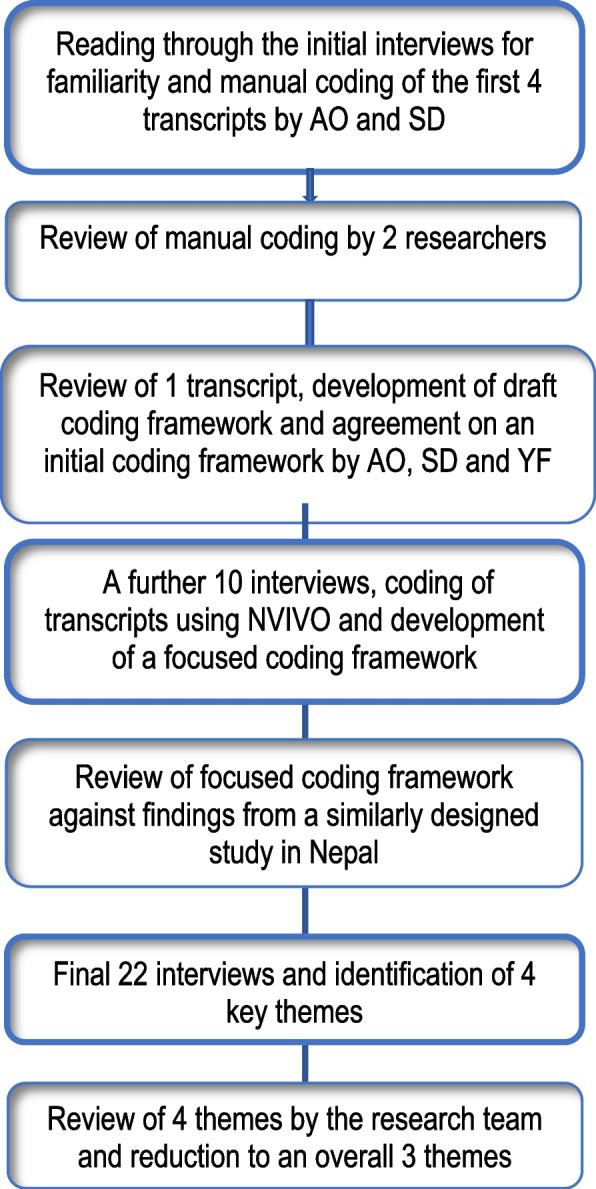
- Thematic analysis used a three-staged constant comparison technique. Transcripts were transcribed verbatim, translated and back-translated, coded manually and with NVivo 10; the final phase included 22 final interviews, from which four key themes were reduced to three overall themes.
Limitations
- Stated in the paper: the study was conducted among staff in 12 PHCs in Southwestern Nigeria, so findings may not be generalisable to all Nigerian primary health care settings.
- Evident from the text: the study reports perceptions only, with no implementation or clinical outcome data; participants were mhGAP-IG-trained and purposively selected, so views may not represent all PHCWs.
- The authors caution about possible novelty effects around enthusiasm for the e-mhGAP-IG, noting that paper mhGAP-IG use was not embedded despite training and official expectations.
Model-written summary. Check it against the paper before relying on it.
Integrity signals
Registry
Cites
Statistics
Figures
Verification
Claims the paper makes
23 Valid · 0 Not valid · 0 Not checked · 85 Own results and interpretations
Every source the paper cites for this claim was checked and supports it.
In the paper
“Studies in Nigeria have demonstrated the use of mobile technology to support the delivery of evidence-based mental health interventions through task sharing with non-specialist health workers.”
§ Perception of providers on use of the WHO mental health Gap Action Programme-Intervention Guide (mhGAP-IG) electronic version and smartphone-based clinical guidance in Nigerian primary care settings > Introduction
What the sources say
- Supportedcites [17] Gureje O Oladeji BD Montgomery AA Araya R Bello T Chisholm D High- versus low-intensity interventions for perinatal depression delivered by non-specialist primary maternal care providers in Nigeria: cluster randomised controlled trial (the EXPONATE trial) Br J Psychiatry 2019 215 3 528 535 10.1192/bjp.2019.4 30767826 source
The High-intensity treatment section (page not provided) describes a psychological intervention delivered by non-specialist primary maternal care providers, with supervision and specialist consultation provided by mobile phone. The Discussion (page not provided) identifies the trial as confirming the feasibility of this task-sharing model of care. (LLM, conf=0.91)
boostedstates an association- Asserted: passes — The authors put it forward as true.
- Checkable: passes — It can be checked against evidence.
- Load-bearing: unclear — It is unclear whether the paper’s conclusions depend on it.
- Based: passes — The paper gives a reason why it holds.
- Supported
Every source the paper cites for this claim was checked and supports it.
In the paper
“However, there is limited literature on its use to date.”
- Also stated in: § Introduction · plain
“The most recent updated systematic review of implementation of the WHO mhGAP-IG and its associated tools found one trial registration for the comparison of the e-version with the paper mhGAP-IG [10].”
§ Perception of providers on use of the WHO mental health Gap Action Programme-Intervention Guide (mhGAP-IG) electronic version and smartphone-based clinical guidance in Nigerian primary care settings > Introduction
What the sources say
- Supportedcites [10] Keynejad R, Spagnolo J, Thornicroft G. WHO mental health gap action programme (mhGAP) intervention guide: updated systematic review on evidence and impact. Evid Based Ment Health. 2021;24(3):124–30. 10.1136/ebmental-2021-300254. Epub ahead of print. PMC8311089 33903119 source
The Findings (Use in clinical practice; page not available) identify just one trial registration comparing the electronic mhGAP-IG with the paper version. The review reports many studies of the mhGAP-IG overall, so its account supports the narrower point that published work on the electronic version was limited at the time of its search. (LLM, conf=0.82)
plain- Asserted: passes — The authors put it forward as true.
- Checkable: passes — It can be checked against evidence.
- Load-bearing: passes — The paper’s conclusions depend on it.
- Based: passes — The paper gives a reason why it holds.
- Also stated in: § Introduction · plain
The cited sources support only part of this claim — read each source’s verdict below.
In the paper
“Several randomised controlled trials (RCT), reviewed by Singla and colleagues [9], have demonstrated the effectiveness of psychosocial interventions delivered by non-specialist healthcare workers for mental health conditions in LMICs [10].”
§ Perception of providers on use of the WHO mental health Gap Action Programme-Intervention Guide (mhGAP-IG) electronic version and smartphone-based clinical guidance in Nigerian primary care settings > Introduction
What the sources say
- Supportedcites [9] Singla DR Kohrt BA Murray LK Anand A Chorpita BF Patel V Psychological Treatments for the World: Lessons from Low- and Middle-Income Countries Annu Rev Clin Psychol 2017 13 149 181 10.1146/annurev-clinpsy-032816-045217 28482687 PMC5506549 source
Split into 2 atoms — 2 confirmed, 0 partially supported, 0 disputed, 0 misattributed, 0 unverifiable. Expand the claim to see per-atom verdicts.
- Partly supportedcites [10] Keynejad R, Spagnolo J, Thornicroft G. WHO mental health gap action programme (mhGAP) intervention guide: updated systematic review on evidence and impact. Evid Based Ment Health. 2021;24(3):124–30. 10.1136/ebmental-2021-300254. Epub ahead of print. PMC8311089 33903119 sourceExperimental — accuracy not yet measured
In Findings > Use in research (page not provided), the review reports several RCTs and beneficial outcomes for psychological interventions in India, and an RCT in Pakistan involving community health workers. It does not establish that the effective Indian interventions were delivered by non-specialist healthcare workers; it also reports a Pakistani psychosocial trial with no difference from enhanced usual care. The reference to Singla’s review is attached to [9], not to this source [10]. (LLM, conf=0.84)
boostedstates a cause- Asserted: passes — The authors put it forward as true.
- Checkable: passes — It can be checked against evidence.
- Load-bearing: unclear — It is unclear whether the paper’s conclusions depend on it.
- Based: passes — The paper gives a reason why it holds.
- Supported
The cited sources support only part of this claim — read each source’s verdict below.
In the paper
“It has been found to be effective for the delivery of evidence-based mental health services within primary healthcare in LMICs [10].”
§ Perception of providers on use of the WHO mental health Gap Action Programme-Intervention Guide (mhGAP-IG) electronic version and smartphone-based clinical guidance in Nigerian primary care settings > Introduction
What the sources say
- Partly supportedcites [10] Keynejad R, Spagnolo J, Thornicroft G. WHO mental health gap action programme (mhGAP) intervention guide: updated systematic review on evidence and impact. Evid Based Ment Health. 2021;24(3):124–30. 10.1136/ebmental-2021-300254. Epub ahead of print. PMC8311089 33903119 sourceExperimental — accuracy not yet measured
The Background identifies the mhGAP-IG as an evidence-based tool aimed at primary-healthcare staff in LMICs, and Findings > Use in clinical practice reports positive clinical and access-to-care outcomes. The review does not isolate version 1.0 when reporting those outcomes, so it does not establish the effectiveness claim specifically for that version. Page numbers are unavailable in our copy. (LLM, conf=0.84)
plainstates a cause- Asserted: passes — The authors put it forward as true.
- Checkable: passes — It can be checked against evidence.
- Load-bearing: passes — The paper’s conclusions depend on it.
- Based: passes — The paper gives a reason why it holds.
- Partly supported
The cited sources support only part of this claim — read each source’s verdict below.
In the paper
“A similar finding has been reported in Nepal [23] where despite an initial increase in detection rates for mental disorders after the introduction of the mhGAP-IG v.1.0, rates of detection reduced substantially two years later.”
§ Perception of providers on use of the WHO mental health Gap Action Programme-Intervention Guide (mhGAP-IG) electronic version and smartphone-based clinical guidance in Nigerian primary care settings > Discussion
What the sources say
- Partly supportedcites [23] Jordans MJD Luitel NP Kohrt BA Rathod SD Garman EC De Silva M Community-, facility-, and individual-level outcomes of a district mental healthcare plan in a low-resource setting in Nepal: A population-based evaluation PLoS Med 2019 16 2 e1002748 10.1371/journal.pmed.1002748 30763321 PMC6375569 sourceExperimental — accuracy not yet measured
The Methods (Interventions; page unavailable) describe training health workers to follow the mhGAP intervention guide. The Results (Detection of persons with mental illness; page unavailable) show a substantial fall in AUD detection from 60.0% at six months to 12.1% at 24 months, but a much smaller fall in depression detection from 24.6% to 19.2%. The claim overgeneralizes the substantial decline to mental disorders broadly; the cited passages also do not specify guide version 1.0. (LLM, conf=0.88)
plainstates a cause- Asserted: passes — The authors put it forward as true.
- Checkable: passes — It can be checked against evidence.
- Load-bearing: passes — The paper’s conclusions depend on it.
- Based: passes — The paper gives a reason why it holds.
- Partly supported
41 more claims · 1 with their cited sources checked
Create a free account to see all 108 claims and every source verdict.
- Probably not a substantial claim. 53
- It may state two separate claims as one. 24
Citations
Cites
Using thematic analysis in psychology
Braun, V., & Clarke, V. (2006) · Qualitative Research in Psychology · doi:10.1191/1478088706qp063oa · Cited by 194,414
James, S. L., Abate, D., Abate, K. H., Abay, S. M., Abbafati, C., Abbasi, N., Abbastabar, H., Abd-Allah, F., Abdela, J., Abdelalim, A., et al. (2018) · The Lancet · doi:10.1016/s0140-6736(18)32279-7 · Cited by 13,867
The global burden of mental disorders: An update from the WHO World Mental Health (WMH) surveys
Kessler, R. C., Aguilar-Gaxiola, S., Alonso, J., Chatterji, S., Lee, S., Ormel, J., Üstün, T. B., & Wang, P. S. (2009) · Epidemiologia e Psichiatria Sociale · doi:10.1017/s1121189x00001421 · Cited by 1,895 · cited 2×
“Evidence from the World Mental Health Surveys [3, 4] suggested that in Nigeria, only 0.8% of persons with anxiety disorders and 6% of those with mood disorders made any treatment contact in the year of the illness.”
BackgroundInfluentialPsychological Treatments for the World: Lessons from Low- and Middle-Income Countries
Singla, D. R., Kohrt, B. A., Murray, L. K., Anand, A., Chorpita, B. F., & Patel, V. (2017) · Annual Review of Clinical Psychology · doi:10.1146/annurev-clinpsy-032816-045217 · Cited by 913 · cited 1×
“Several randomised controlled trials (RCT), reviewed by Singla and colleagues [9], have demonstrated the effectiveness of psychosocial interventions delivered by non-specialist healthcare workers for mental health conditions in LMICs [10].”
BackgroundAgarwal, S., Perry, H. B., Long, L., & Labrique, A. B. (2015) · Tropical Medicine & International Health · doi:10.1111/tmi.12525 · Cited by 498
Kruse, C., Betancourt, J., Ortiz, S., Valdes Luna, S. M., Bamrah, I. K., & Segovia, N. (2019) · Journal of Medical Internet Research · doi:10.2196/13263 · Cited by 299 · cited 14×
“Scarcity of mental health specialists and the concentration of hospitals with mental health capabilities in geographically distant urban locations are two factors that rank as top barriers to accessing specialist mental health care in LMICs [6].”
BackgroundInfluentialKeynejad, R., Spagnolo, J., & Thornicroft, G. (2021) · Evidence Based Mental Health · doi:10.1136/ebmental-2021-300254 · Cited by 219 · cited 3×
“Several randomised controlled trials (RCT), reviewed by Singla and colleagues [9], have demonstrated the effectiveness of psychosocial interventions delivered by non-specialist healthcare workers for mental health conditions in LMICs [10].”
BackgroundMethodSelf-citationLora, A., Kohn, R., Levav, I., McBain, R., Morris, J., & Saxena, S. (2012) · Bulletin of the World Health Organization · doi:10.2471/blt.11.089284 · Cited by 212
Gureje, O., Abdulmalik, J., Kola, L., Musa, E., Yasamy, M. T., & Adebayo, K. (2015) · BMC Health Services Research · doi:10.1186/s12913-015-0911-3 · Cited by 188 · cited 1×
“The mhGAP-IG was adopted, in 2013, by Nigeria’s highest health policy making body as a pathway for scaling up mental health services in the country [16].”
MethodSelf-citationChang, L. W., Kagaayi, J., Arem, H., Nakigozi, G., Ssempijja, V., Serwadda, D., Quinn, T. C., Gray, R. H., Bollinger, R. C., & Reynolds, S. J. (2011) · AIDS and Behavior · doi:10.1007/s10461-011-9995-x · Cited by 184 · cited 4×
“Chang LW, Kagaayi J, Arem H, Nakigozi G, Ssempijja V, Serwadda D, et al. Impact of a mHealth intervention for peer health workers on AIDS care in rural Uganda: a mixed methods evaluation of a cluster-randomized trial.”
BackgroundMethodResultInfluentialGureje, O., & Lasebikan, V. O. (2005) · Social Psychiatry and Psychiatric Epidemiology · doi:10.1007/s00127-005-0001-7 · Cited by 164
Self-citationAre Smartphones Ubiquitous?: An in-depth survey of smartphone adoption by seniors
Berenguer, A., Goncalves, J., Hosio, S., Ferreira, D., Anagnostopoulos, T., & Kostakos, V. (2017) · IEEE Consumer Electronics Magazine · doi:10.1109/mce.2016.2614524 · Cited by 150
Jordans, M. J. D., Luitel, N. P., Kohrt, B. A., Rathod, S. D., Garman, E. C., De Silva, M., Komproe, I. H., Patel, V., & Lund, C. (2019) · PLOS Medicine · doi:10.1371/journal.pmed.1002748 · Cited by 104
Muke, S. S., Shrivastava, R. D., Mitchell, L., Khan, A., Murhar, V., Tugnawat, D., Shidhaye, R., Patel, V., & Naslund, J. A. (2019) · Asian Journal of Psychiatry · doi:10.1016/j.ajp.2019.09.006 · Cited by 98
Gureje, O., Oladeji, B. D., Montgomery, A. A., Araya, R., Bello, T., Chisholm, D., Groleau, D., Kirmayer, L. J., Kola, L., Olley, L. B., et al. (2019) · British Journal of Psychiatry · doi:10.1192/bjp.2019.4 · Cited by 69
Self-citationPokhrel, P., Karmacharya, R., Taylor Salisbury, T., Carswell, K., Kohrt, B. A., Jordans, M. J. D., Lempp, H., Thornicroft, G., & Luitel, N. P. (2021) · BMC Medical Informatics and Decision Making · doi:10.1186/s12911-021-01386-0 · Cited by 55 · cited 4×
“These narrower codes were reviewed against findings from a similarly designed study conducted in Nepal [15].”
BackgroundResultInfluentialSelf-citationBarriers to mental health service utilisation in Sudan - perspectives of carers and psychiatrists
Ali, S. H., & Agyapong, V. I. O. (2015) · BMC Health Services Research · doi:10.1186/s12913-016-1280-2 · Cited by 46 · cited 14×
“Scarcity of mental health specialists and the concentration of hospitals with mental health capabilities in geographically distant urban locations are two factors that rank as top barriers to accessing specialist mental health care in LMICs [6].”
BackgroundInfluentialThe importance of faith-based mental healthcare in African urbanized sites
Ojagbemi, A., & Gureje, O. (2020) · Current Opinion in Psychiatry · doi:10.1097/yco.0000000000000590 · Cited by 33 · cited 1×
“They often live in the same community as patients and share patients’ explanatory models of illness [8].”
BackgroundSelf-citationThe acceptability of contraception task-sharing among pharmacists in Canada — the ACT-Pharm study
Norman, W. V., Soon, J. A., Panagiotoglou, D., Albert, A., & Zed, P. J. (2015) · Contraception · doi:10.1016/j.contraception.2015.03.013 · Cited by 28
QUALITATIVE AND QUANTITATIVE METHODS OF SUICIDE RESEARCH IN OLD AGE.
Ojagbemi, A. (2017) · PubMed Central · Cited by 5
Self-citation
Research works printed but not linked: 3
- Bughra D Maj M Ventriglio A Ruiz P Sadock BJ Sadock VA Ruiz P Word Aspects of Psychiatry Kaplan and Sadock's Comprehensive Texbook of Psychiatry 2017 10 Surrey Wolters Kluwer
- World Health Organization mhGAP Mental Health Gap Action Programme: scaling up care for mental, neurological and substance use disorders 2008 Geneva World Health Organisation 26290926
- World Health Organization mhGAP intervention guide for mental, neurological and substance use disorders in non-specialized health settings: mental health Gap Action Programme (mhGAP) 2010 Geneva World Health Organisation 23741783
Cited by
Mudiyanselage, K. W. W., De Santis, K. K., Jörg, F., Saleem, M., Stewart, R., Zeeb, H., & Busse, H. (2024) · BMC Public Health · doi:10.1186/s12889-023-17417-6 · Cited by 48
“Another qualitative study found that non-specialist MHC workers prefer using digital protocols for their convenience during the treatment when adequately trained on using the digital device [64].”
BackgroundHumayun, A., Najmussaqib, A., & Muneeb, N. U. A. (2025) · SSM - Mental Health · doi:10.1016/j.ssmmh.2025.100451 · Cited by 7
Digital psychiatry in Nigeria: A scoping review
Onu, J. U., & Onyeka, T. C. (2024) · South African Journal of Psychiatry · doi:10.4102/sajpsychiatry.v30i0.2115 · Cited by 14
Humayun, A., Muneeb, N. U. A., Najmussaqib, A., Haq, I. U., & Asif, M. (2025) · medRxiv · doi:10.1101/2025.05.21.25327990 · Cited by 6
Ojagbemi, A., Daley, S., Feeney, Y., Elugbadebo, O. O., Kola, L., & Gureje, O. (2023) · International Journal of Geriatric Psychiatry · doi:10.1002/gps.6019 · Cited by 6
Self-citation
Metadata
- Authors
- Ojagbemi, A., Daley, S., Kola, L., Taylor Salisbury, T., Feeney, Y., Makhmud, A., Lempp, H., Thornicroft, G., & Gureje, O.
- Affiliations
- Brighton and Sussex Medical School (GB)
- University of Ibadan (NG)
- King's College London (GB)
- ORCID
- Venue
- BMC Primary Care
- Published
- 2022-10-15
- Volume
- 23
- Issue
- 1
- Pages
- 264-264
- ISSN
- 1471-2296 (ISSN-L)
- 2731-4553
- PMC
- PMC9571457
- OpenAlex
- W4306292594
- Cited by
- 28
- References
- 20
- Citations by year
- 2026: 2 · 2025: 6 · 2024: 19 · 2023: 1
- FWCI
- 6.14
- Type
- journal article
- Language
- en
- Open access
- gold
- doi.org
- Licence
- cc-by
- creativecommons.org/licenses/by/4.0 (tdm)
- creativecommons.org/licenses/by/4.0 (vor)
- Locations
- BMC Family Practice (publishedVersion, cc-by)
- PubMed Central (publishedVersion, cc-by)
- PubMed (publishedVersion)
- Sussex Research Online (University of Sussex) (submittedVersion, cc-by)
- DOAJ (DOAJ: Directory of Open Access Journals) (submittedVersion, cc-by-sa)
- Figshare (submittedVersion, cc-by)
- Funders
- NIHR and Wellcome Global Health Partnership (220684/Z/20/Z)
- Medical Research Council (MR/R023697/1)
- Topics
- Health Sciences › Medicine › Psychiatry and Mental health › Mental Health Treatment and Access
- Health Sciences › Health Professions › General Health Professions › Mobile Health and mHealth Applications
- Physical Sciences › Computer Science › Information Systems › ICT in Developing Communities
- Keywords
- WHO Mental Health Gap Action Programme, mobile health apps, mental health service delivery, feasibility and acceptability, decision-making tools, community health workers
- MeSH terms
- Smartphone, Electronics, Humans, Mental Health, Nigeria, Perception, Primary Health Care, World Health Organization
About these checks
Registry, retraction, Cites and statistics results are computed, not judged, with one exception: a printed reference that no index lists is read once by a model before it counts as a citation error. Claims are extracted by a model and kept only when their quote appears verbatim in the text; each cited source is then checked, with a model’s help, for whether it says what the claim relies on. Those verdicts can be wrong — read the claim’s quote and the cited source before relying on one.
The claim verdicts this report counts are experimental: their accuracy is not yet measured.
A language model drew the claims from the paper on 2026-10-10, under version 3 of the claim definition (model deepseek-v4.1-flash, prompt extract-v3).
A second model labelled each claim on 2026-10-10 (model jev-1.13-20260917, definition revision gold-guideline-v0.2).
Cited sources are checked with a language model’s help (gpt-6-sol).
Statistics and arithmetic are recomputed, not judged.
Confidence bands are shown only for fields calibrated on our annotated test set. None is calibrated yet, so no band is shown.
What counts as a claim ›How we measure confidence ›How we check this ›
Are you an author, or do you see a problem with this page? Request a review
Data sources
Bibliographic data: Semantic Scholar, OpenAlex, Crossref.
Contains information from the Semantic Scholar Academic Graph Datasets, made available under the ODC Attribution License (ODC-BY 1.0).
Semantic Scholar’s data is described in: Kinney, R., et al. (2023). The Semantic Scholar Open Data Platform. arXiv:2301.10140.
