

Dementia knowledge assessment scale (DKAS): confirmatory factor analysis and comparative subscale scores among an international cohort
Open accessThe DOI matches its Crossref record; 50 of the 51 references it cites were found in a registry or an index.
Abstract
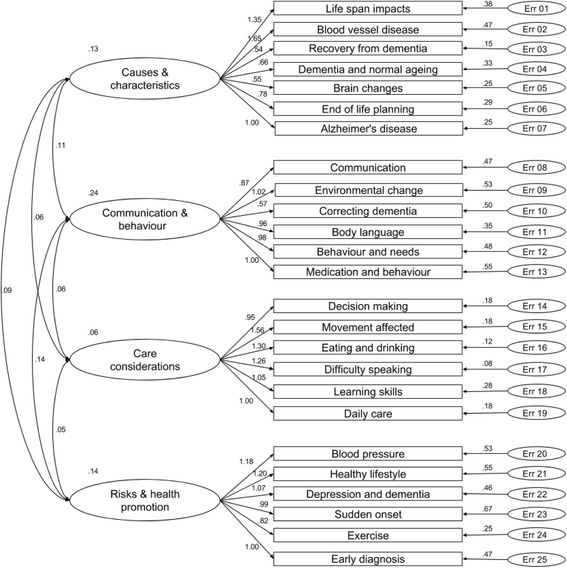
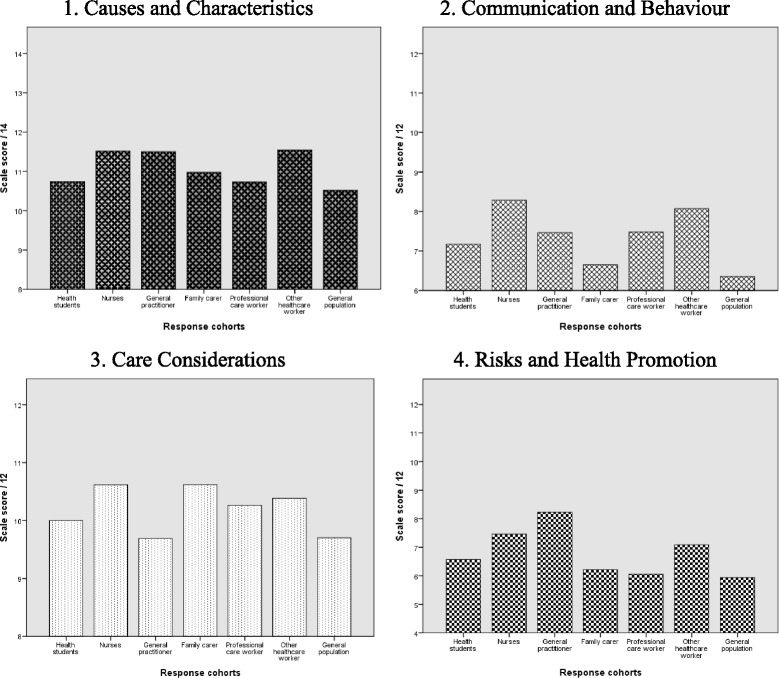
BACKGROUND: Dementia is a life-limiting condition that is increasing in global prevalence in line with population ageing. In this context, it is necessary to accurately measure dementia knowledge across a spectrum of health professional and lay populations with the aim of informing targeted educational interventions and improving literacy, care, and support. Building on prior exploratory analysis, which informed the development of the preliminarily valid and reliable version of the Dementia Knowledge Assessment Scale (DKAS), a Confirmatory Factor Analysis (CFA) was performed to affirm construct validity and proposed subscales to further increase the measure's utility for academics and educators. METHODS: A large, de novo sample of 3649 volunteer respondents to a dementia-related online course was recruited to evaluate the performance of the DKAS and its proposed subscales. Respondents represented diverse cohorts, including health professionals, students, and members of the general public. Analyses included CFA (using structural equation modelling), measures of internal consistency (α), and non-parametric tests of subscale correlation (Spearman Correlation) and score differences between cohorts (Kruskal-Wallis one-way analysis of variance). RESULTS: = .87; overall scale), with acceptable subscale internal consistency (α ≥ .65; subscales). Subscales showed acceptable correlation without any indication of redundancy. Finally, total and DKAS subscale scores showed good discrimination between cohorts of respondents who would be anticipated to hold different levels of knowledge on the basis of education or experience related to dementia. CONCLUSION: The DKAS has been confirmed as a reliable and valid measure of dementia knowledge for diverse populations that is capable of elucidating knowledge characteristics across four coherent domains: 1) Causes and Characteristics, 2) Communication and Behaviour, 3) Care Considerations, and 4) Risks and Health Promotion. Importantly, the four confirmed subscales clearly distinguish between groups who might be expected to hold differing levels of knowledge about dementia, allowing for a fine-grained level of detail to be established when evaluating baseline understanding or knowledge change associated with educational intervention.
Overview
The claims and statistics of this paper haven’t been checked yet.
Free: it reads the open-access text and checks the first 5 claims that cite a source we can check. Create a free account to check every claim.
Integrity signals
Registry
Cites
Statistics
Figures
Verification
Claims the paper makes
The claims and statistics of this paper haven’t been checked yet.
Free: it reads the open-access text and checks the first 5 claims that cite a source we can check. Create a free account to check every claim.
Claims other papers make about this one
Each is checked against this paper’s own text: does it say what the citing paper says it does?
The source backs part of the claim, not all of it — or backs it for a different population, condition or comparison.
In the citing paper
“Public knowledge about dementia can affect behaviors and attitudes towards this syndrome. 5-9”
From Dementia Knowledge in Older and Young Adults: A Cross-Sectional Study (2024) · cites this paper as [7]
Experimental — accuracy not yet measuredThe cited source says what the claim attributes to it.
In the citing paper
“The Dementia Knowledge Assessment Scale (DKAS) is instead a 25 items questionnaire designed to measure knowledge of dementia from a biopsychosocial perspective [7–9]”
The cited source says what the claim attributes to it.
In the citing paper
“Another strength of the DKAS is that it produces, in addition to an overall score for dementia knowledge, four sub-scores on the syndrome causes and characteristics, related risk and protective factors, care consideration and communication with people with the condition [7, 8, 11].”
Self-check
Percentages, sums and reported differences re-computed from the paper’s own numbers.
The self-check needs the paper’s full text.
Citations
Cites
Statistical Power Analysis for the Behavioral Sciences
Muller, K. (1989) · Technometrics · doi:10.1080/00401706.1989.10488618 · Cited by 99,167
Tabachnick, B. G., & Fidell, L. S. (1983) · Cited by 80,054
Statistical power analysis for the behavioral sciences
(1990) · Computers, Environment and Urban Systems · doi:10.1016/0198-9715(90)90050-4 · Cited by 65,269
Principles and Practice of Structural Equation Modeling
Tabri, N., & Elliott, C. M. (2012) · Canadian Graduate Journal of Sociology and Criminology · doi:10.15353/cgjsc-rcessc.v1i1.25 · Cited by 38,891
(1998) · Cited by 36,049
(1985) · Medical Entomology and Zoology · Cited by 19,180
(1991) · Cited by 15,554
Health Behavior and Health Education: Theory, Research, and Practice
(1992) · Annals of Internal Medicine · doi:10.7326/0003-4819-116-4-350_1 · Cited by 13,207
A Beginner's Guide to Structural Equation Modeling: Fourth Edition
Schumacker, R. E., & Lomax, R. G. (2015) · doi:10.4324/9781315749105 · Cited by 6,604
A Beginner's Guide to Structural Equation Modeling
Schumacker, R. E., & Lomax, R. G. (2004) · doi:10.4324/9781410610904 · Cited by 6,235
Statistics notes: Cronbach's alpha: Table 1
Bland, J. M., & Altman, D. G. (1997) · BMJ · doi:10.1136/bmj.314.7080.572 · Cited by 5,300 · cited 1×
“70 and consistent with other validated scales reported in the health literature [35].”
ResultStructural Equation Modeling With AMOS: Basic Concepts, Applications, and Programming, Third Edition
Byrne, B. M. (2016) · doi:10.4324/9781315757421 · Cited by 4,653
Review of Using Multivariate Statistics.
Hays, W. L. (1983) · Contemporary Psychology: A Journal of Reviews · doi:10.1037/022267 · Cited by 3,139
Reporting practices in confirmatory factor analysis: an overview and some recommendations
Jackson, D. L., Gillaspy, J. A., & Purc-Stephenson, R. (2009) · Psychological Methods · doi:10.1037/a0014694 · Cited by 2,242 · cited 1×
“Consistent with established best-practice analysis [30], CFA verified the construct validity of a 25-item iteration of the DKAS and supported refined iterations of the four indicative subscales that were initially observed in prior exploratory analysis.”
MethodForsetlund, L., Bjørndal, A., Rashidian, A., Jamtvedt, G., O'Brien, M. A., Wolf, F. M., Davis, D., Odgaard-Jensen, J., & Oxman, A. D. (2009) · Cochrane Database of Systematic Reviews · doi:10.1002/14651858.cd003030.pub2 · Cited by 1,849 · cited 1×
“This assertion is supported by systematic review of evidence in chronic health management for older adults, which has found that higher levels of clinical knowledge resulting from workplace education portend better care outcomes mediated through changes in care and treatment behaviour [14].”
BackgroundHandbook of Psychological Testing
Kline, P. (2013) · Routledge eBooks · doi:10.4324/9781315812274 · Cited by 1,194
Harrington, D. (2008) · Oxford University Press eBooks · doi:10.1093/acprof:oso/9780195339888.001.0001 · Cited by 1,105
Neurological Disorders: Public Health Challenges
Vardi, G., & Merrick, J. (2008) · Journal of Policy and Practice in Intellectual Disabilities · doi:10.1111/j.1741-1130.2007.00143.x · Cited by 762
Neurological Disorders. Public Health Challenges
Vardi, G., & Merrick, J. (2007) · Journal of Policy and Practice in Intellectual Disabilities · doi:10.1111/j.1741-1130.2007.00122.x · Cited by 759
Japan: Super-Aging Society Preparing for the Future
Muramatsu, N., & Akiyama, H. (2011) · The Gerontologist · doi:10.1093/geront/gnr067 · Cited by 522 · cited 1×
“Super-aging societies [44] in the AsiaPacific region, including Japan, Taiwan, Singapore, and”
BackgroundThe Alzheimer's Disease Knowledge Scale: Development and Psychometric Properties
Carpenter, B. D., Balsis, S., Otilingam, P. G., Hanson, P. K., & Gatz, M. (2009) · The Gerontologist · doi:10.1093/geront/gnp023 · Cited by 450 · cited 2×
“family caregivers [4], general practitioners (GPs) [5], and students from health-related disciplines [6].”
BackgroundTurner, S., Iliffe, S., Downs, M., Wilcock, J., Bryans, M., Levin, E., Keady, J., & O'Carroll, R. (2004) · Age and Ageing · doi:10.1093/ageing/afh140 · Cited by 375 · cited 1×
“family caregivers [4], general practitioners (GPs) [5], and students from health-related disciplines [6].”
BackgroundSymptom burden in community-dwelling older people with multimorbidity: a cross-sectional study
Eckerblad, J., Theander, K., Ekdahl, A., Unosson, M., Wirehn, A.-B., Milberg, A., Krevers, B., & Jaarsma, T. (2015) · BMC Geriatrics · doi:10.1186/1471-2318-15-1 · Cited by 277
Dementia Knowledge Assessment Scale: Development and Preliminary Psychometric Properties
Annear, M. J., Toye, C. M., Eccleston, C. E., McInerney, F. J., Elliott, K. J., Tranter, B. K., Hartley, T., & Robinson, A. L. (2015) · Journal of the American Geriatrics Society · doi:10.1111/jgs.13707 · Cited by 184 · cited 8×
“However, previous research has identified the need for CFA concerning the DKAS to verify construct validity (factorability), further refine the scale, and finalise four hypothesised subscales [17, 23].”
BackgroundMethodResultInfluentialSelf-citationAnkam, N. S., Levinson, M., Jerpbak, C., Collins, L., Umland, E., Kern, S. B., Egger, S., Lucatorto, K., Covelman, K., & Koeuth, S. (2013) · MedEdPORTAL · doi:10.15766/mep_2374-8265.9321 · Cited by 184
Dementia literacy: Recognition and beliefs on dementia of the Australian public
Low, L., & Anstey, K. J. (2009) · Alzheimer's & Dementia · doi:10.1016/j.jalz.2008.03.011 · Cited by 172
Using a biopsychosocial model of dementia as a tool to guide clinical practice
Spector, A., & Orrell, M. (2010) · International Psychogeriatrics · doi:10.1017/s1041610210000840 · Cited by 159 · cited 1×
“Such measures should not only include items addressing the biomedical aspects of the syndrome (pathology, causes, risk factors, and symptoms), but also address the psychosocial issues of care and communication – reflecting a holistic, biopsychosocial approach [9].”
BackgroundA survey-based study of knowledge of Alzheimer’s disease among health care staff
Smyth, W., Fielding, E., Beattie, E., Gardner, A., Moyle, W., Franklin, S., Hines, S., & MacAndrew, M. (2013) · BMC Geriatrics · doi:10.1186/1471-2318-13-2 · Cited by 152 · cited 1×
“Target populations for education include health service workers [2], aged care staff [3],”
BackgroundDementia Friendly, Dementia Capable, and Dementia Positive: Concepts to Prepare for the Future
Lin, S.-Y., & Lewis, F. M. (2015) · The Gerontologist · doi:10.1093/geront/gnu122 · Cited by 130 · cited 1×
“national government plans are being developed to facilitate inclusion of, and equity for, people living with dementia [8],”
BackgroundRobinson, A., Eccleston, C., Annear, M., Elliott, K.-E., Andrews, S., Stirling, C., Ashby, M., Donohue, C., Banks, S., Toye, C., et al. (2014) · Journal of Palliative Care · doi:10.1177/082585971403000305 · Cited by 127
Self-citationConfirmatory Factor Analysis of the Geriatric Depression Scale
Adams, K. B., Matto, H. C., & Sanders, S. (2004) · The Gerontologist · doi:10.1093/geront/44.6.818 · Cited by 125
The complex relationship between depression and dementia
Varghese, M., & Muliyala, K. (2010) · Annals of Indian Academy of Neurology · doi:10.4103/0972-2327.74248 · Cited by 119 · cited 1×
“Indeed, the prevalence of depression in people with dementia may be as high as 68% in some cases [37].”
BackgroundSousa, R. M., Dewey, M. E., Acosta, D., Jotheeswaran, A. T., Castro‐Costa, E., Ferri, C. P., Guerra, M., Huang, Y., Jacob, K. S., Pichardo, J. G. R., et al. (2010) · International Journal of Methods in Psychiatric Research · doi:10.1002/mpr.299 · Cited by 118 · cited 1×
“There is some debate in the international literature concerning the use of PCA as a preliminary step in the development of a CFA, although the process aligns with published procedures for the development of other gerontological measures [18, 28, 29].”
MethodGoldberg, L. R., Bell, E., King, C., O’Mara, C., McInerney, F., Robinson, A., & Vickers, J. (2015) · BMC Medical Education · doi:10.1186/s12909-015-0344-z · Cited by 116
Self-citationBenson, J., & Fleishman, J. A. (1994) · Quality & Quantity · doi:10.1007/bf01102757 · Cited by 103 · cited 1×
“maximum likelihood) under a range of conditions [33].”
BackgroundA systematic review of ‘knowledge of dementia’ outcome measures
Spector, A. E., Orrell, M. W., Schepers, A. K., & Shanahan, N. (2011) · Ageing Research Reviews · doi:10.1016/j.arr.2011.09.002 · Cited by 97 · cited 4×
“CFA with dementia knowledge scales remains relatively uncommon in the international literature [15].”
BackgroundInfluentialCare staff working with people with dementia: Training, knowledge and confidence
Hughes, J., Bagley, H., Reilly, S., Burns, A., & Challis, D. (2008) · Dementia · doi:10.1177/1471301208091159 · Cited by 94
Development of Short Versions for the WHOQOL-OLD Module
Fang, J., Power, M., Lin, Y., Zhang, J., Hao, Y., & Chatterji, S. (2011) · The Gerontologist · doi:10.1093/geront/gnr085 · Cited by 79
Audit and feedback: effects on professional practice
Ivers, N., Yogasingam, S., Lacroix, M., Brown, K. A., Antony, J., Soobiah, C., Simeoni, M., Willis, T. A., Crawshaw, J., Antonopoulou, V., et al. (2025) · Cochrane Database of Systematic Reviews · doi:10.1002/14651858.cd000259.pub4 · Cited by 78
Annear, M. J., Eccleston, C. E., McInerney, F. J., Elliott, K. J., Toye, C. M., Tranter, B. K., & Robinson, A. L. (2016) · Journal of the American Geriatrics Society · doi:10.1111/jgs.14142 · Cited by 77 · cited 4×
“However, previous research has identified the need for CFA concerning the DKAS to verify construct validity (factorability), further refine the scale, and finalise four hypothesised subscales [17, 23].”
BackgroundMethodInfluentialSelf-citationProctor, R., Martin, C., & Hewison, J. (2002) · International Journal of Geriatric Psychiatry · doi:10.1002/gps.762 · Cited by 70 · cited 1×
“Previous studies of dementia knowledge have observed that understanding is associated with higher levels of health education [4, 39].”
BackgroundFlynn Longmire, C. V., & Knight, B. G. (2011) · The Gerontologist · doi:10.1093/geront/gnr011 · Cited by 64 · cited 1×
“CFA has seldom been employed in the verification of dementia knowledge scales, although it has previously been used to develop measures of depression among older adults [18, 19] and carer burden [20].”
MethodWhat should we know about dementia in the 21st Century? A Delphi consensus study
Annear, M. J., Toye, C., McInerney, F., Eccleston, C., Tranter, B., Elliott, K.-E., & Robinson, A. (2015) · BMC Geriatrics · doi:10.1186/s12877-015-0008-1 · Cited by 58 · cited 2×
“dures [6, 21] and was informed by an international Delphi study of dementia experts to inform content selection [22].”
BackgroundSelf-citationTully, P. J., Winefield, H. R., Baker, R. A., Turnbull, D. A., & de Jonge, P. (2011) · Journal of Health Psychology · doi:10.1177/1359105310383604 · Cited by 57 · cited 1×
“CFA has seldom been employed in the verification of dementia knowledge scales, although it has previously been used to develop measures of depression among older adults [18, 19] and carer burden [20].”
MethodTargeted MOOC captivates students
King, C., Robinson, A., & Vickers, J. C. (2014) · Nature · doi:10.1038/505026a · Cited by 51
Self-citationImproving student nurses' aged care understandings through a supported placement
Lea, E. J., Marlow, A., Bramble, M., Andrews, S., Eccleston, C. E. A., McInerney, F., & Robinson, A. (2014) · International Nursing Review · doi:10.1111/inr.12156 · Cited by 47 · cited 1×
“This is important because the evidence suggests significant knowledge deficits within health and aged care professionals and family carers [4], as well as undergraduate nursing students [45] who will take a key role in providing dementia care into the future.”
BackgroundSelf-citationAnnear, M. J., Otani, J., & Li, J. (2016) · Geriatrics and gerontology international/Geriatrics & gerontology international · doi:10.1111/ggi.12911 · Cited by 44 · cited 1×
“cessfully piloted [43] and validation in other languages is”
BackgroundSelf-citationDevelopment of the Knowledge about Memory Loss and Care (KAML-C) test
Kuhn, D., King, S. P., & Fulton, B. R. (2005) · American Journal of Alzheimer's Disease & Other Dementias® · doi:10.1177/153331750502000108 · Cited by 41 · cited 1×
“dures [6, 21] and was informed by an international Delphi study of dementia experts to inform content selection [22].”
BackgroundThyrian, J. R., Eichler, T. S., Reimann, M., Wucherer, D., Dreier, A., Michalowsky, B., & Hoffmann, W. U. (2016) · International Psychogeriatrics · doi:10.1017/s1041610215002458 · Cited by 20 · cited 1×
“There is evidence that symptoms of depression in people living with dementia often go unrecognised in primary care, meaning that under-treatment becomes more likely [36].”
BackgroundEstimating standardized linear contrasts of means with desired precision.
Bonett, D. G. (2009) · Psychological Methods · doi:10.1037/a0014270 · Cited by 9
Research works printed but not linked: 4
- World Health Organization Towards a common language for functioning, disability and health: ICF 2002 Geneva, Switzerland World Health Organization
- McAlister AL, Perry CL, Parcel GS: How individuals, environments, and health behaviors interact. In: Health behavior and health education: theory, research, and practice. Edited by Glanz K, Rimer BK, viswanath K. San Francisco: Jossey-Bass; 2008: 169–188.
- Corp IBM IBM SPSS statistics for windows, version 20.0 2011 IBM Corp Armonk, New York
- Alzheimer's Disease International Women in dementia: a global research review 2015 London, United Kingdom Alzheimer’s Disease International
Cited by
Diagnostic approach to tinnitus.
Crummer, R. W., & Hassan, G. A. (2004) · PubMed · Cited by 152
Knowledge about Alzheimer's disease in the Brazilian population
Amado, D. K., & Brucki, S. M. D. (2018) · Arquivos de Neuro-Psiquiatria · doi:10.1590/0004-282x20180106 · Cited by 68
Knowledge of Dementia Among the Australian Health Workforce: A National Online Survey
Annear, M. J. (2020) · Journal of Applied Gerontology · doi:10.1177/0733464817752085 · Cited by 64
“The scale has been validated with large Australian and international samples (n > 3,500) of health professionals (nurses, aged care workers, physiotherapists, occupational therapists, health educators, and students) and lay respondents (Annear, Eccleston, et al., 2016; Annear, Toye, Eccleston et al., 2015; Annear et a…”
BackgroundMethodInfluentialSelf-citationA Framework of AI-Based Approaches to Improving eHealth Literacy and Combating Infodemic
Liu, T., & Xiao, X. (2021) · Frontiers in Public Health · doi:10.3389/fpubh.2021.755808 · Cited by 77
Vrijsen, J., Matulessij, T. F., Joxhorst, T., de Rooij, S. E., & Smidt, N. (2021) · BMC Public Health · doi:10.1186/s12889-021-10913-7 · Cited by 58
Metadata
- Authors
- Annear, M. J., Toye, C., Elliott, K.-E. J., McInerney, F., Eccleston, C., & Robinson, A.
- Affiliations
- University of Tasmania (AU)
- Corresponding author
- Annear, Michael J.
- Venue
- BMC Geriatrics
- Published
- 2017-07-31
- Volume
- 17
- Issue
- 1
- Pages
- 168-168
- ISSN
- 1471-2318 (ISSN-L)
- PMC
- PMC5537989
- OpenAlex
- W2741918151
- Semantic Scholar
- eaed6d5175648abc814c2a6b9f45d1d3772c8627
- Cited by
- 212
- References
- 51
- Citations by year
- 2026: 23 · 2025: 42 · 2024: 36 · 2023: 18 · 2022: 33 · 2021: 24 · 2020: 16 · 2019: 10 · 2018: 9
- FWCI
- 7.86
- Type
- journal article
- Language
- en
- Open access
- gold
- doi.org
- Licence
- cc-by
- Locations
- BMC Geriatrics (publishedVersion, cc-by)
- Europe PMC (PubMed Central) (publishedVersion, cc-by)
- PubMed Central (publishedVersion, cc-by)
- PubMed (publishedVersion)
- UTAS Research Repository (acceptedVersion)
- eCite Digital Repository (University of Tasmania) (submittedVersion, cc-by)
- DOAJ (DOAJ: Directory of Open Access Journals) (submittedVersion, cc-by-sa)
- eSpace (Curtin University) (submittedVersion, cc-by)
- Figshare (submittedVersion, cc-by)
- Open Scholarship Institutional Repository (Washington University in St. Louis) (submittedVersion, cc-by)
- Funders
- University of Tasmania
- Topics
- Health Sciences › Medicine › Psychiatry and Mental health › Dementia and Cognitive Impairment Research
- Health Sciences › Nursing › Research and Theory › Health Education and Validation
- Social Sciences › Decision Sciences › Management Science and Operations Research › Psychometric Methodologies and Testing
- Keywords
- dementia knowledge, scale validation, construct validity, subscales, healthcare workers, lay public, dementia education, knowledge assessment, dementia care
- MeSH terms
- Adolescent, Adult, Aged, Aged, 80 and over, Dementia, Factor Analysis, Statistical, Female, Health Education, Health Surveys, Humans, Health Knowledge, Attitudes, Practice, Male, Middle Aged, Psychometrics, Reproducibility of Results, Cohort Studies, Comprehension, Internationality, Young Adult
About these checks
Registry, retraction, Cites and statistics results are computed, not judged, with one exception: a printed reference that no index lists is read once by a model before it counts as a citation error. Claims are extracted by a model and kept only when their quote appears verbatim in the text; each cited source is then checked, with a model’s help, for whether it says what the claim relies on. Those verdicts can be wrong — read the claim’s quote and the cited source before relying on one.
Statistics and arithmetic are recomputed, not judged.
Confidence bands are shown only for fields calibrated on our annotated test set. None is calibrated yet, so no band is shown.
What counts as a claim ›How we measure confidence ›How we check this ›
Are you an author, or do you see a problem with this page? Request a review
Data sources
Bibliographic data: Semantic Scholar, OpenAlex, Crossref.
Contains information from the Semantic Scholar Academic Graph Datasets, made available under the ODC Attribution License (ODC-BY 1.0).
Semantic Scholar’s data is described in: Kinney, R., et al. (2023). The Semantic Scholar Open Data Platform. arXiv:2301.10140.
