

Evaluation of Xpert® MTB/RIF and Ustar EasyNAT™ TB IAD for diagnosis of tuberculous lymphadenitis of children in Tanzania: a prospective descriptive study
Open accessThe DOI matches its Crossref record; 34 of the 36 references it cites were found in a registry or an index, and 1 are not checked yet; 16 of the 34 sources its claims cite were checked for support.
Abstract
BACKGROUND: Fine needle aspiration biopsy has become a standard approach for diagnosis of peripheral tuberculous lymphadenitis. The aim of this study was to compare the performance of Xpert MTB/RIF and Ustar EasyNAT TB IAD nucleic acid amplification assays, against acid-fast bacilli microscopy, cytology and mycobacterial culture for the diagnosis of TB lymphadenitis in children from a TB-endemic setting in Tanzania. METHODS: Children of 8 weeks to 16 years of age, suspected of having TB lymphadenitis, were recruited at a district hospital in Tanzania. Fine needle aspirates of lymph nodes were analysed using acid-fast bacilli microscopy, liquid TB culture, cytology, Xpert MTB/RIF and EasyNAT. Latent class analysis and comparison against a composite reference standard comprising "culture and/or cytology" was done, to assess the performance of Xpert MTB/RIF and EasyNAT for the diagnosis of TB lymphadenitis. RESULTS: Seventy-nine children were recruited; 4 were excluded from analysis. Against a composite reference standard of culture and/or cytology, Xpert MTB/RIF and EasyNAT had a sensitivity and specificity of 58 % and 93 %; and 19 % and 100 % respectively. Relative to latent class definitions, cytology had a sensitivity of 100 % and specificity of 94.7 %. CONCLUSIONS: Combining clinical assessment, cytology and Xpert MTB/RIF may allow for a rapid and accurate diagnosis of childhood TB lymphadenitis. Larger diagnostic evaluation studies are recommended to validate these findings and on Xpert MTB/RIF to assess its use as a solitary initial test for TB lymphadenitis in children.
Verified 2026-11-25 · 1 reference not checked yet
Overview
CoChat Summary
## TL;DR
In this prospective study of Tanzanian children with suspected tuberculous lymphadenitis, Xpert MTB/RIF outperformed EasyNAT but still had only modest sensitivity. The authors conclude that combining clinical assessment, cytology, and Xpert MTB/RIF may be the most promising diagnostic approach, while EasyNAT was not suitable as a stand-alone test.
## Key findings
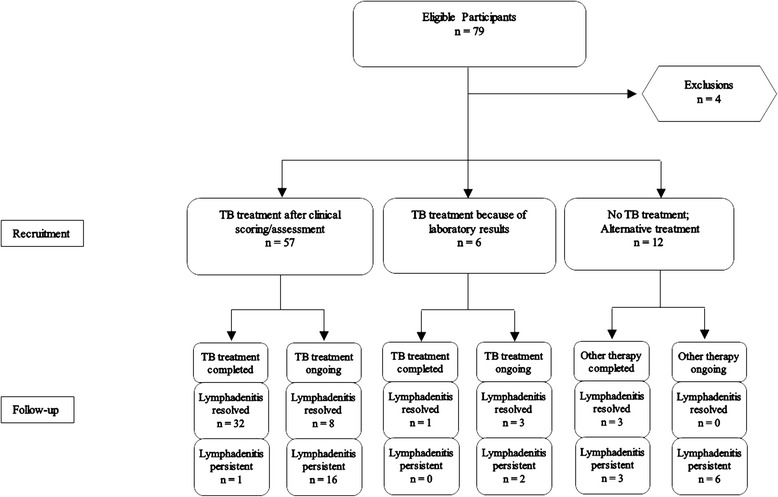
- Among 79 recruited children, 4 were excluded; the analyzed sample therefore included 75 children.
- Against the composite reference standard (culture and/or cytology), Xpert MTB/RIF had sensitivity 58% and specificity 93%, while EasyNAT had sensitivity 19% and specificity 100%.
- In the results section, Xpert MTB/RIF showed sensitivity/specificity of 56%/96% against culture, 69%/93% against cytology, and 58%/93% against the composite reference standard; EasyNAT was 22%/100%, 22%/100%, and 19%/100%, respectively.
- Latent class analysis estimated prevalence of TB lymphadenitis at 22.8%; sensitivities were 100% for cytology, 74% for culture, 71% for Xpert MTB/RIF, 29% for EasyNAT, and 19% for ZN microscopy, with specificities of 95%, 90%, 94%, 100%, and 100%, respectively.
## Methods
- Prospective descriptive study conducted from April 2012 to August 2013 at Temeke District Hospital in Dar es Salaam, Tanzania, enrolling children older than 8 weeks and younger than 16 years with suspected TB lymphadenitis.
- Fine needle aspirates from lymph nodes were tested by acid-fast bacilli microscopy, cytology, liquid TB culture, Xpert MTB/RIF, and EasyNAT; clinical assessment also included chest X-ray, TST, full blood count, HIV testing, and follow-up clinical outcome assessment.
- Diagnostic performance was assessed using sensitivity, specificity, and Cohen’s kappa against culture, cytology, and a composite reference standard; latent class analysis and a mixed logistic regression model were also applied.
## Limitations
- The paper explicitly states that 19% of cytology samples were unsuitable for analysis and 48% of TB cultures were contaminated, which reduced the number of valid comparisons and weakened culture as a reference standard.
- The authors note that larger, more representative pediatric studies are needed; this indicates limited sample size and limited generalizability beyond this setting.
- Evident from the text: some outcomes were missing or excluded, and the imperfect reference standards make estimates uncertain.
Model-written summary. Check it against the paper before relying on it.
Integrity signals
Registry
Cites
Statistics
Figures
Verification
Claims the paper makes
11 Valid · 0 Not valid · 10 Not checked · 32 Own results and interpretations
Every source the paper cites for this claim was checked and supports it.
In the paper
“A systematic review and meta-analysis of 13 studies described a pooled sensitivity and specificity of 83.1 and 93.6 % for the Xpert MTB/RIF assay with TB culture as a reference standard for the diagnosis of lymph node TB [34].”
§ Evaluation of Xpert® MTB/RIF and Ustar EasyNAT™ TB IAD for diagnosis of tuberculous lymphadenitis of children in Tanzania: a prospective descriptive study > Discussion
What the sources say
- Supportedcites [34] Denkinger CM Schumacher SG Boehme CC Dendukuri N Pai M Steingart KR Xpert MTB/RIF assay for the diagnosis of extrapulmonary tuberculosis: a systematic review and meta-analysis Eur Respir J 2014 44 435 46 10.1183/09031936.00007814 24696113 source
The “Detection of lymph node TB” section reports 13 studies of lymph node biopsy or fine-needle aspirate samples using culture as the reference standard, with pooled sensitivity of 83.1%. The continuation reports pooled specificity of 93.6%. (LLM, conf=0.95)
plain- Asserted: passes — The authors put it forward as true.
- Checkable: passes — It can be checked against evidence.
- Load-bearing: unclear — It is unclear whether the paper’s conclusions depend on it.
- Based: passes — The paper gives a reason why it holds.
- Supported
The cited sources support only part of this claim — read each source’s verdict below.
In the paper
“Sensitivity in these studies was further reduced when only smear-negative but culture-positive pulmonary TB cases were tested (59.8 and 10 %) which indicates a suboptimal limit of detection that probably could explain the poor sensitivity with our paediatric patients, where low density of mycobacteria is expected in lymph nodes.”
§ Evaluation of Xpert® MTB/RIF and Ustar EasyNAT™ TB IAD for diagnosis of tuberculous lymphadenitis of children in Tanzania: a prospective descriptive study > Discussion
What the sources say
- Partly supportedcites [40] Ou X Song Y Zhao B Li Q Xia H Zhou Y A multicenter study of cross-priming amplification for tuberculosis diagnosis at peripheral level in China Tuberc Edinb Scotl 2014 94 428 33 10.1016/j.tube.2014.04.006 24880705 sourceExperimental — accuracy not yet measured
Section 3.4 reports 59.8% CPA sensitivity among smear-negative patients, and the Discussion suggests that some culture-positive, CPA-negative samples fell below the detection limit. The paper does not report the claimed 10% sensitivity for smear-negative, culture-positive cases. The explanation concerning paediatric lymph-node samples is the citing authors’ own inference, not a finding of this study. (LLM, conf=0.88)
- Supportedcites [41] Mhimbira FA Bholla M Sasamalo M Mukurasi W Hella JJ Jugheli L Detection of Mycobacterium tuberculosis by EasyNAT diagnostic kit in sputum samples from Tanzania J Clin Microbiol 2015 53 1342 4 10.1128/JCM.03037-14 25609720 PMC4365259 source
The discussion reports EasyNAT sensitivity of 10% in this study’s smear-negative, culture-positive group, compared with 59.8% in an earlier evaluation. It suggests that the low detection rate was due to paucibacillary disease, with DNA copies below the assay’s detection limit. The 10% estimate came from a small group of ten participants, all HIV positive. (LLM, conf=0.91)
hedgedstates a cause- Asserted: passes — The authors put it forward as true.
- Checkable: passes — It can be checked against evidence.
- Load-bearing: passes — The paper’s conclusions depend on it.
- Based: passes — The paper gives a reason why it holds.
- Partly supported
The cited sources support only part of this claim — read each source’s verdict below.
In the paper
“Until now, EasyNAT, a manual assay based on isothermal cross-priming amplification, has only been evaluated for the detection of pulmonary TB in adults [40, 41].”
§ Evaluation of Xpert® MTB/RIF and Ustar EasyNAT™ TB IAD for diagnosis of tuberculous lymphadenitis of children in Tanzania: a prospective descriptive study > Discussion
What the sources say
- Partly supportedcites [40] Ou X Song Y Zhao B Li Q Xia H Zhou Y A multicenter study of cross-priming amplification for tuberculosis diagnosis at peripheral level in China Tuberc Edinb Scotl 2014 94 428 33 10.1016/j.tube.2014.04.006 24880705 sourceExperimental — accuracy not yet measured
The Study design (section 2.1) reports evaluating a cross-priming amplification assay on sputum from TB suspects, supporting the pulmonary-TB evaluation portion of the claim. Our copy does not name the assay EasyNAT, specify that participants were adults, or establish that its evaluations had been limited to adults with pulmonary TB. (LLM, conf=0.83)
- Partly supportedcites [41] Mhimbira FA Bholla M Sasamalo M Mukurasi W Hella JJ Jugheli L Detection of Mycobacterium tuberculosis by EasyNAT diagnostic kit in sputum samples from Tanzania J Clin Microbiol 2015 53 1342 4 10.1128/JCM.03037-14 25609720 PMC4365259 sourceExperimental — accuracy not yet measured
The study description (section labeled Abstract; page unavailable) evaluates EasyNAT using sputum from presumptive pulmonary TB patients, and the reported mean age is 40.5 years. The copy does not establish that all participants were adults or that EasyNAT had only been evaluated in adults for pulmonary TB. (LLM, conf=0.78)
plain- Asserted: passes — The authors put it forward as true.
- Checkable: passes — It can be checked against evidence.
- Load-bearing: passes — The paper’s conclusions depend on it.
- Based: passes — The paper gives a reason why it holds.
- Partly supported
Every source the paper cites for this claim was checked and supports it.
In the paper
“This latent class model was used because of the imperfect or missing reference standard [33].”
§ Evaluation of Xpert® MTB/RIF and Ustar EasyNAT™ TB IAD for diagnosis of tuberculous lymphadenitis of children in Tanzania: a prospective descriptive study > Discussion
What the sources say
- Supportedcites [33] Reitsma JB Rutjes AWS Khan KS Coomarasamy A Bossuyt PM A review of solutions for diagnostic accuracy studies with an imperfect or missing reference standard J Clin Epidemiol 2009 62 797 806 10.1016/j.jclinepi.2009.02.005 19447581 source
The Abstract (p. 1) identifies latent class analysis as an approach for assessing diagnostic tests when no gold standard exists and reference tests are imperfect. The Latent Class Analysis section (p. 3) likewise describes its use when a reliable gold standard is absent. (LLM, conf=0.91)
plainstates a cause- Asserted: passes — The authors put it forward as true.
- Checkable: passes — It can be checked against evidence.
- Load-bearing: passes — The paper’s conclusions depend on it.
- Based: passes — The paper gives a reason why it holds.
- Supported
The cited sources support only part of this claim — read each source’s verdict below.
In the paper
“Sensitivity in these studies was further reduced when only smear-negative but culture-positive pulmonary TB cases were tested (59.8 and 10 %) which indicates a suboptimal limit of detection that probably could explain the poor sensitivity with our paediatric patients, where low density of mycobacteria is expected in lymph nodes.”
§ Evaluation of Xpert® MTB/RIF and Ustar EasyNAT™ TB IAD for diagnosis of tuberculous lymphadenitis of children in Tanzania: a prospective descriptive study > Discussion
What the sources say
- Partly supportedcites [40] Ou X Song Y Zhao B Li Q Xia H Zhou Y A multicenter study of cross-priming amplification for tuberculosis diagnosis at peripheral level in China Tuberc Edinb Scotl 2014 94 428 33 10.1016/j.tube.2014.04.006 24880705 sourceExperimental — accuracy not yet measured
The Results (§3.4) report 59.8% sensitivity for CPA in smear-negative patients, and the Discussion (§4) suggests that some culture-positive samples fell below its detection limit. The study tested sputum from TB suspects; it does not examine paediatric lymph nodes or establish that this detection limit explains the citing study’s poor sensitivity. (LLM, conf=0.87)
- Partly supportedcites [41] Mhimbira FA Bholla M Sasamalo M Mukurasi W Hella JJ Jugheli L Detection of Mycobacterium tuberculosis by EasyNAT diagnostic kit in sputum samples from Tanzania J Clin Microbiol 2015 53 1342 4 10.1128/JCM.03037-14 25609720 PMC4365259 sourceExperimental — accuracy not yet measured
The passage labeled Abstract reports 10% EasyNAT sensitivity in smear-negative, culture-positive sputum samples and attributes the low detection rate to bacillary DNA below the assay’s detection limit. The paper does not study paediatric patients or lymph-node samples, so it does not establish that this mechanism explains the citing study’s poor sensitivity. (LLM, conf=0.86)
hedgedstates a possible cause- Asserted: passes — The authors put it forward as true.
- Checkable: passes — It can be checked against evidence.
- Load-bearing: passes — The paper’s conclusions depend on it.
- Based: passes — The paper gives a reason why it holds.
- Partly supported
20 more claims
Create a free account to see all 53 claims and to verify the 8 references still open.
- Probably not a substantial claim. 12
- It may state two separate claims as one. 23
Citations
Cites
Weighted kappa: nominal scale agreement provision for scaled disagreement or partial credit
Cohen, J. (1968) · Psychological Bulletin · doi:10.1037/h0026256 · Cited by 8,736 · cited 1×
“Sensitivity, specificity and Cohen’s Kappa [32] were calculated for each and for all diagnostic modalities combined with culture and cytology as single reference standards, and with culture and cytology combined (M.”
MethodRapid Molecular Detection of Tuberculosis and Rifampin Resistance
Boehme, C. C., Nabeta, P., Hillemann, D., Nicol, M. P., Shenai, S., Krapp, F., Allen, J., Tahirli, R., Blakemore, R., Rustomjee, R., et al. (2010) · New England Journal of Medicine · doi:10.1056/nejmoa0907847 · Cited by 2,309 · cited 1×
“tuberculosis complex and rifampicin drug-resistance from sputum and other specimens, with a turnaround time of less than two hours [19, 20].”
BackgroundMurray, C. J. L., Ortblad, K. F., Guinovart, C., Lim, S. S., Wolock, T. M., Roberts, D. A., Dansereau, E. A., Graetz, N., Barber, R. M., Brown, J. C., et al. (2014) · The Lancet · doi:10.1016/s0140-6736(14)60844-8 · Cited by 975
Perez-Velez, C. M., & Marais, B. J. (2012) · New England Journal of Medicine · doi:10.1056/nejmra1008049 · Cited by 572
Denkinger, C. M., Schumacher, S. G., Boehme, C. C., Dendukuri, N., Pai, M., & Steingart, K. R. (2014) · European Respiratory Journal · doi:10.1183/09031936.00007814 · Cited by 527 · cited 1×
“6 % for the Xpert MTB/RIF assay with TB culture as a reference standard for the diagnosis of lymph node TB [34].”
MethodNewton, S. M., Brent, A. J., Anderson, S., Whittaker, E., & Kampmann, B. (2008) · The Lancet Infectious Diseases · doi:10.1016/s1473-3099(08)70182-8 · Cited by 480
Rapid Molecular Detection of Extrapulmonary Tuberculosis by the Automated GeneXpert MTB/RIF System
Hillemann, D., Rüsch-Gerdes, S., Boehme, C., & Richter, E. (2011) · Journal of Clinical Microbiology · doi:10.1128/jcm.02268-10 · Cited by 413 · cited 1×
“tuberculosis complex and rifampicin drug-resistance from sputum and other specimens, with a turnaround time of less than two hours [19, 20].”
BackgroundReitsma, J. B., Rutjes, A. W. S., Khan, K. S., Coomarasamy, A., & Bossuyt, P. M. (2009) · Journal of Clinical Epidemiology · doi:10.1016/j.jclinepi.2009.02.005 · Cited by 405 · cited 1×
“This latent class model was used because of the imperfect or missing reference standard [33].”
MethodBurden of childhood tuberculosis in 22 high-burden countries: a mathematical modelling study
Dodd, P. J., Gardiner, E., Coghlan, R., & Seddon, J. A. (2014) · The Lancet Global Health · doi:10.1016/s2214-109x(14)70245-1 · Cited by 370 · cited 1×
“Other groups however, estimated the TB incidence for the same year, as between 200,000 and 970,000 new cases [2–4].”
BackgroundCytology: Diagnostic Principles and Clinical Correlates
Chen, L. (2010) · American Journal of Surgical Pathology · doi:10.1097/pas.0b013e3181cc7ca3 · Cited by 345 · cited 1×
“Cytology results were categorised as “confirmed mycobacterial lymphadenitis” (visualization of AFB), “suspected mycobacterial lymphadenitis” (signs of TB necrosis and granuloma consistent with mycobacterial infection), nonspecific “reactive lymphadenopathy” or “suspicion of malignancy” [29].”
BackgroundGraham, S. M. (2007) · Europe PMC (PubMed Central) · Cited by 328
Jenkins, H. E., Tolman, A. W., Yuen, C. M., Parr, J. B., Keshavjee, S., Pérez-Vélez, C. M., Pagano, M., Becerra, M. C., & Cohen, T. (2014) · The Lancet · doi:10.1016/s0140-6736(14)60195-1 · Cited by 314 · cited 1×
“Other groups however, estimated the TB incidence for the same year, as between 200,000 and 970,000 new cases [2–4].”
BackgroundChakravorty, S., Sen, M. K., & Tyagi, J. S. (2005) · Journal of Clinical Microbiology · doi:10.1128/jcm.43.9.4357-4362.2005 · Cited by 282 · cited 1×
“The limited sensitivity of Xpert MTB/RIF is most likely caused by the paucibacillary nature of lymphatic TB manifestations in children [38] or by suboptimal rinsing of needle passes [37].”
Background(2015) · Clinical Tuberculosis · doi:10.1201/b20755-9 · Cited by 234
Cytology: Diagnostic Principles and Clinical Correlates
Cibas, E. S., & Ducatman, B. S. (1996) · Cited by 227
Clinical manifestations of tuberculosis in children
Cruz, A. T., & Starke, J. R. (2007) · Paediatric Respiratory Reviews · doi:10.1016/j.prrv.2007.04.008 · Cited by 204 · cited 1×
“lymphadenitis (TB lymphadenitis) in about two thirds of EPTB cases, followed by central nervous system involvement (meningitis), pleural, disseminated and skeletal TB [9].”
BackgroundTuberculosis Diagnostics in 2015: Landscape, Priorities, Needs, and Prospects
Pai, M., & Schito, M. (2015) · The Journal of Infectious Diseases · doi:10.1093/infdis/jiu803 · Cited by 193 · cited 1×
“tuberculosis) is often not detectable in paucibacillary paediatric specimens and host biomarkers are not yet in place to reliably identify children with TB disease [5, 6].”
BackgroundCross-Priming Amplification for Rapid Detection of Mycobacterium tuberculosis in Sputum Specimens
Fang, R., Li, X., Hu, L., You, Q., Li, J., Wu, J., Xu, P., Zhong, H., Luo, Y., Mei, J., et al. (2009) · Journal of Clinical Microbiology · doi:10.1128/jcm.01528-08 · Cited by 167 · cited 1×
“tuberculosis [22].”
Bechara, J. K., & Muchenik, J. (1975) · PubMed · Cited by 165
Ardito, F., Posteraro, B., Sanguinetti, M., Zanetti, S., & Fadda, G. (2001) · Journal of Clinical Microbiology · doi:10.1128/jcm.39.12.4440-4444.2001 · Cited by 154 · cited 3×
“The residue in needle and syringe was rinsed in mycobacterial growth indicator tube (MGIT) medium for mycobacterial culture with standard PANTA antibiotic/growth supplement (Beckton Dickinson, Sparks, USA) [28].”
MethodInfluential(2001) · PubMed · Cited by 103
Diagnostic accuracy of the Xpert® MTB/RIF assay for extra-pulmonary tuberculosis: a meta-analysis
Penz, E., Boffa, J., Roberts, D. J., Fisher, D., Cooper, R., Ronksley, P. E., & James, M. T. (2015) · The International Journal of Tuberculosis and Lung Disease · doi:10.5588/ijtld.14.0262 · Cited by 97 · cited 1×
“An additional meta-analysis which also examined Xpert MTB/RIF against TB culture for the diagnosis of TB lymphadenitis showed a slightly better pooled sensitivity (87 %) and a similar specificity (92 %) [36].”
BackgroundWright, C. A., van der Burg, M., Geiger, D., Noordzij, J. G., Burgess, S. M., & Marais, B. J. (2008) · Diagnostic Cytopathology · doi:10.1002/dc.20788 · Cited by 84 · cited 1×
“If combined, these three modalities have a reasonably high sensitivity and specificity compared to culture [18].”
BackgroundOLOYA, J., OPUDA-ASIBO, J., KAZWALA, R., DEMELASH, A. B., SKJERVE, E., LUND, A., JOHANSEN, T. B., & DJONNE, B. (2008) · Epidemiology and Infection · doi:10.1017/s0950268807009004 · Cited by 76 · cited 1×
“bovis [11, 12]; data on these etiologies in East-African children, however, are still scarce [13, 14].”
BackgroundMfinanga, S., Morkve, O., Kazwala, R., Cleaveland, S., Sharp, M., Kunda, J., & Nilsen, R. (2004) · East African Medical Journal · doi:10.4314/eamj.v81i4.9150 · Cited by 68
(2009) · PubMed · Cited by 59
(2009) · PubMed · Cited by 52
Epidemiology and disease burden of tuberculosis in children: a global perspective
Shingadia, D., & Seddon, J. A. (2014) · Infection and Drug Resistance · doi:10.2147/idr.s45090 · Cited by 35 · cited 1×
“TB infection, can guide clinicians in their decisions, but does not confirm TB disease [7].”
BackgroundOu, X., Song, Y., Zhao, B., Li, Q., Xia, H., Zhou, Y., Pang, Y., Wang, S., Zhang, Z., Cheng, S., et al. (2014) · Tuberculosis · doi:10.1016/j.tube.2014.04.006 · Cited by 29 · cited 1×
“Until now, EasyNAT, a manual assay based on isothermal cross-priming amplification, has only been evaluated for the detection of pulmonary TB in adults [40, 41].”
MethodRapid Diagnosis of Pediatric Mycobacterial Lymphadenitis Using Fine Needle Aspiration Biopsy
Coetzee, L., Nicol, M. P., Jacobson, R., Schubert, P. T., van Helden, P. D., Warren, R. M., & Wright, C. A. (2014) · Pediatric Infectious Disease Journal · doi:10.1097/inf.0000000000000312 · Cited by 29 · cited 2×
“8 % against a CRS (cytology suggestive of mycobacterial disease with visualization of the bacillus and/or positive TB culture) [37].”
BackgroundReview of the histopathologic patterns of superficial lymph node diseases, in Lagos (1991-2004)
Anunobi, C., Banjo, A., Abdulkareem, F. B., Daramola, A. O., & Abudu, E. (2008) · Nigerian Postgraduate Medical Journal · doi:10.4103/1117-1936.181062 · Cited by 19
Detection of Mycobacterium tuberculosis by EasyNAT Diagnostic Kit in Sputum Samples from Tanzania
Mhimbira, F. A., Bholla, M., Sasamalo, M., Mukurasi, W., Hella, J. J., Jugheli, L., & Reither, K. (2015) · Journal of Clinical Microbiology · doi:10.1128/jcm.03037-14 · Cited by 17 · cited 1×
“Until now, EasyNAT, a manual assay based on isothermal cross-priming amplification, has only been evaluated for the detection of pulmonary TB in adults [40, 41].”
MethodSelf-citationModeling the impact of novel diagnostic tests on pediatric and extrapulmonary tuberculosis
Denkinger, C. M., Kampmann, B., Ahmed, S. I., & Dowdy, D. W. (2014) · BMC Infectious Diseases · doi:10.1186/1471-2334-14-477 · Cited by 13 · cited 1×
“In the future, more sensitive, point-of-care NAAT, which are also able to perform resistance testing, are required to make an impact over current modalities with regard to mortality caused by paediatric and extrapulmonary TB, as described in a recent modelling study [39].”
BackgroundPattern of acquired neck masses in a Kenyan paediatric population
Ayugi, J., Ogengo, J., Macharia, I., & Olabu, B. (2011) · International Journal of Oral and Maxillofacial Surgery · doi:10.1016/j.ijom.2010.10.019 · Cited by 7 · cited 1×
“bovis [11, 12]; data on these etiologies in East-African children, however, are still scarce [13, 14].”
BackgroundCibas, E. S., & Ducatman, B. S. (2009) · Cytology · doi:10.1016/b978-1-4160-5329-3.00020-7
Research works printed but not linked: 6
- Ministry of Health and Social Welfare. Manual of the National Tuberculosis and Leprosy Programme in Tanzania. United Republic of Tanzania Ministry of Health and Social Welfare; 2006. Report No.: 5th Edition.
- Ministry of Health and Social Welfare. Manual of the National Tuberculosis and Leprosy Programme in Tanzania. United Republic of Tanzania Ministry of Health and Social Welfare; 2012. Report No.: 1st Edition.
- National guidelines for the management of HIV and AIDS. National Aids Control Programme (NACP). Third Edition (revised 2009); 2009.
- Siddiqi SH Rusch-Gerdes S MGIT Procedure Manual for BACTEC MGIT 960 TB System (FIND) 2006
- Ustar Biotechnologies EasyNAT TB Isothermal Amplification Diagnostic Kit (Glassified Reagents) Instructions for Use 2009
- World Health Organization Automated real-time nucleic acid amplification technology for rapid and simultaneous detection of tuberculosis and rifampicin resistance: Xpert MTB/RIF system for the diagnosis of pulmonary and extrapulmonary TB in adults and children 2013 Geneva WHO 25473701
Cited by
Xpert ® MTB/RIF assay for extrapulmonary tuberculosis and rifampicin resistance
Kohli, M., Schiller, I., Dendukuri, N., Dheda, K., Denkinger, C. M., Schumacher, S. G., & Steingart, K. R. (2018) · Cochrane Database of Systematic Reviews · doi:10.1002/14651858.cd012768.pub2 · Cited by 245
Kohli, M., Schiller, I., Dendukuri, N., Yao, M., Dheda, K., Denkinger, C. M., Schumacher, S. G., & Steingart, K. R. (2021) · Cochrane Database of Systematic Reviews · doi:10.1002/14651858.cd012768.pub3 · Cited by 215
Point of care diagnostics for tuberculosis
García‐Basteiro, A. L., DiNardo, A. R., Saavedra, B., Silva, D. R., Palmero, D., Gegia, M., Migliori, G. B., Duarte, R., Mambuque, E., Centis, R., et al. (2018) · Pulmonology · doi:10.1016/j.rppnen.2017.12.002 · Cited by 152
Kay, A. W., Fernández, L. G., Takwoingi, Y., Eisenhut, M., Detjen, A., Steingart, K. R., & Mandalakas, A. M. (2020) · Cochrane Database of Systematic Reviews · doi:10.1002/14651858.cd013359.pub2 · Cited by 156
Rapid molecular assays for detection of tuberculosis
Eddabra, R., & Benhassou, H. A. (2018) · Pneumonia · doi:10.1186/s41479-018-0049-2 · Cited by 96
Metadata
- Authors
- Bholla, M., Kapalata, N., Masika, E., Chande, H., Jugheli, L., Sasamalo, M., Glass, T. R., Beck, H.-P., & Reither, K.
- Affiliations
- Ifakara Health Institute (TZ)
- Ministry of Health and Social Welfare (TZ)
- Muhimbili University of Health and Allied Sciences (TZ)
- Swiss Tropical and Public Health Institute (CH)
- Corresponding author
- Bholla, Maira
- Venue
- BMC Infectious Diseases
- Published
- 2016-06-06
- Volume
- 16
- Issue
- 1
- Pages
- 246-246
- ISSN
- 1471-2334 (ISSN-L)
- PMC
- PMC4895953
- OpenAlex
- W2415618464
- Semantic Scholar
- 5693c06c347c505909213ce71356703df475e231
- Cited by
- 31
- References
- 36
- Citations by year
- 2026: 1 · 2025: 3 · 2024: 2 · 2023: 3 · 2022: 1 · 2021: 2 · 2020: 5 · 2019: 5 · 2018: 9
- FWCI
- 4.31
- Type
- journal article
- Language
- en
- Open access
- gold
- doi.org
- Licence
- cc-by
- Locations
- BMC Infectious Diseases (publishedVersion, cc-by)
- PubMed Central (publishedVersion, cc-by)
- PubMed (publishedVersion)
- edoc (University of Basel) (acceptedVersion)
- edoc (University of Basel)
- Funders
- Swiss National Science Foundation (32EC30_131192/1)
- Topics
- Health Sciences › Medicine › Infectious Diseases › Tuberculosis Research and Epidemiology
- Health Sciences › Medicine › Infectious Diseases › Diagnosis and treatment of tuberculosis
- Health Sciences › Medicine › Infectious Diseases › Infectious Diseases and Tuberculosis
- Keywords
- tuberculous lymphadenitis, pediatric tuberculosis, Xpert MTB/RIF, nucleic acid amplification tests, diagnostic accuracy, acid-fast bacilli microscopy, fine needle aspiration cytology, mycobacterial culture, latent class analysis, composite reference standard, Tanzania
- MeSH terms
- Adolescent, Child, Child, Preschool, Female, Humans, Infant, Lymph Nodes, Male, Microscopy, Mycobacterium tuberculosis, Prospective Studies, Sensitivity and Specificity, Tanzania, Tuberculosis, Lymph Node, Nucleic Acid Amplification Techniques, Biopsy, Fine-Needle
About these checks
Registry, retraction, Cites and statistics results are computed, not judged, with one exception: a printed reference that no index lists is read once by a model before it counts as a citation error. Claims are extracted by a model and kept only when their quote appears verbatim in the text; each cited source is then checked, with a model’s help, for whether it says what the claim relies on. Those verdicts can be wrong — read the claim’s quote and the cited source before relying on one.
The claim verdicts this report counts are experimental: their accuracy is not yet measured.
A language model drew the claims from the paper on 2026-10-11, under version 3 of the claim definition (model deepseek-v4.1-flash, prompt extract-v3).
A second model labelled each claim on 2026-10-11 (model jev-1.13-20260917, definition revision gold-guideline-v0.2).
Cited sources are checked with a language model’s help (gpt-6-sol).
Statistics and arithmetic are recomputed, not judged.
Confidence bands are shown only for fields calibrated on our annotated test set. None is calibrated yet, so no band is shown.
What counts as a claim ›How we measure confidence ›How we check this ›
Are you an author, or do you see a problem with this page? Request a review
Data sources
Bibliographic data: Semantic Scholar, OpenAlex, Crossref.
Contains information from the Semantic Scholar Academic Graph Datasets, made available under the ODC Attribution License (ODC-BY 1.0).
Semantic Scholar’s data is described in: Kinney, R., et al. (2023). The Semantic Scholar Open Data Platform. arXiv:2301.10140.
