

Antenatal mindfulness intervention to reduce depression, anxiety and stress: a pilot randomised controlled trial of the MindBabyBody program in an Australian tertiary maternity hospital
Open accessThe DOI matches its Crossref record; 62 of the 63 references it cites were found in a registry or an index.
Abstract
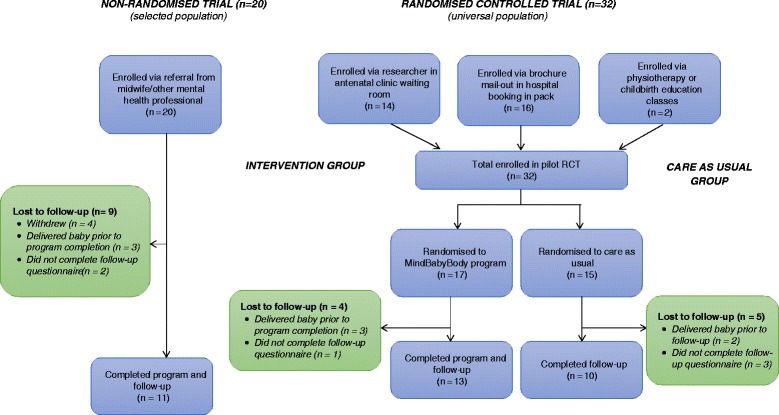
BACKGROUND: Mindfulness interventions to reduce psychological distress are well-suited to pregnancy, due to their brief and non-pharmacological nature, but there is a need for more robust evidence determining their usefulness. This pilot study was designed to explore the feasibility of a randomised controlled trial of a mindfulness intervention to reduce antenatal depression, anxiety and stress. METHODS: The study was designed in two parts 1) a non-randomised trial targeting women at risk of mental health problems (a selected population) and 2) a randomised controlled trial (RCT) of a universal population. Process evaluation focused on feasibility of recruitment pathways, participant retention, acceptability of study measures, and engagement with mindfulness practices. Measurement of psychological distress was taken pre and post intervention through the Centre for Epidemiologic Studies Depression Scale Revised, the Depression Anxiety and Stress Scale-21, the State-Trait Anxiety Inventory, and the Perceived Stress Scale. RESULTS: 20 women were recruited to the non-randomised trial, and 32 to the RCT. Recruitment through a mailed study brochure at the time of booking-in to the hospital resulted in the largest number of participants in the RCT (16/32; 50%), and resulted in considerably earlier recruitment (50% in first trimester, 50% second trimester) compared to recruitment through the antenatal clinic waiting room (86% in second trimester, 14% third trimester). Over a third of women in the universal population scored above clinical cut-offs for depression and anxiety, indicating a sample with more symptomology than the general population. The most common reason for loss to follow-up was delivery of baby prior to follow-up (n = 9). In the non-randomised study, significant within group improvements to depression and anxiety were observed. In the intervention arm of the RCT there were significant within group improvements to anxiety and mindfulness. No between group differences for the intervention and 'care as usual' control group were observed. CONCLUSIONS: This small pilot study provides evidence on the feasibility of an antenatal mindfulness intervention to reduce psychological distress. Major challenges include: finding ways to facilitate recruitment in early pregnancy and engaging younger women and other vulnerable populations. TRIAL REGISTRATION: Australian New Zealand Clinical Trials Registry ACTRN12613000742774 (31/10/2012).
Overview
The claims and statistics of this paper haven’t been checked yet.
Free: it reads the open-access text and checks the first 5 claims that cite a source we can check. Create a free account to check every claim.
Integrity signals
Registry
Cites
Statistics
Figures
Verification
Claims the paper makes
The claims and statistics of this paper haven’t been checked yet.
Free: it reads the open-access text and checks the first 5 claims that cite a source we can check. Create a free account to check every claim.
Claims other papers make about this one
Each is checked against this paper’s own text: does it say what the citing paper says it does?
The source backs part of the claim, not all of it — or backs it for a different population, condition or comparison.
In the citing paper
“The decrease in perceived pain, anxiety, and psychological stress, thus improvements in psychological well-being, is consistent with other qualitative studies assessing women's experiences in a mindfulnessbased intervention (Duncan & Bardacke, 2010; Woolhouse etal., 2014).”
From A Qualitative Investigation of a Prenatal Mindfulness Relationship-Based (PMRB) Program to Support Maternal Mental Health and Mother–Baby Relationship During Pregnancy and Post-Partum (2024) · cites this paper as Woolhouse et al., 2014
Experimental — accuracy not yet measuredThe cited source says what the claim attributes to it.
In the citing paper
“The main themes identified in the current analysis, especially regarding the changes attributed to the practice of mindfulness, are consistent with those of earlier qualitative analysis, especially the concept of acceptance (Allen etal., 2009; Woolhouse etal., 2014).”
From A Qualitative Investigation of a Prenatal Mindfulness Relationship-Based (PMRB) Program to Support Maternal Mental Health and Mother–Baby Relationship During Pregnancy and Post-Partum (2024) · cites this paper as Woolhouse et al., 2014
The cited source says what the claim attributes to it.
In the citing paper
“mindfulness level can be improved by program based on mindfulness meditation.”
From Acceptance Mindfulness-Trait as a Protective Factor for Post-Natal Depression: A Preliminary Research (2022) · cites this paper as [40]
The cited source says what the claim attributes to it.
In the citing paper
“recent pilot studies showed that prenatal mindfulness interventions have potential benefits for improving the emergence of perinatal depression [39,40].”
From Acceptance Mindfulness-Trait as a Protective Factor for Post-Natal Depression: A Preliminary Research (2022) · cites this paper as [40]
The cited source says what the claim attributes to it.
In the citing paper
“Recent studies suggest a relationship between mindfulness and the reduction of perinatal anxiety [10–15], stress [13] and perinatal depression [10, 11, 14, 16, 17].”
From Effects of an antenatal mindfulness-based childbirth and parenting programme on the postpartum experiences of mothers: a qualitative interview study. (2017) · cites this paper as [10]
3 more claims about this paper
Create a free account to see every claim other papers make about this one.
Self-check
Percentages, sums and reported differences re-computed from the paper’s own numbers.
The self-check needs the paper’s full text.
Citations
Cites
The CES-D Scale: A Self-Report Depression Scale for Research in the General Population
Radloff, L. S. (1977) · Applied Psychological Measurement · doi:10.1177/014662167700100306 · Cited by 53,267
A Global Measure of Perceived Stress
Cohen, S., Kamarck, T., & Mermelstein, R. (1983) · Journal of Health and Social Behavior · doi:10.2307/2136404 · Cited by 32,807 · cited 3×
“The ice meditation, which encouraged participants to try out different mindful approaches to pain (generated by holding a handful of ice) Table 5 Within group comparison for the RCT (universal population) MindBabyBody intervention group (n = 13)* Care as usual group (n = 10)* Pre-program M (SD) Post-program M (SD) Wit…”
MethodInfluentialLovibond, P. F., & Lovibond, S. H. (1995) · Behaviour Research and Therapy · doi:10.1016/0005-7967(94)00075-u · Cited by 14,523
An inventory for measuring clinical anxiety: Psychometric properties.
Beck, A. T., Epstein, N., Brown, G., & Steer, R. A. (1988) · Journal of Consulting and Clinical Psychology · doi:10.1037/0022-006x.56.6.893 · Cited by 14,407 · cited 1×
“This anxiety measure has been widely used with pregnant populations [21,36,37], and has demonstrated good psychometric qualities [38].”
MethodDeveloping and evaluating complex interventions: the new Medical Research Council guidance
Craig, P., Dieppe, P., Macintyre, S., Michie, S., Nazareth, I., & Petticrew, M. (2008) · BMJ · doi:10.1136/bmj.a1655 · Cited by 10,995 · cited 1×
“Prior to any large-scale evaluation study, a thorough process of piloting and feasibility work is advised by the Medical Research Council Guidance on Developing & Evaluating Complex Interventions [24].”
MethodInterpretative Phenomenological Analysis: Theory, Method and Research
(2010) · QMiP Bulletin · doi:10.53841/bpsqmip.2010.1.10.44 · Cited by 8,189
Using Self-Report Assessment Methods to Explore Facets of Mindfulness
Baer, R. A., Smith, G. T., Hopkins, J., Krietemeyer, J., & Toney, L. (2006) · Assessment · doi:10.1177/1073191105283504 · Cited by 7,511 · cited 4×
“Mindfulness was measured by the Five-Factor Mindfulness Questionnaire (FFMQ) [44].”
MethodInfluential(1993) · Cited by 7,136
(1995) · Cited by 6,909
Cognitive-Behavioral Treatment of Borderline Personality Disorder
Cary, G. L. (1994) · American Journal of Psychotherapy · doi:10.1176/appi.psychotherapy.1994.48.1.155 · Cited by 6,283
Research works printed but not linked: 1
- Mercuri K Woolhouse H MindBabyBody Group Program: Facilitators Manual 2014 Melbourne Australia The Royal Women’s Hospital and Murdoch Childrens Research Institute
Cited by
US Preventive Services Task Force, Curry, S. J., Krist, A. H., Owens, D. K., Barry, M. J., Caughey, A. B., Davidson, K. W., Doubeni, C. A., Epling, J. W., Grossman, D. C., et al. (2019) · JAMA · doi:10.1001/jama.2019.0007 · Cited by 494
Quaglia, J. T., Braun, S. E., Freeman, S. P., McDaniel, M. A., & Brown, K. W. (2016) · Psychological Assessment · doi:10.1037/pas0000268 · Cited by 341
O’Connor, E., Senger, C. A., Henninger, M. L., Coppola, E., & Gaynes, B. N. (2019) · JAMA · doi:10.1001/jama.2018.20865 · Cited by 316
Galante, J., Friedrich, C., Dawson, A. F., Modrego-Alarcón, M., Gebbing, P., Delgado-Suárez, I., Gupta, R., Dean, L., Dalgleish, T., White, I. R., et al. (2021) · PLOS Medicine · doi:10.1371/journal.pmed.1003481 · Cited by 319
“…(1) Post–int, 1 m Wong 2018 [275], China (HK) 197 Peri–/postmenopausal women (2) 52 (3.1) 100% Dis, Mindf, Somat MBSR (3) Menopause Education Control (3) Post–int, 3 m, 6 m Woolhouse 2014 [276], Australia 32 Pregnant women (2) 33 (0.6) 100% Anx, Dep, Dis, Mindf MindBabyBody Programme (2) Care…”
BackgroundInfluentialLever Taylor, B., Cavanagh, K., & Strauss, C. (2016) · PLOS ONE · doi:10.1371/journal.pone.0155720 · Cited by 284
“stress symptoms [59; 60], while the uncontrolled arm of Woolhouse et al’s, [61] study recruited women deemed to be at risk of stress, anxiety or depression by their midwives or obstetricians.”
BackgroundMethodInfluential
Metadata
- Authors
- Woolhouse, H., Mercuri, K., Judd, F., & Brown, S. J.
- Affiliations
- Royal Children's Hospital (AU)
- Royal Women's Hospital (AU)
- The Royal Melbourne Hospital (AU)
- Corresponding author
- Woolhouse, Hannah
- ORCID
- Brown, Stephanie J
- Venue
- BMC Pregnancy and Childbirth
- Published
- 2014-10-25
- Volume
- 14
- Issue
- 1
- Pages
- 369-369
- ISSN
- 1471-2393 (ISSN-L)
- PMC
- PMC4215015
- OpenAlex
- W2147534718
- Cited by
- 212
- References
- 62
- Citations by year
- 2026: 6 · 2025: 10 · 2024: 9 · 2023: 23 · 2022: 23 · 2021: 13 · 2020: 67 · 2019: 17 · 2018: 13 · 2017: 16 · 2016: 10 · 2015: 5
- FWCI
- 10.24
- Type
- journal article
- Language
- en
- Open access
- gold
- doi.org
- Locations
- BMC Pregnancy and Childbirth (publishedVersion, cc-by)
- PubMed Central (publishedVersion, cc-by)
- PubMed (publishedVersion)
- Minerva Access (University of Melbourne) (submittedVersion, cc-by)
- Funders
- State Government of Victoria
- Topics
- Health Sciences › Medicine › Public Health, Environmental and Occupational Health › Maternal Mental Health During Pregnancy and Postpartum
- Social Sciences › Psychology › Clinical Psychology › Mindfulness and Compassion Interventions
- Social Sciences › Psychology › Applied Psychology › Digital Mental Health Interventions
- Keywords
- mindfulness-based interventions, antenatal depression, prenatal anxiety, perceived stress, psychological distress in pregnancy, participant retention, feasibility, maternity hospital
- MeSH terms
- Adult, Anxiety, Australia, Depression, Feasibility Studies, Female, Hospitals, Maternity, Humans, Pilot Projects, Pregnancy, Pregnancy Complications, Pregnancy Trimesters, Prenatal Care, Prenatal Diagnosis, Stress, Psychological, Patient Selection, Tertiary Care Centers, Mindfulness
About these checks
Registry, retraction, Cites and statistics results are computed, not judged, with one exception: a printed reference that no index lists is read once by a model before it counts as a citation error. Claims are extracted by a model and kept only when their quote appears verbatim in the text; each cited source is then checked, with a model’s help, for whether it says what the claim relies on. Those verdicts can be wrong — read the claim’s quote and the cited source before relying on one.
Statistics and arithmetic are recomputed, not judged.
Confidence bands are shown only for fields calibrated on our annotated test set. None is calibrated yet, so no band is shown.
What counts as a claim ›How we measure confidence ›How we check this ›
Are you an author, or do you see a problem with this page? Request a review
How to cite
Cite CoChat for the checks on this page, and the paper for its own findings.
- This page
- CoChat. (2026). Citation check: Antenatal mindfulness intervention to reduce depression, anxiety and stress: a pilot randomised controlled trial of the MindBabyBody program in an Australian tertiary maternity hospital. https://app.cochat.ai/papers/10.1186/s12884-014-0369-z
- The paper
- Woolhouse, H., Mercuri, K., Judd, F., & Brown, S. J. (2014). Antenatal mindfulness intervention to reduce depression, anxiety and stress: a pilot randomised controlled trial of the MindBabyBody program in an Australian tertiary maternity hospital. BMC Pregnancy and Childbirth. https://doi.org/10.1186/s12884-014-0369-z
Data sources
Bibliographic data: Semantic Scholar, OpenAlex, Crossref.
Contains information from the Semantic Scholar Academic Graph Datasets, made available under the ODC Attribution License (ODC-BY 1.0).
Semantic Scholar’s data is described in: Kinney, R., et al. (2023). The Semantic Scholar Open Data Platform. arXiv:2301.10140.
