

Antenatal mindfulness intervention to reduce depression, anxiety and stress: a pilot randomised controlled trial of the MindBabyBody program in an Australian tertiary maternity hospital
Open accessThe DOI matches its Crossref record; 62 of the 63 references it cites were found in a registry or an index.
Abstract
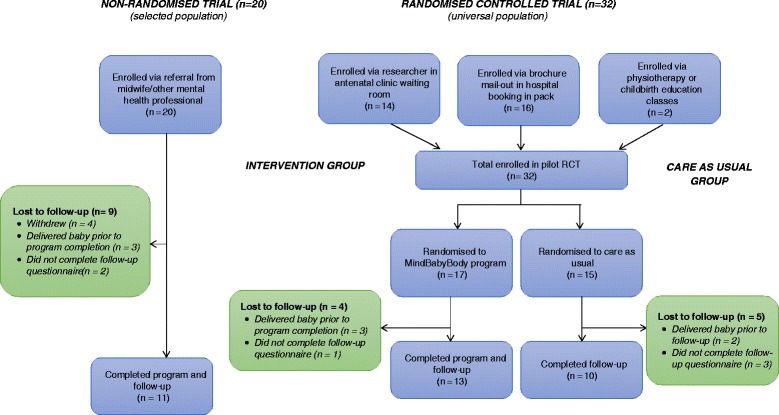
BACKGROUND: Mindfulness interventions to reduce psychological distress are well-suited to pregnancy, due to their brief and non-pharmacological nature, but there is a need for more robust evidence determining their usefulness. This pilot study was designed to explore the feasibility of a randomised controlled trial of a mindfulness intervention to reduce antenatal depression, anxiety and stress. METHODS: The study was designed in two parts 1) a non-randomised trial targeting women at risk of mental health problems (a selected population) and 2) a randomised controlled trial (RCT) of a universal population. Process evaluation focused on feasibility of recruitment pathways, participant retention, acceptability of study measures, and engagement with mindfulness practices. Measurement of psychological distress was taken pre and post intervention through the Centre for Epidemiologic Studies Depression Scale Revised, the Depression Anxiety and Stress Scale-21, the State-Trait Anxiety Inventory, and the Perceived Stress Scale. RESULTS: 20 women were recruited to the non-randomised trial, and 32 to the RCT. Recruitment through a mailed study brochure at the time of booking-in to the hospital resulted in the largest number of participants in the RCT (16/32; 50%), and resulted in considerably earlier recruitment (50% in first trimester, 50% second trimester) compared to recruitment through the antenatal clinic waiting room (86% in second trimester, 14% third trimester). Over a third of women in the universal population scored above clinical cut-offs for depression and anxiety, indicating a sample with more symptomology than the general population. The most common reason for loss to follow-up was delivery of baby prior to follow-up (n = 9). In the non-randomised study, significant within group improvements to depression and anxiety were observed. In the intervention arm of the RCT there were significant within group improvements to anxiety and mindfulness. No between group differences for the intervention and 'care as usual' control group were observed. CONCLUSIONS: This small pilot study provides evidence on the feasibility of an antenatal mindfulness intervention to reduce psychological distress. Major challenges include: finding ways to facilitate recruitment in early pregnancy and engaging younger women and other vulnerable populations. TRIAL REGISTRATION: Australian New Zealand Clinical Trials Registry ACTRN12613000742774 (31/10/2012).
Overview
The claims and statistics of this paper haven’t been checked yet.
Free: it reads the open-access text and checks the first 5 claims that cite a source we can check. Create a free account to check every claim.
Integrity signals
Registry
Cites
Statistics
Figures
Verification
Claims the paper makes
The claims and statistics of this paper haven’t been checked yet.
Free: it reads the open-access text and checks the first 5 claims that cite a source we can check. Create a free account to check every claim.
Claims other papers make about this one
Each is checked against this paper’s own text: does it say what the citing paper says it does?
The source backs part of the claim, not all of it — or backs it for a different population, condition or comparison.
In the citing paper
“The decrease in perceived pain, anxiety, and psychological stress, thus improvements in psychological well-being, is consistent with other qualitative studies assessing women's experiences in a mindfulnessbased intervention (Duncan & Bardacke, 2010; Woolhouse etal., 2014).”
From A Qualitative Investigation of a Prenatal Mindfulness Relationship-Based (PMRB) Program to Support Maternal Mental Health and Mother–Baby Relationship During Pregnancy and Post-Partum (2024) · cites this paper as Woolhouse et al., 2014
Experimental — accuracy not yet measuredThe cited source says what the claim attributes to it.
In the citing paper
“The main themes identified in the current analysis, especially regarding the changes attributed to the practice of mindfulness, are consistent with those of earlier qualitative analysis, especially the concept of acceptance (Allen etal., 2009; Woolhouse etal., 2014).”
From A Qualitative Investigation of a Prenatal Mindfulness Relationship-Based (PMRB) Program to Support Maternal Mental Health and Mother–Baby Relationship During Pregnancy and Post-Partum (2024) · cites this paper as Woolhouse et al., 2014
The cited source says what the claim attributes to it.
In the citing paper
“mindfulness level can be improved by program based on mindfulness meditation.”
From Acceptance Mindfulness-Trait as a Protective Factor for Post-Natal Depression: A Preliminary Research (2022) · cites this paper as [40]
The cited source says what the claim attributes to it.
In the citing paper
“recent pilot studies showed that prenatal mindfulness interventions have potential benefits for improving the emergence of perinatal depression [39,40].”
From Acceptance Mindfulness-Trait as a Protective Factor for Post-Natal Depression: A Preliminary Research (2022) · cites this paper as [40]
The cited source says what the claim attributes to it.
In the citing paper
“Recent studies suggest a relationship between mindfulness and the reduction of perinatal anxiety [10–15], stress [13] and perinatal depression [10, 11, 14, 16, 17].”
From Effects of an antenatal mindfulness-based childbirth and parenting programme on the postpartum experiences of mothers: a qualitative interview study. (2017) · cites this paper as [10]
3 more claims about this paper
Create a free account to see every claim other papers make about this one.
Self-check
Percentages, sums and reported differences re-computed from the paper’s own numbers.
The self-check needs the paper’s full text.
Citations
Cites
The CES-D Scale: A Self-Report Depression Scale for Research in the General Population
Radloff, L. S. (1977) · Applied Psychological Measurement · doi:10.1177/014662167700100306 · Cited by 53,267
A Global Measure of Perceived Stress
Cohen, S., Kamarck, T., & Mermelstein, R. (1983) · Journal of Health and Social Behavior · doi:10.2307/2136404 · Cited by 32,807 · cited 3×
“The ice meditation, which encouraged participants to try out different mindful approaches to pain (generated by holding a handful of ice) Table 5 Within group comparison for the RCT (universal population) MindBabyBody intervention group (n = 13)* Care as usual group (n = 10)* Pre-program M (SD) Post-program M (SD) Wit…”
MethodInfluentialLovibond, P. F., & Lovibond, S. H. (1995) · Behaviour Research and Therapy · doi:10.1016/0005-7967(94)00075-u · Cited by 14,523
An inventory for measuring clinical anxiety: Psychometric properties.
Beck, A. T., Epstein, N., Brown, G., & Steer, R. A. (1988) · Journal of Consulting and Clinical Psychology · doi:10.1037/0022-006x.56.6.893 · Cited by 14,407 · cited 1×
“This anxiety measure has been widely used with pregnant populations [21,36,37], and has demonstrated good psychometric qualities [38].”
MethodDeveloping and evaluating complex interventions: the new Medical Research Council guidance
Craig, P., Dieppe, P., Macintyre, S., Michie, S., Nazareth, I., & Petticrew, M. (2008) · BMJ · doi:10.1136/bmj.a1655 · Cited by 10,995 · cited 1×
“Prior to any large-scale evaluation study, a thorough process of piloting and feasibility work is advised by the Medical Research Council Guidance on Developing & Evaluating Complex Interventions [24].”
MethodInterpretative Phenomenological Analysis: Theory, Method and Research
(2010) · QMiP Bulletin · doi:10.53841/bpsqmip.2010.1.10.44 · Cited by 8,189
Using Self-Report Assessment Methods to Explore Facets of Mindfulness
Baer, R. A., Smith, G. T., Hopkins, J., Krietemeyer, J., & Toney, L. (2006) · Assessment · doi:10.1177/1073191105283504 · Cited by 7,511 · cited 4×
“Mindfulness was measured by the Five-Factor Mindfulness Questionnaire (FFMQ) [44].”
MethodInfluential(1993) · Cited by 7,136
(1995) · Cited by 6,909
Cognitive-Behavioral Treatment of Borderline Personality Disorder
Cary, G. L. (1994) · American Journal of Psychotherapy · doi:10.1176/appi.psychotherapy.1994.48.1.155 · Cited by 6,283
Research works printed but not linked: 1
- Mercuri K Woolhouse H MindBabyBody Group Program: Facilitators Manual 2014 Melbourne Australia The Royal Women’s Hospital and Murdoch Childrens Research Institute
Cited by
US Preventive Services Task Force, Curry, S. J., Krist, A. H., Owens, D. K., Barry, M. J., Caughey, A. B., Davidson, K. W., Doubeni, C. A., Epling, J. W., Grossman, D. C., et al. (2019) · JAMA · doi:10.1001/jama.2019.0007 · Cited by 494
Quaglia, J. T., Braun, S. E., Freeman, S. P., McDaniel, M. A., & Brown, K. W. (2016) · Psychological Assessment · doi:10.1037/pas0000268 · Cited by 341
Galante, J., Friedrich, C., Dawson, A. F., Modrego-Alarcón, M., Gebbing, P., Delgado-Suárez, I., Gupta, R., Dean, L., Dalgleish, T., White, I. R., et al. (2021) · PLOS Medicine · doi:10.1371/journal.pmed.1003481 · Cited by 319
“…(1) Post–int, 1 m Wong 2018 [275], China (HK) 197 Peri–/postmenopausal women (2) 52 (3.1) 100% Dis, Mindf, Somat MBSR (3) Menopause Education Control (3) Post–int, 3 m, 6 m Woolhouse 2014 [276], Australia 32 Pregnant women (2) 33 (0.6) 100% Anx, Dep, Dis, Mindf MindBabyBody Programme (2) Care…”
BackgroundInfluentialO’Connor, E., Senger, C. A., Henninger, M. L., Coppola, E., & Gaynes, B. N. (2019) · JAMA · doi:10.1001/jama.2018.20865 · Cited by 316
Lever Taylor, B., Cavanagh, K., & Strauss, C. (2016) · PLOS ONE · doi:10.1371/journal.pone.0155720 · Cited by 284
“stress symptoms [59; 60], while the uncontrolled arm of Woolhouse et al’s, [61] study recruited women deemed to be at risk of stress, anxiety or depression by their midwives or obstetricians.”
BackgroundMethodInfluentialMindfulness-based interventions during pregnancy: a systematic review and meta-analysis
Dhillon, A., Sparkes, E., & Duarte, R. V. (2017) · Mindfulness · doi:10.1007/s12671-017-0726-x · Cited by 239
“Woolhouse et al. (2014) A 6-session mindfulness-based group therapy programme developed specifically for pregnancy by one of the investigators.”
BackgroundMethodDimidjian, S., Goodman, S. H., Felder, J. N., Gallop, R., Brown, A. P., & Beck, A. (2016) · Journal of Consulting and Clinical Psychology · doi:10.1037/ccp0000068 · Cited by 223
“The evidence of the acceptability of MBCT-PD is convergent with an emerging literature on the use of mindfulness during pregnancy to support mental health (Dunn et al., 2012; J. H. Goodman et al., 2014; Vieten & Astin, 2008; Woolhouse et al., 2014) and parenting (Duncan & Bardacke, 2010).”
MethodWu, Y., Lu, Y.-C., Jacobs, M., Pradhan, S., Kapse, K., Zhao, L., Niforatos-Andescavage, N., Vezina, G., du Plessis, A. J., & Limperopoulos, C. (2020) · JAMA Network Open · doi:10.1001/jamanetworkopen.2019.19940 · Cited by 218
Sun, Y., Li, Y., Wang, J., Chen, Q., Bazzano, A. N., & Cao, F. (2021) · Journal of Medical Internet Research · doi:10.2196/23410 · Cited by 165
Shi, Z., & MacBeth, A. (2017) · Mindfulness · doi:10.1007/s12671-016-0673-y · Cited by 148
“…randomized controlled trials (Dimidjian et al. 2016; Guardino et al. 2014; Narimani andMusavi 2015; Perez-Blasco et al. 2013; Vieten and Astin 2008; Woolhouse et al. 2014, sample 1; Zhang and Emory, 2015); two studies were nonrandomized controlled trials (Dunn et al. 2012; Miklowitz et al. 2015)…”
BackgroundMethodResultInfluentialWu, Y., Kapse, K., Jacobs, M., Niforatos-Andescavage, N., Donofrio, M. T., Krishnan, A., Vezina, G., Wessel, D., du Plessis, A., & Limperopoulos, C. (2020) · JAMA Pediatrics · doi:10.1001/jamapediatrics.2019.5316 · Cited by 128
“To MRI 1 NA 42 (23) [7-94] NA To MRI 2 NA 91 (24) [41-129]”
Townshend, K., Jordan, Z., Stephenson, M., & Tsey, K. (2016) · JBI Database of Systematic Reviews and Implementation Reports · doi:10.11124/jbisrir-2016-2314 · Cited by 120
San Lazaro Campillo, I., Meaney, S., McNamara, K., & O'Donoghue, K. (2017) · BMJ Open · doi:10.1136/bmjopen-2017-017802 · Cited by 115
Wu, Y., Espinosa, K. M., Barnett, S. D., Kapse, A., Quistorff, J. L., Lopez, C., Andescavage, N., Pradhan, S., Lu, Y.-C., Kapse, K., et al. (2022) · JAMA Network Open · doi:10.1001/jamanetworkopen.2022.9244 · Cited by 113
Yang, M., Jia, G., Sun, S., Ye, C., Zhang, R., & Yu, X. (2019) · Journal of Midwifery & Women's Health · doi:10.1111/jmwh.12944 · Cited by 99
Domínguez-Solís, E., Lima‐Serrano, M., & Lima‐Rodríguez, J. S. (2021) · Midwifery · doi:10.1016/j.midw.2021.103126 · Cited by 185
Lönnberg, G., Jonas, W., Unternaehrer, E., Bränström, R., Nissen, E., & Niemi, M. (2020) · Journal of Affective Disorders · doi:10.1016/j.jad.2019.10.048 · Cited by 108
Pan, W.-L., Chang, C.-W., Chen, S.-M., & Gau, M.-L. (2019) · BMC Pregnancy and Childbirth · doi:10.1186/s12884-019-2503-4 · Cited by 107
“The mindfulness intervention may best be administered during both the prenatal and postnatal periods in order to sustain its beneficial effects [18].”
BackgroundMindfulness and perinatal mental health: A systematic review
Hall, H. G., Beattie, J., Lau, R., East, C., & Anne Biro, M. (2016) · Women and Birth · doi:10.1016/j.wombi.2015.08.006 · Cited by 105
Recruitment and retention strategies in mental health trials – A systematic review
Liu, Y., Pencheon, E., Hunter, R. M., Moncrieff, J., & Freemantle, N. (2018) · PLOS ONE · doi:10.1371/journal.pone.0203127 · Cited by 98
The effects of mindfulness interventions on prenatal well-being: A systematic review
Matvienko-Sikar, K., Lee, L., Murphy, G., & Murphy, L. (2016) · Psychology & Health · doi:10.1080/08870446.2016.1220557 · Cited by 98
“The majority of studies reported significant reductions in anxiety following intervention use (Beddoe et al., 2009; Byrne et al., 2014; Duncan & Bardacke, 2010; Goodman et al., 2014; Vieten & Astin, 2008; Woolhouse et al., 2014).”
BackgroundMethodResultInfluentialSmith, C. A., Shewamene, Z., Galbally, M., Schmied, V., & Dahlen, H. (2019) · Journal of Affective Disorders · doi:10.1016/j.jad.2018.11.054 · Cited by 98
Mindfulness for pregnancy: a randomised controlled study of online mindfulness during pregnancy
Krusche, A., Dymond, M., Murphy, S. E., & Crane, C. (2018) · Midwifery · doi:10.1016/j.midw.2018.07.005 · Cited by 97
Mindfulness-based programme on the psychological health of pregnant women
Pan, W.-L., Gau, M.-L., Lee, T.-Y., Jou, H.-J., Liu, C.-Y., & Wen, T.-K. (2019) · Women and Birth · doi:10.1016/j.wombi.2018.04.018 · Cited by 90
Salm Ward, T., Kanu, F. A., & Robb, S. W. (2017) · Archives of Women's Mental Health · doi:10.1007/s00737-016-0689-2 · Cited by 68
Zarenejad, M., Yazdkhasti, M., Rahimzadeh, M., Tourzani, Z. M., & Saeieh, S. E. (2020) · Brain and Behavior · doi:10.1002/brb3.1561 · Cited by 89
Evans, K., Spiby, H., & Morrell, J. (2019) · Archives of Women s Mental Health · doi:10.1007/s00737-018-0936-9 · Cited by 77
“High confidence (Brugha et al. 2015, Cornsweet Barber et al. 2013, Côté-Arsenault et al. 2014, Davis et al. 2015, Dunn et al. 2012, Goodman et al. 2014, Milgrom et al. 2015, Woolhouse et al. 2014) In general the studies were moderately well conducted.”
BackgroundInfluentialBeattie, J., Hall, H., Biro, M. A., East, C., & Lau, R. (2017) · Midwifery · doi:10.1016/j.midw.2017.04.006 · Cited by 58
Mendelson, T., McAfee, C., Damian, A. J., Brar, A., Donohue, P., & Sibinga, E. (2018) · Archives of Women's Mental Health · doi:10.1007/s00737-018-0862-x · Cited by 58
Warriner, S., Crane, C., Dymond, M., & Krusche, A. (2018) · Midwifery · doi:10.1016/j.midw.2018.05.004 · Cited by 57
An evaluation of perinatal mental health interventions: An integrative literature review
Lavender, T. J., Ebert, L. M., & Jones, D. (2016) · Women and Birth · doi:10.1016/j.wombi.2016.04.004 · Cited by 64
Leng, L. L., Yin, X. C., & Ng, S. M. (2023) · Comprehensive Psychiatry · doi:10.1016/j.comppsych.2023.152375 · Cited by 55
Isgut, M., Smith, A. K., Reimann, E. S., Kucuk, O., & Ryan, J. (2017) · Journal of Perinatal Medicine · doi:10.1515/jpm-2016-0189 · Cited by 53
“[63] used a similar 6-week program (MindBabyBody) which combined the MBSR, MBCT, and MBCP programs.”
MethodSalazar de Pablo, G., De Micheli, A., Solmi, M., Oliver, D., Catalan, A., Verdino, V., Di Maggio, L., Bonoldi, I., Radua, J., Baccaredda Boy, O., et al. (2021) · Harvard Review of Psychiatry · doi:10.1097/hrp.0000000000000294 · Cited by 51
Meditation and Mindfulness in Pregnancy and Postpartum: A Review of the Evidence
Babbar, S., Oyarzabal, A. J., & Oyarzabal, E. A. (2021) · Clinical Obstetrics & Gynecology · doi:10.1097/grf.0000000000000640 · Cited by 65
Mindfulness interventions during pregnancy: A narrative review
Lucena, L. D. R., Frange, C., Pinto, A. C. A., Andersen, M. L., Tufik, S., & Hachul, H. (2020) · Journal of Chinese Integrative Medicine · doi:10.1016/j.joim.2020.07.007 · Cited by 60
Lu, Y.-C., Andescavage, N., Wu, Y., Kapse, K., Andersen, N. R., Quistorff, J., Saeed, H., Lopez, C., Henderson, D., Barnett, S. D., et al. (2022) · Communications Medicine · doi:10.1038/s43856-022-00111-w · Cited by 46
Togher, K. L., Treacy, E., O’Keeffe, G. W., & Kenny, L. C. (2017) · Psychiatry Research · doi:10.1016/j.psychres.2017.05.013 · Cited by 43
“Additionally, a preliminary RCT showed significant improvement in anxiety and depressive symptoms in women receiving an antenatal mindfulness intervention (Woolhouse et al., 2014).”
BackgroundNetworks, F. T. N. N. A. N. N. H. H. S., Monk, C. E., Webster, R., McNeil, R. B., Parker, C. B., Catov, J. M., Greenland, P., Merz, C. N. B., Silver, R. M., Simhan, H. N., et al. (2019) · Archives of Women s Mental Health · doi:10.1007/s00737-019-00970-8 · Cited by 52
Luberto, C. M., Park, E. R., & Goodman, J. H. (2018) · Mindfulness · doi:10.1007/s12671-017-0825-8 · Cited by 42
“In previous studies, women often practiced four days per week for 5–10 minutes each time (Byrne et al., 2014; Guardino et al., 2014; Woolhouse et al., 2014), whereas participants practiced approximately four days per week for 30 minutes in the current study.”
BackgroundYan, H., Wu, Y., & Li, H. (2022) · Journal of Affective Disorders · doi:10.1016/j.jad.2022.03.002 · Cited by 54
Clinkscales, N., Golds, L., Berlouis, K., & MacBeth, A. (2023) · Psychology and Psychotherapy: Theory, Research and Practice · doi:10.1111/papt.12441 · Cited by 41
Corbally, L., & Wilkinson, M. (2021) · Mindfulness · doi:10.1007/s12671-021-01697-3 · Cited by 50
“…mean differences in mindfulness Perez-Blasco et al.(2013) Zhang and Emory (2015) Beattie et al. (2017) Lonnberg et al. (2020) Pan et al. (2019) Woolhouse et al. (2014) Gambrel and Piercy (2015) Duncan et al. (2017) Q7 = 6.52, p = 0.48; I 2 = 0.01% 1.07 [0.13, 2.01] 0.48 [-0.21, 1.17] 0.35…”
InfluentialMissler, M., Donker, T., Beijers, R., Ciharova, M., Moyse, C., de Vries, R., Denissen, J., & van Straten, A. (2021) · BMC Pregnancy and Childbirth · doi:10.1186/s12884-021-03752-2 · Cited by 40
Psychotherapeutic Treatments for Depression During Pregnancy
Genovez, M., Vanderkruik, R. C., Lemon, E. L., & Dimidjian, S. (2018) · Clinical Obstetrics & Gynecology · doi:10.1097/grf.0000000000000388 · Cited by 43
Perinatal anxiety: approach to diagnosis and management in the obstetric setting
Thorsness, K. R., Watson, C., & LaRusso, E. M. (2018) · American Journal of Obstetrics and Gynecology · doi:10.1016/j.ajog.2018.05.017 · Cited by 52
Mindfulness-Based Interventions for Psoriasis: a Randomized Controlled Trial
D’Alton, P., Kinsella, L., Walsh, O., Sweeney, C., Timoney, I., Lynch, M., O’Connor, M., & Kirby, B. (2019) · Mindfulness · doi:10.1007/s12671-018-0973-5 · Cited by 39
“The FFMQ has demonstrated good psychometric properties with evidence supporting its factor structure and incremental and concurrent validity (Baer et al. 2008).”
ResultInfluentialMartinez‐Paredes, J. F., & Jácome-Pérez, N. (2017) · Revista Colombiana de Psiquiatría · doi:10.1016/j.rcp.2017.07.003 · Cited by 75
Güney, E., Cengizhan, S. Ö., OKYAY, E. K., Zeynep, B. A. L., & Uçar, T. (2022) · Complementary Therapies in Clinical Practice · doi:10.1016/j.ctcp.2022.101566 · Cited by 44
Roy Malis, F., Meyer, T., & Gross, M. M. (2017) · BMC Pregnancy and Childbirth · doi:10.1186/s12884-017-1240-9 · Cited by 36
“Recent studies suggest a relationship between mindfulness and the reduction of perinatal anxiety [10–15], stress [13] and perinatal depression [10, 11, 14, 16, 17].”
BackgroundAbdolalipour, S., Mohammad‐Alizadeh‐Charandabi, S., Mashayekh‐Amiri, S., & Mirghafourvand, M. (2023) · Journal of Affective Disorders · doi:10.1016/j.jad.2023.04.020 · Cited by 47
Guo, P., Zhang, X., Liu, N., Wang, J., Chen, D., Sun, W., Li, P., & Zhang, W. (2020) · Journal of Advanced Nursing · doi:10.1111/jan.14588 · Cited by 44
Lönnberg, G., Jonas, W., Bränström, R., Nissen, E., & Niemi, M. (2020) · Mindfulness · doi:10.1007/s12671-020-01403-9 · Cited by 39
“Support for feasibility and indications of improvements in psychological distress was also found in a pilot study of the antenatal MBI called theMindBabyBody program (Woolhouse et al. 2014).”
ResultAbdollahi, S., Faramarzi, M., Delavar, M. A., Bakouei, F., Chehrazi, M., & Gholinia, H. (2020) · Frontiers in Psychology · doi:10.3389/fpsyg.2020.00787 · Cited by 51
“The mindfulness group therapy program, with six sessions of 2 h once a week, reduced the score of state anxiety (Woolhouse et al., 2014).”
MethodEvans, K., Morrell, C. J., & Spiby, H. (2018) · Journal of Advanced Nursing · doi:10.1111/jan.13456 · Cited by 33
“Pregnant women were also recruited by: posting flyers in clinic locations (Vieten & Astin 2008, Woolhouse et al. 2014, Guardino et al. 2014); via antenatal classes (Korol & Von Baeyer 1992, Vieten & Astin 2008, Woolhouse et al. 2014); support groups (Côté-Arsenault et al. 2014), attendance at…”
BackgroundInfluentialPlatt, L. M., Whitburn, A. I., Platt-Koch, A. G., & Koch, R. L. (2016) · Journal of Psychosocial Nursing and Mental Health Services · doi:10.3928/02793695-20160725-07 · Cited by 33
Evans, K., Spiby, H., & Morrell, C. J. (2020) · BMC Pregnancy and Childbirth · doi:10.1186/s12884-020-03469-8 · Cited by 33
Emphasizing mindfulness training in acceptance relieves anxiety and depression during pregnancy
Yang, M., Zhou, X., Ye, C., Li, J., Sun, S., & Yu, X. (2022) · Psychiatry Research · doi:10.1016/j.psychres.2022.114540 · Cited by 29
Lönnberg, G., Nissen, E., & Niemi, M. (2018) · BMC Pregnancy and Childbirth · doi:10.1186/s12884-018-2098-1 · Cited by 29
Davis, J. A., Gibson, L. Y., Bear, N., Finlay‐jones, A. L., Ohan, J. L., Silva, D. T., & Prescott, S. L. (2021) · International Journal of Environmental Research and Public Health · doi:10.3390/ijerph18136958 · Cited by 38
“A number of mindfulness programs have reported reduced rates of anxiety, depression, and stress during pregnancy [31].”
BackgroundSbrilli, M. D., Duncan, L. G., Bardacke, N., & Laurent, H. K. (2020) · BMC Pregnancy and Childbirth · doi:10.1186/s12884-020-03318-8 · Cited by 40
Sacristán-Martín, O., Germán, M. Á. S., García‐Campayo, J., Duncan, L. G., Bardacke, N., Fernández-Alonso, C., Garcia-Sacristan, G., Garcia-Sacristan, D., Barceló‐Soler, A., & Montero‐Marín, J. (2019) · Trials · doi:10.1186/s13063-019-3739-z · Cited by 40
Weis, K. L., Lederman, R. P., Walker, K. C., & Chan, W. (2017) · Journal of Obstetric, Gynecologic & Neonatal Nursing · doi:10.1016/j.jogn.2017.07.003 · Cited by 34
Wilson, N., Wynter, K. H., Anderson, C., Rajaratnam, S. M. W., Fisher, J., & Bei, B. (2019) · BMC Psychiatry · doi:10.1186/s12888-019-2024-8 · Cited by 31
Developmental implications of maternal antenatal anxiety mechanisms and approaches to intervention
Newman, L., Judd, F., & Komiti, A. (2017) · Translational Developmental Psychiatry · doi:10.1080/20017022.2017.1309879 · Cited by 24
Self-citationACEs and Pregnancy: Time to Support All Expectant Mothers
Hudziak, J. J. (2018) · PEDIATRICS · doi:10.1542/peds.2018-0232 · Cited by 28
Effect of mindfulness meditation on depression during pregnancy: A meta-analysis
Li, Y., Chen, J.-H., Chen, B.-X., Wang, T., Wu, Z., Huang, X., & Li, S.-S. (2022) · Frontiers in Psychology · doi:10.3389/fpsyg.2022.963133 · Cited by 23
Prenatal yoga for young women a mixed methods study of acceptability and benefits
Styles, A., Loftus, V., Nicolson, S., & Harms, L. (2019) · BMC Pregnancy and Childbirth · doi:10.1186/s12884-019-2564-4 · Cited by 30
Reangsing, C., Punsuwun, S., & Oerther, S. E. (2024) · Journal of Affective Disorders · doi:10.1016/j.jad.2024.02.049 · Cited by 28
Lyngsøe, B. K., Rytter, D., Munk‐Olsen, T., Vestergaard, C. H., Christensen, K. S., & Bech, B. H. (2018) · British Journal of General Practice · doi:10.3399/bjgp18x700733 · Cited by 20
The approach to managing perinatal anxiety: A mini-review
Silverwood, V., Bullock, L., Turner, K. M., Chew-Graham, C. A., & Kingstone, T. (2022) · Frontiers in Psychiatry · doi:10.3389/fpsyt.2022.1022459 · Cited by 23
Pregnancy-Related Anxiety in Women Who Conceive Via In Vitro Fertilization: A Mixed Methods Approach
Stevenson, E. L., Trotter, K. J., Bergh, C., & Sloane, R. J. (2016) · The Journal of Perinatal Education · doi:10.1891/1058-1243.25.3.193 · Cited by 19
Prenatal Maternal Psychological Distress During the COVID-19 Pandemic and Newborn Brain Development
Weiner, S. L., Wu, Y., Kapse, K. J., Vozar, T. M., Cheng, J. J., Murnick, J. G., Henderson, D., Teramoto, H., Limperopoulos, C., & Andescavage, N. N. (2024) · JAMA Network Open · doi:10.1001/jamanetworkopen.2024.17924 · Cited by 27
van der Riet, P., Francis, L., & Rees, A. (2019) · Scandinavian Journal of Caring Sciences · doi:10.1111/scs.12762 · Cited by 22
The relationship of trait mindfulness to physical and psychological health during pregnancy
Mennitto, S., Ditto, B., & Costa, D. D. (2020) · Journal of Psychosomatic Obstetrics & Gynecology · doi:10.1080/0167482x.2020.1761320 · Cited by 25
Lönnberg, G., Niemi, M., Salomonsson, B., Bränström, R., Nissen, E., & Jonas, W. (2021) · Mindfulness · doi:10.1007/s12671-021-01658-w · Cited by 20
Qi, W., Zhao, F., Huang, S., Wei, Z., Yang, H., He, K., Li, C., Guo, Q., & Hu, J. (2023) · Mindfulness · doi:10.1007/s12671-023-02221-5 · Cited by 15
“The purpose was to inform participants al., 2018 , b ; Lönnberg et al., 2020 ; Pan et al., 2019 ; Yang et al., 2019b ), or 6 weeks (Guardino et al., 2014; Woolhouse et al., 2014 ).”
BackgroundZeinabeh, M. Z., Ahmadi, A., Ghazanfarpour, M., Dehesh, T., Sanjari, M., & Alidousti, K. (2023) · Revista Brasileira Ginecologia e Obstetrícia · doi:10.1055/s-0043-1775810 · Cited by 15
Impact of Parental Psychiatric Illness on Infant Development
Milgrom, J., Ericksen, J., & Sved‐Williams, A. (2015) · Springer eBooks · doi:10.1007/978-3-319-21557-0_4 · Cited by 18
Martinez‐Paredes, J. F., & Jácome-Pérez, N. (2019) · Revista Colombiana de Psiquiatría (English ed ) · doi:10.1016/j.rcpeng.2017.07.002 · Cited by 41
Parents’ perceptions of antenatal educational programs: A meta-synthesis
Shorey, S., Loh, D. N. L., Chan, V., Chua, C. M. S., & Choolani, M. A. (2022) · Midwifery · doi:10.1016/j.midw.2022.103432 · Cited by 21
Trait mindfulness scores are related to trajectories of depressive symptoms during pregnancy
Hulsbosch, L. P., Boekhorst, M. G. B. M., Endendijk, J. J., Nyklíček, I., Potharst, E. S., & Pop, V. J. M. (2022) · Journal of Psychiatric Research · doi:10.1016/j.jpsychires.2022.04.023 · Cited by 16
Liaw, W. R., Northrup, T. F., Stotts, A. L., Bakos‐Block, C., Suchting, R., Chen, A., Hernandez, A., Finzetto, L., Green, C., & Murphy, T. (2023) · The Journal of the American Board of Family Medicine · doi:10.3122/jabfm.2022.220349r1 · Cited by 15
“Prior interventions using the PSS have reported mean differences of approximately 3 (scale range: 0to 40; SD=6).(23,24,39,40) Given a 2-sided a of 0.”
MethodHauck, Y. L., Fisher, C. M., Byrne, J., & Bayes, S. J. (2016) · The Journal of Perinatal Education · doi:10.1891/1058-1243.25.3.162 · Cited by 15
“The small number of international pilot studies that have evaluated programs incorporating mindfulness within childbirth education have produced promising results (Byrne et al., 2014; Duncan & Bardacke, 2009; Woolhouse et al., 2014).”
BackgroundThe relationship between mindfulness and envy: The mediating role of emotional intelligence
Xiang, Y., Dong, X., Zhao, J., Li, Q., Zhao, J., & Zhang, W. (2021) · PsyCh Journal · doi:10.1002/pchj.493 · Cited by 16
Doty, M. S., Chen, H.-Y., Ajishegiri, O., Sibai, B. M., Blackwell, S. C., & Chauhan, S. P. (2022) · American Journal of Obstetrics & Gynecology MFM · doi:10.1016/j.ajogmf.2022.100562 · Cited by 12
A Randomized Control Trial of Meditation for Mothers Pumping Breastmilk for Preterm Infants
Massa, K., Ramireddy, S., Ficenec, S., Mank, C., Josephsen, J. B., & Babbar, S. (2022) · American Journal of Perinatology · doi:10.1055/a-1787-7576 · Cited by 16
Sansone, A., Stapleton, P., Patching, A., & Lawrence, Z. (2024) · OBM Integrative and Complementary Medicine · doi:10.21926/obm.icm.2401001 · Cited by 18
Mindfulness training modifies attentional bias to facial emotion and emotional symptoms
Kou, H., Luo, W., Liu, X., Ke, M., Xie, Q., Li, X., & Bi, T. (2023) · Journal of Psychiatric Research · doi:10.1016/j.jpsychires.2023.10.020 · Cited by 11
Akça, E. İ., Cengizhan, S. Ö., & Gökbulut, N. (2023) · Mindfulness · doi:10.1007/s12671-023-02247-9 · Cited by 14
“It is known that mindfulness interventions have positive effects on the distress (Pan et al., 2019; Woolhouse et al., 2014) and anxiety (İbici Akca et al., 2023; Mohamed et al., 2017; Vieten & Astin, 2008; Woolhouse et al., 2014) levels of pregnant women.”
Stress, anxiety and depression levels in pregnancy: outpatient versus inpatient
Doty, M. S., Chen, H.-Y., Grace, R., Ashimi, S. S., & Chauhan, S. P. (2022) · The Journal of Maternal-Fetal & Neonatal Medicine · doi:10.1080/14767058.2022.2049748 · Cited by 13
“5 in ages 25 to 34 years old (similar to our population) [1,24,25].”
BackgroundMethodInfluentialEffects of mindfulness-based childbirth education on prenatal anxiety: A quasi-experimental study
Innab, A., AlKhunaizi, A. N., Al-Otaibi, A. G., & Moafa, H. (2023) · Acta Psychologica · doi:10.1016/j.actpsy.2023.103978 · Cited by 17
Asis‐Cruz, J. D., Kim, J., Krishnamurthy, D., Lopez, C., Kapse, K. J., Andescavage, N. N., Vézina, G., & Limperopoulos, C. (2023) · Developmental Cognitive Neuroscience · doi:10.1016/j.dcn.2023.101282 · Cited by 11
“Scores for the STAI ranged between 20 and 80; a score ≥40 is indicative of the presence of anxiety (Woolhouse et al., 2014).”
Outcomes of a Multimodal Resilience Training Program in an Outpatient Integrative Medicine Clinic
Griffin, K. H., Johnson, J. R., Kitzmann, J. P., Kolste, A. K., & Dusek, J. A. (2015) · The Journal of Alternative and Complementary Medicine · doi:10.1089/acm.2015.0130 · Cited by 11
The Handbook of Wellness Medicine
IsHak, W. W. (2020) · Cambridge University Press eBooks · doi:10.1017/9781108650182 · Cited by 13
Saeed, H., Lu, Y.-C., Andescavage, N. N., Kapse, K. J., Andersen, N. R., Lopez, C., Quistorff, J. L., Barnett, S. D., Henderson, D., Bulas, D., et al. (2023) · Scientific Reports · doi:10.1038/s41598-023-33343-4 · Cited by 14
Treating postpartum mood and anxiety disorders in primary care pediatrics
Umylny, P., Germán, M., & Lantiere, A. (2017) · Current problems in pediatric and adolescent health care · doi:10.1016/j.cppeds.2017.08.003 · Cited by 13
Wi, D., Lee, R. Y., & Kantrowitz‐Gordon, I. (2025) · PLoS ONE · doi:10.1371/journal.pone.0322931 · Cited by 10
“Prior studies on the effect of mindfulness-based intervention [55–57] couldn’t find significant improvement in the level of mindfulness in pregnant women, which is similar to our findings.”
Bhamani, S. S., Arthur, D., Parys, A. V., Letourneau, N. L., Wagnild, G. M., & Degomme, O. (2023) · International Journal of Environmental Research and Public Health · doi:10.3390/ijerph20085517 · Cited by 10
“A RCT conducted in Australia on mindfulness intervention (meditation and cognitive exercises) to reduce depression and anxiety in the perinatal period reported significant decreases in depression, anxiety, and stress scores in the intervention arm [39].”
BackgroundDick, J. A., Sun, W., Stanyon, W., Papaconstantinou, E. A., D’Paiva, V., Jiwani-Ebrahim, N., & Dennis, C. (2019) · Journal of Child and Family Studies · doi:10.1007/s10826-019-01657-5 · Cited by 12
Metadata
- Authors
- Woolhouse, H., Mercuri, K., Judd, F., & Brown, S. J.
- Affiliations
- Royal Children's Hospital (AU)
- Royal Women's Hospital (AU)
- The Royal Melbourne Hospital (AU)
- Corresponding author
- Woolhouse, Hannah
- ORCID
- Brown, Stephanie J
- Venue
- BMC Pregnancy and Childbirth
- Published
- 2014-10-25
- Volume
- 14
- Issue
- 1
- Pages
- 369-369
- ISSN
- 1471-2393 (ISSN-L)
- PMC
- PMC4215015
- OpenAlex
- W2147534718
- Semantic Scholar
- b66f21467cc4095163c50bacd9b287bc6cdfd028
- Cited by
- 212
- References
- 62
- Citations by year
- 2026: 6 · 2025: 10 · 2024: 9 · 2023: 23 · 2022: 23 · 2021: 13 · 2020: 67 · 2019: 17 · 2018: 13 · 2017: 16 · 2016: 10 · 2015: 5
- FWCI
- 10.24
- Type
- journal article
- Language
- en
- Open access
- gold
- doi.org
- Locations
- BMC Pregnancy and Childbirth (publishedVersion, cc-by)
- PubMed Central (publishedVersion, cc-by)
- PubMed (publishedVersion)
- Minerva Access (University of Melbourne) (submittedVersion, cc-by)
- Funders
- State Government of Victoria
- Topics
- Health Sciences › Medicine › Public Health, Environmental and Occupational Health › Maternal Mental Health During Pregnancy and Postpartum
- Social Sciences › Psychology › Clinical Psychology › Mindfulness and Compassion Interventions
- Social Sciences › Psychology › Applied Psychology › Digital Mental Health Interventions
- Keywords
- mindfulness-based interventions, antenatal depression, prenatal anxiety, perceived stress, psychological distress in pregnancy, participant retention, feasibility, maternity hospital
- MeSH terms
- Adult, Anxiety, Australia, Depression, Feasibility Studies, Female, Hospitals, Maternity, Humans, Pilot Projects, Pregnancy, Pregnancy Complications, Pregnancy Trimesters, Prenatal Care, Prenatal Diagnosis, Stress, Psychological, Patient Selection, Tertiary Care Centers, Mindfulness
About these checks
Registry, retraction, Cites and statistics results are computed, not judged, with one exception: a printed reference that no index lists is read once by a model before it counts as a citation error. Claims are extracted by a model and kept only when their quote appears verbatim in the text; each cited source is then checked, with a model’s help, for whether it says what the claim relies on. Those verdicts can be wrong — read the claim’s quote and the cited source before relying on one.
Statistics and arithmetic are recomputed, not judged.
Confidence bands are shown only for fields calibrated on our annotated test set. None is calibrated yet, so no band is shown.
What counts as a claim ›How we measure confidence ›How we check this ›
Are you an author, or do you see a problem with this page? Request a review
Data sources
Bibliographic data: Semantic Scholar, OpenAlex, Crossref.
Contains information from the Semantic Scholar Academic Graph Datasets, made available under the ODC Attribution License (ODC-BY 1.0).
Semantic Scholar’s data is described in: Kinney, R., et al. (2023). The Semantic Scholar Open Data Platform. arXiv:2301.10140.
