

Antenatal mindfulness intervention to reduce depression, anxiety and stress: a pilot randomised controlled trial of the MindBabyBody program in an Australian tertiary maternity hospital
Open accessThe DOI matches its Crossref record; 62 of the 63 references it cites were found in a registry or an index.
Abstract
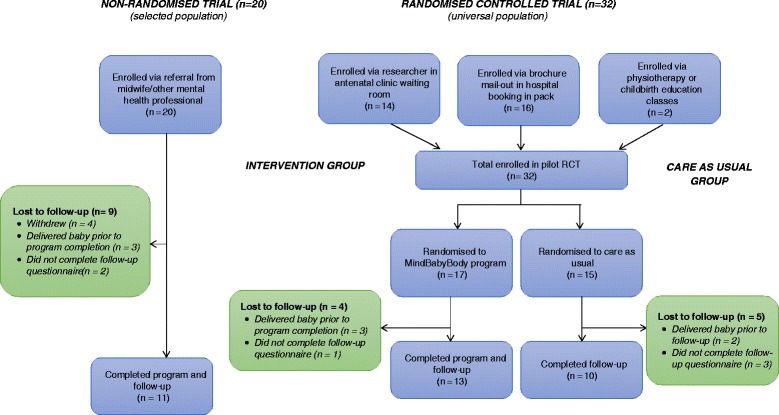
BACKGROUND: Mindfulness interventions to reduce psychological distress are well-suited to pregnancy, due to their brief and non-pharmacological nature, but there is a need for more robust evidence determining their usefulness. This pilot study was designed to explore the feasibility of a randomised controlled trial of a mindfulness intervention to reduce antenatal depression, anxiety and stress. METHODS: The study was designed in two parts 1) a non-randomised trial targeting women at risk of mental health problems (a selected population) and 2) a randomised controlled trial (RCT) of a universal population. Process evaluation focused on feasibility of recruitment pathways, participant retention, acceptability of study measures, and engagement with mindfulness practices. Measurement of psychological distress was taken pre and post intervention through the Centre for Epidemiologic Studies Depression Scale Revised, the Depression Anxiety and Stress Scale-21, the State-Trait Anxiety Inventory, and the Perceived Stress Scale. RESULTS: 20 women were recruited to the non-randomised trial, and 32 to the RCT. Recruitment through a mailed study brochure at the time of booking-in to the hospital resulted in the largest number of participants in the RCT (16/32; 50%), and resulted in considerably earlier recruitment (50% in first trimester, 50% second trimester) compared to recruitment through the antenatal clinic waiting room (86% in second trimester, 14% third trimester). Over a third of women in the universal population scored above clinical cut-offs for depression and anxiety, indicating a sample with more symptomology than the general population. The most common reason for loss to follow-up was delivery of baby prior to follow-up (n = 9). In the non-randomised study, significant within group improvements to depression and anxiety were observed. In the intervention arm of the RCT there were significant within group improvements to anxiety and mindfulness. No between group differences for the intervention and 'care as usual' control group were observed. CONCLUSIONS: This small pilot study provides evidence on the feasibility of an antenatal mindfulness intervention to reduce psychological distress. Major challenges include: finding ways to facilitate recruitment in early pregnancy and engaging younger women and other vulnerable populations. TRIAL REGISTRATION: Australian New Zealand Clinical Trials Registry ACTRN12613000742774 (31/10/2012).
Overview
The claims and statistics of this paper haven’t been checked yet.
Free: it reads the open-access text and checks the first 5 claims that cite a source we can check. Create a free account to check every claim.
Integrity signals
Registry
Cites
Statistics
Figures
Verification
Claims the paper makes
The claims and statistics of this paper haven’t been checked yet.
Free: it reads the open-access text and checks the first 5 claims that cite a source we can check. Create a free account to check every claim.
Claims other papers make about this one
Each is checked against this paper’s own text: does it say what the citing paper says it does?
The source backs part of the claim, not all of it — or backs it for a different population, condition or comparison.
In the citing paper
“The decrease in perceived pain, anxiety, and psychological stress, thus improvements in psychological well-being, is consistent with other qualitative studies assessing women's experiences in a mindfulnessbased intervention (Duncan & Bardacke, 2010; Woolhouse etal., 2014).”
From A Qualitative Investigation of a Prenatal Mindfulness Relationship-Based (PMRB) Program to Support Maternal Mental Health and Mother–Baby Relationship During Pregnancy and Post-Partum (2024) · cites this paper as Woolhouse et al., 2014
Experimental — accuracy not yet measuredThe cited source says what the claim attributes to it.
In the citing paper
“The main themes identified in the current analysis, especially regarding the changes attributed to the practice of mindfulness, are consistent with those of earlier qualitative analysis, especially the concept of acceptance (Allen etal., 2009; Woolhouse etal., 2014).”
From A Qualitative Investigation of a Prenatal Mindfulness Relationship-Based (PMRB) Program to Support Maternal Mental Health and Mother–Baby Relationship During Pregnancy and Post-Partum (2024) · cites this paper as Woolhouse et al., 2014
The cited source says what the claim attributes to it.
In the citing paper
“mindfulness level can be improved by program based on mindfulness meditation.”
From Acceptance Mindfulness-Trait as a Protective Factor for Post-Natal Depression: A Preliminary Research (2022) · cites this paper as [40]
The cited source says what the claim attributes to it.
In the citing paper
“recent pilot studies showed that prenatal mindfulness interventions have potential benefits for improving the emergence of perinatal depression [39,40].”
From Acceptance Mindfulness-Trait as a Protective Factor for Post-Natal Depression: A Preliminary Research (2022) · cites this paper as [40]
The cited source says what the claim attributes to it.
In the citing paper
“Recent studies suggest a relationship between mindfulness and the reduction of perinatal anxiety [10–15], stress [13] and perinatal depression [10, 11, 14, 16, 17].”
From Effects of an antenatal mindfulness-based childbirth and parenting programme on the postpartum experiences of mothers: a qualitative interview study. (2017) · cites this paper as [10]
3 more claims about this paper
Create a free account to see every claim other papers make about this one.
Self-check
Percentages, sums and reported differences re-computed from the paper’s own numbers.
The self-check needs the paper’s full text.
Citations
Cites
The CES-D Scale: A Self-Report Depression Scale for Research in the General Population
Radloff, L. S. (1977) · Applied Psychological Measurement · doi:10.1177/014662167700100306 · Cited by 53,267
A Global Measure of Perceived Stress
Cohen, S., Kamarck, T., & Mermelstein, R. (1983) · Journal of Health and Social Behavior · doi:10.2307/2136404 · Cited by 32,807 · cited 3×
“The ice meditation, which encouraged participants to try out different mindful approaches to pain (generated by holding a handful of ice) Table 5 Within group comparison for the RCT (universal population) MindBabyBody intervention group (n = 13)* Care as usual group (n = 10)* Pre-program M (SD) Post-program M (SD) Wit…”
MethodInfluentialLovibond, P. F., & Lovibond, S. H. (1995) · Behaviour Research and Therapy · doi:10.1016/0005-7967(94)00075-u · Cited by 14,523
An inventory for measuring clinical anxiety: Psychometric properties.
Beck, A. T., Epstein, N., Brown, G., & Steer, R. A. (1988) · Journal of Consulting and Clinical Psychology · doi:10.1037/0022-006x.56.6.893 · Cited by 14,407 · cited 1×
“This anxiety measure has been widely used with pregnant populations [21,36,37], and has demonstrated good psychometric qualities [38].”
MethodDeveloping and evaluating complex interventions: the new Medical Research Council guidance
Craig, P., Dieppe, P., Macintyre, S., Michie, S., Nazareth, I., & Petticrew, M. (2008) · BMJ · doi:10.1136/bmj.a1655 · Cited by 10,995 · cited 1×
“Prior to any large-scale evaluation study, a thorough process of piloting and feasibility work is advised by the Medical Research Council Guidance on Developing & Evaluating Complex Interventions [24].”
MethodInterpretative Phenomenological Analysis: Theory, Method and Research
(2010) · QMiP Bulletin · doi:10.53841/bpsqmip.2010.1.10.44 · Cited by 8,189
Using Self-Report Assessment Methods to Explore Facets of Mindfulness
Baer, R. A., Smith, G. T., Hopkins, J., Krietemeyer, J., & Toney, L. (2006) · Assessment · doi:10.1177/1073191105283504 · Cited by 7,511 · cited 4×
“Mindfulness was measured by the Five-Factor Mindfulness Questionnaire (FFMQ) [44].”
MethodInfluential(1993) · Cited by 7,136
(1995) · Cited by 6,909
Cognitive-Behavioral Treatment of Borderline Personality Disorder
Cary, G. L. (1994) · American Journal of Psychotherapy · doi:10.1176/appi.psychotherapy.1994.48.1.155 · Cited by 6,283
Antony, M. M., Bieling, P. J., Cox, B. J., Enns, M. W., & Swinson, R. P. (1998) · Psychological Assessment · doi:10.1037/1040-3590.10.2.176 · Cited by 4,874 · cited 1×
“This measure has demonstrated good psychometric properties in both clinical and non-clinical samples [27-29].”
BackgroundMindfulness training as a clinical intervention: a conceptual and empirical review
Baer, R. A. (2003) · Clinical Psychology: Science and Practice · doi:10.1093/clipsy.bpg015 · Cited by 4,577 · cited 2×
“Evidence of the efficacy of mindfulness interventions in treating a range of mental health issues is growing [12,20], and they appear well-suited to pregnancy given their brief and non-pharmaceutical nature.”
BackgroundMindfulness training as a clinical intervention: A conceptual and empirical review.
Baer, R. A. (2003) · Clinical Psychology: Science and Practice · doi:10.1093/clipsy/bpg015 · Cited by 4,576
(1988) · Cited by 4,111
Health consequences of intimate partner violence
Campbell, J. C. (2002) · The Lancet · doi:10.1016/s0140-6736(02)08336-8 · Cited by 4,055 · cited 1×
“However, given mounting evidence that a variety of common issues in pregnancy - such as relationship difficulties [7], intimate partner abuse [8], and even daily hassles [9] are associated with adverse outcomes for children, it can be argued that interventions involving both selected and universal populations are warr…”
BackgroundInterpretative Phenomenological Analysis
(2020) · SAGE Research Methods Foundations · doi:10.4135/9781526421036813346 · Cited by 4,040
Baer, R. A., Smith, G. T., Lykins, E., Button, D., Krietemeyer, J., Sauer, S., Walsh, E., Duggan, D., & Williams, J. M. G. (2008) · Assessment · doi:10.1177/1073191107313003 · Cited by 2,930 · cited 1×
“The FFMQ has shown good construct validity, and reliability [45,46].”
BackgroundSpielberger, C. D. (2010) · The Corsini Encyclopedia of Psychology · doi:10.1002/9780470479216.corpsy0943 · Cited by 2,535
Depression Anxiety Stress Scales
Lovibond, S. H., & Lovibond, P. F. (2011) · PsycTESTS Dataset · doi:10.1037/t01004-000 · Cited by 2,416
Developing and Evaluating Complex Interventions: New Guidance
Craig, P., Dieppe, P. A., MacIntyre, S., Michie, S., Nazareth, I., & Petticrew, M. P. (2006) · UCL Discovery (University College London) · Cited by 1,979
Psychometric properties of the Depression Anxiety Stress Scales (DASS) in clinical samples
Brown, T. A., Chorpita, B. F., Korotitsch, W., & Barlow, D. H. (1997) · Behaviour Research and Therapy · doi:10.1016/s0005-7967(96)00068-x · Cited by 1,860 · cited 1×
“This measure has demonstrated good psychometric properties in both clinical and non-clinical samples [27-29].”
BackgroundMindfulness-based cognitive therapy for depression
(2006) · Buddhist Thought and Applied Psychological Research · doi:10.4324/9780203098899-33 · Cited by 1,324
Metacognitive awareness and prevention of relapse in depression: Empirical evidence
Teasdale, J. D., Moore, R. G., Hayhurst, H., Pope, M., Williams, S., & Segal, Z. V. (2002) · Journal of Consulting and Clinical Psychology · doi:10.1037/0022-006x.70.2.275 · Cited by 1,221
Interpretative phenomenological analysis
Smith, J. A., & Osborn, M. (2004) · Doing Social Psychology Research · doi:10.1002/9780470776278.ch10 · Cited by 1,204
The Corsini encyclopedia of psychology
(2010) · Choice Reviews Online · doi:10.5860/choice.47-6008 · Cited by 1,082
Maternal antenatal anxiety and children's behavioural/emotional problems at 4 years
O'Connor, T. G., Heron, J., Golding, J., Beveridge, M., & Glover, V. (2002) · British Journal of Psychiatry · doi:10.1192/bjp.180.6.502 · Cited by 1,070
Frohlich, K. L., & Potvin, L. (2008) · American Journal of Public Health · doi:10.2105/ajph.2007.114777 · Cited by 989 · cited 1×
“It has also been argued that universal interventions to improve overall public health have the potential to increase health inequalities [53].”
BackgroundFurther psychometric support for the 10-item version of the Perceived Stress Scale
Roberti, J. W., Harrington, L. N., & Storch, E. A. (2006) · Journal of College Counseling · doi:10.1002/j.2161-1882.2006.tb00100.x · Cited by 984 · cited 1×
“Good psychometric qualities have been previously demonstrated [40,41] and the measure has been used in pregnant samples [21,42,43].”
MethodKabat-Zinn, J., Wheeler, E., Light, T., Skillings, A., Scharf, M. J., Cropley, T. G., Hosmer, D., & Bernhard, J. D. (1998) · Psychosomatic Medicine · doi:10.1097/00006842-199809000-00020 · Cited by 826 · cited 1×
“While relaxation is not an aim of mindfulness practice, it is a common outcome, and may play a part in the improvement of stress-related symptoms and physical disorders [16,17].”
BackgroundMaternal depression, anxiety and stress during pregnancy and child outcome; what needs to be done
Glover, V. (2014) · Best Practice & Research Clinical Obstetrics & Gynaecology · doi:10.1016/j.bpobgyn.2013.08.017 · Cited by 818 · cited 1×
“Importantly, it is not only diagnosable mental illness in mothers which is associated with poorer outcomes for children, but also a range of objective stressors and subjective stresses (including symptoms at sub-clinical levels) [5].”
Background. Caution regarding the use of pilot studies to guide power calculations for study proposals.
Kraemer, H. C., Mintz, J., Noda, A., Tinklenberg, J., & Yesavage, J. A. (2006) · Archives of General Psychiatry · doi:10.1001/archpsyc.63.5.484 · Cited by 702 · cited 1×
“A sample size estimate was not conducted on the pilot study data, given the advice of Kraemer and colleagues that this is not an accurate means of estimating the required sample size for a large randomised controlled trial [55].”
MethodComing to Our Senses: Healing Ourselves and the World Through Mindfulness
Sierpina, V. S. (2005) · EXPLORE · doi:10.1016/j.explore.2005.04.001 · Cited by 680
(2004) · Cited by 673
(2005) · Medical Entomology and Zoology · Cited by 671
Stress during pregnancy is associated with developmental outcome in infancy
Huizink, A. C., Robles de Medina, P. G., Mulder, E. J. H., Visser, G. H. A., & Buitelaar, J. K. (2003) · Journal of Child Psychology and Psychiatry · doi:10.1111/1469-7610.00166 · Cited by 651 · cited 1×
“However, given mounting evidence that a variety of common issues in pregnancy - such as relationship difficulties [7], intimate partner abuse [8], and even daily hassles [9] are associated with adverse outcomes for children, it can be argued that interventions involving both selected and universal populations are warr…”
BackgroundChiesa, A., & Serretti, A. (2011) · Psychiatry Research · doi:10.1016/j.psychres.2010.08.011 · Cited by 650 · cited 1×
“Evidence of the efficacy of mindfulness interventions in treating a range of mental health issues is growing [12,20], and they appear well-suited to pregnancy given their brief and non-pharmaceutical nature.”
BackgroundVan Dam, N. T., & Earleywine, M. (2011) · Psychiatry Research · doi:10.1016/j.psychres.2010.08.018 · Cited by 647 · cited 1×
“This scale has demonstrated excellent psychometric properties, including high internal consistency, strong factor loadings, and theoretically consistent convergent and divergent validity [34].”
BackgroundAntenatal Anxiety Predicts Child Behavioral/Emotional Problems Independently of Postnatal Depression
O'CONNOR, T. G., HERON, J., & GLOVER, V. (2002) · Journal of the American Academy of Child & Adolescent Psychiatry · doi:10.1097/00004583-200212000-00019 · Cited by 576
Teixeira, J. M. A., Fisk, N. M., & Glover, V. (1999) · BMJ · doi:10.1136/bmj.318.7177.153 · Cited by 526
Longitudinal Study of Maternal Depressive Symptoms and Child Well-Being
LUOMA, I., TAMMINEN, T., KAUKONEN, P., LAIPPALA, P., PUURA, K., SALMELIN, R., & ALMQVIST, F. (2001) · Journal of the American Academy of Child & Adolescent Psychiatry · doi:10.1097/00004583-200112000-00006 · Cited by 490 · cited 1×
“Maternal anxiety, depression and stress (during and after pregnancy) have short and long term consequences for women’s health, affect mother-child interactions, and increase the risk of a range of ongoing emotional, behavioural and cognitive problems in children [2-4].”
BackgroundMaternal Stress During Pregnancy Predicts Cognitive Ability and Fearfulness in Infancy
BERGMAN, K., SARKAR, P., O'CONNOR, T. G., MODI, N., & GLOVER, V. (2007) · Journal of the American Academy of Child & Adolescent Psychiatry · doi:10.1097/chi.0b013e31814a62f6 · Cited by 431 · cited 1×
“However, given mounting evidence that a variety of common issues in pregnancy - such as relationship difficulties [7], intimate partner abuse [8], and even daily hassles [9] are associated with adverse outcomes for children, it can be argued that interventions involving both selected and universal populations are warr…”
BackgroundVieten, C., & Astin, J. (2008) · Archives of Women's Mental Health · doi:10.1007/s00737-008-0214-3 · Cited by 369 · cited 5×
“All mindfulness studies to date in the antenatal period have called for further randomised controlled trials with larger samples and longer follow-up [19,21-23].”
BackgroundMethodInfluentialDuncan, L. G., & Bardacke, N. (2010) · Journal of Child and Family Studies · doi:10.1007/s10826-009-9313-7 · Cited by 352 · cited 3×
“Week 4 focused on an ice meditation [19] where participants were given experience practicing mindfulness of painful sensations.”
BackgroundMethodCooper, P. J., & Murray, L. (1998) · BMJ · doi:10.1136/bmj.316.7148.1884 · Cited by 338
Hoffman, S., & Hatch, M. C. (2000) · Health Psychology · doi:10.1037//0278-6133.19.6.535 · Cited by 317 · cited 1×
“Depression was additionally measured by the Centre for Epidemiologic Studies Depression Scale Revised (CES-D) [30] a 20-item scale of depressive symptoms which has been used previously in antenatal populations [21,31-33].”
MethodDoing Social Psychology Research
(2004) · Wiley eBooks · doi:10.1002/9780470776278 · Cited by 307
Cancer expert doubts claims about prostate cancer trial
Cole, A. (2008) · BMJ · doi:10.1136/bmj.a979 · Cited by 255
The importance of piloting an RCT intervention.
Feeley, N., Cossette, S., Côté, J., Héon, M., Stremler, R., Martorella, G., & Purden, M. (2009) · PubMed · Cited by 244
Effects of music therapy on psychological health of women during pregnancy
Chang, M., Chen, C., & Huang, K. (2008) · Journal of Clinical Nursing · doi:10.1111/j.1365-2702.2007.02064.x · Cited by 236 · cited 1×
“Good psychometric qualities have been previously demonstrated [40,41] and the measure has been used in pregnant samples [21,42,43].”
MethodExploring the Psychometric Properties of the Five Facet Mindfulness Questionnaire
Christopher, M. S., Neuser, N. J., Michael, P. G., & Baitmangalkar, A. (2012) · Mindfulness · doi:10.1007/s12671-011-0086-x · Cited by 234 · cited 1×
“The FFMQ has shown good construct validity, and reliability [45,46].”
BackgroundYelland, J., Sutherland, G., & Brown, S. J. (2010) · BMC Public Health · doi:10.1186/1471-2458-10-771 · Cited by 230 · cited 1×
“While baseline means for the universal population in our study were not above clinical cut-offs, over a third of women in the RCT scored above clinical cut-offs for depression, anxiety and stress - indicating a sample with more mental health symptoms than the general perinatal population [52].”
BackgroundSelf-citationExamining the relationship between antenatal anxiety and postnatal depression
Austin, M.-P., Tully, L., & Parker, G. (2007) · Journal of Affective Disorders · doi:10.1016/j.jad.2006.11.015 · Cited by 222 · cited 1×
“This anxiety measure has been widely used with pregnant populations [21,36,37], and has demonstrated good psychometric qualities [38].”
MethodBastani, F., Hidarnia, A., Kazemnejad, A., Vafaei, M., & Kashanian, M. (2005) · Journal of Midwifery & Women's Health · doi:10.1016/j.jmwh.2004.11.008 · Cited by 221 · cited 1×
“Good psychometric qualities have been previously demonstrated [40,41] and the measure has been used in pregnant samples [21,42,43].”
MethodA controlled study of a stress-reduction, cognitive-behavioral treatment program in fibromyalgia.
Goldenberg, D. L., Kaplan, K. H., Nadeau, M. G., Brodeur, C., Smith, S., & Schmid, C. H. (1994) · Journal of Musculoskeletal Pain · doi:10.1300/j094v02n02_05 · Cited by 183
Dunn, C., Hanieh, E., Roberts, R., & Powrie, R. (2012) · Archives of Women's Mental Health · doi:10.1007/s00737-012-0264-4 · Cited by 178 · cited 18×
“All mindfulness studies to date in the antenatal period have called for further randomised controlled trials with larger samples and longer follow-up [19,21-23].”
BackgroundResultInfluentialIckovics, J. R., Reed, E., Magriples, U., Westdahl, C., Schindler Rising, S., & Kershaw, T. S. (2011) · Psychology & Health · doi:10.1080/08870446.2011.531577 · Cited by 160 · cited 1×
“Depression was additionally measured by the Centre for Epidemiologic Studies Depression Scale Revised (CES-D) [30] a 20-item scale of depressive symptoms which has been used previously in antenatal populations [21,31-33].”
MethodPsychosocial Stressors and Low Birthweight in an Urban Population
Orr, S. T., James, S. A., Arden Miller, C., Barakat, B., Daikoku, N., Pupkin, M., Engstrom, K., & Huggins, G. (1996) · American Journal of Preventive Medicine · doi:10.1016/s0749-3797(18)30268-x · Cited by 138 · cited 1×
“Depression was additionally measured by the Centre for Epidemiologic Studies Depression Scale Revised (CES-D) [30] a 20-item scale of depressive symptoms which has been used previously in antenatal populations [21,31-33].”
MethodThe Need for Mental Health Promotion
Herrman, H. (2001) · Australian & New Zealand Journal of Psychiatry · doi:10.1046/j.1440-1614.2001.00947.x · Cited by 129 · cited 1×
“It has been argued that even small reductions in population prevalence of perinatal mental disorders have a greater public health benefit than treating individuals who are already symptomatic [50] and that a comprehensive approach to mental health must include both mental health promotion and attempts to prevent menta…”
BackgroundWoolhouse, H., Gartland, D., Hegarty, K., Donath, S., & Brown, S. (2012) · BJOG: An International Journal of Obstetrics & Gynaecology · doi:10.1111/j.1471-0528.2011.03219.x · Cited by 108 · cited 1×
“Reduce repetition in questionnaires, and aim to provide a more holistic picture of women’s health and wellbeing, drawing on learnings from large cohort studies which have achieved excellent retention rates over time [56].”
BackgroundSelf-citationFisher, J. R., Wynter, K. H., & Rowe, H. J. (2010) · BMC Public Health · doi:10.1186/1471-2458-10-432 · Cited by 91
Intervening to reduce depression after birth: A systematic review of the randomized trials
Lumley, J., Austin, M.-P., & Mitchell, C. (2004) · International Journal of Technology Assessment in Health Care · doi:10.1017/s0266462304000911 · Cited by 75 · cited 1×
“Lumley and colleagues [6] described three potential intervention populations: indicated, selected, and universal.”
BackgroundRowe, H. J., & Fisher, J. R. (2010) · BMC Public Health · doi:10.1186/1471-2458-10-499 · Cited by 63 · cited 1×
“Importantly, the evaluation of interventions targeting selected and universal populations has “substantial potential benefits for population health” [10].”
BackgroundMindfulness approaches to childbirth and parenting
Hughes, A., Williams, M., Bardacke, N., Duncan, L. G., Dimidjian, S., & Goodman, S. H. (2009) · British Journal of Midwifery · doi:10.12968/bjom.2009.17.10.44470 · Cited by 48 · cited 1×
“All mindfulness studies to date in the antenatal period have called for further randomised controlled trials with larger samples and longer follow-up [19,21-23].”
Research works printed but not linked: 1
- Mercuri K Woolhouse H MindBabyBody Group Program: Facilitators Manual 2014 Melbourne Australia The Royal Women’s Hospital and Murdoch Childrens Research Institute
Cited by
US Preventive Services Task Force, Curry, S. J., Krist, A. H., Owens, D. K., Barry, M. J., Caughey, A. B., Davidson, K. W., Doubeni, C. A., Epling, J. W., Grossman, D. C., et al. (2019) · JAMA · doi:10.1001/jama.2019.0007 · Cited by 494
Quaglia, J. T., Braun, S. E., Freeman, S. P., McDaniel, M. A., & Brown, K. W. (2016) · Psychological Assessment · doi:10.1037/pas0000268 · Cited by 341
O’Connor, E., Senger, C. A., Henninger, M. L., Coppola, E., & Gaynes, B. N. (2019) · JAMA · doi:10.1001/jama.2018.20865 · Cited by 316
Galante, J., Friedrich, C., Dawson, A. F., Modrego-Alarcón, M., Gebbing, P., Delgado-Suárez, I., Gupta, R., Dean, L., Dalgleish, T., White, I. R., et al. (2021) · PLOS Medicine · doi:10.1371/journal.pmed.1003481 · Cited by 319
“…(1) Post–int, 1 m Wong 2018 [275], China (HK) 197 Peri–/postmenopausal women (2) 52 (3.1) 100% Dis, Mindf, Somat MBSR (3) Menopause Education Control (3) Post–int, 3 m, 6 m Woolhouse 2014 [276], Australia 32 Pregnant women (2) 33 (0.6) 100% Anx, Dep, Dis, Mindf MindBabyBody Programme (2) Care…”
BackgroundInfluentialLever Taylor, B., Cavanagh, K., & Strauss, C. (2016) · PLOS ONE · doi:10.1371/journal.pone.0155720 · Cited by 284
“stress symptoms [59; 60], while the uncontrolled arm of Woolhouse et al’s, [61] study recruited women deemed to be at risk of stress, anxiety or depression by their midwives or obstetricians.”
BackgroundMethodInfluential
Metadata
- Authors
- Woolhouse, H., Mercuri, K., Judd, F., & Brown, S. J.
- Affiliations
- Royal Children's Hospital (AU)
- Royal Women's Hospital (AU)
- The Royal Melbourne Hospital (AU)
- Corresponding author
- Woolhouse, Hannah
- ORCID
- Brown, Stephanie J
- Venue
- BMC Pregnancy and Childbirth
- Published
- 2014-10-25
- Volume
- 14
- Issue
- 1
- Pages
- 369-369
- ISSN
- 1471-2393 (ISSN-L)
- PMC
- PMC4215015
- OpenAlex
- W2147534718
- Cited by
- 212
- References
- 62
- Citations by year
- 2026: 6 · 2025: 10 · 2024: 9 · 2023: 23 · 2022: 23 · 2021: 13 · 2020: 67 · 2019: 17 · 2018: 13 · 2017: 16 · 2016: 10 · 2015: 5
- FWCI
- 10.24
- Type
- journal article
- Language
- en
- Open access
- gold
- doi.org
- Locations
- BMC Pregnancy and Childbirth (publishedVersion, cc-by)
- PubMed Central (publishedVersion, cc-by)
- PubMed (publishedVersion)
- Minerva Access (University of Melbourne) (submittedVersion, cc-by)
- Funders
- State Government of Victoria
- Topics
- Health Sciences › Medicine › Public Health, Environmental and Occupational Health › Maternal Mental Health During Pregnancy and Postpartum
- Social Sciences › Psychology › Clinical Psychology › Mindfulness and Compassion Interventions
- Social Sciences › Psychology › Applied Psychology › Digital Mental Health Interventions
- Keywords
- mindfulness-based interventions, antenatal depression, prenatal anxiety, perceived stress, psychological distress in pregnancy, participant retention, feasibility, maternity hospital
- MeSH terms
- Adult, Anxiety, Australia, Depression, Feasibility Studies, Female, Hospitals, Maternity, Humans, Pilot Projects, Pregnancy, Pregnancy Complications, Pregnancy Trimesters, Prenatal Care, Prenatal Diagnosis, Stress, Psychological, Patient Selection, Tertiary Care Centers, Mindfulness
About these checks
Registry, retraction, Cites and statistics results are computed, not judged, with one exception: a printed reference that no index lists is read once by a model before it counts as a citation error. Claims are extracted by a model and kept only when their quote appears verbatim in the text; each cited source is then checked, with a model’s help, for whether it says what the claim relies on. Those verdicts can be wrong — read the claim’s quote and the cited source before relying on one.
Statistics and arithmetic are recomputed, not judged.
Confidence bands are shown only for fields calibrated on our annotated test set. None is calibrated yet, so no band is shown.
What counts as a claim ›How we measure confidence ›How we check this ›
Are you an author, or do you see a problem with this page? Request a review
Data sources
Bibliographic data: Semantic Scholar, OpenAlex, Crossref.
Contains information from the Semantic Scholar Academic Graph Datasets, made available under the ODC Attribution License (ODC-BY 1.0).
Semantic Scholar’s data is described in: Kinney, R., et al. (2023). The Semantic Scholar Open Data Platform. arXiv:2301.10140.
