

The DOI matches its Crossref record; 45 of the 45 references it cites were found in a registry or an index.
Feasibility, useability and acceptability of technology-based interventions for informal cancer carers: a systematic review
Open accessAbstract
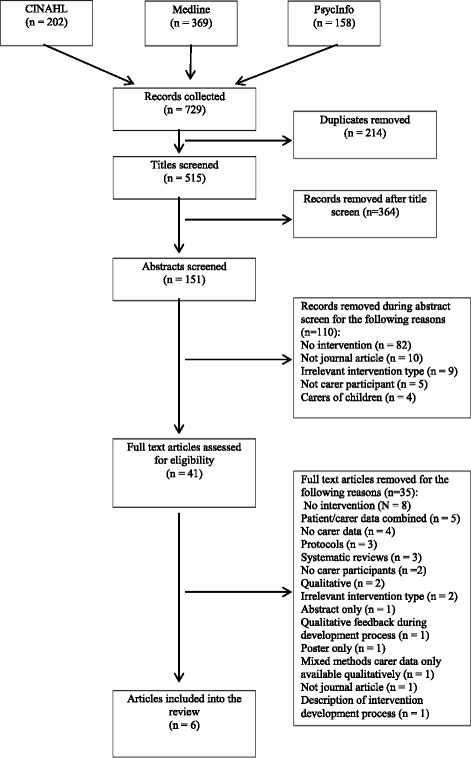
BACKGROUND: Carers looking after someone with cancer often experience negative impacts on their own health. M-health interventions have been designed to provide information and support to patients and their carers. However, the effectiveness of technology-based interventions for carers is less well understood. The objectives were to assess the feasibility, useability and acceptability of technology-based interventions among carers of people living with cancer. METHODS: A systematic search of the CINAHL, MEDLINE and PSYCINFO databases was performed using terms related to web-based interventions and smartphone applications, carers and cancer. Studies were included if a randomised controlled trial or pilot study was conducted, focused on adult carers looking after another adult with cancer and were published between January 2007-June 2017. Articles were excluded if they reported qualitative results only or were evaluating existing websites and applications. Feasibility was measured by attrition, recruitment rates and frequency of intervention use; useability was measured by the ease of intervention use and the role of features to minimise errors in use. Acceptability was measured by carers' perception of the appropriateness of the content and their ability to incorporate the intervention into their daily routines. RESULTS: Of the 729 articles, six articles met the inclusion criteria. Attrition ranged from 14% - 77%, recruitment rates from 20% - 66% and intervention useability varied across studies. Half of the studies implemented measures to improve useability. Overall, carers rated the content of the interventions as appropriate and reported improved knowledge and communication. Acceptability was further demonstrated as carers preferred the flexibility available with web-based interventions. CONCLUSIONS: Technology-based interventions are suitable for use among carers of people with cancer. Further research is required to fully assess the impact of technology as an information and support mechanism for carers.
Overview
The claims and statistics of this paper haven’t been checked yet.
Run the check — free, no account needed. It reads the open-access text and checks the sources it cites.
Integrity signals
Registry
Cites
Statistics
Figures
Verification
Claims the paper makes
The claims and statistics of this paper haven’t been checked yet.
Run the check — free, no account needed. It reads the open-access text and checks the sources it cites.
Claims other papers make about this one
Each is checked against this paper’s own text: does it say what the citing paper says it does?
The source backs part of the claim, not all of it — or backs it for a different population, condition or comparison.
In the citing paper
“Another systematic review [33] found e-Health interventions to be feasible, usable, and acceptable for caregivers of cancer survivors.”
From It is time to address fear of cancer recurrence in family caregivers: protocol for the feasibility and acceptability of a randomized pilot study of the online version of the Family Caregiver–Fear Of Recurrence Therapy (FC-FORT) (2024) · cites this paper as [33]
Experimental — accuracy not yet measured
Self-check
Percentages, sums and reported differences re-computed from the paper’s own numbers.
The self-check needs the paper’s full text.
Citations
Cites
Preferred Reporting Items for Systematic Reviews and Meta-Analyses: the PRISMA statement
Moher, D., Liberati, A., Tetzlaff, J., Altman, D. G., & for the PRISMA Group (2009) · BMJ · doi:10.1136/bmj.b2535 · Cited by 83,823
Preferred Reporting Items for Systematic Reviews and Meta-Analyses: The PRISMA Statement
Moher, D., Liberati, A., Tetzlaff, J., Altman, D. G., & The PRISMA Group (2009) · PLoS Medicine · doi:10.1371/journal.pmed.1000097 · Cited by 64,042
Preferred reporting items for systematic reviews and meta-analyses: the PRISMA Statement.
(2009) · PubMed Central · Cited by 44,859
The Cochrane Collaboration's tool for assessing risk of bias in randomised trials
Higgins, J. P. T., Altman, D. G., Gotzsche, P. C., Juni, P., Moher, D., Oxman, A. D., Savovic, J., Schulz, K. F., Weeks, L., Sterne, J. A. C., et al. (2011) · BMJ · doi:10.1136/bmj.d5928 · Cited by 33,817
Wang, G., Ma, R., Qiao, G., Wada, K., Aizawa, Y., & Satoh, T. (2015) · Integrative Medicine International · doi:10.1159/000368408 · Cited by 18,762
How we design feasibility studies
Bowen, D. J., Kreuter, M., Spring, B., Cofta-Woerpel, L., Linnan, L., Weiner, D., Bakken, S., Kaplan, C. P., Squiers, L., Fabrizio, C., et al. (2009) · American Journal of Preventive Medicine · doi:10.1016/j.amepre.2009.02.002 · Cited by 4,021 · cited 2×
“In developing a technology-based intervention, it is important to determine if the content of the intervention is useful and acceptable for end users, if the intervention can be used to sustain their wellbeing and if technology itself does not create any barrier to access [22].”
BackgroundWhiting, P., Rutjes, A. W., Reitsma, J. B., Bossuyt, P. M., & Kleijnen, J. (2003) · BMC Medical Research Methodology · doi:10.1186/1471-2288-3-25 · Cited by 3,592
Caregiver Burden: A Clinical Review
Adelman, R. D., Tmanova, L. L., Delgado, D., Dion, S., & Lachs, M. S. (2014) · JAMA · doi:10.1001/jama.2014.304 · Cited by 2,002
The digital divide shifts to differences in usage
van Deursen, A. J., & van Dijk, J. A. (2014) · New Media & Society · doi:10.1177/1461444813487959 · Cited by 1,733 · cited 1×
“Age may have an impact on the likelihood of carers using technology over other information methods and possessing the skills to navigate technology-based interventions [23].”
BackgroundInterpreting trends in cancer patient survival
DICKMAN, P. W., & ADAMI, H. ‐. (2006) · Journal of Internal Medicine · doi:10.1111/j.1365-2796.2006.01677.x · Cited by 508
A systematic review of telehealth tools and interventions to support family caregivers
Chi, N.-C., & Demiris, G. (2015) · Journal of Telemedicine and Telecare · doi:10.1177/1357633x14562734 · Cited by 409
Bender, J. L., Yue, R. Y. K., To, M. J., Deacken, L., & Jadad, A. R. (2013) · Journal of Medical Internet Research · doi:10.2196/jmir.2661 · Cited by 346
Girgis, A., Lambert, S. D., McElduff, P., Bonevski, B., Lecathelinais, C., Boyes, A., & Stacey, F. (2013) · Psycho-Oncology · doi:10.1002/pon.3166 · Cited by 176
The use of smartphones for health research
Dorsey, E. R., “Yvonne” Chan, Y.-F., McConnell, M. V., Shaw, S. Y., Trister, A. D., & Friend, S. H. (2017) · Academic Medicine · doi:10.1097/acm.0000000000001205 · Cited by 154
A Tailored Web-Based Psycho-Educational Intervention for Cancer Patients and Their Family Caregivers
Northouse, L., Schafenacker, A. M., Barr, K. L. C., Katapodi, M., Yoon, H., Brittain, K., Song, L.-X., Ronis, D., & An, L. C. (2014) · Cancer Nursing · doi:10.1097/ncc.0000000000000159 · Cited by 140
Effects of eHealth for patients and informal caregivers confronted with cancer: A meta-review
Slev, V. N., Mistiaen, P., Pasman, H. R. W., Leeuw, I. M. V., van Uden‐Kraan, C. F., & Francke, A. L. (2015) · International Journal of Medical Informatics · doi:10.1016/j.ijmedinf.2015.12.013 · Cited by 140
CHESS improves cancer caregivers’ burden and mood: Results of an eHealth RCT.
DuBenske, L. L., Gustafson, D. H., Namkoong, K., Hawkins, R. P., Atwood, A. K., Brown, R., Chih, M., Mctavish, F. M., Carmack, C. L., Buss, M. K., et al. (2013) · Health Psychology · doi:10.1037/a0034216 · Cited by 138
Using Web-Based Interventions to Support Caregivers of Patients With Cancer: A Systematic Review
Kaltenbaugh, D., Klem, M. L., Hu, L., Turi, E., Haines, A., & Hagerty Lingler, J. (2015) · Oncology Nursing Forum · doi:10.1188/15.onf.156-164 · Cited by 98 · cited 2×
“[21] who assessed the impact of web-based interventions on physical, social, psychological, and financial outcomes of carers.”
BackgroundUssher, J. M., & Sandoval, M. (2008) · Psychology and Health · doi:10.1080/08870440701596585 · Cited by 98
Li, Q., & Loke, A. Y. (2013) · European Journal of Oncology Nursing · doi:10.1016/j.ejon.2013.01.007 · Cited by 97
Reese, J. B., Porter, L. S., Regan, K. R., Keefe, F. J., Azad, N. S., Diaz, L. A., Herman, J. M., & Haythornthwaite, J. A. (2014) · Psycho-Oncology · doi:10.1002/pon.3508 · Cited by 84
Chih, M., DuBenske, L. L., Hawkins, R. P., Brown, R., Dinauer, S., Cleary, J. F., & Gustafson, D. H. (2012) · Palliative Medicine · doi:10.1177/0269216312457213 · Cited by 83
Badr, H., Carmack, C. L., & Diefenbach, M. A. (2015) · Journal of Health Communication · doi:10.1080/10810730.2014.965369 · Cited by 81
Arnold, B. L. (2011) · BMC Palliative Care · doi:10.1186/1472-684x-10-1 · Cited by 71
Improving Couples’ Quality of Life Through a Web-Based Prostate Cancer Education Intervention
Song, L., Rini, C. K., Deal, A. M., Nielsen, M. E., Chang, H., Kinneer, P., Teal, R., Johnson, D. C., Dunn, M. W., Mark, B. A., et al. (2015) · Oncology nursing forum · doi:10.1188/15.onf.183-192 · Cited by 70
Creating a Bond Between Caregivers Online: Effect on Caregivers’ Coping Strategies
Namkoong, K., DuBenske, L. L., Shaw, B. R., Gustafson, D. H., Hawkins, R. P., Shah, D. V., Mctavish, F. M., & Cleary, J. F. (2011) · Journal of Health Communication · doi:10.1080/10810730.2011.585687 · Cited by 69
Caregiving burden and health-promoting behaviors among the family caregivers of cancer patients
Rha, S. Y., Park, Y., Song, S. K., Lee, C. E., & Lee, J. (2014) · European Journal of Oncology Nursing · doi:10.1016/j.ejon.2014.09.003 · Cited by 66
Austrom, M. G., Geros, K. N., Hemmerlein, K., McGuire, S. M., Gao, S., Brown, S. A., Callahan, C. M., & Clark, D. O. (2015) · Dementia · doi:10.1177/1471301214544338 · Cited by 64
Hanly, P. A., Céilleachair, A. Ó., Skally, M., O’Leary, E., Kapur, K., Fitzpatrick, P., Staines, A. S., & Sharp, L. (2013) · Supportive Care in Cancer · doi:10.1007/s00520-013-1834-3 · Cited by 56
Badr, H., Lipnick, D., Diefenbach, M. A., Posner, M., Kotz, T., Miles, B., & Genden, E. (2016) · European Journal of Cancer Care · doi:10.1111/ecc.12396 · Cited by 55
Adapting an in‐person patient–caregiver communication intervention to a tailored web‐based format
Zulman, D. M., Schafenacker, A., Barr, K. L. C., Moore, I. T., Fisher, J., McCurdy, K., Derry, H. A., Saunders, E. W., An, L. C., & Northouse, L. (2011) · Psycho-Oncology · doi:10.1002/pon.1900 · Cited by 55
Fergus, K. D., McLeod, D., Carter, W., Warner, E., Gardner, S. L., Granek, L., & Cullen, K. I. (2014) · European Journal of Cancer Care · doi:10.1111/ecc.12162 · Cited by 47
Köhle, N., Drossaert, C. H., Schreurs, K. M., Hagedoorn, M., Verdonck-de Leeuw, I. M., & Bohlmeijer, E. T. (2015) · BMC Public Health · doi:10.1186/s12889-015-1656-y · Cited by 38
Gunn, K. M., Heckel, L. D., Wilson, C. J., Byrnes, M., & Livingston, P. M. (2016) · Supportive Care in Cancer · doi:10.1007/s00520-015-3069-y · Cited by 33
Self-citationPatient/Caregiver influences for declining participation in supportive oncology trials.
Buss, M. K., DuBenske, L. L., Dinauer, S., Gustafson, D. H., Mctavish, F. M., & Cleary, J. F. (2008) · PubMed · Cited by 30
Beatty, L., Koczwara, B., & Wade, T. (2011) · E-Journal of Applied Psychology · doi:10.7790/ejap.v7i2.256 · Cited by 30
Scott, K., & Beatty, L. (2013) · Australian Journal of Primary Health · doi:10.1071/py13025 · Cited by 28
Fergus, K. D., Ahmad, S., McLeod, D. L., Stephen, J. E., Gardner, S. L., Pereira, A., Warner, E., & Carter, W. (2015) · Trials · doi:10.1186/s13063-014-0534-8 · Cited by 28
Cancer Carepartners: Improving patients' symptom management by engaging informal caregivers
Silveira, M. J., Given, C. W., Cease, K. B., Sikorskii, A. E., Given, B. A., Northouse, L., & Piette, J. D. (2011) · BMC Palliative Care · doi:10.1186/1472-684x-10-21 · Cited by 24
Hung, H.-C., Tsai, M.-C., Chen, S., Liao, C., Chen, Y.-R., & Liu, J.-F. (2012) · Cancer Nursing · doi:10.1097/ncc.0b013e31826c79d0 · Cited by 24
Leow, M. Q. H., & Chan, S. W. (2016) · Palliative & Supportive Care · doi:10.1017/s1478951516000225 · Cited by 16
Heckel, L. D., Gunn, K. M., Mohebbi, M., Byrnes, M., & Livingston, P. M. (2017) · European Journal of Oncology Nursing · doi:10.1016/j.ejon.2017.03.007 · Cited by 15
Self-citationBell, J. F., Reed, S. C., Kim, K. K., Ngo, V., Wait, W., Apesoa‐Varano, E. C., Morgan, J., Whitney, R. L., Blackmon, E., & Joseph, J. G. (2016) · Journal of Clinical Oncology · doi:10.1200/jco.2016.34.26_suppl.73 · Cited by 3
A web-based program to engage informal caregivers to support patients through chemotherapy.
Silveira, M. J., Given, C. W., Sikorskii, A. E., Given, B. A., Cease, K. B., & Piette, J. D. (2015) · Journal of Clinical Oncology · doi:10.1200/jco.2015.33.29_suppl.90 · Cited by 2
Feasibility of a telephone support service for carers
Shum, N. F., Lui, Y. L. T., Law, W., & Fong, D. (2013) · Cancer Nursing Practice · doi:10.7748/cnp2013.12.12.10.28.e1028 · Cited by 1
Cited by
Sorted by citations
Klaic, M., Kapp, S., Hudson, P., Chapman, W. W., Denehy, L., Story, D., & Francis, J. (2022) · Implementation Science · doi:10.1186/s13012-021-01171-7 · Cited by 443
Digital health and telehealth in cancer care: A scoping review of reviews
Shaffer, K. M., Turner, K. L., Siwik, C., Gonzalez, B. D., Upasani, R., Glazer, J. V., Ferguson, R. J., Joshua, C., & Low, C. A. (2023) · The Lancet Digital Health · doi:10.1016/s2589-7500(23)00049-3 · Cited by 263
Understanding and supporting informal cancer caregivers
Molassiotis, A., & Wang, M. (2022) · Current Treatment Options in Oncology · doi:10.1007/s11864-022-00955-3 · Cited by 138
Caring for the informal cancer caregiver.
Sun, V., Raz, D. J., & Kim, J. Y. (2019) · Current Opinion in Supportive & Palliative Care · doi:10.1097/spc.0000000000000438 · Cited by 125
Acknowledging cancer as a family disease: A systematic review of family care in the cancer setting.
Coyne, E., Heynsbergh, N., & Dieperink, K. (2020) · European Journal of Oncology Nursing · doi:10.1016/j.ejon.2020.101841 · Cited by 90
Self-citation
Metadata
- Authors
- Heynsbergh, N., Heckel, L., Botti, M., & Livingston, P. M.
- Affiliations
- Deakin University (AU)
- Corresponding author
- Heynsbergh, Natalie
- Venue
- BMC Cancer
- Published
- 2018-03-02
- Volume
- 18
- Issue
- 1
- Pages
- 244-244
- ISSN
- 1471-2407 (ISSN-L)
- PMC
- PMC5834845
- OpenAlex
- W2794475018
- Cited by
- 109
- References
- 45
- Citations by year
- 2026: 3 · 2025: 11 · 2024: 13 · 2023: 13 · 2022: 23 · 2021: 18 · 2020: 13 · 2019: 11 · 2018: 4
- FWCI
- 2.09
- Type
- journal article
- Language
- en
- Open access
- gold
- doi.org
- Licence
- cc-by
- Locations
- BMC Cancer (publishedVersion, cc-by)
- Europe PMC (PubMed Central) (publishedVersion, cc-by)
- PubMed Central (publishedVersion, cc-by)
- PubMed (publishedVersion)
- UniSA Research Outputs Repository (University of South Australia) (acceptedVersion, other-oa)
- Adelaide Research & Scholarship (AR&S) (University of Adelaide) (submittedVersion, cc-by)
- DOAJ (DOAJ: Directory of Open Access Journals) (submittedVersion, cc-by-sa)
- Figshare (submittedVersion, cc-by)
- Funders
- Eastern Health Foundation
- Deakin University
- Topics
- Health Sciences › Health Professions › General Health Professions › Mobile Health and mHealth Applications
- Health Sciences › Medicine › Oncology › Cancer survivorship and care
- Social Sciences › Psychology › Applied Psychology › Digital Mental Health Interventions
- Keywords
- technology-based interventions, mobile health, online intervention, mobile application, feasibility, acceptability, caregiver support, attrition, recruitment rate, intervention use
- MeSH terms
- Adult, Humans, Neoplasms, Pilot Projects, Quality of Life, Caregivers, Telemedicine, Mobile Applications
About these checks
Registry, retraction, Cites and statistics results are computed, not judged, with one exception: a printed reference that no index lists is read once by a model before it counts as a citation error. Claims are extracted by a model and kept only when their quote appears verbatim in the text; each cited source is then checked, with a model’s help, for whether it says what the claim relies on. Those verdicts can be wrong — read the claim’s quote and the cited source before relying on one.
Statistics and arithmetic are recomputed, not judged.
Confidence bands are shown only for fields calibrated on our annotated test set. None is calibrated yet, so no band is shown.
What counts as a claim ›How we measure confidence ›How we check this ›
Are you an author, or do you see a problem with this page? Request a review
