

Depression and anxiety among people living with and beyond cancer: a growing clinical and research priority
Open accessThe DOI matches its Crossref record; 52 of the 52 references it cites were found in a registry or an index.
Abstract
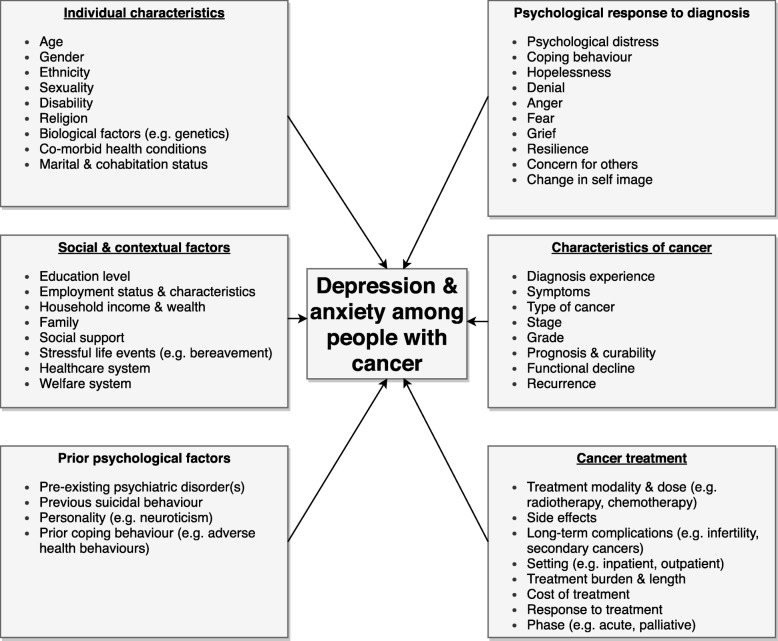
Background: A cancer diagnosis can have a substantial impact on mental health and wellbeing. Depression and anxiety may hinder cancer treatment and recovery, as well as quality of life and survival. We argue that more research is needed to prevent and treat co-morbid depression and anxiety among people with cancer and that it requires greater clinical priority. For background and to support our argument, we synthesise existing systematic reviews relating to cancer and common mental disorders, focusing on depression and anxiety. We searched several electronic databases for relevant reviews on cancer, depression and anxiety from 2012 to 2019. Several areas are covered: factors that may contribute to the development of common mental disorders among people with cancer; the prevalence of depression and anxiety; and potential care and treatment options. We also make several recommendations for future research. Numerous individual, psychological, social and contextual factors potentially contribute to the development of depression and anxiety among people with cancer, as well as characteristics related to the cancer and treatment received. Compared to the general population, the prevalence of depression and anxiety is often found to be higher among people with cancer, but estimates vary due to several factors, such as the treatment setting, type of cancer and time since diagnosis. Overall, there are a lack of high-quality studies into the mental health of people with cancer following treatment and among long-term survivors, particularly for the less prevalent cancer types and younger people. Studies that focus on prevention are minimal and research covering low- and middle-income populations is limited. Conclusion: Research is urgently needed into the possible impacts of long-term and late effects of cancer treatment on mental health and how these may be prevented, as increasing numbers of people live with and beyond cancer.
Overview
The claims and statistics of this paper haven’t been checked yet.
Free: it reads the open-access text and checks the first 5 claims that cite a source we can check. Create a free account to check every claim.
Integrity signals
Registry
Cites
Statistics
Figures
Verification
Claims the paper makes
The claims and statistics of this paper haven’t been checked yet.
Free: it reads the open-access text and checks the first 5 claims that cite a source we can check. Create a free account to check every claim.
Claims other papers make about this one
Each is checked against this paper’s own text: does it say what the citing paper says it does?
The source backs part of the claim, not all of it — or backs it for a different population, condition or comparison.
In the citing paper
“As the fear of cancer returning and progressing in the same organ or another part of the body is one of the most common and distressing concerns among cancer survivors”
From A randomised controlled trial comparing internet-delivered cognitive behavioural therapy (iCBT) with and without main carer access versus treatment-as-usual for depression and anxiety among breast cancer survivors: Study protocol (2021) · cites this paper as Niedzwiedz et al., 2019
Experimental — accuracy not yet measuredThe check wasn’t confident either way, so it gives no verdict — never disputed.
In the citing paper
“Repetitive negative thinking (RNT), which includes worry and rumination, is both a risk factor for and a common symptom of anxiety and depression15–17”
From An exploration into the relationship between insomnia and repetitive negative thinking among cancer survivors. (2025) · cites this paper as [17]
Experimental — accuracy not yet measured
Self-check
Percentages, sums and reported differences re-computed from the paper’s own numbers.
The self-check needs the paper’s full text.
Citations
Cites
Bray, F., Ferlay, J., Soerjomataram, I., Siegel, R. L., Torre, L. A., & Jemal, A. (2018) · CA: A Cancer Journal for Clinicians · doi:10.3322/caac.21492 · Cited by 84,109
Barnett, K., Mercer, S. W., Norbury, M., Watt, G., Wyke, S., & Guthrie, B. (2012) · The Lancet · doi:10.1016/s0140-6736(12)60240-2 · Cited by 6,972
Self-management approaches for people with chronic conditions: a review
Barlow, J., Wright, C., Sheasby, J., Turner, A., & Hainsworth, J. (2002) · Patient Education and Counseling · doi:10.1016/s0738-3991(02)00032-0 · Cited by 2,800
Fear of cancer recurrence in adult cancer survivors: a systematic review of quantitative studies
Simard, S., Thewes, B., Humphris, G., Dixon, M., Hayden, C., Mireskandari, S., & Ozakinci, G. (2013) · Journal of Cancer Survivorship · doi:10.1007/s11764-013-0272-z · Cited by 1,217 · cited 1×
“ant area of unmet need for cancer survivors [24].”
BackgroundSelf-management: Enabling and empowering patients living with cancer as a chronic illness
McCorkle, R., Ercolano, E., Lazenby, M., Schulman-Green, D., Schilling, L. S., Lorig, K., & Wagner, E. H. (2011) · CA: A Cancer Journal for Clinicians · doi:10.3322/caac.20093 · Cited by 950 · cited 2×
“Studies on self-management, cancer and psychological distress have focused on the treatment phase, with fewer investigating interventions following treatment or at the end of life [48].”
BackgroundFaller, H., Schuler, M., Richard, M., Heckl, U., Weis, J., & Küffner, R. (2013) · Journal of Clinical Oncology · doi:10.1200/jco.2011.40.8922 · Cited by 912
Krebber, A. M. H., Buffart, L. M., Kleijn, G., Riepma, I. C., de Bree, R., Leemans, C. R., Becker, A., Brug, J., van Straten, A., Cuijpers, P., et al. (2014) · Psycho-Oncology · doi:10.1002/pon.3409 · Cited by 908
Depression and anxiety in patients with cancer
Pitman, A., Suleman, S., Hyde, N., & Hodgkiss, A. (2018) · BMJ · doi:10.1136/bmj.k1415 · Cited by 871
Mitchell, A. J., Ferguson, D. W., Gill, J., Paul, J., & Symonds, P. (2013) · The Lancet Oncology · doi:10.1016/s1470-2045(13)70244-4 · Cited by 749 · cited 1×
“was more prevalent among cancer survivors, compared to healthy controls [30].”
BackgroundOsborn, R. L., Demoncada, A. C., & Feuerstein, M. (2006) · The International Journal of Psychiatry in Medicine · doi:10.2190/eufn-rv1k-y3tr-fk0l · Cited by 621
Emerging cancer trends among young adults in the USA: analysis of a population-based cancer registry
Sung, H., Siegel, R. L., Rosenberg, P. S., & Jemal, A. (2019) · The Lancet Public Health · doi:10.1016/s2468-2667(18)30267-6 · Cited by 618
Shapiro, C. L. (2018) · New England Journal of Medicine · doi:10.1056/nejmra1712502 · Cited by 608
Depression in cancer patients: Pathogenesis, implications and treatment (Review)
SMITH, H. R. (2015) · Oncology Letters · doi:10.3892/ol.2015.2944 · Cited by 478
Depression and anxiety in prostate cancer: a systematic review and meta-analysis of prevalence rates
Watts, S., Leydon, G., Birch, B., Prescott, P., Lai, L., Eardley, S., & Lewith, G. (2014) · BMJ Open · doi:10.1136/bmjopen-2013-003901 · Cited by 460
Post-traumatic stress disorder and cancer
Cordova, M. J., Riba, M. B., & Spiegel, D. (2017) · The Lancet Psychiatry · doi:10.1016/s2215-0366(17)30014-7 · Cited by 442 · cited 1×
“anxiety, including post-traumatic stress disorder [20].”
Walker, J., Hansen, C. H., Martin, P., Symeonides, S., Ramessur, R., Murray, G., & Sharpe, M. (2014) · The Lancet Psychiatry · doi:10.1016/s2215-0366(14)70313-x · Cited by 435 · cited 1×
“In Scotland, the prevalence of depression was found to be highest in patients with lung cancer (13%), followed by gynaecological cancer (11%), breast cancer (9%), colorectal cancer (7%), and genitourinary cancer (6%) [28].”
BackgroundMaass, S. W. M. C., Roorda, C., Berendsen, A. J., Verhaak, P. F. M., & de Bock, G. H. (2015) · Maturitas · doi:10.1016/j.maturitas.2015.04.010 · Cited by 420
Prevalence of depression in adults with cancer: a systematic review
Walker, J., Holm Hansen, C., Martin, P., Sawhney, A., Thekkumpurath, P., Beale, C., Symeonides, S., Wall, L., Murray, G., & Sharpe, M. (2013) · Annals of Oncology · doi:10.1093/annonc/mds575 · Cited by 308
Casellas‐Grau, A., Ochoa, C., & Ruini, C. (2017) · Psycho-Oncology · doi:10.1002/pon.4426 · Cited by 261 · cited 1×
“Experiencing temporary distress related to a cancer diagnosis may lead to positive psychological changes in the long-term whereby individuals feel a greater appreciation of life and are able to re-evaluate their priorities [36].”
BackgroundHui, D., Glitza, I., Chisholm, G., Yennu, S., & Bruera, E. (2013) · Cancer · doi:10.1002/cncr.27854 · Cited by 250
Risk of Suicide After Cancer Diagnosis in England
Henson, K. E., Brock, R., Charnock, J., Wickramasinghe, B., Will, O., & Pitman, A. (2019) · JAMA Psychiatry · doi:10.1001/jamapsychiatry.2018.3181 · Cited by 247
Howell, D., Oliver, T. K., Keller-Olaman, S., Davidson, J. R., Garland, S., Samuels, C., Savard, J., Harris, C., Aubin, M., Olson, K., et al. (2014) · Annals of Oncology · doi:10.1093/annonc/mdt506 · Cited by 235
Death or Debt? National Estimates of Financial Toxicity in Persons with Newly-Diagnosed Cancer
Gilligan, A. M., Alberts, D. S., Roe, D. J., & Skrepnek, G. H. (2018) · The American Journal of Medicine · doi:10.1016/j.amjmed.2018.05.020 · Cited by 232
Depression and anxiety in ovarian cancer: a systematic review and meta-analysis of prevalence rates
Watts, S., Prescott, P., Mason, J., McLeod, N., & Lewith, G. (2015) · BMJ Open · doi:10.1136/bmjopen-2015-007618 · Cited by 211
The treatment of depression in cancer patients: a systematic review
Rodin, G., Lloyd, N., Katz, M., Green, E., Mackay, J. A., Wong, R. K. S., & Supportive Care Guidelines Group of Cancer Care Ontario Program in Evidence-based Care (2007) · Supportive Care in Cancer · doi:10.1007/s00520-006-0145-3 · Cited by 204
Antidepressants for the treatment of depression in people with cancer
Ostuzzi, G., Matcham, F., Dauchy, S., Barbui, C., & Hotopf, M. (2015) · Cochrane Database of Systematic Reviews · doi:10.1002/14651858.cd011006.pub2 · Cited by 183
Zhu, J., Fang, F., Sjölander, A., Fall, K., Adami, H. O., & Valdimarsdóttir, U. (2017) · Annals of Oncology · doi:10.1093/annonc/mdx265 · Cited by 168 · cited 1×
“Among those with no previous psychiatric history, a diagnosis of cancer is associated with heightened risk of common mental disorders, which may adversely affect cancer treatment and recovery, as well as quality of life and survival [3].”
BackgroundAntidepressants for the treatment of depression in people with cancer
Ostuzzi, G., Matcham, F., Dauchy, S., Barbui, C., & Hotopf, M. (2018) · Cochrane Database of Systematic Reviews · doi:10.1002/14651858.cd011006.pub3 · Cited by 158
Kvåle, K. (2007) · European Journal of Oncology Nursing · doi:10.1016/j.ejon.2007.01.002 · Cited by 152
Li, M., Kennedy, E. B., Byrne, N., Gérin-Lajoie, C., Katz, M. R., Keshavarz, H., Sellick, S., & Green, E. (2017) · Psycho-Oncology · doi:10.1002/pon.4286 · Cited by 151
Kaul, S., Avila, J. C., Mutambudzi, M. S., Russell, H. V., Kirchhoff, A. C., & Schwartz, C. L. (2016) · Cancer · doi:10.1002/cncr.30417 · Cited by 141
Cook, S. A., Salmon, P., Hayes, G., Byrne, A., & Fisher, P. L. (2018) · Psycho-Oncology · doi:10.1002/pon.4601 · Cited by 133
Baker‐Glenn, E. A., Park, B., Granger, L., Symonds, P., & Mitchell, A. J. (2011) · Psycho-Oncology · doi:10.1002/pon.1759 · Cited by 130
Self-management interventions for cancer survivors: a systematic review
Boland, L., Bennett, K., & Connolly, D. (2017) · Supportive Care in Cancer · doi:10.1007/s00520-017-3999-7 · Cited by 119
Psychological aspects of prostate cancer: a clinical review
Sousa, A., Sonavane, S., & Mehta, J. (2012) · Prostate Cancer and Prostatic Diseases · doi:10.1038/pcan.2011.66 · Cited by 114
Mitchell, A. J., Meader, N., Davies, E., Clover, K., Carter, G. L., Loscalzo, M. J., Linden, W., Grassi, L., Johansen, C., Carlson, L. E., et al. (2012) · Journal of Affective Disorders · doi:10.1016/j.jad.2011.12.043 · Cited by 107
Alfano, C. M., Mayer, D. K., Bhatia, S., Maher, J., Scott, J. M., Nekhlyudov, L., Merrill, J. K., & Henderson, T. O. (2019) · CA: A Cancer Journal for Clinicians · doi:10.3322/caac.21558 · Cited by 99
Nead, K. T., Sinha, S., Yang, D. D., & Nguyen, P. L. (2017) · Urologic Oncology: Seminars and Original Investigations · doi:10.1016/j.urolonc.2017.07.016 · Cited by 96
The risk factors for depression in cancer patients undergoing chemotherapy: a systematic review
Wen, S., Xiao, H., & Yang, Y. (2019) · Supportive Care in Cancer · doi:10.1007/s00520-018-4466-9 · Cited by 77 · cited 1×
“such as unemployment, fewer educational qualifications and a lack of social support [7].”
BackgroundSmith, A. “., Rutherford, C., Butow, P., Olver, I., Luckett, T., Grimison, P., Toner, G., Stockler, M., & King, M. (2018) · Psycho-Oncology · doi:10.1002/pon.4596 · Cited by 76
Klaassen, Z. W. A., Wallis, C. J. D., Goldberg, H., Chandrasekar, T., Sayyid, R. K., Williams, S. B., Moses, K. A., Terris, M. K., Nam, R. K., Urbach, D. R., et al. (2019) · British Journal of Cancer · doi:10.1038/s41416-019-0390-0 · Cited by 69
Ball, H., Moore, S. G., & Leary, A. (2016) · European Journal of Oncology Nursing · doi:10.1016/j.ejon.2016.09.007 · Cited by 67
Foster, C. L., Calman, L. A., Richardson, A. M., Pimperton, H., & Nash, R. (2018) · Journal of Cancer Policy · doi:10.1016/j.jcpo.2018.02.004 · Cited by 67
Steroid-induced mental disorders in cancer patients: a systematic review
Ismail, M. F., Lavelle, C., & Cassidy, E. (2017) · Future Oncology · doi:10.2217/fon-2017-0306 · Cited by 62
Unrecognised and untreated depression in cancer care
Kissane, D. W. (2014) · The Lancet Psychiatry · doi:10.1016/s2215-0366(14)70345-1 · Cited by 61
Analyzing excess mortality from cancer among individuals with mental illness
Musuuza, J., Sherman, M. E., Knudsen, K. J., Sweeney, H. A., Tyler, C. V., & Koroukian, S. M. (2013) · Cancer · doi:10.1002/cncr.28091 · Cited by 59
Lu, L., O’Sullivan, E. M., & Sharp, L. (2019) · Psycho-Oncology · doi:10.1002/pon.5034 · Cited by 58
Ostuzzi, G., Benda, L., Costa, E., & Barbui, C. (2015) · Cancer Treatment Reviews · doi:10.1016/j.ctrv.2015.06.003 · Cited by 51
Risk of suicide within 1 year of cancer diagnosis
Wang, S., Chang, J., Weng, S., Yeh, M., & Lee, C. (2017) · International Journal of Cancer · doi:10.1002/ijc.31224 · Cited by 41
Ryan, D. A., Gallagher, P., Wright, S., & Cassidy, E. (2012) · Palliative Medicine · doi:10.1177/0269216311399663 · Cited by 13
Walker, Z., Jones, M. P., & Ravindran, A. V. (2017) · BMJ Open · doi:10.1136/bmjopen-2017-017043 · Cited by 7
Understanding survivors’ needs and outcomes: the role of routinely collected data
Lu, L., Deane, J., & Sharp, L. (2018) · Current Opinion in Supportive and Palliative Care · doi:10.1097/spc.0000000000000352 · Cited by 3
Research works printed but not linked: 2
- Halliwell E, Main L, Richardson C. The fundamental facts: the latest facts and figures on mental health: mental Health Foundation; 2007.
- Sargent CLIC. Hidden costs: the mental health impact of a cancer diagnosis on young people; 2017.
Cited by
Anxiety and depression in adult cancer patients: ESMO Clinical Practice Guideline
Grassi, L., Caruso, R., Riba, M. B., Lloyd-Williams, M., Kissane, D., Rodin, G., McFarland, D., Campos-Ródenas, R., Zachariae, R., Santini, D., et al. (2023) · ESMO Open · doi:10.1016/j.esmoop.2023.101155 · Cited by 316
Depression and Anxiety in Patients With Cancer: A Cross-Sectional Study
Naser, A. Y., Hameed, A. N., Mustafa, N., Alwafi, H., Dahmash, E. Z., Alyami, H. S., & Khalil, H. (2021) · Frontiers in Psychology · doi:10.3389/fpsyg.2021.585534 · Cited by 281
Singh, N., Kim, J., Kim, J., Lee, K., Zunbul, Z., Lee, I., Kim, E., Chi, S.-G., & Kim, J. S. (2022) · Bioactive Materials · doi:10.1016/j.bioactmat.2022.08.016 · Cited by 175
Prevalence and determinants of anxiety and depression in long-term breast cancer survivors
Breidenbach, C., Heidkamp, P., Hiltrop, K., Pfaff, H., Enders, A., Ernstmann, N., & Kowalski, C. (2022) · BMC Psychiatry · doi:10.1186/s12888-022-03735-3 · Cited by 155
Brunckhorst, O., Hashemi, S., Martin, A., George, G., Van Hemelrijck, M., Dasgupta, P., Stewart, R., & Ahmed, K. (2021) · Prostate Cancer and Prostatic Diseases · doi:10.1038/s41391-020-00286-0 · Cited by 116
Metadata
- Authors
- Niedzwiedz, C. L., Knifton, L., Robb, K. A., Katikireddi, S. V., & Smith, D. J.
- Affiliations
- University of Glasgow (GB)
- University of Strathclyde (GB)
- MRC/CSO Social and Public Health Sciences Unit (GB)
- Corresponding author
- Niedzwiedz, Claire L.
- Venue
- BMC Cancer
- Published
- 2019-10-11
- Volume
- 19
- Issue
- 1
- Pages
- 943-943
- ISSN
- 1471-2407 (ISSN-L)
- PMC
- PMC6788022
- OpenAlex
- W2979695050
- Cited by
- 756
- References
- 52
- Citations by year
- 2026: 64 · 2025: 135 · 2024: 159 · 2023: 136 · 2022: 130 · 2021: 94 · 2020: 37
- FWCI
- 27.06
- Type
- journal article
- Language
- en
- Open access
- gold
- doi.org
- Licence
- cc-by
- creativecommons.org/licenses/by/4.0/ (tdm)
- creativecommons.org/licenses/by/4.0/ (vor)
- Locations
- BMC Cancer (publishedVersion, cc-by)
- PubMed Central (publishedVersion, cc-by)
- PubMed (publishedVersion)
- Strathprints: The University of Strathclyde institutional repository (University of Strathclyde) (acceptedVersion)
- ENLIGHTEN (Jurnal Bimbingan dan Konseling Islam) (acceptedVersion, cc-by-sa)
- DOAJ (DOAJ: Directory of Open Access Journals) (submittedVersion, cc-by-sa)
- Funders
- Medical Research Council (MR/R024774/1, MC_UU_12017/13, MC_UU_12017/15)
- NRS Senior Clinical Fellowship (SCAF/15/02)
- Scottish Government Chief Scientist Office (SPHSU13, SPHSU15)
- Topics
- Health Sciences › Medicine › Oncology › Cancer survivorship and care
- Health Sciences › Medicine › Pediatrics, Perinatology and Child Health › Childhood Cancer Survivors' Quality of Life
- Health Sciences › Medicine › Psychiatry and Mental health › Mental Health Treatment and Access
- Keywords
- depression, anxiety, cancer, common mental disorders, cancer survivors, long-term cancer survivors, late effects of cancer treatment, mental health, prevalence, risk factors, prevention, quality of life
- MeSH terms
- Cancer Survivors, Self-Management, Systematic Reviews as Topic, Adaptation, Psychological, Adolescent, Adult, Aged, Aged, 80 and over, Anxiety, Depression, Female, Humans, Male, Mental Health, Neoplasms, Quality of Life, Research, Risk Factors, Meta-Analysis as Topic, Cognitive Behavioral Therapy, Prevalence, Young Adult
About these checks
Registry, retraction, Cites and statistics results are computed, not judged, with one exception: a printed reference that no index lists is read once by a model before it counts as a citation error. Claims are extracted by a model and kept only when their quote appears verbatim in the text; each cited source is then checked, with a model’s help, for whether it says what the claim relies on. Those verdicts can be wrong — read the claim’s quote and the cited source before relying on one.
Statistics and arithmetic are recomputed, not judged.
Confidence bands are shown only for fields calibrated on our annotated test set. None is calibrated yet, so no band is shown.
What counts as a claim ›How we measure confidence ›How we check this ›
Are you an author, or do you see a problem with this page? Request a review
Data sources
Bibliographic data: Semantic Scholar, OpenAlex, Crossref.
Contains information from the Semantic Scholar Academic Graph Datasets, made available under the ODC Attribution License (ODC-BY 1.0).
Semantic Scholar’s data is described in: Kinney, R., et al. (2023). The Semantic Scholar Open Data Platform. arXiv:2301.10140.
