

Anxiety among Lebanese adolescents: scale validation and correlates
Open accessThe DOI matches its Crossref record; 55 of the 56 references it cites were found in a registry or an index.
Abstract
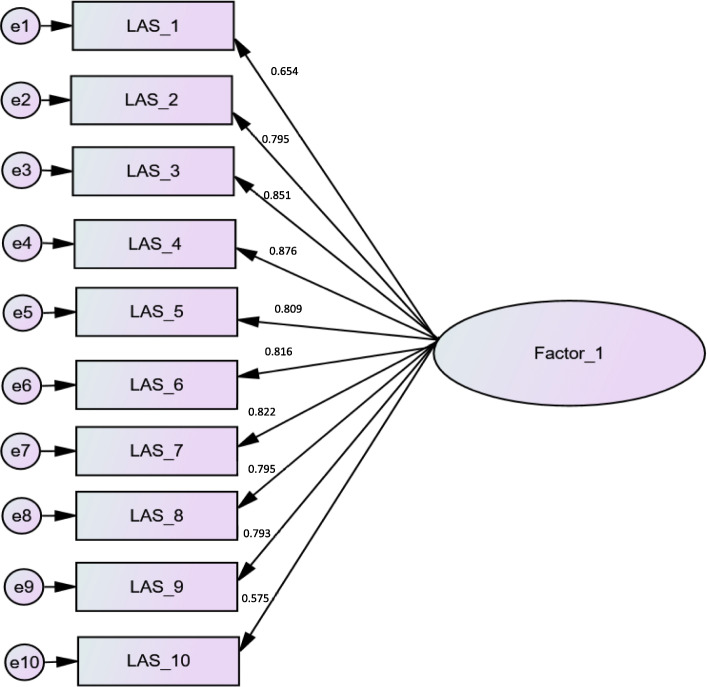
Background: The Lebanese population has undergone several conflicts and were the most afflicted by shelling and chaos during the civil war from 1975 to 1990, or even by displacement, bereavement, emigration, family separations, not to mention the economic crises that have hit the country since 2019 under which young adults are still succumbing. Our study aims to validate the Lebanese Anxiety Scale and assess correlates of anxiety among Lebanese adolescents. Methods: A cross-sectional study was carried between January and May 2019, using a proportionate random sampling of schools from all five Lebanese governorates, among which 1810 adolescents aged 14 to 17 years. Results: All LAS items remained in the model and formed one factor solution that explained 61.38% of the total variance (KMO = 0.873; p Bartlett test < 0.001), with an excellent Cronbach’s alpha of 0.93. Higher neglect (B = 0.38), insomnia (B = 0.21) and child psychological abuse (B = 0.08) were significantly associated with more anxiety. Those results were considered adjusted overall sociodemographic variables since the latter had no statistically significant association with anxiety. Conclusion: The study confirmed the association between anxiety and some variables such as psychological child abuse, neglect, and insomnia and emphasized the correlation between anxiety and these factors. Further, the LAS appears to be a short, valid and efficient tool for assessing anxiety among Lebanese adolescents. Further studies need to be carried to evaluate whether the LAS-10 gives a similar diagnosis to psychiatrists.
Overview
The claims and statistics of this paper haven’t been checked yet.
Free: it reads the open-access text and checks the first 5 claims that cite a source we can check. Create a free account to check every claim.
Integrity signals
Registry
Cites
Statistics
Figures
Verification
Claims the paper makes
The claims and statistics of this paper haven’t been checked yet.
Free: it reads the open-access text and checks the first 5 claims that cite a source we can check. Create a free account to check every claim.
Self-check
Percentages, sums and reported differences re-computed from the paper’s own numbers.
The self-check needs the paper’s full text.
Citations
Cites
Diagnostic and Statistical Manual of Mental Disorders
American Psychiatric Association (2013) · doi:10.1176/appi.books.9780890425596 · Cited by 116,369
(1970) · Cited by 24,983
Marsh, H. W., Hau, K.-T., & Wen, Z. (2004) · Structural Equation Modeling: A Multidisciplinary Journal · doi:10.1207/s15328007sem1103_2 · Cited by 6,691
Polanczyk, G. V., Salum, G. A., Sugaya, L. S., Caye, A., & Rohde, L. A. (2015) · Journal of Child Psychology and Psychiatry · doi:10.1111/jcpp.12381 · Cited by 3,990 · cited 1×
“1% of those adolescents, which is higher than the numbers reported internationally [35] and in other Arab countries [36, 37].”
BackgroundStraus, M. A., Hamby, S. L., Finkelhor, D., Moore, D. W., & Runyan, D. (1998) · Child Abuse & Neglect · doi:10.1016/s0145-2134(97)00174-9 · Cited by 2,498
Epidemiology of anxiety disorders in the 21st century
Bandelow, B., & Michaelis, S. (2015) · Dialogues in Clinical Neuroscience · doi:10.31887/dcns.2015.17.3/bbandelow · Cited by 2,079 · cited 1×
“Previous research reported that women and young adults, especially those under 35, are more susceptible to experience anxiety than other groups [12].”
BackgroundUncertainty and anticipation in anxiety: an integrated neurobiological and psychological perspective
Grupe, D. W., & Nitschke, J. B. (2013) · Nature Reviews Neuroscience · doi:10.1038/nrn3524 · Cited by 2,007 · cited 1×
“Anxiety orients us to danger; it can motivate us to face new challenges and experiences in life [7].”
BackgroundWhat I Think and Feel: A Revised Measure of Children's Manifest Anxiety
Reynolds, C. R., & Richmond, B. O. (1997) · Journal of Abnormal Child Psychology · doi:10.1023/a:1025751206600 · Cited by 1,935
What i think and feel: A revised measure of children's manifest anxiety
Reynolds, C. R., & Richmond, B. O. (1978) · Journal of Abnormal Child Psychology · doi:10.1007/bf00919131 · Cited by 1,741 · cited 1×
“Many scales could be used to screen for anxiety in adolescents, such as the State-Trait Anxiety Inventory for Children [22], the Revised Children’s Manifest Anxiety Scale [23], and the Fear Survey Schedule for ChildrenRevised [24].”
MethodJohnson, E. O., Roth, T., & Breslau, N. (2006) · Journal of Psychiatric Research · doi:10.1016/j.jpsychires.2006.07.008 · Cited by 804 · cited 1×
“Furthermore, insomnia may have bidirectional associations with anxiety disorders [19].”
Background
Research works printed but not linked: 1
- 23. Ollendick TH. The fear survey schedule for children-revised; 1978.
Cited by
Zouki, C.-J. E., Chahine, A., Mhanna, M., Obeïd, S., & Hallit, S. R. (2022) · BMC Psychiatry · doi:10.1186/s12888-022-04180-y · Cited by 64
“7 questions are rated from 0 to 4 and 3 questions graded from 1 to 4; higher scores indicate more anxiety [41, 42] (current Cronbach’s α = 0.”
BackgroundSelf-citationBitar, Z., Akel, M., Salameh, P., Obeïd, S., & Hallit, S. R. (2022) · Current Psychology · doi:10.1007/s12144-022-03104-z · Cited by 58
“Higher scores indicate more anxiety (Hallit et al., 2020; Merhy et al., 2021) (current Cronbach’s α = 0.”
BackgroundSelf-citationValidation of a shortened version of the Eating Attitude Test (EAT-7) in the Arabic language
Fekih‐Romdhane, F., Obeïd, S., Malaeb, D. N., Hallit, R. R., & Hallit, S. R. (2022) · Journal of Eating Disorders · doi:10.1186/s40337-022-00651-5 · Cited by 42
“It measures the severity of anxiety symptoms among Lebanese adults [23] and adolescents [37].”
BackgroundSelf-citationBitar, Z., Elias, M.-B., Malaeb, D. N., Hallit, S. R., & Obeïd, S. (2023) · BMC Psychology · doi:10.1186/s40359-023-01091-9 · Cited by 51
“Lebanese anxiety scale (LAS-10) This ten-item self-report scale was developed in Lebanon and validated among adults [22], and adolescents [23].”
MethodSelf-citationRahme, C., Akel, M., Obeïd, S., & Hallit, S. R. (2021) · BMC Psychology · doi:10.1186/s40359-021-00674-8 · Cited by 37
“Lebanese anxiety scale The LAS-10 is a 10-item scale used to screen for anxiety in the general Lebanese adult [32] and adolescent [33] populations.”
MethodSelf-citationMhanna, M., Zouki, C.-J. E., Chahine, A., Obeïd, S., & Hallit, S. R. (2022) · PLoS ONE · doi:10.1371/journal.pone.0277883 · Cited by 33
Self-citationGerges, S., Hallit, R. R., & Hallit, S. R. (2023) · BMC Psychiatry · doi:10.1186/s12888-023-04833-6 · Cited by 32
“and validated to depict anxiety among the Lebanese population [36, 37].”
BackgroundSelf-citationRahme, C., Kadri, N. E., Haddad, C., Fekih‐Romdhane, F., Obeïd, S., & Hallit, S. R. (2023) · BMC Psychiatry · doi:10.1186/s12888-023-04531-3 · Cited by 27
“Lebanese anxiety scale The 10-item scale validated among adults [66] and adolescents [67], is used to screen for anxiety in the general population.”
MethodSelf-citationLebanese Waterpipe Dependence Scale (LWDS-11) validation in a sample of Lebanese adolescents
Hallit, S. R., Obeïd, S., Sacre, H., & Salameh, P. (2021) · BMC Public Health · doi:10.1186/s12889-021-11662-3 · Cited by 21
Self-citationValidation of the Arabic version of the ORTO-R among a sample of Lebanese young adults
Rogoza, R., Mhanna, M., Gerges, S., Donini, L. M., Obeïd, S., & Hallit, S. R. (2022) · Eating and Weight Disorders - Studies on Anorexia Bulimia and Obesity · doi:10.1007/s40519-021-01350-x · Cited by 23
Self-citationPrevalence and Associated Factors of Social Anxiety Among Lebanese Adolescents
Haddad, C., Chidiac, J., Sacre, H., Salameh, P., Hallit, R. R., Obeïd, S., Soufia, M., & Hallit, S. R. (2022) · The Primary Care Companion For CNS Disorders · doi:10.4088/pcc.21m03061 · Cited by 24
Self-citationMalaeb, D. N., Bianchi, D., Pompili, S., Berro, J., Laghi, F., Azzi, V., Akel, M., Obeïd, S., & Hallit, S. R. (2021) · Eating and Weight Disorders - Studies on Anorexia Bulimia and Obesity · doi:10.1007/s40519-021-01321-2 · Cited by 15
Self-citationObeïd, S., Azzi, V., & Hallit, S. R. (2023) · PLoS ONE · doi:10.1371/journal.pone.0285665 · Cited by 17
Self-citationHallit, S., Bitar, Z., Rogoza, R., & Obeid, S. (2022) · doi:10.21203/rs.3.rs-1255958/v1 · Cited by 13
Self-citationValidity and Reliability of the Anxiety Assessment Scale: A New Three-dimensional Perspective
Malakçıoğlu, C. (2022) · Medeniyet Medical Journal · doi:10.4274/mmj.galenos.2022.75318 · Cited by 20
Bitar, Z., Rogoza, R., Hallit, S., & Obeid, S. (2023) · BMC Psychology · doi:10.1186/s40359-023-01155-w · Cited by 12
“Lebanese anxiety scale (LAS-10) It consists of 10 items such as “I have intellectual problems (Difficulty in concentration, poor memory); I feel indecisive” assessing the severity of anxiety symptoms among Lebanese adults [43] and adolescents [44].”
BackgroundSelf-citationSfeir, M., Saliba, G., Akel, M., Hallit, S. R., & Obeïd, S. (2022) · Perspectives In Psychiatric Care · doi:10.1111/ppc.13087 · Cited by 14
Self-citationBitar, Z., Fekih Romdhane, F., Rogoza, R., Ghorab, H. M., Obeid, S., & Hallit, S. (2024) · International Journal of Environmental Health Research · doi:10.1080/09603123.2023.2267483 · Cited by 9
“This scale has been validated in adults (Hallit et al. 2020) and adolescents (Merhy et al. 2021); higher scores reflect more anxiety.”
MethodSelf-citationLahoud, C., Merhy, G., Kahwaji, G.-J., Lahoud, R., Hallit, S. R., Fekih‐Romdhane, F., & Mattar, H. (2024) · Psychological Reports · doi:10.1177/00332941241251457 · Cited by 9
“The LAS was validated for both adults and adolescents and in both the English and Arabic languages (Hallit et al., 2020; Hallit S, et al., 2020; Merhy et al., 2021; Merhy G, et al., 2021).”
Self-citationHallit, S. R., Rogoza, R., Semaan, C. A., Azzi, V., Sawma, T., & Obeïd, S. (2023) · BMC Psychiatry · doi:10.1186/s12888-023-05123-x · Cited by 8
“The LAS-10 evaluates anxiety among Lebanese adults [35] and adolescents [36].”
BackgroundSelf-citationAzzi, V., Iskandar, K., Obeïd, S., & Hallit, S. R. (2022) · BMC Pediatrics · doi:10.1186/s12887-022-03523-8 · Cited by 11
“Lebanese Anxiety Scale (LAS) It is a 10-item tool, created for anxiety assessment among adults [54] and adolescents [55].”
MethodSelf-citationMenstrual symptoms variation among Lebanese women before and after the COVID-19 pandemic
Issa, R., Kharaba, Z. J., Azzi, V., Obeïd, S., Sawma, T., Said, A. S. A., AlAhmad, M. M., Alfoteih, Y., Malaeb, D. N., & Hallit, S. R. (2022) · Pharmacy Practice · doi:10.18549/pharmpract.2022.3.2699 · Cited by 7
Self-citationHajj-Moussa, M., Hachem, N. E., Sebaaly, Z. E., Moubarak, P., Kahwagi, R., Malaeb, D. N., Hallit, R. R., Khatib, S. E., Hallit, S. R., Obeïd, S., et al. (2024) · PLoS ONE · doi:10.1371/journal.pone.0306262 · Cited by 6
“The prevailing negative events in Lebanon have exacerbated the level of pessimism among its population, and one particularly distressing aspect is the dire situation facing chronic kidney disease patients in their access to essential medical care [49].”
BackgroundSelf-citationNehme, A., Barakat, M. M., Malaeb, D. N., Obeïd, S., Hallit, S. R., & Haddad, G. (2023) · Pharmacy Practice · doi:10.18549/pharmpract.2023.1.2763 · Cited by 7
Self-citationHamdan, A., Ghzayel, L., Yammine, Y., Hosn, O. A., Daou, A. M., Chaar, J. A., & Semaan, Z. M. (2024) · Journal of Voice · doi:10.1016/j.jvoice.2024.10.006 · Cited by 5
Karam, J.-M., Malaeb, D. N., Hallit, R. R., Fekih‐Romdhane, F., Obeïd, S., & Hallit, S. R. (2024) · BMC Psychiatry · doi:10.1186/s12888-024-05822-z · Cited by 9
“In literature, numerous studies tried searching for different factors that would trigger anxiety in this age group; neglect, child abuse, financial and cultural instability were shown as correlates of anxiety among Lebanese young adults [21].”
BackgroundSelf-citationBitar, Z., Haddad, C., Obeïd, S., & Hallit, S. R. (2022) · Croatian Medical Journal · doi:10.3325/cmj.2022.63.412 · Cited by 5
“It is a scale measuring the severity of anxiety symptoms among Lebanese adults (29) and adolescents (30).”
Self-citationKahwaji, C. E., Barakat, E., Fekih‐Romdhane, F., Akkari, C., Barakat, S., & Hallit, S. R. (2025) · BMC Psychology · doi:10.1186/s40359-025-02410-y · Cited by 7
“The Lebanese Anxiety Scale-10 (LAS-10) , which is a tool of 10 items, designed to evaluate anxiety in both adults [47] and adolescents [48].”
Self-citationAzzi, R., Samaha, S., Malaeb, D. N., Akel, M., Azzi, V., Hallit, S. R., & Obeïd, S. (2023) · BMC Psychiatry · doi:10.1186/s12888-023-04847-0 · Cited by 8
“Lebanese Anxiety Scale (LAS‐10) The LAS-10 evaluates general anxiety among Lebanese adults [52] and adolescents [53].”
BackgroundSelf-citationNehme, A., Moussa, S., Fekih‐Romdhane, F., Hallit, S. R., Obeïd, S., & Haddad, G. (2024) · International Journal of Environmental Health Research · doi:10.1080/09603123.2024.2341132 · Cited by 3
“Higher scores are associated with greater anxiety (Hallit et al. 2020; Merhy et al. 2021).”
Self-citationKaddoura, T. R., Hodroj, M., Chmeis, B., Rammal, F., Malhab, S. B., Mansour, S., Akour, A. A., Khatib, S. E., Hosseini, B., Hallit, S. R., et al. (2025) · Frontiers in Public Health · doi:10.3389/fpubh.2025.1443920 · Cited by 3
“Lebanese Anxiety Scale (LAS-10) is a validated tool utilized to screen for anxiety in adults (25) and adolescents (26).”
Self-citationHajj-Moussa, M., Hachem, N. E., Sebaaly, Z. E., Moubarak, P., Malaeb, D. N., Hallit, R. R., Khatib, S. E., Hallit, S. R., Obeïd, S., & Fekih‐Romdhane, F. (2023) · Research Square · doi:10.21203/rs.3.rs-3494149/v1 · Cited by 3
Self-citationHamdan, A., Ghzayel, L., Semaan, Z. M., Hosn, O. A., Daou, A. M., Chaar, J. A., Nawfal, N., & Barazi, R. (2025) · Laryngoscope Investigative Otolaryngology · doi:10.1002/lio2.70256 · Cited by 2
“Nearly 60% of adults reported depression strongly tied to low socio-economic status and poor living conditions [25], while youth faced anxiety as a result of neglect and abuse [26].”
Nercessian, A., & Salameh, P. (2025) · Global Social Welfare · doi:10.1007/s40609-025-00421-6 · Cited by 2
Self-citationElshaikh, U. A. M., Hassan, D. A., Daher‐Nashif, S., Khaled, S. M., & Rahim, H. F. A. (2026) · BMC Public Health · doi:10.1186/s12889-026-26312-9 · Cited by 2
“Similarly, the Illinois Bully Scale also showed strong internal consistency (α = 0.97) across multiple studies [93, 121, 124, 137].”
InfluentialSulejmani, H., & Pop-Jordanova, N. (2026) · PRILOZI · doi:10.2478/prilozi-2026-0017 · Cited by 2
“The validity and reliability of such instruments have been supported across diverse populations, underscoring the importance of robust psychometric evaluation and latent structure analysis [Adamczyk et al., 2022; Chaaya et al., 2023; Merhy et al., 2021].”
Prevalence of Orthorexic Tendencies and Their Correlates Among Lebanese Patients with Cancer
Zoghbi, R., Awad, E., Hallit, S. R., & Matta, C. (2023) · Perceptual and Motor Skills · doi:10.1177/00315125231182733 · Cited by 2
Self-citationHamdan, A., Feghali, P. A. R., Semaan, Z. M., Zalaquett, N., Ghzayel, L., Carapiperis, I., Hosn, O. A., & Jaber, B. (2024) · Journal of Voice · doi:10.1016/j.jvoice.2024.10.033 · Cited by 2
Khadra, T., Hallit, R. R., Malaeb, D. N., Hallit, S. R., Fekih‐Romdhane, F., & Obeïd, S. (2025) · BMC Psychology · doi:10.1186/s40359-024-02219-1 · Cited by 1
Self-citationThe mediating role of anxiety between child abuse and pain among a sample of Lebanese adults
Kesrewani, E., Chammas, G., Malaeb, D. N., Sakr, F., Dabbous, M., Khatib, S. E., Hallit, S. R., Fekih‐Romdhane, F., & Obeïd, S. (2025) · Scientific Reports · doi:10.1038/s41598-025-01689-6 · Cited by 2
Self-citationChaaya, R., Cattan, R., Lahoud, C., Tornquist, D., Schuch, F. B., Merhy, G., Kahwaji, G.-J., Lahoud, R., Mattar, H., Obeïd, S., et al. (2025) · Chronobiology International · doi:10.1080/07420528.2025.2525465 · Cited by 6
“The LAS is a 10-item scale that has been validated and used with adults (Hallit et al. 2020) and adolescents (Merhy et al. 2021) to screen for the presence of anxiety.”
Self-citationKaram, M. A., Hallit, R. R., Malaeb, D. N., Sakr, F., Dabbous, M., Fekih‐Romdhane, F., Obeïd, S., & Hallit, S. R. (2025) · PLoS ONE · doi:10.1371/journal.pone.0334725 · Cited by 1
“Greater levels of crowding have been linked to increased psychological distress, irritability, and sleep disturbances in adolescents, particularly those from low-income households [33,34].”
Self-citationSfeir, M., Postigo, Á., Fekih‐Romdhane, F., González‐Nuevo, C., Malaeb, D. N., Hallit, S. R., & Obeïd, S. (2025) · Scientific Reports · doi:10.1038/s41598-024-83089-w · Cited by 1
“This scale has been validated in adults 49 and adolescents 50 ; higher scores reflect more anxiety.”
Self-citationHawila, B., Malaeb, D. N., Hallit, S. R., & Obeïd, S. (2023) · Pharmacy Practice · doi:10.18549/pharmpract.2023.2.2776 · Cited by 1
Self-citationChaaya, R., Cattan, R., Lahoud, C., Merhy, G., Kahwaji, G.-J., Lahoud, R., Mattar, H., Obeïd, S., Hallit, S. R., & Fekih‐Romdhane, F. (2024) · Research Square · doi:10.21203/rs.3.rs-4377091/v1
Self-citationBaissary, J., Hallit, S. R., Assaf, M., Fekih‐Romdhane, F., Farhat, M., & Noun, P. (2025) · Archives de Pédiatrie · doi:10.1016/j.arcped.2025.10.006
Self-citationFekih‐Romdhane, F., Obeïd, S., Malaeb, D., Hallit, R., & Hallit, S. (2022) · Figshare · doi:10.6084/m9.figshare.20677867
Self-citationHallit, S., Rogoza, R., Abi Semaan, C., Azzi, V., Sawma, T., & Obeïd, S. (2024) · Figshare · doi:10.6084/m9.figshare.26612285
Self-citation
Metadata
- Authors
- Merhy, G., Azzi, V., Salameh, P., Obeid, S., & Hallit, S.
- Affiliations
- Holy Spirit University of Kaslik (LB)
- Lebanese University (LB)
- Corresponding author
- Hallit, Souheil
- Venue
- BMC Pediatrics
- Published
- 2021-06-22
- Volume
- 21
- Issue
- 1
- Pages
- 288-288
- ISSN
- 1471-2431 (ISSN-L)
- PMC
- PMC8218523
- OpenAlex
- W3176094968
- Cited by
- 48
- References
- 56
- Citations by year
- 2026: 2 · 2025: 10 · 2024: 8 · 2023: 12 · 2022: 13 · 2021: 3
- FWCI
- 6.14
- Type
- journal article
- Language
- en
- Open access
- gold
- doi.org
- Licence
- cc-by
- creativecommons.org/licenses/by/4.0 (tdm)
- creativecommons.org/licenses/by/4.0 (vor)
- Locations
- BMC Pediatrics (publishedVersion, cc-by)
- PubMed Central (publishedVersion, cc-by)
- PubMed (publishedVersion)
- DOAJ (DOAJ: Directory of Open Access Journals) (submittedVersion, cc-by-sa)
- Topics
- Social Sciences › Psychology › Clinical Psychology › Child and Adolescent Psychosocial and Emotional Development
- Social Sciences › Psychology › Experimental and Cognitive Psychology › Anxiety, Depression, Psychometrics, Treatment, Cognitive Processes
- Social Sciences › Psychology › Clinical Psychology › COVID-19 and Mental Health
- Keywords
- anxiety, adolescents, scale validation, Lebanese civil war, child neglect, child psychological abuse, insomnia, Lebanese adolescents, psychosocial risk factors
- MeSH terms
- Adolescent, Anxiety, Anxiety Disorders, Child, Child Abuse, Cross-Sectional Studies, Humans, Schools, Young Adult
About these checks
Registry, retraction, Cites and statistics results are computed, not judged, with one exception: a printed reference that no index lists is read once by a model before it counts as a citation error. Claims are extracted by a model and kept only when their quote appears verbatim in the text; each cited source is then checked, with a model’s help, for whether it says what the claim relies on. Those verdicts can be wrong — read the claim’s quote and the cited source before relying on one.
Statistics and arithmetic are recomputed, not judged.
Confidence bands are shown only for fields calibrated on our annotated test set. None is calibrated yet, so no band is shown.
What counts as a claim ›How we measure confidence ›How we check this ›
Are you an author, or do you see a problem with this page? Request a review
Data sources
Bibliographic data: Semantic Scholar, OpenAlex, Crossref.
Contains information from the Semantic Scholar Academic Graph Datasets, made available under the ODC Attribution License (ODC-BY 1.0).
Semantic Scholar’s data is described in: Kinney, R., et al. (2023). The Semantic Scholar Open Data Platform. arXiv:2301.10140.
