

Anxiety among Lebanese adolescents: scale validation and correlates
Open accessThe DOI matches its Crossref record; 55 of the 56 references it cites were found in a registry or an index.
Abstract
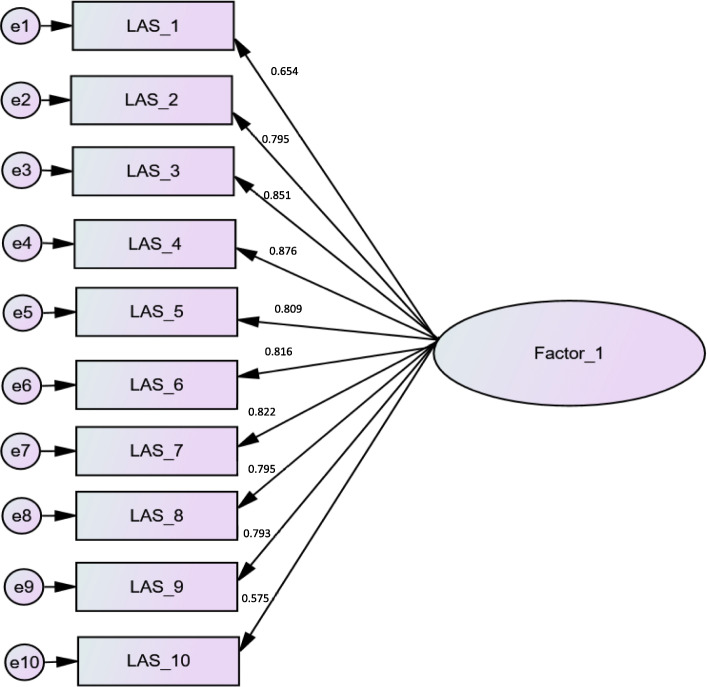
Background: The Lebanese population has undergone several conflicts and were the most afflicted by shelling and chaos during the civil war from 1975 to 1990, or even by displacement, bereavement, emigration, family separations, not to mention the economic crises that have hit the country since 2019 under which young adults are still succumbing. Our study aims to validate the Lebanese Anxiety Scale and assess correlates of anxiety among Lebanese adolescents. Methods: A cross-sectional study was carried between January and May 2019, using a proportionate random sampling of schools from all five Lebanese governorates, among which 1810 adolescents aged 14 to 17 years. Results: All LAS items remained in the model and formed one factor solution that explained 61.38% of the total variance (KMO = 0.873; p Bartlett test < 0.001), with an excellent Cronbach’s alpha of 0.93. Higher neglect (B = 0.38), insomnia (B = 0.21) and child psychological abuse (B = 0.08) were significantly associated with more anxiety. Those results were considered adjusted overall sociodemographic variables since the latter had no statistically significant association with anxiety. Conclusion: The study confirmed the association between anxiety and some variables such as psychological child abuse, neglect, and insomnia and emphasized the correlation between anxiety and these factors. Further, the LAS appears to be a short, valid and efficient tool for assessing anxiety among Lebanese adolescents. Further studies need to be carried to evaluate whether the LAS-10 gives a similar diagnosis to psychiatrists.
Overview
The claims and statistics of this paper haven’t been checked yet.
Free: it reads the open-access text and checks the first 5 claims that cite a source we can check. Create a free account to check every claim.
Integrity signals
Registry
Cites
Statistics
Figures
Verification
Claims the paper makes
The claims and statistics of this paper haven’t been checked yet.
Free: it reads the open-access text and checks the first 5 claims that cite a source we can check. Create a free account to check every claim.
Self-check
Percentages, sums and reported differences re-computed from the paper’s own numbers.
The self-check needs the paper’s full text.
Citations
Cites
Diagnostic and Statistical Manual of Mental Disorders
American Psychiatric Association (2013) · doi:10.1176/appi.books.9780890425596 · Cited by 116,369
(1970) · Cited by 24,983
Marsh, H. W., Hau, K.-T., & Wen, Z. (2004) · Structural Equation Modeling: A Multidisciplinary Journal · doi:10.1207/s15328007sem1103_2 · Cited by 6,691
Polanczyk, G. V., Salum, G. A., Sugaya, L. S., Caye, A., & Rohde, L. A. (2015) · Journal of Child Psychology and Psychiatry · doi:10.1111/jcpp.12381 · Cited by 3,990 · cited 1×
“1% of those adolescents, which is higher than the numbers reported internationally [35] and in other Arab countries [36, 37].”
BackgroundStraus, M. A., Hamby, S. L., Finkelhor, D., Moore, D. W., & Runyan, D. (1998) · Child Abuse & Neglect · doi:10.1016/s0145-2134(97)00174-9 · Cited by 2,498
Epidemiology of anxiety disorders in the 21st century
Bandelow, B., & Michaelis, S. (2015) · Dialogues in Clinical Neuroscience · doi:10.31887/dcns.2015.17.3/bbandelow · Cited by 2,079 · cited 1×
“Previous research reported that women and young adults, especially those under 35, are more susceptible to experience anxiety than other groups [12].”
BackgroundUncertainty and anticipation in anxiety: an integrated neurobiological and psychological perspective
Grupe, D. W., & Nitschke, J. B. (2013) · Nature Reviews Neuroscience · doi:10.1038/nrn3524 · Cited by 2,007 · cited 1×
“Anxiety orients us to danger; it can motivate us to face new challenges and experiences in life [7].”
BackgroundWhat I Think and Feel: A Revised Measure of Children's Manifest Anxiety
Reynolds, C. R., & Richmond, B. O. (1997) · Journal of Abnormal Child Psychology · doi:10.1023/a:1025751206600 · Cited by 1,935
What i think and feel: A revised measure of children's manifest anxiety
Reynolds, C. R., & Richmond, B. O. (1978) · Journal of Abnormal Child Psychology · doi:10.1007/bf00919131 · Cited by 1,741 · cited 1×
“Many scales could be used to screen for anxiety in adolescents, such as the State-Trait Anxiety Inventory for Children [22], the Revised Children’s Manifest Anxiety Scale [23], and the Fear Survey Schedule for ChildrenRevised [24].”
MethodJohnson, E. O., Roth, T., & Breslau, N. (2006) · Journal of Psychiatric Research · doi:10.1016/j.jpsychires.2006.07.008 · Cited by 804 · cited 1×
“Furthermore, insomnia may have bidirectional associations with anxiety disorders [19].”
BackgroundBlake, M. J., Trinder, J. A., & Allen, N. B. (2018) · Clinical Psychology Review · doi:10.1016/j.cpr.2018.05.006 · Cited by 443 · cited 2×
“For instance, research confirmed the robust association between chronic insomnia and anxiety [20].”
BackgroundThe Oxford Handbook of Computational and Mathematical Psychology
(2015) · Oxford Handbooks Online · doi:10.1093/oxfordhb/9780199957996.001.0001 · Cited by 396
Melki, I. S., Beydoun, H. A., Khogali, M., Tamim, H., & Yunis, K. A. (2004) · Journal of Epidemiology and Community Health · doi:10.1136/jech.2003.012690 · Cited by 387 · cited 1×
“The first part evaluated participants’ sociodemographic characteristics, their self-reported height, their weight in order to determine the Body Mass Index (BMI), and the number of individuals and rooms in the household, excluding the bathroom and the kitchen in order to determine the household crowding index (the num…”
BackgroundJiang, S., & Ngien, A. (2020) · Social Media + Society · doi:10.1177/2056305120912488 · Cited by 316 · cited 1×
“McCarthy, MD, believes that today’s teens are very connected to social media, unlike the last decade; therefore, their self-esteem becomes correlated to what they see on social media from posts, videos, and images [11].”
BackgroundThe long-term health outcomes of childhood abuse: An overview and a call to action
Springer, K. W., Sheridan, J., Kuo, D., & Carnes, M. (2003) · Journal of General Internal Medicine · doi:10.1046/j.1525-1497.2003.20918.x · Cited by 299
Chronic Insomnia and the Stress System
Basta, M., Chrousos, G. P., Vela-Bueno, A., & Vgontzas, A. N. (2007) · Sleep Medicine Clinics · doi:10.1016/j.jsmc.2007.04.002 · Cited by 286 · cited 1×
“A few mental and physiological variables contribute to the onset and propagation of sleep deprivation, such as anxious-ruminative identity characteristics, upsetting occasions, age-related sleep homeostasis, debilitating mechanisms, and numerous other components [56].”
BackgroundEffects of acute sleep deprivation on state anxiety levels: a systematic review and meta-analysis
Pires, G. N., Bezerra, A. G., Tufik, S., & Andersen, M. L. (2016) · Sleep Medicine · doi:10.1016/j.sleep.2016.07.019 · Cited by 271
Model Comparison and the Principle of Parsimony
Vandekerckhove, J., Matzke, D., & Wagenmakers, E.-J. (2015) · Oxford Handbooks Online · doi:10.1093/oxfordhb/9780199957996.013.14 · Cited by 269 · cited 1×
“24│ to achieve more parsimonious models [52].”
Burstein, M., He, J.-P., Kattan, G., Albano, A. M., Avenevoli, S., & Merikangas, K. R. (2011) · Journal of the American Academy of Child & Adolescent Psychiatry · doi:10.1016/j.jaac.2011.06.005 · Cited by 225 · cited 1×
“(2014 & 2011) reported that around 3 and 9% of the participants had generalized anxiety disorder in 6months duration, and social phobia in their lifetime, respectively [4, 6].”
BackgroundChild Sexual Abuse in the Etiology of Anxiety Disorders: A Systematic Review of Reviews
Maniglio, R. (2013) · Trauma, Violence, & Abuse · doi:10.1177/1524838012470032 · Cited by 178
Arabic Validation of the Internet Addiction Test
Hawi, N. S. (2013) · Cyberpsychology, Behavior, and Social Networking · doi:10.1089/cyber.2012.0426 · Cited by 146 · cited 15×
“* Correspondence: saharobeid23@hotmail.com; souheilhallit@hotmail.com Sahar Obeid and Souheil Hallit are last coauthors 2INSPECT-LB: National Institute of Public Health, Clinical Epidemiology and Toxicology, Beirut, Lebanon 1Faculty of Medicine and Medical Sciences, Holy Spirit University of Kaslik (USEK), Jounieh, Le…”
BackgroundInfluentialRisk factor characteristics in carers who physically abuse or neglect their elderly dependants
Reay, A. M. C., & Browne, K. D. (2001) · Aging & Mental Health · doi:10.1080/13607860020020654 · Cited by 129 · cited 1×
“On the other hand, higher depression scores were significantly present in adolescents who experienced physical abuse in their early years, while childhood neglect had higher anxiety scores [15].”
BackgroundPsychiatric disorders among adolescents from Lebanon: prevalence, correlates, and treatment gap
Maalouf, F. T., Ghandour, L. A., Halabi, F., Zeinoun, P. A., Shehab, A. A. S., & Tavitian, L. (2016) · Social Psychiatry and Psychiatric Epidemiology · doi:10.1007/s00127-016-1241-4 · Cited by 109 · cited 1×
“In addition, a previous study [34] conducted among Lebanese adolescents aged between 11 and 17 years revealed the presence of psychiatric disorders in 26.”
ResultRehan, W., Antfolk, J., Johansson, A., Jern, P., & Santtila, P. (2017) · PLOS ONE · doi:10.1371/journal.pone.0177252 · Cited by 106 · cited 2×
“Specifically, previous literature highlighted the role of children’s physical, psychological, and sexual assaults in predisposing adults to mental health disorders such as anxiety and depression [17].”
BackgroundSuicidal ideation among Lebanese adolescents: scale validation, prevalence and correlates
Chahine, M., Salameh, P., Haddad, C., Sacre, H., Soufia, M., Akel, M., Obeïd, S., Hallit, R. R., & Hallit, S. R. (2020) · BMC Psychiatry · doi:10.1186/s12888-020-02726-6 · Cited by 103
Self-citationThe Lebanese–Syrian crisis: impact of influx of Syrian refugees to an already weak state
Arcos González, P., Cherri, Z., & Castro Delgado, R. (2016) · Risk Management and Healthcare Policy · doi:10.2147/rmhp.s106068 · Cited by 99 · cited 1×
“Lebanon has been experiencing an unsteady political crisis, wars, armed conflicts, and terrorist attacks [27], in addition to local problems such as the shortage of clean water, electricity, and waste mishandling [27, 28].”
Obeid, S., Saade, S., Haddad, C., Sacre, H., Khansa, W., Al Hajj, R., Kheir, N., & Hallit, S. (2019) · Journal of Nervous & Mental Disease · doi:10.1097/nmd.0000000000001034 · Cited by 88 · cited 1×
“regarding the association between anxiety and internet addiction indicated that individuals who were highly addicted to internet usage experienced emotional, generalized anxiety, and social disorders [21].”
BackgroundSelf-citationBurstein, M., Beesdo-Baum, K., He, J.-P., & Merikangas, K. R. (2014) · Psychological Medicine · doi:10.1017/s0033291713002997 · Cited by 87 · cited 2×
“The DSM-5 defines general anxiety disorder as an excessive worry about particular work events or performance occurring for more than 6 months [5].”
BackgroundAlexithymia, aggressive behavior and depression among Lebanese adolescents: A cross-sectional study
Sfeir, E., Geara, C., Hallit, S. R., & Obeïd, S. (2020) · Child and Adolescent Psychiatry and Mental Health · doi:10.1186/s13034-020-00338-2 · Cited by 84 · cited 1×
“Recent studies showed that the mental health of Lebanese adolescents [30] and adults [31–33] has been affected.”
BackgroundSelf-citationConstruction of the Lebanese Anxiety Scale (LAS-10): a new scale to assess anxiety in adult patients
Hallit, S., Obeid, S., Haddad, C., Hallit, R., Akel, M., Haddad, G., Soufia, M., Khansa, W., Khoury, R., Kheir, N., et al. (2020) · International Journal of Psychiatry in Clinical Practice · doi:10.1080/13651501.2020.1744662 · Cited by 77 · cited 3×
“It displays 10 items, giving more load to the anxious mood and somatic symptoms in the Lebanese population [26].”
BackgroundMethodInfluentialSelf-citationWeary-Smith, K. A. (2007) · D-Scholarship@Pitt (University of Pittsburgh) · Cited by 72
Nakhoul, L., Obeid, S., Sacre, H., Haddad, C., Soufia, M., Hallit, R., Akel, M., Salameh, P., & Hallit, S. (2020) · BMC Psychology · doi:10.1186/s40359-020-00404-6 · Cited by 65
Self-citationMalaeb, D. N., Awad, E., Haddad, C., Salameh, P., Sacre, H., Akel, M., Soufia, M., Hallit, R. R., Obeïd, S., & Hallit, S. R. (2020) · BMC Pediatrics · doi:10.1186/s12887-020-02413-1 · Cited by 65 · cited 16×
“* Correspondence: saharobeid23@hotmail.com; souheilhallit@hotmail.com Sahar Obeid and Souheil Hallit are last coauthors 2INSPECT-LB: National Institute of Public Health, Clinical Epidemiology and Toxicology, Beirut, Lebanon 1Faculty of Medicine and Medical Sciences, Holy Spirit University of Kaslik (USEK), Jounieh, Le…”
MethodInfluentialSelf-citationJaju, S., Al-Adawi, S., Al-Kharusi, H., Morsi, M., & Al-Riyami, A. (2009) · Child and Adolescent Psychiatry and Mental Health · doi:10.1186/1753-2000-3-29 · Cited by 63
Baiden, P., Mengo, C., Boateng, G. O., & Small, E. (2019) · Journal of Affective Disorders · doi:10.1016/j.jad.2018.08.078 · Cited by 63 · cited 1×
“Lebanon has been experiencing an unsteady political crisis, wars, armed conflicts, and terrorist attacks [27], in addition to local problems such as the shortage of clean water, electricity, and waste mishandling [27, 28].”
BackgroundObeïd, S., Akel, M., Haddad, C., Fares, K., Sacre, H., Salameh, P., & Hallit, S. R. (2019) · BMC Psychology · doi:10.1186/s40359-019-0353-5 · Cited by 63
Self-citationFactors associated with depression among the Lebanese population: Results of a cross‐sectional study
Obeid, S., Lahoud, N., Haddad, C., Sacre, H., Akel, M., Fares, K., Salameh, P., & Hallit, S. (2020) · Perspectives in Psychiatric Care · doi:10.1111/ppc.12518 · Cited by 59
Self-citationFactors associated with problematic internet use among a large sample of Lebanese adolescents
Dib, J. E., Haddad, C., Sacre, H., Akel, M., Salameh, P., Obeïd, S., & Hallit, S. R. (2021) · BMC Pediatrics · doi:10.1186/s12887-021-02624-0 · Cited by 59 · cited 15×
“* Correspondence: saharobeid23@hotmail.com; souheilhallit@hotmail.com Sahar Obeid and Souheil Hallit are last coauthors 2INSPECT-LB: National Institute of Public Health, Clinical Epidemiology and Toxicology, Beirut, Lebanon 1Faculty of Medicine and Medical Sciences, Holy Spirit University of Kaslik (USEK), Jounieh, Le…”
BackgroundInfluentialSelf-citationHousehold crowding and psychosocial health among Inuit in Greenland
Riva, M., Larsen, C. V. L., & Bjerregaard, P. (2014) · International Journal of Public Health · doi:10.1007/s00038-014-0599-x · Cited by 57 · cited 1×
“Specifically, it has been associated with lower mental wellbeing [14].”
BackgroundPierse, N., Carter, K., Bierre, S., Law, D., & Howden-Chapman, P. (2016) · Journal of Epidemiology and Community Health · doi:10.1136/jech-2015-206716 · Cited by 56 · cited 1×
“Moreover, household crowding has a robust connection with mental health issues [13].”
BackgroundSelf-reported neglect, amygdala volume, and symptoms of anxiety in adolescent boys
Roth, M. C., Humphreys, K. L., King, L. S., & Gotlib, I. H. (2018) · Child Abuse & Neglect · doi:10.1016/j.chiabu.2018.03.016 · Cited by 54 · cited 3×
“In fact, it was proven that neglect significantly affects the anatomic development of the brain structures [54].”
BackgroundInfluentialAnxiety in adolescents: Update on its diagnosis and treatment for primary care providers
Dickstein, D. (2011) · Adolescent Health, Medicine and Therapeutics · doi:10.2147/ahmt.s7597 · Cited by 52 · cited 1×
“Anxiety is generally expected in adolescents since teenagers have new experiences, opportunities, and challenges; hence, they seek more independence [9].”
BackgroundAnxiety Disorders in Children and Adolescents
(2011) · Cambridge University Press eBooks · doi:10.1017/cbo9780511994920 · Cited by 50
Obeïd, S., Lahoud, N., Haddad, C., Sacre, H., Fares, K., Akel, M., Salameh, P., & Hallit, S. R. (2020) · International Journal of Psychiatry in Clinical Practice · doi:10.1080/13651501.2020.1723641 · Cited by 50
Self-citationHallit, J., Salameh, P., Haddad, C., Sacre, H., Soufia, M., Akel, M., Obeïd, S., Hallit, R. R., & Hallit, S. R. (2020) · BMC Pediatrics · doi:10.1186/s12887-020-02116-7 · Cited by 50
Self-citationJabbour, N., Rached, V. A., Haddad, C., Salameh, P., Sacre, H., Hallit, R. R., Soufia, M., Obeïd, S., & Hallit, S. R. (2020) · BMC Public Health · doi:10.1186/s12889-020-09108-3 · Cited by 44
Self-citationSmith, K. A., Gallagher, M. S., Hays, A. E., Goss, F. L., & Robertson, R. (2012) · Journal of Physical Activity and Health · doi:10.1123/jpah.9.6.757 · Cited by 42
Hallit, S., Sacre, H., Haddad, C., Malaeb, D., Al Karaki, G., Kheir, N., Hajj, A., Hallit, R., & Salameh, P. (2019) · BMC Psychiatry · doi:10.1186/s12888-019-2406-y · Cited by 42 · cited 1×
“This new LIS-18 scale was used to assess for the presence of insomnia [48], with higher scores indicating more insomnia.”
MethodSelf-citationStudent's Experiences with Traditional Bullying and Cyberbullying: Findings from a Romanian Sample
Tomşa, R., Río, C. J., Campbell, M. A., & Neacşu, D. (2013) · Procedia - Social and Behavioral Sciences · doi:10.1016/j.sbspro.2013.04.356 · Cited by 41
Adolescents' Mental Health in Abha City, Southwestern Saudi Arabia
Mahfouz, A. A., Al-Gelban, K. S., Amri, H. S. A., Khan, M. Y., Abdelmoneim, I., Daffalla, A. A., Shaban, H., & Mohammed, A. A. (2009) · The International Journal of Psychiatry in Medicine · doi:10.2190/pm.39.2.e · Cited by 39 · cited 1×
“1% of those adolescents, which is higher than the numbers reported internationally [35] and in other Arab countries [36, 37].”
BackgroundMahfoud, Z. R., Abdulrahim, S., Taha, M. B., Harpham, T., Hajj, T. E., Makhoul, J., Nakkash, R. T., Kanj, M., & Afifi, R. (2011) · Child and Adolescent Psychiatry and Mental Health · doi:10.1186/1753-2000-5-9 · Cited by 38 · cited 1×
“Further, the developed Arab Youth Mental Health (AYMH) scale is useful as a screening tool for general mental health states and a valid screening instrument for common mental disorders among girls; however it is not a valid instrument for detecting depression and anxiety among boys in an Arab culture [25].”
MethodDepression and intimate relationships of adolescents from divorced families
Hadžikapetanović, H., Babić, T., & Bjelošević, E. (2016) · Medicinski Glasnik · doi:10.17392/854-16 · Cited by 35 · cited 1×
“74% of anxiety disorders in adolescents with and without parental divorce, respectively [42].”
BackgroundObeïd, S., Haddad, C., Salame, W. O., Kheir, N., & Hallit, S. R. (2019) · Perspectives In Psychiatric Care · doi:10.1111/ppc.12415 · Cited by 26 · cited 1×
“In addition, Lebanese have been facing higher rates of unemployment especially after the displacement of a big number of Syrians after the start of the war in their country [29].”
BackgroundSelf-citationMental Health Disorders in Adolescents: A Guide for Parents, Teachers, and Professionals
Hazen, E. P., Goldstein, M. A., & Goldstein, M. C. (2010) · Rutgers University Press eBooks · doi:10.36019/9780813552347 · Cited by 11
Is there a link between child abuse and neglect and anxiety disorders
Perna, G., Alciati, A., Prestía, D., Torti, T., & Nemeroff, C. B. (2013) · Minerva psichiatrica e psicologica · Cited by 6
Research works printed but not linked: 1
- 23. Ollendick TH. The fear survey schedule for children-revised; 1978.
Cited by
Zouki, C.-J. E., Chahine, A., Mhanna, M., Obeïd, S., & Hallit, S. R. (2022) · BMC Psychiatry · doi:10.1186/s12888-022-04180-y · Cited by 64
“7 questions are rated from 0 to 4 and 3 questions graded from 1 to 4; higher scores indicate more anxiety [41, 42] (current Cronbach’s α = 0.”
BackgroundSelf-citationBitar, Z., Akel, M., Salameh, P., Obeïd, S., & Hallit, S. R. (2022) · Current Psychology · doi:10.1007/s12144-022-03104-z · Cited by 58
“Higher scores indicate more anxiety (Hallit et al., 2020; Merhy et al., 2021) (current Cronbach’s α = 0.”
BackgroundSelf-citationValidation of a shortened version of the Eating Attitude Test (EAT-7) in the Arabic language
Fekih‐Romdhane, F., Obeïd, S., Malaeb, D. N., Hallit, R. R., & Hallit, S. R. (2022) · Journal of Eating Disorders · doi:10.1186/s40337-022-00651-5 · Cited by 42
“It measures the severity of anxiety symptoms among Lebanese adults [23] and adolescents [37].”
BackgroundSelf-citationBitar, Z., Elias, M.-B., Malaeb, D. N., Hallit, S. R., & Obeïd, S. (2023) · BMC Psychology · doi:10.1186/s40359-023-01091-9 · Cited by 50
“Lebanese anxiety scale (LAS-10) This ten-item self-report scale was developed in Lebanon and validated among adults [22], and adolescents [23].”
MethodSelf-citationRahme, C., Akel, M., Obeïd, S., & Hallit, S. R. (2021) · BMC Psychology · doi:10.1186/s40359-021-00674-8 · Cited by 37
“Lebanese anxiety scale The LAS-10 is a 10-item scale used to screen for anxiety in the general Lebanese adult [32] and adolescent [33] populations.”
MethodSelf-citation
Metadata
- Authors
- Merhy, G., Azzi, V., Salameh, P., Obeid, S., & Hallit, S.
- Affiliations
- Holy Spirit University of Kaslik (LB)
- Lebanese University (LB)
- Corresponding author
- Hallit, Souheil
- Venue
- BMC Pediatrics
- Published
- 2021-06-22
- Volume
- 21
- Issue
- 1
- Pages
- 288-288
- ISSN
- 1471-2431 (ISSN-L)
- PMC
- PMC8218523
- OpenAlex
- W3176094968
- Cited by
- 48
- References
- 56
- Citations by year
- 2026: 2 · 2025: 10 · 2024: 8 · 2023: 12 · 2022: 13 · 2021: 3
- FWCI
- 6.14
- Type
- journal article
- Language
- en
- Open access
- gold
- doi.org
- Licence
- cc-by
- creativecommons.org/licenses/by/4.0 (tdm)
- creativecommons.org/licenses/by/4.0 (vor)
- Locations
- BMC Pediatrics (publishedVersion, cc-by)
- PubMed Central (publishedVersion, cc-by)
- PubMed (publishedVersion)
- DOAJ (DOAJ: Directory of Open Access Journals) (submittedVersion, cc-by-sa)
- Topics
- Social Sciences › Psychology › Clinical Psychology › Child and Adolescent Psychosocial and Emotional Development
- Social Sciences › Psychology › Experimental and Cognitive Psychology › Anxiety, Depression, Psychometrics, Treatment, Cognitive Processes
- Social Sciences › Psychology › Clinical Psychology › COVID-19 and Mental Health
- Keywords
- anxiety, adolescents, scale validation, Lebanese civil war, child neglect, child psychological abuse, insomnia, Lebanese adolescents, psychosocial risk factors
- MeSH terms
- Adolescent, Anxiety, Anxiety Disorders, Child, Child Abuse, Cross-Sectional Studies, Humans, Schools, Young Adult
About these checks
Registry, retraction, Cites and statistics results are computed, not judged, with one exception: a printed reference that no index lists is read once by a model before it counts as a citation error. Claims are extracted by a model and kept only when their quote appears verbatim in the text; each cited source is then checked, with a model’s help, for whether it says what the claim relies on. Those verdicts can be wrong — read the claim’s quote and the cited source before relying on one.
Statistics and arithmetic are recomputed, not judged.
Confidence bands are shown only for fields calibrated on our annotated test set. None is calibrated yet, so no band is shown.
What counts as a claim ›How we measure confidence ›How we check this ›
Are you an author, or do you see a problem with this page? Request a review
Data sources
Bibliographic data: Semantic Scholar, OpenAlex, Crossref.
Contains information from the Semantic Scholar Academic Graph Datasets, made available under the ODC Attribution License (ODC-BY 1.0).
Semantic Scholar’s data is described in: Kinney, R., et al. (2023). The Semantic Scholar Open Data Platform. arXiv:2301.10140.
