

The Effects of Stress on Cognitive Aging, Physiology and Emotion (ESCAPE) Project
Open accessThe DOI matches its Crossref record; 93 of the 97 references it cites were found in a registry or an index.
Abstract
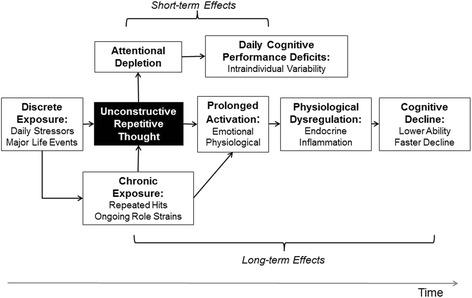
BACKGROUND: Despite evidence that psychological stress is an important risk factor for age-related cognitive loss, little research has directly evaluated psychological and physiological mediators of the relationship between stressful experiences and cognitive function. A key objective of the ESCAPE (Effects of Stress on Cognitive Aging, Physiology, and Emotion) project is to evaluate whether engaging in stress-related unconstructive repetitive thought (URT) is a pathway through which stressful experiences negatively affect cognitive health over the short- and long-term. Over the short-term, we hypothesize that engaging in URT will deplete attentional resources and result in worse cognitive performance in daily life. Over the long-term, we expect that the effects of chronic stress, from repeated exposure to stressors and regular engagement in URT, will be apparent in dysregulated hypothalamic-pituitary-adrenal (HPA) axis function and inflammation. Over time, stress-related physiological dysregulation will result in accelerated cognitive decline. METHODS/DESIGN: This study utilizes a prospective longitudinal measurement-burst design. A systematic probability sample of participants aged 25 to 65 is recruited from residents of the Bronx, NY. Consenting participants complete a baseline assessment and follow-up waves at 9, 18, and 27 months post-baseline. At each wave, participants complete a 14 day measurement burst of brief surveys and cognitive assessments delivered via study smartphones during daily life. Participants provide saliva samples four times each day for five days during the measurement burst and fasting blood samples at the end of each burst from which cortisol and dehydroepiandrosterone sulfate (DHEAS), circulating inflammatory markers, and stimulated inflammatory responses to lipopolysaccharide in whole blood are determined. DISCUSSION: This study takes a multi-pronged approach to assessing stress (i.e., early adversity, chronic strains, major events, daily hassles), psychological mediators (e.g., URT), biological mechanisms (i.e., HPA function, inflammation) and outcomes across different time-scales (i.e., momentary cognitive performance, cognitive decline across years). The systematic probability sample is locally representative and can be compared with national norms on key markers of health and well-being. The findings will improve our understanding of how environmental, psychological, and physiological stress-related influences accumulate to affect cognitive health and identify potential targets (e.g., URT, inflammation) for prevention and intervention promoting cognitive health.
Overview
The claims and statistics of this paper haven’t been checked yet.
Free: it reads the open-access text and checks the first 5 claims that cite a source we can check. Create a free account to check every claim.
Integrity signals
Registry
Cites
Statistics
Figures
Verification
Claims the paper makes
The claims and statistics of this paper haven’t been checked yet.
Free: it reads the open-access text and checks the first 5 claims that cite a source we can check. Create a free account to check every claim.
Claims other papers make about this one
Each is checked against this paper’s own text: does it say what the citing paper says it does?
In the citing paper
“Experiences of acute and chronic stress lead to hypersecretion of stress hormones in the hypothalamic-pituitary-adrenal (HPA) axis, and have adverse consequences for brain health.45,46”
From Why the cognitive ‘fountain of youth’ may be upstream: pathways to dementia risk and resilience through social connectedness (2022) · cites this paper as [46]
In the citing paper
“In humans, stress is associated with memory impairment and faster rates of cognitive decline among those with early stage ADRD.38,46,47”
From Why the cognitive ‘fountain of youth’ may be upstream: pathways to dementia risk and resilience through social connectedness (2022) · cites this paper as [46]
Self-check
Percentages, sums and reported differences re-computed from the paper’s own numbers.
The self-check needs the paper’s full text.
Citations
Cites
A Global Measure of Perceived Stress
Cohen, S., Kamarck, T., & Mermelstein, R. (1983) · Journal of Health and Social Behavior · doi:10.2307/2136404 · Cited by 32,807 · cited 1×
“Subjective Perceived stressfulness of life over last month Perceived Stress Scale [73]”
BackgroundDevelopment and validation of brief measures of positive and negative affect: The PANAS scales.
Watson, D., Clark, L. A., & Tellegen, A. (1988) · Journal of Personality and Social Psychology · doi:10.1037/0022-3514.54.6.1063 · Cited by 32,433
The satisfaction with life scale
Diener, E., Emmons, R. A., Larsen, R. J., & Griffin, S. (1985) · Journal of Personality Assessment · doi:10.1207/s15327752jpa4901_13 · Cited by 31,768 · cited 1×
“Subjective Physical functioning, medical history, medication use, anxiety, depression, mood over last month, life satisfaction PROMIS Physical Function Short Form-A, PROMIS Emotional Distress – Anxiety – Short Form 7-A, PROMIS Depression Short From 8-A, Positive and Negative Affect Schedule, Satisfaction with Life Sca…”
MethodFrom inflammation to sickness and depression: when the immune system subjugates the brain
Dantzer, R., O'Connor, J. C., Freund, G. G., Johnson, R. W., & Kelley, K. W. (2008) · Nature Reviews Neuroscience · doi:10.1038/nrn2297 · Cited by 7,395 · cited 1×
“Daily stress has also been associated with short-term increases in inflammation as well as in negative mood; both inflammation and negative mood are associated with fatigue and may further explain reductions in attentional resources that can occur with acute stress [13].”
BackgroundOptimism, coping, and health: Assessment and implications of generalized outcome expectancies.
Scheier, M. F., & Carver, C. S. (1985) · Health Psychology · doi:10.1037/0278-6133.4.3.219 · Cited by 6,690
Individual differences in working memory and reading
Daneman, M., & Carpenter, P. A. (1980) · Journal of Verbal Learning and Verbal Behavior · doi:10.1016/s0022-5371(80)90312-6 · Cited by 6,336 · cited 1×
“Three standardized tasks were used to measure WM in the lab: counting span, operation span [42, 43], and the backwards letter-span task [44].”
MethodStress, adaptation, and disease. Allostasis and allostatic load
McEWEN, B. S. (1998) · Annals of the New York Academy of Sciences · doi:10.1111/j.1749-6632.1998.tb09546.x · Cited by 5,092
2016 Alzheimer's disease facts and figures
Alzheimer's Association (2016) · Alzheimer's & Dementia · doi:10.1016/j.jalz.2016.03.001 · Cited by 5,069
Racial Differences in Physical and Mental Health: Socio-economic Status, Stress and Discrimination
Williams, D. R., Yu, Y., Jackson, J. S., & Anderson, N. B. (1997) · Journal of Health Psychology · doi:10.1177/135910539700200305 · Cited by 4,786
Stress and emotion: a new synthesis
(1999) · Choice Reviews Online · doi:10.5860/choice.37-1229 · Cited by 3,662
Research works printed but not linked: 2
- Kahneman D Attention & Effort 1973 Englewood Cliffs Prentice-Hall
- Snijders T Bosker R Multilevel Modeling: An Introduction to Basic and Advanced Multilevel Modeling 1999 London Sage
Cited by
Items 201–226 of 226
Bandhan, S. D. (2024) · ScholarWorks (Walden University)
Uwajeh, P. C. (2019) · Eastern Mediterranean University Institutional Repository (Eastern Mediterranean University)
The Effect of Test Difficulty on Perceived Memory Performance
Bean, P. S. (2021) · ScholarWorks at University of Montana
McNamara, A. (2024) · ePrints Soton (University of Southampton)
Stressor Exposure, Appraisal, and Reactivity Among Middle-Aged and Older Men and Women
Lancki, K. M. (2017) · OhioLink ETD Center (Ohio Library and Information Network) · Cited by 1
Neurological and Psychological Effects of COVID-19 on Cognitive Impairment
Mufti, S. (2021) · Digital Commons - PCOM (Philadelphia College of Osteopathic Medicine)
Occupational experiences and brain health outcomes in older age
Jiao, Y., Burzynska, A., Fisher, G. G., & Bielak, A. A. (2019) · Digital Collections of Colorado (Colorado State University) · doi:10.25675/3.019410 · Cited by 2
Jordan, S. (2025) · CU Scholar (University of Colorado Boulder)
McDonnell, S. (2024) · CU Scholar (University of Colorado Boulder)
Sex differences in alcohol use and perceptions of cognitive health in rural Uganda
Maleka, E., Kyomya, J., Namwase, J., Beja, H., Mary, S., Rukundo, G. Z., Wakida, E. K., & Obua, C. (2026) · BMC Geriatrics · doi:10.1186/s12877-026-07527-2
“Moreover, the chronic stress associated with their demanding gender roles coupled with modest alcohol use could potentially lead to cognitive decline [51].”
Voruz, P., Nuber‐Champier, A., Henchoz, Y., Allali, G., Assal, F., & Péron, J. (2026) · Innovation in Aging · doi:10.1093/geroni/igag055
“Nevertheless, the results support the broader view that socioeconomic disadvantage may shape cognitive aging through multiple pathways, including healthcare, 22 increased chronic stress, 23 and diminished cognitive reserve.”
Enhancing mental health and cognitive research with generative artificial intelligence
Joshi, G., Ghai, B., Goutam, N., & Joshi, N. (2026) · Elsevier eBooks · doi:10.1016/b978-0-443-44344-2.00008-x
Franklin, C., Ren, B., Kaufman, J. R., Nercessian, O., Schurr, M. S., Patrick, R. E., & Weisenbach, S. L. (2026) · American Journal of Geriatric Psychiatry · doi:10.1016/j.jagp.2026.06.017
Park, J., Choi, H., Hong, H., Lee, G. S., Na, J., Oh, S., Shin, J., Baek, J., Kim, K.-H., Do, Y., et al. (2026) · BMC Plant Biology · doi:10.1186/s12870-026-09470-1
“…clustering generated different grouping patterns, both approaches consistently separated cultivars according to developmental trajectories, indicating that RGB-derived temporal responses reflect fundamental differences in growth duration and physiological status among rice cultivars [42, 43].”
A continuous-time approach to short-term activity-cognition dynamics.
Luo, M., Driver, C., Zavala, D. V., Scott, S., & Röcke, C. (2026) · Psychology and Aging · doi:10.1037/pag0001012 · Cited by 1
Self-citationPENGARUH STRES TERHADAP FUNGSI KOGNITIF PADA LANSIA: STUDI PADA DUA PANTI WREDA DI JABODETABEK
Rosadi, S. A., & Biromo, A. R. (2026) · Ebers Papyrus · doi:10.24912/yzz9m926
Romanova, E. N., Manukyan, P. A., Karpova, N., Sarkisyan, R. A., Kasatkin, V., Aleksandrovich, A., & Tolchennikova, V. V. (2026) · Scientific Reports · doi:10.1038/s41598-026-61314-y
Herrera, E., Barrera-Ocampo, A. A., & Ordoñez, W. O. C. (2026) · Frontiers in Human Neuroscience · doi:10.3389/fnhum.2026.1840131
Kircher, J. A., Engeland, C. G., Charles, S. T., Kang, J. E., Cerino, E. S., & Graham‐Engeland, J. E. (2026) · Social Science & Medicine · doi:10.1016/j.socscimed.2026.119776
Self-citationCognitive Reserve and Psychological Well‐Being in Aging Population of Community‐Dwellers in Spain
Ordin, M., Barrasa, Á., López-Granero, C., & Polyanskaya, L. (2026) · Brain and Behavior · doi:10.1002/brb3.71714
Development across days: where are we now in the study of daily life experiences?
Neupert, S. D., Zhou, S., Castle, J. E., & Scott, S. (2026) · Elsevier eBooks · doi:10.1016/b978-0-443-27490-9.00010-5 · Cited by 1
Self-citationWeathering the Storm: How Socio-demographics Influence Stress, Resilience, and Couple Satisfaction
Kamble, J. (2025) · Vidhyayana · doi:10.58213/s4kzed35
Exploring epigenetic aging and cognitive change in middle adulthood
Zavala, D. V., Kim, S. H., Felt, J. M., Oravecz, Z., Sliwinski, M. J., Graham‐Engeland, J. E., Engeland, C. G., Bernard, K., Veeramah, K. R., & Scott, S. (2026) · The Journals of Gerontology Series A · doi:10.1093/gerona/glag240
Self-citationPrieto, S., Thompson, L. I., Split, M., Rooney, C. N., Ross, D., Sunderaraman, P., Vito, A. N. D., Roque, N. A., Felt, J. M., Sliwinski, M. J., et al. (2026) · Frontiers in Digital Health · doi:10.3389/fdgth.2026.1878732
“HFA are particularly well-suited for studying stress, as they can capture the immediate cognitive consequences of momentary stress that retrospective stress measures may overlook (27, 28).”
Self-citationKang, J. E., Engeland, C. G., Felt, J. M., Harrington, K., Sliwinski, M. J., & Graham‐Engeland, J. E. (2026) · Aging & Mental Health · doi:10.1080/13607863.2026.2750968
Self-citation
Metadata
- Authors
- Scott, S. B., Graham-Engeland, J. E., Engeland, C. G., Smyth, J. M., Almeida, D. M., Katz, M. J., Lipton, R. B., Mogle, J. A., Munoz, E., Ram, N., & Sliwinski, M. J.
- Affiliations
- University of South Florida (US)
- Pennsylvania State University (US)
- Albert Einstein College of Medicine (US)
- Corresponding author
- Sliwinski, Martin J.
- ORCID
- Venue
- BMC Psychiatry
- Published
- 2015-07-03
- Volume
- 15
- Issue
- 1
- Pages
- 146-146
- ISSN
- 1471-244X (ISSN-L)
- PMC
- PMC4490700
- OpenAlex
- W2159289539
- Cited by
- 197
- References
- 97
- Citations by year
- 2026: 11 · 2025: 23 · 2024: 21 · 2023: 19 · 2022: 26 · 2021: 29 · 2020: 23 · 2019: 15 · 2018: 14 · 2017: 8 · 2016: 7 · 2015: 1
- FWCI
- 5.20
- Type
- journal article
- Language
- en
- Open access
- gold
- doi.org
- Locations
- BMC Psychiatry (publishedVersion, cc-by)
- Europe PMC (PubMed Central) (publishedVersion, cc-by)
- PubMed Central (publishedVersion, cc-by)
- PubMed (publishedVersion)
- Funders
- Georgia Clinical and Translational Science Alliance
- National Institutes of Health (UL1TR001425, UL1TR001073, UL1TR000077, AG03949)
- National Institute on Aging (P01AG03949, P01AG003949, R01AG042595, R01AG039409)
- National Center for Advancing Translational Sciences (CTSA 1UL1TR001073)
- Topics
- Life Sciences › Neuroscience › Behavioral Neuroscience › Stress Responses and Cortisol
- Social Sciences › Psychology › Developmental and Educational Psychology › Aging and Gerontology Research
- Health Sciences › Medicine › Psychiatry and Mental health › Dementia and Cognitive Impairment Research
- Keywords
- psychological stress, cognitive aging, chronic stress, hypothalamic-pituitary-adrenal axis, cortisol, dehydroepiandrosterone sulfate, inflammation, lipopolysaccharide response, cognitive decline, attentional resources, daily hassles, childhood adversity, major life events, cognitive health
- MeSH terms
- Cognitive Aging, Cognition, Cognition Disorders, Emotions, Female, Humans, Hydrocortisone, Hypothalamo-Hypophyseal System, Male, Pituitary-Adrenal System, Prospective Studies, Research Design, Stress, Psychological, Outcome Assessment, Health Care
About these checks
Registry, retraction, Cites and statistics results are computed, not judged, with one exception: a printed reference that no index lists is read once by a model before it counts as a citation error. Claims are extracted by a model and kept only when their quote appears verbatim in the text; each cited source is then checked, with a model’s help, for whether it says what the claim relies on. Those verdicts can be wrong — read the claim’s quote and the cited source before relying on one.
Statistics and arithmetic are recomputed, not judged.
Confidence bands are shown only for fields calibrated on our annotated test set. None is calibrated yet, so no band is shown.
What counts as a claim ›How we measure confidence ›How we check this ›
Are you an author, or do you see a problem with this page? Request a review
Data sources
Bibliographic data: Semantic Scholar, OpenAlex, Crossref.
Contains information from the Semantic Scholar Academic Graph Datasets, made available under the ODC Attribution License (ODC-BY 1.0).
Semantic Scholar’s data is described in: Kinney, R., et al. (2023). The Semantic Scholar Open Data Platform. arXiv:2301.10140.
